
Mostly Monday Reads: Of Caucuses and Kings
Posted: January 15, 2024 Filed under: just because | Tags: 2, 2024, 3, 4, 6, and Inclusion, Black American Women Folk Artists, Courting White Iowa Crazies, diversity, Equity, Faith Ringgold, Iowa Caucuses, Jr., Malcah Zeldis, Martin Luther King, We Shall Overcome 6 Comments
Happy Martin Luther King Day, Sky Dancers!
Time to celebrate Diversity, Equity, and Inclusion! It’s also time to remember our history so we can work together to form a more perfect union for every one of our citizens and citizens-to-be. The paintings today are the work of two African American Women Artists. Faith Ringgold, 93 years old, paints with various materials. She’s an intersectionalist artist who is most known for her narrative quilts. Malcah Zeldis, 92 years old, is known for art that reflects biblical, historical, and autobiographical themes. Zeldis has painted themes that present Reverend Doctor Martin Luther King and his life and legacy. Both of these artists should be celebrated for their contributions to art and the lives it represents. Thanks to JJ, who sent me down this rabbit hole! Please spend some time with the links to their stories and art.
Today is also the Iowa Republican Caucuses. I find it odd they chose this day but probably felt that a holiday might increase turn-out. However, Mother Nature had a different idea. NBC reports this. “Highlights: Trump and Haley nabbed big endorsements in freezing Iowa. “The candidates braved record-low temperatures as they made their final pitches.” The Polar Vortex making its way here and will give us temps all day tomorrow in the 20s. Hence, I will be spending the afternoon wrapping pipes. Everyone farther north has the brutal cold.
I agree with this from Lakota Man on his threads feed. I’m not sharing his photos. I want it all to be about the images of these fabulous artists!
Ron DeSantis has banned Black authored books and African-American history from Florida schools. And Nikki Haley still won’t attribute the Civil War to slavery. So, any kind of MLK related statement they make today will be totally and completely full of shit and more Republican hypocrisy.
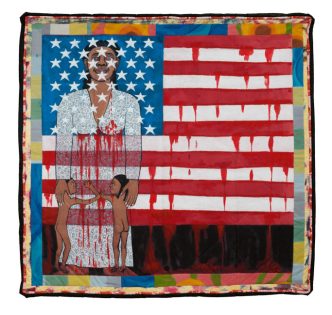
Trump is counting on the crazy vote. This is from Mike Wendling for the BBC. “Iowa caucus: Trump counts on evangelicals to carry him to victory.”
The video is bombastic, even by Mr Trump’s standards. Just consider the title: God Made Trump.
“God looked down on his planned paradise and said, ‘I need a caretaker,'” a voiceover intones over a minimalist piano track. “So God gave us Trump.”
The former president, according to the narrator, is carrying out the will of God. He’s “a shepherd to mankind” who will “fight the Marxists” with “arms strong enough to wrestle the deep state”.
The video is based on So God Made a Farmer, a 1978 speech by American radio host Paul Harvey which extols the virtues of simple rural American life.
Independently produced by a group calling itself “Trump’s Online War Machine”, the clip started to pick up steam a week ago when Mr Trump shared it with millions of followers on his Truth Social account. It immediately enraged some religious leaders here in Iowa.
“He’s not the saviour,” said Michael Demastus, pastor of the Fort Des Moines Church of Christ in the state capital. “Our allegiance as evangelicals is to Jesus, not to the Republican Party or to Donald Trump.”
But despite Mr Demastus’ insistence that many voters agree with him – and that a surprise is in store on Monday – opinion polls show a different story, with Mr Trump poised for a runaway victory over his Republican rivals.
Evangelical support is crucial here in Iowa, with born-again Christians expected to make up around two-thirds of all Republican caucusgoers.
They are a diverse voting bloc – made up of various denominations and including more traditional churchgoers along with others who may not even regularly go to a church, yet still define themselves as evangelical.
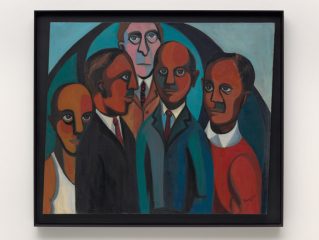
American People Series #4: The Civil Rights Triangle, 1963 ©Faith Ringgold
I first met these folks in 1980 when the Nebraska Chair of the Democratic Party sent me to try to stop the Republican Party’s foray into theocracy. I went to the County convention to save the platform from folks trying to remove support from the ERA and decimate Reproductive Health. Pat Robertson’s political campaign had ignited them. They had to be bussed in because they simultaneously showed up like some kind of cult army. They all carried the list of who and how they should vote on colored cards. The women were versions of each other. Hand-made pioneer=looking dresses of little floral prints, long dull hair, bowed heads and herded like sheep by men. I watched them later in 1992, screaming and yelling about ‘multicultural influences’ in the school curriculum. They never gave up, and here we are. They are angry, violent, and hateful. They are everything I always was taught that biblical Jesus was not.
This is from Politico. “Trump consolidates evangelical vote in Iowa. Kari Lake swooped into Bob Vander Plaats’ church on Sunday, a show of force — if not an outright troll — ahead of the caucuses.” Trump suits them to a tee.
Just as the Sunday morning service started here at Soteria church, a top Donald Trump surrogate and Arizona firebrand, Kari Lake, walked in.
To any political observer, it appeared to be an obvious troll. In a metro area rich with churches, Soteria has hosted several Republican presidential candidates in the past year. But the Baptist church, with its 1,300-member congregation, also has a well known parishioner: the Iowa social conservative leader Bob Vander Plaats, who endorsed Ron DeSantis and angered Trump and his allies in doing so.
Lake said she woke up on Sunday and just wanted to go to church.
But it was also a flex. For all the attempts by DeSantis and his evangelical allies to court the conservative Christian vote, Trump not only remains dominant with the group, but is relying on it to fuel his massive lead in Iowa ahead of the caucuses on Monday. A critical faction of the GOP that once blocked his ascendance here in 2016, evangelicals are now a primary reason he is so far ahead.
“Of course I’m caucusing for President Trump,” said Judy Billings, a loyal member of the congregation, clutching her Bible as she entered the foyer. “I just love the guy. I think he’s a total hero, and he has my full support … I think he’s the only one that can win and lead our country.”
Some Republicans are saying the quiet part out loud now that Donald has made being openly racist cool again.

Malcah Zeldis, Martin Luther King, 1995
Elizabeth Spiers has a great Op-Ed up in the New York Times. “What Nikki Haley — and I — Learned at a Segregation Academy.”
After her failure to identify slavery as the cause of the Civil War generated a wave of criticism last month, Nikki Haley assured her potential constituents that she had Black friends, and that she understood the war’s origins. Growing up in South Carolina, she said, “literally in second and third grade, you learn about slavery.” Conveniently producing Black friends is, alas, not surprising, but claiming she learned that the Civil War was a battle over slavery in second and third grade is.
Governor Haley attended a segregation academy, a type of private school established in the years after the Supreme Court’s 1954 decision in Brown v. Board of Education by white parents who did not want their children attending school with Black children.
By 1975, the number of private schools in South Carolina grew more than tenfold, enrolling as many as 90 percent of the white children in some majority Black counties. The Supreme Court eventually ruled that discrimination on the basis of race wasn’t legal at private schools, either, but even today, many segregation academies remain overwhelmingly white.
Ms. Haley graduated in 1989 from Orangeburg Preparatory School. Orangeburg was the product of a merger between Wade Hampton and Willington Academy, also segregation academies, the former of which was named after one of the largest slaveholding families in South Carolina. At one point, graduates of Hampton received Confederate flag lapel pins, which were meant to symbolize resistance against integration. The year Ms. Haley graduated, her high school yearbook featured at most a handful of Black students.
I believe they refer to this as passing. No wonder Haley identifies as white on the census and other forms. While Haley haunts Iowa, our Vice President speaks at an NAACP conference in South Carolina. She also did this virtual speech.
Another black woman defending the rule of law in our country has taken the podium today.

Slave Rape #3: Fight to Save Your Life, 1972 © 2021 Faith Ringgold
Meanwhile, back in Iowa, John McCormack of The Dispatch reports this. “Courting the Kook Vote in Iowa, Vivek Draws the Ire of Trump. Ramaswamy is fourth in the polls, but top-of-mind for the former president.” I admit I’m giggling over these sparring bullies.
Vivek Ramaswamy was just going through his implausible plan for firing 75 percent of the federal workforce—“the first four agencies we’re going to shut down outright are the FBI, the ATF, the CDC, and the U.S. Department of Education”—when he was interrupted by a man in the crowd.
“What about the CIA, sir?” asked an Iowan named Nathen Trausch. “That’s where all the pedophiles are.”
“Well, CIA is a major problem, but they shouldn’t even exist outside of the military,” Ramaswamy replied. He tried to turn the conversation back to his plan to slash the federal government before Trausch interrupted him again.
“Department of Defense has 5,000 pedophiles in it that in 2019 got arrested by Trump,” Trausch said.
“Well, you know, they deserve to actually be held accountable,” Ramaswamy replied. He later promised Trausch that he would arrest even more child sex-traffickers than Trump did.
It was par for the course for Ramaswamy, who in recent weeks has made an aggressive play for the kook vote. At the December 6 GOP presidential primary debate—the last he qualified for—Ramaswamy emphasized that he was the only candidate on stage who would say that “January 6 now does look like it was an inside job.” He spent the last week campaigning with Candace Owens, a media personality who has made headlines in recent months for her anti-Israel and antisemitic rhetoric, and former Iowa congressman Steve King, who was stripped of his committee assignments and defeated in a GOP primary following his comments questioning whether white supremacy should be considered “offensive.”
What does Ramaswamy have to show for it? The final Des Moines Register poll conducted by the highly respected J. Ann Selzer found Ramaswamy ticking up a few points since December, from 5 percent to 8 percent, while Donald Trump ticked down a few points, from 51 percent to 48 percent.

Malcha Zeldis (NY/Israel 1933-) Peaceable Kingdom
Vivek, however, evidently can’t pass as white. This is from The Independent. “Voter tells Vivek Ramaswamy’s wife that some Iowans don’t support him because ‘they think he’s Muslim’. The presidential hopeful’s religion and skin colour are still factors that prospective voters are considering, locals told Apoorva Ramaswamy.” I also wonder about the current hatred of immigrants among Republicans impacting the few bits of diversity we find in its presidential candidates.
Some voters in Iowa are still hesitant to throw their support behind Vivek Ramaswamy because they “think he is Muslim”, according to supporters of the presidential hopeful.
Mr Ramaswamy’s religion and skin colour are still factors that prospective voters are considering, locals told his wife Apoorva Ramaswamy at a recent campaign event.
According to polling by FiveThirtyEight, Mr Ramaswamy lags far behind his three Republican rivals on both a national and state level – commanding just 6.6 per cent of the vote in the latter survey – ahead of the Iowa caucuses on Monday.
At a campaign meet-and-greet on Thursday, Ms Ramaswamy asked supporter Theresa Fowler “what do people say” about why they were not supporting her husband.
“Well, the only one I have and I couldn’t even remember who said it to me, but they mentioned his dark skin and they think he’s Muslim,” Ms Fowler said.
“I kind of set them straight on that. I don’t know if they believe me or think I was covering for him, I don’t know.”
Ms Ramaswamy replied: “Not much we can do about that one.”
No, there’s not much you can do about that one. It’s why we need to up the Voting Rights Act, which is something Republicans abhor. Why be a part of that? Why put your children through that? Why teach your children to be like that?
Have a wonderful day! Those Caucuses have coverage tonight, but I’ll be doing something else. I can’t imagine listening to the press interview any Iowa Republicans these days. It makes my stomach churn just thinking about it. Anyway, I’m off to load up on some hot steel oats and take on those pipes and faucets.
What’s on your reading and blogging list today?
Wednesday Reads
Posted: January 3, 2024 Filed under: 2024 Elections, 2024 presidential Campaign, just because, Media, polling, The Media SUCKS | Tags: Autocracy, big media, Claudine Gay, democracy, diversity, Greg Sargent, Harvard, journalism, Joyce Vance, Racism, Rick Perlstein, The Washington Post 13 CommentsGood Morning!!
It’s 2024, and the media and the Republicans are gearing up for the presidential election in November. What are the Democrats doing? I’m sure they are raising plenty of money, but when will they wake up and start fighting back against the Republicans and the media? Make no mistake, big media is hoping for another Trump presidency, because it will mean chaos and gobs of money for those who cover the chaos. It will mean riches for the media bosses and reporters alike–think of all the new books they can sell as Trump destroys democracy and attempts to gain dictatorial power?
You’ve probably heard that The Washington Post recently got rid of 240 employees through buyouts. They chose to keep right wing columnists like Hugh Hewitt and dumped liberals like Greg Sargent. Fortunately, Sargent has been hired by The New Republic.
This post by Tom Jones is from Poynter, a site that reports on and critiques the media: Opinion | Washington Post reaches buyout goals to, for now, avert layoffs.
The good news is that the Post has been able to meet its goal of trimming staff through buyouts instead of layoffs. The bad news is the Post will enter the new year with fewer employees — perhaps a couple of hundred.
Greg Sargent
Back in October, the Post announced that it was offering buyouts with the hopes of reducing staff by 240. (At the time, the Post had approximately 2,500 employees.)
Then late last month, Post interim CEO Patty Stonesifer told staff only half of the desired number of staffers — about 120 or so — had accepted the buyouts and that there would be layoffs if not enough employees took the buyouts. At the same time, The Daily Beast’s Corbin Bolies reported that Post executive editor Sally Buzbee told staff in an email that about 36 of the 120 who accepted the buyouts were from the newsroom. She said that was “about 30 percent of our goal across the News department.”
Then came Tuesday’s news that the Post had enough buyouts to avoid layoffs — for now (my words, not the Post’s). The exact number of buyouts isn’t known publicly.
In an email to staff, Stonesifer said the company “will enter the new year with a smaller organization but a better financial position.” Stonesifer also wrote, “I am very aware of how difficult this process has been for everyone involved and I want to thank you for the grace and respect you have shown at every step.”
In July, The New York Times Benjamin Mullin and Katie Robertson reported the Post was on track to lose about $100 million this year.

For the gossip columnists at the WaPo, President Biden is boring. Imagine how much better the paper’s “financial position” will be when Trump gets back in the White House and consolidates his power. The same will be true of The New York Times. Maggie Haberman will be cleaning up, along with her co-writers.
In another positive development, historian and political observer Rick Perlstein will be writing for The American Prospect. I’m seriously thinking about dumping my Washington Post subscription and giving that money to one of these liberal publications.
Perlstein has published his first column. In it, he addresses three issues I worry about: the media focus on polls, the failure of journalists to address real issues, while tending to favor right wing narratives, and the failure of Democratic politicians to fight back hard against those narratives.
Rick Perlstein at The American Prospect: You are Entering the Infernal Triangle: Authoritarian Republicans, ineffectual Democrats, and a clueless media.
Perlstein on Polling:
As a historian who also writes about the present, there are certain well-worn grooves in the way elections get written about by pundits and political journalists from which I instinctively recoil. The obsession with polling, for one. Polls have value when approached with due humility, though you wonder how politicians and the public managed to make do without them before their modern invention in the 1930s. But given how often pollsters blow their most confident—and consequential—calls, their work is as likely to be of use to historians as object lessons in hubris as for the objective data they mean to provide.
Pollsters themselves are often the more useful data to study, especially when their models encode mistaken presumptions frozen in place from the past. In 1980, for instance, Ronald Reagan’s landslide was preceded by a near-universal consensus that the election was tied. The pollster who called it correctly, Lou Harris, was the only one who thought to factor into his models a variable that hadn’t been accounted for in previous elections, because it did not yet really exist: the Christian right.
Polling is systematically biased in just that way: toward variables that were evident in the last election, which may or may not be salient for this election. And the more polls dominate discussions of campaigns and elections, the more they crowd out intellectual energy that could be devoted to figuring out those salient, deeper, structural changes conditioning political reality: the kind of knowledge that doesn’t obediently stand still to be counted, totted up, and reduced to a single number.
On media predictions:
Another waaaaay too well-worn journalistic groove isprediction. I have probably read thousands of newspaper opinion column prognostications going back to the 1950s. Their track record is too embarrassing for me to take the exercise seriously, let alone practice it myself. Like bad polls, pundits’ predictions are most usefulwhen they are wrong. They provide an invaluable record of the unspoken collective assumptions of America’s journalistic elite, one of the most hierarchical, conformist groups of people you’ll ever run across. Unfortunately, they help shape our world nearly as much, and sometimes more, than the politicians they comment about. So their collective mistakes land hard….
Rick Perlstein, author, Reaganland: America’s Right Turn 1976-1980.
And how ritualized? Consider one of elite journalism’s most deeply worn grooves: the morning-after declarations, should any Democrat win a presidential election, that the Republican politics of demagogic hate-mongering has shown itself dead and buried for all time—forgetting how predictably it returns in each new election, often in an increasingly vicious form.
In 1964: When the author of the Civil Rights Act, Lyndon Johnson, defeated a Republican who voted against the Civil Rights Act, Barry Goldwater, one of the most distinguished liberal newspaper editors in the South, Sam Ragan of the Raleigh News & Observer, pronounced that all future American elections would be decided “on issues other than civil rights.” His essay quoted the Los Angeles Times’ Washington bureau chief, who affirmed that conventional wisdom by observing that henceforth, whichever party takes the Black vote would be no more predictable than who would win “freckle-faced redheads and one-armed shortstops.” [There are many more examples of this phenomenon in the essay.]
This particular bias is rooted into elite punditry’s deepest, most dangerous groove of all: a canyon, if you will. On one side of the yawning gulf is the perennial fantasy that America is a nation fundamentally united and at peace with itself, “moderate,” “centrist,” where exceptions are epiphenomena entirely alien to settled American “norms.”
On “Reality”:
On the other side of the gulf is, well, reality.
The media habits that make it so hard to grasp that reality—that made Trump and his merry band of insurrectionists such a surprise to us—are perhaps as systematic as any foisted upon the public by state media in authoritarian nations. A little more innocent than, say, Pravda, however, because one wellspring of this stubborn fantasy, and why audiences are so receptive to it, is simple psychology. To acknowledge the alternative is to stare into a terrifying abyss: the realization that America has never not been part of the way to something like a civil war.But suddenly, in 2024, no one can avoid acknowledging that abyss anymore. And that leaves journalism in a genuine crisis.
Generations of this incumbent, consensus-besotted journalism have produced the very conceptual tools, metaphors, habits, and technologies that we understand as political journalism. But these tools are thoroughly inadequate to understanding what politics now is.
According to polls (which, yes, have their uses, in moderation), something around half of likely voters would like to see as our next president a man who thinks of the law as an extension of his superior will, who talks about race like a Nazi, wants to put journalistic organizations whose coverage he doesn’t like in the dock for “treason,” and who promises that anyone violating standards of good order as he defines them—shoplifters, for instance—will be summarily shot dead by officers of the state who serve only at his pleasure. A fascist, in other words. We find ourselves on the brink of an astonishing watershed, in this 2024 presidential year: a live possibility that government of the people, by the people, and for the people could conceivably perish from these United States, and ordinary people—you, me—may have to make the kind of moral choices about resistance that mid-20th-century existentialist philosophers once wrote about. That’s the case if Trump wins. But it’s just as likely, or even more likely, if he loses, then claims he wins. That’s one prediction I feel comfortable with.
I’ve already quoted too much, but I hope it’s enough so that you’ll want to read the rest at The American Prospect.
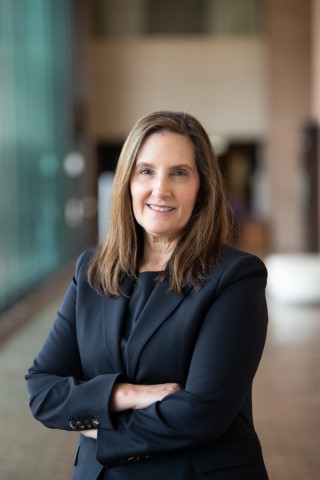
Every morning, I read Joyce Vance’s substack, Civil Discourse. Today, she offered “a warning” to all of us who want to save democracy. We have to remember that no everyone is following news and politics closely.
One morning before Christmas, I was working out with a friend who I adore, and workout with regularly. She’s young, smart, and a recent college graduate. In the middle of our session, my phone started going off incessantly and I finally picked it up. It was, of course, breaking news. That day, it was about the Giuliani bankruptcy.
I apologized to her for taking the call. I got off quickly and told her, by way of explanation, “Rudy Giuliani just filed for bankruptcy.”
Joyce Vance
“Who’s Rudy Giuliani?” she asked.
One morning before Christmas, I was working out with a friend who I adore, and workout with regularly. She’s young, smart, and a recent college graduate. In the middle of our session, my phone started going off incessantly and I finally picked it up. It was, of course, breaking news. That day, it was about the Giuliani bankruptcy.
I apologized to her for taking the call. I got off quickly and told her, by way of explanation, “Rudy Giuliani just filed for bankruptcy.”
“Who’s Rudy Giuliani?” she asked.
You know that noise they make in TV sitcoms, the one where the needle scratches across the record, and everything is interrupted? That was what I heard in my head. My mind worked over the implications of her question for the remainder of our time together.
She was born after 9-11. She never knew Giuliani as America’s mayor when the Towers fell and certainly not as the staunch pro-law enforcement mayor in the city in earlier years. But it shocked me that someone of voting age was unaware of Giuliani—didn’t recognize his name and associate it with Trump’s efforts to overturn the 2020 election.
She asked me about the bankruptcy. “Is that a good thing or a bad thing?” I explained that he’d lost a big defamation case in Georgia because he said horrible things about two election workers and disrupted their lives. Still no signs of recognition, but she got the point. “What an a**hole,” she concluded, based on my brief description of what he’d done.
Read the rest at the substack link.
Like Joyce Vance, I grew up in a politically engaged family. It’s always a shock to me when I learn that some people have no idea what’s going on in the government. We need to reach out to the people us and discuss the danger of autocracy.
I’m really troubled by what happened to Claudine Gay, Harvard’s first Black president. She may well have some issues with past plagiarism, but if she had been white, I doubt if the issue would have even come up. The truth is, she was set up by Congressional Republicans who hate diversity in education. Two articles:
At The Atlantic, David Graham expresses the typical liberal media response: it’s a shame and of course she was targeted by right wingers, but Harvard still had to do the “right” thing: An Old-Fashioned Scandal Fells a New Harvard President.
Gay, a political scientist, resigned…, making her the second president of an Ivy League institution to bow out in the past month. University of Pennsylvania President Liz Magill stepped down on December 9, but the cases are not as similar as they might initially seem. Magill’s departure stemmed directly from the shaky December 5 congressional testimony by a panel of college presidents about anti-Semitism and the Israeli-Palestinian conflict, and was viewed as a victory for Elise Stefanik, the Republican representative who led the questioning.
What appear to have doomed Gay were the allegations of plagiarism lodged against her. This is an important distinction. Penn’s board of trustees was spooked by pressure from donors and politicians. The Harvard Corporation, an equivalent body, was not. In a December 12 statement, it acknowledged that Gay’s testimony had gone poorly, but said she would remain in her post, describing its position as a defense of open discourse and academic freedom. Although Stefanik is already claiming credit, what ended Gay’s short tenure were not the hot-button issues of campus speech and anti-Semitism but was instead the kind of scandal that one might expect to fell the president of any educational institution, whether a member of the Ivy League or a community college.
Yes, because Harvard initially supported her remaining president, so the right wingers had to find another reason to get rid of her.
On December 5, Gay, Magill, and MIT’s Sally Kornbluth were hauled before Congress to speak about anti-Semitism on campus, though many GOP members really seemed to be upset about what they saw as inconsistent standards for deciding what speech is and isn’t acceptable on campuses. The hearing was remarkable for, among other things, how little intellectual agility the presidents showed in the face of questioning. A college president has to fulfill a dual role, serving not only as an academic officer but also as a sort of front woman for her institution. The failure of these presidents to represent their universities well in such a public setting was bound to raise questions about their leadership, regardless of the subject matter.
Claudine Gay
Gay survived the initial backlash to her testimony, but since then, the furor around allegations of plagiarism has grown. Many of the examples that have been made public represent extremely lazy rewriting of source material—Gay borrowed sentences or paragraphs, making minor changes to their wording or order of clauses without adding much analysis of her own. Some academics have described this as entirely unacceptable, while others have defended Gay—including some, such as David Canon, from whose work she repeatedly drew. “I am not at all concerned about the passages. This isn’t even close to an example of academic plagiarism,” Canon told The Washington Free Beacon….
The origin of the complaints is still murky. Allegations of academic misconduct against Gay had floated around online message boards for some time, The Wall Street Journal reported. One unnamed individual claims to be the source of the current charges. On October 24, the New York Post contacted the university to ask about allegations against Gay. On December 10, the conservative agitator Christopher Rufo and the journalist Christopher Brunet published claims of plagiarism in Gay’s 1997 Harvard dissertation. The next day, The Washington Free Beacon added more reporting….
Conservatives have long had it out for Gay, Harvard’s first Black president, whose appointment they viewed as a sop to progressive diversity, equity, and inclusion initiatives. The identity of the initial anonymous complainant against Gay is unclear, as is when he or she brought the complaints forward. The appearance of the allegations in conservative outlets and their timing, coming shortly after the war in Gaza thrust Gay into the spotlight, certainly suggest a politically motivated effort.
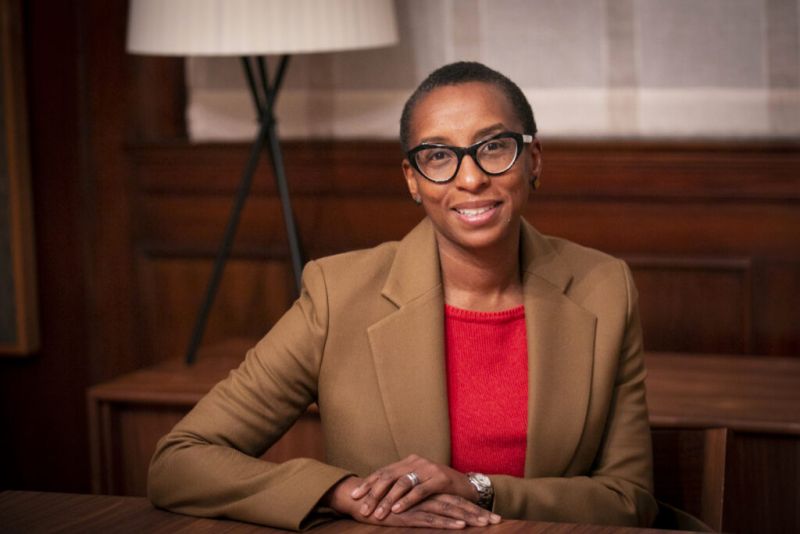
I’ve quoted the parts of Graham’s article that support my point of view. He still thinks she should have been fired.
Nia T. Evans at Mother Jones: What Claudine Gay’s Resignation From Harvard Means for the Rest of Us.
Claudine Gay’s resignation from her post as president of Harvard University is a shocking new twist in the ongoing saga over campus free speech. Gay resigned on Tuesday amid new allegations of plagiarism leveled through an unsigned complaint published in the Washington Free Beacon, a conservative outlet that has long criticized Gay. The news, which was broken by the Crimson, comes after months of attacks on Gay’s response to campus antisemitism and weeks after university leaders reaffirmed their support for her. Gay’s stunning departure is the latest casualty in a growing conservative crusade against “diversity in education” and a chilling reminder of the state of campus free speech amid Israel’s war on Gaza.
“It has become clear that it is in the best interests of Harvard for me to resign,” Gay wrote in a letter to the Harvard community. “It has been distressing to have doubt cast on my commitments to confronting hate and to upholding scholarly rigor—two bedrock values that are fundamental to who I am.”
Gay’s 186-day tenure is the shortest in the school’s 388-year history.
Just six months ago, Gay was heralded as the future of Harvard University. “I stand before you on this stage with the weight and honor of being a first,” she told a rain-soaked crowd during her inauguration ceremony. Her journey to becoming Harvard’s first Black female president felt like the quintessential American dream: she is the daughter of Haitian immigrants, a Stanford graduate with a doctorate from Harvard. An accomplished political scientist with an emphasis on race, democracy, and politics, she was praised by university and political leaders alike after being named Harvard’s 30th president in late 2022. Massachusetts Gov. Maura Healey called her “a leader for our time” driven by the “values to meet the moment” at Gay’s September inauguration ceremony. Harvard’s governing board announced her selection with glee. “We are confident Claudine will be a thoughtful, principled, and inspiring president for all of Harvard,” wrote Harvard Corporation senior fellow Penny Pritzker. “She will be a great Harvard president in no small part because she is such a good person.”
Gay’s brief tenure collided with historic political assaults against diversity and education. In June, the Supreme Court struck down affirmative action in a case in which Harvard was at its center. The October 7 terrorist attack on Israel by Hamas instigated an ongoing war that’s claimed more than 22,000 lives. The war also set off a fierce debate on college campuses across the country over free speech. In one well-documented incident, a conservative group paid for a truck to circle around Harvard Square with a billboard on which the names and photos of opponents of Israel’s actions were displayed. The billboard dubbed them “Harvard’s Leading Antisemites.”
The end result of the controversy and the efforts of right wingers:
Her resignation not only shakes things up at the most prestigious university in the country, it also exposes a larger trend of racial regression that picked up in the years following the 2020 uprisings as Black leaders have been installed in positions of power only to find themselves undermined by the systems they sought to save. Love it or hate it, Harvard sets the tone for national and international debates. To conservative activists celebrating on Twitter, Gay’s ouster is part of a larger project to purge progressive Black leaders from public institutions. Or as Chris Rufo put it, to abolish “DEI ideology from every institution in America.” In the end, Gay’s presidency has created yet another first: Harvard’s first Black female president was also its shortest-serving.
Those are my top stories for today. Lots more is happening, of course. Here are more stories you might find interesting/enraging:
Times of Israel: Israel in talks with Congo and other countries on Gaza ‘voluntary migration’ plan.
The Texas Tribune: Emergency rooms not required to perform life-saving abortions, federal appeals court rules.
Jose Pagliery at The Daily Beast: Jack Smith Keeps Telegraphing Some Seriously Scandalous Trump Crimes.
David Kurtz at TPM’s Morning Memo: The New Argument That Might Save Trump’s March Trial Date.
Newsweek: ‘Storm the Capitol’ Board Game Celebrates Jan. 6 Rioters.
That’s it for me today. What’s on your mind?
Appointments Like Us
Posted: January 10, 2013 Filed under: Barack Obama | Tags: diversity, lack of diversity in Obama's cabinet 7 CommentsAs BB pointed out in this morning’s reads, there is a distinct lack of diversity showing up in Obama’s cabinet appointments. It would be easy for me to drag out the old MS magazine cover showing Obama as the new vision of Feminism for ridicule. I could also send out a few calls 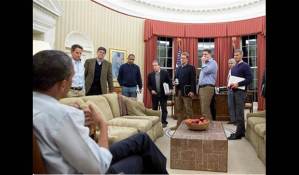 for Romney’s binders filled with women. But, the original picture and the visual of all those white guys and the leg of Valerie Jarret still just seems to be the best representation of the bigger problem.
Today, the president appointed the 4th white male in a row to what are considered the top cabinet positions. Obama’s second term is the result of an election that showed the decreasing representation of white men in the populace. It’s obviously not trickling up to the positions of power and voices that will be heard, be counted, and will matter when setting policy. I’m wondering what white man will become chief of staff at this point.
The topic of diversity in the Obama administration was also raised by the press. Jay Carney–white male–parried questions from the front row of the self-serving and pleased White House Press Corps. Btw, they are all white men too. But, it’s not just the women that have noticed that the advisers on major economic policies and issues on deck for the next four years seem to come from that same old boys groups. Don’t the people that vote for you get a seat at your table? Aren’t we among the powerful and qualified now?
“The first black president,” MSNBC anchor Chris Jansing began, “and he’s getting questions about diversity. Are these questions fair? Are you concerned?”
Rangel replied that he is concerned and the questions about a lack of diversity in the White House are fair.
“It’s embarrassing as hell,” Rangel said. “We were very hard on Mitt Romney – with his women binder, and a variety of things – and, I kind of think there’s no excuse when it’s the second term.”
Rangel said that there could be “the Harvard problem” at work in this instance. He said that women and minorities simply do not have the access to high ranking officials in Washington and, thus, are rarely promoted to positions of authority.
That said, Rangel thought that, after four years, there was no excuse for the president to not have a qualified stable of minorities and women to promote to high ranking posts in the White House.
“He’s had four years to work the bench, to work the second team, so that – in the second term – these people should be just as experienced as any other American,” Rangel concluded.
The conversation has already become uncivil as seen on Morning Joe this morning.
The issue of diversity took up the entire segment, but started to grow contentious when the BBC’s Katty Kay sought to downplay the lack of diversity in Obama’s cabinet while noting that Mitt Romney‘s “binders full of women” comment resonated because it reinforced the “1950s” attitude some perceived him having toward women.
“This is what’s wrong with political reporting,” Scarborough charged. The left took a “faux pas” and blew it up — but in Obama’s case, they’re talking about “something that matters.” Actual cabinet positions. That led to some back-and-forth between the two, who plainly disagreed.
As the segment went on, Brzezinski noted that Susan Rice could have been another woman in Obama’s cabinet had Republicans not “routed” her out. “Talk about old guys being completely chauvinistic jerks,” she remarked, as Scarborough noted David Axelrod‘s assertion that Rice hadn’t been considered for the Secretary of State position. Brzezinski countered that the president’s policies speak to his commitment to women’s issues.
Still, the show went on… until Scarborough’s joking around proved to be too much for Brzezinski who told him, “You’re being chauvinistic right now.” She can make personal attacks, Scarborough retorted, but “you’ve got a president you worship on this show every day.” Yet she “savaged” Romney. Had the president been Republican, she’d have been upset about the issue, he argued.
“You really — knowing me and seeing me work around here for five years — you want to call me a chauvinist on television?” Scarborough asked, with Brzezinski replying that she wasn’t calling him that.
“I said the way you’re acting is chauvinistic,” she responded, “especially the way you were handling this conversation. It’s not funny.”
Irin Carmon at Salon also writes about Obama’s White House: Still white, overwhelmingly male saying that “The stale sameness of the president’s second-term Cabinet picks belies the administration’s rhetoric on diversity.” BB included this link this morning and it was a compelling read and worth repeating.
Today on TV, I’ve watched Joe Biden take point on gun violence just shortly after taking the lead on the latest rounds of negotiations on the budget, tax, and spending deals. Yet, look at whose lives are overwhelmingly impacted by gun violence or by cuts in government spending and obsessive tax cutting for rich people? Is it folks like Biden? Wouldn’t it be nice to have a few voices at that bargaining table that realize what’s at stake? There has to be more to policy making that putting Washington DC insiders and power players at the head of the table. There are many qualified women and minorities that have come in through the ranks of the state department, the pentagon, the treasury, and many businesses. The most feared person by Wall Street this days is grandmother and Senator Elizabeth Warren. The two people most involved with gun violence prevention laws have been victims of violence or close to victims of gun violence themselves. That would be Senator Dianne Feinstein and Long Island Congresswoman Carolyn McCarthy. They’ve been on top of the gun violence issue since starting out in federally elected positions. How about any black member of congress representing an urban district? Couldn’t they have a place at the table along with Joe Biden instead of being shuttled in for an interview with the likes of the NRA lobbyist?
Andrea Mitchell points out that Obama’s Cabinet is Deja Vu all over again. New Hampshire Sen. Jeanne Shaheen appeared on the program calling the appointments disappointing.
On Thursday, New Hampshire Sen. Jeanne Shaheen called the lack of women among the new appointees “disappointing.” Shaheen, whose state elected the nation’s first all-female delegation in November–-with two female senators, a female governor, and two congresswomen–appeared on Andrea Mitchell Reports Thursday to discuss the new White House cabinet and the importance of women in government.
“I would hope the president would follow New Hampshire’s lead,” Shaheen told Mitchell, pointing to the fact that women account for half of the population of the United States. “He still has an opportunity,” she added. “He has places where he could appoint women, and I hope he’ll take a look and do that.”
As for Jack Lew’s soon-to-be-open post as chief of staff, the front runners are Denis McDonough and Ron Klain. McDonough, a current Obama advisor, and Klain, a former chief of staff to vice President Biden, are also white men. Labor Secretary Hilda Solis, one of the few women in the president’s cabinet, announced her resignation on Wednesday, leaving the White House with even fewer X chromosomes. This is not just a public relations problem for President Obama and his staff. According to Shaheen, it is a problem for democracy.
“We have different life experiences,” Shaheen told Andrea Mitchell. “We need a government that looks like America, so we can address the concerns that we hear from across the spectrum.”
It’s good that we’re at least getting some air time on this issue. However, I really doubt it will do much good. I guess we’ll see what happens with the next few appointments. I should add that women’s groups shouldn’t be the only one’s complaining here. I wonder if we’ll begin to see some folks offer up some binders full of Hispanics, African Americans, and other minorities too. Oddly enough, as I published this, I just got an action email from NOW with the topic being “Where are the Women?” It’s probably better put to ask where are the people that look like all of us who voted for you?

 peej
peej Carissa
 bostonboomer
 dakinikat
 ecocatwoman
 mablue2
 Mama Lopez
 peggysue22
 quixote
 skydancingguestblogger
 Mona (aka Wonk the Vote)



 Sky Dancing
Recent Comments