
Perverse Incentives
Posted: March 17, 2010 Filed under: Uncategorized | Tags: cognitive dissonance, deadweight loss, disequilibrium, equilibrium Comments Off on Perverse IncentivesDisequilibrium is an interesting concept that has roots in many disciplines. Of course, in physiology it just simply means something’s off balance. You can have an inner ear infection, become dizzy, and feel miserable as well as fall because you become unsteady on your feet. That’s the kind of disequilibrium associated with vertigo. There’s linkage disequilibrium which is a term used in population genetics which causes diseases like cystic fibrosis when there are “non-random association of alleles at two or more loci, not necessarily on the same chromosome.” Something’s off balance there too, although I frankly can’t explain it at all.
In economics, disequilibrium is a state where a market can’t achieve that place where forces reach a state of balance in terms of supply and demand. You don’t achieve the magical market clearing status called equilibrium where you get this mutually agreed upon price level and quantity so things usually stay at a place where you get excesses or shortages and the society really wastes a lot of communal resources. Wasting resources is a big welfare inhibitor in this situation because you’re preventing a state where a lot more mutually beneficial transactions could occur. We’re looking for optimality, for efficiency, for correct allocation of resources and none will happen.
I’m not a psychologist but I’ve had more than a few psychology courses and I do love the idea of disequilibrium in this 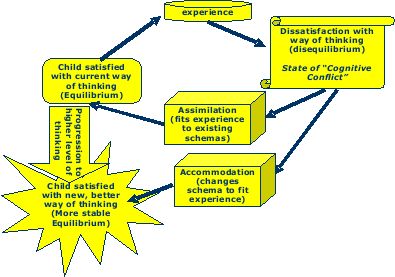 discipline. I studied cognitive dissonance a lot when I got a teaching certificate and had to endure quite a few hours in educational psychology and psychology. You just can’t avoid the work of Jean Piaget and disequilibrium in cognitive development. It is one of his big things. I was so impressed with his work that both my children went to Montessori schools which is an offshoot of his studies on human development. You can ask BostonBoomer the details because that’s her thing, not mine. Mine is General Equilibrium of the economic sort but it operates in markets instead of the minds of children.
I’ve put the nifty graphic in there which shows you the basic Piaget model. In all the processes of disequilibrium, the cognitive one included, something is off-balance. It just isn’t right. When you get a sense of cognitive dissonance your supposed to get an uncomfortable feeling because you’re holding two logically inconsistent viewpoints in your mind and it upsets your balance. That’s the state of Cognitive Conflict. You react noticeably as you try to reconcile the two distinct beliefs or states. In psychology this can lead to what they call confirmation bias where your mind starts blocking out evidence so that you can feel better about the situation by ignoring the disconfirming evidence altogether. It’s basically an ego defense mechanism.
So, back to economics now where our model is out of whack because something is in the way of the market reaching equilibrium. Either supply or demand has been fettered by something. This something can come from the government in the form of quotas, tariffs or price controls. It also can come from the market. Something can slow the process to equilibrium like “sticky downward’ or rigid wages which is a Keynesian concept related to people not particularly liking their incomes and budgets messed with regardless of what’s going on with prices in the broader economy. This is a economics example of cognitive dissonance, although most economists will completely run the other way whenever you try to equate their sacred science with something that resembles ‘psycho-babble’ and not their model of the rational, need driven householder.
So, why am I babbling on about this like the weird and wonky academic with a lot of background in social science research that I have? Because, I sense a huge macro-disequilibrium in the United States right now in a much more multi-discliplined way than most social scientists or scientists sense and study.
Something doesn’t feel right and I can’t solve the equation. It’s a disequilibrium in that touch- feely cognitive dissonance sort’ve way that I believe is coming from one of the root sources of economic disequilibrium. That would be perverse incentives. The government can put a market perpetually out of equilibrium by taxing or rewarding behaviors that make one side benefit and the other side lose. This is what happens when they use Tobin Taxes (so-called sin taxes) or quotas for imports or quantity restrictions to prop up businesses, or some other kind of price controls. The result is measurable in a market. It creates what we call a deadweight loss. This is a situation where there is no Pareto optimality, ever, which is that state of equilibrium where supply equals demand, the right price is achieved and an optimum quantity becomes available to the market. Deadweight loss is an excess burden which reflects the loss to society of not having the Pareto or optimal outcome. We lose something. We transfer benefit from one group to another or from both groups to the government for one reason or another. Sometimes, we do this for seemingly quite good and innocuous reasons, but it still creates disequilibrium. Usually, it’s perverse incentives. We try to correct some problem and just wind up creating a bigger problem, like New York City did with Rent Controls in the 1970s.
What’s been going on recently is just one set of circumstances that’s throwing off the balance of one thing after another and it’s transferring the benefit from one group to another. It’s like some perverse set of incentives is causing us to self-destruct in a way that makes us all feel this massive group cognitive dissonance. Something just doesn’t feel right and we can’t use the evidence that exists to find equilibrium because we can’t get there from here without throwing out some of the evidence just to get rid of that off feeling.
So, the deal is, in Psychology, some people are able to throw out evidence. They will convince themselves that up is down and right is wrong to maintain a sense of equilibrium even when evidence suggests equilibrium cannot be achieved under this conflicting evidence or under these perverse incentives. That, for all the good that it does, explains why some folks can believe that this mess of a health policy will solve ills and achieve goals when it is likely to create a massive wealth transfer and a huge deadweight loss to society. It makes them feel better to believe that this is a circumstance where the lightbringer will deliver their pony. It justifies their decision to support him at all costs. Others, will go batshit crazy and vote Republican. It completely depends on which evidence you throw out. Some of us will just sit here trying to resolve our sense of unease unsuccessfully.
I’ve never been very good at inducing a state of denial, and I assume that most of you here aren’t either, so where does it leave us?
My answer is simply in that we are in state of cognitive vertigo together. Maybe, at the moment, that’s the best we can do.

 peej
peej Carissa
 bostonboomer
 dakinikat
 ecocatwoman
 mablue2
 Mama Lopez
 peggysue22
 quixote
 skydancingguestblogger
 Mona (aka Wonk the Vote)



 Sky Dancing
Recent Comments