
If the Turkey didn’t put you to sleep …
Posted: November 26, 2010 Filed under: The Great Recession, U.S. Economy | Tags: Bruce Bartlett, Bush tax cuts, deflation, FOREX, inflation, Martin Feldstein, QE2, supply side fairy tales, voodoo economics 9 CommentsEconomics doesn’t take holidays. It’s probably why we economists are so grim. Just in case you need a good nap, here’s some of my pointy head friends with 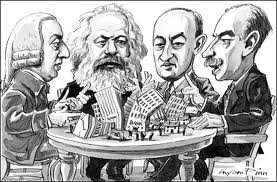 bow ties discussing things economic. I was going to try to spare you out of holiday cheer, but Mark Thoma reeled me in and now I must share.
I’ve mentioned recently how absolutely baffled I am by the number of “conservative” (i.e. radical) Republicans who keep buying into economic fallacies that even conservative (i.e. authentically conservative) economists can’t support. I mentioned Nobel Prize winning and father of the Monetarists Milton Friedman’s huge study on the Great Depression. His thesis was that very poor Fed policy made the Great Depression. In 2002, Bernake even agreed and apologized to him for the FED’s errant ways. Friedman was a consummate free marketer and wrote pop books and pop Newsweek columns during his heyday as a conservative icon. I’m sure he would not be suffering these fools were he alive today.
Thoma points to two recent columns by two former Reagan Team economists. One article is from Martin Feldstein who is probably the closest thing remaining to Milton Friedman in terms of conservative, free market, economic thought. The other is from Bruce Bartlett who was one of the fathers of Supply Side economics during the Reagan years but has since repented. He’s really adapted the Friedman statement “We’re all Keynesians now”. Both economists are intent on stopping this current batch of policy nincompoops from recreating The Great Depression.
The first Thoma thread references Feldstein who writes on the QE2 at Project Syndicate. Feldstein was Chair of Reagan’s Council of Economic Advisors and was President of the NBER. You may recall that NBER dates business cycles for the country. I want to hit his bottom line first so those of you that are using this for nap material can see that it’s ludicrous to think the QE2 is wild-eyed and out-there policy experimentation.
In short, the Fed’s policy of quantitative easing is likely to accelerate the rise of the renminbi – an outcome that is in China’s interest no less than it is in America’s. But don’t expect US officials to proclaim that goal openly, or Chinese officials to express their gratitude.
China is experiencing inflation. We are experiencing deflation. The reason this is good for both countries is that it will offset each of these pressures. Feldstein explains the goal of the QE2 in terms of US policy first. I’ll cover that quote. You’ll need to go read the explanation for the China side of the equation too.
The United States Federal Reserve’s policy of “quantitative easing” is reducing the value of the dollar relative to other currencies that have floating exchange rates. But what does the new Fed policy mean for one of the most important exchange rates of all – that of the renminbi relative to the dollar and to other currencies?
The effect of quantitative easing on exchange rates between the dollar and the floating-rate currencies is a predictable result of the Fed’s plan to increase the supply of dollars. The rise in the volume of dollars is causing the value of each dollar to fall relative to these currencies, whose volume has remained constant or risen more slowly.
The Fed’s goal may be to stimulate domestic activity in the US and to reduce the risk of deflation. But, intended or not, the increased supply of dollars also affects the international value of the dollar. American investors who sell bonds to the Fed will want to diversify the dollars that they receive from it. One form of that diversification is to buy foreign bonds and stocks, driving up the value of those currencies.
The result of this move will be to make our exports more competitive abroad and to make every one else’s exports–including those countries that have pegged their currencies to the dollar in an unfair manner–less competitive. We are simply turning the tables on the beggar-thy-neighbor growth policy China and others have adopted. The Fed is doing this because there is no will on the part of domestic policy makers to stimulate the demand in our country for consumers or government. There are 4 major parts of GDP. If fiscal policy doesn’t stimulate Consumption or Government demand, then there remain Investment and Exports. Investment is the least reliable form of demand and is rather small compared to the rest of the economy. The Fed is trying to tackle the aggregate demand shortage as best it can in response to the laws that compel it to act when unemployment is high.
Which brings me to the Bruce Bartlett thread. Bartlett has a piece today up at The Fiscal Times called ‘Starve the Beast: Just Bull, not Good Economics’. As some one who is currently suffering from a governor who has selectively adopted the policy as a path to the White House, I personally can tell you that it is very much Bull and causes a lot of undue suffering. It is ideology chosen over fact, logic, and above all, compassion. Bartlett goes straight to the heart of Voodoo Economics by using data to show that Dubya Bush’s embrace of of tax cuts in his first term as president did nothing to further economic growth and did everything to drive us in to unnecessary deficit spending.
It ought to be obvious from the experience of the George W. Bush administration that cutting taxes has no effect whatsoever even on restraining spending, let alone actually bringing it down. Just to remind people, Bush inherited a budget surplus of 1.3 percent of the gross domestic product from Bill Clinton in fiscal year 2001. The previous year, revenues had been 20.6 percent of GDP, spending had been 18.2 percent, and there had been a budget surplus of 2.4 percent.
When Bush took office in January 2001, we were already well into fiscal year 2001, which began on Oct. 1, 2000. He immediately pushed for a huge tax cut, which Congress enacted. In 2002 and 2003, Bush demanded still more tax cuts, even as the economy showed no signs of having been stimulated by his previous tax cuts. The tax cuts and the slow economy caused revenues to evaporate. By 2004, they were down to 16.1 percent of GDP. The postwar average is about 18.5 percent of GDP.
Spending did not fall in response to the STB decimation of federal revenues; in fact, spending rose from 18.2 percent of GDP in 2001 to 19.6 percent in 2004, and would continue to rise to 20.7 percent of GDP in 2008. Insofar as the Bush administration was a test of STB, the evidence clearly shows not only that the theory doesn’t work at all, but is in fact perverse.
There is nothing better than an addict who has fought their demons and comes out the other side to explain exactly why the demon should die. Bartlett succinctly explains why the Republicans continue to support the ideology and the drivel despite evidence that everything they believe is quite false.
Nor was Bush’s budgetary profligacy limited to programs that could be justified, however loosely, on national security grounds. As I detailed last week, he and a Republican Congress created a massive new entitlement program, Medicare Part D, to buy the votes of seniors and buy themselves reelection in 2004. Among those voting for this monstrosity were many Republicans still in Congress today who are unjustly considered to be staunch fiscal conservatives, including incoming Speaker of the House John Boehner, House Majority Leader Eric Cantor, and House Budget Committee chairman Paul Ryan.
Because of its obvious ridiculousness, one seldom hears conservatives say openly that tax cuts automatically reduce spending. But it still underpins the entire Republican budget strategy — tax cuts never have to be paid for, no meaningful spending cuts are ever put forward, earmarks and foreign aid are said to be the primary sources of budget deficits, and similar absurdities.
Both of these men have written tractable–albeit, tough–reads on policy decisions that people really need to understand. I know there is a tendency this time of year to wallow in football games, shopping binges, and short term feel good embrace of childhood memories, but really, there is a lame duck congress in session and an incoming group of Congressional morons with a President in office who wants to play Let’s Make a Deal with them.
If you can awake from tryptophan dreams long enough to read these two articles thoroughly, please do so. We can’t afford any more Voodoo policy mistakes.

 peej
peej Carissa
 bostonboomer
 dakinikat
 ecocatwoman
 mablue2
 Mama Lopez
 peggysue22
 quixote
 skydancingguestblogger
 Mona (aka Wonk the Vote)



 Sky Dancing
Recent Comments