
Congressional Insider Trading: A case study in Moral Hazard
Posted: December 9, 2011 Filed under: #Occupy and We are the 99 percent!, corruption | Tags: congressional insider trading, congressional self dealing, josephy stiglitz 9 Comments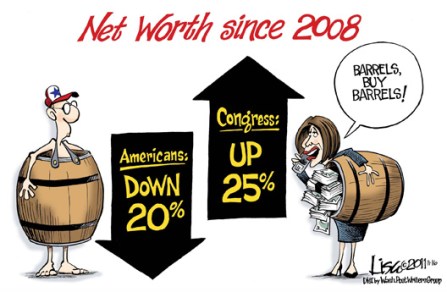 The more I’ve become aware of how pervasive the problem is of congressional insider trading, the more horrified I’ve become. This is a worst case scenario because this is just like congressional raises and campaign finance reform in that the foxes are in charge of their taxpayer funded chicken coop. They are unlikely to pass any kind of law that controls self-dealing behavior and there is no other way to get it done. There are always a few of them that are willing to do the right thing but the leadership of each house is most likely to be the stellar examples of those that manipulate the system to their own advantage. So, if a law comes up, the leadership will stop any forward momentum. Insider trading appears to be a bi-partisan problem with egregious examples from both sides of the aisle.
Insider trading in the financial markets is one of the most prosecuted and investigated crimes. The realization that inside information–information you have that is not available to the public–gives you an unfair advantage in predicting prices of assets is long standing. It’s been declared unethical and illegal for some time. Insider, self dealing behavior has been a problem for our country both in and outside of government. One good early congressional example is that of William Duer who was a member of the Continental Congress. However, Duer was an outlier for his time. Recent investigation by journalists indicate that the current congresspeople regularly self deal by buying stocks and other assets while influencing legislation that directly impacts those holdings.
Eric Cantor just blocked a bill that would outlaw insider trading by members of congress. This appears to be another example of a congressional leader who has made money off a practice ensuring they can continue to ride their gravy train. The behavior is clearly an example of self-dealing and is considered unethical in Wall Street and financial market circles. Given those guys frequently try to push the envelop on acceptable investing behaviors, that really puts Cantor in the poster child of moral hazard category.
The Republican sponsor of the bill in the House, Financial Services Chairman Spencer Bachus of Alabama, had scheduled a markup of the Stop Trading on Congressional Knowledge (STOCK) Act for next week. But on Wednesday, Majority Leader Eric Cantor of Virginia cancelled the markup session.
Cantor reportedly said he blocked the bill to give Congress more time to examine the issue. Critics of the move, however, fear that any delay could kill the bill entirely.
Some version of the the STOCK Act has been bouncing around Capitol Hill for six years. But recent attention to the issue of Congressional insider trading, following reports from CNBC’s Eamon Javers and a “60 Minutes” report, brought the bill out of stasis and made its passage into law seem likely. If the latest delay pushes the bill into next year, it may become lost in election-year politics.
Trading by lawmakers based on non-public information about legislation falls into what many see as a loophole in insider trading regulations.
Although corporate insiders are banned from trading on non-public information about their companies, congressional representatives and senators may not be banned from trading on non-public information about legislation or regulation. The legal issue is disputed by scholars and regulators.
The head of the enforcement division of the Securities and Exchange Commission recently argued that congressional insider trading is already banned. But he admitted that no legal action has ever been taken against a member of Congress.
Studies have shown the investment portfolios of House members and Senators consistently outperform the market by significant degrees, suggesting they are either miraculously bright and lucky investors or using their access to non-public information when trading. Financial experts regard the idea that it is just luck or investing smarts as laughable.
Minnesota Democrat-Farm-Labor Representative Tim Walz has been one of the bill’s sponsor. He’s currently doing interviews in an attempt to shame Cantor into releasing his hold.
The 1st District DFL Rep. Tim Walz-sponsored STOCK Act — Stop Trading in Congressional Knowledge — has been around for six years, but just recently started getting attention. It had been going nowhere until a “60 Minutes” report in November.
“We know that during the health care debate, people were trading health care stocks. We know that during the financial crisis of 2008, they were getting out of the market before the rest of America really knew what was going on,” Peter Schweizer, a fellow at the conservative Hoover Institution said on “60 Minutes.”
Overnight, the bill went from a handful of co-sponsors to having dozens. A month later, the bill has more than 220 co-sponsors from both parties, but mostly from the House.
This is a bill that should be on the top of the list for things that those sympathetic of the Occupy movement. It should appeal to Tea Republicans too. This is clearly something that is highly unethical and similar behavior by senior management in the private sector would be subject to criminal investigation and would result in charges. You can watch the 60 Minutes segment here. It’s worth watching. This bill should pass and be implemented. Something is seriously wrong with Eric Cantor’s moral barometer if he really thinks it needs more study.
Cantor’s move comes after we find that the wealth of US households suffered their biggest loss last quarter since the worst part of the financial crisis in 2008. Congress actually gained net worth during the same period. Last quarter’s losses by ordinary Americans are undoubtedly due to the eurozone crisis–which is essentially yet another bank problem–and the brinkmanship behavior of Congress balking at passing the debt ceiling increase to pay for spending they approved. The inability of congress to do anything substantial for the economy and instead engaging in naked partisan one-up-man-ship has been beyond the comprehension of most economists who know exactly what needs to be done to put the nation back on solid ground.
Even more unsettling than the latest quarterly figures on wealth destruction is the amount of wealth that has been vaporized in the past four years. The net worth of American households peaked in 2007 at $66.8 trillion. As of September 30, 2011, the net worth of American households had plunged to $57.4 trillion for a loss of $9.4 trillion. To put these number in perspective, this is a loss of net worth per person in the United States of $30,618. A family of four is statistically poorer by $122,472 than they were in 2007.
This is nothing less than malpractice on the part of elected officials that are more focused on gaining and keeping seats in their caucuses than doing right by the American people. Joseph Stiglitz’s ‘The Book of Jobs’ in January’s Vanity Fair is a compelling list of America’s economic troubles and the sins our elected officials in getting everything backasswards. This has not been our grandparent’s Great Depression where the government and the administration thought and acted big to take care of American people and their communities. Instead, our congress jumped to benefit personally from their knowledge of the problems by investing correctly and conducting policy improperly. They seem to know what their actions are doing when it comes to smartly using their own funds for their own enrichment.
It has now been almost five years since the bursting of the housing bubble, and four years since the onset of the recession. There are 6.6 million fewer jobs in the United States than there were four years ago. Some 23 million Americans who would like to work full-time cannot get a job. Almost half of those who are unemployed have been unemployed long-term. Wages are falling—the real income of a typical American household is now below the level it was in 1997.
We knew the crisis was serious back in 2008. And we thought we knew who the “bad guys” were—the nation’s big banks, which through cynical lending and reckless gambling had brought the U.S. to the brink of ruin. The Bush and Obama administrations justified a bailout on the grounds that only if the banks were handed money without limit—and without conditions—could the economy recover. We did this not because we loved the banks but because (we were told) we couldn’t do without the lending that they made possible. Many, especially in the financial sector, argued that strong, resolute, and generous action to save not just the banks but the bankers, their shareholders, and their creditors would return the economy to where it had been before the crisis. In the meantime, a short-term stimulus, moderate in size, would suffice to tide the economy over until the banks could be restored to health.
The banks got their bailout. Some of the money went to bonuses. Little of it went to lending. And the economy didn’t really recover—output is barely greater than it was before the crisis, and the job situation is bleak. The diagnosis of our condition and the prescription that followed from it were incorrect.
The problem is that congress–due to its ability to self deal–has no experience of any of this. In fact, the more we suffer it appears the more they make up fairy tales that suggest the only people doing well in this economy should be left to repeat the sins of their past. A congressional seat should not be an easy path to a secure position among the 1 percent. It appalls me that so many folks don’t seem to actually get this. Witness the rise of ultimate self-dealer Newt Gingrich to the front runner status of the republican presidential campaign. If we can’t stand up to the likes of Eric Cantor and we can’t reject the leadership model of Newt Gingrich, we will certainly loose any semblance of truly representative government. This bill would close the door on one faucet of the moral hazard problems that are rampant in government.

 peej
peej Carissa
 bostonboomer
 dakinikat
 ecocatwoman
 mablue2
 Mama Lopez
 peggysue22
 quixote
 skydancingguestblogger
 Mona (aka Wonk the Vote)



 Sky Dancing
Recent Comments