
The Austerity Plot
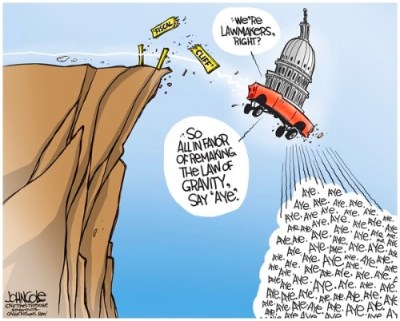
Posted: December 7, 2012 Filed under: 2012 elections | Tags: austerity, class war, fiscal cliff, kleptocracy 14 CommentsThe only thing that has lessened my hysteria about the crazy Simpson Bowles plan, the shrieking about a fiscal cliff, the repeated insanity about the US federal government 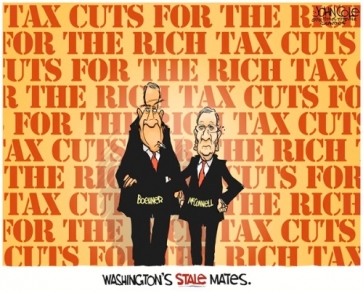 going “bankrupt”, and the continuing insistence that the people that benefited most from unrealistic policy moves over the last 30 years shouldn’t kick in their fair share for our civilization is the conversation that goes on within the community of economists. Economists know it’s insanity. There’s a lot of agreement that most of the media hysteria and political power playing around this entire deficit hysteria is mostly a plot form “obscenely rich men” who just simply want more of everything we have. Here’s some excellent analysis and points by Lynn Stewart Parramore.
New York magazine calls it a “Mass Movement for Millionaires.” The New York Times’ Paul Krugman sums up the idea : “Hey, sacrifice is for the little people.”
The Campaign to Fix the Debt is a huge, and growing, coalition of powerful CEOs, politicians and policy makers on a mission to lower taxes for the rich and to cut Social Security, Medicare and Medicaid under the cover of concern about the national debt. The group was spawned in July 2012 by Erskine Bowles and Alan Simpson, architects of a misguided deficit reduction scheme in Washington back in 2010. By now, the “fixers” have collected a war chest of $43 million. Private equity billionaire Peter G. Peterson, longtime enemy of the social safety net, is a major supporter.
This new Wall Street movement, which includes Republicans and plenty of Democrats, is hitting the airwaves, hosting roundtables, gathering at lavish fundraising fêtes, hiring public relations experts, and traveling around the country to push its agenda. The group aims to seize the moment of the so-called “fiscal cliff” debate to pressure President Obama to concede to House Republicans and continue the Bush income tax cuts for the rich while shredding the social safety net. The group includes Goldman Sachs’ Lloyd Blankfein, JPMorgan Chase’s Jamie Dimon, Honeywell’s David Cote, Aetna’s Mark Bertolini, Delta Airlines’ Richard Anderson, Boeing’s W. James McNerney, and over 100 other influential business honchos and their supporters.
Corporations represented by the fixers have collected massive bailouts from taxpayers and gigantic subsidies from the government, and they enjoy tax loopholes that in many cases bring their tax bills down to zero. Sometimes their creative accountants even manage to get money back from Uncle Sam. For instance, according to Citizens for Tax Justice, Boeing has paid a negative 6.5 percent tax rate for the last decade, even though it was profitable every year from 2002 through 2011.
These CEOs talk about shared sacrifice, but it seems that they don’t intend to share anything but your retirement money with their wealthy friends. As New York magreports:
“Most on-the-record comments are a mishmash of platitudes about shared sacrifice and working together for the good of the country. But interviews with a number of organizers and CEO council members point to a massive networking effort among one-percenters — one that relies on strategically exploiting existing business relationships and appealing to patriotic and economic instincts.”
 It is outrageous to think that a country that has been suffering from decades of ever increasing income inequality, exorbitant CEO pay, and financial crises triggered by corporate and financial industry corruption should lead to calls that the victims should pay more than perpetrators–who are also the pirates that profiteered–for the damages done to the public treasury. There is a full on assault for everything that’s defined as America progress since the 20th century. The majority of Americans–we poor, huddled masses–are losing the assault. We’ve lost the conversation in the halls of congress and to the media that appears to be joined at the hip with its plutocratic enablers.
It’s obvious Republican leaders have no idea of what they speak and are only talking from points they feel will tingle the fingers of their donor base. The ink is barely dry on the Romney loss and the 2016 Republican candidates are already on the run. All of them are basically running on the same crap rejected just weeks ago with the exception of trying to find a kinder gentler way to spin the obvious hatred of any one that’s not a rich white male. Most of them don’t even care about learning about the issues. They only want to find a message that will sell to their privileged constituents.
As Jonathan Chait points out, Bobby Jindal — who is supposed to be one of the intellectual leaders of his party — has just published an op-ed on the cliff that sure looks as if he has no idea whatsoever what the cliff is about. There’s nothing in that piece even hinting that the looming problem is spending cuts and tax increases that will shrink the deficit too soon; and his big policy ideas would actually make the lurch to austerity worse. It’s not just the idea of a balanced budget amendment, which would force harsh austerity every time the economy goes into recession; putting a cap on spending as share of GDP would do the same, because you’d have to cut spending whenever GDP went down.
You really have to wonder how someone who’s a major political figure could be this uninformed — but you have to wonder even more about the state of mind that induces you to write an op-ed about a subject you don’t comprehend at all.
But this isn’t the first time something like this has happened to a supposed GOP star. In the early stages of the Republican primary, Tim Pawlenty — a supposed thoughtful conservative — published an op-ed based on the premise that public-sector employment was booming; in fact, it was plunging. And, of course, Mitt Romney made statements — about the 47 percent, about Benghazi — that he clearly thought were smart and well-informed, but were in fact flatly false.
I think it comes back to the epistemic closure issue. Even supposedly well-informed people on the right get their “facts” from the likes of the Heritage Foundation. Probably Jindal never talks to anyone who will quietly explain that the fiscal cliff is a problem because, well, Keynesian economics is basically right, and you really don’t want austerity in a depressed economy. So he has some vague notion that it’s about the wages of fiscal irresponsibility, which it isn’t, and apparently believes that he knows enough to pontificate.
Now, there’s talk of doing something very fiscally unsound to give the Republicans a trophy. Will Democrats actually take the imprudent action to increase the Medicare age just to get the Republicans to move on something, anything? Ezra Klein–hosting for Rachel Maddow–points out the incredibly unpopular policy is also terrible fiscal policy because it will cost more to cover the change than it saves.
Despite the fact it’s unpopular, republicans really want to make cuts in medicare and want to raise the age by two years from 65 to 67. that’s also super unpopular…What’s weird is it’s always presented as the height of fiscal responsibility even though it’s fiscally irresponsible. Which brings us to the challenge. why raising the age does not save you very much money and is probably a bad policy idea in under two minutes…The seniors turning to private insurance will have to pay more from the same coverage. 3.7 billion more in the first year of the policy…it’s a terrible policy, but because obama care and employers and others are there to catch a lot of these people, it might get more votes while doing less harm to seniors than the alternatives.
The basic reasoning behind all of this is the continual need by the Republicans to serve their richest of the rich and the inability of the rich to EVER GET ENOUGH MONEY and Power. It’s a zero sum game for them and they seem to want every one else to lose. The worst of these offenders have installed themselves on Wall Street. They still keep pushing the idea that Social Security is insolvent and going bankrupt when it is not. These are also the guys that would love to access that big pool of money for their gambling schemes.
“Fix” means cut : When they say “fix” Social Security, they mean cut Social Security. Fixers want to convince the public that a well-managed, hugely popular program that does not add to the deficit (it’s self-funded) is somehow in crisis and requires intervention in the form of various cutting schemes. They seek this because many of the rich do not want to pay taxes for Social Security, and financiers want very much to move toward privitization of retirement accounts so they can collect fees on such accounts.
It is surreal that any elected official could still hold and trumpet these ideas after they were sincerely stomped on by the electorate just weeks ago. But the deal is that the rich just cannot get enough and they are willing to drive the country into developing country status to get more. The United State continues to nosedive on lists of quality of life. What exactly will it take to get jerks like the Koch Brothers back into their evil box?
Here’s an excellent essay that sums up what’s wrong with the country these days by James Kenneth Galbraith. He mentions the importance of the our stagnant wages but goes one further. The very things that gave us our strong middle class after the Great Depression and up to the Reagan years are our social contracts with each other. These programs are under attack today like never before.
The real threat to the middle class is not there, it’s in the erosion of the programs I just mentioned. That is to say, it’s in the attack on the public schools, it’s in the squeeze on higher education, it’s in the threat to Social Security. When you look at housing, you have a very large unambiguous loss. Millions of people have been displaced, but many, many more have lost the capital value of their homes. They won’t be able to sell and retire on the proceeds.
So I think there is a threat to the middle class, but if I were talking about it in political terms, I wouldn’t be giving an abstract statistical picture of wages. This doesn’t connect to people’s experiences. If I were designing the boilerplate rhetoric of a popular movement, I would take a blue pencil to these statistical formulations. I don’t like the stagnant median wage argument—I think it obscures what actually happened. And I don’t particularly care for the “one percent” argument. I understand it has a certain power, but one can be much more precise about what it is you want to attack, and what it is you want to preserve and to build. I would cut to the chase: we need to tear down the financial sector and rebuild it from scratch in a very different way.
In our current situation, the financial sector makes its money by destroying, not by building. When one frames the issue that way, and when you try to explain to people why that’s so, I think they have a much clearer picture of what they’re facing and what should be done. Occupy Wall Street wasn’t wrong to focus on Wall Street. That was exactly right. But talking in terms of the “one percent”—which, after all, would be about 3.1 million people—doesn’t clarify what is truly at issue. What do people care about? People care about their public services, they care about their schools, they care about the environment in which they live, they care about safety, they care about the terms of student loans, they care about health care and retirement. When one talks about those issues, I think you connect much more effectively than by addressing this in terms of “the middle class,” which is itself a very abstract term.
We are going to come to a point of decision fairly soon as to whether the core institutions of the New Deal and the Great Society survive. It is a straightforward question: do we insure the whole population against old age, disability, or the loss of their income, or not? Do we provide a decent standard of health care and long-term care for the elderly and people in the final phases of life, or not? Is this a community that provides this as a matter of common insurance, or isn’t it?
We need to buck up whoever we can to say no to compromises that include our basic social safety programs. We should go over the fiscal cliff rather than give Republicans trophies that will ruin our society in the long run.

 peej
peej Carissa
 bostonboomer
 dakinikat
 ecocatwoman
 mablue2
 Mama Lopez
 peggysue22
 quixote
 skydancingguestblogger
 Mona (aka Wonk the Vote)



 Sky Dancing
Recent Comments