
Mostly Monday Reads: Cassandras Among Us
Posted: November 17, 2025 Filed under: #FARTUS, #We are so Fucked, Disappearing Immigrants, Discrimination against women, GOP Crimes Against Humanity, Human Rights, ICE Immigration and Customs Enforcement, Injustice system | Tags: @johnbuss.bsky.social John Buss, Back to the Gilded Past, Brotacracy, Heather Cox Richardson, How can people be so Heartless?, Polycrisis, Public Intellectuals, Steven Beschloss, The Wise and Wonderful Kira, Wildmoon 8 Comments
“Breaking news, literally!” John Buss, @repeat1968, cartooning the anti-Cassandra
Good Day, Sky Dancers!
I always take the counsel of Kira, the wise and wonderful cat, and her muse, my friend Wildmoon. Dinah and Kristal are big fans. Kira had some reading recommendations this morning during her morning revelations. We’ve begun to see the extent to which the fish is rotting from the head. Remember, this autocracy has come about not just from the foibles of Orange Caligula, but the likes of the techboys, lawyers, and Dark Money/Bad Research organizations like the Heritage Foundation and the Federalist Society. Maxwell and Epstein were both sex traffickers and abusers. However, as Kira tells us, there are these “elite muckitymucks.” ‘Tis the season, so let’s see if a klatch of we crones can take them down.
Kira speaks.
As usual, Kira did my morning reading before I got up and was waiting on the heated pad to tell me about it.
“Two things,” she said. “That professor lady and Margaret Sullivan.”
“Heather Cox Richardson?” I asked.
“Yes yes professor lady with three names. She writes about how the Epstein emails are exposing an undercurrent of elite muckitymucks similar to the robber baron era and earlier, before that era got going, plus how they tried to stop the dismantling of it despite how it was obvious their focus solely on wealth and their own wellbeing was destroying human society.”
“Ouch. That’s harsh, little girl.”
“It’s truth. HCR doesn’t put it in those terms, but it’s real. Then Margaret Sullivan. She writes about how the New York Times is going all nostalgic about the elite monsters who populate Epstein’s emails, calling it a “lost world” (gack), while Will Bunch from the Philly Inquirer writes in an oped (not a news story mind you) wrote about ‘the much deeper rot that’s already been laid bare about the entire decrepit class of men (because they’re almost all men) who rule the world with atrocious grammar amid a non-stop booty call.’”
“Again harsh.”
“Again truth. Are you going soft on me?”
“Hardly. I just need coffee.”
“OK, get your coffee. Then read those two.”
So I did. I may have more to say about them later. I’ll say this now – this whole sordid affair is laying out into the open that “much deeper rot” that permeates the real “elites” MAGAts go on about all the time. MAGAts tend to think, somehow, that everyone who’s not a MAGAt is some kind of rich elite being paid by other rich elites to disagree with them. That’s not who the “elites” are.
The real elites are a bunch of men, but not always men (as Sullivan and Professor Cox Richardson both point out) who are sometimes filthy rich and who are all powerful or just want to be near the powerful (Noam “can’t wait to come to the Caribbean see you in 3 weeks” Chomsky, looking at you) because of the veneer of power they get.This rot is waaaaaaaay deeper than the dumbfuck in chief and his band of merry idiots in the White House right now – this is about the motherfuckers who gleefully put him there while either “enjoying” the trafficked women and girls Epstein gleefully provided them or at the very least knowing full well about it and considering the damage done to those women and girls worth it.
And THAT, my friends, is what need to be destroyed. All of it. The Thiels and Chomskys and Dershowitzes and all of them – they all belong in the lowest depths of hell that can be imagined, worse than anything Dante wrote about.For the survivors of those monsters.
 That’s why I’m exploring Kira’s suggestions today and adding a few of my own. Margaret Atwood has been a symbol of so much of women’s lived experiences written in prose that sings to our souls. She’s finally written about herself. This New York Times interview with the author captures the spirit of “The Book of Lives.” Alexandra Alter interviewed Atwood for this article in early November. “For a Literary Saint, Margaret Atwood Can Sure Hold a Grudge. She had to be pushed to write her new memoir, “Book of Lives.” The result reveals the experiences (and a few slights) that have shaped her work.”
Margaret Atwood doesn’t like being called a prophet.
“Calm down, folks,” was the withering response when I asked why her fiction often seems eerily predictive. “If I could really do this, I would have cornered the stock market a long time ago.”
Still, she concedes she’s been right on occasion.
When she published “The Handmaid’s Tale” in 1985, some critics were skeptical of Atwood’s vision of a future authoritarian America, where the government controls women’s reproduction and persecutes dissidents.
Since then, events in the novel that once struck unimaginative reviewers as implausible have come to pass. Abortion has been outlawed in parts of America. The rule of law feels increasingly fragile. Insurgents attacked the Capitol. Censorship is rampant — Atwood herself is a frequent target.
When I point out these parallels to Atwood, she still brushes off the idea that she can sense where things are heading.
“Prescient is not the same as prediction,” she told me recently when we met for lunch in Toronto. “People remember the times when you were right, and forget the times when you were wrong.”
At 85, Atwood is as droll, slyly funny and blunt as ever, prone to turning questions she doesn’t particularly like back on the interrogator. “And?” she’ll say in her low, gravelly monotone.
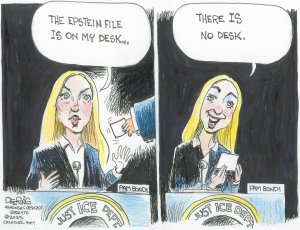 There is nothing more interesting and rewarding than watching and listening to one of my favorite writers tour the country in support of a book. Finding out that she was both a Scorpio, like me, and the daughter of a narcissistic mother just brought her closer to my heart and mind.
An awkward child who had a caterpillar for a pet, Atwood sometimes struggled to fit in. At 9, she was tormented by a group of girls who subjected her to degradations, like leaving her out in the snow and burying her in a hole. She drew on the experience in her novel “Cat’s Eye,” about a woman who was viciously bullied by other girls as a child. But she always dodged when asked if the story was autobiographical because the “chief perp,” as she writes, was still alive (she no longer is).
Other villains from Atwood’s past escape public shaming. She describes a frightening night when she blacked out after her drink was spiked at a party, and woke up being groped by a boy on a couch in the basement: “I know your names, but won’t mention them here because it was a long time ago and anyway you are probably dead,” she writes.
Atwood got her start as a poet. She self-published her first book of poems, “Double Persephone,” in 1961, and sold copies for 50 cents. A few years later, she started to gain recognition when another poetry collection, “The Circle Game,” won a prestigious award.
Her provocative debut novel, “The Edible Woman,” a biting satire about a young woman who develops a strange relationship to food and struggles to eat, made waves in 1969. Some readers and critics saw it as a feminist manifesto — a framing that Atwood still disputes.
“I suppose if you squint really hard, you could say I was an early feminist,” she said. “But did I think the feminist movement was coming? No.”
 Who among those of us at a certain age can’t relate to that? I remember reading a book in the choir room in high school, then being dragged to the riser by two boys much bigger than me, stretched across it, and being told that I needed Christ because I wasn’t humble enough. That was followed a few weeks later by a session with the school psychologist about the results of my Ben Sex-Role inventory, and I was told I was a definite outlier because I was a teenage girl with a huge level of ambition. That was the point in my life where I was determined to become a lawyer and prosecute crimes against women and children, as I sat doing volunteer work on a nascent Violence Against Women phone number and listened to stories while desperately trying to find sources of help for them in my rather thin notebook. Those, sadly, are just a few of my experiences. It wasn’t the last time I would be assaulted for Jesus either.
Heather Cox Richardson is someone whose Substack gets shared here frequently. This is from her entry yesterday. (P.S. Kira was right)
On Thursday, November 13, Michael Schmidt reported in the New York Times the story of the 17-year-old girl the House Ethics Committee found former representative Matt Gaetz (R-FL) likely paid to have sex with him. The girl was a homeless high schooler who needed to supplement the money she made from her job at McDonald’s to be able to pay for braces.
Through a “sugar dating” website that connected older men with younger women, she met Florida tax collector Joel Greenberg, who introduced her to Gaetz. Both men allegedly took drugs with her and paid her for sex, allegedly including at a party at the home of a former Republican member of the Florida legislature, Chris Dorworth.
The Justice Department charged Greenberg with sex trafficking a minor and having sex with a minor in exchange for money. He pleaded guilty and was sentenced to a decade in prison. The Justice Department did not charge Gaetz. In 2022 the girl’s lawyers asked Gaetz and Dorworth about reaching a financial settlement with her. She didn’t sue, but Dorworth sued her, sparking depositions and disclosure of evidence. Dorworth dropped the case. That material has recently been released and made up some of Schmidt’s portrait of the girl.
Schmidt’s story added another window into the world depicted in the more than 20,000 documents the House Oversight Committee dropped from the estate of Jeffrey Epstein the day before. Those emails show a network of elite people—mostly but not exclusively men—from politics, business, academia, foreign leadership, and entertainment who continued to seek chummy access to the wealthy Epstein, the information he retailed, and his contacts despite his 2008 guilty plea for soliciting prostitution from a minor.
When accusations against Epstein resurfaced in 2018, along with public outrage over the sweetheart deal he received in 2008 from former U.S. attorney Alexander Acosta—who in 2018 was secretary of labor in Trump’s first administration—Trump ally Stephen Bannon and Epstein worked together to combat the story. As Jason Wilson of The Guardian notes, Epstein and Bannon treated the crisis as a publicity problem to fix as they pushed Bannon’s right-wing agenda and supported Trump.
As David Smith of The Guardian put it, Epstein’s in-box painted a picture of “a world where immense wealth, privileged access and proximity to power can insulate individuals from accountability and consequences. For those inside the circle, the rules of the outside world do not apply.”
On Tuesday, November 4, Elizabeth Dwoskin of the Washington Post described the ideology behind this world. She profiled Chris Buskirk of the Rockbridge Network, a secretive organization funded by tech leaders to create a network that will permit the MAGA movement to outlive Trump. Dwoskin wrote that political strategists credit the Rockbridge Network with pushing J.D. Vance—one of the network’s members—into the vice presidency.
Dwoskin explains that Buskirk embraces a theory that says “a select group of elites are exactly the right people to move the country forward.” Such an “aristocracy”—as he described his vision to Dwoskin—drives innovation. It would be “a proper elite that takes care of the country and governs it well so that everyone prospers.” When he’s not working in politics, Buskirk is, according to Dwoskin, pushing “unrestrained capitalism into American life.” The government should support the country’s innovators, network members say.
We have heard this ideology before.
 We all recognize that there is a huge circle of extremely privileged, mostly white men in this country where the rules of law and civility just do not apply at all. Here’s another Substack post. This time it’s Steven Beschloss. “Can America Avoid Moral Collapse? Even as Trump reverses himself and calls for the release of the Epstein files, he and his enablers may have already damaged our nation beyond repair.” This is in response to Trump’s call to release the Epstein Files. Those are the same files he’s been covering up since even his last term in office.
Make no mistake: Trump’s reversal is not a sign that he intends to come clean about his involvement with sex traffickers and child molesters Jeffrey Epstein and Ghislaine Maxwell—not after he’s worked so aggressively to deny any role. On Friday, intensifying his effort to avoid accountability, Trump demanded Justice Department investigations of high-profile Democrats, including former President Bill Clinton. This was an obvious attempt to deflect attention from himself—look over there!—but also to serve up the classic schoolyard argument: They did it, too.
Of course, Trump was quick last night to further politicize and lie about what’s at issue. “It’s time to move on from this Democrat Hoax perpetrated by Radical Left Lunatics in order to deflect from the Great Success of the Republican Party, including our recent Victory on the Democrat ‘Shutdown,’” he posted.
The reversal makes clear that the feral Trump grasped that he’s in trouble and feared humiliation. But we can assume that Trump is counting on enough uncertainties and confusion in a subsequent flood of files to enable him to spin his way out—as well as enough sycophants to support his interpretation of what the documents really mean. He also clearly figured out that he couldn’t hold together a GOP coalition of coverup supporters, not as many have now calculated that the growing firestorm would eventually burn them if they didn’t vote for the release. So, too, Trump may be counting on a failure of the needed 60 votes in the Senate, providing him continuing cover.
But let’s not lose sight of what’s really happening here. This is a corrosive, criminal story involving profound immorality that will only deepen this week when the House votes.
The stench will linger: The man who holds the highest office in the land maintained a long-time relationship with convicted pedophiles and may well have committed pedophilia himself. The blight on our identity and our future as Americans is at stake.
We can say this is about Trump, not us. We can insist this is about Trump’s America, not our America. But there comes a point where any nation’s identity is defined by the values and behavior of its leaders, even leaders that are only supported by a minority of the population.
You and I and the majority of Americans can reasonably insist that he doesn’t represent us, but at what point does that become insufficient? In other words, is there a point when we cannot overcome the accelerating moral collapse resulting from his repugnant actions?
How much longer can we the people sit back and watch the body of evidence grow—the emails and text messages that make clear Trump “knew about the girls” and likely much more than that—before we become complicit by doing nothing to remove him from office?
 What I want to know is how we make this happen, and who will actually make a thoughtful, strategic, and successful move on it? We see some progress with the courts, but then what happens when it hits the corrupt group of autocrats on SCOTUS? Here’s the latest on the vengeance indictment of Comey. This is from Reuters. “US judge orders DOJ to turn over Comey grand jury materials, citing ‘misconduct’.
A U.S. judge on Monday found evidence of “government misconduct” in how a prosecutor aligned with President Donald Trump secured criminal charges against former FBI Director James Comey and ordered that grand jury materials be turned over to Comey’s defense team.U.S. Magistrate Judge William Fitzgerald of the Eastern District of Virginia found that Lindsey Halligan, the Trump-appointed U.S. attorney leading the case, may have made significant legal errors in presenting evidence and instructing grand jurors who were weighing whether to charge Comey.“The record points to a disturbing pattern of profound investigative missteps, missteps that led an FBI agent and a prosecutor to potentially undermine the integrity of the grand jury proceeding,” Fitzgerald wrote in his ruling.Comey has pleaded not guilty to charges of making false statements and obstructing a congressional investigation. He is one of three perceived political enemies of Trump who have been criminally charged by the Justice Department in recent weeks.
The Supreme Court on Monday agreed to review the question of when a migrant actually arrives in the United States, in a case that could determine whether migrants intercepted before crossing U.S. borders can apply for asylum.
The Trump administration in July petitioned the Supreme Court to reverse a decision by the U.S. Court of Appeals for the 9th Circuit, which held that migrants stopped on the Mexico side of the U.S.-Mexico border have the right to apply for asylum in the United States and be screened for admission.
“The decision thus deprives the Executive Branch of a critical tool for addressing border surges and for preventing overcrowding at ports of entry along the border,” Solicitor General D. John Sauer and other Trump administration lawyers wrote in their petition.
The case arises from a class-action lawsuit filed in 2017 by 13 asylum seekers and the immigrants rights organization Al Otro Lado. They alleged then that U.S. Customs and Border Protection agents were unlawfully “denying asylum seekers access to the U.S. asylum process” by turning migrants away at border ports of entry.
In 2022, a judge in the U.S. District Court for the Southern District of California held that the class of migrants who are turned away in the process of arriving in the United States are unlawfully denied their right to seek asylum. A divided panel on the 9th Circuit affirmed.
The case centers on a former practice called “metering,” which allowed border officials to stop migrants without documentation before they enter the United States. It was implemented in 2016 during the Obama administration. The first Trump administration continued the policy and, in 2021, the Biden administration rescinded it.
In a brief in October, lawyers for Al Otro Lado and the other respondents wrote that the case is not ripe for Supreme Court review because the policy was not in use.
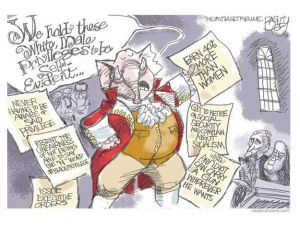
 We’re at the point where we should scrub ‘liberty and justice for all’ right out of the Pledge. One last bit for HCR blog on what the fuck we now seem to have back from the dreadful past of the Gilded Age. There are still folks who want to see slavery and servitude for everyone but themselves.
In 1858, in a period in which a few fabulously wealthy elite enslavers in the American South were trying to take over the government and create their own oligarchy, South Carolina senator James Henry Hammond explained to his colleagues that “democracy” meant only that voters got to choose which set of leaders ruled them. Society worked best, he said, when it was run by natural leaders: the wealthy, educated, well-connected men who made up the South’s planter class.
Hammond explained that society was naturally made up of a great mass of workers, rather dull people, but happy and loyal, whom he called “mudsills” after the timbers driven into the ground to support elegant homes above. These mudsills supported “that other class which leads progress, civilization, and refinement,” one that modeled itself on the British aristocracy. The mudsills needed the guidance of their betters to produce goods that would create capital, Hammond said. That capital would be wasted if it stayed among the mudsills; it needed to move upward, where better men would use it to move society forward.
Hammond’s ideology gave us the 1857 Dred Scott v. Sandford decision, in which the Supreme Court found that Black Americans “are not included, and were not intended to be included, under the word ‘citizens’ in the Constitution, and can therefore claim none of the rights and privileges which that instrument provides for and secures to citizens of the United States.”
In 1889, during the Gilded Age, industrialist Andrew Carnegie embraced a similar idea when he explained that the concentration of wealth and power in the hands of a few was not only inevitable in an industrial system, but was beneficial. The wealthy were stewards of society’s money, administering it for the common good by funding libraries, schools, and so on, to uplift everyone, rather than permitting individual workers to squander it in frivolity. It was imperative, Carnegie thought, for the government to protect big business for the benefit of the country as a whole.
Carnegie’s ideology gave us the 1905 Lochner v. New York Supreme Court decision declaring that states could not require employers to limit workers’ hours in a bakery to 10 hours a day or 60 hours a week. The court reasoned that there was no need of such a law for workers’ welfare or safety because “there is no danger to the employ[ee] in a first-class bakery.” The court concluded that the Fourteenth Amendment to the Constitution protected “freedom of contract”: the right of employers to contract with laborers at any price and for any hours the workers could be induced to accept.
In 1929, after the Great Crash tore the bottom out of the economy, Treasury Secretary Andrew Mellon did not blame the systemic inequality his policies had built into the economy. He blamed lazy Americans and the government that had served greedy constituencies. He told President Herbert Hoover not to interfere to help the country.
“Liquidate labor, liquidate stocks, liquidate the farmers, liquidate real estate,” he told Hoover. “It will purge the rottenness out of the system. High costs of living and high living will come down. People will work harder, live a more moral life. Values will be adjusted, and enterprising people will pick up the wrecks from less competent people.”
Mellon’s ideology gave us “Hoovervilles”—shantytowns built from packing boxes and other salvaged materials—and the Great Depression.
Today, an ideology of “aristocracy” justifies the fabulous wealth and control of government by an elite that increasingly operates in private spaces that are hard for the law to reach, while increasingly using the power of the state against those it considers morally inferior.
We’re in trouble. That’s certain, and most of us feel it in our hearts, minds, and guts.
What’s on your Reading, Action, and Blogging lists today?
How can people be so heartless
How can people be so cruel
Easy to be hard
Easy to be cold
How can people have no feelings
How can they ignore their friends
Easy to be proud
Easy to say no
And especially people
Who care about strangers
Who care about evil
And social injustice
Do you only
Care about the bleeding crowd?
How about a needing friend?
I need a friend

 peej
peej Carissa
 bostonboomer
 dakinikat
 ecocatwoman
 mablue2
 Mama Lopez
 peggysue22
 quixote
 skydancingguestblogger
 Mona (aka Wonk the Vote)



 Sky Dancing
Recent Comments