
Mostly Monday Reads: Meathead
Posted: December 15, 2025 Filed under: Media and Entertainment, Take Back America | Tags: @johnbuss.bsky.social John Buss, All in the Family, Broligarchy, media, Rob Reiner, The Princess Bride 4 Comments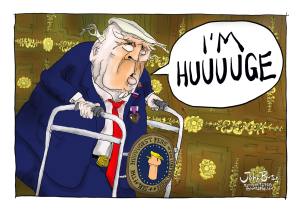
“No big surprise to MAGA. Things are getting interesting.” John Buss, @repeat1968
Good Day, Sky Dancers!
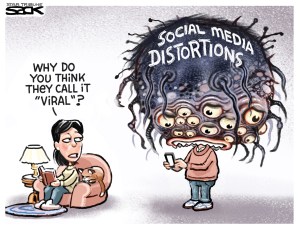
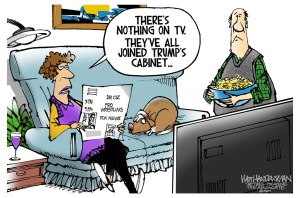
These posts get more challenging to write each day. This year has been tough on everyone. I haven’t thought about weekends spent watching TV sitcoms with a limited choice of three channels in a while. My only TV is still sitting in its box, untouched. That about sums up my relationship with the old-school way of getting news and entertainment. I’d rather play my guitar or piano, create another watercolor of an old New Orleans building, or walk my dog than stay glued to it the way I did as a kid. However, I grew up in an area where there was not much else to do than join the family to stare into fake realities.
I will admit to spending way too much time on my cellphone or computer now. I can find many better things out there with a virtual library and the chance to interact with friends all over the world. It’s so damn cold out there now that I rushed the walk to sit here and stare at another sort’ve screen. The one that lets me read magazines and newspapers without getting black ink all over my fingers.
 Of course, my entire family watched All in the Family. I admit that The Mary Tyler Moore Show was my favorite, and when I briefly moved to Minneapolis, I had to throw my hat in the air and visit the house on Lake Harriet that was used to style the set. Dick Van Dyke turned 100 this week. Rob Reiner and his wife lost their lives. This year has been full of days I’d rather forget. Family violence is all too common. We still don’t do well helping people with mental health and drug issues. Here’s the headline from USA Today. “Rob Reiner, wife Michele Singer’s son in custody – Live updates.”
An arrest has been made in the killing of Rob Reiner and his wife, Michele Singer.
Their son, Nick Reiner, has been taken into police custody and is being held on $4 million bail, according to Los Angeles Sheriff’s Department records views by USA TODAY. The acclaimed Hollywood director and actor was killed alongside Singer in their California home Sunday night, according to Variety and TMZ.
Their deaths continue to be under investigation by the Los Angeles Police Department after the couple was found dead in their home in the Brentwood neighborhood of Los Angeles. In a press conference on Sunday night, the LAPD said the robbery-homicide division will continue to investigate through the night and expect to release more information in the morning.
Authorities confirmed that “many family members” will be interviewed in the course of their work and that they were obtaining a search warrant to conduct a full crime scene investigation. They did not comment on the injuries sustained by Reiner and Singer.
USA TODAY was unable to reach a representative for Reiner at the time of publication.
 The L.A. Times has background on Nick Reiner. “What we know about Nick Reiner, who struggled with addiction and shared his recovery with the world.”
Nick Reiner spent years struggling with addiction and with help from his father, Hollywood legend Rob Reiner, told his story to the world.
On Monday, Nick was booked into the L.A. County jail on suspicion of murder, hours after Reiner and his wife were found dead inside their Brentwood home.
Nick cycled in and out of rehab centers and experienced bouts of homelessness as a teenager.
He had gotten clean by 2015, when he worked with his father on “Being Charlie,” a semi-autobiographical film about addiction and recovery. Rob Reiner directed and Nick co-wrote the film about a successful actor with political ambitions and a son addicted to drugs.
Many aspects of the movie were inspired by Nick’s relationship with his father — including a line where the father character tells his son, “I’d rather you hate me and you be alive.” Nick said in a 2016 interview with AOL that he “didn’t bond a lot” with his father while he was growing up.
Nick gave an interview about “Being Charlie” alongside his family at the Toronto Film Festival in 2015, saying that his decision to quit heroin was driven by a practical realization.
“I got sick of doing that,” he told The Times. “I come from a nice family. I’m not supposed to be out there on the streets and in homeless shelters doing all these … things.”
During the interview, Rob said he regretted valuing the advice of counselors over the voice of his son.
“When Nick would tell us that it wasn’t working for him, we wouldn’t listen,” he said. “We were desperate, and because the people had diplomas on their wall, we listened to them when we should have been listening to our son.”
Michele added: “We were so influenced by these people. They would tell us he’s a liar, that he was trying to manipulate us. And we believed them.”
Nick talked about the many different rehab centers and programs he tried without success. In 2016, he told People magazine that he lived on the streets because he refused to go to the rehab facilities his parents recommended.
“If I wanted to do it my way and not go to the programs they were suggesting, then I had to be homeless,” he said.
He told the magazine that he could have died on the streets.
“It’s all luck,” he said. “You roll the dice and you hope you make it.”
It’s remarkable to me that we frequently discuss the American Dream, yet it seems we lack a clear understanding of what that means. We’ve been shaped by SitComs, schools, political parties, and many other things that have left us in the dark about the very nature of our lives. Perhaps it is time to find some better ways.
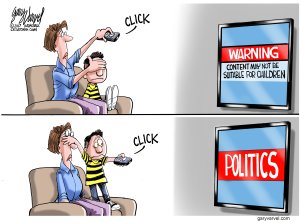 I’ll keep this post brief today. Most days, I struggle to make sense of things. That’s been the reality of 2025. The reality of 2025 is also one filled with friends locked in their homes and neighbors struggling to protect themselves from our own government. I’m going to take a few days to just bake bread and sit down in front of a TV, not my own, and see if the offerings have improved. Fortunately for me, I’ve found the films of Guillermo del Toro on my last such adventure. I’m hoping to discover more. The documentary about him is also a solid watch. It’s been a long time since I’ve actually watched something without wanting to grab my cell phone instead. That’s a far road from the sixteen-year-old me and the TV console in our family room. Being with friends always brings a good end to a bad year.
So, one more read about today’s media. This is from Dr. Paul Krugman. “MAGA, the Broligarchs and the Media, This isn’t just about business; it’s about democracy.” Be sure to refer to the chart as you read.
Warner Bros. Discovery, which among other things controls CNN, has agreed to sell itself to Netflix. But it isn’t a done deal, because Paramount has made a rival, hostile bid.
Now, most Americans, even those like me who pay a lot of attention to the economy, don’t usually take much interest in insider baseball about corporate wheeling and dealing. But this is a bigger story than usual, for three reasons.
First, there’s an antitrust issue. In an earlier era, when the U.S. government took monopoly power seriously, both proposed acquisitions would probably have been blocked by regulators.
Second, there’s a financial issue. On its own, there is no way that Paramount, which is deeply in debt and whose credit rating is “a notch below ‘junk’” could afford to buy Warner. It’s able to make a semi-credible bid only because of assurances of support from Larry Ellison, one of the world’s richest men thanks to his stake in the software giant Oracle. But when analysts look closely at the details, they find that Ellison’s promises of support are more than a bit squirrely:
[T]he Warner Bros. Discovery board worried that Mr. Ellison did not personally guarantee the bid under his name and is planning to contribute equity for the deal through a trust with holdings that could be modified at any time.
Adding to the risk of Oracle’s deal is the fact that Oracle is itself shaky according to the estimation of gimlet-eyed financial markets due to its huge, debt-financed bets on AI.
As Bloomberg reports, its investment grade debt now “trades like junk.”
But it’s not just about the money. For the average American, there is something fundamentally important about this corporate cage-match to win Warner Bros. Discovery. And it’s not about entertainment, it’s about democracy. You should understand that Paramount’s hostile bid is, above all, a political move in the pursuit of cementing the dominance of MAGA-supporting tech billionaires and further eroding American democracy.
Back in 2018, during Trump I, the political scientists Steven Levitsky and Daniel Ziblatt published How Democracies Die, which described how nations like Hungary had descended into one-party authoritarianism although the formal, but now toothless, institutions of democracy remain. In the latest edition of Foreign Affairs Levitsky, Ziblatt and Lucan Way say that this process is already well underway here in the U.S.:
In Trump’s second term, the United States has descended into competitive authoritarianism—a system in which parties compete in elections but incumbents routinely abuse their power to punish critics and tilt the playing field against their opposition. Competitive authoritarian regimes emerged in the early twenty-first century in Hugo Chávez’s Venezuela, Recep Tayyip Erdogan’s Turkey, Viktor Orban’s Hungary, and Narendra Modi’s India. Not only did the United States follow a similar path under Trump in 2025, but its authoritarian turn was faster and farther-reaching than those that occurred in the first year of these other regimes.
Now, in some ways America is unusually well-positioned to resist this authoritarian push. As Levitsky et al note, we have a “well-organized and rich civil society” — ranging from law firms to universities to nonprofits — that can push back. And while some of these institutions are led by cowards, not all are. We also have unified political opposition in the form of the Democratic Party, which is very different from the splintered opposition thatfaced Viktor Orban in Hungary, for example.
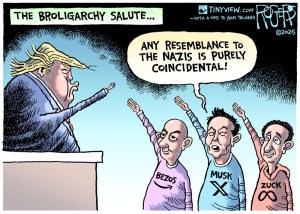
Yet, ominously, Trump and Trumpism have powerful allies that had no counterpart in previous competitive authoritarian regimes. Namely, there is a network of deeply anti-democratic tech billionaires, of which Ellison is a very significant player. The Authoritarian Stack project,which tracks that network, calls it the “Authoritarian Tech Right”. I’ve put their chart of some of the keyplayers at the top of this post. Some of us refer to that network, less formally, as the “broligarchy.”
Have a good week!
What’s on your Reading, Action, and Blogging List today?
TRIGGER WARNING!
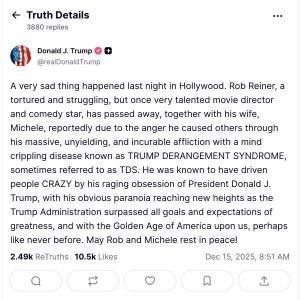
Really hate to add this, but this is what Trump had to say today. What an asshole!
Mostly Monday Reads: Oy mishigas!
Posted: March 24, 2025 Filed under: #FARTUS, #MAGAnomics, American Fascists, Broligarchy, corporate greed, democracy is threatened, kakistocracy, Middle East, Polycrisis | Tags: @repeat1968, Broligarchy, FARTUS, Mafia Don, oligarchy, Paul Krugman, Vladimir Putin 7 Comments
“Putin addresses the residents of his newly acquired territory.” John Buss, @repeat1968, @johnbuss.bsky.social
Good Day, Sky Dancers!
I am having an ongoing debate with myself about the current administration. Is it the stupidity, the arrogance, or the meanness that most damaged our Constitutional democracy? Or is it the greed? I’m tagging all my posts here with the words Polycrisis, Kakistocracy, and Oligarchy or Broligarchy. It’s getting to be a tough search to find a few journalists who will actually tell it like it is.
This article in The Guardian early this month by Jonathan Freeland describes the current president thusly. “Donald Trump is turning America into a mafia state. The pattern is inescapable – with just one caveat: organised crime bosses occasionally display more honour.” I’ll just add a local New Orleans colloquialism. True Dat.
Behold Donald Corleone, the US president who behaves like a mafia boss – but without the principles. Of course, one hesitates to make the comparison, not least because Donald Trump would like it. And because the Godfather is an archetype of strength and macho glamour while Trump is weak, constantly handing gifts to America’s enemies and getting nothing in return. But when the world is changing so fast – when a nation that has been a friend for more than a century turns into a foe in a matter of weeks – it helps to have a guide. My colleague Luke Harding clarified the nature of Vladimir Putin’s Russia when he branded it the Mafia State. Now we need to attach the same label to the US under Putin’s most devoted admirer.
Consider the way Trump’s White House conducts itself, issuing threats and menaces that sound better in the original Sicilian. This week the president said that a deal ending Russia’s war on Ukraine “could be made very fast” but “if somebody doesn’t want to make a deal, I think that person won’t be around very long”. You didn’t need a translator to know that the somebody he had in mind was Volodymyr Zelenskyy.
On Thursday, Trump was confident that the Ukrainians would soon do his bidding “because I don’t think they have a choice”. Almost as if he had made them an offer they couldn’t refuse. Which of course he had. By ending the supply of military aid and the sharing of US intelligence, as he did this week, he had effectively put a Russian revolver to Ukraine’s temple, its imprint scarcely reduced by Trump’s declaration today that he is “strongly considering” banking sanctions and tariffs against Moscow, a move that looked a lot like a man pretending to be equally tough on the two sides, but which should fool nobody. He expects Zelenskyy to sign away a huge chunk of Ukraine’s minerals, the way Corleone’s rivals surrendered their livelihoods to save their lives.
This is how the US now operates in the world. Dispensing with the formalities during his annual address to Congress on Tuesday, Trump repeated his threat to grab Greenland: “One way or the other, we’re going to get it.” That recalled his earlier warning to Copenhagen to give him what he wants or face the consequences: “maybe things have to happen with respect to Denmark having to do with tariffs”. Nice place you got there; would be a shame if something happened to it.
It’s the same shakedown he’s performing on the US’s northern neighbour. Canada’s outgoing prime minister Justin Trudeau spelled it out this week, accusing Trump of trying to engineer “a total collapse of the Canadian economy because that will make it easier to annex us”, adding that: “We will never be the 51st state.” It’s a technique familiar in the darker corners of the New Jersey construction industry: a series of unfortunate fires that only stops when a recalcitrant competitor submits.
Both the substance and the style are pure mafia. Note the obsession with respect, demonstrated in last week’s Oval Office confrontation with Zelenskyy. Between them, JD Vance and Trump accused the Ukrainian leader three times of showing disrespect, sounding less like world leaders than touchy Tommy DeVito, the Joe Pesci character in Goodfellas.
Note too the humiliation of subordinates. In his address to Congress, the president introduced secretary of state Marco Rubio as the man charged with taking back the Panama canal. “Good luck, Marco,” said Trump, with a chuckle. “Now we know who to blame if anything goes wrong.” Cue anxious laughter from the rest of the underlings, briefly relieved that it wasn’t them.
It’s hard for aides and opponents alike to keep up because power is exercised arbitrarily and inconsistently. Tariffs are imposed, then suspended. Indeed, one reason why import taxes so appeal to Trump is that they can be enforced instantly and by presidential edict. That extends to the exemptions Trump can offer to favoured US industries. As MSNBC’s Chris Hayes observed: “This is very obviously going to be a protection racket, where Trump can at the stroke of a pen destroy or save your business depending on how compliant you are.”
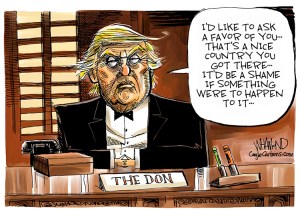 This characterization of Trump is so spot on that you really should go read the rest. I’m using this description of FARTUS as a background to the absolutely appalling crap that’s going on today. It’s hard to mentally deal with how quickly he’s disassembled so many long-standing U.S. Institutions in such a short time. This is especially true because it appears that the massive amount of incompetence and ignorance that his appointments display just escalates the damage. Look at this headline in The Atlantic. It’s reported by Jeffrey Goldberg. “The Trump Administration Accidentally Texted Me Its War Plans. U.S. national-security leaders included me in a group chat about upcoming military strikes in Yemen. I didn’t think it could be real. Then the bombs started falling.” WTAF?
The world found out shortly before 2 p.m. eastern time on March 15 that the United States was bombing Houthi targets across Yemen.
I, however, knew two hours before the first bombs exploded that the attack might be coming. The reason I knew this is that Pete Hegseth, the secretary of defense, had texted me the war plan at 11:44 a.m. The plan included precise information about weapons packages, targets, and timing.
This is going to require some explaining.
The story technically begins shortly after the Hamas invasion of southern Israel, in October 2023. The Houthis—an Iran-backed terrorist organization whose motto is “God is great, death to America, death to Israel, curse on the Jews, victory to Islam”—soon launched attacks on Israel and on international shipping, creating havoc for global trade. Throughout 2024, the Biden administration was ineffective in countering these Houthi attacks; the incoming Trump administration promised a tougher response.
This is where Pete Hegseth and I come in.
On Tuesday, March 11, I received a connection request on Signal from a user identified as Michael Waltz. Signal is an open-source encrypted messaging service popular with journalists and others who seek more privacy than other text-messaging services are capable of delivering. I assumed that the Michael Waltz in question was President Donald Trump’s national security adviser. I did not assume, however, that the request was from the actual Michael Waltz. I have met him in the past, and though I didn’t find it particularly strange that he might be reaching out to me, I did think it somewhat unusual, given the Trump administration’s contentious relationship with journalists—and Trump’s periodic fixation on me specifically. It immediately crossed my mind that someone could be masquerading as Waltz in order to somehow entrap me. It is not at all uncommon these days for nefarious actors to try to induce journalists to share information that could be used against them.
I accepted the connection request, hoping that this was the actual national security adviser, and that he wanted to chat about Ukraine, or Iran, or some other important matter.
Two days later—Thursday—at 4:28 p.m., I received a notice that I was to be included in a Signal chat group. It was called the “Houthi PC small group.”
A message to the group, from “Michael Waltz,” read as follows: “Team – establishing a principles [sic] group for coordination on Houthis, particularly for over the next 72 hours. My deputy Alex Wong is pulling together a tiger team at deputies/agency Chief of Staff level following up from the meeting in the Sit Room this morning for action items and will be sending that out later this evening.”
The message continued, “Pls provide the best staff POC from your team for us to coordinate with over the next couple days and over the weekend. Thx.”
The term principals committee generally refers to a group of the senior-most national-security officials, including the secretaries of defense, state, and the treasury, as well as the director of the CIA. It should go without saying—but I’ll say it anyway—that I have never been invited to a White House principals-committee meeting, and that, in my many years of reporting on national-security matters, I had never heard of one being convened over a commercial messaging app.
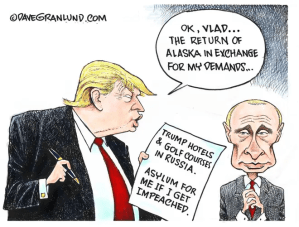 Definitely go read this one. I’ve been missing reading John le Carré. I’m assuming anyone with a background in spying would have saucer eyes by this time. Trump’s love of playing checkers with the countries of the world is dangerous and immoral. He plays with everyone’s life like a mad king. This is from Oliver Darcy at Status. It’s a remarkable indictment of how the press enables his heinous policies and statements. “Gulf of Fear. When news anchors tiptoe around the name Gulf of Mexico, it’s not just semantics—it’s a glimpse at how the press starts to flinch under political pressure.”
In China, Taiwan doesn’t exist—at least not as a country. On official maps, it’s a province. The government enforces strict language about Taiwan’s status, shaping how its people—and the rest of the world—talk about it. The goal, of course, is far more significant than the name on a map. It’s not about semantics. It’s about wielding influence and asserting dominance. Controlling the language people use, particularly in relation to global geography, is a powerful capability to possess.
In the United States, that kind of top-down dictation might feel like a distant threat, the kind of thing that happens in authoritarian regimes or dystopian novels like “1984,” not in a country built on free speech safeguarded by the First Amendment. Americans tend to believe our press is too independent and and too proud to ever bow to government pressure. We assume that if a president ever tried to dictate language, the Fourth Estate would resist. We assume that we’re immune from such pressures.
But an important segment of the press—the television news media—over the past week quietly demonstrated that it is far less adversarial and far more compliant than the breathless promos these networks air hyping themselves as fearless truth-tellers. When the eyes of the world fixated on the stranded NASA astronauts being rescued and touching down back on Earth, every channel danced around what precisely to call the body of water they splashed into. A review of transcripts, courtesy of SnapStream, revealed an alarming reality: not one of the outlets could muster up the courage to simply refer to it as the Gulf of Mexico, the water feature’s name since the 16th century.
Instead, television news organizations tied themselves in knots, performing linguistic gymnastics to stay out of Donald Trump’s crosshairs, while also tiptoeing around audiences who would have surely been incensed to see them bend the knee and call it the “Gulf of America.” On ABC News, “World News Tonight” anchor David Muir referred to “spectacular images from off the coast of Florida.” On the “NBC Nightly news,” anchor Lester Holt spoke about the astronauts “splashing down off the Florida Gulf coast.” On the “CBS Evening News,” it was referred to simply as “the Gulf.” And on CNN, anchor Jake Tapper tried to seemingly have it both ways, noting the U.S. government refers to it as the “Gulf of America,” but the rest of the world calls it the Gulf of Mexico.
In fact, I could only one find instance on a television newscast where a journalist referred to the body of water as the Gulf of Mexico. During an appearance on MSNBC, NBC News correspondent Tom Costello used the term, but then quickly corrected himself, almost as if he had realized he was forbidden from doing so. “Six hours from right now, there will be a splashdown in the Gulf of Mexico,” he said, before backtracking. “Sorry, however you want to call the Gulf. It will be splashing down in the Gulf.”
Suffice to say, none of this was an accident.
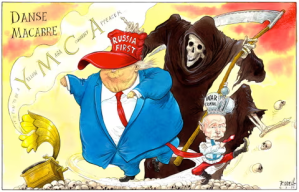 We first saw the capitulation of the tech bros and their social media platforms, including Jeff Bezos, who has ruined The Washington Post. This week, the situation there is getting worse. The first thing any autocrat wants to do is to come for any vestige of a free media. This is from MEDIAITE as reported by David Gilmour. “Trump Claims Jeff Bezos Trashed the ‘Crazy People’ in His Own Newsroom: ‘They’re Out of Control’.
President Donald Trump claimed that billionaire Washington Post owner Jeff Bezos privately expressed regret over the newspaper’s editorial direction and trashed his own “out of control” newsroom for writing “bad articles” about him.
The comments came during a sit-down with OutKick’s Clay Travis aboard Air Force One on Saturday after Travis suggested “it seems” that Bezos may be attempting to make The Washington Post “more fair” in coverage towards Trump.
Trump agreed and didn’t hesitate to praise Bezos, telling Travis “I think it’s great.”
Travis later asked whether Trump had discussed how the newspaper had come after him “like crazy” in the past, AND the president replied: “At length, I talked to him about it. [Bezos is] a good guy. I didn’t really know him in the first term. I mean, it’s such a difference between now and the first time.”
Pressed on what Bezos had said he had planned for The Post’s coverage, Trump said: “Just that. He’s really trying to be more fair.”
Trump continued: “They actually did a couple of bad articles on him. He said, ‘This is crazy, I lose my fortune running this thing and they, you know, they’re out of control.’ These people are crazy. They’re crazy people. They’re out of control.”
“And he’s a actually a very good guy,” the president added. “If you look at the inauguration, look at the people that were on that stage, here was a who’s who of a world that was totally against me the first time. It’s a much different presidency. I have much more support.”
 And now, we have the capitulation of top law firms. How many more legs of democracy will we lose? The Bulwark draws the line today. “Stop Making Excuses for Not Fighting Trump. The capitulations and acquiescence we’ve seen so far will only make opposition more difficult down the road.” This is written by William Kristol under the lede “No Excuse.”
Among those who might be expected to stand up against Donald Trump’s authoritarianism, the hills are alive with the sound of excuses.
You’re an elected official. The Trump administration has rounded up individuals and sent them, without any due process and with much carelessness about who’s been seized, to a mega-prison in El Salvador. The administration is boasting about what it’s done and heralding it a prelude to further actions in the same vein.
You’re thinking of condemning these truly grotesque violations of constitutional rights and human decency. Maybe I should say this isn’t right?
Whoa, Nellie! Not so fast, your political advisers hasten to instruct you. The polls on this issue aren’t great. This really isn’t the hill to die on.
You take their advice. But you tell yourself, and you assure others, that of course you will fight one day—on some other hill, on some faraway hill, some time far in the future.
But to fight now? Bad idea. That would simply play into Trump’s hands. After all, Trump and his allies are good at fighting. If you try to do something, there’s a risk they’ll turn it against you. Whereas if you say nothing, nothing can be used against you.
You might worry for a second that silence and acquiescence just plays into Trump’s hands. But you’re not a sophisticated Democratic operative. So you take their advice.
And anyway, there’s a better plan. That plan is that, eventually, Trump will become less popular. Then, the public will rise up. And then you can speak up. It all works out.
It also works out if you’re in the private sector. In fact, if you’re the head of a huge law firm, capitulation isn’t just a regrettable necessity, it’s your duty. You’re acting in the best interests of your clients. It would be wrong and irresponsible to act otherwise.
What’s more, No one in the wider world can appreciate how stressful it is to confront an executive order like this until one is directed at you.
The people in the “wider world”—those serving in the military or waiting tables or cleaning offices at Paul Weiss—they just can’t appreciate the stress that comes from occupying that corner office at 51st and 6th.
Ugh.
All of these excuses—and there are many more!—are distasteful. But what’s worse is that they make it easier and more likely that others will capitulate. They make it seem that you’re kind of a chump if you actually fight Trump’s authoritarian takeover. The excuses offered for capitulation increase the damage done by capitulation.
As usual, Shakespeare saw all. Here’s Pembroke in Act IV, Scene 2 of King John:
And oftentimes excusing of a fault
Doth make the fault the worse by th’ excuse,
As patches set upon a little breach
Discredit more in hiding of the fault
Than did the fault before it was so patched.The excuses offered by our elites for not standing up to authoritarianism have the effect of helping the authoritarians gain further ground.
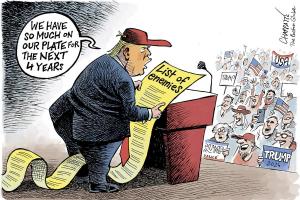 Zach Beauchamp writes at VOX, “There’s a pattern in Trump’s power grabs. The White House strategy demands we defend alleged criminals and those with unpopular views.”
After rising to power, Nazis pitched power grabs as efforts to address the alleged threat posed by menaces like “Judeo-Bolshevism,” harnessing the powers of bigotry and political polarization to get ordinary Germans on board with the demolition of their democracy.
What’s happening in America right now has chilling echoes of this old tactic. When engaging in unlawful or boundary-pushing behavior, the Trump administration has typically gone after targets who are either highly polarizing or unpopular. The idea is to politicize basic civil liberties questions — to turn a defense of the rule of law into either a defense of widely hated groups or else an ordinary matter of partisan politics.
The administration’s first known deportation of a green card holder targeted a pro-Palestinian college activist at Columbia University, the site of some of the most radical anti-Israel activity. For this reason, Columbia was also the first university it targeted for a funding cutoff. Trump has also targeted an even more unpopular cohort: The first group of American residents sent to do hard labor in a Salvadoran prison was a group of people his administration claimed without providing evidence were Tren de Aragua gang members.
Trump is counting on the twin powers of demonization and polarization to justify their various efforts to expand executive authority and assail civil liberties. They want to make the conversation less about the principle — whether what Trump is doing is legal or a threat to free speech — and more a referendum on whether the targeted group is good or bad.
There is every indication this pattern will continue. And if we as a society fail to understand how the Trump strategy works, or where it leads, the damage to democracy could be catastrophic.
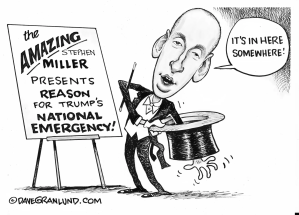 This, too, is a long read that deserves a look. A lot of this goes back to White House aid Stephan Miller. This guy needs to have an entire press detail following him. I’m going to end with a few articles on economics. The first comes from Paul Krugman and will clarify what’s happening with Social Security. “Social Security: A Time for Outrage. Trump’s policies attack his own base — but who will tell them?” I often find myself in conversations with friends, and we all wonder if Trump Supporters will ever show a glimmer of intelligence.
Donald Trump is often described as a “populist.” Yet his administration is stuffed with wealthy men who are clueless about how the other 99.99 percent lives, while his policies involve undermining the working class while enabling wealthy tax cheats.
What is true is that many working-class voters supported Trump last year because they believed that he was on their side. And that disconnect between perceptions and reality ought to be at the heart of any discussion of what Democrats should do now.
Right now the central front in the assault on the working class is Social Security, which Elon Musk, unable to admit error, keeps insisting is riddled with fraud. The DOGE-bullied Social Security Administration has already announced that those applying for benefits or trying to change where their benefits are deposited will need to verify their identity either online or in person — a huge, sometimes impossible burden on the elderly, often disabled Americans who need those benefits most. And with staff cuts and massive DOGE disruption, it seems increasingly likely that some benefits just won’t arrive as scheduled.
Oh, and Leland Dudek, the acting Social Security administrator, threatened to shut the whole thing down unless DOGE was given access to personal data.
Not to worry, says Howard Lutnick, Trump’s Commerce secretary. Only “fraudsters” would complain about missing a Social Security check:
Let’s say social security didn’t send out their checks this month. My mother who’s 94, she wouldn’t call and complain. She’d think something got messed up, and she’ll get it next month. A fraudster always makes the loudest noise, screaming, yelling and complaining.
There’s so much wrong with that statement that it’s hard to know where to start. But it’s clear that Lutnick — like many affluent people — has no idea how important Social Security is to the finances of most older Americans. According to a Social Security Administration study, half of Americans over 65 get a majority of their income from Social Security; a quarter depend almost entirely on Social Security, which supplies more than 90 percent of their income. I doubt that these people would shrug off a missed check.
Reliance on Social Security isn’t evenly distributed across the population; it’s strongly correlated with socioeconomic status. In particular, it very much depends on education, with less-educated Americans much more reliant on the program than those with more education:
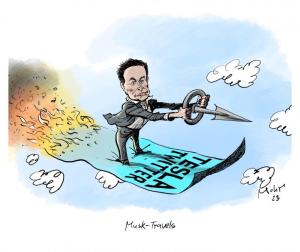 That Lutnick quote cannot be repeated enough. The last read I’m sharing today comes from The Economist. “Musk Inc is under serious threat. The world’s richest man has lost focus. His competitors are taking advantage.” Well, isn’t that special?
UNTIL RECENTLY Elon Musk had little need to look over his shoulder. He once described competition for Tesla, his electric-vehicle (EV) company, as “the enormous flood of gasoline cars pouring out of the world’s factories every day”, rather than the “small trickle” of other EV-makers. SpaceX, his rocket firm, had so undercut and outwitted the bloated aerospace incumbents that it had developed an almost invincible aura.
Yet if Mr Musk can tear himself away from the intoxication of shredding the American government, he may notice something. It is not just that the political firestorms he has whipped up this year are singeing his companies’ brands. It is that the two businesses that underpin his corporate empire—accounting for around 90% of its value and probably all its profit—are facing increasingly stiff competition. The world’s richest man has lost focus—and now has a target on his back.
Start with SpaceX. Last year it conducted five out of every six of the world’s spacecraft launches. Through its Starlink division, it owns 60% of satellites in space. In December it sold shares at a valuation of $350bn, two-thirds higher than its previous level. Starlink, its main profit engine, is on track to generate more than $11bn of revenue this year and $2bn of free cash flow, says Chris Quilty of Quilty Space, a consultancy.
Now, however, Mr Musk’s bomb-throwing interventions are alarming SpaceX customers, and at a time when rivals are growing more capable. His on-again, off-again threats to end Starlink’s support for Ukraine have raised the difficult question of trust. European politicians are pondering how reliable Mr Musk will be as a long-term provider of strategic satellite communications. The search for alternatives has helped spur a more than tripling of the share price of Eutelsat, the French owner of OneWeb, which provides satellite services to broadband companies.
No European supplier could come close to matching the 7,000 satellites Starlink has in low orbit. (Eutelsat has a mere 600.) Nor could any compete on price. As Simon Potter of BryceTech, another space consultancy, puts it, for now the concerns are “more noise than action”. Yet Starlink may soon face meaningful competition from Amazon’s Project Kuiper, which aims to put over 3,000 satellites into low orbit, creating a space-based broadband network. If it achieves that, some customers outside America may decide they have more confidence in an Amazon product than in one belonging to the mercurial Mr Musk.
Jeff Bezos, Amazon’s founder, is also stepping up the pace in the launch business with Blue Origin. His rocket firm is separate from Project Kuiper, but has contracts to fly many of its satellites. In January Mr Bezos’s New Glenn rocket reached orbit on its first try. If Blue Origin manages to make repeated successful journeys with reusable rockets, it could become a meaningful competitor to SpaceX. So could Rocket Lab, SpaceX’s closest rival by number of launches, which is due to debut Neutron, a new rocket, this year.

Here comes the Rooster.
It’s like we’re in a very bad dystopian novel and can’t escape. Anyway, I’m not shutting up any time soon.
What’s on your Reading and Blogging list today?
Here’s a picture of this big boy who keeps crossing the road in front of my house. The rain just stopped, and the sun cleared up, so he’s been yelling at the sun for about an hour now. I feel like he’s some kind of omen.
Here’s an Alice in Chains song about the Vietnam War. That ought to cheer you up.

 peej
peej Carissa
 bostonboomer
 dakinikat
 ecocatwoman
 mablue2
 Mama Lopez
 peggysue22
 quixote
 skydancingguestblogger
 Mona (aka Wonk the Vote)



 Sky Dancing
Recent Comments