
What Does it Mean to Have a Speaker that Knows Nothing about Economics?
Posted: June 22, 2013 Filed under: John Birch Society in Charge | Tags: Boehner, economics, Hoovernomics 65 Comments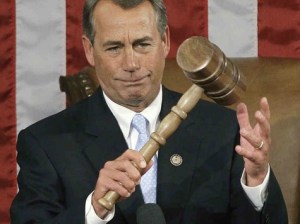 Speaker John Boehner is bad at a lot of things. His speakership has been marred by so many mishaps and embarrassing moments that it’s easy just to try to laugh at him and the entire House of Representatives. They seem to do nothing but try to repeal the impossible and stand for the unfathomable. However, the country is struggling to come out of an extremely horrible financial crisis with deep, lasting and dangerous unemployment. The Fed chair–a republican and republican appointee–points out exactly how bad this has been for our economy. What does it mean when the third in line to the presidency is clueless about one of the most important functions of modern government and appears to get all of his knowledge from a bad Ayn Rand novel?
Bernanke spoke to the press after the release of the Federal Open Market Committee minutes.
If the recovery continues, the Fed plans to taper off mortgage-backed securities purchases once the unemployment rate hits 7%, the Fed Chair suggested. And while reporters grilled Bernanke about inflationary risks and the impact of MBS purchases, he remained cautiously optimistic.
The Fed Chair’s more optimistic tone stemmed from improving market fundamentals, with Bernake highlighting increases in household wealth and fewer large scale layoffs. State and local governments also are improving somewhat financially, he said.
The only major drag is federal fiscal policy.
It is difficult to understand why the portion of US government designed to be the most accountable to the masses seems least concerned with jobs and economic growth. It is undoubtedly due to the significant misunderstanding and willful ignorance of economics recently demonstrated by the speaker and many–if not most– in his party. Paul Krugman speaks sincerely to this problem.
John Boehner’s remarks on recent financial events have attracted a lot of unfavorable comment, and they should. Actually, I think even the stuff most commentators have shied away from — he talks about the Fed “deflating” when I think he means either inflating or debasing, or possibly is doing a Sarah Palin and merging the two — is significant. I mean, he’s the Speaker of the House at a time when economic issues are paramount; shouldn’t he have basic familiarity with simple economic terms?
But the main thing is that he’s clinging to a story about monetary policy that has been refuted by experience about as thoroughly as any economic doctrine of the past century. Ever since the Fed began trying to respond to the financial crisis, we’ve had dire warnings about looming inflationary disaster. When the GOP took the House, it promptly called Bernanke in to lecture him about debasing the dollar. Yet inflation has stayed low, and the dollar has remained strong — just as Keynesians said would happen.
Yet there hasn’t been a hint of rethinking from leading Republicans; as far as anyone can tell, they still get their monetary ideas from Atlas Shrugged.
Oh, and this is another reminder to the “market monetarists”, who think that they can be good conservatives while advocating aggressive monetary expansion to fight a depressed economy: sorry, but you have no political home. In fact, not only aren’t you making any headway with the politicians, even mainstream conservative economists like Taylor and Feldstein are finding ways to advocate tighter money despite low inflation and high unemployment. And if reality hasn’t dented this dingbat orthodoxy yet, it never will.
It is rather obvious and rather sad that nearly all the economic ideas of the Speaker and his party come from a bad piece of fiction and ignore every lesson of economics learned from even libertarian-leaning economists like the late Milton Friedman. The result has been damaging to many Americans and the underlying economy.
SPEAKER JOHN BOEHNER: Well,it certainly could because you know, people open their 401(k) statements you know, at the end of every quarter and for most people it’s an indication of their wealth. And the value of their home would be another indication,how well homes are selling in their neighborhoods.
But sell off is in large part due to the policies that we’ve had coming’ out of the Federal Reserve. You know, you can’t continue to deflate our money and deflate it and deflate it– have equity markets go– without some change, yeah. Bernanke has made it clear he’s doing these policies in the absence of the government doing its part to help improve our economy.
That’s why Democrats and Republicans here on Capitol Hill and the president need to deal with– fix our tax code that would help us promote more economic growth and deal with our long term spending problem. We’ve spent more money than what we’ve brought in for 55 of the last 60 years. That ought to scare the hell out of every American.
We need to deal with this problem openly and honestly. Because if we do, investors around the country, business owners are going to look up and go, “Gee, they’re actually dealing with the issues that I’m most concerned about.” Then they’ll begin to invest.
MARIA BARTIROMO: But how likely is that over the next year? I mean, Bernanke made it clear yesterday that if the data continues as it is then they could be out of the bonds buying business by next year this time. So that’s one year. Will we see fiscal policy in terms of tax reform, in terms of regulatory clarity? Will we see that in the next 12 months?
SPEAKER JOHN BOEHNER: Listen,hope springs eternal in my heart. And while we have big differences over what tax reform might look like, what entitlement reform might look like we have to — we have to come together and deal with these things. Because if we want our economy to grow, we want to create jobs– we’ve got to deal with the issues that are affecting it.
You know, Republicans– we’ve got our jobs plan. We’ve had it now for literally the last three or four years. We’ve updated this effort and it’s our number one focus here. And while, you know, we’ve got other obligations under the constitution that provides oversight of the Executive Branch we’re trying to stay focused on those things that would improve our economy– help the American people’s wages increase and have more jobs available.
Fixing the tax code is not fiscal policy. It’s not anything that will create any kind of job growth or economic well being. What is this man thinking?
To quote Matthew O’Brien at The Atlantic, Boehner is “dangerously clueless” about economics and economic policy required of the Federal Government in challenging times. It is rather pathetic and deluded. O’Brien points out the facts about that quote from Boehner above.
Bookmark this, print it out, and put it in a time capsule, because this is about as wrong as anybody could possibly be about economics (excluding Don Luskin, of course). Now, Boehner doesn’t put it very clearly, but when he says markets are going down because Bernanke is “deflating the dollar”, he means markets are in the red because the Fed is weakening the dollar. The opposite is true. Markets sold off not because the Fed is doing too much, but because markets worry it won’t do enough. As you can see below from Bloomberg, the dollar went up during the recent sell-off on Wednesday and Thursday after Bernanke explained how and when the Fed expects to wind down QE3. That’s what happens when the Fed tightens policy.
For all the talk of “currency debasement” from conservatives who fancy themselves monetary experts, the dollar is actually stronger today than it was when the Great Recession began. Core PCE inflation, the Fed’s preferred measure, just hit a 50-year low at 1.05 percent. And no, stripping out food and energy prices isn’t hiding the inflation monster: headline PCE inflation was a meager 0.74 percent in April. Weimar we are not.
Boehner was no more coherent on fiscal policy. Now, it’s true that Bernanke would like to see some kind of budget deal that reins in long-term deficits, but he wishes we were doing less to try to rein in short-term deficits. In other words, he wants less austerity now, and more austerity later. Here’s what Bernanke said about about our cutting-spending problem in his press conference on Wednesday:The main drag or the main headwind to growth this year is, as you know, is the federal fiscal policy, which the CBO estimates is something on the order of 1.5 percentage points of growth.That’s not exactly the clarion call for future spending cuts that Boehner imagines. It’s a plea, in the understated lexicon of central bankers, to stop maiming the recovery with pointless and premature austerity. But Boehner either isn’t listening or doesn’t understand. He somehow thinks it’s scary that the government has run deficits for 55 of the last 60 years (though not so scary that he didn’t vote for many of those budgets). This is nonsense. As Josh Barro points out, there’s no better proof that we shouldn’t be scared of deficits than the fact that we have run them for 55 of the past 60 years without any problem. As long as the economy grows faster than the debt, there’s no reason we can’t run deficits forever.We tried Hoovernomics. It failed. So we’re … trying it again?

Yes. Republicans are completely in love with failed policies of the past and they’re not about to change anything now. It’s unbelievable that we could have a Speaker of the House that can be so completely ignorant about economic policy this day and age. It’s pathetic and it’s sad. It is also dangerous.

 peej
peej Carissa
 bostonboomer
 dakinikat
 ecocatwoman
 mablue2
 Mama Lopez
 peggysue22
 quixote
 skydancingguestblogger
 Mona (aka Wonk the Vote)



 Sky Dancing
Recent Comments