
Like We Need More Austerity …
Posted: April 28, 2011 Filed under: Economy, jobs | Tags: BEA, GDP growth, still feels like a recession, U.S. Economy 19 Comments
Too bad we can't buy some stock in soup kitchens ...
U.S. Economic Growth did exactly what most economists expected during the first quarter of 2011, it slowed substantially. There is some hope that the low rate was due to temporary factors like bad weather and political unrest in the MENA region that’s contributed to higher gas prices.
Of these various economic menaces, the most enduring is probably higher commodity prices, which reduce the amount of pocket money that households and businesses have available to spend on other purchases and, in the case of companies, hires. Gasoline prices have shown little sign of falling in recent weeks, and have nearly neutralized the 2011 payroll tax cuts that were intended as a stimulus.
“Consumers are spending more, but it’s getting soaked up in higher gas prices and higher food prices,” the chief economist at RDQ Economics, John Ryding, said. “That’s not leaving nearly as much left over for discretionary spending.”
Declines in government spending will continue to drag on the economy throughout the year, as strapped state and local governments cut back and the federal government tries to cut down on nonmilitary spending. Last quarter’s steep drop in military spending, which tends to be volatile, will probably reverse itself later in the year, economists said.
It’s pretty easy to tell who is experiencing the worst end of this lackluster recovery. Hint: It’s not the wealthiest Americans. But, if you had any doubts, Wal-Mart reports their shoppers are “running out of money”. Again, there’s low overall inflation but higher gas and food prices make up a large portion of the family budget for ordinary Americans.
Wal-Mart’s core shoppers are running out of money much faster than a year ago due to rising gasoline prices, and the retail giant is worried, CEO Mike Duke said Wednesday.
“We’re seeing core consumers under a lot of pressure,” Duke said at an event in New York. “There’s no doubt that rising fuel prices are having an impact.”
Wal-Mart shoppers, many of whom live paycheck to paycheck, typically shop in bulk at the beginning of the month when their paychecks come in.
Lately, they’re “running out of money” at a faster clip, he said.
“Purchases are really dropping off by the end of the month even more than last year,” Duke said. “This end-of-month [purchases] cycle is growing to be a concern.
This would explain the results of this Gallup Poll where “More than Half Still Say U.S. is in a Recession”. This amount of consumer depression in an economy driven by 70% household spending cannot bode well for future GDP growth. Businesses are expanding overseas and will not create any jobs or businesses here unless they see customers. This, in the Keynesia mold, calls for increased government spending. What we have been getting is decreases in taxes to people whose investments and job creation efforts are going outside of the country. It’s not hard to see why most citizens do not think we’re in any kind of recovery other than a technical one.
More than half of Americans (55%) describe the U.S. economy as being in a recession or depression, even as the Federal Open Market Committee (FOMC) reports that “the economic recovery is proceeding at a moderate pace.” Another 16% of Americans say the economy is “slowing down,” and 27% believe it is growing.
Meanwhile, every one within the D.C. beltway continue to eye the dwindling American safety net with greedy eyes. This has elicited comments from all over but none is perhaps more jaw-dropping than a pronouncement from Former Dubay Treasury Secretary Paul O’Neill who likened Republicans threatening to block the increase in the debt ceiling to Al Qaeda Terrorists. It does indeed seem that Republicans would like to bring on a great depression rather than find middle ground on spending and taxing priorities.
“The people who are threatening not to pass the debt ceiling are our version of al Qaeda terrorists. Really,” O’Neill, Treasury secretary in the Republican administration of George W. Bush, said Wednesday in an interview with Bloomberg Television’s InBusiness with Margaret Brennan.
“They’re really putting our whole society at risk by threatening to round up 50 percent of the members of the Congress, who are loony, who would put our credit at risk,” O’Neill said.
It’s as if our elected officials are deliberately sabotaging the country. The details in the National Income and Spending accounts are given here at the BEA. You can see that we’re not getting stimulus from either Federal Spending, Business Investments or Exports. (There’s a pretty much a wash when you look at Net Exports or you subtract Imports from Exports.)
Real exports of goods and services increased 4.9 percent in the first quarter, compared with an increase of 8.6 percent in the fourth. Real imports of goods and services increased 4.4 percent, in contrast to a decrease of 12.6 percent.
Real federal government consumption expenditures and gross investment decreased 7.9 percent in the first quarter, compared with a decrease of 0.3 percent in the fourth. National defense decreased 11.7 percent, compared with a decrease of 2.2 percent. Nondefense increased 0.1 percent, compared with an increase of 3.7 percent. Real state and local government consumption expenditures and gross investment decreased 3.3 percent, compared with a decrease of 2.6 percent.
The change in real private inventories added 0.93 percentage point to the first-quarter change in
real GDP after subtracting 3.42 percentage points from the fourth-quarter change. Private businesses
increased inventories $43.8 billion in the first quarter, following increases of $16.2 billion in the fourth
quarter and $121.4 billion in the third.
None of this is good news when coupled with the still high rates of unemployment. Despite all these tax cuts, the business sector is clearly not going anywhere. Here’s a link to some further analysis and nifty graphs from Econbrowser. This analysis is particularly germane to our conversation.
Inventory rebuilding and a gain in exports made positive contributions, but these were essentially undone by increases in imports and decreases in government spending. Perhaps the most disappointing detail was investment spending by businesses, which had been making solid contributions to growth the previous three quarters, but was essentially flat for Q1. Housing remains stuck at very low levels, but at least it’s no longer a significant factor dragging the level of GDP down.
But until housing and business investment start making a positive contribution, we’re likely to be disappointed by the employment and GDP reports.
It’s pretty obvious that fiscal policy in this country has gone to VooDoo land because we’re still in deep DooDoo. What we have here is fiscal policy malpractice. Too bad we can’t all join in a massive lawsuit and sue the Congress. Thanks a lot SCOTUS!!!
In Search of a Trough
Posted: July 31, 2009 Filed under: Global Financial Crisis, The Great Recession, U.S. Economy | Tags: BEA, GDP, job markets, jobless recovery, minimum wage, Real economic Growth, wages Comments Off on In Search of a Trough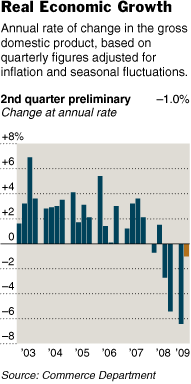 The U.S. economy still shrank in second quarter 2009 but at a much lower pace than was anticipated. That’s a pretty good indicator that the bottom or trough of The Great Recession may be near. Here’s the precise release from the Bureau of Economic Analysis (BEA).
Real gross domestic product — the output of goods and services produced by labor and property located in the United States — decreased at an annual rate of 1.0 percent in the second quarter of 2009, (that is, from the first quarter to the second), according to the “advance” estimate released by the Bureau of Economic Analysis. In the first quarter, real GDP decreased 6.4 percent.
While the many recent indicators show the recession is loosing some of its downward momentum, there are few economists ready to sing Happy Days are Here Again. The NYT’s coverage of the statistical release continues to bring up some of the same concerns we’ve discussed here before.
The economy’s long, churning decline leveled off significantly in the second quarter, as stock markets started to recover, corporate profits bounced back, housing markets stabilized and the rampant pace of job losses tapered off. Declines in business investment leveled off, and the economy was aided by big increases in government spending at the federal, state and local levels.
“We’re in a deep hole, and now we’ve got to dig ourselves out of it, which is a very difficult task,” Diane Swonk, chief economist at Mesirow Financial, said.
But consumer spending fell by 1.2 percent as Americans put more than 5 percent of their disposable income into savings. Economists are concerned that consumer spending, which makes up 70 percent of the economy, will not rebound as long as employers keep cutting jobs and trimming wages.

 peej
peej Carissa
 bostonboomer
 dakinikat
 ecocatwoman
 mablue2
 Mama Lopez
 peggysue22
 quixote
 skydancingguestblogger
 Mona (aka Wonk the Vote)



 Sky Dancing
Recent Comments