
Misplaced Blame and Impact
Posted: March 14, 2011 Filed under: Bailout Blues, Economy, financial institutions, Global Financial Crisis | Tags: Banksters, credit crunch, U.S. Economy 15 Comments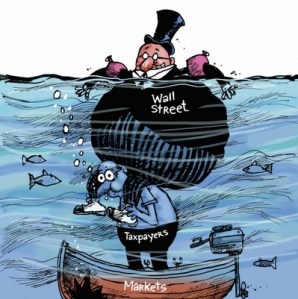 The blame for the worst recession since the The Great Depression clearly rests on the private sector where millions of bad loans and financial innovations turned peoples homes and investments into casino style gambling games. The disastrous lack of regulation, accountability, and common sense is still wrecking havoc on the economy today. The lending industry is still at odds with common sense, community well being, and the national interest. Paul Krugman wrote about this today in his NYT op ed using the academy award winning film Inside Job as the cautionary frame. What is evident in all of this fall out is that the people that deserve the blame are still acting abominably and the people they wronged are still getting the worst end of the deal.
What the film didn’t point out, however, is that the crisis has spawned a whole new set of abuses, many of them illegal as well as immoral. And leading political figures are, at long last, showing some outrage. Unfortunately, this outrage is directed, not at banking abuses, but at those trying to hold banks accountable for these abuses.
The immediate flashpoint is a proposed settlement between state attorneys general and the mortgage servicing industry. That settlement is a “shakedown,” says Senator Richard Shelby of Alabama. The money banks would be required to allot to mortgage modification would be “extorted,” declares The Wall Street Journal. And the bankers themselves warn that any action against them would place economic recovery at risk.
All of which goes to confirm that the rich are different from you and me: when they break the law, it’s the prosecutors who find themselves on trial.
To get an idea of what we’re talking about here, look at the complaint filed by Nevada’s attorney general against Bank of America. The complaint charges the bank with luring families into its loan-modification program — supposedly to help them keep their homes — under false pretenses; with giving false information about the program’s requirements (for example, telling them that they had to default on their mortgages before receiving a modification); with stringing families along with promises of action, then “sending foreclosure notices, scheduling auction dates, and even selling consumers’ homes while they waited for decisions”; and, in general, with exploiting the program to enrich itself at those families’ expense.
The end result, the complaint charges, was that “many Nevada consumers continued to make mortgage payments they could not afford, running through their savings, their retirement funds, or their children’s education funds. Additionally, due to Bank of America’s misleading assurances, consumers deferred short-sales and passed on other attempts to mitigate their losses. And they waited anxiously, month after month, calling Bank of America and submitting their paperwork again and again, not knowing whether or when they would lose their homes.”
There are more issues than just the foreclosure one. Here’s an example of a family fighting to sue BOA for the wrongful death of an elderly man who committed suicide after they recommended investments to him that failed miserably. The family has found out that the man had probably unknowingly signed away the right to sue in the fine print of the investment documents. I can’t imagine any one recommending a portfolio of risky assets to any one over the age of 50, yet this is exactly what BOA did to Mr. Phillip Grossman.
Philip Grossman saved carefully his whole life, never investing in anything more exotic than certificates of deposit. But in June 2007, his longtime banker at a Bank of America branch in Waltham told him he could do better, without taking more risk, and introduced him to a broker at the bank’s investment arm.
Two years later, Grossman, then a 65-year-old computer consultant, and his wife had lost $400,000 — more than half their savings. In despair in the fall of 2009, Grossman checked into a Woburn motel, left his glasses and watch on the desk in his room, and killed himself.
Stunned by the tragedy, his family tried to sue Bank of America, asserting that the broker invested more aggressively than promised, adding to the steep losses and contributing to Grossman’s suicide. But they soon found out they would not get their day in court: The papers the Grossmans signed to open their account required that any dispute go to a private panel of arbitrators.
“They’ve committed a crime against us, as far as I’m concerned,’’ Grossman’s wife, Gail, said in an interview. “Why do we have to go to arbitration? With other crimes you get a trial and a jury. It just seems very unfair to me.’’
The Grossmans’ case shows how entrenched arbitration has become in the financial industry, demonstrating that even in an extreme case alleging wrongful death, aggrieved clients have no recourse other than a system that critics say favors investment firms. Most investors have no idea that when they open a brokerage account, they give up their right to sue, and must, under a 1987 Supreme Court ruling, take complaints to arbitration.
There are more outrages to share with you. Think that having a perfect credit score and a huge down payment will get you a loan these days if you’re a consumer? Think again. Banks are lending to junk bond quality businesses while denying the best of households basic mortgages. The recovery is not just around the corner for the majority of US households for many reasons. Government help has been concentrated at reaching banks and businesses. This is not translating into improvement for all.
The consumer loan market, particularly housing, remains a challenge for borrowers. Total U.S. consumer credit outstanding was $2.4 trillion in January, or 6.6 percent below its July 2008 level, the Fed said in a March 7 report. Total housing debt has declined by $536 billion since 2008 to $10.1 trillion, Fed data show. The median price of an existing U.S. home has dropped 13 percent since June to $158,800, bringing its decline since July 2006 to 31 percent, according to the Chicago-based National Association of Realtors. About 10.8 million homes were worth less than the debt owed on them in the third quarter, research firm CoreLogic Inc. said in a Dec. 13 report.
By contrast, the least creditworthy corporations have been able to borrow record amounts at the cheapest rates ever. Junk- rated companies sold an unprecedented $287.6 billion in bonds in 2010 and are setting an even faster pace of issuance this year. Claire’s Stores Inc., the costume jewelry retailer that had debt that was almost 10 times its earnings last year, sold $450 million of bonds last month that Moody’s Investors Service gave its third-lowest rating.
There are several other disturbing figures in the Bloomberg article quoted directly above.
The U.S. economy grew at a 2.8 percent annual rate in the fourth quarter, slower than previously calculated, and is forecast to expand 3.2 percent this year, according to the median estimate of 66 economists in a Bloomberg survey.
Household purchases account for about 70 percent of the U.S. economy, making the consumer the single biggest driver of any economic recovery. Those consumers “stumbled at bit” at the start of this year, Michael Feroli, chief U.S. economist at JPMorgan Chase & Co. in New York, said in a February note.
While the economy expanded and companies are beginning to spend more, the improvements haven’t driven the nation’s unemployment rate below 8.9 percent for almost two years and the Conference Board’s gauge of consumer confidence is still 37 percent below the level reached in July 2007.
“The 2007-2009 recession period looks different from previous economic cycles,” John McElravey, a bond analyst at Wells Fargo Securities LLC in Charlotte, North Carolina, said in a March 8 report. “Consumer credit outstanding contracted much more sharply than in other periods, and the return to positive growth rates has been relatively slow.”
There are so many things different and bad with this recovery that it is indeed troubling. Perhaps the most important factor is that government is clearly not helping homeowners, the jobless, and the many families who have lost wealth via the crash in home values and their investments. The focus of bailouts has been on banks and businesses that have not used the funds to benefit their communities. Something is clearly wrong here with policy priorities when you’re not focused on the major source of consumption in a consumer-drive economy.
Not only is policy not aimed at the majority of people in the country, the focus in the District is now clearly turning to austerity measures and turning neighbor against neighbor. I can’t tell you exactly how worried I am that a huge number of households will still be in trouble come the next recession. Here’s another opinion on that very subject from E.J. Dionne Jr. at WAPO.
A phony metaphor is being used to hijack the nation’s political conversation and skew public policies to benefit better-off Americans and hurt most others.We have an 8.9 percent unemployment rate, yet further measures to spur job creation are off the table. We’re broke, you see. We have a $15 trillion economy, yet we pretend to be an impoverished nation with no room for public investments in our future or efforts to ease the pain of a deep recession on those Americans who didn’t profit from it or cause it in the first place.
As Sen. Al Franken (D-Minn.) pointed out in a little-noticed but powerful speech on the economy in December, “during the past 20 years, 56 percent of all income growth went to the top 1 percent of households. Even more unbelievably, a third of all income growth went to just the top one-tenth of 1 percent.” Some people are definitely not broke, yet we can’t even think about raising their taxes.
By contrast, Franken noted that “when you adjust for inflation, the median household income actually declined over the last decade.” Many of those folks are going broke, yet because “we’re broke,” we’re told we can’t possibly help them.
That’s the new excuse. We could help Chrysler. We could help GM. We could help the financial institutions and Wall Street. We could invade Iraq and Afghanistan to help them. We could do all that, but now we’re too broke to help ordinary Americans. It’s obvious that the financial institutions are doing nothing to improve the situation. It’s also pretty obvious that Iraq and Afghanistan are money pits. When do we get the government to quit throwing our money to rich people and businesses? When do we get them to stop blaming teachers, firefighters, and police offers for taking up too much of the pie? When do we actually start looking at the real numbers and the real culprits who took all this vast wealth and continue to ensure the rules only benefit the few?
US Claims “National Security” to Cover Up Embarrassing Deal with Con Man
Posted: February 20, 2011 Filed under: income inequality, Psychopaths in charge, Social Security, The Bonus Class, U.S. Economy, U.S. Military, U.S. Politics, We are so F'd | Tags: Angelo Mozilo, Banksters, con man, Countrywide, Dennis Montgomery, Fraud, Justice Department, national security, software 10 CommentsAccording to the politicians running things in our country these days, paying fair salaries to teachers, social workers, and firefighters is irresponsible because it runs up the deficit. Paying Social Security to old folks is driving the country into bankruptcy. But when the feds pour millions of dollars down the drain because they get duped by a con man, that’s a national security secret.

Dennis Montgomery, Con Man
From The New York Times:
For eight years, government officials turned to Dennis Montgomery, a California computer programmer, for eye-popping technology that he said could catch terrorists. Now, federal officials want nothing to do with him and are going to extraordinary lengths to ensure that his dealings with Washington stay secret.
In fact, the Justice Department has argued in court that if they had to reveal the embarrassing details of what happened, it would damage national security. That could be true if revealing how dumb our public officials and “intelligence” experts are puts our country in danger….
Mr. Montgomery and his associates received more than $20 million in government contracts by claiming that software he had developed could help stop Al Qaeda’s next attack on the United States. But the technology appears to have been a hoax, and a series of government agencies, including the Central Intelligence Agency and the Air Force, repeatedly missed the warning signs, the records and interviews show.
Get this, Montgomery convinced U.S. intelligence wizards that he had designed some software that could detect secret Al Qaeda messages concealed in Al Jazeera broadcasts! ROFLOL! That’s reminds me of the days when religious nuts used to claim they could detect Satanic messages in rock ‘n’ roll music by playing it backwards.
Montgomery also told the CIA that his magic software could “identify terrorists from Predator drone videos” and pick up sounds from submarines. And the CIA geniuses bought Montgomery’s tale hook, line, and sinker. As a result of the government’s involvement with this grifter, there was
…an international false alarm that led President George W. Bush to order airliners to turn around over the Atlantic Ocean in 2003.
The software led to dead ends in connection with a 2006 terrorism plot in Britain. And they were used by counterterrorism officials to respond to a bogus Somali terrorism plot on the day of President Obama’s inauguration, according to previously undisclosed documents.
OMG, my sides are splitting from laughter! And on top of all that,
C.I.A. officials…came to believe that Mr. Montgomery’s technology was fake in 2003, but their conclusions apparently were not relayed to the military’s Special Operations Command, which had contracted with his firm. In 2006, F.B.I. investigators were told by co-workers of Mr. Montgomery that he had repeatedly doctored test results at presentations for government officials. But Mr. Montgomery still landed more business.
In 2009, the Air Force approved a $3 million deal for his technology, even though a contracting officer acknowledged that other agencies were skeptical about the software, according to e-mails obtained by The New York Times.
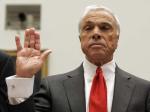
Angelo Mozilo, Fraudster
Hold onto your wallets, I think President Obama is going to have to ask us “small people” to “sacrifice” some more to make up the difference. Meanwhile, Mr. Montgomery will very likely get away with his fraud, just like Countrywide’s Angelo Mozilo, formerly of Countrywide, and every other fraudster and bankster who comes down the pike. Don’t worry, though, “sacrifice” is good for you, your parents, and your children and grandchildren.

 peej
peej Carissa
 bostonboomer
 dakinikat
 ecocatwoman
 mablue2
 Mama Lopez
 peggysue22
 quixote
 skydancingguestblogger
 Mona (aka Wonk the Vote)



 Sky Dancing
Recent Comments