
Romney Campaign Solves Flip-Flop Problem — For Now
Posted: July 6, 2012 Filed under: Barack Obama, U.S. Economy, U.S. Politics | Tags: Affordable Care Act ruling, Arizona Immigration Law, Bain Capital, Chief Justice John Roberts, Eric Fehrnstrom, individual mandate, John Kerry, Joshua Green, Michael Dukakis, Mitt Romney, risk avoidance, SCOTUS 36 Comments
It has been a difficult couple of weeks for Mitt Romney.
First, the Supreme Court struck down the Arizona immigration law that Romney had termed a model for the nation. Romney’s response:
“Today’s decision underscores the need for a President who will lead on this critical issue and work in a bipartisan fashion to pursue a national immigration strategy. President Obama has failed to provide any leadership on immigration. This represents yet another broken promise by this President. I believe that each state has the duty–and the right–to secure our borders and preserve the rule of law, particularly when the federal government has failed to meet its responsibilities. As Candidate Obama, he promised to present an immigration plan during his first year in office. But 4 years later, we are still waiting.”
Romney refused to say whether he agreed with the decision or provide specifics about how he would deal with undocumented immigrants if he were elected.
Next, his former favorite Supreme Court Justice, John Roberts, voted with the liberals on the court, agreeing that the Democrats’ Affordable Care Act, including the individual mandate is constitutional. Romney’s response to that one was strikingly terse and even more vague than his statement on immigration:
“What the court did not do on its last day in session, I will do on my first day,” he said. “I will act to repeal Obamacare.”
Still no specifics on how he would convince Congress to repeal the law or what he would replace it with. And then real disaster struck. Top Romney aide Eric Fehrnstrom told MSNBC that, despite Chief Justice Roberts’ calling the individual mandate a “tax,” Romney disagrees–he thinks it’s a “penalty.” Of course this contradicted the latest Republican meme–that the mandate is the biggest tax increase in human history. Ooops! And the next day (ironically it was Independence Day), Mitt changed his mind and said the mandate is a tax after all. Here’s a summary from Chuck Todd and colleagues:
Romney’s verbal gymnastics: When you think about it, Romney never had to truly deal with his fatal flaw on health care. Yes, he gave that health-care PowerPoint speech in Michigan in May 2011. And, yes, he was asked questions about the issue during the 20-odd GOP debates in which he participated. But he never REALLY had to reconcile his health-care law with President Obama’s — with a campaign team capable of going toe to toe with him — until last week’s Supreme Court decision. As for his explanation in calling the mandate a tax, his verbal gymnastics would have impressed even the Russian judges. First, he technically didn’t disagree with Fehrnstrom’s original take; he simply conceded that the Supreme Court called it a tax. “Well, the Supreme Court has the final word, and their final word is that Obamacare is a tax. So it’s a tax,” he said. And then he painfully tried to explain why the federal mandate is a tax, but Romney’s state mandate is a penalty. “Actually the chief justice in his opinion made it very clear that at the state level, states have the power to put in place mandates. They don’t need to require them to be called taxes in order for them to be constitutional.”
Recent polls show that the Obama campaign’s attacks on Romney’s record at Bain Capital are working–especially in the swing states. But Romney has let those attacks go largely unanswered as he struggled to develop a coherent response to the Obamacare decision.
Over the past few days, there have been stinging critiques of the Romney campaign from conservative media sources. Rupert Murdock tweeted that Romney’s campaign is too insular and they need to shake up the staff and add more experienced people. The Wall Street Journal’s editorial board dressed down the candidate and his staff on the editorial page. On the tax/penalty flip flop, they wrote:
For conservative optimists who think Mr. Fehrnstrom misspoke or is merely dense, his tax absolution gift to Mr. Obama was confirmed by campaign spokeswoman Andrea Saul, who tried the same lame jujitsu spin. In any event, Mr. Fehrnstrom is part of the Boston coterie who are closest to Mr. Romney, and he wouldn’t say such a thing without the candidate’s approval.
In a stroke, the Romney campaign contradicted Republicans throughout the country who had used the Chief Justice’s opinion to declare accurately that Mr. Obama had raised taxes on the middle class. Three-quarters of those who will pay the mandate tax will make less than $120,000 a year, according to the Congressional Budget Office. The Romney high command has muddied the tax issue in a way that will help Mr. Obama’s claims that he is merely taxing rich folks like Mr. Romney. And it has made it that much harder for Republicans to again turn ObamaCare into the winning issue it was in 2010.
Why make such an unforced error? Because it fits with Mr. Romney’s fear of being labeled a flip-flopper, as if that is worse than confusing voters about the tax and health-care issues. Mr. Romney favored the individual mandate as part of his reform in Massachusetts, and as we’ve said from the beginning of his candidacy his failure to admit that mistake makes him less able to carry the anti-ObamaCare case to voters.
Bill Kristol assailed Romney as the successor to fellow Massachusetts pols Michael Dukakis and John Kerry:
Remember Michael Dukakis (1988) and John Kerry (2004)? It’s possible to lose a winnable presidential election to a vulnerable incumbent in the White House (or in the case of 1988, a sitting vice president). So, speaking of losing candidates from Massachusetts: Is it too much to ask Mitt Romney to get off autopilot and actually think about the race he’s running?
Adopting a prevent defense when it’s only the second quarter and you’re not even ahead is dubious enough as a strategy. But his campaign’s monomaniacal belief that it’s about the economy and only the economy, and that they need to keep telling us stupid voters that it’s only about the economy, has gone from being an annoying tick to a dangerous self-delusion.
As Frank Cannon and Jeff Bell, among others, have pointed out, the economy is not an automatic path to victory. It does provide a favorable backdrop for this year’s campaign. But what are voters to think when they hear the GOP nominee say, as he did yesterday to CBS’s Jan Crawford, “As long as I continue to speak about the economy, I’m going to win”? That they’re dopes who don’t know the economy’s bad, but as long as the Romney campaign keeps instructing them that it is bad, they’ll react correctly and vote the incumbent out of office?
Of course Romney punctuated this criticism by riding around Lake Winnipesaukee on a jet ski, which naturally reminded everyone of the iconic shot of Kerry windsurfing off Nantucket in 2004.
Now, in response the the Vanity Fair article on Romney stashing his money in multiple foreign tax shelters, his campaign has adopted a new strategy: simply repeat the same meaningless response word for word whenever there is a question about Romney’s finances. Twice in one day, two different Romney spokespersons released the exact same unresponsive response to questions from different news organizations. From ABC News The Note:
Here’s Romney spokeswoman Amanda Henneberg’s statement to the press earlier today about reports by the AP and Vanity Fair about Romney’s offshore accounts in Bermuda:
“President Obama’s attacks on Mitt Romney have been proven false time and again. As job growth slows, manufacturing activity stalls, and our economy continues to sputter, President Obama knows he can’t make a legitimate argument for another term in office, so instead he is trying to tear down his opponent. This is just the latest example of President Obama and his political machine saying or doing anything to distract from his abysmal record over the last four years.”
And here’s Romney spokeswoman Andrea Saul responding to an interview that Obama strategist David Axelrod gave to ABC News, in which he said Romney is “the most secretive candidate” since Richard Nixon:
“President Obama’s attacks on Mitt Romney have been proven false time and again. As job growth slows, manufacturing activity stalls, and our economy continues to sputter, President Obama knows he can’t make a legitimate argument for another term in office, so instead he is trying to tear down his opponent. This is just the latest example of President Obama and his political machine saying or doing anything to distract from his abysmal record over the last four years.”
We asked the Romney campaign why they’re using the same statements and will update if they respond with another statement about their statements.
In what has to be one of the best pieces I’ve read today, Joshua Green of The Boston Globe addressed Romney’s obsession with avoiding risk.
This has become a familiar pattern: a ringing affirmation of some major policy difference with President Obama, followed by a lot of vagueness about what he would do instead.
Take deficit reduction. Romney has promised to extend the entire Bush tax cut, reduce marginal rates by an additional 20 percent, cut corporate rates, and still bring down the deficit. He’s said he’ll pay for this by closing loopholes and deductions but won’t identify which ones. His campaign initially indicated that it would clarify this once Romney had sewn up the nomination. Months later, the details are still not forthcoming. Yet he routinely gives speeches denouncing Obama over the deficit and promising — somehow — to bring it under control.
Green discusses Romney’s bizarre response to the SCOTUS ruling on Arizona’s immigration law.
His campaign’s greatest obfuscation was its response to the Supreme Court’s voiding much of Arizona’s Draconian immigration law. Romney’s statement was magnificently vague, leaving unclear whether he still supported the law, as he once had. Even more remarkable was the long, circular, and ultimately fruitless exchange between his spokesman Richard Gorka and reporters trying to nail down Romney’s position. Afterward, some fellow press secretaries took to Twitter to marvel at Gorka’s capacity to dissemble.
Romney has plainly calculated that he can win without explaining what he’d do as president, and seems intent on becoming the “generic Republican candidate” that pollsters include in surveys (and that often outperform real Republicans). He seems to be making two assumptions: The country is in such dire shape that simply being against Obama is enough, and his background at Bain Capital is a sufficient qualification to get him elected. His campaign is a sustained exercise in avoiding risk.
Green calls it “the Romney Fog Machine: a great outpouring of words intended to obscure, rather than clarify, the issue at hand.”
As Green points out, the problem with this tactic is that if you don’t give specific answers to questions others will fill in the blanks for you. That is what seems to be happening with Obama’s attacks on Romney’s Bain career. How long can the Romney campaign keep this up? Only time will tell.
SCOTUS and the Arizona Immigration Law
Posted: April 25, 2012 Filed under: immigration, SCOTUS | Tags: Arizona Immigration Law, SCOTUS 14 CommentsThe Supremes heard arguments on the Arizona Immigration Law today. This is the law that Romney considers to be a blueprint for immigration laws in the US that 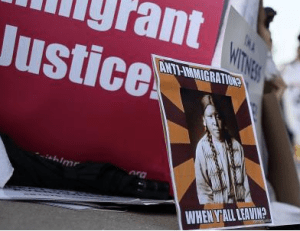 has been challenged by the Obama Justice Department. I’m not a lawyer so I can’t offer up any authoritative opinions, but I can offer up some reads for you.
From the NYT: Justices Seem Sympathetic to Central Part of Arizona Law
Mr. Verrilli, representing the federal government, had urged the court to strike down part of the law requiring state law enforcement officials to determine the immigration status of anyone they stop if the officials have reason to believe that the person might be an illegal immigrant.
“Why don’t you try to come up with something else?” Justice Sotomayor asked Mr. Verrilli.
It was harder to read the court’s attitude toward the three other provisions of the law at issue in the case, including ones that make it a crime for illegal immigrants to work or to fail to register with federal authorities. The court’s ruling, expected by June, may thus be a split decision that upholds parts of the law and strikes down others.
Should the court uphold any part of the law, immigration groups are likely to challenge it based on an argument not before that court on Wednesday — that the law discriminates on the basis of race and ethnic background.
Indeed, Chief Justice John G. Roberts Jr. made clear that the case, like last month’s arguments over President Obama’s health care law, was about the allocation of state and federal power.
“No part of your argument has to do with racial or ethnic profiling, does it?” the chief justice asked Mr. Verrilli, who agreed.
SCOTUSblog: Argument recap: A choice between radical and reasonable?
With Justice Antonin Scalia pushing the radical idea that the Constitution gives states clear authority to close their borders entirely to immigrants without a legal right to be in the U.S., seven other Justices on Wednesday went looking for a more reasonable way to judge states’ power in the immigration field. If the Court accepts the word of Arizona’s lawyer that the state is seeking only very limited authority, the state has a real chance to begin enforcing key parts of its controversial law — S.B. 1070 — at least until further legal tests unfold in lower courts.
In an oral argument that ran 20 minutes beyond the scheduled hour, the Justices focused tightly on the actual operation of the four specific provisions of the law at issue, and most of the Court seemed prepared to accept that Arizona police would act in measured ways as they arrest and detain individuals they think might be in the U.S. illegally. And most of the Justices seemed somewhat skeptical that the federal government would have to change its own immigration priorities just because states were becoming more active.
At the end of the argument in Arizona v. United States (11-182), though, the question remained how a final opinion might be written to enlarge states’ power to deal with some 12 million foreign nationals without basing that authority upon the Scalia view that states have a free hand under the Constitution to craft their own immigration policies. The other Justices who spoke up obviously did not want to turn states entirely loose in this field. So perhaps not all of the four clauses would survive — especially vulnerable may be sections that created new state crimes as a way to enforce federal immigration restrictions.
The Hill: Supreme Court seems favorable to Arizona illegal immigration law
Chief Justice John Roberts said he didn’t see a problem with that portion of the Arizona law, S.B. 1070. Under the statute, state officials would be notifying federal officials of the immigration status of the person in question. Roberts argued that the power to decide what to do with the that person still lay within the hands of the federal government. He also said the state, in that instance, would be attempting to help the federal government and supersede its role.
A key element to the government’s objections to the Arizona law rests on the argument that the state law conflicts with federal immigration laws already in place.
Verrilli also argued that immigration enforcement matters were entrusted to the federal government by the framers of the country — and not to the states — because they involve matters of foreign policy.
A final decision will not be reached until June, but the line of questioning from the more liberal and conservative justices alike seemed to indicate a belief that Arizona had a stronger case than the government on at least two of the law’s four provisions under question.
The passage of the law created an uproar last year and renewed the national debate over how to deal with the millions of illegal immigrants living in the United States. It’s expected to be an issue in the election as the Obama administration sued to stop it, and Mitt Romney, the presumptive GOP nominee, has expressed support for parts of it.
This is turning out to be a very interesting SCOTUS session and it appears that most of the justices have a distinct ideological bias. This proves that elections may not always bring the results in other areas but in terms of stacking the supreme court, the election of Presidents with IOUs to an ideological base shows up in how our laws will be interpreted.

 peej
peej Carissa
 bostonboomer
 dakinikat
 ecocatwoman
 mablue2
 Mama Lopez
 peggysue22
 quixote
 skydancingguestblogger
 Mona (aka Wonk the Vote)



 Sky Dancing
Recent Comments