
Live Blog: Florida Democratic Debate
Posted: March 9, 2016 Filed under: U.S. Politics | Tags: 2016 Democratic primaries, Florida Democratic debate, live blog 76 Comments
Hey Sky Dancers!
Even that exclamation point makes me tired. I must admit that I’m getting fed up with the constant debates and town halls this primary season. I think the DNC was wise to try to limit them. Both Hillary and Bernie need to make some changes to their stump speeches, because we’ve all heard them so many times at this point that it’s getting boring.
Nevertheless, I’ll be watching tonight to see how each of the candidates deals with the results of yesterday’s primaries. Someone needs to remind the country that not just Michigan voted yesterday–Mississippi voted too and the results of that one were more consequential in terms of delegates than the one the media is hyping today.
Tonight’s debate is at Miami-Dade College, and it will begin at 9PM ET. It is sponsored by Univision and the Washington Post and it will be simulcast on CNN. It will also be live streamed at The Washington Post. The moderators will be Karen Tumulty of The Washington Post and Maria Elena Salinas and Jorge Ramos of Univision.

Hillary Clinton and Bernie Sanders at the Flint debate
The Fix: How to watch the Washington Post-Univision Democratic presidential debate.
What (to watch for): Immigration almost certainly will be a major topic of discussion, given the setting and Univision’s involvement. Univision announced in February that it would launch a voter registration drive aimed at growing the Latino electorate by 3 million people. Look for the moderators to ask Sanders, who lags far behind Clinton in the delegate count, about his path forward. But if Sanders senses dismissiveness, look for him to push back hard. Univision chairman Haim Saban has contributed $2.5 million toPriorities USA Action, a super PAC backing Clinton. Ramos’s daughter, Paola Ramos, works for the Clinton campaign’s communications team. And in January, Sanders memorably unloaded on The Washington Post editorial board for criticizing his “fiction-filled campaign.” The dynamics among the candidates and sponsoring media outlets could provide intriguing subplots.
Some info on the moderators from IBT:
Univision’s María Elena Salinas. Salinas is a co-host of “Noticiero Univision” and the prime-time show “Here and Now.” She has covered presidential elections for three decades, and in the race to the 2008 presidency, she interviewed Hillary Clinton, Republican nominee John McCain and then-Illinois Sen. Barack Obama. Along with Salinas, Univision’s Jorge Ramos is also scheduled to moderate. Ramos is the host of Univision’s “Noticiero Univision” and “Al Punto,” as well as Fusion’s “AMERICA with Jorge Ramos.”
The Washington Post’s Karen Tumulty is also expected to moderate Wednesday night’s debate alongside Ramos and Salinas. Tumulty is a national political correspondent who previously worked for TIME Magazine, where she held positions as a congressional correspondent and White House correspondent, and the Los Angeles Times.
A few stories to get you warmed up for the watch party.

Joshua Tucker at the WaPo: No, actually Hillary Clinton won Tuesday night. The story is written in the form of a dialogue:
Wait a minute! It’s Cranky Reader from John Sides’s posts at The Monkey Cage.
CR: Hold on a second! I read the papers Wednesday morning. The New York Times, the LA Times, and even your Washington Post (to say nothing of Politico or CNN), and they all have top stories about how Clinton lost Tuesday night in Michigan.
Me: That’s true. Sanders did get more votes than Clinton in Michigan. But Clinton got more votes than Sanders in Mississippi. A lot more votes. As in, five times as many votes. So actually, as of 10 a.m. Wednesday, she had picked up more than 125,000 more total votes than Sanders on Tuesday.
CR: But Michigan is a bigger state and has more electoral votes than Mississippi. Therefore, it is more important to win Michigan than it is to win Mississippi if you want to be the nominee, regardless of the number of votes she won across the two states.
Me: That would be true if states in the Democratic primary were “winner take all” like most states are in the general election. Michigan does have more electoral votes than Mississippi in the general election, and for largely the same reason does award a lot more delegates to the Democratic nominating convention (123) than Mississippi (33).
CR: Ah ha! So winning Michigan is more important.
Me: That would be the case if each candidate won by the same margin. That’s because delegates to the Democratic nominating convention are distributed proportionally. Sanders doesn’t get all 123 delegates because he won Michigan, and Clinton doesn’t get all 33 Mississippi delegates because she won there. Instead, provided they get at least 15 percent of the vote — which they both did in both states — they each win a number of delegates determined by a complex set of electoral rules that in the end roughly approximates their vote share. So since Sanders won by a smaller margin in Michigan (50 percent to 48 percent) than Clinton did in Mississippi (83 percent to 17 percent), she actually won more delegates Tuesday night. And, for that matter, more than 125,000 more votes across the two states.
Head over to the WaPo to read the rest.

Miami Dade College
Claire Foran at The Atlantic: Hillary Clinton’s Intersectional Politics.
Hillary Clinton has taken pains to describe the lead-contaminated drinking water of Flint, Michigan, not only as a public-health and environmental crisis, but also as a crisis of poverty and racism. Along the way, the Democratic presidential contender has invoked the idea of intersectionality, the concept that different forms of inequality and discrimination overlap and compound one another.
Clinton’s use of the term, which was at one time largely confined to academia, signals that it is now a common way of thinking about inequality for a younger generation. Her decision to employ it may also elevate the concept in American politics, and alter the terms of a national debate over poverty, racism and other forms of inequity.
In recent weeks, Clinton has increasingly made reference to the concept on the campaign trail. “We face a complex set of economic, social, and political challenges. They are intersectional, they are reinforcing, and we have got to take them all on,” Clinton declared during a February speech in Harlem. Over the weekend, her campaign tweeted that “Flint’s water crisis is an example of the combined effects of intersecting issues that impact communities of color.” An appended graphic draws literal lines between “poverty,” “systemic racism,” “underfunded school systems,” and “crumbling infrastructure.”
Intersectionality was coined in the late 1980s to explain how different markers of identity coalesce to yield unique forms of discrimination. A black woman, for example, might experience not only racism and sexism in her daily life, but could also confront additional barriers that white women and black men do not. It became a way of making visible the experience of individuals that had previously been caught between the feminist and civil-rights movements.
Foran argues that Clinton may be using the term to attract the young voters who are “flocking to Bernie Sanders,” but I highly doubt that. Intersectionality is a concept that Sanders doesn’t understand at all, and it has been important to feminist analysis for a long time. It is also important to understanding the effects of racism. Anyway, read more at the link.

Mami Dade College Student Union
Bernie Sanders showed up in Florida for the first time last night, and Floridians have noticed his absence and find his attitude troubling.
Tampa Bay Times: With a week to go before Florida primary, Bernie Sanders shows up to campaign.
Less than a week before the primary in the country’s third-largest state, Democratic presidential candidate Bernie Sanders has a skeleton crew in Florida: four paid staffers and three campaign offices.
Compare that with former Secretary of State Hillary Clinton’s dozens of staffers and eight offices.
Even with three campaign events this week and a debate tonight in Miami — his first trip to Florida as a presidential candidate — there have been few signs of the Vermont senator on the state’s campaign trail….
“To say it’s a pipe dream would imply he actually thinks he has a shot,” said University of Central Florida political science professor Aubrey Jewett. “I suspect he realizes he doesn’t have a shot in Florida, but to be taken seriously as a candidate, you have to basically compete in the biggest battleground state.”
As of Tuesday, Sanders was 26 points behind Clinton in Florida, with just 32 percent of Democrats’ support, according to a RealClearPolitics.com average of state polling data….
Clinton has had a more robust infrastructure in the state since the very beginning, said Alan Clendinin, first vice chair of the Florida Democratic Party. After the 2008 election, a political action committee called Ready for Hillary began collecting names and contact information of supporters at fairs and festivals, he said. When Clinton officially announced her candidacy last year, the committee handed over its database to the campaign, effectively giving it a “turnkey operation,” Clendinin said.
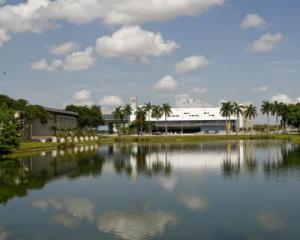
Miami Dade College
Politico: Bernie Sanders discovers Florida.
Bernie Sanders’ plane touched down here Tuesday before the polls started to close in Michigan, offering him a prime opportunity to springboard off what was looking like an unexpectedly strong performance.
The only problem: Sanders’ Miami rally Tuesday evening — more than 10 months into his White House bid, and just one week before Florida votes — was his first campaign event in the most crucial swing state of them all.
It reflected a tactical decision to all-but-cede the South to Hillary Clinton and her decades of relationship-building there, part of a post-Nevada strategic recalibration that turned the campaign’s attention to states voting later in the calendar. The idea was to pick off delegates from the March 15 tranche — Illinois, Ohio, and Missouri are among the states voting next Tuesday — but it’s come at a cost in Florida.
The Vermont senator now trails the former secretary of state by a wide margin in Florida polls, leading local Democrats to question the long-term viability of a candidate without a real Florida operation….
“Florida is very representative of America, the new demographic, the new look of America,” added former Miami Mayor Manny Díaz, a Clinton supporter. “And if you believe that you should not spend any time in Florida, then you should not spend anytime anywhere else. You’re going to run into the same problem everywhere else.”
More details at the link.
Get ready to document the good performances, the gaffes, and the atrocities. I expect a strong performance from Hillary because she’s always at her best when she is challenged.

 peej
peej Carissa
 bostonboomer
 dakinikat
 ecocatwoman
 mablue2
 Mama Lopez
 peggysue22
 quixote
 skydancingguestblogger
 Mona (aka Wonk the Vote)



 Sky Dancing
Recent Comments