
Wisconsin Recall Election – My Take on it
Posted: June 7, 2012 Filed under: Elections, worker rights | Tags: Scott Walker, unions, Wisconsin 49 Comments
My anticipation about Tuesday’s election was high. My information about the how, why, when and what of this recall election came from the Left side of politics. I generally avoid the blogs and the radio and television shows of the Right.
I am pro-union because I am pro-worker. No business can operate without employees, no business can succeed without employees. Employees are a vital part of any business and are, all too often, dismissed or ignored when the success of owners and CEOs are applauded. And unions give employees a voice in working conditions, employee safety, wages, health care and pensions. Within large companies and/or corporations individual employees have relatively no chance to ensure their health and welfare, along with what they are paid. That isn’t saying that employee versus employer is a good guy versus bad guy situation. It is more like one person, with no weapons, facing another armed with guns, ample ammunitions, tanks, missiles and more. Or even going into a poker game where one person is dealt a single card while the other has six cards. It simply isn’t a level playing field.
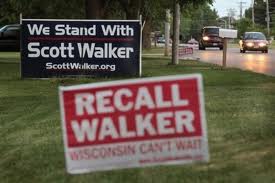
Regardless of what news outlet you follow, there have been a wide variety of speculations, theories and hypotheses about why the election turned out as it did. Personally, I don’t think the outcome can be narrowed down to one single reason that Walker won the election or that Barrett lost.
Walker is only the third governor in U.S. history to face a recall. The other two both lost and were recalled. Each of the political pundits is feverishly competing to come up with the definitive explanation for this outcome. Personally I think the bigger story is the solidification of the division between the opposing sides and the repercussions which will follow for, not only, the state of Wisconsin but the rest of the country as well. Families and friendships have broken apart because of this battle. For me it seems our increasingly contentious political system is becoming as toxic as the lead up to the Civil War and the animosity between those who supported slavery and the abolitionists.
Initially, I felt certain that the imbalance of money in the election would be the determining factor in the election (Walker is estimated to have outspent Barrett 7 to 1). After reading some of the post election coverage, I am not so sure that the enormous amount of money spent (estimated at $60 million) really had much impact on how people voted. In a piece at HuffPo, it was pointed out that the vote split in the recall almost matched the initial faceoff between Walker and Barrett. Basically the people of Wisconsin voted this time the way they voted in the governor’s race in 2010. The undecided voters only amounted to about 8%, with new voters accounting for around 13%. To me that means that those 8% were the only ones who might have been influenced by “the money” issue. The article goes on to say that Walker managed to turn out a higher percentage of his original supporters than did Barrett.
Joshua Holland has a similar take on Alternet called 8 Ways Right-Wingers Are Blowing Wisconsin Out of Proportion. He says the Right Wingers
claimed the outcome spelled doom for Obama this fall, marked the death of the labor movement and was a pure reflection of voters’ love for Scott Walker’s economy-crushing austerity policies.
He goes on to refute the rest of the Right Wing’s claims. Check out the post because it is worth your time.
Recall elections are few and far between in the U.S., as evidenced by my earlier point that Walker is only the third governor in our history to face a recall election. Several sources, including the one I’ve cited above, have put forth that about a third of people polled don’t support recall elections unless the politician has done something egregious, like committing a crime. Their political affiliation doesn’t matter. The seriousness of the offense is the concern of to the voting public regardless of political party. What that says to me is that most voters believe in democracy, meaning the voters have chosen and the person with the most votes, whether or not you voted for him/her, is the winner. Shut up, bite the bullet and let the winner serve out their term. (NOTE: I am not saying that I believe we actually live in a democracy, but that the general public believes in democracy and that our American system is a democracy……..because that is what they have been told. The formerly and currently disenfranchised probably have a different perspective).
Add to this that the opinion of unions, unlike in the mid 20th century, is mostly negative. After about 50 years of chipping away at the number of American workers who belong to a union or have a union member in the family, the number of union workers has declined substantially. Where once both union and non-union workers banded together in solidarity, it has become a mostly contentious relationship, where union workers are seen as greedy, lazy and recipients of unfair pay scales, benefits and pensions. Big business has succeeded in demonizing the collective power of unions who were responsible for the 5 day 40 hours work week, minimum wage, paid sick time and the formation of OSHA to protect the safety of workers on their job. For me, that is the story, not the fact that Walker successfully kept his job. It’s the workers and employees of America that are the losers in this race.

And then there is Jon Stewart’s take on the recall:
crossposted from ecocatwoman.blogspot.com
Pay Check Fairness Act and the Politics of the Gender Gap
Posted: April 29, 2012 Filed under: Paycheck Fairness Act, War on Women, Women's Rights, worker rights | Tags: Gender Gap politics, Harry Reid, Lily Ledbetter Act 62 Comments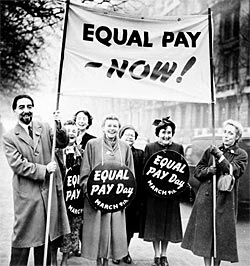 It’s evident that the Democratic Party wants that wide Gender Gap to stay right where it is until the November Elections. The introduction of the Pay Check Fairness Act may be a ploy to put Republicans and Blue Dawg Dems on the spot but it will be an interesting ploy and one to watch. The last time the bill came to the floor was in 2010.
Senate Majority Leader Harry Reid (D-Nev.) will bring to the floor in coming weeks legislation to protect women from retaliation by employers if they inquire about salaries paid to male colleagues
Republicans voted in unison to block the bill, the Paycheck Fairness Act, when it came to the floor in November of 2010.
Democrats say it will be difficult for GOP senators to back out of their opposition, especially because the U.S. Chamber of Commerce has staunchly opposed the legislation.
Mitt Romney will either have to split with Republicans and an important business group or take a position that could further erode his support among women.
“Romney’s going to be on defense on the Paycheck Fairness Act,” said a senior Democratic aide.
“Women are making 70 cents on a dollar of what a man is making. This will resonate with females across the spectrum. If Republicans to a person are coming down against it, it will be at their political peril,” the aide said.
A spokeswoman for Romney’s campaign did not respond to a request for comment.
The bill would prohibit employer discrimination for inquiring about, discussing or disclosing the wages of another employee.
It would expand the definition of wage discrimination by allowing employees to compare the pay of male colleagues not only within the same office but also with colleagues in other local offices. A female employee could allege wage discrimination if she is paid less than a male working the same job for the same employer across town.
Not a single Republican voted to advance the legislation when Reid brought it to the floor during the 2010 lame duck session, after Republicans scored a huge electoral victory but Democrats still controlled the House and Senate.
Forty Republicans and Sen. Ben Nelson (D-Neb.) voted against the legislation. Sen. Lisa Murkowski (R-Alaska) did not vote.
So why exactly do Republicans dislike the Equal Pay Act so much since its only function is to level the playing ground and prevent discrimination? Well, for one, Republicans deny that women are paid differently from men.
This morning, during a heated discussion with Rachel Maddow on Meet The Press, GOP consultant Alex Castellanos denied that women make 77 cents for a man’s dollar in the workplace and noted, “there are lots of reasons for that.” Maddow expressed shock at the assertion, but concluded that it explained why Republicans and Mitt Romney are so hesitant to embrace the Lilly Ledbetter Fair Pay Act of 2009, a law that helps women hold accountable employers who discriminate in the pay practices based on gender.
“Now we know, at least from both of your perspectives,” Maddow said, pointing to Castellanos and Romney surrogate Rep. Cathy McMorris Rodgers (R-WA), “women are not fairing worse than men in the economy that women aren’t getting paid less for equal work.” “It’s about policy and whether or not you want to fix some of the structural discrimination that women really do face that Republicans don’t believe is happening,” she added. Castellanos responded to Maddow’s policy argument by remarking on her passion, to which the MSNBC host took offense:
CASTELLANOS: It is about policy and I love how passionate you are. I wish you were as right about what you’re saying as you are passionate about it. I really do.
MADDOW: That’s really condescending. This is a stylistic issue. My passion on this issue is actually me making a factual argument on it.
My guess is that the introduction of this law is geared to force Romney to take a stand on something he’s been trying to avoid. Romney has been quite coy about his position on the Lily Ledbetter Act which was the first bill signed into law by Obama. Romney’s position on the law is unclear. This comes behind the miserable behavior of Republicans on renewal of the Violence Against Women Act. Every GOP member of the judiciary committee voted against scheduling a vote on the Act.
Romney sidestepped the controversy by announcing his support for reauthorizing the Violence Against Women Act without specifically endorsing the Senate Democratic bill. Senate Republicans quickly conceded and allowed the bill to receive a final vote without waging a filibuster.
Clearly, Reid is maneuvering these bills to put Romney and Republicans in the hot seat. This makes me wonder if we’re even going to get a fair hearing on the issues themselves. Even though Republicans will likely tank the bill, it would be nice to bring the topic into a discussion that is more about the issue and less about the political process. Greg Sargent of WAPO’s Plum Line has some of the behind the scene maneuvers.
The looming vote could revive a recent controversy that erupted around equal pay issues. On a recent Romney campaign conference call, HuffPo’s Sam Stein asked Romney surrogates whether Romney supports the Lily Ledbetter Fair Pay Act of 2009, which mad e it easier for people to challenge pay discrimination. The campaign at first waffled, but then released a statement confirming that Romney “supports pay equity and is not looking to change current law.”
But Romney’s campaign has not said whether he would have signed that law in the first place.
Now Romney’s rhetorical support for pay equity faces another test in the looming Senate vote on the Paycheck Fairness Act.
This Act would put more pressure on employers to prove that differences in wages are not rooted in gender difference, and would make it easier for employees to divulge information about their salaries, which would in turn facilitate deterring or challenging pay discrimination.
Two years ago Senate Republicans opposed the Paycheck Fairness Act, which had strong support from Obama, and it’s likely they will do so again. But Romney is on record supporting “pay equity” in principle, so he’d either have to break with that principle, or break with Senate Republicans, at a time when the battle over the female vote is raging in the presidential race. If Romney supports the measure, it could make passage of it more likely.
“This is an issue that a number of women Democratic Senators are absolutely intent on addressing — they know that with women still being paid 77 cents to each male worker’s dollar, this is an issue of fundamental fairness that women across the country face daily,” a senior aide to a female Senator says. “A lot of women who don’t necessarily see this as a partisan issue will be watching.”
The Romney campaign, in its pitch for female voters, has argued that women don’t care about social issues as much as they do about jobs, and that pocketbook issues will ultimately drive the female vote. But the Paycheck Fairness Act is a gender issue that’s all about the pocketbook and the economy.
Guess we’ll have to stay tuned to see how much we actually get to discuss this issue compared to the political wrangling designed to keep the gender gap working for the benefit of democratic politicians. Hopefully, the women in congress will add some substance to the discussion so that it becomes more than just one more partisan sideshow.
Ya Think? The impact of Republican Extremism
Posted: April 21, 2012 Filed under: 2012 elections, 2012 presidential campaign, 2012 primaries, abortion rights, American Gun Fetish, Tea Party activists, The Bonus Class, The Right Wing, U.S. Politics, Voter Ignorance, War on Women, Women's Healthcare, Women's Rights, worker rights | Tags: Republican Extremism 23 Comments The amazingly, huge gender gap and the obvious lack of support by Hispanic Americans for Romney and other Republicans is troubling the party’s establishment. Republicans have also lost the vote of young people who don’t understand why state officials are obsessed with every one’s personal sex life. Republicans have been denying the party has escalated their attempts to eradicate women’s constitutional rights to abortion but the number of laws introduced by states in the last two years has been monumental. They have moved to directly attacking other women’s preventative health services like birth control access and funding of Planned Parenthood. They’ve passed laws that allow law enforcement to stop folks on the street based on no other reason than they might possibly “look” illegal and demand proof of citizenship. They’ve chipped away at labor bargaining rights, citizen voting access, and science education by supporting bogus religious-based claims on climate change and evolution. They’ve tried everything possible to deny basic civil rights to GLBT Americans by passing laws that use a purely religious definition of marriage and parenthood.
In the last two years, there’s been a surge in legislation that seems squarely aimed at inserting religious dogma into law and enacting privatization schemes for prisons, schools, and all levels of public services. There’s also been noticeable defunding of public education and public health access. They’ve insisted they’ve been focused on the economy. However, even there, the sole focus appears to be taxing poor people, providing tax breaks to the rich and corporations, and decimating public services at all levels of government. The nation’s infrastructure has never been in worse shape. It’s at the point where it’s not only dangerous but it threatens our commercial competitiveness. Our transportation, telecommunications and power infrastructures are antiquated and falling apart.
So, now they are scrambling to get back to an “economic” message to ramrod right wing panderer Willard Romney into the White House. They think we’re all stupid and we’re going to forget two years of legislation aimed at driving us back into the dark ages.
Here’s a snippet of a NYT article that catches the party elite grumbling about state efforts to turn the country into something that resembles a theocratic, corporate state. Considering they’ve gotten in bed with these reactionaries to win elections in the past, they really shouldn’t grumble now that the party’s been purged of all but the most extreme.
But this year, with the nation heading into the heart of a presidential race and voters consumed by the country’s economic woes, much of the debate in statehouses has centered on social issues.
Tennessee enacted a law this month intended to protect teachers who question the theory of evolution. Arizona moved to ban nearly all abortions after 20 weeks, and Mississippi imposed regulations that could close the state’s only abortion clinic. Gov. Scott Walker of Wisconsin signed a law allowing the state’s public schools to teach about abstinence instead of contraception.
The recent flurry of socially conservative legislation, on issues ranging from expanding gun rights to placing new restrictions on abortion, comes as Republicans at the national level are eager to refocus attention on economic issues.
Some Republican strategists and officials, reluctant to be identified because they do not want to publicly antagonize the party’s base, fear that the attention these divisive social issues are receiving at the state level could harm the party’s chances in November, when its hopes of winning back the White House will most likely rest with independent voters in a handful of swing states.
One seasoned strategist called the problem potentially huge.
What The Irish Can Teach Us
Posted: March 18, 2012 Filed under: Barbara Ehrenreich, Charles Murray, corporatism, Economy, financial institutions, free market ideology, hunger, income inequality, The Great Hunger, U.S. Economy, unemployment, voodoo economics, worker rights 12 CommentsNow that we’ve all been Irish for a day–donning the green, marching or watching parades and downing those pints at the local bar, we might ask ourselves [whether we’re from Irish American backgrounds or not]: Is there anything more the Irish can teach us?
Running across an essay by Barbara Ehrenreich on American poverty, specifically the lingering, depressing notion of the ‘culture of poverty’ and
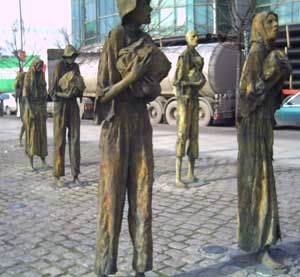
Dublin's Famine Memorial
having listened to Charles Murray on Book TV discuss his recent book, “Coming Apart: The State of White America, 1960-2012,” I think the answer is a resounding ‘yes.’
As Ehrenreich reminds us, the idea that poor people are inherently different than the affluent and in fact, need to be changed, corrected, put right has been an enduring theme of the conservative right. The inequality between the poor and the rich is not a matter of jobs or opportunity, education or money, so the theory goes. It’s about the poor being substantially flawed. They lack core values: ambition, get-up-and-go, faith, and the ability to plan for the future. The poor are impulsive, promiscuous, prone to addiction and crime and, as Ehrenreich points out, theorists all contend that the poor ‘certainly cannot be trusted with money.’
Charles Murray’s presentation picks up on the ‘culture of poverty’ theory and runs with it like a champion of reason and rightness. The American Project, Murray contends, the continuation of a civil society is threatened because the working class and upper-middle class are of a different kind altogether. The unraveling of America has nothing to do with the inequality of income but the inequality of culture.
Murray uses two ‘symbolic’ communities to illustrate his thesis: Belmont and Fishtown though both communities actually exist—Belmont, an affluent neighborhood outside Boston and Fishtown, a working class neighborhood of Philadelphia. Murray goes on to compare the two communities in four main areas: marriage, industriousness, honesty, and religiosity. And surprise, surprise. Fishtown gets a failing grade on all scores.
What does this have to do with the Irish? I suggest a quick trip back in time, say to the mid-19th century during what became known as the Great Hunger.
Ireland was heavily populated with subsistence/tenant farmers, generally in debt to their English landlords. Most have heard of the ‘great potato blight’ of 1845-1849 when over 1 million Irish died of starvation. What many may not know is that the the affluent English landlords were exporting an abundance of grain, meat and dairy for profit as the Irish poor starved. And the conservative government response? Their policy was one of laissez faire, leave well enough alone. As the Assistant Secretary of Ireland reportedly said at the time: to give the people something for nothing, ‘would have the country on us for an indefinite time.’ The fear of dependency was greater than watching the population starve. Free market policies and workhouses became popular. But still people died. In droves. The fields of once blighted potatoes became graveyards.
How were the Irish viewed by ‘polite’ English society? The Irish were considered brutish, lazy, devious, promiscuous, prone to crime and heavy drinking. Worse yet—they were Catholic.
The point is that this warped view on poverty is not new. Nor are the political responses. Even when a population was starving to death en masse, the response in Ireland was an ideological one: people had to work to be fed, even when they were too weak and sick to stand upright.
The Irish know this. They remembered it well and passed the bleak stories down to their descendants. The impoverished Irish immigrants, those who came to America [if they survived the ocean crossing], found the same weary stereotypes waiting on another shore. Anyone with Irish American grandparents or other family oldsters have likely heard the tales of blatant bigotry while growing up—the ‘no dogs or Irish’ signs in shop windows.
 Still I found it amazing that Murray could say the main problem threatening the Nation today is not income inequality but cultural inequality. Minx wrote a very effective piece last week on the growing poverty in the US. Cited in her post was a statement by Tavis Smiley, who is pushing to have the issue of exploding poverty included in the 2012 election:
Women are much more likely to be poor than men, and more than a million children have fallen into poverty, and more than 500,000 have fallen into extreme poverty” — that is, living on less than $2 a day — “since 2010.” Recent census data shows that the number of children who live in extreme poverty has doubled from 1996 to 2011, from 1.4 million to 2.8 million.
And yet, as Minx pointed out a number of states: Kansas, Utah and Nebraska have initiated policies to cut food stamps to needy children.
Well here’s a factoid that turns the whole cultural argument on its head: the fastest growing segment of the newly poor are in suburban neighborhoods.

Warrensville Heights, Cleveland suburb, photo:dustin franz,NYT
Some of this is due to changing demographics but the larger percentage has to do with long-term unemployment, stagnate wages, off-shoring, the housing debacle, etc., etc. Here’s a chilling study from the same link:
Mark Rank, a social welfare professor at Washington University in St. Louis, has written extensively about shifts in U.S. poverty since the 1960s, and finds that Americans today are more likely to face poverty than in the past. According to Rank’s data, 24 percent of people who were in their 20s in the 1970s were likely to experience poverty at some point in their lives. That number rose to 31 percent in the 1980s and 37 percent in the 1990s. Today a majority of Americans-51.4 percent, according to the Urban Institute-will experience poverty by the time they’re 65.
Are we to believe that this sudden shift to poverty or expectation of poverty is all about lost moral/cultural compasses? Charles Murray would say, ‘yes.’ He suggests that the upper-middle class reach out, reintegrate and reeducate the working classes in the four pillars of civil society: marriage, industriousness, honesty and religiosity. Note that Murray’s study just happens to begin at the soon-to-be turbulent 1960s. Ahhh, if only we could go back to those Father Knows Best days.
In contrast, Barbara Ehrenreich pointedly says:
. . . a new discovery of poverty is long overdue. This time, we’ll have to take account not only of stereotypical Skid Row residents and Appalachians, but of foreclosed-upon suburbanites, laid-off tech workers, and America’s ever-growing army of the “working poor.” And if we look closely enough, we’ll have to conclude that poverty is not, after all, a cultural aberration or a character flaw. Poverty is a shortage of money.
My suggestion? Find yourself an Irish grandmother, the older the better. She’ll give you an earful. Generational memory is a powerful thing!
Let’s Hear It For The Girls, All Month Long
Posted: March 7, 2012 Filed under: #Occupy and We are the 99 percent!, birth control, Civil Rights, collective bargaining, Economy, Feminists, income inequality, War on Women, Women's Rights, worker rights | Tags: international women's day 10 Comments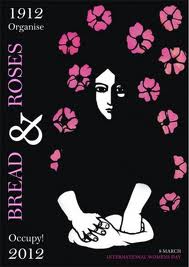 Though GOP madness is in full swing, March is the month to celebrate women—their lives, strengths and accomplishments. True to its nature, the month has roared in but with a twist, acting as a party crasher, snapping at all female guests of honor.
We’ve seen reproductive rights assaulted, the 100-year contraception battle reignited and shock-jock Rush Limbaugh bully and slander a female student from Georgetown University. Rick Santorum has turned the Republican effort into a Comstock-era discussion of acceptable moral/sexual behavior and a county in the Great State of South Carolina is suggesting a purity pledge for Republican membership. Even the workplace is under assault with candidates suggesting the elimination of minimum wage and repealing Child Labor laws.
What’s next? The village pillory? 
Who invited the Crazies?
My suggestion? Show them the door, kick their arses to the street. We didn’t invite reactionary fools to the party. This woman would not have tolerated their company for a single nanosecond:

Margaret Sanger
Nor these women
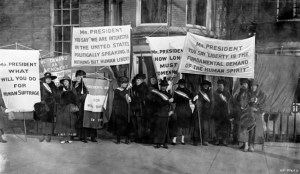
Women's Suffrage Parade
Nor these:
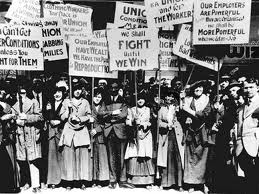
Bread and Roses Protest
The last photo, the Bread and Roses protest, was a workers’ strike protesting deplorable work conditions, non-living wages and inconceivably long days in New England’s textile mills. One of these strikes occurred in Lawrence, Massachusetts, fueled by earlier actions in NYC’s garment district. Thursday, March 8th is the official recognition date of a 100-year old struggle, under the aegis of the IWW [Industrial Workers of the World] but primarily led by immigrant women, young and old, who successfully striked for humane working conditions, decent wages and openly opposed child labor and workplace exploitation.
It did not come easy. But come it did.
One of the descriptions I read of these early battles was nothing short of shake-your-head inspiring:
According to [Consiglia] Teutonica, this time a 22-year-old Syrian immigrant named Annie Kiami stepped in front of the crowd. Calling the soldiers “Cossacks,” Kiami wrapped an American flag around her body and dared them to shoot holes in Old Glory.
Once thought of as docile and subservient, the Bread and Roses women quickly gained the notorious title among mill owners of radicals of the worst sort.
“One policeman can handle 10 men,” Lawrence’s district attorney lamented, “while it takes 10 policemen to handle one woman.”
In the words of one horrified boss, the women activists were full of “lots of cunning and also lots of bad temper. They’re everywhere, and it’s getting worse all the time.”
Lots of cunning and bad temper! I like that.
Flip forward some 50+ years and the Bread and Roses contingent in Boston fought for reproductive rights and abortion, child care, equal employment laws against discrimination in the workplace and recognition of and legal remedies to fight and reduce violence against women. In 1971, the Bread and Roses group occupied a building owned by Harvard University for 10 days, during which they offered free classes and childcare. After they were removed from their encampment, several sympathetic donors offered $5000 with which the group opened The Women’s Center in Cambridge.
The Women’s Center is in operation today, offering a multitude of services to battered women, victims of rape and child abuse and providing counsel, support and health information to moderate to low-income women. Their mission statement reads as follows:
To provide women with the resources and support they need to emerge from
conditions of domestic violence, sexual abuse, poverty, discrimination, social isolation and degradation.
To challenge and change the attitudes, actions, and institutions that subjugate women.
They’re still going strong.
A myriad of Bread and Roses communities have grown and spread across the country, many charitable outreaches to low income families, providing meals and support to the unemployed, the sick and disadvantaged. In each case, the Bread and Roses emblematic power rests in the idea of social justice, community outreach and support. With each and every group, each program, the legacy returns to those women and children of 1912, the day they said–Enough is enough—and then put their bodies, their very lives on the line, demanding to be treated with dignity, to be seen and counted as human beings.
As for the name, Bread and Roses? The phrase reportedly came from a banner—Give Us Bread But Give Us Roses–carried during the early days of the textile strikes. James Oppenheim, a poet, novelist and editor, attended one of those protests and was so moved by the imagery that he wrote the following poem to honor the women.
As we come marching, marching in the beauty of the day,
A million darkened kitchens, a thousand mill lofts gray,
Are touched with all the radiance that a sudden sun discloses,
For the people hear us singing: “Bread and roses! Bread and roses!”
As we come marching, marching, we battle too for men,
For they are women’s children, and we mother them again.
Our lives shall not be sweated from birth until life closes;
Hearts starve as well as bodies; give us bread, but give us roses!
As we come marching, marching, unnumbered women dead
Go crying through our singing their ancient cry for bread.
Small art and love and beauty their drudging spirits knew.
Yes, it is bread we fight for — but we fight for roses, too!
As we come marching, marching, we bring the greater days.
The rising of the women means the rising of the race.
No more the drudge and idler — ten that toil where one reposes,
But a sharing of life’s glories: Bread and roses! Bread and roses!
Oppenheim was inspired by the women and their courage. The women were inspired by the words.
It’s a fine legacy, one among many in which women had a leading role in changing the course of American history. The citizens of Lawrence will be commemorating the women and their efforts with a Centennial festival. The major programs are slated to kickoff tomorrow Thursday, March 8 and run through May 1.
There’s no better time to give these women their due because income inequality, rising poverty and homelessness has returned to the Nation, a vicious cycle tearing at families and communities alike. The Lawrence strike has an uncanny parallel to the Occupy protests. At the turn of the 20th century, the concentration of wealth in the hands of the few was unrivaled. Until today. What Bread and Roses reminds us is the power of solidarity, fighting the good fight. With cunning and bad temper if necessary. Or as James Oppenheim wrote a century ago:
The rising of women means the rising of the race.
Bread and roses! Bread and roses!
Happy 100th!

 peej
peej Carissa
 bostonboomer
 dakinikat
 ecocatwoman
 mablue2
 Mama Lopez
 peggysue22
 quixote
 skydancingguestblogger
 Mona (aka Wonk the Vote)



 Sky Dancing
Recent Comments