
Mostly Monday Reads: I come to Bury CBS, Not to Praise It
Posted: November 3, 2025 Filed under: #We are so Fucked, Cheater in Chief, Journalism, kakistocracy, Our Media is Complicit with Autocracy, Televising Propaganda instead of News | Tags: @johnbuss.bsky.social John Buss, @repeat1968, John Buss, Norah O'Donnell, Sixty Minutes, Tales of a teenage reporter, The Legacy Media Sucks, Walter Cronkite 6 Comments
“How can we tire from all this winning?” John Buss, @repeat1968
Good Day, Sky Dancers!
60 Minutes premiered on September 24th, 1968, with Harry Reasoner and Mike Wallace. I was barely a teenager when it premiered, but even then, I was growing into fully all the fringed suede and tattered blue jeans I could find with my guitar set filled with the likes of Dylan and Crosby, Stills, Nash, and Young. However, I realized that I was watching something I’d watched for a very long time. Next year, I would buy that Woodstock Guitar strap and cut my first real studio audition. My best friend and I recorded a cover of “One Tin Soldier,” which was requested by Billy Jack for his second movie. Music and the News were the only things that got me through the banality of my life at that point. (Omaha, UGH!)
I spent my entire childhood watching and reading the news with my Dad, through the Civil Rights Movement, the Vietnam War, and all those crazy times in the 1960s. It was a pivotal moment that led me to become the social justice activist I am today. Reasoner described 60 Minutes as a type of News Magazine, and we had just about all of them that went from our house to the customer service area of my Dad’s small Ford Dealership in a small town in Iowa. It was difficult to get the Washington Post during Watergate, but 60 Minutes was there in living color.
I haven’t really watched in a long time because so much has gone missing. Ever since I got my first newspaper subscription to the Manchester Guardian in High School, I have to say it was part of my education, right through to Graduate School. Now, during the time when I have ever been the least sanguine about our country’s future, I can only say RIP 60 Minutes. These are indeed bleak times. The U.S. Media has a grand old tradition dating back to Benjamin Franklin. It has lost its way to the same evil it sought to expose during World Wars and other events. It has a history of struggle between the powerful entities that seek to control the narrative and the writers who research and reveal the truth. In the age of Techbros and MAGA, Crypto and Virtual Cash, we see a barren landscape destroyed by greed.
 I’ll start with the offending program, then offer some perspectives from a number of folks who used to have a place on TV news and are now relegated to the New Deal Blogosphere. I should mention that during that same period of becoming who I am, I wrote for both an underground Newspaper (The Aardvark) and two school newspapers. This blog is an extension of those of us who became very interested again in discussing the news during Dubya’s adventures in the Middle East and the hope we had of simply seeing a woman become president.
This is from CBS News, the former home of everyone’s Uncle Walter, and my personal favorite, Edward Bradley, who always showed up for the New Orleans Jazz Fest, sat with me in monitor world to hear his beloved jazz after I’d put all the microphones in their proper places and dealt with the talent. He always remembered to ask about my daughters by name. It hurts that the overseers used a woman to do this. “Read the full transcript of Norah O’Donnell’s interview with President Trump here.”
Editor’s note: On October 31, 2025, correspondent Norah O’Donnell spoke with President Donald J. Trump at Mar-a-Lago in Palm Beach, FL, and this is a transcript of that conversation. They started by discussing the president’s recent meeting with China’s President Xi Jinping.
PRESIDENT DONALD TRUMP: Well, first of all, we get along great, and we always really have. We had the COVID moment, which was not– attractive as far as I was concerned. I wasn’t so happy. But outside of that, we have always had a great relationship. He’s a powerful man. He’s a strong man, a very powerful leader.
And– we’ve always– had the best of relationships, probably the best of– I could– I think I could speak for him, just about as good as it gets from his standpoint and from my standpoint. And having that is important because of the power of the two countries.
NORAH O’DONNELL: What did you get out of this deal that you wanted?
PRESIDENT DONALD TRUMP: Well, I got sort of everything that we wanted. We got– no rare earth threat. That’s gone, completely gone. We have tremendous amounts of– dollars pouring in– ’cause we have– very big tariffs, almost 50%. We never had anything in terms of tariffs, although I put tariffs on China, but Biden let it lapsed by the– by the fact that he gave exemptions on almost everything, which was just ridiculous.

By this time, the fact-checking should’ve begun, and some good old-fashioned interrupting with follow-up questions. It went on with none. Instead, we got mealy-mouthed clarifications.
But– we have– billions and billions of dollars coming in, and we have a very good relationship. I mean, we have– a great relationship with a powerful country. And I’ve always felt if we can make deals that are good, it’s better to get along with China than not, if you can’t make the right kind of a deal than not, because, you know, China, along with many other countries (they’re not alone in this), they’ve ripped us off from day one.
They’ve ripped us so much. They’ve taken trillions of dollars out of our country. And now they’re– it’s the opposite. I mean, we’re doing very well with China, and hopefully they’re gonna do very well with us. But I do think it’s important that China and the U.S. get along, and we get along very well at the top.
NORAH O’DONNELL: This trade war, though, was hurting Americans. I mean, our soybean farmers. China had stopped buying the soybeans.
PRESIDENT DONALD TRUMP: Yeah.
NORAH O’DONNELL: As you mentioned, they were– China was withholding these rare earth materials that you need for everything from smartphones to– to build submarines.
PRESIDENT DONALD TRUMP: Sure.
NORAH O’DONNELL: What– what was the crucial thing? I mean, how tough of a negotiatior–
PRESIDENT DONALD TRUMP: Well, when you say hurting–
NORAH O’DONNELL: –is President Xi–
PRESIDENT DONALD TRUMP: –it was a temporary hurt. It was a hurt because– I was takin’ in a lot of money from China. We’re doing very well against China. And all of a sudden they said, “You know, we have to fight back.” And so they used their powers. The power they have is rare earth because of the fact that they’ve been accumulating it and– and really taking care of it for a period of 25, 30 years.
Other countries haven’t. Now we are. I mean, we have tremendous rare earth, and it’s going to be– you know, it’s going to be– it’ll be a strength, but it won’t really be a strength if everybody has it. Everyone’s gonna have it pretty soon.
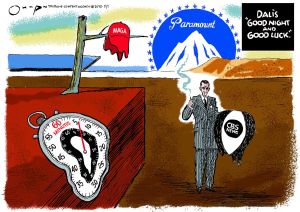 `I would call this full-throated propaganda allowed air time for way too long. Here’s another example before I start telling Norah there’s something brown growing on her nose. It’s further on down the page. I’m just glad I didn’t watch it.
PRESIDENT DONALD TRUMP: I think in two years, we’ll start opening up plants and we’ll have a very substantial portion of the chip market. Right now we have almost none. We should have had a hundred percent. If we had par– if we had presidents that knew anything about business or knew what they were doing, because, frankly, they didn’t.
We lost 50% of our automobile business. It’s all coming back. We lost a hundred percent of the chip– you know, it used to be all Intel and other companies. And what happened is other countries came in, and they stole our chip business, and we didn’t charge tariffs.
If we would have charged let’s say a 100% tariff, none of those companies would have left. But they all left. Now they’re all coming back, Norah, because the only way they avoid the tariffs is to build in our country. If they build in our country, make their plant and make their product in our country, then it’s a very simple thing. They– they don’t have any tariff to pay.
NORAH O’DONNELL: Uh-huh.
 Well, she’s certainly not an heir to the Murrow Boys. Like so many, Medhi Hassan left a big desk on a 4-letter network because someone saw him as being a bit too much of a journalist and one of color. He has his own spot out here on his own website.
It’s similar to the choice of my first Newspaper: The Manchester Guardian, which I still read daily as The Guardian. His site, named Zeteo, can be found on Substack on the web, alongside other banished reporters and what used to be known as “Public Intellectuals” rather than influencers. Today’s offering is ” Factchecking Trump on ’60 Minutes’.” He’s taken the place of the major legacy newspapers. The lede is divine. ’60 Minutes’ of Shame and Submission.’
Having watched the whole ‘60 Minutes’ interview and read the entire transcript, too, I genuinely can’t decide what was worse: Trump’s endlessly dishonest answers or O’Donnell’s non-stop softball questions.
I kid you not, here is a short selection of some of the questions this award-winning, highly-paid, veteran news anchor chose to ask the most powerful man on Earth in her limited time with him:
- “Have some of these [ICE] raids gone too far?”
- “Who’s tougher to deal with, Vladimir Putin or Xi Jinping?”
- “Why won’t Putin end this war?
- “Do you worry about an AI bubble?”
- “What do you hope to accomplish in the next three years?”
Ooooohh! Tough stuff! The new owner of CBS, David Ellison, and the new head of CBS News, Bari Weiss, must both be so proud. This is the kind of ‘balanced’ coverage I’m sure they were waiting for. Then again, to be fair to them, O’Donnell has a long history of softball interviewing that predates the recent takeover of her network by a MAGA billionaire. Remember her love-in with Saudi crown prince MBS in 2018?
But this isn’t just about O’Donnell or CBS. The ‘60 Minutes’ interview with Trump showcased everything that is wrong with US political interviews in general. The deferential tone. The lack of preparation. The failure to ask follow-up questions or dig deep into an interviewee’s answers. The inability (unwillingness?) to fact-check in real time.
At one point, Trump asked O’Donnell whether she knew “how many presidents have used the Insurrection Act,” to which the CBS anchor simply responded: “Tell me.” Trump then proceeded to lie about the proportion (“Almost 50% of ‘em,” he said, when the real proportion is 38%) and the absolute number (“some of the presidents, recent ones, have used it 28 times,” he said, when the most was actually only six times, and back in the 1870s).
But O’Donnell said nothing. She just moved on.
There were so many falsehoods and half-truths, and so little pushback, that after a while, I gave up. I stopped counting. Here’s what I did manage to catch, in terms of brazen lies, all of which were left unrebutted, uncorrected, unchallenged, by O’Donnell:
- “We had nine wars on our planet. I solved eight of ‘em.” I have debunked this nonsensical claim before.
- “We have no inflation.” Inflation is at 3%.
- “It’s at 2%. It’s– it’s the perfect inflation.” Inflation is at 3%.
- “Right now [grocery prices are] going down.” Grocery prices are up 1.4% since Trump came to office.
- “A year ago, we were a dead country.” Not only did the US have the fastest-growing economy in the G7 in both 2023 and 2024, but the Economist magazine called it “the envy of the world.”
- “11,888 murderers were let into our country.” Not only is this number inaccurate, but many of the non-citizens convicted of homicide either here or abroad came in during Trump’s first term.
- “Washington, DC, was… almost like a crime capital of the world.” In 2023, per PolitiFact, “at least 49 other cities in the world had higher homicide rates.
- “[Biden] hardly went anywhere. Guy couldn’t leave his bedroom.” Not only did Joe Biden visit roughly as many countries in his term of office as Trump did in his first term, but Biden was the first US president to visit an active warzone – Ukraine – not under the control of US forces.
- “I made Middle East peace. For 3,000 years, they couldn’t do it.” There is no peace in Palestine, no peace deal in place, and it isn’t a 3,000-year-old conflict.
- “Communist, not socialist. Communist. He’s far worse than a socialist.” Zohran Mamdani is not a communist.
- “I can’t give them $1.5 trillion so that they can give welfare to people that came into our country illegally.” The Trump/GOP claim that Democrats want to give free healthcare to undocumented immigrants has been repeatedly debunked.
- “They emptied their mental institutions and their insane asylums– into the United States of America.” Asylum seekers don’t come from “insane asylums.” Obviously.
- “One thing I can tell you, the 2020 election was rigged.” It wasn’t. The courts agreed.
- “And a lotta people say when it’s rigged you’re allowed to do it again.” A lot of people don’t say this. The US Constitution doesn’t, for sure.
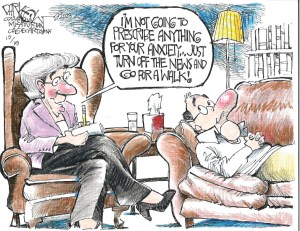 Please read it. The next section lists the questions O’Donnell should have asked as a follow-up. I will say that I believe Mehdi’s follow-up questions in every interview I’ve watched him do are stellar. He points out exaggerations and falsehoods, zeroes in on exactly what the issue with the response is, and just delivers it deliciously. I’m a Fan grrrl. And me, the teenage girl who had to sneak her friend Cathie into the Journalism workspace so she could lust after Kurt Anderson to keep her from going on about him all lunchtime long.
CNN had a more traditional take on said Interview by Daniel Dale. “Fact check: 18 false claims Trump made on ‘60 Minutes’.”
Trump told his usual lie that the free and fair 2020 election was stolen from him. He lied again that grocery prices “are down” even after CBS’ Norah O’Donnell informed him they are up. He declared once more that there is now “no inflation,” though there certainly is, and then that inflation is 2% or “even less than 2%,” though the most recent available Consumer Price Index figure is now up to 3%.
The president also deployed multiple other fictional numbers during his exchanges with O’Donnell, which were recorded Friday and released by CBS on Sunday.
- He falsely claimed “$17 trillion” is being invested in the US “right now,” though the $17 trillion figure is nearly double the White House’s own wildly inflated figure.
- He falsely claimed each alleged drug boat the US has attacked in recent weeks “kills 25,000 Americans,” though experts note this figure plainly does not make sense.
- He falsely claimed some recent former presidents invoked the Insurrection Act “28 times,” though no individual president has invoked it on more than six occasions with this record set by President Ulysses S. Grant in the 1800s.
- He falsely claimed he has ended “eight wars,” though his list includes two situations that were not wars at all and at least one war that continues.
- He falsely claimed CBS aired an edited interview with Trump’s 2024 opponent Kamala Harris “two days” before the election, though it was actually more than four full weeks before Election Day.
- He falsely claimed former President Joe Biden gave $350 billion in aid to Ukraine (the real number is well under half that) and allowed in “25 million” migrants (the real number here is well under half that, too).
And Trump made a variety of additional false claims on several subjects, including the government shutdown, the artificial intelligence boom, tariffs, his first impeachment and his former legal battle with “60 Minutes” itself.
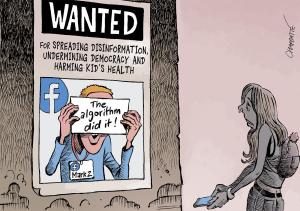 I really wonder how many people besides you and me actually read this stuff and bring it up in normal conversation. I know that the MAGATs will never read or hear it. I saved the best for last. This is from my precious Guardian reporting about the heavy-handed editing given to this latest 60 Minutes interview with Trump. Quelle Suprise, y’all! “CBS News heavily edits Trump 60 Minutes interview, cutting boast network ‘paid me a lotta money’. Trump said Paramount’s sale to David and Larry Ellison was ‘greatest thing that’s happened in a long time’ for free press.” This is reported by Jeremy Barr.
The CBS News program 60 Minutes heavily edited down an interview with Donald Trump that aired on Sunday night, his first sit-down with the show in five years.
Trump sat down with correspondent Norah O’Donnell for 90 minutes, but only about 28 minutes were broadcast. A full transcript of the interview was later published, along with a 73-minute-long extended version online.
The edits are notable because, exactly one year before Trump was interviewed by O’Donnell at his Mar-a-Lago resort on Friday he had sued CBS over the editing of a 60 Minutes interview with then-Vice President Kamala Harris, which he alleged had been deceptively edited to help her chances in the presidential election.
While many legal experts widely dismissed the lawsuit as “meritless” and unlikely to hold up under the first amendment, CBS settled with Trump for $16m in July. As part of the settlement, the network had agreed that it would release transcripts of future interviews of presidential candidates.
At the beginning of Sunday’s show, O’Donnell reminded viewers that Paramount settled Trump’s lawsuit, but noted that “the settlement did not include an apology or admission of wrongdoing”.
During the interview, in a clip that did not air on the broadcast, Trump needled CBS over the settlement and repeated his claims against the network.
“Actually 60 Minutes paid me a lotta money. And you don’t have to put this on, because I don’t wanna embarrass you, and I’m sure you’re not,” Trump said. “But 60 Minutes was forced to pay me a lot of money because they took her answer out that was so bad, it was election-changing, two nights before the election. And they put a new answer in. And they paid me a lot of money for that. You can’t have fake news. You’ve gotta have legit news. And I think that it’s happening.”
During another un-aired portion of the interview, Trump praised the sale of CBS to the Ellison family and said the network’s new editor-in-chief, Bari Weiss, was a “great new leader”.
The US president said he didn’t know Weiss, but told O’Donnell: “I hear she’s a great person.
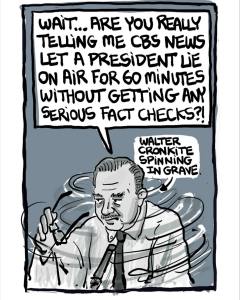 Well, this is getting long for a meager WordPress blog post.
“And that’s the way it is.” Can you believe he signed off when I was getting my first graduate degree? Wow! I’m old!
What’s on your Reading, Action, and Blogging List today?
Finally, Friday Reads: A Trumpy Halloween!
Posted: October 31, 2025 Filed under: #FARTUS, #MAGAnomics, #We are so Fucked | Tags: @johnbuss.bsky.social John Buss, A Trumpy Halloween, CBS News Shake-up, Losing Democracy, Paramount, Senate Filibuster, Venezuela 9 Comments
“We are so blessed to have a businessman in charge.” John Buss, @repeat1968
Good Day, Sky Dancers!
Well, if you need to be scared out of your wits, no need to rewatch those Freddy Krueger Movies. Just pick up a newspaper or two and be prepared to be chilled to your bones, if the weather isn’t already doing that to you. I’m a lot on the late side today because Temple snuggled up so close to me last night she nearly shoved me off the bed several times. The furnace is already on, but I’ve also brought out the space heater to try to warm her up and then lower the temperature back to the foot of the bed.
It appears the New York Times may have gone woke. My jaw dropped reading the Editorial Board headline. Cue the Jaws Shark theme song.”Donald Trump has wielded power as no previous president has, often in open defiance of the law. His actions have raised a chilling question.” Oh, really? Finally, starting to notice that, are we? “Are We Losing Our Democracy?” (The link is shared for you to read.)
Countries that slide from democracy toward autocracy tend to follow similar patterns. To measure what is happening in the United States, the Times editorial board has compiled a list of 12 markers of democratic erosion, with help from scholars who have studied this phenomenon. The sobering reality is that the United States has regressed, to different degrees, on all 12.
Our country is still not close to being a true autocracy, in the mold of Russia or China. But once countries begin taking steps away from democracy, the march often continues. We offer these 12 markers as a warning of how much Americans have already lost and how much more we still could lose.
 The first section is on authoritarian speech, which seems a fitting place for reporters to start.
Authoritarian takeovers in the modern era often do not start with a military coup. They instead involve an elected leader who uses the powers of the office to consolidate authority and make political opposition more difficult, if not impossible. Think of Vladimir Putin in Russia, Nicolás Maduro in Venezuela and, to lesser degrees, Recep Tayyip Erdogan in Turkey, Viktor Orban in Hungary and Narendra Modi in India. These leaders have repressed dissent and speech in heavy-handed ways.
Over the past year, President Trump and his allies have impinged on free speech to a degree that the federal government has not since perhaps the Red Scare of the 1940s and 1950s. His administration pressured television stations to stop airing Jimmy Kimmel’s talk show when Mr. Kimmel criticized Trump supporters after the murder of Charlie Kirk; revoked the visas of foreign students for their views on the war in Gaza; and ordered investigations of liberal nonprofit groups. Mr. Trump so harshly criticizes people who disagree with him, including federal judges, that they become targets of harassment from his supporters.
The Bottom Line
Many forms of speech and dissent remain vibrant in the United States. But the president has tried to dull them. His evident goal is to cause Americans to fear they will pay a price for criticizing him, his allies, or his agenda.
 Emily Atkin has a blog post up at HEATED describing the incredible firings of reporters at CBS News who were covering Climate Change. “The fall of the CBS News climate team. David Ellison, the new pro-Trump chief executive of Paramount Skydance, has dismantled the best climate change reporting team in cable news.”
As Hurricane Melissa raced toward Jamaica on Monday, CBS News senior coordinating producer Tracy Wholf sent an email to the newsroom, detailing the historic storm’s scientific connection to climate change.
In the message obtained by HEATED, Wholf explained how an overly-hot Atlantic Ocean supercharged Melissa, fueling its rapid 70-mph intensification in a single day, boosting winds by about 10 mph, and turning what might have been a category 4 storm into a category 5. Wholf suggested a simple sentence CBS News reporters could use in storm-related stories to make the connection.
Wholf usually sent emails like this in the wake of deadly extreme weather events, two CBS News staffers told HEATED. But it was the first such email Wholf had sent under the company’s new pro-Trump billionaire chief executive David Ellison, and its new anti-“woke” editor-in-chief Bari Weiss.
It was also the last. Two days later, as Hurricane Melissa smashed into the Caribbean, Wholf was laid off, along with the majority of the five person team supporting CBS News’s climate coverage.
Today, the only person remaining at CBS News to cover climate change is national environmental correspondent David Schechter, who no longer has a dedicated producer. In addition to Wholf’s layoff, two producers supporting the climate team were let go, and another dedicated climate producer was reassigned.
The cuts were part of a larger layoff on Wednesday that affected nearly 100 other CBS News staffers, including the network’s race and culture team, and around 1,000 staffers across newly-merged parent company Paramount Skydance.
 Two days ago, CNN reported on other areas that have lost staff, which may be seen as areas that likely offend Trump, as Paramount Skydance plans more mergers. Under any functional Justice Department, these mergers would be viewed as leading to excessive concentration in a single industry. A high concentration of markets is non-competitive and detrimental to the economy and consumers. There are numerous laws, starting with the Sherman Act, that block such mergers. Brian Stelter reports that “Paramount begins steep layoffs as David Ellison reshapes the media giant.”
The new Paramount is laying off about 10% of its workforce, achieving some of the cost savings that CEO David Ellison promised investors when he took charge of the media company over the summer.
Many divisions of Paramount Skydance will be impacted, from the iconic movie studio to CBS News to Comedy Central.
About a thousand jobs are expected to be cut this week, and another thousand in the near future, as a new management team reorganizes the company.
Ellison, who headed the production company Skydance and merged it with the much larger Paramount, said in a memo on Wednesday morning that “these steps are necessary to position Paramount for long-term success.”
“In some areas, we are addressing redundancies that have emerged across the organization,” he said. “In others, we are phasing out roles that are no longer aligned with our evolving priorities and the new structure designed to strengthen our focus on growth.”
Steep cuts and sweeping changes are common after mergers, but Paramount has gone through multiple rounds of layoffs in recent years, so employees have been especially on edge about this fall’s expected terminations.
At CBS News, nearly 100 positions will be eliminated, a person familiar with the matter told CNN on condition of anonymity.
The person said the CBS News cuts were already in the works before Ellison appointed Bari Weiss as editor-in-chief earlier this month, following the purchase of her startup outlet, The Free Press.
The reorganization comes as the wider media industry waits to see Ellison’s ambitious plans for Paramount. In recent weeks Ellison has been pursuing Warner Bros. Discovery, the parent of CNN, HBO Max and the Warner Bros. studio.
The WBD board has rebuffed those initial offers and started a strategic review, which could result in a sale of the entire company, a continuation of the current plan to split WBD into two, or some other outcome.
 The impact on reporting and free expression could be huge.
There are indications that “U.S. poised to strike military targets in Venezuela in escalation against Maduro regime.” This is reported by Antonio Maria Delgado writing for the Miami Herald.”
The Trump Administration has made the decision to attack military installations inside Venezuela and the strikes could come at any moment, sources with knowledge of the situation told the Miami Herald, as the U.S. prepares to initiate the next stage of its campaign against the Soles drug cartel. The planned attacks, also reported by the Wall Street Journal, will seek to destroy military installations used by the drug-trafficking organization the U.S. says is headed by Venezuelan strongman Nicolás Maduro and run by top members of his regime.
Sources told the Herald that the targets — which could be struck by air in a matter of days or even hours — also aim to decapitate the cartel’s hierarchy. U.S. officials believe the cartel exports around 500 tons of cocaine yearly, split between Europe and the United States.
While sources declined to say whether Maduro himself is a target, one of them said his time is running out. “Maduro is about to find himself trapped and might soon discover that he cannot flee the country even if he decided to,” the source said. “What’s worse for him, there is now more than one general willing to capture and hand him over, fully aware that one thing is to talk about death, and another to see it coming.”
Well, aren’t we the rogue nation now? The Associated Press reports that the “UN human rights chief says US strikes on alleged drug boats are ‘unacceptable’.”
The U.N. human rights chief said Friday that U.S. military strikes against boats in the Caribbean Sea and eastern Pacific Ocean allegedly carrying illegal drugs from South America are “unacceptable” and must stop.
The U.N. High Commissioner for Human Rights, Volker Türk, called for an investigation into the strikes, in what appeared to mark the first such condemnation of its kind from a United Nations organization.
Ravina Shamdasani, a spokeswoman for Türk’s office, relayed his message Friday at a regular U.N. briefing: “These attacks and their mounting human cost are unacceptable. The U.S. must halt such attacks and take all measures necessary to prevent the extrajudicial killing of people aboard these boats.”
She said Türk believed “airstrikes by the United States of America on boats in the Caribbean and in the Pacific violate international human rights law.”
President Donald Trump has justified the attacks on the boats as a necessary escalation to stem the flow of drugs into the United States, but the campaign against drug cartels has been divisive among countries in the region.
 Orange Caligula is insisting that the United States Senate nix the Filibuster. This is reported by Politico. “Republicans quickly push back on Trump’s call to nix filibuster. Both Senate Majority Leader John Thune and Speaker Mike Johnson poured cold water on the idea Friday.” We’ll have to see if the two leaders will hold to that.
Republicans are quickly tamping down President Donald Trump’s call to eliminate the Senate filibuster as they try to keep pressure on Democrats to end the 31-day government shutdown.
GOP leaders believed Thursday they were on track to reopen agencies as soon as next week. Then Trump threw a fresh complication into their laps overnight when he revived calls for Republicans to invoke the “nuclear option” and eliminate the 60-vote threshold for passing most legislation. Without it, Republican senators could reopen the government on their own.
But many GOP senators have vocally defended the filibuster, including Majority Leader John Thune, calling the 60-vote rule a fundamental feature of the Senate and one that works to conservatives’ benefit in the long run.
Thune has defended the filibuster multiple times during the shutdown, calling it a “bad idea” to suggest eliminating it. “The 60-vote threshold has protected this country,” he said earlier this month.
 More news on Epstein is keeping the scandals on the front page. This is from The Independent, as reported by Harry Cockburn. “JPMorgan Chase alerted Trump admin to over $1B in ‘suspicious’ transactions involving Epstein and prominent Wall Street figures: report Over 4,700 transactions, including wire transfers to Russian banks raised red flags in 2019, new documents reveal.”
Just weeks after Jeffrey Epstein died in jail in 2019, banking giant JPMorgan Chase alerted the Trump administration to more than $1 billion in potentially suspicious transactions involving several high-profile U.S. business figures, as well as wire transfers to Russian banks.
The report, which JPMorgan filed – and which was released this week among hundreds of pages of previously sealed court records – flagged over 4,700 transactions, amid concerns they could potentially be related to human trafficking operations involving Epstein.
Among the names highlighted in JPMorgan’s suspicious activity report are: Leon Black, co-founder of private equity firm Apollo Global Management and former MoMA chairman; billionaire hedge fund manager Glenn Dubin; celebrity attorney Alan Dershowitz; and trusts linked to retail magnate Leslie Wexner.
Though each man appeared in connection with financial dealings tied to Epstein, what those transactions involved, and precisely how Epstein fits into the picture, remains unclear. None of them has been charged with crimes in connection with the disgraced financier.
According to The New York Times, which – alongside The Wall Street Journal – requested the documents to be made public, the report alerted authorities to wire transfers to Russian banks, while also mentioning sensitivities surrounding Epstein’s “relationships with two U.S. presidents.” Epstein is known to have been close to President Trump and former President Bill Clinton.
The report offered few specifics about the suspicious transactions or why they raised red flags, other than their apparent ties to Epstein.
Key points it highlights include $65 million worth of wire transfers linked to trusts controlled by retail billionaire Wexner. The transfers, dating back to the mid-2000s, appeared to pass through multiple banks.
Epstein served as a trustee for some of Wexner’s trusts and acted as a close financial adviser for nearly 20 years.
 Julia Ainsley has the Halloween Cruelty story at NBC News. “‘Happy Halloween!’: DHS spokeswoman responds to report of immigration agents wearing horror masks in L.A.. The story by a local news site featured images posted to social media showing what the outlet says were agents in unmarked cars donning Chucky and Momo masks.”
A Department of Homeland Security spokeswoman offered a two-word reply Friday in response to a local news report that said immigration agents were seen wearing Halloween masks in the Los Angeles area.
“Happy Halloween!” DHS assistant secretary for public affairs Tricia McLaughlin wrote to NBC News when asked about the report.
The story by the local news site LA Taco featured images posted to social media showing what the outlet says were agents in unmarked cars donning Chucky and Momo masks. It said a member of the Harbor Area Peace Patrol, which monitors federal activity in the area, spotted the vehicle with the Momo mask-wearing driver at an immigration raid on Tuesday.
An activist with Harbor Area Peace Patrol told NBC News that he observed cars previously used on immigration raids leaving an ICE staging area on Tuesday, as they typically do ahead of raids. Two people in the cars were wearing masks – one Momo, the other Chucky.
“We are out there six days a week,” said the activist, who only wanted to be identified as Victor. “We take pictures of the cars as they leave. We put information out for the community to be aware.”
Between this immigration nightmare, the incredibly increasing costs of health insurance and food, and the lack of any nutrition support to many families, I think this will be the scariest Thanksgiving ever.
Additionally, Thanksgiving may have few tangible blessings to be thankful for. It’s time we stand up against deliberate cruelty and exploitation.
What’s on your Reading, Action, and Blogging list today?
Mostly Monday Reads: Exponential Insanity
Posted: October 27, 2025 Filed under: #FARTUS, #MAGAnomics, #We are so Fucked, American Fascists, Corruption and Criminal Insanity, kakistocracy, kleptocracy, Polycrisis | Tags: #FARTUS Mafia State, FARTUS 12 Comments
“No one said it would be easy.” John Buss, @Repeat1968
Good Day, Sky Dancers!
Once again, we’ve been treated to the overtly unconstitutional view that Orange Caligula can run for a third term. Somehow, Steve Bannon managed to get airtime again, and the legacy media has gone wild with speculation. We’re also listening to more insane chatter about how mentally “healthy” #FARTUS is now that he’s had a supposed MRI at Walter Reed. All of these sideshows are undoubtedly trying to get the focus off the Epstein files, bombing hapless fishermen off coasts in South America, and the incredible price inflation in food, gasoline, and everything.
Can you believe this is our reality now? Here’s the headline from the New York Times from the story by Katie Rogers. “Trump Says a Recent M.R.I. Scan Was ‘Perfect,’ and He’d ‘Love’ a Third Term. President Trump made the comments on the second day of his trip to Asia. The Constitution limits presidents to two terms, but Mr. Trump has suggested he might try to circumvent it.”
President Trump said that he underwent magnetic resonance imaging earlier this month, telling reporters aboard Air Force One on Monday that the results had been “perfect” but declining to say why his doctors had ordered the scan.
Mr. Trump also reiterated that he was interested in serving a third term, saying that he “would love to do it” because of his popularity with his supporters. Mr. Trump, who spoke to journalists for about 30 minutes on a flight to Tokyo from Kuala Lumpur, Malaysia, during his almost weeklong trip to Asia, seemed intent on presenting himself as fit to lead, if not run for the presidency again.
The Constitution sets a two-term limit for presidents, but Mr. Trump and his supporters have increasingly floated the possibility of finding a way to circumvent the 22nd Amendment, which states that “no person shall be elected to the office of the president more than twice,” regardless of whether the terms are consecutive.
In discussing his health, Mr. Trump offered a small new detail about the tests that the White House physician, Dr. Sean P. Barbabella, said the president had received during a recent visit to Walter Reed National Military Medical Center.
“I gave you the full results,” Mr. Trump said, mischaracterizing the summary that was released by his physician. The summary did not say that Mr. Trump had an M.R.I. scan and had few details on what testing the president had undergone. When asked why he had undergone an M.R.I., the president said, “you could ask the doctors.” Magnetic resonance imaging, a noninvasive technology that creates detailed images of the inside of the body, is often used for disease detection and monitoring, or to detect bone or joint abnormalities.
At 79, Mr. Trump is the oldest person to be elected president, and he would be well into his 80s by the end of his second term. Mr. Trump’s critics have speculated about his health in recent months after he repeatedly appeared on camera with bruises on the back of his hand and swollen ankles.
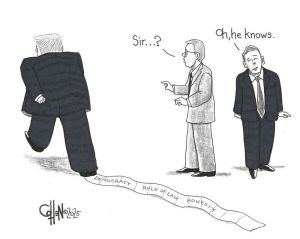 Even the ladies on the view have a better handle on this nonsense than most of the news media. This is from MediaITE. “Trump’s 3rd Term Flirtation Triggers Five-Alarm Panic on The View: ‘Damn if He Isn’t a Dictator!’” I wouldn’t be so damned worried about this if it weren’t for the corrupt Supreme Court.
The co-hosts of The View sounded a full five-alarm warning on Monday over President Donald Trump’s musings about running for an unconstitutional third term.
Whoopi Goldberg began Monday’s show by declaring, “Well, you-know-who told us he was going to be a dictator on day one and, damn, if he isn’t a dictator!”
Goldberg referred to former Trump advisor Steve Bannon’s claim that Trump is “going to get a third term.”
On Air Force One on his way to Japan Monday, Trump gave a nebulous answer to a reporter’s question about whether he would pursue a third term.
“Am I not ruling it out? I mean, you’ll have to tell me,” Trump said.
Alyssa Farah Griffin said, “There’s certain people in Trump’s orbit who, when they tell you what they’re going to do, I listen. And I would put Steve Bannon on the top of the list. He has been one of the most senior advisers to Trump the first time he ran, predicted the events around January 6th, the efforts to overturn the election. And I feel crazy because I feel like a conspiracy theorist talking about this!”
Sunny Hostin said that Trump’s ballroom project indicates that he doesn’t plan to leave the White House.
“He is hooking up the White House because he doesn’t plan on leaving it. I don’t think he plans on leaving,” Hostin said.
“I told y’all that years ago, that he had — he was not going anywhere,” Goldberg added. “He said it. He said, ‘I want to be president for life.’ I heard him say it, I watched his lips move, and I thought, he means this!”
Ana Navarro claimed, “This is a guy who has got authoritarian envy. He goes around to these countries and he loves — he wants the parades, he wants the arches, he wants the ballrooms, he wants to be an emperor, he wants to be an authoritarian. Paying no attention to the Constitution, that’s the way Ortega does it, the way Chavez did it, the way Maduro does it, Putin does it.”
 Perhaps we need a national GoFundMe for relieving Trump of his duties due to mental deficiencies. I always look to Ruth Ben-Ghiat for some rational and data-based explanations of our situation. Her blog, Lucid, is a very good place to start. “TINA (There Is No Alternative) and the Leader as “A Vehicle of Divine Providence, and my video on covering corruption and violence with an aura of holiness.” If there ever is a fascist movement, you can rely on the hyper-religious to be behind it.
In January 2016, when I forecast that Donald Trump would develop a formidable personality cult along the lines of Vladimir Putin’s and Silvio Berlusconi’s if he won the GOP presidential nomination, people called me an idiot and a clown. But Trump has developed a leader cult that conforms to my description from nine years ago:
Here’s the trick to cults of personality: the leader has to embody the people but also stand above them. He must appear ordinary, to allow people to relate to him. And yet he must also be seen as extraordinary, so that people will grant him permission to be the arbiter of their individual and national destiny.
Autocrats are always looking over their shoulders for rivals, and the claim of uniqueness is also designed to insulate the leader from the idea that others could do or have done his job better. It also silences dreaded talk of successors.
The history of autocrats suggests that the more corrupt, violent, and hated they become, the more they use TINA messaging as they seek to stay in office indefinitely. In 2008, when Putin was still consolidating his power, he agreed to have someone else (Dmitry Medvedev) serve as president, while he served as prime minister, due to a constitutional ban on an individual serving three consecutive terms. By 2020, following the large 2019 public protests over corrupted Moscow elections, vacating the presidency was no longer an option. So Putin staged a referendum to amend the constitution to stay in power until 2036. His argument? That looking for successors would jeopardize the stability that only he could offer.
Americans got a taste of TINA messaging on Oct. 19, the day after an estimated 7 million people participated in No Kings protests. Trump responded by posting an AI-edited video that advocates for him staying in office in 2036, 2048, and…forever (“Trump4Eva”).
There is no better way to give TINA traction than to proclaim the leader as in office by the will of God and spin his every action as the fruit of divine intention. This idea has the most credibility if religious leaders circulate it. Dictator Benito Mussolini, an atheist, knew this: he made the Lateran Accords with the Catholic Church and was rewarded by Pope Pius XI proclaiming him to be a “man of Providence.”
 I really don’t want to be making you have nightmares tonight, but there needs to be some bud-nipping about his virality, sanity, and a third term right now. I’m getting tired of propaganda driving decisions for this country. Here’s some more news that should make you shiver. This is from AXIOS and written by Emily Peck. “The economy is in uncharted territory.” Literally.
Data went dark this month. The government shutdown is halting the collection and release of statistics tracking the job market, public health and crop production, as well as other economic indicators.
Why it matters: The numbers are critical for understanding what’s happening in the U.S., particularly at a moment of rapid change in both government policies and in the job market.
How it works: Businesses use gold-standard government data, like the jobs report, to set wages and make hiring, pricing and investment decisions.
- Investors watch the numbers so closely that they can drive big stock reactions. Policymakers use the data to set minimum wage standards and increase food assistance or other important benefits.
Where it stands: Since the shutdown began on Oct. 1, government agencies have stopped collecting or releasing information about:
The labor market. The Bureau of Labor Statistics didn’t release a September employment report and hasn’t collected any data in October.
- We don’t know the unemployment rate or how many jobs businesses are creating. Few companies appear to be hiring, and job anxiety is skyrocketing.
Public health. Weekly numbers that track how many Americans are coming down with the flu, RSV or COVID-19 haven’t been updated.
- Local governments, doctors and Americans are in the dark about illnesses that lead to hospitalizations and the deaths of tens of thousands every year just as respiratory virus season typically kicks up.
Agriculture. The USDA’s weekly export sales report and daily sales announcements, and its monthly World Agricultural Supply and Demand Estimates aren’t coming out. Farmers and commodity traders are left with little information at the peak of the harvest season and at a time when tariffs are driving much angst, Reuters reports.
Demographic information. The 2024 American Community Survey Public Use Microdata Sample was supposed to be released on Oct. 16.
- It’s one of the few publicly available datasets that allows for measurement of economic, demographic and housing trends across small geographic areas and small population subgroups.
Between the lines: This isn’t an all-inclusive list.
- And though these should be temporary stops, there is other data that the Trump administration has walked away from permanently: on food insecurity and weather disasters.
Reality check: Some information was too important to skip. On Friday, the BLS released its Consumer Price Index, covering inflation in September — a measure tied to Social Security’s Cost of Living Adjustment, which the government said would be 2.8% next year.
- But no data on October has been collected.
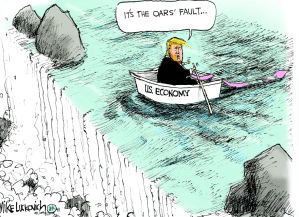 This is no way to run a modern economy. We’re now on the IMF warning list. This is via MSN but originally published at Euronews. “US borrowing expected to rival Europe’s most indebted states, says IMF.” This story is reported by Una Hajdari.
Global public debt is rising faster than at any point in modern history, and this time, it is not just the historically large spenders driving it.
The International Monetary Fund’s latest Fiscal Monitor warns that the public finances of major powers, led by the United States, have become a systemic global risk.
“Although the number of countries with debt above 100% will be steadily declining in the next five years, their share in world GDP is projected to rise,” the report stated.
This means that the collective or “global public debt is projected to rise above 100% of world GDP by 2029,” it said. In such a scenario, public debt would be at its highest level since 1948.
According to IMF calculations, this trajectory “reflects a higher and steeper path than projected before the pandemic”, signalling that governments have failed to stabilise their debt despite the recovery of global growth.
The US marks the steepest rise
The United States will see the steepest increase among major advanced economies when it comes to debt-to-GDP ratio, according to the IMF.
From 2023 to 2030, general government gross debt will climb from 119.8% of GDP in 2023 to 143.4% in 2030.
The institution noted that the United States will, for the first time this century, surpass Italy and Greece on this front — long viewed as the developed world’s most indebted states.
I’m not the least bit a deficit hawk, but this is really not good. You may read the analysis at the link.
This is from Mehdi’s Monday morning round-up, which can be found at the above Bluesky link.
Who was the president of the United States in 2020? Donald Trump, right? Obviously. We all know that.
Except perhaps… Donald Trump himself. For years now, Trump and his supporters have bizarrely behaved as if the first Trump presidency ended in 2019. They like to brag about the amazing state of the economy in 2019, while ignoring the soaring unemployment they left behind at the end of 2020. They complain about the COVID lockdowns in 2020, as if the president behind the lockdowns wasn’t… Donald John Trump.
On Friday, Trump went one step further. In fact, the president took a full step right into Crazytown with this post on his Truth Social website:
Got that? The president of the United States thinks ex-Special Counsel Jack Smith and former Biden DOJ alums Merrick Garland and Lisa Monaco “cheated and rigged the 2020 Presidential Election.” Back in 2020, to be clear, Merrick Garland was an appeals court judge, Lisa Monaco was a lawyer in private practice, and Jack Smith was the chief prosecutor at a war crimes tribunal in The Hague.
How, then, did they “rig” the 2020 election when they weren’t in government? Or did they, upon joining the Biden administration in 2021 and 2022, take a time machine and travel back in time to November 2020?
I mean, how is this not completely and utterly deranged from Trump? How are we not in 25th Amendment territory? Nothing Joe Biden ever said, even in that car-crash 2024 televised presidential debate, comes close to this unhinged nonsense from the sitting president.
And, on Saturday, the mad king in the White House took a further step into Crazytown. He increased tariffs on Canada by 10% over current levels because – I kid you not – the Canadians hurt his feelings with a television ad. Yes, really!
“Canada was caught, red handed, putting up a fraudulent advertisement on Ronald Reagan’s Speech on Tariffs,” he declaimed on – where else? – Truth Social, adding: “The sole purpose of this FRAUD was Canada’s hope that the United States Supreme Court will come to their ‘rescue’ on Tariffs that they have used for years to hurt the United States.”
How is this not a parody? How is this even legal? Does this sound like a sufficient national security argument for Trump bypassing congressional authority on tariffs? American families will now have to pay even more in taxes – as that is what tariffs are! – because their president got really mad over a foreign television ad. An ad which, as the New York Times pointed out, “faithfully reproduces Reagan’s words” from 1987, in which the Gipper denounced tariffs.
On Sunday, the King of Crazytown continued his demented and dangerous all-caps ranting online, insisting pregnant women not take Tylenol unless “ABSOLUTELY NECESSARY” and telling parents to avoid the MMR shot.
None of this is remotely normal. There is a clear mental health crisis going on in the Oval Office right now. He is detached from reality. Every politician and pundit, every journalist in the White House press corps, knows this. It should be the biggest story in our media.
But, shamefully, it isn’t.

I so miss Mehdi and Joy! I’m glad they can be found writing important things like this while the old school media folds to the Trump Regime like paper airplanes from Qatar.
Anyway, that’s enough depressing us for one day.
Is he dead yet?
What’s on your Reading, Action, and Blogging list today?
Finally Friday Reads: Waking up to?
Posted: October 24, 2025 Filed under: #We are so Fucked, American Fascists, Breaking News, Civil Liberties, Civil Rights, Psychopaths in charge | Tags: @johnbuss.bsky.social John Buss, Bombing Fishing Boats, Eminem - No Kings (Donald Trump Diss), Pardons for the Guilty, Who the Fuck Voted for this? 4 Comments
“So, a supposed desperately needed huge ballroom that seats anywhere from 650 to 1K people doesn’t include necessary parking for that kind of crowd? Seems a real estate genius would have thought of that. If only he hadn’t sold the hotel next door.’ @repeat1968, John Buss
Good Day, Sky Dancers!
Each news cycle brings us to yet another fresh hell. Considering the breaking news cycle is now endless, we’re suffering ongoing PTSD. I admit that I’ve always been a night person. However, I now sleep away as much of the morning as possible. Given that I teach in the evenings, it’s easy for me to hand over the morning to the Poland Avenue Rooster and the commuters from Chalmette bound for whatever the sons of overseers have planned for them on any particular day. So, yes, I’m late. It’s lucky my dog is very patient with me about morning walks.
The news from today is just as full of shock and awe as usual. We’re still blowing up fishing boats and watching the people’s house being turned into a tacky midcentury modern whore house. Who can be auctioned off next? Who is losing their livelihood and next meal today? Today’s attack on hapless South Americans in boats is another demonstration of how far the illegal, expensive, murder of innocents will be allowed by rapists Trump and the Drunkard Secretary of “War” will go to attempt to overcompensate for their lack of true manhood. This is from the AP as reported by Konstantin Toropin. “US is sending an aircraft carrier to Latin America in major escalation of military buildup.” We’re a rogue, terrorist country now demonstrating that the rule of law is no longer our guiding North Star.
The U.S. military is sending an aircraft carrier to the waters off South America, in the latest escalation and buildup of military forces in the region, the Pentagon announced Friday.
Defense Secretary Pete Hegseth ordered the USS Gerald R. Ford and its strike group to deploy to U.S. Southern Command to “bolster U.S. capacity to detect, monitor, and disrupt illicit actors and activities that compromise the safety and prosperity of the United States,” Pentagon spokesman Sean Parnell said in a social media post.
The USS Ford, which has five destroyers in its strike group, is currently deployed to the Mediterranean Sea. A person familiar with the operation told The Associated Press that one of those destroyers is in the Arabian Sea and another is in the Red Sea. At the time of the announcement, the USS Ford was in port in Croatia on the Adriatic Sea.
The person, who spoke on condition of anonymity to discuss sensitive military operations, would not say how long it would take for the strike group to arrive in the waters off South America or if all five destroyers would make the journey.
Deploying an aircraft carrier is a major escalation of military power in a region that has already seen an unusually large U.S. military buildup in the Caribbean Sea and the waters off Venezuela.
Hours before Parnell announced the news, Hegseth said the military had conducted the 10th strike on a suspected drug-running boat, leaving six people dead and bringing the death count for the strikes that began in early September to at least 43 people.
 The move to deny Americans and bully them away from their ability to vote has begun. This move was announced by the JustICE department today. We are dismantling our democracy in plain sight. “Justice Department to Monitor Polling Sites in California, New Jersey.” All we need now are fierce dogs and ‘literacy’ tests.
” Today, the Department of Justice announced that it will monitor polling sites in six jurisdictions ahead of the upcoming November 4, 2025, general election to ensure transparency, ballot security, and compliance with federal law.
The Department, through the Civil Rights Division, enforces federal voting rights laws that protect the rights of all eligible citizens to access the ballot. The Department regularly deploys its staff to monitor for compliance with federal civil rights laws in elections in communities across the country.
“Transparency at the polls translates into faith in the electoral process, and this Department of Justice is committed to upholding the highest standards of election integrity,” said Attorney General Pamela Bondi. “We will commit the resources necessary to ensure the American people get the fair, free, and transparent elections they deserve.”
So, we can find funds to demolish the East Wing of the White House, carry out bombing of fishing boats, and harass voters, but we can’t pay any of our Federal Workers or Soldiers. How can this be? Charlie Savage has this political analysis of our current situation in the New York Times. “The Peril of a White House That Flaunts Its Indifference to the Law. The White House has made no legal argument explaining its bald claim that the president has wartime power to summarily kill people suspected of smuggling drugs.” It’s been a few foreign atrocities ago since I read the term “summary executions” used. If any of our rogue soldiers were caught doing this, they would be hauled in to a military tribunal immediately. What do we do with a rogue President?
Since he returned to office nine months ago, President Trump has sought to expand executive power across numerous fronts. But his claim that he can lawfully order the military to summarily kill people accused of smuggling drugs on boats off the coast of South America stands apart.
A broad range of specialists in laws governing the use of lethal force have called Mr. Trump’s orders to the military patently illegal. They say the premeditated extrajudicial killings have been murders — regardless of whether the 43 people blown apart, burned alive or drowned in 10 strikes so far were indeed running drugs.
The administration insists that the killings are lawful, invoking legal terms like “self-defense” and “armed conflict.” But it has offered no legal argument explaining how to bridge the conceptual gap between drug trafficking and associated crimes, as serious as they are, and the kind of armed attack to which those terms can legitimately apply.
The irreversible gravity of killing, coupled with the lack of a substantive legal justification, is bringing into sharper view a structural weakness of law as a check on the American presidency.
It is becoming clearer than ever that the rule of law in the White House has depended chiefly on norms — on government lawyers willing to raise objections when merited and to resign in protest if ignored, and on presidents who want to appear law-abiding. This is especially true in an era when party loyalty has defanged the threat of impeachment by Congress, and after the Supreme Court granted presidents immunity from prosecution for crimes committed with official powers.
Every modern president has occasionally taken some aggressive policy step based on a stretched or disputed legal interpretation. But in the past, they and their aides made a point to develop substantive legal theories and to meet public and congressional expectations to explain why they thought their actions were lawful, even if not everyone agreed.
 I keep seeing that Monty Python skit in my mind. “Nobody expects …” The stacking of the Supreme Court, the complete cowardice and compliance of all Republican elected officials, and the responses of the Democratic Party, which seems lost in Wonderland at times, is something no one from the founders forward ever completely expected. Even when we’ve seen things inch towards totalitarianism, the institutions of governance would eventually pull through. Now we seem to capitulate on all fronts except with lawsuits brought by private lawyers to key judges. Even when we win the lawsuits, however, Trump just ignores things. It’s hard to see the impeachment remedy even being discussed with the current, feckless Speaker of the House. Please take time to read that article.
The Department of Homeland Security has turned into the Gestapo. I always had a problem with the creation of that Department and felt it would be likely open to abuse at some point, but I never had this on my dance card. “DHS Tries To Unmask Ice Spotting Instagram Account by Claiming It Imports Merchandise.” Again, the most interesting information comes from alternative media sources these days. In this case, it’s 404 Media. The big media companies are too busy paying for the Ballroom Atrocity.
The Department of Homeland Security (DHS) is trying to force Meta to unmask the identity of the people behind Facebook and Instagram accounts that post about Immigration and Customs Enforcement (ICE) activity, arrests, and sightings by claiming the owners of the account are in violation of a law about the “importation of merchandise.” Lawyers fighting the case say the move is “wildly outside the scope of statutory authority,” and say that DHS has not even indicated what merchandise the accounts, called Montcowatch, are supposedly importing.
“There is no conceivable connection between the ‘MontCo Community Watch’ Facebook or Instagram accounts and the importation of any merchandise, nor is there any indicated on the face of the Summonses. DHS has no authority to issue these summonses,” lawyers with the American Civil Liberties Union (ACLU) wrote in a court filing this month. There is no indication on either the Instagram or Facebook account that the accounts are selling any type of merchandise, according to 404 Media’s review of the accounts. “The Summonses include no substantiating allegations nor any mention of a specific crime or potential customs violation that might trigger an inquiry under the cited statute,” the lawyers add.
A judge temporarily blocked DHS from unmasking the owners last week.
“The court now orders Meta […] not to produce any documents or information in response to the summonses at issue here without further order of the Court,” the judge wrote in a filing. The move to demand data from Meta about the identities of the accounts while citing a customs statute shows the lengths to which DHS is willing to go to attempt to shut down and identify people who are posting about ICE’s activities.
 We know the Trump Criminal Syndicate is all about the grift. Here are some thoughts by Sidney Blumenthal writing at The Guardian. “Donald Trump has built a regime of retribution and reward. The president’s purges and attacks on his enemies have developed into a system in which injustice is made routine.” Nice use of alliteration there!
Donald Trump’s voracious desire for retribution has quickly evolved into a regular and predictable system. In the year since his election, the president’s rage and whims have assumed the form of policies in the same way that Joseph Stalin’s purges could be called policies. Figures within the federal system of justice who do not do his bidding are summarily fired and replaced by loyalists. Leaders who have called him to account or are in his way may face indictment, trial and punishment. Opponents have been designated under Presidential National Security Memorandum No 7 as “Antifa”: “anti-American”, “anti-Christian” and “anti-capitalist”, and threatened with prosecution as a “terrorist”. Meanwhile, many aligned with him escape justice, whether through the hand of the Department of Justice (DoJ) or the presidential pardon power. Now, he demands compensation for having been prosecuted to the tune of $230m from the DoJ budget.
Each of the cases involving prosecution of Trump’s enemies and, on the other hand, the leniency extended to his allies has its own peculiarities of outrage. But whatever their unique and arbitrary perversities, they are expressions of what has emerged as a technique. These episodes are not isolated or coincidental. Trump’s purge of DoJ prosecutors and FBI agents, accompanied by his installment of flunkies in senior positions, started in a rush and quickly assumed a pattern, but has now been molded into a regime. The justice department and the FBI have been remade into political agencies under Trump’s explicit command to carry out his wishes. Injustice is made routine. It is the retribution system.
The origin of this system has been exposed in the complaint of three former senior FBI officials filed on 10 September in the US district court in DC against the FBI director, Kash Patel, and the US attorney general, Pam Bondi, for illegal termination in “a campaign of retribution against Plaintiffs for what Defendants deemed to be a failure to demonstrate sufficient political loyalty”. In the complaint, Brian Driscoll, the former acting FBI director, describes a conversation in which Patel “openly acknowledged the unlawfulness of his actions”.
Driscoll had tried to shield FBI agents from being fired, the complaint alleges. Patel told him that “they” – understood by Driscoll to be the White House and justice department – had directed him to fire anyone whom they identified as having worked on a criminal investigation against Trump. The complaint continues: “Patel explained that he had to fire the people his superiors told him to fire, because his ability to keep his own job depended on the removal of the agents who worked on cases involving the President. Patel explained that there was nothing he or Driscoll could do to stop these or any other firings, because ‘the FBI tried to put the President in jail and he hasn’t forgotten it.’” When Driscoll told Patel he was violating the FBI’s own internal rules, Patel allegedly said “he understood that and he knew the nature of the summary firings were likely illegal”.
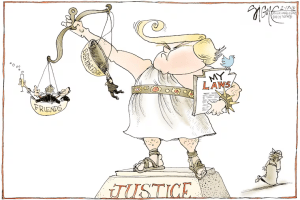 Read more and weep at the link. Orange Caligula’s favorite presidential power is that of the pardon. He’s been going wild recently, letting white guys who commit high crimes out for no particular reason other than he relates to them and the crimes. Plus, he loves the power. This is from AXIOS’ Steve Neukam. “Exclusive: Senate Dems move to condemn Trump’s Binance pardon.” This is the case where the evidence and crime were so obvious that the guy copped to the crime. Evidently, saying you’re actually guilty doesn’t count as being actually guilty in TrumpLandia. That doesn’t even count the amount of the Bribes that bribed Trump for the pardon by throwing crypto at Trump Klan’s plan.
Senate Democrats are moving to officially condemn President Trump’s pardon of Changpeng Zhao, better known as CZ, the founder of crypto exchange Binance, Axios has learned.
Why it matters: Some Senate Republicans have already criticized the pardon, with Democrats eyeing rare bipartisan pushback against the White House.
- Trump’s pardon of CZ, who was facing four months in prison related to money laundering, likely provides a path for Binance to operate in the U.S. after more than a year of lobbying from the president.
- Democrats argue the pardon is blatant “corruption,” urging Congress to take steps to avoid similar acts in the future.
- The resolution was led by Sens. Elizabeth Warren (D-Mass.) and Adam Schiff (D-Calif.), two longtime Trump foes.
The big picture: The Trump family’s crypto empire has drawn the ire of Capitol Hill this year. Their connection to Binance is only intensifying the scrutiny.
- In May, World Liberty Financial, the Trump family’s crypto venture, announced that an Emirati state-backed venture fund would use World Liberty’s new stablecoin to complete a $2 billion investment in Binance.
- “We thank President Trump for his leadership and for his commitment to make the US the crypto capital of the world,” a Binance spokesperson said in a statement.
What they’re saying: Sen. Thom Tillis (R-N.C.) said this week that the pardon “is a bad signal.”
 Let me know when “officially condemning” actually works with this asshole. He wears that label like a tribute. Another Democratic Governor has stepped up to the fight to contain the Trump Regime. This time it’s Michigan’s Gretchen Whitmer. Her latest speech on the audacities committed by Trump is highlighted in this article in The Hill. “Whitmer: ‘No one is worried about building a ballroom’.” This is reported by Ryan Mancini.
Michigan Gov. Gretchen Whitmer (D) brushed off debate over the demolition of the East Wing of the White House and President Trump’s plans to build a ballroom, saying Thursday the focus should instead be on the government shutdown’s impact on federal workers in her state.
Whitmer appeared on MSNBC’s “The Briefing with Jen Psaki” to talk about the shutdown when the host shared an “insane split screen” that featured the East Wing’s demolition “happening while the shutdown is leaving so many workers without pay and critical benefits.”
“I just wonder, from your vantage point as a governor of a state, what are you making of that split screen?” Psaki asked.
“Well, as I have talked to people, I’m telling you right now, no one is worried about building a ballroom in Washington, D.C.,” Whitmer replied. “What they want is to make sure that they can feed their kids next week. And the longer the shutdown goes, the more precarious it gets for people.”
The governor said most Americans are “never going to step foot in a ballroom over the course of their lifetime.”
“But what they do every single day is try to feed their kids, make sure that they get a job to show up to, make sure that they don’t hit a pothole on their drive to work and they have to take money out of their rent or their child care to pay to fix their damn car,” she continued. “That’s why we got to stay focused on the issues that matter to people.”
On Thursday, excavators completed the demolition of the White House’s East Wing. Set to replace is a ballroom the Trump administration expects will be finished before the end of the president’s second term in 2029. Trump said this week the project would cost roughly $300 million, and the administration released a list of donors Thursday who it said it funding the project.
I’m really getting tired of these obvious steps back to Kings, autocracy, and huge wastes of money. Who the Fuck voted for this?
What’s on your Reading, Blogging, and Action List today?
Mostly Monday Reads: Whitewashing Indigenous Peoples’ Day
Posted: October 13, 2025 Filed under: #FARTUS, #MAGAnomics, #We are so Fucked, kakistocracy, Polycrisis | Tags: Stagflation, Trump Chaos and Incompetency, Trump Stagflation, Trump Tarriffs, Trump Unemployment, Trump War on Science, Trup War on History 7 Comments
“If it looks like a pig, smells like a pig, acts like a pig….” John Buss, @repeat1968
Good Day, Sky Dancers!
Today, we celebrate the Indigenous tribes of America. Joe Biden was the first president to recognize the day in 2021. We still haven’t dropped Columbus Day, which glorifies a man who truly represents the worst of European colonization of other continents.
Christopher Columbus has become a controversial figure over the years, despite the federal holiday in his honor. While many credit the explorer with “discovering” America, many others condemn Columbus for forced conversion of native peoples to Christianity, the use of violence and slavery, and the introduction of new diseases that would cause serious and long-lasting harm to Indigenous people.
In 2021, former President Joe Biden became the first president to recognize Indigenous Peoples Day, celebrating it in tandem with Columbus Day. In 2025, President Donald Trump issued a proclamation condemning critics of Columbus.
 Yes, you read that right. Trump issued one of his ugly proclamations, criticizing those of us who don’t stand by whitewashed history. Yam Tits and his ugly band of White Christian Nationalists reject the idea that anyone but them created places worth saving and celebrating.
On Oct. 9, Trump issued a proclamation titled “Columbus Day, 2025.”
Trump celebrated Italian explorer Columbus as “the original American hero” in the proclamation, accusing his critics of slander.
“Outrageously, in recent years, Christopher Columbus has been a prime target of a vicious and merciless campaign to erase our history, slander our heroes, and attack our heritage,” reads the proclamation.
Meanwhile, in the world of bill paying and trying to live, it’s still the Economy Stupid! This is from Reuters. “How the United States is eating Trump’s tariffs.” This is reported by “Francesco Canepa and Howard Schneider.”
U.S. companies and consumers are bearing the brunt of the country’s new import tariffs, early indications show, contradicting assertions by President Donald Trump and complicating the Federal Reserve’s fight against inflation.
Trump famously predicted that foreign countries would pay the price of his protectionist policies, wagering that exporters would absorb that cost just to keep a foothold in the world’s largest consumer marketBut academic studies, surveys and comments from businesses show that through the first months of Trump’s new trade regime it is U.S. companies that are footing the bill and passing on some of it to the consumer – with more price hikes likely.
“Most of the cost seems to be borne by U.S. firms,” Harvard University professor Alberto Cavallo said in an interview to discuss his findings. “We have seen a gradual pass-through to consumer prices and there’s a clear upward pressure.
A White House spokesperson said “Americans may face a transition period from tariffs” but the cost would “ultimately be borne by foreign exporters.” Companies were diversifying supply chains and bringing production to the United States, the spokesperson added.
Cavallo and researchers Paola Llamas and Franco Vasquez have been tracking the price of 359,148 goods, from carpets to coffee, at major online and brick-and-mortar retailers in the United States.
They found that imported goods have become 4% more expensive since Trump started imposing tariffs in early March, while the price of domestic products rose by 2%.The biggest increases for imports were seen in goods that the United States cannot produce domestically, such as coffee, or that come from highly penalised countries, like Turkey.
These price hikes, while material, have been generally far smaller than the tariff rate on the products in question – implying that sellers were absorbing some of the cost as well.
Yet U.S. import prices, which don’t include tariffs, showed foreign exporters have been raising their prices in dollars and passing on to their U.S. buyers part of the greenback’s depreciation against their currencies.
“This suggests foreign producers are not absorbing much if any of the U.S. tariffs, consistent with prior economic research,” researchers at Yale University’s Budget Lab think-tank said in a blog post.
National indices of export prices paint the same picture. The cost of goods exported by China, Germany, Mexico, Turkey and India have all risen, with Japan the only exception.
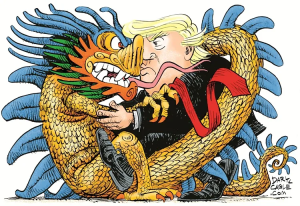 Dr. Paul Krugman has a serious economic analysis of the evolving trade relationship between the US and China today in his Substack. “How Trump Is Making China Great. Why we’re going to lose the trade war, and much more besides.” Yes, we’re still practicing the dismal science, but being forewarned is better than being caught unprepared.
There is, however, one big difference between Trump’s trade policy and China’s. Namely, the Chinese appear to know what they’re doing.
It should have been obvious from the beginning that if America were to get into a full-scale trade war with China, the Chinese would have the upper hand. For one thing, in real terms China has the bigger economy.
Furthermore, while our economies are interdependent, America is more vulnerable to a rupture than China is. True, Chinese industry has relied to an important degree on sales to the United States. But the U.S. economy is dependent on China for critical inputs, above all those rare earths. And here’s the thing: China can quickly compensate, at least in part, for the loss of the U.S. export market by stimulating domestic demand. Given time, America could wean itself from dependence on Chinese inputs — but doing so would take years.
That said, a year ago the United States still had some important advantages over China. Although China has made great strides in science and technology, America still had a commanding position, thanks in large part to our unmatched research establishment, our great research universities, and our ability — thanks in large part to the openness of our society — to recruit talent from all over the world.
Furthermore, America had allies — which, as Phillips O’Brien emphasizes, are a vastly underrated source of national power. China may sometimes make alliances of convenience, but no more than that. The U.S. could and did build a powerful alliance system, because America was more than a nation: It was an idea and a set of values, values we shared with the rest of the democratic world. And you should always bear in mind that Europe, in particular, while it sometimes acts weak, is an economic superpower in the same league as China and America.
OK, you know what’s coming: Since taking office, Trump and his minions have been systematically demolishing each of these pillars of U.S. strength.
 The first pillar mentioned, and the most obvious, is the destruction of the institutions and incentives that support scientific research, which include universities, private industry, and government agencies. You may read more details on that at the link. It’s been rather obvious to most of us, but his list is a good, quick reference.
This administration is characterized by cruelty and incompetence. The absolute destruction of government institutions and specialists made to enhance advancements that private industries can’t afford to fund profitably is a hallmark of both. Nowhere is this felt more than in institutions that support Public Health. Firing experts, then attempting to either rehire or replace them, is unbelievably disruptive to any science-based endeavor. This article is from CNN’s Brenda Goodman and Meg Terrill. “More than half of CDC staffers recently fired by Trump administration have been reinstated.”
Hundreds of staff fired from the US Centers for Disease Control and Prevention late Friday have been reinstated, according to the American Federation of Government Employees.
After a new round of layoff notices sent late Friday night to around 1,300 workers at the CDC, approximately 700 were reinstated on Saturday, while about 600 remain laid off, according to the union, which represents federal workers.
“The employees who received incorrect notifications were never separated from the agency and have all been notified that they are not subject to the reduction in force,” said Andrew Nixon, director of communications for the US Department of Health and Human Services.
Among reinstated employees are staff that publish the agency’s flagship journal, Morbidity and Mortality Weekly Report, according to Dr. Debra Houry, who recently resigned as the agency’s chief medical officer and deputy director for program and science. Houry and other high-level CDC officials resigned in August in protest over the firing of recently confirmed CDC Director Dr. Susan Monarez.
Athalia Christie, the incident commander for the measles response, was among hundreds of employees mistakenly fired on Friday. The annual total of measles cases in the US – now up to 1,563 cases since January – is the highest by a significant margin since measles was declared eliminated in America a quarter-century ago.
Staff were also reinstated at the CDC’s National Center for Immunization and Respiratory Diseases, the Global Health Center, and the Public Health Infrastructure Center, which manages more than $3 billion in grants to 107 state and local governments to help build local public health workforces, said Dr. Brian Castrucci, who is president and chief executive officer of the de Beaumont Foundation, a nonprofit that advocates for public health workers.
Staff and officers at the CDC’s Epidemic Intelligence Service who were able to check their emails have also received notices that their firings were in error, according to a CDC official with knowledge of the situation who asked not to be named for fear of retaliation.
 An analysis of the jobs and people reinstated is provided in the article. Meanwhile, the inhumanity and violence surrounding operations by ICE continue. Andrew Schwartz reports this headline. Documents Allege a Federal Agent at Portland ICE Threatened to Shoot an Ambulance Driver. Feds delayed medics who had come to pick up an injured protester. Then, according to confidential incident reports, the agents became aggressive.”
Late on Oct. 5, a Portland ambulance crew informed dispatchers over the radio that it was attempting to transport a patient from U.S. Immigration and Customs Enforcement to Legacy Emanuel Medical Center but that ICE officers were impeding its departure. Six minutes later, at 9:40 pm, according to publicly archived radio records, the medic driving the vehicle delivered an update: “We are still not being allowed to leave by ICE officers.”
Two confidential incident reports obtained by WW offer insight into what was going on inside the South Portland ICE facility at the time. The written accounts were filed by the ambulance crew members shortly after the incident—one report to their employer, American Medical Response, and another to a union representative—as documentation, as one report puts it, of a “conflict with federal agents.”
The two reports, filed by different medical workers, mirror each other’s accounts, and are consistent with publicly available audio recordings of emergency medical services radio communications, as well as 911 calls and dispatch reports obtained under public records law.
Both reports say that federal agents, in an effort to block the ambulance’s departure, stood directly in front of the vehicle. As the delay dragged on, according to the reports, the ambulance operator put the vehicle into park, causing it to lurch forward slightly.
The reports indicate the federal agents did not like this—so much so that an agent threatened to shoot and arrest the driver. The driver, frightened, asked why. An agent, according to the reports, responded that the driver had attempted to hit him with the ambulance.
“I was still in such shock,” the driver later wrote, “that they were not only accusing me of such a thing, but crowding and cornering me in the seat, pointing and screaming at me, threatening to shoot and arrest me, and not allowing the ambulance to leave the scene. This was no longer a safe scene, and in that moment, I realized that the scene had not actually been safe the entire time that they were blocking us from exiting, and that we were essentially trapped.”
 The latest child abduction by ICE has occurred in Boston. This is from MASS LIVE. “Mass. 13-year-old was picked up by ICE after a police interaction and now he’s hundreds of miles from home.” The story was filed by Adam Bass. Is this really the kind of country we want to live in?
A 13-year-old boy from Everett who was arrested and detained by Immigration and Customs Enforcement (ICE) has been transferred to a juvenile facility in Virginia.
Andrew Lattarulo, of Georges Cotes Law, said his firm received an email from the U.S. Attorney’s Office confirming the child was transferred on Friday at 9:30 a.m. He forwarded the email to MassLive.
The boy is still in custody, Lattarulo said.
The transfer occurred on the same day Judge Richard G. Stearns of the Boston federal court ordered the boy’s release by Tuesday unless ICE and the Department of Homeland Security could provide grounds for continued detention, according to court documents
ICE arrested the boy, whose family is from Brazil, after an interaction with the Everett Police Department, the Boston Globe reported.
The boy’s mother received a call on Thursday to pick her son up from the department; however, an hour and a half later, she was told ICE had taken her son, the Globe reported.
 Something is very wrong with a human being who can support this level of cruelty. Meanwhile, The Hill‘s Emily Brooks reports on the callous and snivelling Speaker of the House’s latest shrug. “Johnson: ‘We’re barreling toward one of the longest shutdowns in American history’.
Speaker Mike Johnson (R-La.) said Monday the government shutdown is on its way to being one of the longest in history unless Democrats accept the House-passed, GOP-crafted stopgap bill to reopen the government.
“We’re barreling toward one of the longest shutdowns in American history, unless Democrats dropped their partisan demands and passed a clean, no-strings-attached budget to reopen the government and pay our federal workers,” Johnson said in a press conference on the 13th day of the government shutdown.
Congressional leaders have been locked in a standoff over government funding as Democrats demand that Republicans make concessions on health care, notably Affordable Care Act tax credits that are expiring at the end of the year. Republican leaders have refused to negotiate on health care during a shutdown, arguing that that Democrats must accept the “clean” funding stopgap the House passed in September — and which has failed to advance in the Senate seven times.
The shutdown, 13 days and counting, already marks one of the longest federal government funding lapses in modern history.
The longest government shutdown, which was also the last time a federal funding lapse occurred, was from 2018 to 2019 during President Trump’s first term, lasting 35 days.
 Things are not going to get better until we’re rid of these tinpot Republicans. The signs of stagflation and the accompanying suffering are on the increase. I’m going wonky on you again with this article from Investors Observer. “This is stagflation (literally): U.S. hiring crashes to recession levels as ‘second stagflation mountain’ rises.”
Stagflation is no longer just a rhetorical device to describe the U.S. economy in 2025.
Real signs of its toxic mix of stagnant growth and stubborn inflation are emerging across both the labor market and consumer prices, painting a grim near-term outlook.
According to Apollo chief economist Torsten Slok, the U.S. hiring rate, a number of hires as a percentage of total employment, has fallen to recessionary levels.
A recent Apollo chart comparing the quits rate and hiring rate shows that hiring has plunged to levels last seen during the 2020 pandemic crash, and is now approaching lows from the Global Financial Crisis.
With slower job growth and rising unemployment, Slok warned that the labor market is nearing a virtual standstill, “where workers are not getting hired or changing jobs.”
At the same time, inflation remains stubbornly high. A separate Apollo analysis found that 60% of the CPI basket is currently rising at an annualized rate above 3%, well above the Federal Reserve’s 2% target.
While that marks an improvement from recent months, when 72% of CPI components ran above 3%, the persistence underscores how broad-based inflation remains.
“Is a second inflation mountain emerging?” Slok asked, referencing the first inflation surge that began in 2021 and peaked in mid-2022 with headline CPI at 9.1%.
Together, the data of higher inflation and slower growth strengthen the case that the U.S. is now grappling with stagflation, a scenario the Fed may find difficult to reverse without triggering deeper economic pain.
 One and done! One of the most disruptive institutions since the Trump regime of Terror has been the Supreme Court. This report by Adam Lipak finally shows how the Republican Appointees really are christofascists trying to hide behind the cloak of Conservatism and Originalism. We’ve seen more radical interpretations by the Roberts court than not. This was published in the New York Times. “Originalist ‘Bombshell’ Complicates Case on Trump’s Power to Fire Officials. As the Supreme Court seems poised to expand the president’s power, a leading scholar whose work the justices have often cited issued a provocative dissent.”
The Supreme Court will hear arguments in December about whether President Trump can fire government officials for any reason, or no reason, despite laws meant to shield them from politics.
There is little question that the court will side with the president. Its conservative majority has repeatedly signaled that it plans to adopt the “unitary executive theory,” which says the original understanding of the Constitution demands letting the president remove executive branch officials as he sees fit.
But a new article, from a leading originalist law professor, has complicated and perhaps upended the conventional wisdom. The legal academy treated the development like breaking news.
“Bombshell!” William Baude, a law professor at the University of Chicago who himself is a prominent originalist, wrote on social media. “Caleb Nelson, one of the most respected originalist scholars in the country, comes out against the unitary executive interpretation” of the Constitution.
Professor Nelson, who teaches at the University of Virginia and is a former law clerk to Justice Clarence Thomas, wrote that the text of the Constitution and the historical evidence surrounding it grants Congress broad authority to shape the executive branch, including by putting limits on the president’s power to fire people.
Professor Nelson’s article was published Sept. 29 by the Democracy Project, an initiative at the New York University School of Law that plans to release 100 essays in 100 days by an ideologically mixed group.
The article is particularly notable, said Richard H. Pildes, who is a law professor at N.Y.U. and one of the project’s founders.
“If a highly respected originalist scholar like Professor Nelson, on whom the court relies frequently, denies that originalism supports the unitary executive theory,” Professor Pildes said, “that inevitably raises serious questions about an originalist justification for the court’s looming approach.”
Professor Nelson’s scholarship has been exceptionally influential. It has been cited in more than a dozen Supreme Court opinions, including ones by every member of the six-justice conservative majority.
Read more at the link.
It’s getting really difficult to be an American these days.
What’s on your Reading, Blogging, and Action list today?

 peej
peej Carissa
 bostonboomer
 dakinikat
 ecocatwoman
 mablue2
 Mama Lopez
 peggysue22
 quixote
 skydancingguestblogger
 Mona (aka Wonk the Vote)



 Sky Dancing
Recent Comments