
We come now to bury Supply Side Economics
Posted: July 25, 2010 Filed under: Team Obama, The Bonus Class, The Great Recession, The Media SUCKS, U.S. Economy, Voter Ignorance | Tags: voodoo economics, why things were so good during the Clinton years Comments Off on We come now to bury Supply Side EconomicsI’ve been having a major hissy fit about the extraordinary bad policy measures proposed and undertaken by Republicans for sustaining tax cuts and deficits for as long as I can 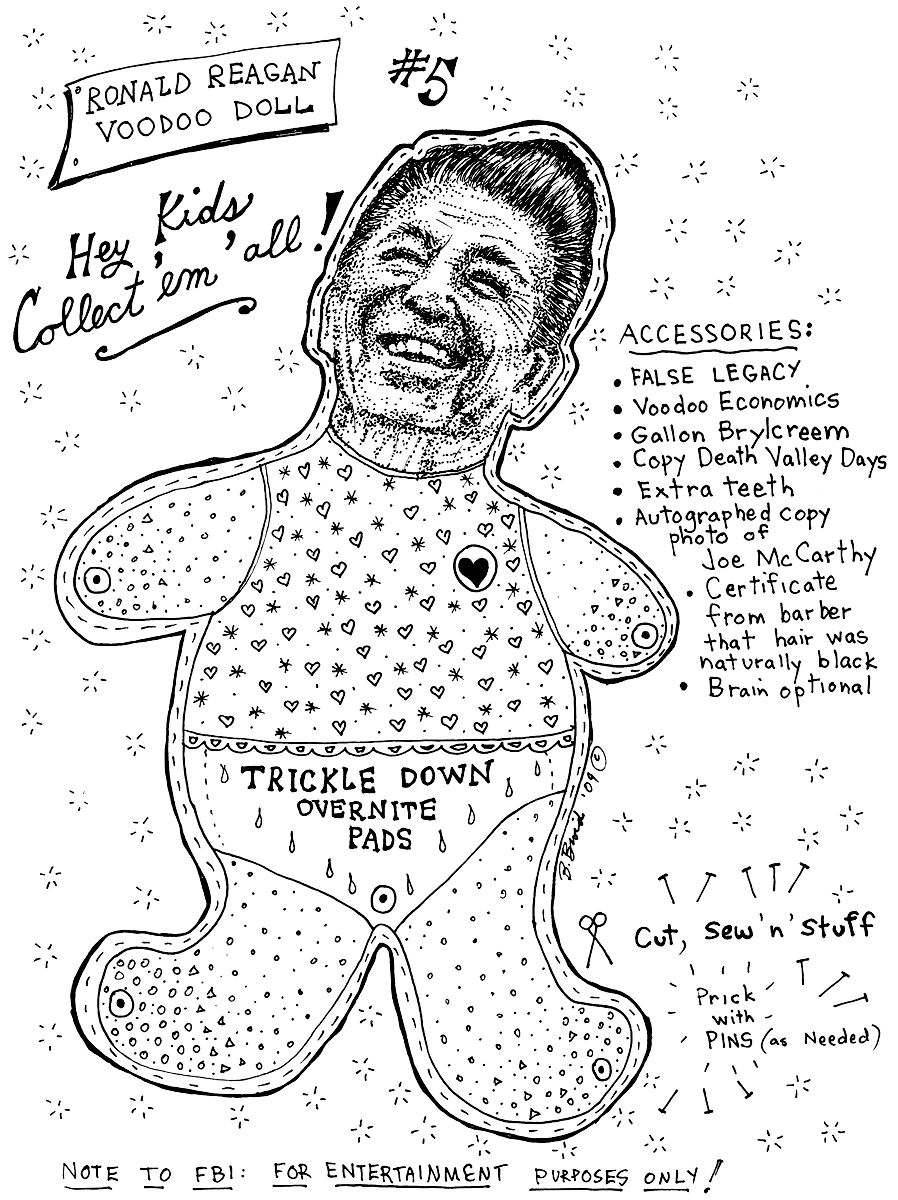 remember. The deal is, however, nobody likes it when you tell them they can’t have a free lunch when Ronnie Raygun repeated it ad infinitum. That is very much how the Republicans have achieved political victory since the Reagan years. Basically, they promise to cut taxes no matter what the circumstances and spend money on every military adventure and toy that comes down the pike and chock it up to preserving American exceptionalism. Ronald Reagan and Dubya Bush are responsible for the deficit today and the people that benefited from their tax cuts–and voted for them–should be asked to clean up the mess.
I was ever so pleased to read this article by FT’s Martin Wolf that recognizes ‘supply-side economics’ for what it is. It has nothing to do with a good economy and has everything to do with good politics. It’s a policy of promising and delivering everything and then screaming about the huge bill when a Democrat is in office. Every 8 years or so they do one huge Dine and Dash on the country. Wolf realizes this and basically calls Dubya’s tax cuts “massive, irresponsible, and unsustainable”. He also rightly calls the Reagan years for what they were. Reagan was a premier example of Keynesian policy. Ronald Reagan spent us out of the recession of the early 1980s. The only thing that was supply side about it was the high supply of bull shit rhetoric that went along with it. Some one needs to correct the message.
Ronald Reagan was the country’s premier Keynesian. Then Bill Clinton got into office and led us to a very long,very good business boom by doing what Keynes said to do during that time. You only deficit spend when the economy sucks. It had improved by the beginning of the 1990s. Bill Clinton was frugal. I can never forget the day that Dubya/Cheney looked at those surpluses they inherited and Cheney said, deficits don’t matter, Reagan showed us that. Then they immediately started two wars and gave away the Treasury to every corporation and rich person in the country. It’s damn ironic now that every Republican and Blue running Dawg thinks deficits matter. This is the time when we need them. We should’ve paid more attention to them like five years ago. But Cheney of no heart has brass balls and a spine. If only we had a Democrat in elected office with spine and balls.
Anyway, here’s Wolf’s nutshell description of supply side economics. It’s a good one.
To understand modern Republican thinking on fiscal policy, we need to go back to perhaps the most politically brilliant (albeit economically unconvincing) idea in the history of fiscal policy: “supply-side economics”. Supply-side economics liberated conservatives from any need to insist on fiscal rectitude and balanced budgets. Supply-side economics said that one could cut taxes and balance budgets, because incentive effects would generate new activity and so higher revenue.
The political genius of this idea is evident. Supply-side economics transformed Republicans from a minority party into a majority party. It allowed them to promise lower taxes, lower deficits and, in effect, unchanged spending. Why should people not like this combination? Who does not like a free lunch?
How did supply-side economics bring these benefits? First, it allowed conservatives to ignore deficits. They could argue that, whatever the impact of the tax cuts in the short run, they would bring the budget back into balance, in the longer run. Second, the theory gave an economic justification – the argument from incentives – for lowering taxes on politically important supporters. Finally, if deficits did not, in fact, disappear, conservatives could fall back on the “starve the beast” theory: deficits would create a fiscal crisis that would force the government to cut spending and even destroy the hated welfare state.
In short, Republicans chose one side of Keynesian economics–the side that uses government spending or tax cuts to spur an economy that should be used only during recessions–and applied it like the apple cider vinegar of economic policy. One spoonful of tax cuts fits all! Decades of data have shown economists that that is the farthest thing from truth, however, the political windbags of the right have managed to continue the charade that every one can have everything and not pay for it as long as we just cut taxes. (That is until a democratic president takes office). It’s like saying 1 + 1 = 4. Problem is that many people still buy that. It’s like thinking there were Dinosaurs in a literal Garden of Eden.
The truth is that tax cuts NEVER pay for themselves. Even one of Dubya’s advisors has said as much.
Indeed, Greg Mankiw, no less, chairman of the Council of Economic Advisers under George W. Bush, has responded to the view that broad-based tax cuts would pay for themselves, as follows: “I did not find such a claim credible, based on the available evidence. I never have, and I still don’t.” Indeed, he has referred to those who believe this as “charlatans and cranks”. Those are his words, not mine, though I agree. They apply, in force, to contemporary Republicans, alas,
Since the fiscal theory of supply-side economics did not work, the tax-cutting eras of Ronald Reagan and George H. Bush and again of George W. Bush saw very substantial rises in ratios of federal debt to gross domestic product. Under Reagan and the first Bush, the ratio of public debt to GDP went from 33 per cent to 64 per cent. It fell to 57 per cent under Bill Clinton. It then rose to 69 per cent under the second George Bush. Equally, tax cuts in the era of George W. Bush, wars and the economic crisis account for almost all the dire fiscal outlook for the next ten years (see the Center on Budget and Policy Priorities).
The Democratic leadership must get out ahead of this misleading set of facts and stories. It doesn’t help that they are also adding to the confusion by dissing the Clinton/Gore economic record. Indeed, if any of them would ever get around to reminding the public how good they had it in the 90s, the message would go far. I also remember the Reagan Years. My first house loan came with an interest rate of %16.7. Both my exhusband and I lost our first jobs out of college because of a bad economy. I lost my job at a huge S&L that went bankrupt. He lost his at the Federal Land Bank because of the bad ag economy. The Reagan period was not morning again in America and the Democrats need to step up the game to remind people of that.
Why is it that the Republicans so clearly and convincingly get people to buy the snake oil and the Democrats can event manage to agree on a coherent message? Of course, it would help if they’d stuff that dead racoon of a hairmet in Senator Ben Nelson’s mouth every time he goes rogue, but it would also help if they mentioned how everything was just fine during the Clinton years.
Here let me remind you. The unemployment rate hit a 30 year low in 1999. It was 4.2% and it was low for all groups including

Find the good trend.
blacks, women and hispanics. (It was 7.3% when he took office). From 1993 to 1999, the economy added 20.4 million jobs. There were also increases in blue collar jobs like construction.
20.4 Million New Jobs Created Under the Clinton-Gore Administration. Since 1993, the economy has added 20.4 million new jobs. That’s the most jobs ever created under a single Administration – and more new jobs than Presidents Reagan and Bush created during their three terms. Under President Clinton, the economy has added an average of 245,000 jobs per month, the highest of any President on record. This compares to 52,000 per month under President Bush and 167,000 per month under President Reagan.
92 Percent — 18.8 Million — of the New Jobs Have Been Created in the Private Sector. Since President Clinton and Vice President Gore took office, the private sector of the economy has added 18.5 million new jobs. That is 92 percent of the 20.4 million new jobs – the highest percentage since Harry S. Truman was President and presiding over the post-World War II demobilization.
We had the fastest and the longest Real Wage growth in two decades. Inflation was the lowest it had been since the 1960s.
Under President Clinton, real wages are up 6.5 percent, after declining 4.3 percent during the Reagan and Bush years. Real wage growth in 1998 reached 2.6 percent — the largest increase since 1972.
Okay, so now, tell me. What policies were highly successful? Which policies lead us to peace and prosperity? Why aren’t we seeing the Democrats today try to reinvigorate the policies of Clinton/Gore instead of putting through legislation that comes from the Heritage Foundation? Why are they even dicking around the Republicans at this juncture?
The Obama apologists wonder why Obama–the greatest things since FDR?–is not getting due credit for all these massively huge bills that his congressional chorus line has passed. Well, it’s the economy stupid! First things should’ve been put first. We got a half assed stimulus bill the same way we now have assed financial reform and half assed health insurance reform. If he’d have put all of his political capital into solving the country’s economic problems (JOBS) first, he’d have had enough to run the gambit on the rest. And I would be willing to bet you we wouldn’t have to wonder why a bunch of half-baked Heritage Foundation plans got implemented under a Democratic presidency and majority.
What is so wrong with so many people that they can’t just point to the Clinton years and say, let’s just do that again? Of all things, why can’t the Democrats take and sell that message seriously?
Simple Truths
Posted: July 4, 2010 Filed under: Environmental Protection, Gulf Oil Spill, U.S. Economy, Voter Ignorance | Tags: disincentives, incentives, oil industry subidies, taxes 2 Comments One of the useful things about theories and laws–in the sense of scientific method–is that they provide some very simple insight into the way things are. They are not based on wishful thinking or faith. Hypotheses grow up to be theories only with rigorous testing by many many great minds who consistently recreate similar truths in similar circumstances.
Once the theory becomes established, it can be used for many purposes and insights. In economics, we use these things for predictions and policy insights. We know that a given outcome will–with extremely high probability–recur given the same circumstances. There are laws of demand and supply. There are theories on elasticities of supply and demand given prices or income. We have a fairly good catalog of theories that we teach and we make doctoral students reprove over and over again so they too, can establish that insight and make predictions.
Established theories are basically things that are ‘no brainers’ in any field. One such set of theories in economics deals with taxes and subsidies. You tax something, you see less of that thing because it adds cost and dampens both supply and demand for the taxed thing. You subsidize it, you get more demand and more supply because it lowers the cost. As a matter of theory, when you really subsidize something, you generally end up warping the incentives for production and consumption of that good so badly that not only does that market become pretty dysfunctional, but it tends to spread to other markets because it transfers scarce resources–better put to other uses– from some markets to the subsidized market.
In some cases, we purposely warp a market with taxes for policy purposes. This is the case with so-called sin taxes. There is a reason that cigarettes are taxed to the point that the pricing point of a pack of cigarettes approaches the cost of a CD of music or a ticket to a movie. That’s because the government wants to discourage entry to the market to teen smokers. Prices (after tax) of cigarettes typically rival things teens do. These include going to movies or buying music. It forces the teen who might become a smoker into a choice and hopefully, a good one that includes not smoking. In this case, the disincentive is the policy choice. We often subsidize things too like public transportation or public education. This is because we’d see less of them and less public benefit if they were priced to the market or priced to the cost of producing the good. When you study microeconomics which is the study of individual choices within individual markets, you study externalities.
Generally speaking, a good policy will subsidize a good or service with positive externalities and tax a good or service with bad externalities. We usually call these “spill over” costs or benefits because the cost or the benefit of the activity spills over to the public. If a business can’t realize the benefit in terms of profit, the business won’t provide the service or good. If the business can pass the cost of an activity or service on to the public, it will.
Subsidies should only go to places where there are positive spillovers. Taxes should be applied to places where there are negative spillovers. It is not considered a good idea for taxpayers to subsidize harmful activities in economic theory. We have finally lowered our subsidies to the tobacco industry because it’s good policy. The taxpayer shouldn’t be incentivizing a public health issue that they will have to pay for on both ends. First, in the subsidy to the business, and second to the costs of tremendous health problems created by the users. People who benefit neither from growing tobacco, making cigarettes or smoking, shouldn’t be asked to pay all the spill over costs that come from that activity.
This is why subsidies to Oil Companies baffle many of us.
There’s a really good article today in the NYT on the billions of dollars provided by the U.S. Taxpayer to Oil Companies. My students will be reading this shortly, believe me, because it’s a great example of really bad public policy. Among the things that the article mentions is that the drilling rig, The Deepwater Horizon, “was flying the flag of the Marshall Islands. Registering there allowed the rig’s owner to significantly reduce its American taxes”. Transocean basically shopped corporate ownership to several countries to avoid tax liability. But wait, it gets worse.
At the same time, BP was reaping sizable tax benefits from leasing the rig. According to a letter sent in June to the Senate Finance Committee, the company used a tax break for the oil industry to write off 70 percent of the rent for Deepwater Horizon — a deduction of more than $225,000 a day since the lease began.
With federal officials now considering a new tax on petroleum production to pay for the cleanup, the industry is fighting the measure, warning that it will lead to job losses and higher gasoline prices, as well as an increased dependence on foreign oil.
But an examination of the American tax code indicates that oil production is among the most heavily subsidized businesses, with tax breaks available at virtually every stage of the exploration and extraction process.
According to the most recent study by the Congressional Budget Office, released in 2005, capital investments like oil field leases and drilling equipment are taxed at an effective rate of 9 percent, significantly lower than the overall rate of 25 percent for businesses in general and lower than virtually any other industry.
And for many small and midsize oil companies, the tax on capital investments is so low that it is more than eliminated by var-ious credits. These companies’ returns on those investments are often higher after taxes than before.
“The flow of revenues to oil companies is like the gusher at the bottom of the Gulf of Mexico: heavy and constant,” said Senator Robert Menendez, Democrat of New Jersey, who has worked alongside the Obama administration on a bill that would cut $20 billion in oil industry tax breaks over the next decade. “There is no reason for these corporations to shortchange the American taxpayer.”
Yes, that’s right. President Obama with his green agenda is working on a bill that CUTS $20 billlion in more tax breaks to this industry. But don’t get me started on their ethanol subsidies, it’s the same damned deal. Take food away from being used as food and use it as an additive to fossil fuels. This, too, is bad policy. (To read more on that you may want to check out this link at The Oregonian.)
THIS is what passes as “free market” capitalism these days. Tax payers pay in their tax bills for these horrendous subsidies, then they take it at the pumps too. (In the case of ethanol subsidies, we’ll also take it at the grocery store.) Republicans are much worse. They have no idea that what they are doing is not capitalism. It’s basically encouraging monopolies and monopoly profits as well as distorting resource markets.
Ethanol subsidies, oil drilling incentives, government insurance and loan guarantees for nuclear energy, natural gas subsidies: These proposals tend to have as many or more Republican advocates as Democratic advocates. Even worse, self-described free-market conservatives often rally for energy subsidies and claim it’s not a deviation from their principles.
Today, at the liberal environmentalist website Grist, blogger Dave Roberts takes to task Newt Gingrich. Roberts, with whom I often spar on the Interwebs, has a great (and depressing) argument and analysis of Gingrich’s defense of current energy subsidies and proposal for even more energy subsidies. This is the heart of the argument:
Gingrich and his acolyte defend these subsidies. Why? Says Gingrich, “a low-cost energy regime is essential to our country.”… Fossil-fuel subsidies don’t reduce costs, they shift costs. The burden is moved from energy companies to the public. The result is what we have today: energy that looks cheap because most of its costs are hidden from view.
Even during times of obscene profits (which are pretty much guaranteed by subsidies in a good where the market demand isn’t very sensitive to price changes), we still subsidize these business. Here’s the link to The Grist which basically outs Ginrich as being anything but a capitalist. This is more like the old mercantilism of the past where the king and queen choose a particular company to be blessed with a monopoly and give them some start up funds to go and rape a colony of its natural resources. Think East India Tea Company and the colonies here pre-Revolution. For years, our tax funds have gone to big oil, big finance, and big defense contractors. Lincoln warned of it. Eisenhower warned about it. Teddy Roosevelt and Sherman did something about.
So, here we are again with companies that feed at the public trough while behaving in a way that has nothing to do with public interest. This is no surprise to any economist. We know that the only things corporations are about are maximizing profits and minimizing costs any way they can. They’ll do it by abusing any resource they can, IF we let them get away with it. That’s why there is still slavery, pollution, strip mining, blood diamonds, and for all intents and purposes, wars in places that sit on oceans of oil.
Politicians are all about maximizing their chances of getting re-elected. If they can’t do that, then they maximize their wealth and their after politics career possibilities. This is where we come in. They will continue to do whatever they want to as long as our vote is no longer a check and balance on those behaviors. We have a responsibility to throw the bums out that do this to us.
So, carrots and sticks are important to economic theory and political theory. We know this. The problem is what are going to do about it?
Who are the Real Welfare Queens?*
Posted: March 31, 2010 Filed under: U.S. Economy, Voter Ignorance | Tags: Buffalo Commons, Farm Subsidies, Federal Spending, Federal Subsidies, Pioneer Woman, Valentine Nebraska Comments Off on Who are the Real Welfare Queens?**Well, one of them is Michelle Bachmann.
 Having lived in the middle of the country all of my life in the biggest cities in large states with geographically huge rural areas, I’m more than aware of the urban v. rural dilemma of where you raise taxes and where you spend them. All of these states are also bright red for the most part. Iowa and Minnesota occasionally go blue these days.
One of the biggest disparities always comes with distribution of highway taxes. In Nebraska, as example a huge amount of tax dollars for taxes are raised by Lincoln and Omaha, but the majority of the highway dollars are spent on maintaining and building roads to almost no where. Visiting Cherry County Nebraska is a trip to nowhere. It’s a beautiful part of the state, it’s the state’s biggest county. It’s basically the Nebraska outback and there are more cows and buffalo than people. According to Wiki, Cherry County ‘had a population of 6,148 at the 2000 census“.
According to the U.S. Census Bureau, the county has a total area of 6,010 square miles (15,565 km²). 5,961 square miles (15,438 km²) of it is land and 49 square miles (127 km²) of it (0.82%) is water. It is by far the largest county in land area in Nebraska and larger than the states of Connecticut, Delaware, or Rhode Island.
My friends from other countries–especially from Europe–or friends from the NE do not really understand the idea of starting a drive on the east side of a state and taking all day to get to the other. A drive across states like North or South Dakota, Montana or Wyoming is where you get the real feel of the term the American Outback. Even on the interstate, you see more antelope and cows then you ever see people. You can actually go miles before you get even get a rest stop. It’s that vast.
So, I was born in the town that is home to the Pioneer Woman Museum. That’s the little town of Ponca City, Oklahoma.  My great grandmother’s maiden name was Chisholm. Yes, that Chisholm. I come from a long line of Pioneer women. I went to the same University as Willa Cather and I celebrated the centennial of Nebraska in 4th grade by spending some time with our school in a mock up of a pioneer school. We wore bloomers and long dresses and bonnets. We sat our benches and wrote on our own little chalk boards. I have to admit, the first set of books I read all the way through was the Little House on the Prairie series. My father’s side of the family is a wonderful blend of German and Irish immigrants and Native Americans. Yes, My Antonia is one of my favorite books. It’s about the Great Nebraskan Outbook. I remember the uproar when the Poppers presented their “Buffalo Commons” idea. It was a major controversy.
The Buffalo Commons is a conceptual proposal to create a vast nature preserve by returning 139,000 square miles (360,000 km2) of the drier portion of the Great Plains to native prairie, and by reintroducing the buffalo, or American Bison, that once grazed the shortgrass prairie. The proposal would affect ten Western U.S. states (Montana, North Dakota, Wyoming, South Dakota, Colorado, Nebraska, Kansas, Oklahoma, New Mexico, and Texas).
Some of the Buffalo Commons idea has evolved naturally. Ted Turner actually owns a lot of the Nebraskan outback and has turned his land into Buffalo Ranches. He’s done this in several Western States including Montana. In the 80s, I worked as a consultant to the State’s Department of Economic Development and as a consultant to many small towns trying to keep the only industry in the county. I consulted with chicken slaughtering plants, plants making parts of bombs, plants making parts for cars, plants making taco chips, and all kinds of things. With that much territory and that few people, it’s hard to get a tax base to support roads, schools, government, parks, libraries, and all the things that folks on the east and west coast take for granted. When you come from pioneer stock or the Native American tribes in the region, you really do relish a sense of self reliance in a very big land. Yet, like many of the myths of the Old West, the New West is a lot more swagger than reality. Native American tribes may do it on their own, but the sons and daughters of pioneers have their own special welfare state going.
However, that sense of rugged independence is belied by the facts. Ah, yes, we’ve finally gotten to the purpose of all my romanticizing of childhood on the edge of nowhere that I really would’ve traded for Manhattan. We subsidize the Prairie Dream hugely. They don’t like to admit it in the list of states proposed as locations for a great huge nature preserve, but they are welfare queens.
Jeff Frankel took a lot of numbers and came up with the graph and results in Red States, Blue States and the Distribution of Federal Spending. I’ve never lived in a state that has paid more in federal taxes than it receives. That’s the big lie in this part of the country. We need the very blue states that most of the folks despise. We’ve talked about this before, but Frankel’s Weblog has the numbers.
The accompanying chart contains 50 data points, one for each state. The data are from 2005, the most recent year available. One axis ranks states by the ratio of income received by that state from the federal government, per dollar of tax revenue paid to the federal government. Personally, I think the “red state / blue state” distinction is overdone. But to capture the widely felt tension between the heartland and the coastal urban centers, I have put on the other axis the ratio of votes for the Republican candidate versus the Democratic candidate in the most recent presidential election.
It will come as a surprise to some, but not to others, that there is a fairly strong statistical relationship, but that the direction is the opposite from what you would think if you were listening to rhetoric from Republican conservatives: The red states (those that vote Republican) generally receive more subsidies from the federal government than they pay in taxes; in other words they are further to the right in the graph. It is the other way around with the blue states (those that vote Democratic).
One reason is that the red states on average have lower population; thus their two Senators give them higher per capita representation in Washington than the blue states get, which translates into more federal handouts. The top ten feeders at the federal trough in 2005 were: New Mexico, Mississippi, Alaska, Louisiana, West Virginia, North Dakota, Alabama, South Dakota, Kentucky and Virginia. (Sarah Palin’s home state of Alaska ranks number one if measured in terms of federal spending per capita. Alabama Senator Shelby evidently gets goodies for his state, ranked 7, by indiscriminately holding up votes on administration appointments.) The top ten milk cows were: New Jersey, Nevada, Connecticut, Minnesota, Illinois, Delaware, California, New York, and Colorado.
Perhaps in determining how the federal government redistributes income across states one should view its role more expansively than is captured in the budget numbers. In the western states there are federal water projects that subsidize water for farmers, artificially low grazing fees for ranchers, and leases for hard rock mining and oil drilling on federal lands that have historically charged artificially low prices. Perhaps the biggest federal redistribution program of all is massive agricultural subsidies. The four congressional districts that receive the most in farm subsidies are all represented by “conservative” Republicans, located in Nebraska, Kansas, Iowa, and Texas. (Michele Bachmann’s family farm apparently received $250,000 in such farm payments between 1995 and 2006.)
The most commonly ignored area of geographical redistribution is the federal government’s permanent policy of “universal service” in postal delivery, phone service and other utilities (electricity; perhaps now broadband…). Universal service means subsidizing those who choose to live in remote places like Alaska, where the cost of supplying these services is much higher than in the coastal cities. Perhaps they should move…
 It’s nice to see that some one is setting the record straight. The transfer of taxpayer wealth is going to places that aren’t the memes of either the tea party, the Republican Party, screamers like Glenn Beck, or fuzzy thinkers like Michelle Bachmann. The true welfare state recipients are the ones that scream the loudest about the welfare state. This hardly fits in with their message of doing it without the help of big government.
Conservative Hypocrisy
Posted: February 17, 2010 Filed under: Voter Ignorance | Tags: movement conservatism Comments Off on Conservative Hypocrisy The recently hyped Mount Vernon statement continues the farcical attempt by movement conservatism to embrace ‘small government’ and ‘individual liberty’. Jim DeMint (R-SC) wants every Republican to sign on to it. I suggest that what’s needed is a clean sweep out of Washington for any one that does.
Here’s a the most seemingly innocuous but intensely hypocritical portion of the manifesto. As with everything that comes out of the Heritage Foundation or any of its cronies, it’s always about the inference between the lines and not the words themselves. That’s where the true meaning of the manifesto lie.
“A constitutional conservatism based on first principles provides the framework for a consistent and meaningful policy agenda.
- It applies the principle of limited government based on the rule of law to every proposal.
- It honors the central place of individual liberty in American politics and life.
- It encourages free enterprise, the individual entrepreneur, and economic reforms grounded in market solutions.
- It supports America’s national interest in advancing freedom and opposing tyranny in the world and prudently considers what we can and should do to that end.
- It informs conservatism’s firm defense of family, neighborhood, community, and faith.”
First, small government in the view of movement conservatism never includes shrinking the budget for military adventurism. This is neatly tucked away between the lines of point four which includes “advancing freedom” and “opposing tyranny”. For example, they would never defund or remove support from our occupation of Iraq and Afghanistan or abandon all those unnecessary bases in places like Germany and South Korea left over from previous occupations. They’ve never met a weapons system in which they didn’t want full government investment. They do not recognize their responsibility for that huge part of the federal deficit that was their making during the Reagan defense build-up or the inception of the Dubya Bush wars in the Middle East. They love their military industrial complex and while the word ‘prudently’ is carefully inserted into the ‘we love a good war’ statement, these folks have never found a skirmish from which they cannot profiteer. They’d create an enemy of heaven and command unearthly legends against a god if there wer a buck to make and a flag to wave.
The statement about “the central place of individual liberty” is the most disturbingly hypocritical. You’ll know this is especially true when you look at the list of signers. These are folks who never consider removing those intrusive laws that place the government’s nose between a woman’s legs, inside the minds of those who reject blind faith over reason, or into the lives of those whose genetics didn’t place them firmly into the realm of the conservative’s acceptable definitions of “family, neighborhood, community, or faith” despite the fact that nothing any alternative actually does threatens the lifestyles of the narrowly defined. They just need a ‘them’ so they can further their power agenda and line their pockets. They want a monopoly on the definition of everything and laws to prevent anything else. They decry expanded government only when it threatens to shake their narrow world view and their hold on the rest of us and our own adult behaviors.
As an economist, I know that their notion of “free enterprise, the individual entrepreneur, and economic reforms grounded in market solutions” simply means, again, they can pick and choose which part of capitalism that best profits them and deftly ignore the rest. They would never remove preferential tax treatment from any business even though that’s anathema to a free market system. Indeed, they don’t even seem to realize that any third party payer–be it Medicare or United Health Care–is basically an offshoot of the failure of the market to provide adequate information and service to a buyer. If they really want free enterprise, let’s start getting rid of drug laws, laws against prostitution, all the blue laws on alcohol sales, and see what they say then. For that matter, why have any control on the market for enriched uranium? Certainly, entrepreneurship is a great thing for all markets.
Again, look at the signers. These are the very folks that want monopolies over all the decisions of our lives. Not one of them wants to the free market of ideas, science, economics, or rational thought.
According to the Web site, some of the establishment conservatives who have signed the document are Wendy Wright, the president of Concerned Women for America; Edwin Feulner Jr., president of the Heritage Foundation; Tony Perkins, president of the Family Research Council; Brent Bozell, president of the Media Research Center; and Alfred Regnery, publisher of The American Spectator.
These people have never been and will never be the true defenders of liberty and justice for all. They only like the rule of law when it benefits them. Their manifesto is the basis for which they tell the rest of us to go to hell. I have but one word for their type of conservatism: intrusive.
Why, oh, why, can’t we have better dialogue on Political Philosophy?
Posted: February 5, 2010 Filed under: The Media SUCKS, Uncategorized, Voter Ignorance | Tags: conservatives, liberals, politics Comments Off on Why, oh, why, can’t we have better dialogue on Political Philosophy? I’m not sure why I even to bother read articles with provocative headlines that ensure you know the conclusion before the discussion even opens. This Washington Post Article by a conservative political science professor Gerard Alexander (also associated with the American Enterprise Institute) just rang all the bells and whistles implied by the title “Why are liberals so condescending?”. If I were to write a similar piece–which come to think of it I’m about to–it would be titled “Why are conservatives so close-minded?”
Okay, right from the get go, he starts with the presupposition that his conclusion is the right one which is pretty much the problem I have with conservatives. They start with the conclusions being firmly grounded in some truth they’ve devised and then let the arguments spew from there. Facts be damned! Full speed ahead! My argument is already moot because of his first paragraph. I’m already trapped by having to argue the argument from the label ‘smug’. I have to prove I’m not smug before I get around to proving him wrong. But what’s worse, being smug or being hypocritical?
Yes, I believe conservatives adhere to ideology over evidence. Still, I try to argue based on fact and reason and expect the deduced conclusion to be so resonant it is self evident. How is this ‘intellectual condescension”? Better yet, how can I successively argue with some one who is so convinced that they’re right from the get-go and from whom you can expect no real evidence? You’re doomed to be the only one that recognizes you’re right in that situation. All you get is argument based on ideological presuppositions with which you disagree. Yes, mind closed. Straw man erected. Straw man knocked down. Argument over.
Every political community includes some members who insist that their side has all the answers and that their adversaries are idiots. But American liberals, to a degree far surpassing conservatives, appear committed to the proposition that their views are correct, self-evident, and based on fact and reason, while conservative positions are not just wrong but illegitimate, ideological and unworthy of serious consideration. Indeed, all the appeals to bipartisanship notwithstanding, President Obama and other leading liberal voices have joined in a chorus of intellectual condescension.
To me, this article is just wrong from the get go and let me tell you why. Let’s just say I take issue with labeling President Obama ‘liberal’ (or socialist or marxist) when he his clearly no such thing. Most conservatives spit the word liberal through the teeth in such a pejorative way that you can’t help but wonder if they even read from the same dictionary. Most liberals–like me– don’t  consider Obama to be one of us.
Let me borrow from another liberal economist whose words caught me on a similar subject.Oregon Professor Mark Thoma has a thread called Why is the Left More Successful in Europe? based on an article at the Boston Globe by Edward Glaeser, a professor (economics) at Harvard. Thoma had issues with this statement by Glaeser in the cited article: “A year ago, I wondered if the Obama victory signaled the declining significance of race and an American lurch to the left.” This is Thoma’s response.
What’s new is the observation that the Obama victory didn’t signal a lurch to the left as he thought it might.
People who believe Obama is a far left populist type haven’t been paying attention. Obama himself is no lurch to the left. The far left has been quite disappointed as they’ve unwrapped the gift they received last November. It wasn’t what they asked for or, in may cases, what they thought they were getting. But it shouldn’t have been a surprise.
The election wasn’t so much a lurch to the left as it was a movement away from the right (a different sort of movement conservatism). People didn’t want four more years of anything resembling George Bush. Sure, there’s been some reversion to the mean, there always is with midterm elections, but the election did ratchet our collective politics to the left. Moving the nation further to the left might might very well be a long, slow process, i.e. the long fight predicted above. And Republicans do manage to make lots of noise when they engage the enemy. But they are struggling to hold on to what they have rather than trying to take new ground. It’s the Republicans, not the Democrats, who need to worry about fighting to hold on to their party.
Americans do tend to be a conservative lot, but not quite in the way that either Glaeser argues in his article or Alexander argues in his. There’s a dialectic going on here that seems to me to miss a bigger picture. When I read the rant on the dismissive attitudes of liberals cited by Alexander, I find utter hypocrisy. He dismisses liberals in the same way he accuses liberals of dismissing his sociopolitical arguments. Then, when I return to the Glaeser article where he tries to explain what slow changing people Americans really are, all I can think is these two guys spend way too much time either on the east coast or in their offices at their respective campuses.
There’s an oversimplification here on both sides on the motivation of the American electorate who, to me, is just figuring out who they can trust after years of bamboozling by both sides. Who even knows what most people think being liberal or conservative represents after years of framing based on political ads and talking heads? How can you have civil discourse when every one is name calling instead of defining themselves?
Let me demonstrate the essential Alexander argument with this quote from the article. He borrows not only from Obama but the big giant talking Cheeto; another person whom I believe is NOT a liberal in the traditional sense of the word. He also quotes Paul Krugman, Howard Dean, and Jon Stewart as examples of condescending, liberal elites. Of course, he trots out the ultimate Obama snafu made during the campaign of speaking of bitter working folks clinging to god, guns, and bibles. Offensive yes? Liberal elitist? I don’t think so. It’s just your basic class snobbery.

 peej
peej Carissa
 bostonboomer
 dakinikat
 ecocatwoman
 mablue2
 Mama Lopez
 peggysue22
 quixote
 skydancingguestblogger
 Mona (aka Wonk the Vote)



 Sky Dancing
Recent Comments