
About 99 percent of us have that sinking feeling
Posted: January 23, 2011 Filed under: just because, Populism, right wing hate grouups, Second Amendment, Social Security, SOTU, The Bonus Class, the villagers, U.S. Economy, U.S. Military, U.S. Politics, Voter Ignorance, We are so F'd | Tags: Kevin Drum, leftwing, liberals, libertarians, political ideology, Right Wing 21 Comments You know me and my wonky graphs. You also know I blog a lot about rising income inequality and that I think it’s a huge problem. So, this MOJO Power graph and the article it came with piqued my curiosity. It’s from an article by Kevin Drum writing on a Timothy B Lee blogpost on the preemption of ‘genuine left wing voices’ by libertarians. I’m not sure how libertarians could be confused for moderates, liberals or lefties but given that establishment conservatives have an orthodoxy so tight that few fit, I suppose everything else gets to wear the liberal label. But, maybe there’s more to it than that.
We talked about this a little on a thread yesterday. Both Ariana Huffington and Kos used to be Republicans. They left the party when the religious right took over and because, frankly, I don’t think they like the fact that so many blue collar Reagan Democrats had just up and joined their old country club. There’s also the odd phenomenon of tea party populists that don’t seem to know where they are or where they belong either. We’ve seen how a lot of these folks have made their way into policy circles through their support or their horror of the current administration so I think it’s worth viewing three blog writers on that topic. Why are so many people confused about their political identity any more?
Libertarian ‘insight’ used to the butt of jokes at academic cocktail parties where you discussed Utopian moonbattery and even worse fiction. Now there seems to be an industry around producing what they call journals, institutions, and philosophy that is some how running loose in mainstream conversations demanding to be taken seriously. It’s hard to do that because they don’t associate with data and they seem to thrive on passing memes that have no basis in reality. (The ones on the FED just kill me.) They’re in the tea party, they’re all for Rand and Ron Paul, and yet, some of them have made their way to the liberal blogosphere. What’s going on? Plus, what’s the deal with all these solid working class–in some cases UNION folks–heading to tea party rallies? Haven’t they ever heard of Dick Armey?
Drum shows how the worst of the libertarian assumptions they hold up as facts just don’t hold up to the light of day. He starts with a shared assumption from the right wing and libertarians as described by Will Wilkinson. This meme is the mild form libertarianism from the Hayek-Friedman sect.
It’s best to just maximize growth rates, pre-tax distribution be damned, and then fund wicked-good social insurance with huge revenues from an optimal tax scheme.
We’ve got scads of data that show this meme to be a completely false assumption. We’d have a better economy right now if that were true. In fact, the only time we had a decent economy in recent history was when that particular assumption was rolled back during the Clinton years. But, don’t take it from me, read what Kevin Drum has to say. Those assumptions are very wrong.
First, it contains an implicit conviction that libertarian notions of tax and regulatory structures will maximize growth rates. This is practically an article of faith on the right, but there’s virtually no empirical evidence to support it. As it happens, I’d argue that my preferred brand of the modern mixed economy is, on the whole, probably more efficient than a stripped down libertarian state, even one that includes lots of centrally-directed income redistribution. But not by much. Personally, I’d be pretty happy if both sides accepted the notion that within a fairly wide range of modern capitalist systems — from Sweden to the U.S., say — overall growth rates change very little. For the most part, we’re really arguing about other things.
Second, I suspect there’s no feasible path to Will’s state of the world. The problem is that a system that generates enormous income inequality also generates enormous power inequality — and if corporations and the rich are allowed to amass huge amounts of economic power, they’ll always use that power to keep their own tax rates low. It’s nearly impossible to create a high-tax/high-service state if your starting point is a near oligarchy where the rich control the levers of political power.
Third, look at the graph. We’ve had this trickle up to the one percent form of economic nonsense since the Reagan years and all it’s done is made things radically worse. It’s led to this situation where the supply side of the curve completely craps all over the demand side of the curve in product markets. The outright hostility to unions and the abuse and disempowerment of human beings–not human “capital”–have completely shifted income levels and underlying market power to some place where you truly think you’d see some kind of general revolt, strike, or overthrow.
It should be patently obvious now that Wall Street has recovered, bonuses have recovered, and corporate profits have recovered while any one not up at the top of that racket can hardly survive these days. The unemployment rate, the numbers of foreclosures, and the numbers of bankruptcies are tips of the icebergs. We’re not going to see growth rates of GDP that will clear that up too. More frightening is that the powers that be don’t seem to even fake caring.
When you point all these things out to libertarians, they’ll shift the ground on you and say point me where it says in the constitution and mutter something about Wilson and the imperial presidency. This is the place where they firmly intersect the right wing. Look, Wilson is dead. The Bush legacy lives and the Obama legacy is still being written. Still, some of them have crept over and become neoliberals and identified with the left. Why?
The Way Back Machine and the SOTU
Posted: January 23, 2011 Filed under: Barack Obama, SOTU, U.S. Economy, U.S. Military, U.S. Politics, Voter Ignorance, We are so F'd | Tags: State of the Union Address 33 Comments So, there’s this NYT article up today called ‘Obama to Press Centrist Agenda in His Address’. Here’s the President’s own words on how the State of the Union address is shaping up.
“My No. 1 focus,” he said, “is going to be making sure that we are competitive, and we are creating jobs not just now but well into the future.”
“These are big challenges that are in front of us,” Mr. Obama also said in the video, sent to members of Organizing for America, his network of supporters from the 2008 campaign. “But we’re up to it, as long as we come together as a people — Republicans, Democrats, independents — as long as we focus on what binds us together as a people, as long as we’re willing to find common ground even as we’re having some very vigorous debates.”
So, we’re hearing themes of jobs, bipartisanship and coming together to focus on the future which probably includes spending cuts to Medicaid, Medicare, and Social Security. Here’s another link for you from the Examiner.com with the headline of ‘Obama’s State of the Union: emphasis on job creation, immigration reform on limbo’.
President Barack Obama delivered his first State of the Union speech which ran for seventy-five minutes emphasizing in job creation, offering very few specifics, and listing a number of ‘accomplishments,’ such as cutting of taxes and preventing a ‘second depression’.
Obama talked Wednesday night about spending freezes as part of the solution to revamp the economy and to repay for the $1 trillion that it took to rescue the economy last year.
Starting in 2011, we are prepared to freeze government spending for three years. Spending related to our national security, Medicare, Medicaid, and Social Security will not be affected. But all other discretionary government programs will. Like any cash-strapped family, we will work within a budget to invest in what we need and sacrifice what we don’t.”
Correct me if I’m wrong, but is the State of the Union address just going to be a mulligan for last year’s SOTU except this time he’ll be even more Republican friendly and business friendly while he delivers the same message? One of the criticisms of Obama’s vision thang has been that he continually offers up the same things but just tinkers with the buzzwords because he sees that it’s not the message that’s the problem but it’s the selling methodology that’s faulty.
Take for example his first stimulus which was about 40% business friendly tax cuts that really didn’t accomplish much in the way of job creation. His latest tax cuts are still business friendly and probably won’t accomplish much in the way of job creation either. This time around, however, he’s not going around giving speeches about ‘fat cat’ businessmen and Wall Street bankers. Most of the Treasury Department is filled with left over Goldman Sachs folks. Now, we have the West Wing filled less with politicians and more with fat cats. Other than a few more musical chairs or a few less hostile names in the spirit of pre-election financing needs, how is this any different than what we’ve seen before?
Can he just basically recycle last year’s speech–sans the swipe at the Supreme Court–and still be seen as some change agent or some transitional figure? I’m going to have to watch, but this lead up is sounding a lot like “Can you hear me now?” more than anything else.
And, what does it say that two years later, we’re still getting State of the Union addresses that need to focus on jobs? How about that the stuff they’ve been trying really isn’t working? Will using the buzz word “competitiveness” just be the new frame from last year’s talk on “doubling U.S. exports over the next five years”? Is this just a remarketing of the same five year plan with a few words meant to give Republican Congressmen hard-ons for hope?
The NYT is calling this “political rebranding”. They’re hinting that he’s even going to talk on reforming the corporate tax code. So, that means we get less of everything, they get more and it sounds like the same trickle down economics from the same set of tax cuts that continues to destroy the budget and brings on calls for decreases in “entitlements”. I’m not seeing any real change here. So, it took me a bit to get to the part of the article that raised questions with answers I’d personally like to hear.
While most midterm presidents use the State of the Union to take credit for their achievements to date, Mr. Obama is constrained by the facts that unemployment remains above 9 percent, that his signature domestic achievement — the expansion of health insurance coverage — remains unpopular with nearly half the country, and that prospects for withdrawing many troops from Afghanistan later this year remain uncertain at best.
So, I’m making my list of things I’d like addressed on Tuesday when we watch the SOTU and live blog it here. The first is about this miserable surge in Afghanistan and the 6 month time line for the end. The second is why are corporate profits setting records and the financial markets recovering if we’re so damned uncompetitive now and we have such a screwed up corporate tax policy? How the heck are we going to export more stuff when we really don’t make anything to export? How many copies of old Arnold movies can the developing world order? Why do businesses and insurance companies want to keep HCR so much? Finally, why do you think that more tax cuts are going to create jobs when they haven’t done so to date?
So, that’s my list. What’s on yours?
Meanwhile, Republicans continue to prove they live in an alternate universe with no use for science,math or economic theory.
The Senate’s top Republican, Mitch McConnell of Kentucky, said on Sunday that his party will vigorously oppose the spending initiatives President Obama plans to include in his State of the Union address on Tuesday because “it’s not a time to be looking at pumping up government spending.”
I’m thinking we might as well change the party names right now. The usual republican suspects are now the leadership of the democratic party. They get to become the Republicrat party. Republicans just may as well change their name to the National Right to Life and John Birch Society Party. Where’s an old style Democratic voter to go?
K Street Apologia
Posted: January 18, 2011 Filed under: Bailout Blues, Barack Obama, Voter Ignorance, We are so F'd | Tags: externalities, K Stree Lobbying, Regulations, social costs 46 CommentsThe President has written a WSJ op-ed and an executive order to declare war on ‘unnecessary’ regulation while looking 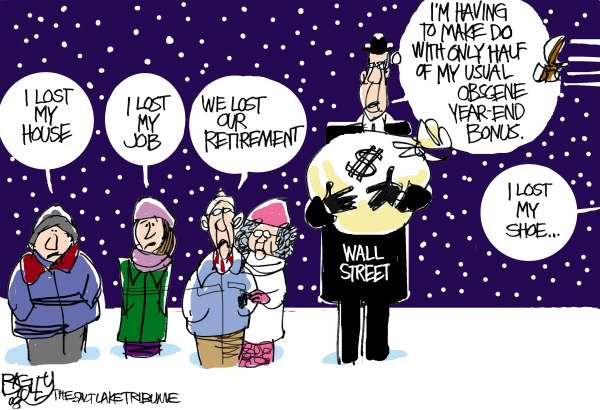 for necessary regulation. He’s evidently a little bit pregnant.
This must be the new and improved, more business friendly President. (Like he wasn’t business friendly enough already? What about bailing out GM, Chrysler, and most of the finance industry?) This is the one that needs to raise $1 billion in campaign funds for re-election and knows it won’t come from unemployed and financially struggling voters.
This order requires that federal agencies ensure that regulations protect our safety, health and environment while promoting economic growth. And it orders a government-wide review of the rules already on the books to remove outdated regulations that stifle job creation and make our economy less competitive. It’s a review that will help bring order to regulations that have become a patchwork of overlapping rules, the result of tinkering by administrations and legislators of both parties and the influence of special interests in Washington over decades.
When is the last time you read a Democratic politician that suggested something like “remove outdated regulations that stifle job creation and make our economy less competitive”? There’s something even more weird and ironic about this sudden urge to op ed for the WSJ. This is an interesting day for the release of a new improved middle path that’s sounds like something the Club for Growth can really sink its teeth into. On this very same day, “The Financial Stability Oversight Council on Tuesday released its six-month study into the Volcker rule and held its third public meeting.” according to FT Alphaville. This group has just made it very clear that removing what several administrations thought was “outdated regulations that stifle job creation and make our economy less competitive” caused the biggest financial melt down and global recession since The Great Depression. They want more regulation not less.
At the moment, banks are playing musical Special Purpose Vehicles; a delightful accounting parlor game that does nothing to get rid of systemic risk. According to the FT article, this includes “creatively shuffling their more obvious proprietary trading operations internally (for example, into asset management and ETF desks) and externally into spun-off funds”. Sure, like that saved ENRON all that nasty embarrassment of bad decision making.
While this report is trying to pick up the pieces of nuclear financial meltdown by suggesting which gaps in regulation need to be filled, the President is chatting up the CEO set on the WSJ op-ed page. There are not even any code words or in-between the lines nudge, nudge wink, winks in these statements. He’s just pandering away.
As the executive order I am signing makes clear, we are seeking more affordable, less intrusive means to achieve the same ends—giving careful consideration to benefits and costs. This means writing rules with more input from experts, businesses and ordinary citizens. It means using disclosure as a tool to inform consumers of their choices, rather than restricting those choices. And it means making sure the government does more of its work online, just like companies are doing.
Does this mean the bidding window is open on which regulations the K street minions want thrown out next? That worked so well with looking the other way for the shadow banking industry and letting the commercial banking industry run a virtual casino, didn’t it? There’s a list of ten major regulatory blueprints coming from The Financial Stability Oversight Council. Are investors, holders of 401ks, pension plans, and savers expected to take any of this seriously given the Wall Street missive?
Regulations reflect the social cost of private consumption and private production of goods and services that have bad side effects. (See this Wikipedia entry on market externalities for more information.) Markets with externalities have bad side effects that do not fall completely on the private producer or the private consumer. This leads to market inefficiency. Goods and services with negative externalties get overproduced, they are under priced, overconsumed and the side costs hit all of us with some of us suffering more than others. Usually, the ones that suffer the most are those least able to get out of the way or stop the problem. The experiences of Hinkley California, people that get lung cancer from secondary smoke, and any of us that were invested in financial or housing assets in the last five years suggests that you cannot just let people and businesses run amok and hope they’ll do right by the people they hurt. Without an effective and accessible judicial system and a vigorous system of sticks and regulatory oversight, you get all kinds of social costs that we get to manage without having any of the fun of buying and using the product or service. Ask me. I’ve spent the last five years living with the results of badly built levees and dealing with the first year of a BP Oil disaster. Let’s point to my 403(B) and my home price that are still in a recovering state from the shadow banking boys run amok. I’m sure you can list a boatload of the ones that the Federal Government ignored recently to give business a more ‘competitive environment” too that have cost you more than they’ve been worth. Sure, they’re now creating more jobs along the Gulf Coast right now but would you seriously let one of your children on to a fishing boat or deep water drilling rig? Do you seriously want your child sitting next to a chain smoker day in and day out?
So, my next question is did I just read that every regulation is now going up to the highest bidder? Maybe, at least, if we get them off the books, we won’t have the moral hazard of thinking any one pays attention to them anymore. If that’s the case, we should all be trial attorneys litigating hazard suits. From where I sit–in a city reeling from the social costs of externalities–our biggest problem is that no one takes regulations or regulators seriously any more because the federal government prioritizes the bottom lines of the perpetrators and not the suffering and the well being of the victims.
An Obituary for New Deal Liberalism
Posted: January 17, 2011 Filed under: Bailout Blues, Barack Obama, Populism, The Bonus Class, U.S. Economy, U.S. Politics, Voter Ignorance | Tags: Looting Social Security, The End of New Deal Liberalism, The Nation, William Grieder 5 CommentsIf you haven’t read William Grieder’s powerful piece ‘The End of New Deal Liberalism’ at The Nation, you really should.  Let me give you a taste.
In these terms, the administration of Barack Obama has been a crushing disappointment for those of us who hoped he would be different. It turns out Obama is a more conventional and limited politician than advertised, more right-of-center than his soaring rhetoric suggested. Most Congressional Democrats, likewise, proved weak and incoherent, unreliable defenders of their supposed values or most loyal constituencies. They call it pragmatism. I call it surrender.
Obama’s maladroit tax compromise with Republicans was more destructive than creative. He acceded to the trickle-down doctrine of regressive taxation and skipped lightly over the fact that he was contributing further to stark injustices. Ordinary Americans will again be made to pay, one way or another, for the damage others did to society. Obama agrees that this is offensive but argues, This is politics, get over it. His brand of realism teaches people to disregard what he says. Look instead at what he does.
Greider outlines the goals of the plutocracy so clearly that you wonder when he’ll be put up for trumped up espionage charges or at least some made-up sex scandal. His opening paragraphs on the capture of our government by corporate interests are just about the most compelling and apt description I’ve read recently. He’s awakened some how to the spokesmodel-in-chief. (h/t to Cinie wherever she may be)
Government has been disabled or captured by the formidable powers of private enterprise and concentrated wealth. Self-governing rights that representative democracy conferred on citizens are now usurped by the overbearing demands of corporate and financial interests. Collectively, the corporate sector has its arms around both political parties, the financing of political careers, the production of the policy agendas and propaganda of influential think tanks, and control of most major media.
What the capitalist system wants is more—more wealth, more freedom to do whatever it wishes. This has always been its instinct, unless government intervened to stop it. The objective now is to destroy any remaining forms of government interference, except of course for business subsidies and protections. Many elected representatives are implicitly enlisted in the cause.
The U.S. Government is NOT a household or a business
Posted: January 14, 2011 Filed under: U.S. Economy, U.S. Politics, Voter Ignorance, We are so F'd | Tags: economic illiteracy, Federal Debt, Federal Deficit, gold buggery, Paul Krugman, Rand Paul, Ron Paul 11 Comments
Gold bug in the garden of eden on a perfectly flat earth.
I’ve noticed the high level of economic illiteracy in the country since the day I started seriously studying economics. I’ve also noticed that faith-based economics rules the thought processes of many politicians. It always reminds me of those folks that believe in a literal garden of eden and a 7 day creation story over the facts that science hands us day-in and day-out. Molecular Biology has pretty much trumped their views but they persist in sticking their fingers in their ears and going la la la la la.
A variety of misguided notions have taken up residence in the brains of the same people, so I suppose it’s not surprising that the same groups that scream war on christmas also think the US will go bankrupt if we don’t up the debt ceiling or some such nonsense. The problem is that anti-intellectual flat earthers control a political party in this country. That problem extends to people who now sit as chairs of congressional committees that deal with the real world and real people. Then, there’s the fact that the other political party doesn’t really fight for the truth. It’s just all very distressing to me.
There are two stories today that I’d like to use as evidence to point to the incredible amount of lunacy floating around today’s Republican Party. The first comes from Paul Krugman. The second from The Economist. Krugman talks about the persistence of gold buggery. (Yes, I’m using a double entendre.) The Economist about the persistence of federal deficit and debt myths. They write on the number of people that don’t seem to understand what it takes for the US to ‘default’. Both myths need airing.
Paul Krugman writes political op-ed as well as information on economics. Economists are trained to separate the two. We even have two names for the circumstances. It’s called discussing positive and normative economics. You teach principles of economics students how to distinguish between the two on the very first day of class. Some times I think Dr. Krugman forgets that most people and politicians are economic illiterates. You see and hear constant confusion on his writings. People don’t seem to distinguish between his op-ed with the liberal bent (normative) and when he’s actually talking economic theory (positive). His op-ed today talks about the fact that there are many issues in politics today that are so polarizing that there is no third way or middle ground. I don’t want to point to that, but his blog post ‘Monetary Morality’ that takes this notion of no compromising with idiots which points to the absurdity of gold buggery or something he called paleomonetarism in an early post.
In those two posts, he points out that there is a narrative out there–mostly preached by the Pauls–that the Fed is evil and we need to be hung on a cross of gold (with apologies to William Jennings Bryan). If you read the two posts you’ll see that this issues isn’t a conversation or liberal issue at all. Economists have a shared understanding of theory that doesn’t include the Paul money narrative. The Paul monetary narrative is not about economics, it’s about some idea that the government and a central bank is some how confiscating something from you. It’s a philosophy of paranoia more than an economic statement.
You see, if you’re the kind of person who views being taxed to pay for social insurance programs as tyranny, you’re also going to be the kind of person who sees the printing of fiat money by a government-sponsored central bank as confiscation. You may try to produce evidence about the terrible things that happen under fiat currencies; you may insist that hyperinflation is just around the corner; but ultimately the facts don’t matter, it’s the immorality of activist monetary policy that you hate.
And this is also why politically conservative economists arguing for something like nominal GDP targeting, and pleading with their perceived political allies to stop talking nonsense, are going to be disappointed. If you’re in the intellectual universe where monetary policy is to be evaluated by results, you’re already out of the true believers’ moral universe. At a fundamental level, Milton Friedman and John Maynard Keynes are on one side; Ron Paul is on the other. And it’s not a debate in which evidence really matters.
The Pauls–and others–dwell in the land (Kentucky, I think) where you can create a theme park and put Neanderthals and all sorts of Dinosaurs that lived millions of years apart with modern animals in the Garden of Eden. All that’s needed in these narratives is the idea that the sun revolves around the earth or the earth is flat. It’s not science, it’s not data based, it’s just you wanting to believe your little view of the world is the correct one for no other reason than it appeals to your outlook on life.

 peej
peej Carissa
 bostonboomer
 dakinikat
 ecocatwoman
 mablue2
 Mama Lopez
 peggysue22
 quixote
 skydancingguestblogger
 Mona (aka Wonk the Vote)



 Sky Dancing
Recent Comments