
The Bailout: More Oversight or More Overlook?
Posted: October 22, 2008 Filed under: Equity Markets, Hillary Clinton: Her Campaign for All of Us, U.S. Economy | Tags: bailout, banks, executive compensation, oversight, treasury plan 1 Comment More bailout news today as the Fed pledges $540 billion to shore up mutual funds. The New York Times outlined the proposed plan to help provide short term debt that many money market mutual funds use to finance their investments. When the Treasury refused to bail out Lehman brothers, shares of its Reserve Fund fell below $1. This caused problems in many money market mutual funds as the investors realized their money may not be safe.
Since then, many funds have experienced redemption requests. This has caused fund managers to move to safer and more liquid sources to shore up their funds. Many fund managers no longer look to commercial paper and have switched strictly to Treasuries and other investments considered highly safe. This has squeezed lending to companies looking for bridge loans and working capital sources. The details have not been finalized, but the Fed is hoping to negoitiate the deal and is looking to JP Morgan Chase to carry out many of the required actions. This basically expands the lines of businees that taxpayers are now shoring up for financial companies.
While the Fed and Treasury have been forthcoming with plans and money, it is still uncertain when we will actually see them get around to solving the problems instead of doing triage. We are experiencing more and more situations where taxpayer money is being used to supplement private investments and loans to corporations (including the very financial corporations responsible for this mess). What we are not seeing is the increased oversight that must go along with the flow of funds into the financial sector. It is really time for Congress to act now before more money flows to these players who will not be held to account.
Corporate Governance is one of those things that should not be overlooked. The Treasury’s bailout seems to have more to do with a short term shore up of markets, than rooting out the bad players and ensuring these funds are not abused. It appears that some of the corporate governance and executive compensation rules originally part of the bail out plan have been watered down. Many in congress and the Treasury itself stated earlier that any of these financial institutions benefiting from government funds must adapt stricter corporate governance rules and executive compensation limits. Corporate Governance is a broad set of that basically protect shareholders from executive malfeasance.
The first concern with corporate governance discussed in the bailout was that executive pay should not encourage unnecessary and excessive risk. In other words, the pay should not INCENT the managers to go after short term profits that endanager the safety of the firm. Market Report states a very important point here.
The Treasury’s interim final rule requires that the compensation committee of a company’s board of directors review executive pay to make sure it doesn’t encourage management to take too many risks.
The committee has to meet at least once a year with the bank’s chief risk officer to check the relationship between the institution’s risk management and executive pay and incentives, according to the rule.But the Treasury isn’t replacing any of the directors on the boards of the banks it’s investing in, or adding new directors to represent taxpayer interests. That means there’s no way for the Treasury to check if executive compensation is encouraging too much risk-taking.
On the issue of the U.S. Government, I would like to make a modest proposal. First, I point out the obvious flaws, whereby legislation was repeatedly brought forth to Congress over the past eight years, which would have reigned in the predatory lending practices of now mostly defunct institutions. These institutions regularly filled the coffers of both parties in return for voting down all of this legislation designed to protect the common citizen. This is an outrage, yet no one seems to know or care about it. Since Thomas Jefferson and Adam Smith passed, I would argue that there has been a dearth of worthy philosophers in this country, at least ones focused on improving government.
In short, Congress needs to get with it and start protecting the taxpayer’s money with much more tenacity than the protected investor’s money. Write them and tell them to strengthen the oversight of the bailout plan.
So Long and Thanks for All the Fish!
Posted: October 21, 2008 Filed under: Equity Markets, U.S. Economy | Tags: Financial markets crisis, hedge funds 1 CommentI was reminded of that quote from Hitch Hiker’s Guide to the Galaxy when I read this article in the UK’s Guardian. Yes, I’m an anglophile and delight in all things British from Willy S down to Monty Python. A similar goodbye came from a 37 year old retiring hedge fund manager. If you ever needed a really good clue to the issues underlying the Financial Crisis as well as what’s really wrong with our government, Andrew Lahde’s retirement tome is a good place to start.
The boss of a successful US hedge fund has quit the industry with an extraordinary farewell letter dismissing his rivals as over-privileged “idiots” and thanking “stupid” traders for making him rich.
Well, that was succinct enough, wasn’t it? Andrew Lahde’s $80m Los Angeles-based firm Lahde Capital Management in Los Angeles made it huge by betting against subprime mortgages. One of his funds returned 866% last year by taking up the position that the US home loans industry would collapse. Lucky you if you got in on his ground floor. Not content with just going quietly into the night, Lahde added this zinger to his retirement speech.
“The low-hanging fruit, ie idiots whose parents paid for prep school, Yale and then the Harvard MBA, was there for the taking,” he wrote. “These people who were (often) truly not worthy of the education they received (or supposedly received) rose to the top of companies such as AIG, Bear Stearns and Lehman Brothers and all levels of our government,” he said.
“All of this behaviour supporting the aristocracy only ended up making it easier for me to find people stupid enough to take the other side of my trades. God bless America.”
Indeed. Do we really need yet another Harvard man at the helm?
The Invisible Hand vs. The Big Stick
Posted: October 18, 2008 Filed under: Equity Markets, U.S. Economy, Uncategorized | Tags: Financial Markets, Financial markets crisis, Regulation of Financial Markets, Scholes, Stiglitz, The Economist 1 Comment “The reason that the invisible hand often seems invisible is that it is often not there.” (Making Globalization Work, 2006)
Nobel Prize winning economist (2001) Joseph E. Stiglitz
After finding out about it on MiradorWealth.com.au, I’m participating in an on line debate at Economist.com concerning regulating the financial system after this crisis. It is interesting to read the comments because they come from all over the world and they come from folks that participate one way or another in the financial markets. Right now 63% of the participants (led by American Economist Joseph Stiglitz) want more regulation of financial markets.
Here is his opening argument:
The current crisis is caused, in part, by inadequate regulation. Unless we have an adequate regulatory system—regulations and a regulatory structure that ensures their implementation—we are bound to have another crisis. This is not the first such crisis in the financial system that we have had in recent decades. Indeed, around the world, it is more unusual for a country not to have had a financial crisis than to have had one. They have occurred in societies with “good institutions”—like those in Scandinavia—and in societies without such institutions. They have occurred in developed and in developing countries. The only countries to have been spared so far are those with strong regulatory frameworks.
The side against regulation is taken up by Myron Scholes who is an equally impressive American Finance Professor. Here is his opening argument:
There is now a rising chorus among regulators, politicians, and academics claiming the freedom to innovate in the financial domain should be curtailed. This stemmed from the apparent recent failures in mortgage finance and credit default swaps and the apparent need for governments and central banks to “bail out” failing and failed financial institutions around the world directly through capital infusions and indirectly by providing a wide array of liquidity facilities and guarantees. They claim that freedom in global financial markets has proceeded at too rapid a pace without controls—in particular with an incentive system that rewards risk-taking at the expense of government entities—and as a result “throwing sand in the gears” of innovation will reduce “deadweight costs” and “moral hazard” issues.
Here are my thoughts.
Financial markets are not like other markets. To function properly, there needs to be transparency and trust. If transparency and trust are not there, they do not work, and if financial markets don’t work, nothing works in an economy.
Regulations should be put into place that increase transparency and increase trust. This does not mean they should be used to push social agendas like ‘affordable housing’. This means that rules of dealing in a market should be clearly established and a regulator should ensure they are followed. Rules concerning leverage, capitalization, prudent underwriting standards, and standardization of contracts all lead to transparency and trust. Countries with the standards attract capital and grow. Countries without do not attract capital and stall. Adequate regulation would have stopped this financial panic. We still have not unwound the rogue credit default swap market. We have yet to determine the full impact this will have on the current situation and it remains an unquantified risk hanging out there in the ethos like a cancer ready to spread. Unless we ensure these markets cannot be gamed, we will lurch from one financial panic to another.
As the financial crisis winds its way through history the discussion concerning the role of regulation, deregulation, and future policy will be an important one. I suggest you get involved with that discussion because it is just that, an important one.
Senator Joe Biden (MBNA-DE)
Posted: October 16, 2008 Filed under: U.S. Economy, Uncategorized | Tags: Bankruptcy Bill, Biden, Credit Card Companies, Deceptive Pracitces, Deleware, Levin, MBNA Comments Off on Senator Joe Biden (MBNA-DE)I about fell off my chair listening to the third presidential debates when Senator Obama suggested that Senator Biden was some how a champion of middle America and the little guy. I was beginning to think that Obama had some how gotten into his own koolaid. Joe Biden, especially when it comes to economic issues, is not the friend of working families who get in a tight pinch. Here’s the comments and here’s the original transcript.
OBAMA: Well, Joe Biden, I think, is one of the finest public servants that has served in this country. It’s not just that he has some of the best foreign policy credentials of anybody. And Democrats and Republicans alike, I think, acknowledge his expertise there.
But it’s also that his entire life he has never forgotten where he came from, coming from Scranton, fighting on behalf of working families, remembering what it’s like to see his father lose his job and go through a downward spiral economically.
And, as a consequence, his consistent pattern throughout his career is to fight for the little guy. That’s what he’s done when it comes to economic policies that will help working families get a leg up.
Senator Obama evidently has forgotten about two things for which we can thank Joe Biden. The first is the current bankruptcy bill which makes it difficult for folks who get into financial trouble for things like unemployment and overwhelming health catastrophic costs to ever recover from. The second is that he’s never met a credit card company supported bill he doesn’t like.
Here’s what one liberal blogger said about that bill while Biden was still running for President. Notice that it also references another ‘progressive’ blog.
The bankruptcy bill is such a cruel piece of legislation, especially to single mothers and people without health insurance, that Kos crossed Biden right off his list of potential candidates. I’m unaware of any major or medium size blogger that supports Biden’s campaign…and it really all comes back to the bankruptcy bill.
There was also this (as reported by the NY Time) floating around concerning dealings behind the passage of the same bankruptcy bill.
During the years that Senator Joseph R. Biden Jr. was helping the credit card industry win passage of a law making it harder for consumers to file for bankruptcy protection, his son had a consulting agreement that lasted five years with one of the largest companies pushing for the changes, aides to Senator Barack Obama’s presidential campaign acknowledged Sunday.
Senator McCain voted for this bill as well as Senator Biden. Senator Obama voted against this bill, but seems to have conveniently forgotten it. The NY Times also reported, in that same article cited above, this:
Consumer advocates say that Senator Biden was one of the first Democratic leaders to support the bankruptcy bill, and he voted for it four times — in 1998, 2000, 2001 and in March 2005, when its final version passed the Senate by a vote of 74 to 25.
Travis Plunkett, legislative director of the Consumer Federation of America, a consumer group that opposed the bill, said that Senator Biden had provided a “veneer of bipartisanship” that eventually helped the credit card companies win over other Democrats. “He provided cover to other Democrats to do what the credit industry was urging them to do,” Mr. Plunkett said.
Here’s more on “Credit Card Joe” from the National Review Online. When Joe was in some financial trouble himself, he got help from the CEO of MBNA.
John Cochran, the company’s vice-chairman and chief marketing officer, did pay top dollar for Biden’s house, and MBNA gave Cochran a lot of money—$330,000—to help with “expenses” related to the move. A few months after the sale, as Biden’s re-election effort got under way, MBNA’s top executives contributed generously to his campaign in a series of coordinated donations that sidestepped the limits on contributions by the company’s political action committee. And then, a short time after the election, MBNA hired Biden’s son for a lucrative job in which, according to bank officials, he is being groomed for a senior management position.
It is possible that the next financial debacle comes from this kissing cousin to the subprime market: credit cards. They are also users of some of the most deceptive lending practices you can find. You’ll recognize some of these I’m sure. How about that Over Limit Fee and bump you get in an interest rate when the company just okays a purchase rather than rejecting it? Here’s one that is my personal “favorite” since it is an ongoing F**k for me at the moment. It is the fine print that says the bank will apply all payments to the lowest interest rate bearing things first. You can’t even send them a specific payment for anything else. When I tried to pay off a $40 cash advance I had to pull during my flight from Hurricane Katrina (which is the ONLY cash advance I’ve ever had and due to my banks being closed and underwater) I was told I’d have to pay the entire balance off. I pulled $40 to help pay a Toll for the Kansas Tollway on my way to my daughter in Nebraska. That $40 is now a balance of $254.76 because I can’t get the silly thing down far enough to even dream of paying off that. It’s the very last thing they will EVER apply my payments towards so thanks Joe, thanks for supporting those credit card companies!! I have to say you’re a real peach by my standards as a solidly middle class person and little guy!
So, my next question is do you think Joe’s been a part of this discussion OR even a sponsor of bills to eliminate these unfair practices? Nope. The so-called Dodd-Levin The Credit Card Accountability Responsibility and Disclosure Act has a few sponsors listed here at Senator Levin’s website. It’s worth a read because it is a bill that would definitely help the middle class that relies so heavily on credit card debt. Is this going to be yet another missed chance at regulating an industry (like the subprime market) that goes into fueling a financial crisis? If so, what will be the terms of the bailouts and where will Senator Biden, MBNA-DE stand?
Congratulations! You’re an Investment Banker!
Posted: October 15, 2008 Filed under: Equity Markets, U.S. Economy, Uncategorized | Tags: financial bail out, U.S. Economy 1 CommentNow what? 
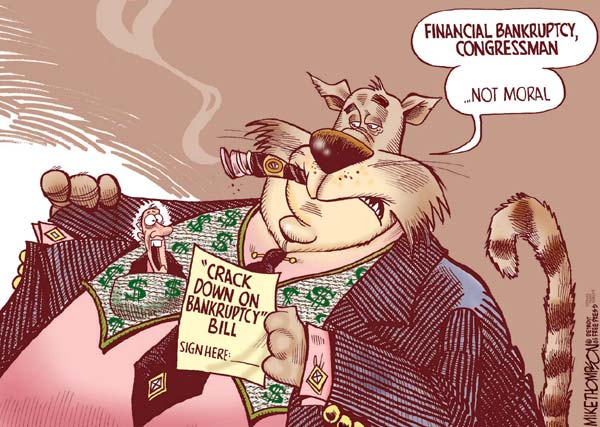
Well, I suggest you start looking at the terms and conditions of our new portfolio and clients. Right now, it’s $250 billion that you and I share with all the other U.S. Tax Payers. So far, about $125 billion dollars has been divvied up among the major banks. In return for that investment, we get preferred stocks and warrants for common stock. There are some sweeteners for us and a few for them. This is the first of the plans that are supposed to ‘inject’ money into banks and ‘unfreeze’ the credit markets. The release of similar plans by the Europeans on Monday gave us that huge bounce on Monday. (Remember the one I thought could be a dead cat bounce and possibly is?)
The European plan also provided the structure for the terms of this deal as well as the impetus to move on it.
So, what goodies do our financial intermediaries get from the deal?
1) The US will guarantee new debt issued by banks for three years. This means any bank that lends to another doesn’t have worry about getting it back. That also means that they don’t have to hold a large amount in reserve for potential loan losses so it should expand consumer lending.
2) The Fed will become the buyer of last resort for commercial paper. This means if a bank is lending to a business in the short run to help it with its working capital needs for things like buying inventory or bridge loans to cover day-to-day business expenses, and the business defaults, the Fed will buy the commercial paper from the bank. The bank will not suffer the loss. This is again decreases default risk and means the banks don’t have to worry about upping their reserves for potential loan loses or holding back loans to businesses that may have less than stellar ratings. A good example of businesses with less than stellar ratings are Ford, GM, and a lot of the airline companies.
3) The FDIC will offer an unlimited guarantee on bank deposits that are not interest bearing. Since several European banks did this, this is a response to stop the possible flow of business checking accounts and payroll accounts to foreign banks. There may be some consumer accounts, campaign, or non-profit checking accounts that get protection here also but it is primarily geared to businesses.
What do we get?
1) Bank Equity: The government will get preferred shares and warrants for common stock with an expectation of a ‘reasonable’ return. This means that the government gets first shot at any profits and dividends earned by the bank holding company. No dividends can be given to common stock holders without first paying preferred stock holders. Preferred stock also has priority in terms of ownership of any assets liquidated in a bankruptcy. Most preferred stock does not come with voting rights. A warrant is a security that allows the holder to purchase a share of common stock in that bank holding company at a specified price. This price is usually higher than the current market price of the common stock. Some warrants stay attached to the preferred stock and basically serve to increase the yield on that stock. Others can be detached and sold on the side.
The preferred stock that will be issued in this plan will pay special dividends. At first, it will be at a 5% interest rate that will increase to 9% after five years. The warrants will be worth 15% of the face value of the preferred stock. (The basic reason for the warrants is that if the stock goes up, the government can exercise the warrant, get the stock from the bank holding company, sell it on the market, and realize a profit. These profits then go to the Treasury to pay down the Federal Deficit and offset the cost of the program.)
2) Restrictions on Executive compensation for those institutions that sell shares to the government. These restrictions include a clawback provision and a ban on golden parachutes as long as the Treasury holds equity issued under this program.
Clawback provisions are written in a way that the government can recover performance-based compensations to CEOs and other executives in the bank to the extent they later determine that performance goals were not actually achieved. You have to write the specifics into the contract but usually it can be due to a restatement of financial results as well as some other reasons. The restatement of the financial results usually has to be significant. It can also kick in if there are determined to be some kind of misconduct.
Gold parachutes are guaranteed severance compensation packages that will executives receive if control of a company changes hands that results in a management shift.
Who do we own to date:
$25 billion: Citigroup, JPMorgan Chase, Bank of America (parent now of Merrill Lynch), Wells Fargo (parent now of Wachovia)
$10 billion: Goldman Sachs, Morgan Stanley
Others with less than that: Bank of New York, State Street and thousands of yet unannounced little guys.
Other issues: At this time, the banks will not be asked to eliminate dividends. CEOs are not required to resign. All of the banks signed the agreement and entered into the deal so there would not be any stigma based on who needed the program and who did not. We’ve basically just semi-nationalized the banking system in the U.S.
Okay, so now we’re all investment bankers. What I want to know is when do we get our bonus checks?

 peej
peej Carissa
 bostonboomer
 dakinikat
 ecocatwoman
 mablue2
 Mama Lopez
 peggysue22
 quixote
 skydancingguestblogger
 Mona (aka Wonk the Vote)



 Sky Dancing

Recent Comments