
13. The next industry (not including finance and auto) to beg for and get a bail out will be:
Posted: January 7, 2009 Filed under: U.S. Economy | Tags: bailout, Dakini's office pool, recession 6 Commentsthe porn industry.
I have to say that your resident dakini did NOT see that one coming when she did the Dakini Office Pool. Okay, they haven’t GOTTEN it yet so it technically doesn’t count, but it’s still good for a laugh.
January 7, 2009Posted: 05:27 PM ETLarry Flynt is asking for a bailout.WASHINGTON (CNN) — Another major American industry is asking for assistance as the global financial crisis continues: Hustler publisher Larry Flynt and Girls Gone Wild CEO Joe Francis said Wednesday they will request that Congress allocate $5 billion for a bailout of the adult entertainment industry.
“The take here is that everyone and their mother want to be bailed out from the banks to the big three,” said Owen Moogan, spokesman for Larry Flynt. “The porn industry has been hurt by the downturn like everyone else and they are going to ask for the $5 billion. Is it the most serious thing in the world? Is it going to make the lives of Americans better if it happens? It is not for them to determine.”
Francis said in a statement that “the US government should actively support the adult industry’s survival and growth, just as it feels the need to support any other industry cherished by the American people.”
“We should be delivering [the request] by the end of today to our congressmen and [Secretary of the Treasury Henry] Paulson asking for this $5 billion dollar bailout,” he told CNN Wednesday.


The American Health Care System: Costly and Inefficient
Posted: January 7, 2009 Filed under: U.S. Economy | Tags: cost and inefficiency of the American Health Care System, Health care, Health care reform, universal health care 5 Comments
My last Journal of Economic Perspectives showed up in the mail at the end of the year. This journal is published by the AEA and I always like it because the research is both topical, academic, and empirical. The empiricists publish here. I was originally drawn to an article on the economic aftermath of Hurricane Katrina for obvious reasons. However, what has now caught my eye is a series of articles under a Symposia heading of Health Care. I have to put a disclaimer on the information that I’d like to share with you. It is this: I’m a financial economist and not a health care economist. While I understand the analysis, methodology and basic tools of the trade in these articles, I’m unfamiliar with the databases and specifics of this market. As you know I’m also not a microeconomist by nature either. This is highly applied microtheory. So, my depth and breadth of knowledge on this issue is not what it is on some of the other things I’ve written about. I’m simply sharing other folks’ research with you
There were two specific articles that caught my attention. The first was by Jonathan Gruber and is entitled “Incremental Universalism for the United States: The States Move First?”. The second is by Alan M. Garber and Jonathan Skinner. It is entitled “Is American Health Care uniquely Inefficient?” Both titles offer up important questions. This is especially true when it is possible that Health Care reform may once again be back on the policy table. Let me highlight a few findings that stood out to me.
Krugman inkles the D-word
Posted: January 5, 2009 Filed under: president teleprompter jesus, Team Obama, U.S. Economy 11 Comments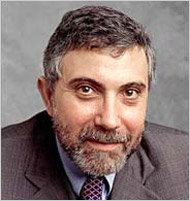 Paul Krugman’s op-ed piece today took my fears about the global free fall in manufacturing from the monetary sector straight to the real sector. He’s making the case that the U.S. economy is at the start of depression.
The fact is that recent economic numbers have been terrifying, not just in the United States but around the world. Manufacturing, in particular, is plunging everywhere. Banks aren’t lending; businesses and consumers aren’t spending. Let’s not mince words: This looks an awful lot like the beginning of a second Great Depression.
As a liberal economist with impeccable credentials, Dr. Krugman has always been called the consummate Keynesian. This is despite his major contributions come from Trade Theory where he argues continually in his academic work for open, unfettered trade. Economists generally tend to be a pragmatic and practical sort because we focus on outcomes.
The main question posed by Krugman today concerns the Obama stimulus plan.
If we don’t act swiftly and boldly,” declared President-elect Barack Obama in his latest weekly address, “we could see a much deeper economic downturn that could lead to double-digit unemployment.” If you ask me, he was understating the case …
So will we “act swiftly and boldly” enough to stop that from happening? We’ll soon find out. “
The Perils Of Prostitution
Posted: January 3, 2009 Filed under: Team Obama, U.S. Economy | Tags: China trade, recession/depression, soveriegn wealth funds, U.S. Stimulus, U.S. Treasuries Comments Off on The Perils Of Prostitution
I’m going to give you a glimpse at my current research area without torturing you with models and data. You’ve probably noticed I’ve been less than consistent with my blogging since the end of semester in mid December. This will continue awhile as I torture trade theory, exchange rates, and the world financial system in pursuit of a few pubs. However, I still am, at heart a teacher and I like to answer questions.
I’ve gotten a lot of questions recently about the current economic stimulus package in terms of increasing the U.S. debt. Many of my students ask me what would happen if China simply decides one day to stop buying our Treasuries or dump all the ones they own, at once, on the market. The answer is worldwide chaos but unlikely to happen. However, there are things afoot that could make it likely that the Chinese might not buy further debt and could slowly shed its current portfolio holdings of both dollars and debt. This could have enormous ramifications for our ability to stimulate the economy via debt financing as well as maintain the dollar as the world currency.
It is also possible that the other sovereign fund countries ( that would be the oil producing countries) may also stop buying further debt. It’s easy to explain that. Less oil revenues means less free money to invest. But what about China?
This is really a side show to what I am currently studying which is monetary policies, trade, and exchange rate policies. But, it is an interesting sideshow. So here’s some questions, some discussion, and enough information to be mildly dangerous. What about China?
Really Bad Numbers = ?
Posted: December 31, 2008 Filed under: Equity Markets, Team Obama, U.S. Economy Comments Off on Really Bad Numbers = ?I’ve tried to lay off my econ-based threads so all those that celebrate national crass consumerism day could stay off the window ledges instead, enjoying the yuletide fireplace. This year, I’m earning my title as dismal scientist and this post is not full of seasonal cheer.
 Employment: The level of continuing first time unemployment claims stands at a 26-year high of 4.51 million. The 1982 recession was the worst post WW2 recession to date.
2008 Yearly Market Performance: (11 year lows)
| U.S. indexes | |
| Dow Jones Industrial Average | -35% |
| S&P 500 | -39% |
| Nasdaq | -42% |
| Dow Jones Financials | -55% |
| Amex Oil Index | -38% |
Housing: House prices have fallen to their 2004 level. Sales of both existing houses and new construction are miserably low. Resales were down 10.6%f this year. Basically, we’re seeing the fastest decrease in sales on record.
Consumer Confidence:
The Reuters/University of Michigan survey of consumers rose to 60.1, better than a preliminary reading of 59.1 released earlier this month and topping the 58.5 reading forecast by economists’ surveyed by MarketWatch.
It also marked a sharp improvement from November’s 55.3 reading, a 28-year low…
The index has tumbled 20% from last year and 38% from a peak reached in Jan. 2007

 peej
peej Carissa
 bostonboomer
 dakinikat
 ecocatwoman
 mablue2
 Mama Lopez
 peggysue22
 quixote
 skydancingguestblogger
 Mona (aka Wonk the Vote)



 Sky Dancing
Recent Comments