
W(h)ither Geithner and his TALF
Posted: April 23, 2009 Filed under: Bailout Blues, Equity Markets, Global Financial Crisis, U.S. Economy, Uncategorized | Tags: banks, Elizabeth Warren, TALF, TARP, Timothy Geithner Comments Off on W(h)ither Geithner and his TALF Neil Irwin of WAPO reported today that the TALF is not having the results trumpeted by the Obama administration. This is leading, again, to speculation about the relevancy of most of these plans and, of course, job security of Treasury Secretary Timothy Geithner.
In its first two months, the government’s signature initiative to support consumer lending has fallen well short of expectations, deploying only a fraction of the amount officials had hoped to extend to stimulate auto loans, student loans and credit card lending.
The slow rollout of the program has frustrated staff at government agencies working on the effort and diminished hopes that they could engineer a rapid return to healthy lending levels, according to interviews with government and industry sources. The initiative also serves as a window into the complexities of designing a giant rescue of the financial system.
The TALF is the private-public partnership that couples the funds of private investors, like hedge funds, and the FED. The hedge funds invest small amounts that are matched by much larger amounts that would presumably come from the Treasury and Tax Payers if they wind up being nonprofitable. The combined funds will supposedly purchase non-toxic, virgin, high rated rated securities to fund everything from student loans and car loans to inventory and capital loans for business. As of yet, they really have failed to do so.
Officials envisioned TALF supporting tens of billions of dollars a month in new lending, saying it could eventually total $1 trillion. But in March, when it was launched, it backed only $4.7 billion in auto loans and credit cards. For April, it logged only $1.7 billion.
Sources involved in the program said private investors have been reluctant to work with the government, which they view as an unreliable business partner. Separately, the brokerage houses that are crucial intermediaries are being exceptionally cautious in the contracts they draw up with participants in the program, in part out of wariness that any mistakes could draw the ire of Congress or the media.
In congressional testimony on Tuesday, Treasury Secretary Timothy F. Geithner said that overall progress is “pretty good” for a program in its early days. Still, he acknowledged that participation was “lower than expected” because of “concern about the conditions that come with the assistance in the program . . . and uncertainty about whether they may change in the future.”
Meanwhile, on the bank front, stupid accounting tricks abound! Which begs the question is any one stupid enough to believe the numbers? Every large financial institution appears to be jumping on the band wagon of conveniently forgetting the month of December. What does this say about the state of public accounting today and Wall Street’s gulliblity?
And the rich just keep getting richer …
Posted: April 20, 2009 Filed under: U.S. Economy, Uncategorized | Tags: Ginie Index, Income Inequality 3 Comments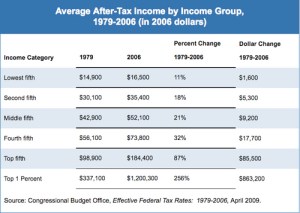
This graph from the Congressional Budget Center for Budget and Policy Priorities shows the most recent date on U.S. Income Inequality. This includes new data from 2006. This is pretty astounding. It shows just exactly how much of the country’s income has gone to the richest and poorest Americans and of course the middle classes.
Let’s assume that all U.S. incomes had all increased at the same rate as the lowest quintile.
lowest fifth: $1,639
second fifth: $3,000 to $33,000
middle fifth: $5,000 to $48,000
fourth fifth : $6,000 to $62,000
fifth fifth: $11,000 to $110,000
top fifth: $37,000 to $374,000
Now let’s see what it would look like if we’d all experienced the same increase as the top 1%.
lowest fifth: $38,000 increase to $53,000
2nd fifth: $77,000 increase to $107,156
3rd fifth: $110,000 increase to $152,000
4th fifth: $144,000 increase to $200,00
5th fifth: $253,000 increase to $352,000
Top fifth: $862,000 increase to 1.2m total
This basically makes the income inequality in this country the widest on record. The Center’s release also included this:
Taken together with prior research, the new data suggest greater income concentration at the top than at any time since 1929
If you want to check out how our US income inequality compares to the rest of the world, check out the GINI Index here in the CIA World Fact Book. The GINI index is a measure of income/wealth distribution. The lower the coefficient, the more equal the wealth distribution. So zero would mean perfect equality where everyone has the exact same income. One means there is perfect inequality or one person has all the income and the rest of the folks have none.
 In 2007, the US had a GINI coefficient of 45. Denmark had a 24 in 2005. UK had 34 in 2005. Needless to say, we are up there with most of the world’s tin pot dictatorships on income equality. Uganda and Venezuela have ratings similar to ours.
In view of these numbers, I would say the populist rage overtaking the country isn’t about taxes. It may not even be about government spending. It is probably about the fact that most Americans are losing ground. This in itself wouldn’t be a problem, but not only are the majority of us losing ground, a select few are gaining hugely. It is also undeniable that this gain has come the political class who becomes wealthy themselves enabling policy that widens the inequality gap.
Bernanke Rules
Posted: April 18, 2009 Filed under: Global Financial Crisis, U.S. Economy, Uncategorized | Tags: bernanke, Credit Default swaps, Credit Derivatives, Fannie Mae, FED, Freddie Mac, Regulations, Subprime mortgages Comments Off on Bernanke Rules Is The Fed under Chairman Ben Bernanke finally beginning to adopt the tougher lending regulations and rules that would’ve prevented much of the havoc of the last two years? In a speech on April 17, Bernanke stated that damage done to the economy was not likely to be undone any time soon. This gives more credence to the idea that we may see an L-shaped recovery. In other words, be prepared to scuttle across the bottom for a very long time. But did the speech deliver the assurances we need that necessary steps and regulations w lending practices and financial innovations are in the works? I don’t think so.
Here’s some interesting analysis by Craig Torres at Bloomberg.com.
Federal Reserve Chairman Ben S. Bernanke said the collapse of U.S. lending will probably cause “long-lasting” damage to home prices, household wealth and borrowers’ good credit score.
“One would be forgiven for concluding that the assumed benefits of financial innovation are not all they were cracked up to be,” the Fed chairman said today in a speech at the central bank’s community affairs conference in Washington. “The damage from this turn in the credit cycle — in terms of lost wealth, lost homes, and blemished credit histories — is likely to be long-lasting.”
The U.S. central bank has cut the benchmark lending rate to as low as zero and taken unprecedented steps to stem the credit crisis through direct support of consumer finance and mortgage lending. The Fed plans to purchase as much as $1.25 trillion in agency mortgage-backed securities this year to support the housing market and is providing financing for securities backed by loans to consumers and small businesses.
Bernanke and the Federal Reserve Board approved rules last July to toughen restrictions on mortgages, banning high-cost loans to borrowers with no verified income or assets and curbing penalties for repaying a loan early. The action came after members of Congress and other regulators urged the Fed to use its authority to prevent abusive lending.
This suggests Bernanke does not see home values going back up any time soon. It also suggests that the lending markets are not likely to return to their heyday. Does this mean, however, that we’re finally going to see the regulation and enforcement of prudent underwriting standards and no more hide the trash in a bundle and pass it to the next sucker?
A Taxing Subject
Posted: April 17, 2009 Filed under: The Media SUCKS, U.S. Economy | Tags: taxes, Tea Party, US Taxes comparison 11 Comments
There was a table set out under a tree in front of the house, and the March Hare and the Hatter were having tea at it: a Dormouse was sitting between them, fast asleep, and the other two were using it as a cushion, resting their elbows on it, and the talking over its head. `Very uncomfortable for the Dormouse,’ thought Alice; `only, as it’s asleep, I suppose it doesn’t mind.’
The table was a large one, but the three were all crowded together at one corner of it: `No room! No room!’ they cried out when they saw Alice coming. `There’s PLENTY of room!’ said Alice indignantly, and she sat down in a large arm-chair at one end of the table.
`Have some wine,’ the March Hare said in an encouraging tone.
Alice looked all round the table, but there was nothing on it but tea. `I don’t see any wine,’ she remarked.
`There isn’t any,’ said the March Hare.
`Then it wasn’t very civil of you to offer it,’ said Alice angrily.
`It wasn’t very civil of you to sit down without being invited,’ said the March Hare.
`I didn’t know it was YOUR table,’ said Alice; `it’s laid for a great many more than three.’
`Your hair wants cutting,’ said the Hatter. He had been looking at Alice for some time with great curiosity, and this was his first speech.
`You should learn not to make personal remarks,’ Alice said with some severity; `it’s very rude.’
from Alice’s Adventures in Wonderland: A Mad Tea Party
by Lewis Carroll
I’ve taught Macroeconomics for a very long time. Tax policy of course is also part of the curriculum so I always get to spend at least a week on U.S. taxes. One of my favorite lectures is to disabuse people in the U.S. of the notion they are ‘over taxed’. You probably saw that I didn’t exactly get on the Tea Party band wagon. I’m not worried about my taxes. I am worried about the huge amount of deficit spending going on and I’m worried about the quality of government I get in return for my taxes . I’m more worried about loosing my constitutional right to privacy. I’m also worried about my tax dollars going to religious organizations and other spurious uses.
Several other economists used their blogs on Tax Day for the purpose of showing folks that the U.S. has extremely low taxes compared to the kinds of things we expect and get from the Government. I’d like to share some of that with you.
What are the Equity Markets Smoking?
Posted: April 13, 2009 Filed under: Bailout Blues, Equity Markets, U.S. Economy 2 CommentsI’m torn between relief at watching my 403(b) improve and wondering why the stock markets appear so oblivious to reality at the moment. Stock markets appear to be celebrating the loosened mark-to-market rules and only the Greater Ethos would know what else. (Perhaps Spring break and more Girls Gone Wild Videos in the offing?) During the 14 trading days prior to March 27th, the S&P 500 index jumped 21%. That would be akin to the steepest rally since 1938. At the same time, the corporate bond market saw 35 defaults. Moody’s stated that number of defaults has not been seen in single month since the Great Depression. The Economist (April 11, 2009), in the article Whistling in the Dark thinks Equity investors have been humming the Monty Python Classic.
As American companies begin the first-quarter earnings season, the news on that front is hardly encouraging either. Profits are forecast to be down by 37%, according to Bloomberg. That will be the seventh straight quarterly drop, the longest losing stretch since, yes, the Depression.
So what explains this dichotomy between share prices and fundamentals? Markets fell so far, so fast that they already reflected a lot of bad news. And prices rarely drop in a straight line. They often rebound as investors who have gone short (bet on falling prices) take profits. There were five rallies of 20% or more between 1930 and 1932, during the worst bear market in history.
 So, who is right? I’m going with the bond markets. They usually have the inside track on what is going on with the companies themselves because they are, well, bond holders. At least Equity Market Volatility is down and the markets appear ready to acknowledge bottom shortly. This is better than the recent series of financial and economic variables that look more like the trails of lemmings over precipices than randomly varying series. Still, the bond markets and most economists are somber because the real numbers still aren’t pointing to recovery despite what Bernanke and POTUS say recently about Green Shoots and Glimmers of Hope.
But David Rosenberg of Bank of America Merrill Lynch, one of the few Wall Street economists to predict the current recession, is sceptical. He points out that although the Institute of Supply Management’s index of American manufacturing has rebounded from 32.9 to 36, the latter figure is still the fourth worst in the last 27 years. Capital Economics, a consultancy, says its recovery index suggests the probability that the American recession has ended is less than 10%.
Other indicators also cast doubt on the idea of a sharp rebound. The Baltic Dry Index of freight rates is seen as a measure of global trade activity (although it is also affected by the supply of shipping). It bottomed in December, a staggering 94% below the May 2008 high. From that point, it more than trebled by early March, a sign of a rebound in activity. But it has since resumed falling and is down by around a third in the last four weeks. Nor is there any sign of a big pickup in commodity prices; the Dow Jones AIG index is above its recent low on March 2nd but is still less than half last July’s peak.

 peej
peej Carissa
 bostonboomer
 dakinikat
 ecocatwoman
 mablue2
 Mama Lopez
 peggysue22
 quixote
 skydancingguestblogger
 Mona (aka Wonk the Vote)



 Sky Dancing
Recent Comments