
Please! No More Kabuki Finance Reform!
Posted: June 15, 2009 Filed under: Bailout Blues, Equity Markets, Global Financial Crisis, Team Obama, U.S. Economy | Tags: banking regulation, Biden, Credit Default swaps, Dodd, Frank, Lawrence Summers, regulation of securities, Timothy Geithner, Vice President MBNA 2 CommentsToday’s Wall Street Journal highlights the Details Set for Remake Of Financial Regulations. The question on every one’s  mind is will it be real this time instead of some show that shuts down the minute the press leaves the room. (You know when Barny Frank and Chris Dodd trot out the single malt and the Cuban Cigars and party down to Chain, Chain, Chain … chain of Fools.
President Barack Obama is expected Wednesday to propose the most sweeping reorganization of financial-market supervision since the 1930s, a revamp that would touch almost every corner of banking from how mortgages are underwritten to the way exotic financial instruments are traded.
We shall see, we shall see. In today’s WAPO, Timothy Geithner and Lawrence Summers are inkling their strategy in A New Financial Foundation. They identify five key problems in the article they see with the current regulation regime.
First, existing regulation focuses on the safety and soundness of individual institutions but not the stability of the system as a whole. As a result, institutions were not required to maintain sufficient capital or liquidity to keep them safe in times of system-wide stress. In a world in which the troubles of a few large firms can put the entire system at risk, that approach is insufficient.
Capital requirements are always nice in a fractional reserve system. After all, banks only make money by lending out the funds they hold at a higher rate, but this needs to be closely examined; especially with capital from government sources at the risk or implied government guarantee of assets. I talked before about Stiglitz’s concept of Banks Too Big to be Restructured. Many of us feel that these banks don’t need to be better regulatedbut completely busted up. The joint statement appears to say that the Obama Adminstration is prepared to let them dither in Zombie land while making them come up with more capital. (The only thing I can say is how long and with whose money?) I call this passage a stinker, but I’ll wait to see the details in the bill itself. If they regulate it the way they regulated Fannie and Freddie, hide your savings under your nearest mattress and try to get all your income in Eurodollars.
The administration’s proposal will address that problem by raising capital and liquidity requirements for all institutions, with more stringent requirements for the largest and most interconnected firms. In addition, all large, interconnected firms whose failure could threaten the stability of the system will be subject to consolidated supervision by the Federal Reserve, and we will establish a council of regulators with broader coordinating responsibility across the financial system.
Should Markets Respect Societal Bounds?
Posted: June 11, 2009 Filed under: Economic Develpment, Hillary Clinton: Her Campaign for All of Us, Human Rights, U.S. Economy | Tags: Dr. Michael Sandel, Economic Development, economics of public good, Elimination of poverty, Grameen Bank, Karela India, microfinance, Microlending, Muhammad Yunus, Reich Lectures 2 CommentsAs you know, I frequently rely on the British press for news and political analysis. I was delighted to find a link on Dr. Mark Thoma’s Economist’s View to the BBC’s broadcasts of the Riech Lectures for 2009. Dr. Michael Sandel, Harvard Professor of Government, delivers four lectures on the prospects of a new politics of the common good in this series. Dr Sandel argues that we need “a politics oriented less to the pursuit of individual self-interest and more to the pursuit of the common good”. I was most intrigued by the series on financial community norms (as pointed to by Dr. Thoma) and the idea that even in markets, “norms matter”.
The series is presented and chaired by Sue Lawley.
Sandel considers the expansion of markets and how we determine their moral limits. Should immigrants, for example, pay for citizenship? Should we pay schoolchildren for good test results, or even to read a book? He calls for a more robust public debate about such questions, as part of a ‘new citizenship’.
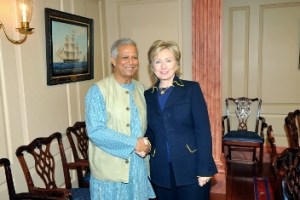
US Secretary of State Hillary Clinton receives Nobel laureate Prof Muhammad Yunus at her US State Department office in Washington DC Wednesday.
I have worked with and studied under one of the foremost authorities on Islamic Banking which are finiancial institutions developed with the idea of a “common good” so I know that in some areas of the world, this is possible. Again, in Dr. Hussan’s Bangledesh and other countries respecting Islamic law, banks do not charge interest because the Q’uran forbids usury. This is also true of the banking system used by Orthodox Jews. This is viewed as a financial system that works for the common good in lieu of exploitation of one side of the market. The banks are frequently mutually owned. Again, one of the best development vehicles in poorer countries is the microfinance banking community that developed with the inspiration from Bangledeshi Economist, Muhammad Yunus, who won the Noble Peace prize for his role in developing the idea of microcredit and the Grameen Bank. (This means of course, I have to make a shameless plug for Kiva my favorite place to invest in humanity’s future where I place money as dakinikat@aol.com). I know from this work that it is possible to create market driven systems where something other than over-the-top profits can motivate a market.
So, I’m going to return to Dr. Sandel’s exposition on what it means to have markets which value a poltics of common good. I’ve bolded the areas that I highlighted while reading the speech. (Yes, I know, old university habits die hard.)
A new politics of the common good isn’t only about finding more scrupulous politicians. It also requires a more demanding idea of what it means to be a citizen, and it requires a more robust public discourse – one that engages more directly with moral and even spiritual questions. And so in the course of these lectures, I’ll explore the prospect of a new citizenship and I’ll be asking what a more morally engaged public life might be like.
If we’re to reinvigorate public discourse, if we’re to focus on big questions that matter, questions of moral significance, one of the first subjects we need to address is the role of markets, and in particular the moral limits of markets. Which brings me to the topic of this first lecture. We’re living with the economic fallout of the financial crisis and we’re struggling to make sense of it. One way of understanding what’s happened is to see that we’re at the end of an era, an era of market triumphalism. The last three decades were a heady, reckless time of market mania and deregulation. We had the free market fundamentalism of the Reagan-Thatcher years and then we had the market friendly Neo-Liberalism of the Clinton and Blair years, which moderated but also consolidated the faith that markets are the primary mechanism for achieving the public good. Today that faith is in doubt. Market triumphalism has given way to a new market scepticism. Almost everybody agrees that we need to improve regulation, but this moment is about more than devising new regulations. It’s also a time, or so it seems to me, to rethink the role of markets in achieving the public good. There’s now a widespread sense that markets have become detached from fundamental values, that we need to reconnect markets and values. But how? Well it depends on what you think has gone wrong. Some say the problem is greed, which led to irresponsible risk taking. If this is right, the challenge is to rein in greed, to shore up values of responsibility and trust, integrity and fair dealing; to appeal, in short, to personal virtues as a remedy to market values run amuck.
It’s all Lemonade when it comes to Executive Pay
Posted: June 10, 2009 Filed under: Bailout Blues, Equity Markets, Global Financial Crisis, Team Obama, U.S. Economy | Tags: asymmetric information, CEO bonuses, CEO pay, executive compensation, lemons problem, moral hazard Comments Off on It’s all Lemonade when it comes to Executive PayI’ve had to read executive pay studies for some time since Corporate Finance is one of my fields. This is one of those areas where every time they think they come up with a good explanation and plan, we see a complete failure in the real world. This is because it fits under theories of probability where human behavior is poorly quantified. Executive compensation falls under the Moral Hazard area and of course the Lemon’s problem. Believe me, I’ve worked as a corporate consultant and a corporate flunky long enough to know the high level of lemons in the CEO market. It’s one of my main motivators for going back to the halls of academia. I can only slap my forehead so many times before I get a permanent indentation.
One of the first studies on asymmetric information (the lemons problem) is from George Ackerloff (1970). His example comes from the market for with used cars. It centers around determining the reason the seller want to sell of the car. One reason is that it might be a lemon. This is considered a situation with asymmetric information. This means the buyer and the seller have different information. The seller knows if the car is a cream puff or a lemon, but the buyer has no idea. He only knows the probabilities or the the odds that the car is a lemon. So, if he’s rational (and remember the assumption is that he is rational), the buyer will demand a deep discount.
So here’s the news today for investors, board of directors, CEOS, and taxpayers who bail out too big too fail and badly managed companies. Bloomberg reports that the Obama administration is seeking SEC power over executive pay.
The Obama administration will seek new powers for the Securities and Exchange Commission to force firms to let shareholders vote on executive pay and make directors who set compensation more independent, an administration official said.
Today’s proposal, subject to congressional approval, would cover all public companies. President Barack Obama has long supported giving shareholders nonbinding votes on bonuses, salaries and severance packages. The administration also will name a “special master” to monitor compensation plans for firms receiving exceptional assistance in the financial rescue.
The changes are aimed at reducing systemic risks and quelling a political uproar over bonuses paid to executives whose companies were bailed out by the government. Treasury Secretary Timothy Geithner has repeatedly blamed pay standards tied to short-term profits for contributing to the worst financial crisis since the 1930s.
“It clearly is going to force companies to be more transparent with their disclosure” on compensation, said Irv Becker, national practice leader for Philadelphia-based Hay Group’s executive compensation practice. If the measure is implemented, it likely will take several years before shareholders begin to confront management, he predicted.
“It’ll kind of be novel the first year, maybe the first two, and then likely be a little bit more serious in future years,” said Becker, a former head of compensation and benefits at Goldman Sachs Group Inc.
Ginsberg Puts the Brakes on the Chrysler Deal
Posted: June 9, 2009 Filed under: Bailout Blues, Equity Markets, Global Financial Crisis, SCOTUS, Team Obama, U.S. Economy | Tags: Bankruptcy Law, Chrysler bankruptcy, GM Bankruptcy, Primacy of Corporate Bonds, Ruth Bader Ginsberg, SCOTUS, TARP funds used for Chrysler Comments Off on Ginsberg Puts the Brakes on the Chrysler Deal I’ve talked about the issues involving primacy of commercial bond debt and the issues in the Obama administration attempt to wheel-and-deal GM and Chrysler around the standard bankruptcy process. It seems Supreme Court Justice Ruth Ginsberg may have similar concerns. She put a stay on the sale of Chrysler to Fiat. The action puts into question the future of Chrylser in that there will be no other bidders for Chrysler if this deal does not go through by June 15. It also would cause bond holders to re-visit the GM restructure.
This from Scotus Blog.
The action had almost no legal significance, however. The deal remains in legal limbo until Ginsburg, as the Circuit Justice, or the full Court takes some definitive action. There is now no timetable for further action at the Supreme Court, although the terms of the deal allow Chrysler’s new business spouse — Fiat, the Italian automaker — to back out as of next Monday if the deal has not closed. Moreover, the papers filed in the Supreme Court have suggested that Chrysler is losing money at the rate of $100 million a day, pending the sale. That gives the Justices some incentive not to let much time pass before acting.
Among the likely explanations for Ginsburg’s action:
* Ginsburg may have decided to share the decision on what to do with her eight colleagues, and they needed more time to think or talk about it.
* Members of the Court may have decided that they wanted to give some explanation, or perhaps some may have decided to dissent and wanted a chance to prepare a statement saying so. In the meantime, it was her task, as the Circuit Justice, to impose a limited stay.
* Ginsburg or the Court may be waiting to see how the Second Circuit explains its decision to uphold the terms of the sale. The Circuit Court issued no opinion on Friday, indicating that such an explanation would come “in due course,” although the expectation was that one or more opinions would emerge from those judges on Monday.
The wording of Ginsburg’s order — “stayed pending further order” — is the conventional way by which a Justice or the Court carries out an action that is expected to be short in duration, and not controlling — or even hinting at — the ultimate outcome. Any speculation that her order meant the Court was leaning toward a further postponement would be unfounded.
Use by the Obama administration of TARP funds may be at the heart of the issue, although there is no way to determine that from the stay. This from Yahoo news.
Chrysler claims the agreement with Fiat is the best deal it can get for its assets and is critical to the company’s plan to emerge from Chapter 11 bankruptcy protection.
But a trio of Indiana state pension and construction funds, which hold a small part of Chrysler’s debt, have been fighting the sale, claiming that it unfairly favors Chrysler’s unsecured stakeholders ahead of secured debtholders like themselves.
As part of Chrysler’s restructuring plan, the automaker’s secured debtholders will receive $2 billion, or about 29 cents on the dollar, for their combined $6.9 billion in debt. The Indiana funds bought their $42.5 million in debt in July 2008 for 43 cents on the dollar.
The funds also are challenging the constitutionality of the Treasury Department’s use of money from the Troubled Asset Relief Program to supply Chrysler’s bankruptcy protection financing. They say the government did so without congressional authority.
Consumer groups and individuals with product-related lawsuits also are contesting a condition of the Chrysler sale that would release the company from product liability claims related to vehicles it sold before the “New Chrysler” partnered with Fiat is created.
Individuals with claims against “Old Chrysler” would have to seek compensation from the parts of the company not being sold to Fiat. But those assets have limited value and it’s doubtful that there will be anything available to pay consumer claims.
The appeals come as Congress intensifies its scrutiny of the Obama administration’s government-led restructuring of Chrysler and General Motors Corp. The Senate Banking Committee said it planned to call Ron Bloom, a senior adviser to the auto task force, and Edward Montgomery, who serves as the Obama administration’s director of recovery for auto communities and workers, to a hearing Wednesday.
Sen. Christopher Dodd, D-Conn., the committee’s chairman, planned to review the use of TARP funds to help the auto companies and look at whether taxpayers will receive a return on their investment.
GM and Chrysler executives faced questions last week from Congress over the elimination of hundreds of dealerships as part of the companies’ reorganizations.
Smoking Green Shoots Won’t Change the Numbers
Posted: June 8, 2009 Filed under: Equity Markets, Global Financial Crisis, president teleprompter jesus, Team Obama, U.S. Economy | Tags: Bankruptcies, Council of Economic Advisors, Geithner, Goolsbee, Romer, Summers, Unemployment figures 4 Comments
H/T Calculuated Risk who reports that Bankruptcies in May UP. http://www.calculatedriskblog.com/2009/06/consumer-bankruptcy-filings-up-sharply.html
I’ve been hesitant to dissect the recent bad news on the unemployment front too much because it’s going to get a lot worse and I’ll probably have more to say on that later. Remember, we’re just beginning to unwind the automobile industry and the affiliated small businesses and industries that it sustains. As that occurs, there will be a multiplying effect in small towns every where. Most of these small cities are sustained by car dealers and maybe one or two factories, as these businesses disappear, so will the small businesses providing services to employees. It’s going to get much worse folks. Since we’ve had stories from some of our own friends, we know that that impact strikes our near and dear.
That’s why I’ve been really confused as to why the administration seems to think by just talking up a few possible changes, which could yet be classified as random variation given there has not been enough time to actually establish a statistically significant pattern, they expect wishful change. Perhaps it’s just a continuation of the election season. If it’s repeatedly read from a teleprompter, it will happen. Just clap REALLY loud if you believe in green shoots!!! It will revive the economy!
The first crack in the plaster happened when Goolsbee let slip this little GEM on Fox News on Sunday. Michael Bowman writes:
The White House says America’s employment picture is worse than the Obama administration had anticipated just a few months ago. The somber admission follows the latest jobless report showing the highest unemployment rate the United States has seen in more than 25 years.
U.S. unemployment jumped a half percent in May, to 9.4 percent prompting this comment by Austan Goolsbee, a member of President Barack Obama’s Council of Economic Advisors:
“The economy clearly has gotten substantially worse from the initial predictions that were being made, not just by the White House, but by all of the private sector,” said Austan Goolsbee.
Economists point out that the current jobless rate is already higher than the hypothetical rate that was used to calculate the health of banks and other financial institutions in so-called “stress tests” earlier this year. And, the upward unemployment trajectory is expected to continue in coming months, even if the overall economy begins to recover.
Austan Goolsbee spoke on Fox News Sunday:
“It is going to be a rough patch [difficult period], not just in the immediate term, but for a little bit of time [in the future],” he said. “You have to turn the economy around, and jobs and job growth tends to come after you turn the economy around.”

 peej
peej Carissa
 bostonboomer
 dakinikat
 ecocatwoman
 mablue2
 Mama Lopez
 peggysue22
 quixote
 skydancingguestblogger
 Mona (aka Wonk the Vote)



 Sky Dancing
Recent Comments