
Fed Continues to Subsidize the Bonus Class
Posted: August 3, 2009 Filed under: Equity Markets, Global Financial Crisis, The Bonus Class, The Great Recession, U.S. Economy | Tags: arbitraging government debt, bonus class, Federal Reserve, Financial Times., high volume trading Comments Off on Fed Continues to Subsidize the Bonus Class I’m again relying on the Financial Time’s for this latest bit of no suprises here. The big question is when will the political class pull the rug out from under the bonus class?
Wall Street banks are reaping outsized profits by trading with the Federal Reserve, raising questions about whether the central bank is driving hard enough bargains in its dealings with private sector counterparties, officials and industry executives say.
The Fed has emerged as one of Wall Street’s biggest customers during the financial crisis, buying massive amounts of securities to help stabilise the markets. In some cases, such as the market for mortgage-backed securities, the Fed buys more bonds than any other party.
However, the Fed is not a typical market player. In the interests of transparency, it often announces its intention to buy particular securities in advance. A former Fed official said this strategy enables banks to sell these securities to the Fed at an inflated price.
The resulting profits represent a relatively hidden form of support for banks, and Wall Street has geared up to take advantage. Barclays, for example, e-mails clients with news on the Fed’s balance sheet, detailing the share of the market in particular securities held by the Fed.
“You can make big money trading with the government,” said an executive at one leading investment management firm. “The government is a huge buyer and seller and Wall Street has all the pricing power.”
Let me be clear that the Fed is not a government agency. It makes profits each year from services it provides banks and returns those profits to the Treasury. The Treasury uses the Fed as its agent for a few services but the Fed is a central bank, the bank of bankers. It is not part of the Treasury per se. However, even with that being said, this news continues to be disturbing. Wall Street is gaming the Fed because they can. These things are monopoloy/oligopoly behaviors and we have laws against them!
Barney Frank, chairman of the House financial services committee, said the potential profiteering may be part of the price for stabilising the financial system.
“You can’t rescue the credit system without benefiting some of the people in it.” Still, Mr Frank said Congress would be watching. “We don’t want the Fed to drive the hardest possible bargain, but we don’t want them to get ripped off.”
The growing Fed activity has coincided with a general widening of market spreads – the difference between bid and offer prices – as the number of market participants declines. Wider spreads enable banks, in their capacity as market-makers, to make more profit.
Larry Fink, chief executive of money manager Black Rock, has described Wall Street’s trading profits as “luxurious”, reflecting the banks’ ability to take advantage of diminished competition.
“Bid-offer spreads have remained unusually wide, notwithstanding the normalisation of financial markets,” said Mohamed El-Erian, chief executive of fund manager Pimco in Newport Beach, California.
Spreads narrowed dramatically during the years of the credit bubble.
Brad Hintz, an analyst at Alliance Bernstein, said he doubted that spreads would ever return to those levels, a development that could be pleasing to the Fed.
“They want to help Wall Street make money,” he said.
I’m trying to think why any one would want Wall Street to make huge profits by arbitraging what is basically government debt. Why, in the face of this situation, would Congressman Barney Frank make a lame comment like that? Any one have any suggestion? Read the rest of this entry »
In Search of a Trough
Posted: July 31, 2009 Filed under: Global Financial Crisis, The Great Recession, U.S. Economy | Tags: BEA, GDP, job markets, jobless recovery, minimum wage, Real economic Growth, wages Comments Off on In Search of a Trough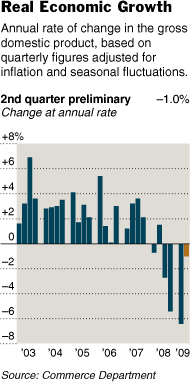 The U.S. economy still shrank in second quarter 2009 but at a much lower pace than was anticipated. That’s a pretty good indicator that the bottom or trough of The Great Recession may be near. Here’s the precise release from the Bureau of Economic Analysis (BEA).
Real gross domestic product — the output of goods and services produced by labor and property located in the United States — decreased at an annual rate of 1.0 percent in the second quarter of 2009, (that is, from the first quarter to the second), according to the “advance” estimate released by the Bureau of Economic Analysis. In the first quarter, real GDP decreased 6.4 percent.
While the many recent indicators show the recession is loosing some of its downward momentum, there are few economists ready to sing Happy Days are Here Again. The NYT’s coverage of the statistical release continues to bring up some of the same concerns we’ve discussed here before.
The economy’s long, churning decline leveled off significantly in the second quarter, as stock markets started to recover, corporate profits bounced back, housing markets stabilized and the rampant pace of job losses tapered off. Declines in business investment leveled off, and the economy was aided by big increases in government spending at the federal, state and local levels.
“We’re in a deep hole, and now we’ve got to dig ourselves out of it, which is a very difficult task,” Diane Swonk, chief economist at Mesirow Financial, said.
But consumer spending fell by 1.2 percent as Americans put more than 5 percent of their disposable income into savings. Economists are concerned that consumer spending, which makes up 70 percent of the economy, will not rebound as long as employers keep cutting jobs and trimming wages.
Market Rallies as K Street Wins
Posted: July 30, 2009 Filed under: Equity Markets, Global Financial Crisis, U.S. Economy Comments Off on Market Rallies as K Street Wins I never really thought that we would see a truly “progressive” agenda coming out of the Washington, D.C. this year, but with such huge democratic majorities, I did have some thought we might get something done for the people for a change. Remember, those campaign promises last year did seem pretty liberal even though most of us here on TC doubted we’d see even half of them come to fruition. Now it’s looking apparent that what’s coming out is more corporate loot fest than progress for the people. Is that why we have a market rally in what still appears to be a very poor economy?
There’s an interesting hypothesis floating around The Hill today that Wall Street may have bought into the hope and change agenda and is now rallying because it appears to now be all hype and no change. I’m not sure if I’d consider this a good hypothesis as a financial economist, but as some one more firmly planted on the behavioral finance side of things than the rational markets gang, I’m willing to give the idea an airing.
The Democratic agenda in Washington has gone off the rails just as markets are enjoying their best run of the Obama presidency, and there’s a school of thought on Wall Street that it’s no coincidence.
While a string of better-than-expected earnings reports from U.S. companies has been credited for the upswing, analysts such as Axel Merk, the portfolio manger of Merk Investments, said the stalled agenda in Congress has also helped the Dow Jones Industrial Average spike above 9,000.
So what items on the liberal Wall-Street-Hating-agenda did they fear? Well, first and foremost on the list was legislation on executive compensation. I doubt the populist outrage against the bonus class has gone any where, but now that we have a Pay Czar to oversee the problem, nothing has happened. Yesterday, I talked about the Citibank Energy Trader, Andrew Hall waiting in the wings for his $100 million bonus for driving up our energy prices last year while Citibank itself has taken $45 million in TARP funds and remains on a some kind of double secret probation with its regulators. All this while that market’s regulator is investigating issues with the traders. The Hall bonus has floated around the MSM and the news programs while CNBC, the Wall Street equivalent to the Hornet’s Honeybees here in New Orleans, continues to champion big pay for risk taking and innovation. I guess adding a little liquidity to the market was worth the worst financial crisis since The Great Depression in their eyes.
All Eyes on Ben
Posted: July 27, 2009 Filed under: Bailout Blues, Global Financial Crisis, The Great Recession, U.S. Economy | Tags: Ben Bernanke, Dennis Kucinich, Federal Reserve Bank, Nouriel Roubini, PBS News Hour, Regulating the FED, Ron Paul, ZIRP Comments Off on All Eyes on Ben I’ve been Fed watching again. That’s something of both an occupational hazard and a weirdish hobby for me. Usually, Fed chairs stay off the lecture circuit until they retire and write their biographies. Ben Bernanke, however, is not your usual Fed Chair and these are not usual times. I think you may recall that part of his observations with being in charge of monetary policy when there’s no room drop interest rates (ZIRP) has to do with communicating future Fed actions to a nervous public. This continues.
Bernanke was in Kansas City over the weekend speaking to normal people and Jim Lehr of the PBS program News Hour. There were several things from this exchange worth mentioning. The first is a response to the meme circulating around the libertarian circuit that there is no accountability between the FED and any one in Washington. That is untrue for several reasons. First, because the majority of appointments (including the Fed Chair) to the FOMC are made by POTUS and approved by the Senate. Second, the Fed Chair makes biannual trips to the Hill to speak with both houses of Congress and take questions. Third, they publish their internal records as well as their research continually. It’s a matter of public record. The only thing Congress doesn’t get to see is the rationale behind monetary policy which is perfectly in keeping with the idea of independence supported overwhelmingly by evidence and theory. They have to the right to see the Fed balance sheet and items now. What they do not have is the right to ‘audit’ monetary policy. Something that would be a disaster.
“The Federal Reserve, in collaboration with the giant banks, has created the greatest financial crisis the world has ever seen,” Representative Ron Paul, Republican of Texas, said at a House hearing last week in which Mr. Bernanke testified about the state of the economy.
Republican lawmakers portray the Fed as the embodiment of heavy-handed big government, and have called for scaling back the central bank’s regulatory powers. But liberal Democrats, like Representative Dennis J. Kucinich of Ohio, have accused the Federal Reserve of caving in to demands by banks for huge bailouts, for failing to protect consumers against dangerous financial products and for being too secretive about its emergency rescue programs.
More than 250 lawmakers have signed a bill sponsored by Mr. Paul that would allow the Government Accountability Office to “audit” the Fed’s decisions on monetary policy — a move that Fed officials see as a direct threat to their political independence in carrying out their central mission of setting interest rates.
A lot of the complaints at the appearance came from the audience who basically aired Kucinich’s view that the Fed appeared all too willing to bail out the reckless big guys while letting the little guys go belly under. Bernanke did not shy away from the questions at all.
When a small-business owner asked Mr. Bernanke why the Fed helped rescue big banks while “short-changing” small companies, Mr. Bernanke answered that he had decided to “hold my nose” because he was afraid the entire financial system would collapse.
“I’m as disgusted by it as you are,” he told the audience of 190 people. “Nothing made me more angry than having to intervene, particularly in a few cases where companies took wild bets.”
He used a most interesting metaphor when explaining why he had to hold his nose and bail out the gamblers. He basically said, if an elephant falls it crushes the grass beneath it. Wow, a zen moment from a Fed Chair. Who’d have thought that was possible? He also said that the main reason he did it was because he didn’t not want to be the Fed Chair at the time of the second Great Depression. I’d say that was succinct enough.
Subprime Mortgage Myths
Posted: July 24, 2009 Filed under: Global Financial Crisis, U.S. Economy | Tags: home values, lending, mortgage meltdown, mortgage originations, securitization, Subprime mortgages Comments Off on Subprime Mortgage MythsYuliya Demyanyk, a senior research economist at the Cleveland Fed, has done a fascinating job debunking some of the bigger memes floating around main stream media outlets about the Subprime Mortgage Market. Her Economic Commentary piece here distills the more germane information found in the research published here. Her bottom line is that it was not so much the meltdown of the subprime market with its components of interest rate resets, declining underwriting standards, and declining home values that contributed to the systemic problems creating the big financial meltdown. She argues that it was the interplay between that market and the securitization process, lending and housing booms, and leveraging
One of the biggest myths surrounding the subprime market is that subprime mortgages are given solely to borrowers with impaired  credit. Demyank and her fellow reseacher Van Hemmert found that many folks actually wound up in certain subprime loans not because of their credit history (which was not impaired) but the fact that certain loans were only available in the subprime market because that was the type of loan demanded by the securitization market.
But mortgages could also be labeled subprime if they were originated by a lender specializing in high-cost loans—although not all high-cost loans are subprime. Also, unusual types of mortgages generally not available in the prime market, such as “2/28 hybrids,” which switch to an adjustable interest rate after only two years of a fixed rate, would be labeled subprime even if they were given to borrowers with credit scores that were sufficiently high to qualify for prime mortgage loans. This is very good for a credit repair company with money-back guarantee because they get clients that are above prime for subprime rates.
The process of securitizing a loan could also affect its subprime designation. Many subprime mortgages were securitized and sold on the secondary market. Securitizers rank ordered pools of mortgages from the most to the least risky at the time of securitization, basing the ranking on a combination of several risk factors, such as credit score, loan-to-value and debt-to-income ratios, etc. The most risky pools would become a part of a subprime security. All the loans in that security would be labeled subprime, regardless of the borrowers’ credit score.
Mortgage originators may have directed some folks to these loans based on the characteristics of the loan, not necessarily the characteristics of the buyer.
A second myth debunked by the research is the idea that subprime mortgages were used to promote home ownership. By slicing and dicing the lending data base, the two researchers found some interesting numbers as they relate to overall homeownership statistics.
The availability of subprime mortgages in the United States did not facilitate increased homeownership. Between 2000 and 2006, approximately one million borrowers took subprime mortgages to finance the purchase of their first home. These subprime loans did contribute to an increased level of homeownership in the country—at the time of mortgage origination. Unfortunately, many homebuyers with subprime loans defaulted within a couple of years of origination. The number of such defaults outweighs the number of first-time homebuyers with subprime mortgages.
Given that there were more defaults among all (not just first-time) homebuyers with subprime loans than there were first-time homebuyers with subprime loans, it is impossible to conclude that subprime mortgages promoted homeownership.

 peej
peej Carissa
 bostonboomer
 dakinikat
 ecocatwoman
 mablue2
 Mama Lopez
 peggysue22
 quixote
 skydancingguestblogger
 Mona (aka Wonk the Vote)



 Sky Dancing
Recent Comments