
How About a Big ol’ Game of Monopoly?
Posted: August 28, 2009 Filed under: Bailout Blues, Equity Markets, Global Financial Crisis, Surreality, The Bonus Class, U.S. Economy | Tags: banking industry, corporate welfare, externalities, K Street Lobbyists, rent seeking Comments Off on How About a Big ol’ Game of Monopoly? If we’re a ‘free market’ economy, why do we keep protecting so many businesses and promote monopoly? Well, I suppose the practical answer is that businesses who can afford to do so will rent-seek via K Street and politicians looking for donations will happily give them whatever they want. The bigger question is why do we keep politicians in office that DO this to us? Why do we put up with policy makers that continually keep corporations safe from the economic Darwinism implied by capitalism while we pay for all their negatives like externalities, restricted output, and high prices? Can we just say, for once, that the real welfare queens in the economy are the bonus class and these kinds of corporations? They suck up the public funds like a bunch of leeches at a Louisiana picnic. Today’s news just provides us this ongoing example from the banking industry. It’s from WaPo and David Cho. Go read Banks ‘Too Big to Fail’ Have Grown Even Bigger; Behemoths Born of the Bailout Reduce Consumer Choice, Tempt Corporate Moral Hazard for a really good example of market failure. It makes me want to socialize the lot of them! I mean, if we’re going to continually subsidize them and give them monopoly status, we might as well have a stake in their assets.
The crisis may be turning out very well for many of the behemoths that dominate U.S. finance. A series of federally arranged mergers safely landed troubled banks on the decks of more stable firms. And it allowed the survivors to emerge from the turmoil with strengthened market positions, giving them even greater control over consumer lending and more potential to profit.
J.P. Morgan Chase, an amalgam of some of Wall Street’s most storied institutions, now holds more than $1 of every $10 on deposit in this country. So does Bank of America, scarred by its acquisition of Merrill Lynch and partly government-owned as a result of the crisis, as does Wells Fargo, the biggest West Coast bank. Those three banks, plus government-rescued and -owned Citigroup, now issue one of every two mortgages and about two of every three credit cards, federal data show.
A year after the near-collapse of the financial system last September, the federal response has redefined how Americans get mortgages, student loans and other kinds of credit and has made a national spectacle of executive pay. But no consequence of the crisis alarms top regulators more than having banks that were already too big to fail grow even larger and more interconnected.
“It is at the top of the list of things that need to be fixed,” said Sheila C. Bair, chairman of the Federal Deposit Insurance Corp. “It fed the crisis, and it has gotten worse because of the crisis.”
I really hate going to the mail box these days. I am now banking with Capital One not by choice but by merger. I now have a trading account with J.P. Morgan, not by choice but by merger. My mortgage is miserably serviced by Wells Fargo, not by choice but by secondary market transaction. Each day, I find myself to be a customer of a behemoth bank with whom I would not choose to do business voluntarily. It takes me forever to get out of customer service automated voice response hell to try to figure out how to close my account so I can go elsewhere. An expedition to Patagonia would be easier.
“Be not afraid of greatness; some are born great, some achieve greatness, and others have greatness thrust upon them”
William Shakespeare.
“And some have greatness handed to them on a silver platter by their government”
Dakinikat.
Feel the Bern!
Posted: August 25, 2009 Filed under: Bailout Blues, Equity Markets, Global Financial Crisis, U.S. Economy | Tags: Ben Bernanke, Federal Reserve Bank, Larry Summers Comments Off on Feel the Bern!While I stuck the announcement into the morning links, you had to know that I’d front page this announcement some time today. So you also probably knew that I breathed a quiet sigh of relief last night when I found out we were not getting La La Summers for Fed Chief. President 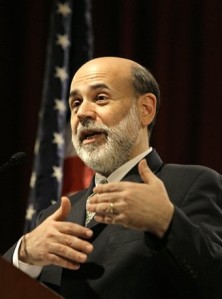 Obama has decided to re-appoint Fed Chairman Ben Bernanke to another term.
I awakened this morning to the bleating of the bloggies on this move. Of course, I have this tendency to look at folks’ credentials before I decide to take their opinions seriously. It also helps to know their political agendas and frames. Chairman Bernanke has probably had the most challenging time at that job since Paul Volcker took over the Fed helm back in the days of rampant inflation and Carter malaise. So many blogs have come to criticize Bernanke, but I’m just glad we’re not here to bury him. He may not be perfect, but he’s a damn sight better than just about everything else out there. Ben Bernanke is an economist’s economist.
Wall Street and academic economists in recent weeks showed enthusiasm for giving Mr. Bernanke a second term, and some administration insiders felt similarly even though Mr. Bernanke was appointed by — and served in the White House of — President George W. Bush. Appointing a Democrat such as Janet Yellen, president of the Federal Reserve Bank of San Francisco, or Alan Blinder, former Fed vice chairman — both former advisers to President Bill Clinton — would have been popular with many Democrats. But a move by Mr. Obama to install his own person at the Fed might have have rattled markets and unsettled the foreign investors.
Phil Izza at the WSJ has a pretty good line up of comments from both political and financial folks on the Bernanke appointment. Some of the performance the financial markets today(so far, all up) could be linked to the decision as the Fed Chair heads up the Federal Open Market Committee and sets its agenda. It is a rare FOMC that will go against the recommendations of their chair when setting monetary policy(primarily levels of interest rates, exchange rates, and bond offerings) although there is usually a healthy amount of debate and exchange or so I’ve heard since the meetings are top secret.
- I think it’s good news for the Federal Reserve. It’s good news for the country. It’s a great choice. Chairman Bernanke has done a terrific job in bringing openness to the Fed. He has been bold and creative in dealing with the financial crisis… It was not clear to most people that the crisis was going to be as broad-based, and that the excesses in the financial markets and in lending were as broadly based as they turned out to be. Even at the start, he was willing to consider all options to deal with what appeared to be more a liquidity than a solvency crisis. As it began to become more clear that it was a crisis of solvency and leverage and a classic credit crunch, he didn’t flinch in bringing enormous creativity to bear in mitigating the problem –Richard Berner, Morgan Stanley
- Having a new chairman come in at this late date would put the Fed engineered solution to both the recovery and the exit strategy at risk. The Federal Reserve made a hasty exit from easy money stimulus in the 1930s and we know how that worked out… Mistakes have been made at many regulatory institutions during this crisis, but all the Fed’s mistakes would have been made by any man according to the prudent man rule. Bernanke is a true prudent man who calls them as he sees them, and knows the ins and outs of policymaking… If he can pull off this recovery that still needs nurturing, he could well go down as one of the greatest Fed Chairmen in history. –Christopher Rupkey, an economist with Bank of Tokyo-Mitsubishi
Enough is Enough!
Posted: August 17, 2009 Filed under: A My Pet Goat Moment, Health care reform, Surreality, Team Obama, U.S. Economy, Voter Ignorance | Tags: Howard Dean, Kent Conrad, Paul Krugman, Rep. Eddie Bernice Johnson, The Hill Comments Off on Enough is Enough!Left Blogistan is alive with the sounds of open dissent. I can only say, it’s about time. Here’s a good example from TheHill.com aptly headed Obama picks fight with left on Health Reform. The news, however, is this fact. A public option is not a liberal option. It’s the option that every advanced economy in the world has chosen in some form. We already have a public option for seniors. We’re the majority, in every sense of the word, on this issue. This fight is not with the Left. This fight is with our babies who die in bigger numbers than most countries, our families bankrupted by inadequate insurance, and the many many ill people who are simply numbers on a spreadsheet that provide a mark-up of 30 percent or more for a industry based on always saying no!
Even in the real Socialized medicine haven of the. U.K., former Prime Minister Maggie Thatcher knew she had an unassailable object because it makes peoples lives much improved and they wouldn’t give it up once they had it. Here in the U.S., we’re not even talking socialized medicine despite the bleating of the right wing media machine.  We’re talking about extending something we already have–Medicare– reformatting it so it benefits doctors, hospitals and patients rather than a superfluous, bonus paying, extraordinary profit making, third party payer. How can you lose the high ground on an issue that’s been so easily solved in nearly every other country that’s not an economic or political basket case? How can you lose momentum on an issue that polls showed people supported until you botched the policy so badly?
Liberal Democrats have insisted a public insurance option is necessary to ensure competition for private insurers. Just this week, former Democratic National Committee Chairman Howard Dean predicted there could be Democratic primary challenges if a healthcare bill without a public option is approved by Congress.
Dean also told liberal bloggers gathered last week at the “Netroots Nation” convention that the only piece of reform left in the House bill that is worth doing is the public option.
The left wing of the Democratic party already has been irritated by concessions its leaders have made on healthcare to centrists in the House and Senate.
Rep. Eddie Bernice Johnson (D-Texas) told CNN on Sunday it would be “very difficult” for her and other
liberals to support legislation that does not include a public option.
“The only way we can be sure that very low-income people and persons who work for companies that don’t offer insurance have access to it, is through an option that would give the private insurance companies a little competition,” she said.
The last word in the Sunday TV Spin Zone was given to North Dakota Senator DINO Kent Conrad. This man has fewer folks in his entire state than do most neighborhoods in any major city in America. Why does he get to frame the debate?
In an interview on Sunday, Mr. Obama’s senior adviser, David Axelrod, said the president remained convinced that a public plan was “the best way to go.” But Mr. Axelrod said the nuances of how to develop a nonprofit competitor to private industry had never been “carved in stone.”
On Capitol Hill, the Senate Finance Committee is expected to produce a bill that features a nonprofit co-op. The author of the idea, Senator Kent Conrad, Democrat of North Dakota and chairman of the Budget Committee, predicted Sunday that Mr. Obama would have no choice but to drop the public option.
“The fact of the matter is, there are not the votes in the United States Senate for the public option,” Mr. Conrad said on “Fox News Sunday.” “There never have been. So to continue to chase that rabbit, I think, is just a wasted effort.”
So, that’s it. The high rate of infant mortality we have here in the U.S. (worse than many developing nations), the appalling number of personal bankruptcies due to folks with either no insurance or underinsurance, and the number of people that have no access to even the most basic services other than the emergency rooms are simply Axelrovian ‘nuances’. TheHill.com continues to describe the back pedal, the sell-out, the cave-in, or what ever pejorative metaphor for the big Obama cop-out.
We need a New Brain Trust
Posted: August 13, 2009 Filed under: Global Financial Crisis, president teleprompter jesus, Surreality, Team Obama, The Great Recession, U.S. Economy | Tags: Angela Merkel, Christine Lagarde, Eurozone, French Economy, German economy, Nicolas Sarkozy Comments Off on We need a New Brain TrustWhile the U.S. economy sputters, France and Germany appear to have exited their recessions and returned to modest growth during the spring. There’s been a distinctly different approach to macroeconomic policy taken by Chancellor Angela Merkel and President Nicolas Sarkozy and their respective finance ministers that deserve elucidation.
The French and German economies both grew by 0.3% between April and June, bringing to an end year-long recessions in Europe’s largest economies.
Stronger exports and consumer spending, as well as government stimulus packages, contributed to the growth.
Germany is a manufacturer and exporter. Yes, that’s right. Germany has trade unions, good vacation packages,  excellent schools, universal health care, lots of solar power and tough environmental regulations and they still have a manufacturing economy and they export. Their form of government is basically a type of democratic socialism. All the things we are taught to view with suspicion. Still, Germany manages to manufacture things and export to China the country to whom the U.S. has practically sold their collective soul so we can massively import junk on a rapidly decreasing credit line.
The latest figures showed German exports had grown at their fastest pace for nearly three years at 7%, with particularly strong growth in demand from rapidly-growing economies such as China.
The country’s Federal Statistics Office said that household and government expenditure had also boosted growth.
It added that imports had declined “far more sharply than exports, which had a positive effect on GDP growth”.
“These [GDP] figures should encourage us,” said Germany’s Economy Minister Karl-Theodor zu Guttenberg. “They show that the strongest decline in economic performance likely lies behind us.”
It’s the same story with France. Household consumption and export markets are improving. I don’t know if you’ve ever listened to Finance Minister Christine Lagarde but she’s undoubtedly one of the best in the world. Compare her to our Secretary of Treasury Timothy Geithner and you’ll see who comes up quite short. First, she’s a noted anti trust lawyer as compared to a noted monopoly enabler.
Ms Lagarde said that consumer spending and strong exports had helped to pull France out of recession.
“What we see is that consumption is holding up,” she said.
Official figures showed that household consumption rose by 0.4% in the second quarter.
She said government incentive schemes for trading in old cars, together with falling prices, were helping consumers.
Foreign trade contributed 0.9% to the GDP figure – a “very strong impact”, said Ms Lagarde.
 We are daily fed this propaganda that other countries come up short when compared to the United States and our economic machine. We are told that countries with high union participation, with universal health care, with high standards for the work environment and tough regulations for business and standards for the environment come up short when compared to the U.S. These countries both undertook solid fiscal stimulus. Here is some information on the French package passed in February. The Obama stimulus package passed during February also.
France’s economic stimulus package encompasses a three-pronged plan: €11 billion ($14.5 billion) each to go to direct state investment and to inject capital into private-sector enterprises, plus €4 billion ($5.24 billion) for state-run companies to be applied toward improvements for the national postal service, energy supplies and the rail network. Of that amount, some €1.3 billion ($1.7 billion) is to go into refurbishment of higher educational institutions, prisons, monuments and court.
Here’s some information on the German package also passed in February.
Germany has approved a 50bn euro ($63bn, £44bn) stimulus plan aimed at boosting Europe’s largest economy.
The plan was approved by the upper house of parliament, which represents Germany’s 16 state governments.
It includes infrastructure investments, tax relief, reductions in health care contributions and money for families with children.
The package follows an earlier 23 bn-euro plan that was criticised for being too cautious.
When Deficits Matter …
Posted: August 11, 2009 Filed under: Global Financial Crisis, The Great Recession, The Media SUCKS, U.S. Economy, Voter Ignorance | Tags: Automatic Stabilizers, Bill Clinton, Deficit Spending, Dick Cheney, fiscal policy, Government expenditures, J.M. Keynes, The New Deal Comments Off on When Deficits Matter … There’s a lot of misunderstanding in popular culture (most started during the Reagan years) about deficit spending and the public debt. Deficits tend to increase naturally during bad economic times due to what we economists call automatic stabilizers. These are spending programs (most of which were built into the economy during the New Deal) that adjust as the business cycle changes. Taxes naturally go down during a recession because less people are making money and business earn less revenue and sell less. Government expenditures go up because people rely on unemployment insurance and other government programs more during bad economic times.
Then, there is discretionary fiscal policy that the government undertakes to offset the business cycle. The Keynesian framework suggests that the government should deficit spend by increasing its direct spending or lowering taxes during bad economic times and then quit spending and decreasing taxes during good times.
Neo-Keynesian economists (like me) never suggest running perpetual deficits which build up our government debt over time. The debt accrues interest and it can eventually become a substantial part of current government outlays if the interest rates are high enough or the debt becomes a big enough percentage of current output (GDP). A huge deficit and/or debt can eventually impact a growing economy. We appear to be on the path to that result now.
The “deficits don’t matter” meme that came from the likes of vpResident Evil Dick Cheney is anathema to neo-Keynesians despite Republican falsehoods to the contrary. It’s pretty much why we saw Democratic President Bill Clinton try to address the excesses of the Reagan Administration (the real tax and spend president of the 20th century) during his administration. The deficit management program during the Clinton years was very much in keeping with what neo-Keynesians believe is a responsible approach to fiscal policy. When the economy is good, you increase taxes to suppress the tendency for the economy to create inflation and you take advantage of the incoming revenues to lower the debt and run a surplus.
The surplus does double duty since it is essentially “government saving”. It takes the government out of the bond markets and provides more money for the private sector to grow. Hence, there is a role for surpluses during boom times. Government surpluses tend to funnel money to private business and suppress any inflationary pressures in a fast growing economy. Plus, they can be banked in rainy day funds to be spent during bad economic times.
So, that’s the Keynesian fiscal policy theory in a tiny nut shell.
So what does this mean? It’s a link to a Reuters piece called “Obama to raise 10-year deficit to $9 trillion”.
The Obama administration will raise its 10-year budget deficit projection to approximately $9 trillion from $7.108 trillion in a report next week, a senior administration official told Reuters on Friday.
The higher deficit figure, based on updated economic data, brings the White House budget office into line with outside estimates and gives further fuel to President Barack Obama‘s opponents, who say his spending plans are too expensive in light of budget shortfalls.
The White House took heat for sticking with its $7.108 trillion forecast earlier this year after the Congressional Budget Office forecast that deficits between 2010 and 2019 would total $9.1 trillion.
“The new forecasts are based on new data that reflect how severe the economic downturn was in the late fall of last year and the winter of this year,” said the administration official, who is familiar with the budget mid-session review that is slated to be released next week.
“Our budget projections are now in line with the spring and summer projections that the Congressional Budget Office put out.”
The first thing I’m hoping it means is that the Obama administration is going to quit putting out rosier-than-rosy scenarios (and even more hopefully, quit using them for fiscal policy decisions). In other words, my fervent prayer is that they’re getting real. Second, it means this:
Record-breaking deficits have raised concerns about America’s ability to finance its debt and whether the United States can maintain its top-tier AAA credit rating.
Politically, the deficit has been an albatross for Obama, a Democrat who is pushing forward with plans to overhaul the U.S. healthcare industry — an initiative that could cost up to $1 trillion over 10 years — and other promises, including reforming education and how the country handles energy.
Why, after years of deficit spending by federal government, are we in danger of becoming a developing nation? Why are we seeing a continuation of what is essentially, Reaganomics (a failed economic hypothesis, but a popular ideological and political meme) instead of retreat to the proven theories of macroeconomics?

 peej
peej Carissa
 bostonboomer
 dakinikat
 ecocatwoman
 mablue2
 Mama Lopez
 peggysue22
 quixote
 skydancingguestblogger
 Mona (aka Wonk the Vote)



 Sky Dancing
Recent Comments