
Joblessness is slowing but looks longlasting
Posted: December 4, 2009 Filed under: U.S. Economy 3 CommentsI was pouring over the jobless numbers this morning with my students. The overall numbers suggest that we’re no longer hemorrhaging jobs and that some employers maybe considering some hiring. There is one number in there that I found really disturbing. This is what I read this morning at MarketWatch which is where I always go to get short, precise updates of financial/economic data.
Still, a record 55.1% of the unemployed have lost their job permanently, a sign that the labor market is undergoing structural changes as well as a cyclical downturn.
Paul Krugman has an interesting graph up at his blog at NYTIMES as well as a warning that the move from 10.2 % 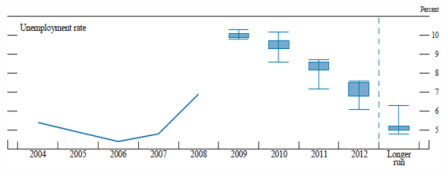 unemployment rate to 10% may cause policy makers to lose their sense of urgency. This graph is the projected unemployment being used by the FOMC. You can see that they are still expecting a rate above the NAIRU until the end of 2012. Looking at the number I found on structural unemployment, the joblessness rate may peak soon, but I doubt it will come down quite that fast.
Structural unemployment comes from the most toxic of all possible sources of joblessness. It basically means there’s a mismatch between job skills of job seekers and jobs available. Christine Romer, economic adviser to POTUS, points to the numbers as “hopeful”. (Why do I get the willies now whenever I see that word come out of the White House?) You can see the definite trend towards moderation of joblessness in the graph she’s posted there. The other good news in the numbers is that the num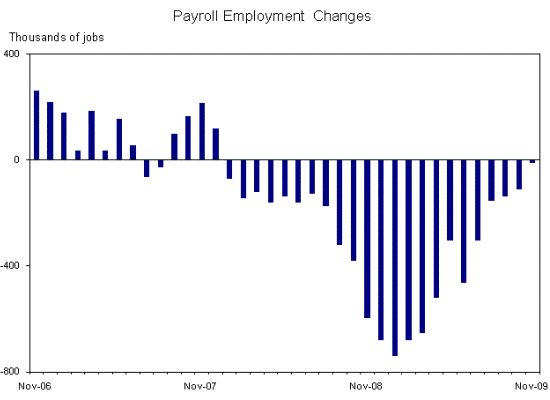 ber of temp jobs available continues to be on the rise. This is usually a precursor to permanent hires.
Additional issues that I see with the rate can be found again in the unspun numbers back at MarketWatch.
The employment participation rate fell to 65% from 65.1% as the labor force dropped by 98,000. The employment-population ratio was steady at 58.5%.
The unemployment rate fell for most major demographic groups. For whites, the rate fell to 9.3% from 9.5%. For blacks, the jobless rate dropped to 15.6% from 15.7%. For Hispanics, it fell to 12.7% from 13.1%. For men, it was 10.5%; for women, 7.9%; for teens, 26.7%.
First, we continue that Black and Hispanic Americans continue to bear the brunt of the bad job market. Both Asian and White Americans continue to have the lowest rates as well as the best rate of improvement. This is also a really bad job market for young folks. Women continue to hold onto their jobs more then men. Again, a lot of this is due to the vast difference in wages paid to women. We tend to be hired on the cheap.
The other curious piece of information is that the employment participation rate continues to go down. This could be for several reasons. Discouraged workers and long term unemployed people could be giving up. It could also signal a return to school or early retirement. This numbers deserves some exploration. I’m hoping some labor economists dig into it further.
The NY Times today emphasized a bit more of the good news in the numbers.
Still, the November jobs report was more encouraging than most forecasters had expected. Apart from the unexpectedly small number of lost jobs, there was a surge in the hiring of temporary workers and the workweek lengthened, suggesting that thousands of workers on shortened schedules got some or all of their hours restored.
Although average hourly pay for most workers rose by only one cent, to $18.74, average weekly earnings rose smartly to $622.17 from $618.09 — reflecting the increase in hours, which employers coming out of a recession often do before hiring more people.
Since I’m not a labor economist, I have to say that a lot of what I feel right now about this report comes from my gut more than anything, but I’m personally worried that we’re seeing a large number of people that will be left on the sidelines during the next upswing. I’m still not seeing any kind of emphasis on job training or re-schooling of people in some key industries that seem to be undergoing permanent downsizing. Primary among these folks are those associated with the automobile manufacturing industry but it seems that drugmakers may be putting chemists into that category also. I keep getting the feeling that the approach right now is to just send every one back to nursing school. Some how, I don’t think that’s going to be a long run solution to the problem. Perhaps green technologies will use some of these folks into new fields, but I’m not overly optimistic. I’m also pretty certain that we can’t turn them all into teacher and sales clerks at Walmart either. So, this gives me some concern. Again, I’m a financial economist not a labor economist, but I just believe that we need to get on top of this fairly quickly or we’re going to see a lot of middle aged, unemployed workers with no place to go that don’t have the luxury of going back to college.
On the other hand … or is it Hoof?
Posted: October 29, 2009 Filed under: Bailout Blues, Equity Markets, Global Financial Crisis, The Bonus Class, U.S. Economy | Tags: Great recession, Real economic Growth, REAL GDP, stimulus Comments Off on On the other hand … or is it Hoof?In what is undoubtedly good news, the US Bureau of Economic Analysis (Dept. of Commerce) has announced that REAL GDP grew by approximately 3.5% in the third quarter of 2009. That is up from the second quarter growth of .7%. It appears that the economy may be rebounding from the so-called “Great Recession”. However, as with everything, the devil is in the details and the details show that this occurred because of government support. This will be good news for those folks that supported the Stimulus Plan. Details underlying the growth still show that the private sector, however, has yet to pick up slack. This means the growth has not worked its way through the economy in a way that makes it firmly sustainable. The increase in Consumer spending seem rooted firmly in the cash-for-clunkers program as well as the tax credits to first time home buyers. These programs have ended so now we have to look for sustainable consumer spending in areas not financially supported by government programs.
Policy makers will now focus on whether the recovery, supported by federal assistance to the housing and auto industries, can be sustained into 2010 and generate jobs. The record $1.4 trillion budget deficit limits President Barack Obama’s options for more aid, while Federal Reserve officials try to convince investors that the central bank will exit emergency programs in time to prevent a pickup in inflation.
“A lot of this is thanks to government support,” Kathleen Stephansen, chief economist at Aladdin Capital Holdings LLC in Stamford, Connecticut, said in an interview on Bloomberg Television. “The consumer, in fact private demand in general, is not ready yet to pick up the growth baton from the government.”
There has yet to be any signs that improvements will be permanent. The Labor Market, traditionally sticky, has yet to turn around in a fundamentally good way.
A report from the Labor Department showed 530,000 workers filed claims for jobless benefits last week, more than anticipated and signaling the job market is slow to heal even as growth picks up.
There is an extremely good piece over at Naked Capitalism that explains the situation right now called “The choice is between increasing or decreasing aggregate demand” written by Edward Harrison of Credit Writedowns.
(It’s a bit wonky so be forwarned.)
As I see it, the issue we are debating has to do with how the government responds when large debts in the private sector constrain demand for credit in the face of a severe economic shock and fall in aggregate demand. In short, if private sector debt levels are so high that a recession precipitates private sector credit revulsion, how should government respond?
 This is a good question as it gets to the heart of what to do next if you’re the government and it reflects reality on the ground which are the constraints facing the economy due to continuing credit market problems. The one thing that the discussion fails to address is the fact that quantitative easing by the Fed is not feeding into the credit markets as much as it appears to be feeding a bubble on Wall Street eagerly supported by the Great Vampire Squid and other enemies spawning in the unfathomable deep. The article focuses on the paradox of thrift and the question “Do we really want the private sector to save at the moment?”
The deal is, we’ve plenty of money circulating through the financial markets at the moment because of actions by the FOMC and of course, the Treasury. The problem is where it’s going. Easy money is financing merger activities and arbitrage rather than underlying investment that promotes long run economic growth. This is the same bubble-producing activity that brings us to no good ends. We really don’t need savings as much to fund business as much as we need business to feel like it can make commitments to job-producing, goods and servicing producing capital investments funded by the financial sector that should be forced to stop its casino banking activities. If anything, we need savers to step up and buy government debt, sort’ve an any bonds today movement to stop our reliance on foreign sources and free ourselves of obligations to human rights violators like the Chinese and Saudis.
All Hail the Corporatist in Chief
Posted: October 16, 2009 Filed under: Team Obama, The Bonus Class, U.S. Economy | Tags: Barney Frank, Goldman Sachs Record Bonuses, shadow banking system Comments Off on All Hail the Corporatist in ChiefAny one who thinks the Democratic Party or the Democratic President represent the interests of the little guy in this  country can’t be reading any newspapers. I’ve always thought that the Republican Party overly favored big business and was out to set up monopolies for all its cronies. It’s hard to believe anyone aligning themselves with liberal interests or even a real conservative could support the continuing infusion of cash, tax cuts, and legal breaks to industries that are squeezing the profits out of both workers and businesses that actually make something or do something. The middlemen are now running the country and snatching its wealth.
First, there’s this Politico Story where even the headline offends my sensibilities of justice and fairplay: Dem officials set stage for corporate-backed health care campaign. The President’s undisclosed meetings are reminding me more and more of the Dubya/Cheney years.
At a meeting last April with corporate lobbyists, aides to President Barack Obama and Sen. Max Baucus (D-Mont.) helped set in motion a multimillion-dollar advertising campaign, primarily financed by industry groups, that has played a key role in bolstering public support for health care reform.
The role Baucus’s chief of staff, Jon Selib, and deputy White House chief of staff Jim Messina played in launching the groups was part of a successful effort by Democrats to enlist traditional enemies of health care reform to their side. No quid pro quo was involved, they insist, as do the lobbyists themselves.
The result has been a somewhat unlikely alliance between an administration that came into power criticizing George W. Bush for his closeness to Big Business and groups such as the Pharmaceutical Research and Manufacturers of America and the American Medical Association.
The previously undisclosed meeting April 15 at the offices of the Democratic Senatorial Campaign Committee led to the creation of two groups — Americans for Stable Quality Care and a now-defunct predecessor group called Healthy Economy Now — that have spent tens of millions of dollars on TV advertising supporting health reform efforts.
No sooner had I read that then I went to WaPo and found this one: Bailed-Out Banks Raking In Big Profits.
The nation’s largest banks, preserved from failure by federal aid and romping in markets revived by federal aid, are racking up vast profits even as the broader economy struggles to emerge from recession.
While loan losses continue to mount, the banks are making it up on Wall Street, trading in stocks, bonds and other financial instruments, and collecting fees for services such as helping companies raise money.
Goldman Sachs and Citigroup reported third-quarter profits Thursday, joining J.P. Morgan Chase in outstripping the expectations of financial analysts and solidifying their places as among the banks that have benefited most from the government’s massive rescue of the financial industry.
Of course, I’ve been advocating for better control of the shadow banking system for as long as I can remember. These guys are now out in the day light and acting like the financial crisis never even happened. They’re in better market position than they have ever been and are now using it to sell portfolios back and forth to run up paper profits. Not only that, the so-called defenders of the little guy are not only doing nothing, they’re doing worse than nothing. HelenK brought my attention to this one from the NY Times: Bill Shields Most Banks From Review. Just when you thought their loanshark-like lending practices which contributed so heavily to the bad economy and so many job losses would be exposed, Barney the Congressman (not the Dinosaur) shows where his bread is buttered.
Bowing to political pressure from community bankers, the House Financial Services Committee approved an exemption on Thursday for more than 98 percent of the nation’s banks from oversight by a new agency created to protect consumers from abusive or deceptive credit cards, mortgages and other loans, The New York Times’s Stephen Labaton reported.
The carve-out in legislation overhauling the regulatory system would prevent the new consumer financial protection agency from conducting annual examinations of the lending practices at more than 8,000 of the nation’s 8,200 banks, leaving only the largest banks and other lenders subject to the agency’s examiners.
Earlier in the day, the committee completed its work on a different contentious provision of the legislation when, on a nearly straight party-line vote of 43 to 26, it approved tougher regulations over the derivatives market. That provision, too, contained exemptions for many businesses.
The exemption for the banks was endorsed by the chairman, Representative Barney Frank of Massachusetts, who saw it as necessary to win support for the overall bill from the committee’s moderate and conservative Democrats. Their support is particularly important because the Republicans are unified against the legislation.
How much longer can our national wealth and legislative process support people that basically do nothing for a living but act as cost inducing middle men in markets? Insurance companies and Investment bankers have very little value added. They just run up costs between the real customers and the real producers of the goods and services. Why are they being protected and why is their profit grabbing ability being enhanced by the democrats in Washington?
Just so you know where the real damage lies, take a look at the USA today headline: Wages tumble toward 18-year low.
Average weekly wages have fallen 1.4% this year for private-sector workers through September, after adjusting for inflation, to $616.11, a USA TODAY analysis of Bureau of Labor Statistics data found. If that trend holds, it will mark the biggest annual decline in real wages since 1991.
The bureau’s data cover 82% of private-sector workers but exclude managers and some higher-paid professionals.
“Wages are usually the last thing to deteriorate in a recession,” says economist Heidi Shierholz of the liberal Economic Policy Institute. “But it’s happening now, and wages are probably going to be held down for a long time.”
Insurance companies and financial middle men do nothing but stand between the consumer and the producer. They add tremendous levels of cost and confusion to those markets and have no gone from helping businesses manage risk to creating more of it. They are anomalies or so-called frictions in a market economy. We does our President and our Congress keep feeding the Sharks and the Vampire Squids?
digg!!! tweet!!! share!!!


Add to: Facebook | Digg | Del.icio.us | Stumbleupon | Reddit | Blinklist | Twitter | Technorati | Furl | Newsvine
Did he come to bury or praise Suppy-Side Economics?
Posted: October 13, 2009 Filed under: The Great Recession, U.S. Economy | Tags: Bruce Bartlett, Kemp Roth Tax bill, Reaganomics, Supply Side Economics 2 Comments Bruce Bartlett has just released a new book–and a mea culpa of sorts– for supply side economics (SSE). As an ex-aide to the late Jack Kemp and author of a book on Reaganomics, Bartlett’s got an interesting perspective from having a seat near the table. He also takes a few undeserved potshots at some Keynesians that were slow to embrace a few ideas that later proved to be good ones. As an example, Bartlett mislabels the District’s discovery of the importance of monetarism as something that could be credited to supply-siders. Reaganuts frequently try to take credit for that even though credit should rightly go to President Jimmy Carter and his appointment of Fed Chair Paul Volker.
There’s also a bit of clinging to that magical marginal tax rate idea the Laffer curve which has been seriously debunked by empirics during the Reagan and Clinton years. However, I will give the Kemp-Roth tax bill–and hence, Bartlett and his Supply Side–credit for two positive policies. The first was a Keynsian style spending/tax fiscal policy during the last bad recession we had back in the 1980s. The other is the realization that it’s good to provide tax incentives for long term supply curve enhancement. This would be tax credits for re-capitalization for industry which should actually be more part of a national industrial plan, but I’ll just leave it at that. The other would be the idea of tax sheltering money for retirement. 401(k)s were a good innovation. The Clinton administration was also instrumental in sheltering long term savings from current taxes. These two things do help with long run economic growth and capital formation which are lofty and necessary goals.
However, for the little bit of good coming from SSE, also came a lot of bad. I found it interesting that in Bartlett’s piece today he reveals the bad with almost what appears to be relish. That is how most Republicans turned the idea that you can promote long term economic growth with some good, targeted tax policy into the mess that Dubya/Cheney wrought with the frightful combination of tax cuts are good for everything that ails you and deficits never matter as long as you spend the money on wars and enriching the military industrial complex.
During the George W. Bush years, however, I think SSE became distorted into something that is, frankly, nuts–the ideas that there is no economic problem that cannot be cured with more and bigger tax cuts, that all tax cuts are equally beneficial, and that all tax cuts raise revenue.
These incorrect ideas led to the enactment of many tax cuts that had no meaningful effect on economic performance. Many were just give-aways to favored Republican constituencies, little different, substantively, from government spending. What, after all, is the difference between a direct spending program and a refundable tax credit? Nothing, really, except that Republicans oppose the first because it represents Big Government while they support the latter because it is a “tax cut.”
I think these sorts of semantic differences cloud economic decisionmaking rather than contributing to it. As a consequence, we now have a tax code riddled with tax credits and other tax schemes of dubious merit, expiring provisions that never expire, and an income tax that fully exempts almost on half of tax filers from paying even a penny to support the general operations of the federal government.
The supply-siders are to a large extent responsible for this mess, myself included. We opened Pandora’s Box when we got the Republican Party to abandon the balanced budget as its signature economic policy and adopt tax cuts as its raison d’être. In particular, the idea that tax cuts will “starve the beast” and automatically shrink the size of government is extremely pernicious.
It’s a great read for any one that wants to understand the economic policy making of the last 30 years or so. This was the best part for me, the stalwart Keynesian when it wasn’t popular. He actually mentions that Keynes isn’t all about government spending and budget deficits all the time. That is the part that the Dubyas and Cheneys of the world always conveniently or ignorantly overlook.
So basically the book is about the rise and fall of Keynesian economics followed by the rise and fall of SSE. Although the Keynesian part of the book was originally intended to flesh out my model of the rise and fall of economic theories, it turned out to have very valuable lessons for today. Indeed, the circle appears to have come around to where Keynesian theories are now the best ones we have for dealing with today’s economic crisis.
Maybe Bruce, who now writes for the Daily Beast and was fired from a conservative think tank for writing a book that criticized Dubya, has found that with age comes wisdom. Also worth a read are two Bartlett’s pieces from the blog new majority. The first is Tax Tea Party Fantasy from last spring and Why I Am Anti-Republican from late this summer. It seems old dogs do occasionally learn new tricks.
Death by Bubble
Posted: October 10, 2009 Filed under: Bailout Blues, Equity Markets, Global Financial Crisis, The Bonus Class, The Great Recession, U.S. Economy | Tags: bubble economies, Consumer Financial Protection Agency, shadow banking system 2 Comments Economist Andy Xie says Lehman Brothers died in vain and that it’s just a matter of time before we get hit by another deadly bubble. His guest post at Caijing Magazine is just so dead on that you must go read it.
There has been plenty to learn from last year’s miserable economy and near collapse of key financial markets but U.S. policy makers appear to rebuilding the same system with the same ghastly mistakes in place. We cannot afford to be complacent about this because if it’s done, another huge mishap can’t be far behind. Xie explains that the entire financial system is one big Lehman now and has become much more costly to bail out.
So Lehman died in vain. Today, governments and central banks are celebrating their victorious stabilizing of the global financial system. To achieve the same, they could have saved Lehman with US$ 50 billion. Instead, they have spent trillions of dollars — probably more than US$ 10 trillion when we get the final tally — to reach the same objective. Meanwhile, a broader goal to reform the financial system has seen absolutely no progress.
‘Absolutely no progress’ may actually be an optimistic estimate of the current situation. No progress would mean, to me, we’re not rebuilding the same time bomb. Xie’s article is remarkable in that it deconstructs the arguments one-by-one that we’re hearing that things are really changing, What we actually have is the proverbial shuffling of the chairs on the financial Titantic.
Top executives on Wall Street talk about having cut leverage by half. That is actually due to an expanding equity capital base rather than shrinking assets. According to the Federal Reserve, total debt for the financial sector was US$ 16.5 trillion in the second quarter 2009 — about the same as the US$ 16.6 trillion reported one year earlier. After the Lehman collapse, financial sector leverage increased due to Fed support. It has come down as the Fed pulled back some support, creating the perception of deleveraging. The basic conclusion is that financial sector debt is the same as it was a year ago, and the reduction in leverage is due to equity base expansion, partly due to government funding.
This, of course, leads to the most fundamental question of all. What happens when the government funding disappears? I admit that I see no end to that infusion unless the Fed or some other central bank becomes spooked by the possibility of inflation. These institutions would have to be rebalancing their portfolios in lieu of all the M&A activity they’ve undertaken this year to be able to live with out cheap government funds. Some of them may be repaying the TARP funds, but the real deal happens when Quantitative Easing and ZIRP ends. We’ve had no indication from the FOMC or Bernanke that that’s in the works any time soon but I can tell you, one little glimpse of inflation and the game ends there.
Now, here’s my favorite point. It’s this bull market where the shadow banking system profits from churning and running up your own portfolio by selling it back and forth between the parent and subsidiaries to create a false sense of momentum.
…financial institutions are operating as before. Institutions led in reporting profit gains in the first half 2009 during a period of global economic contraction. When corporate earnings expand in a shrinking economy, redistribution plays a role. Most of these strong earnings came from trading income, which is really all about getting in and out of financial markets at the right time. With assets backed up by US$ 16.5 trillion in debt, a 1 percent asset appreciation would lead to US$ 16.5 billion in profits. Considering how much financial markets rose in the first half, strong profits were easy to imagine.
Trading gains are a form of income redistribution. In the best scenario, smart traders buy assets ahead of others because they see a stronger economy ahead. Such redistribution comes from giving a bigger share of the future growth to those who are willing to take risk ahead of others. Past experience, however, demonstrates that most trading profits involve redistributions from many to a few in zero-sum bubbles. The trick is to get the credulous masses to join the bubble game at high prices. When the bubble bursts, even though asset prices may be the same as they were at the beginning, most people lose money to the few. What’s occurring now is another bubble that is again redistributing income from the masses to the few.
Yup, there it is. The idea that many of the bigger players are just trying to run up the market enough to entice the suckers back near the top. Catch the one about redistribution? We’re basically using cheap money to finance the reverse Robin Hood scenario one more time.

 peej
peej Carissa
 bostonboomer
 dakinikat
 ecocatwoman
 mablue2
 Mama Lopez
 peggysue22
 quixote
 skydancingguestblogger
 Mona (aka Wonk the Vote)



 Sky Dancing
Recent Comments