
Not a Socialist
Posted: February 15, 2010 Filed under: president teleprompter jesus, The Media SUCKS, U.S. Economy | Tags: crony capitalism 2 Comments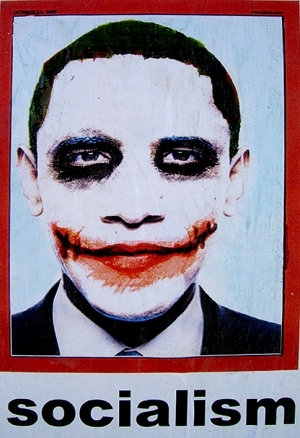
so⋅cial⋅ism
–noun
| 1. | a theory or system of social organization that advocates the vesting of the ownership and control of the means of production and distribution, of capital, land, etc., in the community as a whole. |
| 2. | procedure or practice in accordance with this theory. |
| 3. | (in Marxist theory) the stage following capitalism in the transition of a society to communism, characterized by the imperfect implementation of collectivist principles. |
I cringe every time I hear the Right Wing Media machine continue to label Obama a socialist, a liberal, or even progressive. He’s undoubtedly maintained more status quo from the previous administration than not. There have been a few marginal changes in laws impacting GLBT civil rights, women’s reproductive health, and a return to civil rights in general, but creeping back towards the middle after a big lurch right does not earn him an leftish label in my book.
I’ve used the phrase crony capitalism before to describe Obama’s approach to the economy and the power structure within the beltway. Michael Barone, Senior Political Analyst for The Washington Examiner goes into the numbers vs. the rhetoric on lobbyists and lobbying in the New World Order of Obamanomics. The bottom line is that Obama likes his friends rich and works to ensure they get richer. That is not capitalism. That is not socialism. That is actively creating the formation of monopolies and writing laws to protect monopoly interests. This is the antithesis to both capitalism and socialism
Fast-forward to the present day. Lobbyists, reports the Center for Responsive Politics, had a record 2009 in Barack Obama’s Washington. Despite candidate Obama’s promises to shun them, they raked in $3,470,000,000. Somewhere up there, Tommy Corcoran is chuckling.
Last week, amid Washington’s blizzards, Obama was asked about the $17 million bonus awarded to JPMorgan Chase Chief Executive Officer Jamie Dimon and the $9 million bonus for Goldman Sachs CEO Lloyd Blankfein.
“I know both these guys; they are very savvy businessmen,” he said. “I, like most of the American people, don’t begrudge people success or wealth.” So much for campaign-trail denunciations of “fat cat” bankers and bloated bonuses.
It does not take any savvy to take advantage of government bailouts, near zero loans of capital from the FED, and announcements by the FED of planned buying of you and your buddies toxic assets. It also does not take savvy to be on Timothy Geithner’s best buddy list when things are coming apart at the seams when he can move the market in your direction. Consider this from Baseline Scenario today.
At 9:30pm on Sunday, September 21, 2008, Goldman Sachs was saved from imminent collapse by the announcement that the Federal Reserve would allow it to become a bank holding company – implying unfettered access to borrowing from the Fed and other forms of implicit government support, all of which subsequently proved most beneficial. Officials allowed Goldman to make such an unprecedented conversion in the name of global financial stability. (The blow-by-blow account is in Andrew Ross Sorkin’s Too Big To Fail; this is confirmed in all substantial detail by Hank Paulson’s memoir.)
We now learn – from Der Spiegel last week and today’s NYT – that Goldman Sachs has not only helped or encouraged some European governments to hide a large part of their debts, but it also endeavored to do so for Greece as recently as last November. These actions are fundamentally destabilizing to the global financial system, as they undermine: the eurozone area; all attempts to bring greater transparency to government accounting; and the most basic principles that underlie well-functioning markets. When the data are all lies, the outcomes are all bad – see the subprime mortgage crisis for further detail.
A single rogue trader can bring down a bank – remember the case of Barings. But a single rogue bank can bring down the world’s financial system.
Goldman will dismiss this as “business as usual” and, to be sure, a few phone calls around Washington will help ensure that Goldman’s primary supervisor – now the Fed – looks the other way.
This is not socialism. This is not the way either perfectly competitive markets nor centrally planned economies work. In both situations, the result should be widespread distribution of goods, services and income. This is simply re-writing the rules of the game to benefit the already rich and powerful. Even rightwing blogs get the picture, but many right wingers find the wrong bottom line. Here’s an example from SayAnythingBlog.com. This part is the correct  part. The conclusion is a bit of the mark. Some of the commenters are way off the mark. Screaming Marxism with no real knowledge of what it is does not help a conversation, yet alone lead to a solution of the basic problem.
This is what happens when the government has too much power. Rather than the economy being about who can offer the best goods and services at the most reasonable prices, who can outperform everyone else to provide citizens with what they want at prices they can afford, the economy becomes about who can lobby, bribe and coerce the best deal out of the government.
Grease the right palm and you get government contracts, bailouts and favorable taxation and regulation. Grease the wrong palm and you get demonized by grandstanding politicians and summoned to explain yourself in front of Congress.
Businesses under the vision of a perfectly competitive market–essentially the Invisible Hand concept set up by Adam Smith–are not supposed to be BIG. In the 18th century world of little trade guilds, thousands of small farmers and merchants, and a few monopolies (like the India Tea Company), the original concept of the market did not include megacorporations, huge trade unions, and a democratically elected government that does anything to enable its benefactors. The crony capitalism we see now had its roots in the Civil War, and as Barone points out, most recently the World War 2 period. Remember, Dwight David Eisenhower was the president who termed military industrial complex. A lot of the first lobbyists came from the War Lobby. Lincoln saw the dangers of huge businesses, making money off wars, lobbying congress for the creation of further laws in 1863. Again, all of our monopoly laws are rooted in the Sherman Antitrust Law of 1890. Lenin’s big academic analysis was about J.P. Morgan, interlocking directorates, and huge corporations. The father of modern day socialism/Marxism would have been just updating his old arguments which are pretty much the same thing you see quoted above from the right wing blog. Barone argues that FDR used cronies to win a war, but that Obama is using it for something completely different.
Crony capitalism is now the order of the day in the United States. The government and the United Auto Workers own General Motors and Chrysler, which aren’t likely to pay back their billions in TARP money any time soon, if ever. Meanwhile the government tells Americans to stop driving Toyotas.
The government was going to remake the health care sector, and so Billy Tauzin and other health care industry lobbyists were busy in the White House cutting deals to keep their clients above water. The government was going to remake the energy sector, and utility CEOs and lobbyists have been busy flaunting their green credentials.
As my Washington Examiner colleague Timothy Carney has been documenting, Big Business has been busy lobbying Big Government for “reforms” that serve big companies’ interests. Wal-Mart backs a health care mandate, Philip Morris shapes tobacco regulation, General Electric is setting up a joint venture to trade carbon offsets (wasn’t that Enron’s line of work back in the day?).
The picture is not pretty. Government’s pets or, in the president’s words, “savvy businessmen,” use government to get policies that will give them competitive advantages and stifle smaller competitors. Pleasing their masters in government is now absorbing the psychic energy of CEOs who used to concentrate on meeting consumers’ needs in order to make profits.
This is not capitalism. This is not socialism. This is not Marxism. This is not progressive politics. This is not the policy of some one who is too liberal. This is the policy of a beltway that seeks to stay in power and privilege by enacting laws that provide unfair advantage to their cronies. This is not what many democrats or republicans of past would have found tenable. It’s an unholy alliance between huge business interests and the government of the ‘people’. It can be measured in terms of lobbying dollars and the numbers of Tom Daschles and Billy Tauzins; former elected officials who have joined the ranks of lobbyists.
I’ll give the Financial Times, the bottom line in an article called “Obama fails to turn back lobbying cash tide.”
The lobbying frenzy peaked in the fourth quarter of 2009, which hit a record of $955m spent, just as negotiations over the now stalled healthcare reform supported by the Obama administration were ramped up on Capitol Hill.
“Lobbying appears recession-proof,” said Sheila Krumholz, executive director of the Center. “Even when companies are scaling back other operations, many view lobbying as a critical tool in protecting their future interests.”
The pharmaceutical and health products industry broke all records by spending $267m last year, in what the Center’s analysts said was the “greatest amount ever spent on lobbying efforts by a single industry for one year”.
Not all of those funds were spent rallying against healthcare, however. The pharmaceutical industry’s main lobby group, the Pharmaceutical Research and Manufacturers of America (PhRMA) spent $26m lobbying in favour of healthcare reform after it negotiated an $80bn deal with the Senate and White House last summer that critics said was a gift to the industry.
The chief negotiator of that deal, former congressman Billy Tauzin, yesterday announced his resignation as president of the trade group. Mr Tauzin, who has run the association since 2005, said he would formally step down in June.
This is wrong, wrong, wrong. It doesn’t help to correct the problem by mislabeling it. The right and the left both see problems with this. The name calling has to stop in order for us all to work for the better interests of our country.
mo·nop·o·ly mo·nop·o·lies
-noun
1. Exclusive control by one group of the means of producing or selling a commodity or service: “Monopoly frequently … arises from government support or from collusive agreements among individuals” (Milton Friedman).
2. Law A right granted by a government giving exclusive control over a specified commercial activity to a single party.
3. a. A company or group having exclusive control over a commercial activity.
b. A commodity or service so controlled.
4. a. Exclusive possession or control: arrogantly claims to have a monopoly on the truth.
b. Something that is exclusively possessed or controlled: showed that scientific achievement is not a male monopoly.
Job Training ?
Posted: February 13, 2010 Filed under: Surreality, U.S. Economy | Tags: Detroit, job markets, job training, Walmart 2 Comments
One principal says this new job training program will "to be exposed to people from different cultures". I'm **NOT** kidding.
I’m always interested in jobs and the job market. This is because I need a good job like every one else in this country whose last name isn’t part of a multi-conglomerate or law firm or associated with Hollywood or some other national past time. It’s also because I’m a teacher in a business department and that’s frequently the basis of judgment on our programs, funding, and enrollment by others. It’s also because I’m an economist and I know that we live in a country that’s 70% dependent on consumer income for its economy and about 67% percent of those households are dependent on wages and salaries for their shopping sprees. So, here’s a headline for you from the Detroit Free Press that will probably give you the same kind of willies that I got when giving it a read: Walmart offers job training via DPS. Yup, that’s via the Detroit Public Schools. Evidently we’re now preparing students for those jobs of the future.
“The training program was kicked off today at assemblies held at Frederick Douglass Academy for Young Men and at Western International High.
The Detroit Public Schools have teamed up with Walmart Stores to provide job training and entry-level, afterschool jobs to students at four high schools.
Detroit International Academy for Women and Henry Ford High will also participate.
Students will get 11 weeks of job-readiness training during the school day and 10 high school credits for the class and work experience.”
Sean Vann, principal at Douglass, said 30 students at that school will get jobs at Walmart. He said the program will allow students an opportunity to earn money and to be exposed to people from different cultures – since all of the stores are in the suburbs.
The irony of attending a school named Henry Ford High and preparing for a job at Walmart in the once great industrial city of our country is not lost me. I’m also wondering exactly what kind of “culture” the program exposes its students to since my experience in the surburbs with burbies is their strong desire for a distinct lack of culture. Maybe their planning on a course in customer service that includes ways to not intimidate Stepford wives when you do not look exactly like one of them. Your guess has got to be better than mine. Perhaps they need to learn how to recognize one concrete cement block store from another. Maybe an introduction to bland and boring food found a chain restaurants in those ubiquitous shopping centers in every burb?
This is truly depressing if the best we can offer a group of young people in a major urban city is a future at Walmart. I remember the threat at my high school was you’d get stuck pushing papers at Mutual of Omaha if you didn’t go to college. I’d just like to say, this isn’t a joke, but it sure feels like it should be. What ever happened to training nonuniversity-bound kids to repair automobiles or work with computers?
Is this what our economy has come to these days?
Capturing the Regulator
Posted: February 12, 2010 Filed under: Environmental Protection, Global Financial Crisis, The Bonus Class, U.S. Economy | Tags: corporations, de regulation, externalities, monopolies, Regulation, regulator capture Comments Off on Capturing the Regulator
The original vampire squid: Standard Oil.
We continue to experience fallout from the banking crisis and see that many of the problems were caused by captured regulators. Problems with Fannie Mae were ignored by Barney Frank and the House committee appointed to oversea the mortgage giant’s activities. The NY Fed under Timothy Geithner appears to have been closer to Goldman Sachs and other large banks that its regulatory charter demands. We’ve seen this at the SEC also, as investment banks were able to convince the agency and the senators and congressmen who oversee its activities that deregulating risky activity was a good thing that wouldn’t led to market meltdowns as it had in the past.
We’re still seeing the fall out from continued rent-seeking activity by huge megalocorporations and their captured regulatory agencies and politicians. It’s in more industries than just the financial ones. Since the Reagan years, we’ve seen ongoing defunding of agencies and capture of agencies by the regulated who find ways to buy politicians through lobbyist activities. All of this had led to huge messes in nearly every sector.
Bloomberg.com has further examples of this public-welfare destroying behavior in Regulators Hired by Toyota Helped Halt Investigations. We learn in this piece that many lives were lost because Toyota insiders at the National Highway Traffic Safety headed off “at least four U.S. investigations of unintended acceleration by company vehicles in the last decade, warding off possible recalls, court and government records show.”
Christopher Tinto, vice president of regulatory affairs in Toyota’s Washington office, and Christopher Santucci, who works for Tinto, helped persuade the National Highway Traffic Safety Administration to end probes including those of 2002-2003 Toyota Camrys and Solaras, court documents show. Both men joined Toyota directly from NHTSA, Tinto in 1994 and Santucci in 2003.
While all automakers have employees who handle NHTSA issues, Toyota may be alone among the major companies in employing former agency staffers to do so. Spokesmen for General Motors Co., Ford Motor Co., Chrysler Group LLC and Honda Motor Co. all say their companies have no ex-NHTSA people who deal with the agency on defects.
Possible links between Toyota and NHTSA may fuel mounting criticism of their handling of defects in Toyota and Lexus models tied to 19 deaths between 2004 and 2009. Three congressional committees have scheduled hearings on the recalls.
“Toyota bamboozled NHTSA or NHTSA was bamboozled by itself,” said Joan Claybrook, an auto safety advocate and former NHTSA administrator in the Jimmy Carter administration. “I think there is going to be a lot of heat on NHTSA over this.”
Another corporate whistle-blower is showing how corporate negligence may cost cities and states millions of dollars to replace exploding and cracking PVC pipes. This is from the NY Times. It’s typical corporate behavior. The certification agency here was not ‘informed’ of the changes used to increase production, decrease costs, and of course, feed the bonus class kitty.
JM Eagle was created in 1982, after the bankruptcy of Johns Manville, the first major corporation to seek protection from asbestos claims by filing for bankruptcy. The elder Mr. Wang bought the pipe division out of bankruptcy that year, renamed it JM Manufacturing and added it to his empire. (The company became JM Eagle after acquiring PW Eagle in 2007.)
PVC pipe had been just a small part of Johns Manville’s business, but Mr. Wang made his acquisition at a time when the plastic was fast catching on among cities replacing their older, decaying water systems. For several years, managers stayed on at the company and participated in the development of new standards for plastic pipes.
Mr. Hendrix said in his complaint that after Walter Wang became chief executive in 1990, many of the longtimers resigned or retired, and people who had minimal backgrounds in engineering or failure analysis replaced them.
JM Eagle also put a premium on cutting costs, Mr. Hendrix said, hiring people like him straight out of college. It even maintained a boarding house near Livingston for Taiwanese employees who could not afford suburban New York housing on their modest salaries.
One of his first jobs was to field customer complaints, which he said came in at the rate of at least one a day. He said he was trained to look for ways to attribute leaks and ruptures to the governments and contractors who installed and maintained the pipes.
Only when he was assigned to oversee certain tests did Mr. Hendrix begin to think the complaints stemmed from the company’s own cost-cutting measures. He said he realized JM Eagle had started buying a lower grade of raw materials from Formosa and had speeded up its production lines without reporting the changes to the certification agencies as required.
Republicans continue to label these instances of corporate malfeasance as pending “junk lawsuits” while lives and taxpayer monies indicate they are anything but nuisance. Who is going to pay for these faulty pipe systems? (These are problems economists study and we find the costs of “externalties” usually go to the taxpayer.) Will it be the same folks that are paying for the financial industry meltdown; the U.S. taxpayer? It most certainly will not be the C.E.O. whose short-sightedness and cost reducing behaviors are firmly rooted in bonuses present and past. They cannot be held legally accountable with either their personal network or their freedom because, the corporation is a legal entity all to itself. The worst we can do is watch them go bankrupt and then re-organize to avoid the financial penalties. You can’t put Toyota in Jail. You can see that JM Eagle was a corporation that formed out of the ashes of an earlier corporation that folded to avoid lawsuits from asbestos deaths. They are not unique at all in that behavior. It’s been going on since the courts decided that corporations get limited liability treatment.
One of the stories that I use for my economics class to illustrate these problems is the Radium Dial painting women whose jobs were basically to paint the luminous paint on watch and clock hands back in the 1920s. The original paint contained incredible levels of radioactivity. I saw the documentary about them and the horrible cancers that killed them in a documentary released in the mid 1980s. Many of them died so full of tumors and so full of radio-activity from licking the tips of the brushes or decorating themselves with the radioactive paint–because they were never told of the dangers–that the government has had to go back to their graves and encase them in led boxes because they emit high levels of radioactivity. The company folded to avoid all the costs of clean-up and the survivor lawsuits. The sites of the old factories continue to be problems in places where the factories were located. The most famous was located in Ottawa, Il. Many of our regulatory agencies were formed to avoid situations just like this. There’s a book that you may want to read if this interests you also. Here’s a quote from the link provided above.
It isn’t clear how well known the dangers of radium were in 1917 but no warning was given to the workers. The radium companies denied the dangers of imbibing radium despite the consensus of opinion among most medical experts and government officials that it was dangerous. The dialpainters were such a minority and lacked any financial resources to have any clout in dealing with industry. The battle for recognition of this health hazard to these women went on for many years.
A book titled “Radium Girls: Women and Industrial health reform, 1910-1935” by Claudia Clark was published by The University of North Carolina press, Chapel Hill and London in 1997 (ISBN 0-8078-2331-7 cloth and ISBN 0-8078-4640-6 paperback.) This is an excellent source of information on the subject. It is well documented with many references and an extensive bibliography.
A 1-3/4 hour film titled “Radium City” was made in 1986 about the aftereffects of two radium dial painting companies based in Ottawa, Illinois. The city of Ottawa, IL is about 80 miles southwest of Chicago. The Radium Dial Company (RDC ) moved from the East Coast to Ottawa in 1922. Joseph Kelly was president. The first problems of radiation exposure occurred with the young women who applied the radium paint to the dials. According to the film, RDC went out of business in 1934 after being faced by many lawsuits. Luminous Process Incorporated (LPI) started soon after also headed by Kelly. It operated from 1932 to 1978 when the NRC shut it down. Both factories were demolished, RDC in 1969 and LPI in1984 and much of the material was used as land fill. As a result there are 13 areas today with above normal radiation in Ottawa. The major contaminant is radium-226 and the by-product, radon-222. For more information see the Petitioned Public Health Assessment, Ottawa Radiation Areas, Ottawa, Lasalle County, Illinois
It isn’t known if the radium dials used by Jefferson starting in 1949 were painted by their employees or even done by Jefferson at all. They may have been sent out to be painted. In any case, working conditions were improved by that time but use of the paint was eventually banned.
This is the primary problem with granting corporations their own legal status. Investment bankers used to be mostly be professional partnerships. Recently, they switched to the corporate structure and many are saying that the limited liability (in other words if you screw up they can’t come after your net worth) is one of the reasons they took on so much risk. They no longer have “any skin in the game”.
There is, however, a better solution: expose players in the financial game to greater personal loss if their risk-taking fails. When you worry that a mistake will cause you to lose your second home, your stocks and bonds and your club memberships, then you’re less likely to take the kinds of risks that expose the rest of society to your failures.
A simple mechanism exists to achieve this purpose: the private partnership. Partners face liability that extends to their personal assets. They aren’t protected by the corporate shield that limits losses to what the corporation itself owns (as well as the value of the stocks and bonds the corporation has issued). Unfortunately, the partnership is a legal form of business organization that was largely abandoned by banks over the past quarter-century. Our advice is to bring it back. In other words, don’t nationalize; partnerize.
Even John Gutfreund — the man who kicked off the dramatic change in investment-banking culture and structure when he took Salomon Brothers, a longtime partnership, public in 1981 — confirms our thesis. Michael Lewis wrote in the December issue of Condé Nast Portfolio that Mr. Gutfreund now believes “that the main effect of turning a partnership into a corporation was to transfer financial risk to the shareholders. ‘When things go wrong, it’s their problem,'” said Mr. Gutfreund.
But when the personal wealth of executives is put at risk, as it is in a partnership, their behavior changes. Risk aversion increases. Few partnerships would leverage themselves to the hilt to load up on risky subprime loans.
Not only do these corporations give their management cover for bad decisions, they can raise tons of money in public markets and then use that money to buy political influence and now, after the supreme court decision, to buy ads to further influence elections. These giant corporations whom we give too-big-to-fail status, will in fact place themselves into bankruptcy or collapse to avoid the costs of their externalities. One of the biggest costs is the overproduction of products and services because they don’t reflect the true costs of doing business until it’s usually too late for any one to do something about it. This is exacerbated by neutered or captured regulators. Something that buying the political class achieves.
We need to take a serious look at what many folks are peddling out there as free market capitalism because it’s not free market capitalism. Regulations are there to protect us from bullies just like laws are supposed to do. Third party payers and huge megalocorporations in highly concentrated markets with huge market powers and the ability to influence the market are not what Adam Smith had in mind when he spoke of the invisible hand. Regulation exists to even the playing field when these power players exist,to ensure that markets function under proper conditions, and to hold entities responsible for the costs they create when they make messes.
Since the Reagan years, we’ve gotten one mess after another in one market after another from not realizing and acting on corporate malfeasance. Yes, they create jobs and products but those are by-products of their real purpose which is to maximize profits. They may run ads about loving fuzzy animals, but that is to create an image to help them further their profits. We need major changes in laws that recognize that not all byproducts of economic enterprise by businesses are positive. Most of the good stuff does not come from the huge bully boys. It’s time to evaluate and change the laws surrounding incorporation and to enforce the Sherman Antitrust law again. If we can’t lock them up in jail for doing harmful things to people, then they shouldn’t be granted the same status in the courts as people.
Stupid Banker Tricks
Posted: February 4, 2010 Filed under: U.S. Economy, Uncategorized, Voter Ignorance | Tags: center for responsible lending, credit card abusive practices, fees, Predatory Lending 2 CommentsI have a really great guy in our library that takes care of the business college that digs up some of the most interesting reports and

sends out the links. It’s kind’ve like having my graduate assistant back but on a different level. He doesn’t do grades, but he keeps me current on things I used to follow when I spent more time at my desk and less time in my car driving across bayous and lakes.
I became aware of all the issues surrounding the unbanked, predatory lending practices, check cashing companies, and abusive credit card fees when I spent 5 weeks in Omaha right after Hurricane Katrina. A very old friend of mine–a math teacher at the community college I once taught at for a few years when my eldest was a toddler–took me to a seminar filled with social workers who were complaining how many of their clientele were being gamed by fraudulent lending practices. I returned to New Orleans to spend a lot of time researching things and predicted it was one big house of cards that would bring down the economy eventually. The research was interesting but turned out to not be ‘glamorous’ enough for publication. The other thing was I was basically told my assertions that these practices would bring down the economy part was over the top because, well you know, financial innovation is such a handy dandy thing and these sweethearts were just offering up much needed services to under-served consumers. Yeah, right.
So, this study from the Center for Responsible Lending showed up in my email this morning. I admit to having spent a huge amount of time looking at their studies about 4 years ago, but was told to quit the line of research by my peers. I switched to something more marketable. This report is very useful and it outlines a lot of the new tricks that credit card issuers are using to get around credit card reform. Banks are taking steps to ensure we continue our indentured servant status. I’ve now torn up all by two credit cards and I’m on the verge of just saying no to all loans and credit cards; big or small. Here is a list of ways they’re getting around new legislation to curb their excesses. The name of the report is Dodging Reform and you should at least read the Executive Summary and check out the charts. (Yes, I like nifty charts as well as nifty graphs.) Here’s the stated purpose of the study.
Faced with pending and proposed reforms designed to protect consumers from a series of unfair charges, credit card issuers have established or expanded the use of at least eight hidden charges across more than four hundred million accounts. The May 2009 Credit CARD Act addressed the hidden and deceptive pricing strategies that had been the most costly to credit card users. However, some issuers appear to be working to compensate for part of this lost revenue by instituting or accelerating new practices that increase hidden costs on consumers. Some of the tactics discussed here are not well known, while others are known.
Since the FIRE Lobby has us all in a state of borrower beware, I’d like to outline some of the worst of these new abusive practices for you. These are hidden charges that will cause your credit card balance to compound and keep you paying them forever.
The first practice is called “pick-a-rate” and impacts around 117 million accounts according to the study. This is basically a practice that puts you on a variable interest rate. Since the FED has signaled their willingness to return to higher interest rates within a the year, do not get on one of these plans! Your rate is bound to increase if it hasn’t already. The trick though, is that the APR actually is computed in a way to be higher than the rate you pick and the details about the rate are buried in the fine print. These are the problems according to the study.
- Hidden “pick-a-rate” pricing charges consumers APRs 0.3 percentage points higher ona verage than traditional pricing.
- Pick-a-rate results in a total cost to consumers of $720 million per year and may reach $2.5 billion per year if the practice becomes the industry standard.
There are a lot of nifty graphs that show the impact of interest rate changes on the pick-a-rate plans. These things will get incredibly more expensive as we return to a more normal set of interest rates and monetary policy.
A second practice is that of using Minimum Finance Charges. This practice is aimed at the people who partially pay off their balances every month.
In 2001, the minimum finance charge for 7 of the Top 8 issuers was $0.50. By 2009, most issuers charged a dollar or more as their minimum finance charge, with the highest being $2.00. Currently, they average $1.28.6 Borrowers pay more than $430 million annually as a result of minimum finance charges and that figure is rising as these charges are increased.
Again, the graphs in the study will say everything you need to know here. These charges are expected to skyrocket this year for the top 8 issuers. As this market gets more concentrated into the hands of those eight top issuers, their practices are becoming more in sync with each other in keeping with the game theory model of rivalry. (The McClatchy graph up top will show you exactly how concentrated this market is becoming.) You’ll not be able to avoid these if you EVER take a cash advance on your credit card so DO NOT DO THIS.
These minimum finance charges take effect when a consumer borrows money—a cash advance—on their credit card, but the amount borrowed is low enough (or the interest rate is low enough) that the finance charge would normally be below the minimum. For example, if a consumer charged $50 on their credit card, had an interest rate of 12% and did not pay the balance in full, they would normally owe 50 cents in finance charges. But if the issuer had a minimum finance charge of $1.50, they would instead be required to pay this amount
Variable rate floors are the third practice to worry about. Basically, your issuer will tell you that your interest rate is “variable,” but it only goes up from its starting value and never down. Again, in a situation where interest rates are probably going to increase, this is a bad situation. Don’t get a card with these terms.
Other practices to watch include compression of balances categories into tiered late fees. This practices applies the highest late fee amounts to smaller balances and is predicted to cause in 9 in 10 consumers to pay the highest fee. Inactivity Fees are now being instigated which charge you an annual fee if you do not use a card. They are aware that closing an account impacts your credit card rating so many folks just keep them open for that reason or for precautionary purposes. You’ll now pay for that privilege.
They are also a series of fees being planned for balance transfers, cash advances, and international transactions. The deal is that none of these practices were addressed by the Credit Card Act of 2009 which effectively makes the new law behind the times already. The proposed Consumer Financial Protection Agency would have the ability to identify these practices and control them. I’m not sure if you remember me mentioning recently in the news that Senator Dodd is now actively considering dropping the clause in the proposed financial reform that would create this entity. This is really bad news.
Senate banking committee Chairman Sen. Christopher J. Dodd (D-Conn.) has discussed jettisoning plans for a standalone Consumer Financial Protection Agency, as part of an effort to secure bipartisan support for legislation to reform financial regulation, said people familiar with the matter.
One possibility raised during recent talks between Dodd’s staff and Republican counterparts would be to assign new consumer protection powers to another agency. Such a compromise might offer an opportunity for Dodd to preserve the goal of expanding safeguards while appeasing Republicans who have chafed at any suggestion of a new agency.
“If there’s a bipartisan deal, that’s likely how it’s going to come out,” said one Democratic aide, who was not authorized to speak on the record about the discussions.
President Obama proposed last June the creation of an agency to protect consumers against abuses in mortgages, credit cards and other forms of lending.
It remains unclear if the President will fight to keep the agency in the legislation. I shudder every time I see the the words “secure bipartisan support” because that usually means that congressional Democrats will cave to their Republican counterparts at the first sign of disagreement. The banking industry appears to have both parties captured.
“This is the litmus test about whether Congress is serious in their efforts to overall financial regulation,” said Travis Plunkett, legislative director for the Consumer Federation of America. “If they can’t take consumer protection out of the hands of regulators who failed” at that task before, he added, “then they’re not really serious about doing things differently than in the past.”
Heather Booth, executive director of Americans for Financial Reform, a coalition of nearly 200 consumer, labor and civil rights organizations, on Friday urged Dodd “not to cave to the big banks and their armies of lobbyists.”
Given my take that they’ll cave under the least bit of pressure, it is definitely a borrower beware environment. Again, find out what opportunities you may have with a credit union in your area that is mutually owned by its depositors and see what arrangements it has made with a credit card provider if you must have credit cards. Check out this report and be sure to look for these things in the fine print. You can’t afford not to examine these details because you’ll be indentured to these jerks for a long period of time if you miss the imposition of these terms and fees.
Market Manipulation 101 or How to Rob Fort Knox in front of a Congressional Panel
Posted: February 3, 2010 Filed under: Bailout Blues, Equity Markets, Global Financial Crisis, The Media SUCKS, U.S. Economy, Voter Ignorance | Tags: AIG, bailout, Financial Crisis, Goldman Sachs, Hank Paulson, Timothy Geithner 1 Comment Every day, as the AIG saga unfolds, I have to wonder if there is any vestige of a functional regulatory scheme left in this country. I’ve already decided that there is no shred of decency left in any one whose hand came close to unraveling the insurance giant and its deals. I know this is an area where eyes glaze over, but really, it’s like solving a crime that even Miss. Marple couldn’t fathom. Ladies and Gentlemen, we’ve been robbed.
It may be too complex for most journalists to report about, but the financial blog realm, full of individual investors, academics and pissed off Americans is keeping the story alive. The headline today from the Atlantic is there are $100 Million More in AIG bonuses. Don’t forget, we basically OWN this company so this is OUR money. Most voters are wise enough to know that this alone does not pass the threshold of decency. You don’t have to have a PHd with an emphasis on corporate governance to figure out that something is very wrong when people can bankrupt a company one year, and still collect bonuses the very next.
In the ongoing AIG bonus saga, the troubled insurer will distribute around $100 million in bonuses today, that’s likely much to the dismay of taxpayers who now own the firm. Despite the fact that AIG is technically under compensation restrictions, many so-called “guaranteed bonuses” that were in place before AIG’s collapse still must be honored by law. This is a regrettable situation, and speaks loudly to the messy problem that bailouts pose.
This is the headline today in many of the mainstream papers. This includes the NY Times that reports those bonuses may have been lowered by$20 million to lessen the blow. This is a mere trifling compared to what was pilfered from the dying AIG by Goldman Sachs as it was in the throes of death. Those Revenuers let Goldman Sachs pick clean the dead body of AIG before we got the bill for the funeral.
“A.I.G. has taxpayers over a barrel,” said Senator Charles E. Grassley, an Iowa Republican, in a statement on Tuesday night. “The Obama administration has been outmaneuvered. And the closed-door negotiations just add to the skepticism that the taxpayers will ever get the upper hand.”
A.I.G. first promised the retention bonuses to keep people working at its financial products unit, which traded in the derivatives that imploded in September 2008, leading to the biggest government bailout in history.
The contracts, which were established in December 2007, were intended to keep people from leaving the company and called for the bonuses to be paid in regular installments to more than 400 employees in the unit. The final payment, which was for about $198 million, was due in mid-March, but was accelerated to Wednesday as part of the agreement to reduce its size.
Fearing a firestorm like the one last spring, A.I.G. had been working with the Treasury’s special master for compensation, Kenneth R. Feinberg, on a compromise that would allow it to keep its promise in part, without offending taxpayers.
So, the bonuses plays into the theme of the moment–Populist Outrage–which is driving everything from angry teabots to high ratings for media screamers like Glenn Beck. It hides a bigger problem. What is going on behind the schemes in the books and the deals as we attempt to bailout a group of bad gamblers is far worse. Yves Smith of Naked Capitalism lays out some of the issues on HuffPo as well as a series of thread at her own blog. While we rage at the bonuses, the real crime happened behind the curtains, where you’re not supposed to notice Timothy Geithner, pulling the strings and blowing the steam from the giant talking head of Glenn Beck.
Although the focus of press and public attention has been the decision to pay out “100%”, this issue has not been framed as crisply as it should be. Remember, the underlying transactions were crap CDOs that the banks (or bank customers, a subject we will turn to later) owned, and on which the banks had gotten credit default swaps from AIG. The Fed in fact paid out WELL MORE than 100% on the value of the AIG credit default swaps by virtue of also buying the CDOs.
That is one simple paragraph to describe the scheme behind the bailout of AIG. The facts are nearly beyond belief and as Congressman Dennis Kucinich put it, the testimony provided by Timmy-in-the-Well-again Geithner and among others doesn’t “pass the smell test.” I’m not sure how you miss the smells coming from an open, festering mass grave. But, the majority of Americans, and Congressio Critters, seem to think it could be just a few dead birds in the attic. The evil is the ledger accounts at the New York Fed.
Smith says the details show the FED as either captured regulator exhibiting ‘crony behavior’ or the behavior of Geithner was duplicitous and merits legal action. That is even mild. Her Huffpo article lays out the arguments for both scenarios. Either way, Giethner’s NY Fed comes off badly and Paulson and the Bush Treasury come off as co-conspirators to a heist.
Another article which demonstrates palpable anger at both the ineffective Fed and Congress is written in the financial/investment blog Money Morning by Shah Giliani who is a retired Hedge Manager. Again, the lack of knowledgeable staff could be the reason the pieces to the puzzle are being put together outside of the mainstream media. It could be the story is too complex to be glamorous and deemed beyond the reach of the average 5th grade reading level achieved at most major newspapers. It’s even possible no one wants to take on the financial industry. The deal is what happened as outlined in the testimony–had some one on that Congressional Panel actually had a background in something other than professional politics subsidized by the FIRE lobby and a plethora of worthless law degrees and knew finance–should’ve caused outrage around the country and sent subpoenas flying out of the justice department and the SEC. The central players in this are Goldman Sachs and the New York Fed whose people are so entrenched now in the Treasury and the West Wing that you have to wonder if there ever will be enough justice left in this country to counteract what should be the cries of lynch mobs. Following through with the legal obligations to pay out the bonuses–with the smallish $20 million concession–is just the sprinkles on the cake. Perhaps it’s easier to pay them than to have the AIG financiers talk about the details as the FED and Treasury unwound their deals.
The rationale for what is essentially the breaking of so many laws is the rescue of the U.S. and the world from another Great Depression. There are always ignoble deeds, however, done in the name of the most noble causes. This should go down in the press and in history as The Great U.S. Treasury and Financial Market Heist. The last two secretaries of Treasury-Paulson and Geithner–should be hauled before a government tribunal and stuck in Gitmo with the rest of the terrorists and enemies of the state. The dirty details follow the fold.

 peej
peej Carissa
 bostonboomer
 dakinikat
 ecocatwoman
 mablue2
 Mama Lopez
 peggysue22
 quixote
 skydancingguestblogger
 Mona (aka Wonk the Vote)



 Sky Dancing
Recent Comments