
Ben Nelson and Republican Party own the double dip
Posted: June 24, 2010 Filed under: Global Financial Crisis, U.S. Economy Comments Off on Ben Nelson and Republican Party own the double dip In an act that defies, history, logic, economics, and humanity, the Senate Dems once again were blocked by the Party of the Grinch. What a stand! After all, all who would want to increase the National Debt by 0.00043 percent ? Why do they take what they consider a ‘reasoned’ stand against the deficit only when it applies to the folks that will be forced to soup kitchens?
No Republicans voted yes, while Sen. Ben Nelson (D-Neb.), who had also rejected earlier versions of the legislation, voted no. Sen. Joe Lieberman (I-Conn.) voted yes after voting on previous procedural motions. Sens. Robert Byrd (D-W.Va.) and Lisa Murkowski (R-Alaska) were absent.
After the vote, Senate Majority Leader Harry Reid (D-Nev.) repeated comments he made earlier Thursday that the Senate will now move to a small-business bill. Reid said the unemployment benefits would not be added to that bill, but others have speculated that the provisions could still be attached to the small-business measure.
The failure to move the tax extenders package, which also would have renewed scores of individual and business tax breaks, illustrates the extent to which fears about the deficit are dominating the legislative process five months before a midterm election in which Democratic control of Congress will be on the line.
If only the Salvation Army went public, then I’d recommend you go long on them and maybe we’d be in the money for a change.
More Absentee Policymaking
Posted: June 24, 2010 Filed under: Global Financial Crisis, U.S. Economy Comments Off on More Absentee PolicymakingThere are so many policies running amok these days that it’s hard to keep track of them all. I’m switching my focus back to the

I'll gladly pay you Tuesday for a Hamburger today
financial markets for a bit where Politico’s Ben White is chasing down the bites and pieces that will be part of the Financial Market Sausage. There’s a lot to read over there, but this stood out to me because it seems that there are a many policies going through Congress right now to take care of various crises and there’s a vacuum of executive leadership. (If you’d like to read where they stand, it’s on the White House Blog. That beats hearing it read off of a teleprompter as far as I’m concerned.)
Wall Street executives are complaining that the Obama administration has been largely absent from the financial reform conference process, failing to step up and push back on big issues such as the exact language on derivatives reform and the amendment from Sen. Susan Collins (R-Maine) on capital requirements.
The only thing that brings me a sigh of relief–coupled with a wtf–on this statement is that the complaints about the lackadaisical one are coming from “Wall Street” Executives. I would hope the pushback would come from people wanting the President to be more active in pushing a strategic agenda for Wall Street translucence and safety. As an example, Blanche Lincoln has been trying to ride derivatives reform to re-election. You think she’d like Presidential backing.
Several other things stood out. The discussion on Fannie and Freddie may lead to a liquidation authority. This is a huge deal. These behemoths were obviously mismanaged and misregulated. However, the concern now is with the ratings of the agencies’ debt which is a staple in nearly every ‘safe’ investment portfolio including banks. I’d hate to be any one stuck with one of their bonds should this language become law. I should mention that I’m still betting that parts of my pension plan and yours contain a number of them. This could tank the implicit guarantee from the FEDs on any of those quasi-agency bonds moving them all up a risk level or six.
Bank executives were panicking last night over a proposed fix to Title II of financial reform literally penciled in at the last minute. The fear is that that the proposed change to the orderly liquidation authority could leave banks on the hook for a possible wind-down of Fannie Mae and Freddie Mac that could cost as much as $400 billion. In the House counter-offer below, Fannie and Freddie are penciled in as falling under the definition of ‘financial company,’ meaning they could be resolved by the orderly liquidation process. This process is paid for by the sale of the failing company’s assets and/or through assessments on other financial companies, possibly putting the Street in line to pay for the liquidation of the troubled housing giants.
There are also some interesting tales concerning Dodd and MA Senator Scott Brown who seems to be seeking an exception to every rule. The NYT editorial page stepped in for stronger regulation. It also seemed to take a direct smack at Brown. As long as these things get traded on an exchange, they must be fairly standard, audited and watched by the Exchange, and meet Exchanges standards. This is essential as far as I’m concerned.
Exceptions to the rules in the Senate bill are narrowly drawn. Painstakingly negotiated and uniquely customized contracts would not need to be publicly traded, nor would derivatives deals that commercial businesses use to hedge legitimate risks. Any attempt by negotiators to expand the exceptions would be moving in a dangerously wrong direction.
Lawmakers also have to keep the definition of an “exchange” narrow. A transparent exchange is a trading facility in which many participants make bids and offers and everyone can see what prices were offered and paid. Proposed language from the House for the final bill would allow telephone deals to qualify as a proper trade, which is seriously wrongheaded.
Meanwhile, the housing market is showing signs of weakening. Since this is the major wealth item for most American Families, this will surely depress consumer confidence and buying plans. This also means continued problems for Fannie and Freddie assets and any one holding anything remotely related to mortgages.
“Housing is contributing absolutely zilch to economic growth,” said William Wheaton, an economics professor at the Massachusetts Institute of Technology in Cambridge, Massachusetts. “It’s not that people want houses to be expensive. They want the housing sector to start pulling up the economy as it has done after past recessions, and that’s not going to happen until prices rise.”
When that price gain happens, it will have to be substantial to make up for losses in home values, said Columbia’s Stiglitz.
“Even a 3 to 4 percent increase in value won’t help people who have seen their homes decline 20, or 30 or 50 percent,” Stiglitz said.
Bloomberg has a fairly good summary of what’s left standing in the Financial Overhaul Bill. (You would think the President would take some interest in this at this late stage of the game, but he appears to be off having hamburgers with Russian President Medvedev.) The House and the Senate are hammering out what will stand of the Volcker Rule, how to deal with swaps, and other extremely important measures. So far, the ban on proprietary trading by banks is holding.
On the Volcker measure, lawmakers were awaiting proposed changes to the Senate language that would ban U.S. banks from proprietary trading and bar them from investing in or sponsoring hedge funds and private-equity funds.
Dodd may propose incorporating aspects of a proposal from Democratic Senators Jeff Merkley of Oregon and Carl Levin of Michigan. The two senators want to strengthen the language to eliminate what they consider wiggle room that could allow regulators to change or eliminate the ban later.
In addition, Dodd may offer to add Merkley-Levin language to curb conflicts of interest by preventing companies that underwrite asset-backed securities from placing bets against them. The proposal aims to address the fraudulent activity alleged in the Securities and Exchange Commission’s lawsuit against Goldman Sachs Group Inc. The SEC claims the bank created and sold collateralized debt obligations linked to subprime mortgages without disclosing that hedge fund Paulson & Co. helped pick the underlying securities and bet against them.
Now’s the time to push as much through as possible.
Oh, and more importantly, here’s Business Week’s report on the BIG Hamburger Summit.
Obama had a cheddar cheese burger with onions, lettuce, tomato and pickles, washed down with an iced tea. Medvedev selected a cheddar cheese burger with onions, jalapeno peppers and mushrooms. He ordered a Coca-Cola.
Cholesky Decomposition: Solving a System of Linear Egos
Posted: May 26, 2010 Filed under: Global Financial Crisis, Team Obama, U.S. Economy Comments Off on Cholesky Decomposition: Solving a System of Linear Egos
Consider a dinner table--a matrix if you will--of elements consisting of the world's prominent Economic Minds
I swore I wasn’t going to read The Promise by Jonathan Alter. Even the title oozes that smarmy assurance of a member of the Oborg fluffing brigade and the faith it takes to join a cult of personality. Then I got caught up in an excerpt with a title that could not be ignored by any practitioner of the dismal science. It’s over at the Slate’s The Big Money and under the siren title of “Why Paul Volcker Was Frozen Out of the Obama Administration”. I have to admit to having been awed by Volcker during my young career when the extremely volatile fed funds rate gave me heartburn and euthanized the very sick Savings & Loan where I was working.
While the title implies it’s mostly about Volcker, it’s actually mostly about the extremely volatile La La Summers and his “abrupt manner” and the dynamics of Obama and his economic advisers. What’s pretty amazing is the article says that Summers had mellowed since his tenure at Harvard. You wouldn’t know it as you read–and if you believe–this narrative. Doesn’t this just sound like the boss that every one prays they never get?
Summers’ friends claimed he had mellowed by the time he entered the Obama White House, and it was true that he had learned to take ribbing. Obama teased Summers for repeatedly falling asleep in meetings, for sweating in winter, and for attaching probabilities to everything. Summers’ habit of finding a cloud around every silver lining led the president to privately dub him “Dr. Kevorkian.”
Inside the White House, David Axelrod was among the few representing the so‑called populist side of the argument, and a joshing debate broke out. Axelrod asked Summers, “So, what does your plutocrat constituency make of this, Larry?”
“It’s good to be hearing what Che thinks,” Summers replied.
There was evidently even some stunning moments between La La and Dr. Christie Romer who is the chair of the Council of Economic Advisers. La La is of course well known for thinking women don’t have what it takes to deal with the really big questions and equations. Take a gander at this exchange.
When Christie Romer was brought in to be the chair of the Council of Economic Advisers, Summers tried to exclude her from important meetings. Romer fought back, even suggesting to Summers that sexism might have played a role in her exclusion, a serious charge given that he was fired as president of Harvard for perceived sexism.
“Don’t you threaten me!” Summers yelled.
“Don’t you bully me!” Romer shouted.
Evidently Rahm Emmanual had to work this one out.
So, remember that dinner at the White House of all those economists where we wondering if some one put something in Paul Krugman’s coffee? It’s outlined there too. It also shows how Obama couldn’t possibly be considered a socialist because both Noble Prize winners Krugman and Joseph Stiglitz were arguing for nationalizing of Citigroup and Bank of America. Oh, and here’s the decription of Valerie Jarret’s boss who is supposedly too intelligent and bored all the time to be bothered with ordinary people. This is a guy sitting with a group of clearly brilliant people. Rather than fully discussing the topic at hand, Obama wants the easy solution and turns off the conversation so that it’s all about where he is in this ordeal.
The dinner had been so hastily arranged that Stiglitz didn’t even get invited until the morning of the event. Over a lettuce salad from the White House garden and roast beef, the group held a spirited two-hour discussion. Obama grew slightly impatient when the conversation grew too technical or backward looking. He wanted to know what the economists would do if they were in his shoes. The answers from Krugman and Stiglitz—which amounted to taking over Citigroup (C) and Bank of America (BAC) for a brief time before breaking them up—hardly made Obama wish that he had hired these economists rather than Summers, who had considered the same idea but seemed more appropriately dispassionate in his analysis of it. If Obama had done what Krugman, Stiglitz (who had earlier said nationalizing the banks was the “only answer”), and plenty of other progressives wanted, it would have cost the government perhaps another trillion dollars and quite possibly caused a disastrous run on those banks.
And speaking of Valerie Jarret, guess who was the gatekeeper for Volker?
Volcker could always go through Valerie Jarrett if he needed to see Obama, but he didn’t want to abuse the privilege. After hearing from Obama often during the campaign, Volcker’s phone stopped ringing. He wryly told friends he was nothing more than a “wax figure” for the White House.
So, this is an even more telling excerpt that let’s you know what we’re dealing with in this White House with this set of advisers and this President.
Of the major players, only Volcker (who didn’t consider himself a player because he didn’t hold a government job) thought the whole financial system was conflict-ridden and dangerous. Contrary to much reporting, he did not advocate reinstating the Glass-Steagall Act. But he did favor segregating commercial and investment banking from proprietary trading. Advising clients while trading in one’s own accounts, he felt, was an obvious conflict of interest (the laughable claims of bankers that they had internal “Chinese Walls” notwithstanding) and an inherent source of instability. Why should core banking operations be subjected to such risk? Paul Volcker, principal author of what was once thought of as heartless Reaganomics, was now the most populist of the bunch!
Like I said, I wasn’t going to read Alter’s book, but he has my attention now.
Of Marx and Smith and Mice and Maddoffs
Posted: April 3, 2010 Filed under: Equity Markets, Global Financial Crisis, Team Obama, U.S. Economy Comments Off on Of Marx and Smith and Mice and MaddoffsIf we lived in a perfect world of either perfect market capitalism or perfect government planning, there’s a lot of things that wouldn’t  exist. There would be no corruption, no hidden information, no excesses or shortages, and absolutely no need for banks, insurance companies, and stock, real estate, or insurance brokers. That’s right. The entire FIRE lobby wouldn’t exist. Not only would we not need lobbyists, but we wouldn’t need the industries they represent. The Financial Markets exist because we don’t have any perfectly beneficent centrally planned governments or any form of real capitalism with perfect markets. They can’t exist. They are theoretical models period.
We have blended economies. They’re mishmashes of government intervention and mess-ups and failing markets and limping-along-as-best-they-can-markets. Nearly every economic transaction in the real world is fraught with some kind of chance for a misfire. You hire a real estate broker who you hope you can trust to guide you through the treacherous process of buying and selling the biggest asset most folks will ever have. You don’t know what’s a fair price, you don’t know where the buyers or sellers are and if either are honest or hiding The Money Pit from you, and you certainly don’t know who is a good or bad mortgage loan lender and lawyer to help ensure that you get a loan and a title free of bad encumbrances. That process is the same when you have a baby and you need a doctor and a hospital and you trust your insurance company to get a good deal for you. It’s the same when you look to save up for your pension or your kid’s college. The entire FIRE industry is there to help you navigate a bunch of imperfect markets with a lot of imperfect information. They’re supposed to be the experts who will help you navigate moral hazard and hidden information for you.
Except when they don’t.
Then, their government regulators are there to protect you and them from the bad eggs in the business. No one should be protected from their own stupidity, but these markets are so fraught with hazards and problems, that anything can happen. Bernie Maddoffs happen despite everything. So, do Goldman Sachs’ untoward influence in the NY Fed and the Treasury and financial panics. The key to these markets is middle-path economics. Yes, I’m a Buddhist and a Financial economist so I have to use the don’t tune the string too tight or it breaks, or tune the string to loose or it won’t play metaphor. It’s a balancing act. The financial markets play a unique role in a mixed market economy. The way we treat them must be unique also.
I got drug back from the bliss of the first few days of spring break where the last thing I should be thinking about is the financial markets (not teaching) but the only thing I should be thinking about is the financial markets (researching) by an email by the petulant clown. Did I want to handle or look at the discussion here? It’s a thread at FDL started out with a nod to the WAPO editorial here by Simon Johnson and James Kwak then a retort at the NYT by Paul Krugman here. The central question is financial reform. The specific question is should we break up big banks? Johnson and Kwak join ex-Fed Chair Volcker and say yes. Krugman says no, just toughen their regulation. My bottom line is all of the above. Break them up AND toughen the regulation.
Who are the Real Welfare Queens?*
Posted: March 31, 2010 Filed under: U.S. Economy, Voter Ignorance | Tags: Buffalo Commons, Farm Subsidies, Federal Spending, Federal Subsidies, Pioneer Woman, Valentine Nebraska Comments Off on Who are the Real Welfare Queens?**Well, one of them is Michelle Bachmann.
 Having lived in the middle of the country all of my life in the biggest cities in large states with geographically huge rural areas, I’m more than aware of the urban v. rural dilemma of where you raise taxes and where you spend them. All of these states are also bright red for the most part. Iowa and Minnesota occasionally go blue these days.
One of the biggest disparities always comes with distribution of highway taxes. In Nebraska, as example a huge amount of tax dollars for taxes are raised by Lincoln and Omaha, but the majority of the highway dollars are spent on maintaining and building roads to almost no where. Visiting Cherry County Nebraska is a trip to nowhere. It’s a beautiful part of the state, it’s the state’s biggest county. It’s basically the Nebraska outback and there are more cows and buffalo than people. According to Wiki, Cherry County ‘had a population of 6,148 at the 2000 census“.
According to the U.S. Census Bureau, the county has a total area of 6,010 square miles (15,565 km²). 5,961 square miles (15,438 km²) of it is land and 49 square miles (127 km²) of it (0.82%) is water. It is by far the largest county in land area in Nebraska and larger than the states of Connecticut, Delaware, or Rhode Island.
My friends from other countries–especially from Europe–or friends from the NE do not really understand the idea of starting a drive on the east side of a state and taking all day to get to the other. A drive across states like North or South Dakota, Montana or Wyoming is where you get the real feel of the term the American Outback. Even on the interstate, you see more antelope and cows then you ever see people. You can actually go miles before you get even get a rest stop. It’s that vast.
So, I was born in the town that is home to the Pioneer Woman Museum. That’s the little town of Ponca City, Oklahoma. 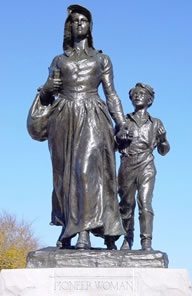 My great grandmother’s maiden name was Chisholm. Yes, that Chisholm. I come from a long line of Pioneer women. I went to the same University as Willa Cather and I celebrated the centennial of Nebraska in 4th grade by spending some time with our school in a mock up of a pioneer school. We wore bloomers and long dresses and bonnets. We sat our benches and wrote on our own little chalk boards. I have to admit, the first set of books I read all the way through was the Little House on the Prairie series. My father’s side of the family is a wonderful blend of German and Irish immigrants and Native Americans. Yes, My Antonia is one of my favorite books. It’s about the Great Nebraskan Outbook. I remember the uproar when the Poppers presented their “Buffalo Commons” idea. It was a major controversy.
The Buffalo Commons is a conceptual proposal to create a vast nature preserve by returning 139,000 square miles (360,000 km2) of the drier portion of the Great Plains to native prairie, and by reintroducing the buffalo, or American Bison, that once grazed the shortgrass prairie. The proposal would affect ten Western U.S. states (Montana, North Dakota, Wyoming, South Dakota, Colorado, Nebraska, Kansas, Oklahoma, New Mexico, and Texas).
Some of the Buffalo Commons idea has evolved naturally. Ted Turner actually owns a lot of the Nebraskan outback and has turned his land into Buffalo Ranches. He’s done this in several Western States including Montana. In the 80s, I worked as a consultant to the State’s Department of Economic Development and as a consultant to many small towns trying to keep the only industry in the county. I consulted with chicken slaughtering plants, plants making parts of bombs, plants making parts for cars, plants making taco chips, and all kinds of things. With that much territory and that few people, it’s hard to get a tax base to support roads, schools, government, parks, libraries, and all the things that folks on the east and west coast take for granted. When you come from pioneer stock or the Native American tribes in the region, you really do relish a sense of self reliance in a very big land. Yet, like many of the myths of the Old West, the New West is a lot more swagger than reality. Native American tribes may do it on their own, but the sons and daughters of pioneers have their own special welfare state going.
However, that sense of rugged independence is belied by the facts. Ah, yes, we’ve finally gotten to the purpose of all my romanticizing of childhood on the edge of nowhere that I really would’ve traded for Manhattan. We subsidize the Prairie Dream hugely. They don’t like to admit it in the list of states proposed as locations for a great huge nature preserve, but they are welfare queens.
Jeff Frankel took a lot of numbers and came up with the graph and results in Red States, Blue States and the Distribution of Federal Spending. I’ve never lived in a state that has paid more in federal taxes than it receives. That’s the big lie in this part of the country. We need the very blue states that most of the folks despise. We’ve talked about this before, but Frankel’s Weblog has the numbers.
The accompanying chart contains 50 data points, one for each state. The data are from 2005, the most recent year available. One axis ranks states by the ratio of income received by that state from the federal government, per dollar of tax revenue paid to the federal government. Personally, I think the “red state / blue state” distinction is overdone. But to capture the widely felt tension between the heartland and the coastal urban centers, I have put on the other axis the ratio of votes for the Republican candidate versus the Democratic candidate in the most recent presidential election.
It will come as a surprise to some, but not to others, that there is a fairly strong statistical relationship, but that the direction is the opposite from what you would think if you were listening to rhetoric from Republican conservatives: The red states (those that vote Republican) generally receive more subsidies from the federal government than they pay in taxes; in other words they are further to the right in the graph. It is the other way around with the blue states (those that vote Democratic).
One reason is that the red states on average have lower population; thus their two Senators give them higher per capita representation in Washington than the blue states get, which translates into more federal handouts. The top ten feeders at the federal trough in 2005 were: New Mexico, Mississippi, Alaska, Louisiana, West Virginia, North Dakota, Alabama, South Dakota, Kentucky and Virginia. (Sarah Palin’s home state of Alaska ranks number one if measured in terms of federal spending per capita. Alabama Senator Shelby evidently gets goodies for his state, ranked 7, by indiscriminately holding up votes on administration appointments.) The top ten milk cows were: New Jersey, Nevada, Connecticut, Minnesota, Illinois, Delaware, California, New York, and Colorado.
Perhaps in determining how the federal government redistributes income across states one should view its role more expansively than is captured in the budget numbers. In the western states there are federal water projects that subsidize water for farmers, artificially low grazing fees for ranchers, and leases for hard rock mining and oil drilling on federal lands that have historically charged artificially low prices. Perhaps the biggest federal redistribution program of all is massive agricultural subsidies. The four congressional districts that receive the most in farm subsidies are all represented by “conservative” Republicans, located in Nebraska, Kansas, Iowa, and Texas. (Michele Bachmann’s family farm apparently received $250,000 in such farm payments between 1995 and 2006.)
The most commonly ignored area of geographical redistribution is the federal government’s permanent policy of “universal service” in postal delivery, phone service and other utilities (electricity; perhaps now broadband…). Universal service means subsidizing those who choose to live in remote places like Alaska, where the cost of supplying these services is much higher than in the coastal cities. Perhaps they should move…
 It’s nice to see that some one is setting the record straight. The transfer of taxpayer wealth is going to places that aren’t the memes of either the tea party, the Republican Party, screamers like Glenn Beck, or fuzzy thinkers like Michelle Bachmann. The true welfare state recipients are the ones that scream the loudest about the welfare state. This hardly fits in with their message of doing it without the help of big government.

 peej
peej Carissa
 bostonboomer
 dakinikat
 ecocatwoman
 mablue2
 Mama Lopez
 peggysue22
 quixote
 skydancingguestblogger
 Mona (aka Wonk the Vote)



 Sky Dancing
Recent Comments