
The No Bailouts Act
Posted: September 30, 2008 Filed under: U.S. Economy, Uncategorized | Tags: Alternatives to bailouts, Financial Crisis, No Bail Outs Act, Peter DeFazio 2 CommentsCongressman Peter DeFazio from Oregon has sent a letter to colleagues offering an alternative to the current $700 billion bailout. It is worth a look.
| DeFazio Introduces the No BAILOUTS Act | | Print | |
|
The following is a Dear Colleague sent by Representative DeFazio introducing his No BAILOUTS Act, which would Address the current financial crisis without putting the American taxpayer on the hook for billions of dollars.
Dear Democratic Colleague:
The House of Representatives rejected the $700 bailout yesterday. Distinguished economists across the world have stated it would not have solved the problem at hand. However, we can potentially solve this liquidity problem at little cost to the taxpayer. I am proposing that Congress drop the Paulson Plan, and instead pass the No BAILOUTS Act. The No BAILOUTS Act provides an alternative to the Paulson Proposal to address the current credit crunch. Once Congress addresses the liquidity shortfalls in our financial markets, a Democratic Congress can turn to Democratic solutions to address the broader economic crises we face today. Specifically, Congress can work to resolve the housing crisis across the country and pass effective job stimulus, which is the response Main Street America expects and deserves. While Democrats and Republicans may disagree on the underlying solutions to solve the economic crises we face, the No BAILOUTS Act – a regulatory based proposal – has the potential for significant bipartisan support. The Paulson Premise Flawed Simon Johnson, a former chief economist as the International Monetary Fund, stated today in the New York Times of Paulson’s plan, “It’s our view that this package, in a fundamental sense, will not solve the problem.” Other economic analysts noted yesterday that the credit markets around the world were almost entirely dysfunctional even when political leaders and investors assumed that Congress had reached a deal and would easily approve the bailout. There is no reason to believe Paulson’s plan will work.
Alternatives We have credible alternatives to the Paulson/Bush $700 billion gamble. William Isaac, the chairman of the FDIC during the previous worst financial crisis in the United States during the 1980s, believes Congress can address the current crisis with simple changes to Securities and Exchange Commission (SEC) rules. Mr. Isaac points out that while we face serious financial challenges today, many banks are still in good shape. This allows Congress to take swift, uncomplicated steps to ensure the financial markets return to working order. After that, we can work to resolve the housing crisis and pass effective job stimulus. Today I am offering an alternative to the Wall Street bailout that will correct the capital shortfalls experienced by many financial institutions and help protect the integrity and quality of the securities market. My plan could be implemented promptly meeting the demands of the Bush Administration to act immediately without putting the American taxpayer on the hook for billions of dollars. No BAILOUTS Act Bringing Accounting, Increased Liquidity, Oversight and Upholding Taxpayer Security 1) Require the Securities and Exchange Commission (SEC) to require an economic value standard to measure the capital of financial institutions. This bill will require SEC to implement a rule to suspend the application of fair value accounting standards to financial institutions, which marks assets to the market value, no matter the conditions of the market. When no meaningful market exists, as is the current market for mortgage backed securities, this standard requires institutions to value assets at fire-sale prices. This creates a capital shortfall on paper. Using the economic value standard as bank examines have traditionally done will immediately correct the capital shortfalls experienced by many institutions. 2) Require the Securities and Exchange Commission to restricting naked short sells permanently This bill will require SEC to implement a rule that blocks naked selling, selling a stock short without first borrowing the shares or ensuring the shares can be borrowed. Such practices many times harm the companies represented in the sales and hurt their efforts to raise capital. There is no economic value produced by naked short sales, but significant negative effects. 3) Require the Securities and Exchange Commission to restore the up-tick rule permanently. This bill will require SEC to implement a rule that blocks short sales without an up-tick in the market. On September 19, 2008, the SEC approved a temporary pause of short selling in financial companies “to protect the integrity and quality of the securities market and strengthen investor confidence.” This rule prevents market crashes brought on by irrational short term market behavior. 4) “Net Worth Certificate Program” This bill will require FDIC to implement a net worth certificate program. The FDIC would determine banks with short-term capital needs and the ability to financially recover in the foreseeable future. For those entities that qualify, the FDIC should purchase net worth certificates in these institutions. In exchange, these institutions issue promissory notes to repay the FDIC, counting the amount “borrowed” as capital on their balance sheets. This exchange provides short term capital, with not cash outlay. Interest rates on the certificates and the FDIC notes should be identical so no subsidy is necessary. Participating banks must be subject to strict oversight by the FDIC including oversight of top executive compensation and if necessary the removal of poor management. Financial records and business plans should be subject to scrutiny while participating in the program. In 1982, Congress approved a program, known as the Net Worth Certificate Program, that allowed banks and thrifts to apply for immediate capital assistance. From 1982 to 1993, banks with total assets of $40 billion participated in the program. The majority of these banks, 75%, required no further assistance beyond the certificate program. 5) Increase the FDIC Insurance limit from $100,000 to $250,000. The bill will require the FDIC raise its limit to provide depositors confidence that their money is safe and help eliminate runs on banks which are destabilizing to the industry.
Sincerely
Peter DeFazio Member of Congress |
Crisis Strategy: Getting it Right the first time
Posted: September 28, 2008 Filed under: Uncategorized | Tags: Bail out of Fannie Mae and Freddie Mac, Financial Crisis, U.S. Economy 8 Comments
(Cross-posted at The Confluence)
There are very little details out in the public concerning the supposedly ironed-out terms that will solve the current financial crisis. Almost every one is worried that the terms of the rescue will involve taxpayers bailing out Wall Street High Rollers and their bonus-loving CEOs. If you review Financial Economics literature, you will discover that there are several findings in the studies done by economists that can provide guidance to every one on the best way to approach the bail-out. One of the most recent studies comes from the International Money Fund. It is by Luc Laeven and Fabian Valencia and was posted this month at the IMF research website.
If you’re not familiar with regression analysis which is the analytical method of choice here, stay away from the last half of this paper. However, you may find some interesting things in the first section because it includes a huge database that looks at all systematically important financial crises between 1970 and 2007. This means the database has 42 crises in 37 countries. It looks at steps taken by government to solve these crises and the length and depth of the crisis.
Here’s the link: http://www.imf.org/external/pubs/ft/wp/2008/wp08224.pdf
Another good source of information for suggestions is the Brit Magazine The Economist. Many of its articles are also available on line and are not technical in nature.
If you’re not up to looking at the details, let me try to explain some of the things that Financial Economists have learned since the Great Depression. You should look for some of these dos and don’ts when we finally get to see the details of the plan. Sixty years of study and growing theories has shown us that the tactical approaches–which mostly involve containing the crisis–are very expensive and don’t work too well. Usually, containment approaches happen while the crisis is unfolding. As an example of this, I will point to the bail-outs of individual banks and financial institutions that have happened to date. We’ve seen this containment tactic most of this year.
Governments can respond to these kinds of crises in many ways. In a lot of cases, we see reallocation of wealth from taxpayers to Banks and other institutions that hold debt. When wealth transfers like this happen, many problems happen in the general economy. The existing research done in this area shows that providing assistance to banks and their borrowers can actually increase loan losses to banks and in many cases lead to laxes in regulation that can be abused. Study-after-study shows that individual bank bail-out is usually not a good approach. Other costly and not that efficient tactical steps can include accomodative policies like direct government guarantees of bank liabilities or injecting ‘liquidity’ into the bank itself by lending money to the bank. The literature shows that none of these steps necessarily lead to a speedier recovery.
So what strategies can our country adopt to staunch the current crisis? Proposals vary, but a good example of something that worked would be the comprehensive plan we had back under the first Bush administration during the S&L meltdown. The RTC (Resolution Trust Corporation) was set up in 1989 to deal with the many, many S&L bankruptcies. The purpose of the RTC was to dispose of failed S&L assets in a way that didn’t drive prices on the properties and assets down. It put a bottom price on things like farm land or houses that were the underlying assets held by the thrifts. In the case of situation now, a new ‘agency’ would buy troubled mortgage-backed securities from the market and hold them until there was a turn around in their value.
This new agency could also serve another purpose similar to a depression-era institution called the Home Owner’s Loan Corporation. Hillary has suggested this type of agency whose purpose would be to buy and restructure existing mortgages. This would basically keep many folks in their homes with mortgages they could handle. For this to work, it has to be geared towards folks that can actually follow-through and make their payments. It could not be a social largess program because that would only create more loan losses in the long run. It’s purpose would be to keep folks in their homes as well as put faith back into house prices and the mortgage market. It would also alleviate the downward pressure on home prices. A new agency would be allowed to hold the loans and troubled securities until the market function agains and the assets once again become valuable. Many of the assets in some of these securities are fine now and could just be repackaged. The profits need to be returned to the taxpayer and used to pay down the debt. We should ensure that the proceeds do not go to any politician’s pet project.
At the same time, we need to look for better oversight of derivatives markets. The big issue that can be layed squarely at the feet of the Bush Administration and Greenspan is their inability to see the need for regulation of these markets. The existance of this market (which serves a similiar function to insurance) injected more ‘moral hazard’ into the banking community. This means if you think you’ve got something insured, you’re more likely to act haphazardly. We already had banks being encouraged to loosen their underwriting standards for certain borrowers by Fannie and Freddie. With the invention of these innovations, banks were covered, or so they thought, even if they did practice lax lending standards. These derivatives were an attempt to manage credit risk. However, as we have seen, actually placing accurate vales on this contracts just created more uncertainty. The implied consent and guarantee of the government via Fannie and Freddie exacerbated the misvaluation in a market with no oversight. We need to re-visit the regulatory responsibilities of the SEC and the FED and update them so that they reflect the existence of these extremely sophisticated and difficult to understand markets. Also, something has to be done about Fannie and Freddie and how their role to feed loans to creditworthy middle class Americans warped into some social engineering plan that began the lax lending standards and provided opportunities for exploitation.
So, do we need a bail-out? Yes. Unfortunately, financial contagions do act as a disease and can create economic downturns that impact everyone. All you have to do is crack a book on the Great Depression to see how problems in banks and stock markets eventually transfer over to Main Street. What is needed is the least expensive and most prudent approach. The literature tells us that it must be systematic and not just tactical. You need to strengthen the market, not just select players. I’ve outlined a few things that financial economists have learned about past crises. I’d hope we get the details out pretty soon so you can look and see if the bailout is consistent with these principles.
Gustav’s First Gust
Posted: August 31, 2008 Filed under: New Orleans, Uncategorized | Tags: Hurricane gustave, Live blogging from new orleans, new orleans hurricane, upper ninth ward 10 CommentsAt about 7 pm cst tonight while my neighbor Lisa and I were chatting, Gustav came in with bluster. We were watching hundreds of birds chatter and line up on the phone lines in what was a nice sunny evening. I was headed for the hurricane party which I understand was broken up at about 6 pm by the National Guard. The mighty mustang is on higher ground and it’s tailpipe is duct taped up …precaution against rising water.
Here’s my first pictures:

- Looking at the darkness coming in over the East
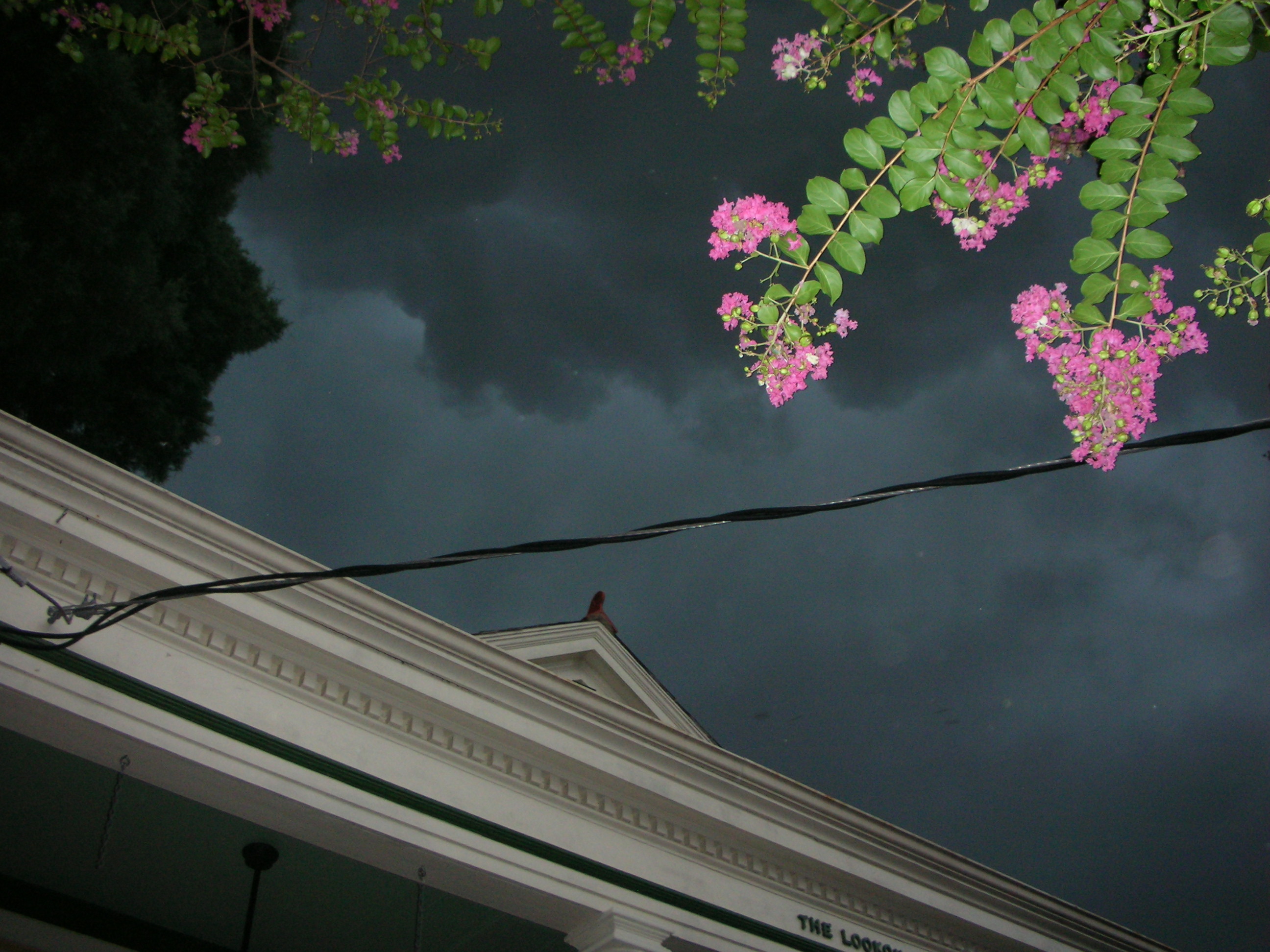


Minutes later the first rain bands hit and it was quite dark. The first gust was at least 50 mph. I still have power and the TV stations say that Plaquemines Parish is under a tornado warning. That cloud definitely had the feel of a wall cloud.
UPDATE : we just have light rain now. some of us have been sitting on the porch of the look out inn having cocktails and misc. libations. only traffic we see is military and police. they just dropped a troop transport vehicle off at the back door of the hebert defense complex which is a few doors up from us. i could go give some good key around the block but am staying put for the moment. it’s quiet now. still not trusting the dog to NOT kill Em’s kitten… AC is here and down the street in the FQ. Seems like old times. I’m trying to hone up on my third world living skills while praying the electricity stays on as long as possible. have to tell you, found that i am much more motivated by gas service than electricity … gas service = stove works and hot water works which = baths at the end of the day. I’ll let you know if any of those cute national guard guys come by this way. One of my favorite post katrina memories was offering hot coffee to the national guard of washington state ( a bunch of babes from tacoma, mostly) who wanted more southern hospitality than the hot coffee. Ah, me, and here I am just off the busline named Desire …
Peace out …
oh, and did i mention how much I’d like General Honore to be Hillary’s VP choice?
Hey BIDEN! Don’t Insult Women with Doctorates!
Posted: August 23, 2008 Filed under: Uncategorized 9 Comments
“Ladies and gentlemen,
my wife Jill, who you’ll meet soon,
is drop dead gorgeous…
she also has her doctorate degree, which is a problem”
Senator Joe Biden … VP and Presidential Wannabe
Hey BIDEN !!! Stop Picking on Smart Women! Hate to out myself, but I’m an economist who teaches economics to college students, and I’m working on my doctorate. What kind of stereotype do you have in your mind? I also play jazz piano and this is me.
Any more stereotypes you wanna discuss?”
Do you ave ANY idea what it means to get a doctorate?
I’ll tell you. It’s hell, it’s one test after another. It’s extremely hard classes and one research paper after another. You do a lot of grunt work, you smile, and you know that most of the glory goes to your teacher. Wanna do some time derivatives? Wanna take on some growth models? Wanna learn what it really takes to stimulate an economy? Analyze moral hazard and determine why CEOs cheat? Discuss derivatives… financial or math? Call me. It’s on. I’ll match my ability to turn around the economy against yours ANY day. Not only that! I can do it while playing Gerswhin’s Rhapsody in Blue, a piano concerto of your choice, or a great Monk riff.
YOU ARE an effete snob. Go back to your DC elitists or come down here to the ninth ward for a throw down! I challenge you to make it on the salaries any of my neighbors make any day!
If that’s not enough you want to discuss my Indian friends, who have doctorates? Perhaps, the one that’s dating my daughter? They’re both in med school. None of them are running 7-11s or Dunkin’ Doughnuts. I also have plenty of black students down here that are “clean” and “articulate”. Would you like to meet them? What exactly would you say to them for your so-called compliments?
Let’s discuss your vote for the Iraq war or how you chased photographers so you could get your pic taken with Dubya after 9/11. Would you rather discuss your inability to support Dr. Anita Hill and her charges against now Supreme Court Justice Clarence Thomas? Obama said he wouldn’t put his name up for nomination, yet you didnt’ stand up and stop the slurs against a very brave women who detailed a hell of sexual abuse. Why didn’t you stand up against the republicans for her truths? How about, hmmmmmmm, the ordinary Americans that now suffer because you’ve sponsored bills that make bankruptcy for ordinary Americans more difficult? How about the laws that would punish predatory lending? Wanna talk about those? Yeah, right, that’s what I thought. Much easier to joke about the fact your wife is highly educated and you’re embarrased rather than go down to the alter and confess that you’ve sold out to corporate interests.
We know you’ve got ambition. We know you have brains. We also know that like Senator Obama, you will do anything to get ahead.
Guess what Joe, you are not the smartest man on the planet and there will be some one to out you as just another ambitious wannabe.
All I can say is, it’s Biden! (YAWN)
Posted: August 23, 2008 Filed under: Uncategorized 1 CommentWell, I’ve been saying that all over the blogosphere for weeks now so excuse me if I’m more focused on Tropical Storm Fay heading my direction. The only interesting thing here is going to be watching Obama’s vp nomination try to look less presidential than Obama in terms of knowledge and experience and watching Obama try to explain away the original race card played in this long drawn out, wickedly stacked primary season. Will the MSM conveniently forget that Biden’s been labeled a racist?
 Remember Biden’s ‘clean’ and ‘articulate’ description of Obama? I do. That was the beginning of the race-baiting strategy so typical of the Obama campaign. This initiated the Obama lessons to white folks on how many adjectives in the English language are ‘code’ for racism. It mattered not how many civil rights legislation you championed. It mattered even less if you were wounded (like Harold Ickes) on the front line of the civil rights movement. It didn’t even matter if people called you the first black president. If you didn’t own the Obama manual of code words, you were brought before the MSM and the usual suspects as this week’s racist against Obama.
So, my question is today, is this an Obama flip-flop on racism so that ALL black folks are now under the bus or is this just an incovenience that the Obama campaign is willing to overlook to giving the seriously flawed candidate some gravitas?

 peej
peej Carissa
 bostonboomer
 dakinikat
 ecocatwoman
 mablue2
 Mama Lopez
 peggysue22
 quixote
 skydancingguestblogger
 Mona (aka Wonk the Vote)



 Sky Dancing
Recent Comments