
Punch Drunk on Tax Funded Bailouts
Posted: March 23, 2009 Filed under: Equity Markets, Global Financial Crisis, Main Stream Media, president teleprompter jesus, Team Obama, U.S. Economy, Uncategorized | Tags: bailout, Change When?, Obama, SouthPark, TARP, Timothy Geithner 4 CommentsWhile the Right Wing is off having tea parties and screaming class war, there appears to be some legitimate soul searching going on in left Blogistan about our “punch drunk” POTUS and his continual campaign like appearances. A lot of the discussion is focused on his dogged support of Turbo Tax Timmy and his bailout of the Suckers who created this bad economy for the rest of us. We’ve been overwhelmed with “heckuva-job-Timmy moments and distasteful ‘gallows humor’. When is enough enough?
Meanwhile, those of us that can’t avoid our jobs by taking a permanent vacation in TVLand are watching the economy unwind in spasms of agony and ecstasy. The market, starved for specific plans and information, provided a big thumbs 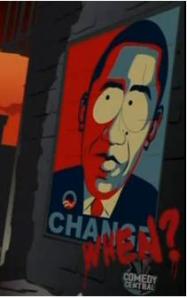 up on a bail out program that at best reheats Dubya’s. If any one was punch drunk, it was the equity markets today. The leaders were the financials, of course, who will continue to provide profits to the market while writing their costs off to the taxpayer. If you were looking for the fresh cold breath of reality, it wasn’t on Wall Street or on Pennsylvania Avenue.
Lucidity, however, is on the rise in other places. I’m finding it in interesting places like the second episode of South Park where the lampoon on the Dark Knight included this little back ground gem; a satire of the famous Obama picutre with a deer-in-the-headlights appearing Obama and the change mantra tagged by a bright red WHEN?
My answer to the when question is probably never.
Most left wing angst appears to be directed at Tim Geithner since the Light Bringer is still too new to the job to blame. We continue to learn how involved both he and his staff at the NY Fed were in the AIG Bonuses. In fact, the Obama administration is trying to scuttle the Excise tax on the bonuses while verbally denouncing executive greed on TV. We’ve also found out that Citibank has managed to insert similar language to protect its executive bonuses. Let’s see how much change we get on that one too.
Not only are right wing shrills like Fox’s Sean Hannity calling for the head of Timmy Geithner but Progressive Diva Arianna Huffington front paged the call on HuffPo today. When Hannity and Huffington carry the same headline, it’s time for more than a few campaign appearances on Leno and 60 minutes. I’m not sure where all this shock and angst is coming from because it’s been rather obvious to some of us for some time that Obama represented rather narrow interests (not ours). How can every Obama supporter be calling the AIG Bailout a travesty while knowing that the architects and enablers of AIG are continuing the task with the Light Bringer’s blessings and attaboys? Well, Obama just mustn’t realize that it’s all Timmy’s fault and we need his head on a limited edition Obama inaugural platter. But, wait, isn’t Obama the one with that great judgement ? C’mon folks reconcile all this in your mental ledger. It really isn’t that hard.
Super Heroes of Macroeconomics
Posted: March 22, 2009 Filed under: Uncategorized | Tags: AIG, bail out, Fraud, Geithner, Obama, Summers, TARP, Wealth Transfers, zombie banks 11 CommentsSomebody must have a lot of time on their hands to write a song called “Hey, Paul Krugman” but still, if the angsty, artsy fartsy creative class that foisted this POTUS on us is finally waking up, then Twitter me when the Revolution comes. I’ve even read the orange cheeto place and seems even a few of them are beginning to see the writing on their blackberries.
So, Paul is still appalled and speaking out against the Zombie Plan. I’d say this is another sfz! warning to the White House. What I can’t repeat enough is that it’s not just Paul. It’s not just me. It’s everyone with any knowledge of macroeconomics and the financial system.
Why am I so vehement about this? Because I’m afraid that this will be the administration’s only shot — that if the first bank plan is an abject failure, it won’t have the political capital for a second. So it’s just horrifying that Obama — and yes, the buck stops there — has decided to base his financial plan on the fantasy that a bit of financial hocus-pocus will turn the clock back to 2006.
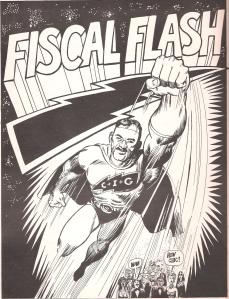 I don’t know if you’ve ever sat in an economics class, but most of you who have will attest that few economics professors are what you would call the dramatic, excitable types. However, I’ve seen more animation out of them recently than I’ve seen in all recent Marvel Comic Books.
From “Reasons Why The Obama Administration will not solve this crisis by the end of 2009” at The Underground Investor:
Consider that President-elect Obama voted FOR the horrible $700 billion bailout plan that accomplished less than zero in fixing the global economy while only transferring wealth from people that were struggling the most to the unethical financial executives that created this problem. These were my exact words in October, 2008, verbatim, about the eventual effect of the bailout plan: “Don’t believe the media spin. This will fix nothing. Even if and when the government overpays Wall Street and US banks by 300%, 500% and 1000% for their toxic assets, this temporarily recapitalizes these financial institutions but only creates A MUCH BIGGER PROBLEM for the future.” If I understood why the bailout plan would most definitely fail, as I blogged here, and the next President of the United States could not, that is a scary thought. On the other hand, if President Obama understood that the bailout plan would likely accomplish nothing but the transference of wealth from hard-working citizens to corrupt financial executives and still voted for the bill, then this action needs no further discourse.
From FT’s Willem Buiter:
Why are the unsecured creditors of banks and quasi-banks like AIG deemed too precious to take a hit or a haircut since Lehman Brothers went down? From the point of view of fairness they ought to have their heads on the block. It was they who funded the excessive leverage and risk-taking of banks and shadow banks. From the point of view of minimizing moral hazard – incentives for future excessive risk taking – it is essential that they pay the price for their past bad lending and investment decisions. We are playing a repeated game. Reputation matters.
Three arguments for saving the unworthy hides of the unsecured creditors are commonly presented:
- Unless the unsecured creditors are made whole, there will be a systemic financial collapse, with dramatic adverse consequences for the real economy.
- If the unsecured creditors are forced to take a hit, no-one will ever lend to banks again or buy their debt.
- The ultimate ‘beneficial owners’ of these securities – notably pensioners drawing their pensions from pension funds heavily invested in unsecured bank debt and owners of insurance policies with insurance companies holding unsecured bank debt – would suffer a large decline in financial wealth and disposable income that would cause them to cut back sharply on consumption. The resulting decline in aggregate demand would deepen and prolong the recession.
I believe all three arguments to be hogwash.
Just Say No to Zombie Banks!
Posted: March 16, 2009 Filed under: Uncategorized | Tags: bad bank, ben bernanke managing market expectations, financial regulation, good bank, zombie banks 6 Comments The market seems to have stabilized for awhile as Ben Bernanke has been giving speeches and making appearances every where he can. For those of you that really want to take on empirical studies in Economics (econometrics and all), this is a part of a strategy he outlined in Monetary Policy Alternatives at the Zero Bound: An Empirical Assessment. (Bernanke and Reinhardt 2001). It’s 113 pages long so be prepared to spend some time with it like I did last year. However, my guess is you can read the front parts and the back parts and skip the methodology and findings and be just as happy. It is basically the Chairman’s take on the Japanese Lost Decade and monetary policy at the time. It talks about quantitative easing which is the new approach that even the Bank of England is using now. That is when the Central Bank uses its balance sheet to buy and sale various financial assets to try to unclog lending channels. Since this is the first time the acting Chairman of the Federal Reserve Bank has ever appeared on any major news channel to have a fire side chat as in last night’s appearance on Sixty Minutes, I thought I’d point you to the motive behind the method. It’s outlined in that academic paper. Bernanke and Reinhard argue that Federal Open Market Committee (FOMC) announcements of policy and other announcements by the Fed shape market expectations and results. (Yes, I know El Presidente told us we shouldn’t care about the DJ but the FED chair still does because he knows IT MATTERS.)
Has the Federal Reserve’s policymaking body, the Federal Open Market Committee, historically exerted any influence on investors’ expectations about the future course of policy? Although members of the FOMC communicate to the public through a variety of channels, including speeches and Congressional testimonies, official communications from the Committee as an official body (ex cathedra, one might say) are confined principally to the statements that the FOMC releases with its policy decisions.
…
The FOMC has moved significantly in the direction of greater transparency over the past decade. Before 1994, no policy statements or description of the target for the federal funds rate were released after FOMC meetings. Instead, except when changes in the federal funds rate coincided with changes in the discount rate (which were announced by a press release of the Federal Reserve Board), the Committee only signaled its policy decisions to the financial markets indirectly through the Desk’s open market operations, typically on the day following the policy decision. In February 1994, the FOMC began
to release statements to note changes in its target for the federal funds rate but continued to remain silent following meetings with no policy changes. Since May 1999, however, the Committee has released a statement after every policy meeting.
The FOMC statements have evolved considerably. In their most recent form, they provide a brief description of the current state of the economy and, in some cases, some hints about the near-term outlook for policy. They also contain a formulaic description of the so-called “balance of risks” with respect to the outlook for output growth and inflation. A consecutive reading of the statements reveals continual tinkering by the Committee to improve its communications. For example, the balance-of-risks portion of the statement replaced an earlier formulation, the so-called “policy tilt”, which characterized the likely future direction of the federal funds rate. Much like the “tilt”statement, the balance of risks statement hints about the likely evolution of policy, but it does so more indirectly by focusing on the Committee’s assessment of the potential risks to its dual objectives rather than on the policy rate. The relative weights of “forward looking”and “backward-looking” characterizations of the data and of policy have also changed over time, with the Committee taking a relatively more forward-looking stance in 2003 and 2004.
Of course, investors read the statements carefully to try to divine the Committee’s views on the economy and its policy inclinations. Investors’ careful attention to the statements is prima facie evidence that what the Committee says, as well as what it does,matters for asset pricing.
I’ve highlighted that last paragraph because it is extremely important in explaining both the Chairman’s sudden interest in TV appearances and the market’s relief rally recently. Bernanke has been out there saying that the Fed will not let major banks fail, he dislikes then entire AIG thing and wants to ensure it never happens again, he’s been asking the senate committees he visits for more regulation, and he’s repeatedly said that the FED expects the recession to experience the trough later this year. We’ve not seen any meaningful discussion about the type of recovery to expect (L shaped or otherwise). We have however, seen more upbeat statements geared to appease the markets and their role in asset pricing.
Toxic US Treasuries?
Posted: March 13, 2009 Filed under: Equity Markets, Global Financial Crisis, Team Obama, U.S. Economy, Uncategorized | Tags: China Debt, Current Account deficit, U.S. Treasuries 15 Comments You know things are changing in the world when a country expresses “concern about the outlook for the U.S. and the safety of its Treasury bonds”. This would especially be true when that country is China and they are your biggest creditor. This is not the sort of thing one hears about industrialized nations, let alone the world’s largest single country economy. But there it is. The US is now considered a credit risk.
Analysts who watch the interest rates that the US must pay on its debt should have felt a little shiver yesterday. The Chinese government, the largest holder of Treasuries, expressed some doubt about the turnaround of the American economy and came a bit too close to stating that US paper might be becoming less attractive as the government borrowing to stimulate the economy and save financial institutions makes American debt a more risky investment.
According to the FT, the Chinese premier said, “We have lent a huge amount of money to the United States. Of course we are concerned about the safety of our assets. To be honest, I am a little bit worried. I request the US to maintain its good credit, to honour its promises and to guarantee the safety of China’s assets.”
I posted at the end of January about the touch and go trade relationship between the US and China. We stimulate their economy by buying Chinese stuff. They enable us to do so by buying our debt. We don’t yell at them for restricting their capital flows, pegging their currency, or violating human rights and we get to spend a lot of money without raising taxes. Well, that was so last month. Today, China’s decided to publicly assert its ‘interests’. We have yet to respond. Is China expressing similar concerns already voiced by economists and the markets over the current handling of the US Economy by the Obama team? Quite possibly. This, from the previously cited WSJ article.
Mr. Wen said that China is also closely watching to see the effects of the policies taken by U.S. President Barack Obama aimed at returning the world’s largest economy to health. Chinese foreign minister Yang Jiechi was also in Washington this week to discuss how the two countries can cooperate on economic policy, among other issues.
A test of that cooperation is quickly approaching. U.S. Treasury Secretary Timothy Geithner this week called on the Group of 20 – a gathering of the world’s largest developed and developing economies – to increase funding for the International Monetary Fund by up to $500 billion to help combat the financial crisis. Achieving that sum likely will depend on getting agreement from countries that hold large foreign exchange reserves, such as China and Saudi Arabia.
Ahead of a preparatory meeting of G-20 financial officials this weekend near London, Mr. Wen said pointedly that “increased funding for the IMF is not a question for just one country” but for all member nations. He also repeated China’s desire to see reforms to the IMF that give more clout to developing nations.
They’re ‘inkling’ that China deserves more international status and bargaining power. They also would like the international community–especially the US– to lay off any notion of a more free and open Tibet. I still find it intolerable that we’ve basically decided cheap Chinese manufactured goods are worth more than the religious and political freedom of native Tibetans. That is, however, the bargain that is on the table.
Mr. Wen used harsh language against the Dalai Lama, Tibet’s spiritual leader, who accused the Chinese government this week of turning the Himalayan region into a “hell on earth.” He said talks between
Beijing and the Dalai Lama, which took place last year without making any progress, could only resume if the Dalai Lama is “sincere.”
Indeed, China does have a big stake in the U.S. economy and is the nation’s biggest creditor. It is always disconcerting when that creditor calls you at work and reminds you about the bill. Here’s the size of the problem reported by the NYT.
China should seek to “fend off risks” as it diversifies its $1.95 trillion in foreign-exchange reserves and will safeguard its own interests, Mr. Wen said. He said that the Chinese had invested $696 billion in United States Treasury bonds as of Dec. 31, an increase of 46 percent from a year ago.
The United States Treasury Master index from Merrill Lynch shows that the securities declined 0.5 percent last month, after falling 3.1 percent in January, the worst since April 2004, as President Barack Obama sells record amounts of debt to finance his $787 billion bailout. The dollar has dropped 17 percent against the yuan since China ended a fixed exchange rate in July 2005.
This definitely presents a challenge to the Obama administration. In order to forward the aggressive spending packages and tax cuts required for their agenda, the Chinese must continue buying US Treasuries. It was rumored that one of the messages brought to China by newly appointed SOS Hillary Clinton was the hope that China would continue its huge investment in Treasuries. The Chinese have now publicly stated that there will be a cost to those funds above and beyond the current interest rate.
Every time my students ask my what would happen if the Chinese suddenly dumped their supply of US Treasuries on the market, I say absolute chaos. Chaos here in the US and chaos throughout the world markets. I’ve also thought that an infinitesimally likely event. I’m not so sure about that now that we’ve had such a public announcement of our bad risk status. I’m also not sure if we’re being threatened with kneecapping, higher fees, or a mortgage on our soul.
Job Markets Keep Getting Worse
Posted: March 6, 2009 Filed under: Uncategorized | Tags: economics, labor markets, unemployment statistics 5 Comments 651,000 jobs disappeared during the month of February according to the BLS. This was the fourth month in a row with job losses over 600,000. The unemployment rate is now at levels unseen since 1983. We have an official unemployment rate of 8.1% but that belies a lot of stories including the number of people forced into part time jobs, the number of people so discouraged they have given up hope of finding a job, and the sectors and people who find themselves most vulnerable to this awful economy. I’m not a labor economist and don’t do research in the area so I’m basically limited to what I know from teaching and attending my own basic economics classes. The most important basic thing to know about labor markets is to dig in there into the break downs behind the unemployment rate for the full story.
Unemployment hits people differently. That is why the major statistics are sliced and diced several different ways. Age and ethnicity are frequent subcategories of interest. Today’s unemployment statistics showed the usual story.
The unemployment rate continued to trend upward in February for adult men (8.1 percent), adult women (6.7 percent), whites (7.3 percent), blacks (13.4 percent), and Hispanics (10.9 percent). The jobless rate for teen-agers was little changed at 21.6 percent. The unemployment rate for Asians was 6.9 percent in February, not seasonally adjusted.
Asian unemployment is always the lowest followed by white unemployment. The worst hit by unemployment are black teenage men whose unemployment rates can average about 30% even in the best of economies. Do you know why women always manage to have lower unemployment rates than me? Well, if you checked Heidi Li’s post on the wage gap, you have your answer. Women are employed on the cheap and are much more likely to be kept on during a bad economy than their over paid male counterparts. Older people generally fare better than younger. That is just the last hired, first fired behavior of businesses trying to hold on to their loyal and most experienced employees.

 peej
peej Carissa
 bostonboomer
 dakinikat
 ecocatwoman
 mablue2
 Mama Lopez
 peggysue22
 quixote
 skydancingguestblogger
 Mona (aka Wonk the Vote)



 Sky Dancing
Recent Comments