
The Wrong Right Wing Stuff
Posted: May 29, 2009 Filed under: Uncategorized | Tags: community reinvestment act, CRA, subprime mortages 2 Comments I inadvertently stepped on a right wing meme back last September when I implied that Fannie and Freddie did their share in contributing to the current financial meltdown. I used figures to show that the problems in the mortgage market were occurring equally in the subprime as well as the prime market. What happened is that I said was associated with the oft -repeated Republican talking point that the CRA (Community Reinvestment Act) caused the meltdown in the mortgage. I still think that was a wild shark jump, but I was called things I won’t repeat here because of that big leap. I was channel surfing last night and heard Glenn Beck (Mr. Emotional Basketcase) repeat this nonsense yet again. So, let me use real research to put clip the right wings off of that one.
Today’s WSJ overviewed a study by the Minneapolis Fed (yes, the peer reviewed, use data kind, not the say what you want to get ratings type of study) and concluded that the CRA did not contribute to the mortgage market meltdown. Let me just add here that I worked for the Fed and the Minneapolis Fed has one of the more conservative research agendas and economists. Most famously, they’re home to Robert Lucas and Thomas Sargent’s work on Rational Expectations. These guys are freshwater economists.
At the center of much of the shouting is the the Community Reinvestment Act (CRA), a 1970s-era law that pushed banks to lend to low-income households. Some — mostly conservatives — contend that the government program, coupled with securitization from Fannie Mae and Freddie Mac, played a role in the surge in risky home lending that formed the root of the financial crisis. Liberals counter that the Fannie/Freddie/CRA argument is a red herring that tries to pin a market failure on government interference.
A report from the Federal Reserve Bank of Minneapolis took a look at data on subprime — referred to as “high-priced” — loan originations and performance at CRA-regulated lenders and their affiliates and institutions not covered by the law. Here’s one of the central findings:
In total, of all the higher-priced loans, only 6 percent were extended by CRA-regulated lenders (and their affiliates) to either lower-income borrowers or neighborhoods in the lenders’ CRA assessment areas, which are the local geographies that are the primary focus for CRA evaluation purposes. The small share of subprime lending in 2005 and 2006 that can be linked to the CRA suggests it is very unlikely the CRA could have played a substantial role in the subprime crisis.
This report doesn’t represent the first time the Fed has tried to bat down the notion that the CRA played an important role in the subprime mess. Late last year, then Fed Governor Randall Kroszner, a University of Chicago economist and former Bush administration official, echoed the findings of the report saying only about 6% of all subprime mortgages to low-income households trace back to banks that had to meet CRA standards. (Although this Investor’s Business Daily editorial is skeptical.)
Heaven has Fjords
Posted: May 14, 2009 Filed under: Economic Develpment, Environmental Protection, Global Financial Crisis, Uncategorized | Tags: democratic socialism., green economy, Kristin Halvorsen, Norway, Standard of living 2 Comments When ever I hear folks rant and rave on the evils of European Social Democracies and how horrid they are, I always ask them to name the country that comes up consistently with the highest literacy rates in the world, lowest infant mortality, and much higher the the USA GDP per capita, and at the same time has what you would probably call the world’s most complete cradle-to-grave welfare state. Of course, no one knows the answer because so many folks here have been brainwashed into thinking productivity, budget surpluses, high standards of living, and great education and health care are not possible in socialist states. Well, they are really wrong.
Without a doubt, the best country to live in the world these days going strictly by the statistics (and not the weather) is Norway. Take a look at the CIA fact book for all the good stuff on Norway then take a look at the United States. Norway has bested the USA in standard of living for quite some time. The United States keeps dropping on all lists and just in GDP per capita is now sitting at number 10. Norway is ranked first on the Human Development index of 177 countries, so essentially they are number one country for living the good life. It is second, only to Luxembourg, for GDP per capita.
Today’s New York Times covers the little country that can and its stellar economic performance in today’s global economic crisis. A lot of credit is goes to Norway’s socialist finance minister Kristin Halvorsen. She’s in charge of Norway’s $300 billion sovereign wealth fund that has been steadily buying stocks since March and is used to build a decent standard of living for every one in that country. Norway likes its government and its government works well. The Times article contrasts the economics of the U.S. and Norway and the U.S. comes up way short.
Don’t Quit Your Job if you can Help It!
Posted: May 8, 2009 Filed under: U.S. Economy, Uncategorized | Tags: Job Losses, Job Market, Unemployment Rate Comments Off on Don’t Quit Your Job if you can Help It!April’s employment data was released today. We now stand at an 8.9% unemployment rate which represents a 26 year high. Every one appears to be spinning away the bright side of over 539,000 lost jobs with the refrain that at least it’s not as bad as it was in January. 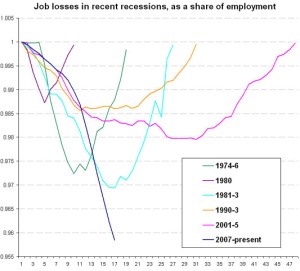 But, just because it’s marginally better, doesn’t mean the worst is over. All time series have variation and this may or may not signal the end of the worst of the worst monthly losses.
I’m still trying to figure out how people are finding glimmers of hope in this news given the historical perspective shown in this graph from the NY Times as presented by its blog Economix. This compares the current recession to previous recessions. As you can see, we’re still straight off the cliff at this point. Equally impressive is this graph from Market Watch which shows the monthly change in nonfarm payroll growth. It seems that the monthly changes may have bottomed, but it’s way too early to tell if there’s going to be any improvement. That’s when you have to examine some of the underlying factors in the market. Remember, variation in any series is to be expected so you’ll get ups and downs just from random variation. Those movements don’t necessarily indicate a trend. What do economists say about these numbers?
From Economix:
“The employment data do not yet corroborate the extent of the diminishment of the intensity of the recession suggested by other economic indicators (ISMs, consumer confidence, etc,). However, if we continue to see declines in the four-week average of jobless claims (which has fallen for four straight weeks), this may suggest smaller declines in employment later in the second quarter. Nonetheless, relating this report to the bank stress tests, the unemployment rate in April is already at the “alternative more adverse” average level assumed for the 2009…” — John Ryding, Conrad DeQuadros, RDQ Economics
“In April, more than one in four unemployed workers, 27.2 percent, had been without jobs for six months or longer, the highest rate on record since the government started calculating this statistic in 1948.” — National Employment Law Project
“The unemployment rate rose to 8.9 percent, but this is entirely due to a surge in the size of the labor force, as household employment is reported to have risen…
“[W]ith the smaller headline job loss number, many are interpreting the April employment report
as yet another sign that the economy is “stabilizing,” but the more accurate assessment is that the economy’s pace of contraction is slowing, which is not quite the same as stability and is still a long way from the economy actually improving.” – Richard F. Moody, chief economist, Forward Capital, LLC

The Hedge Fund Empire Strikes Back
Posted: May 1, 2009 Filed under: Bailout Blues, Equity Markets, Global Financial Crisis, Uncategorized | Tags: bond holders, Chrylser bankruptcy, Chrysler bailout, hedge funds 2 Comments The role of hedge funds in the bankruptcy of Chrysler and GM will probably be discussed and studied for some time. It’s not often this POTUS singles out a Financial Institution for scorn since they’ve all been major donors to his campaign but POTUS made an exception when announcing the Chrysler bankruptcy. Evidently, POTUS was not amused that a few of them would not bend to his will on the deal.
The most interesting thing is that the spoilers are now responding. They are not only responding, they are making it clear that the group the cut the deal were TARP fund babies and they were not. They are actively referring themselves as the No-Tarp Gang just to make that perfectly clear.
Also, interesting is the tone of the coverage concerning the bankruptcy. A Motor Trend blog has a headline screaming Chrysler Bankruptcy “Cruel” Result of Hedge Fund Greediness. Motor Trend obviously has more interest in the Car Makers than the Deal Makers and there in lies the rub. The government-brokered deal, led by four of the biggest Tarp Babies, puts interests that are usually at the back of the line in corporate bankruptcy at the front. Basically the union employees could potentially lose it all in the bankruptcy court.
This deal, turns the entire idea of the safety and primacy of bonds in a bankruptcy deal upside down which could argueably further destabilize financial markets. So, before you accuse me of being anti-union here, which I’m not, let me talk about that. Bonds are usually first in line in any bankruptcy. It’s why they are considered less risky and yield less than their riskier cousins, the equities. Folks that buy corporate bonds play an important role in the market. They provide corporations with huge, long term sources of cash at better terms than any one of them could get from a bank.
If a deal can be cut that undercuts the nature of bonds, what would this mean to other bond holders in other deals that are likely in the bankruptcy pipe? (This would include GM and other industries.) Could this deal actually destabilize the primacy of bonds in the bankruptcy hierarchy? Is that what the fuss is about? Are they being greedy? Are they looking out for their investors? Are they posturing? I don’t think we quite know yet. But, the Hedge Funds spoke up as reported in today’s WAPO.
President Obama’s harsh attack on hedge funds he blamed for forcing Chrysler into bankruptcy yesterday sparked cries of protest from the secretive financial firms that hold about $1 billion of the automaker’s debt.
Hedge funds and investment managers were irate at Obama’s description of them as “speculators” who were “refusing to sacrifice like everyone else” and who wanted “to hold out for the prospect of an unjustified taxpayer-funded bailout.”
“Some of the characterizations that were used today to refer to us as speculators or to say we’re looking for a bailout is really unfair,” said one executive who spoke on condition of anonymity because of the sensitivity of the matter. “What we’re looking for is a reasonable payout on the value of the debt . . . more in line with what unions and Fiat were getting.”
George Schultze, the managing member of the hedge fund Schultze Asset Management, a Chrysler bondholder, said, “We are simply seeking to enforce our bargained-for rights under well-settled law.”
“Hopefully, the bankruptcy process will help refocus on this issue rather than on pointing fingers at lenders,” he said.
I supposed that I don’t have to tell you that hedge funds are not charitable organizations but many of them actually invest for charitable organizations, along with unions and state and government workers. Their clientele can be anything from a small group of rich investors, to you and me, actually. We’ve heard a lot about them recently but most people, I’d speculate, don’t know a lot about what they are and what they do. Hedge funds came onto the scene in the 1950s and what mostly defines them is their regulation regime.
Here’s an easy definition from a website at the University of Iowa.
“Hedge fund” is a general, non-legal term that was originally used to describe a type of private and unregistered investment pool that employed sophisticated hedging and arbitrage techniques to trade in the corporate equity markets. Hedge funds have traditionally been limited to sophisticated, wealthy investors. Over time, the activities of hedge funds broadened into other financial instruments and activities. Today, the term “hedge fund” refers not so much to hedging techniques, which hedge funds may or may not employ, as it does to their status as private and unregistered investment pools.
Hedge funds are similar to mutual funds in that they both are pooled investment vehicles that accept investors’ money and generally invest it on a collective basis. However, they are regulated in significantly different ways. Up until 2005, hedge funds in the United States often relied on Section 4(2) and Rule 506 of Regulation D of the Securities Act of 1933 to avoid having to register their securities with the Securities and Exchange Commission of the United States (SEC). Further, to avoid regulation regarding mutual funds (a type of “investment company”), hedge funds relied on Sections 3(c)(1) and 3(c)(7) of the Investment Company Act of 1940. In short, hedge funds escaped most U.S. regulation directed at other investment vehicles such as mutual funds.
European nations regulate hedge funds by either regulating the type of investor who can invest in a hedge fund or by regulating the minimum subscription level required to invest in a hedge fund. In the years to come, experts are predicting the rise of an alternative regulatory framework that will be tiered yet flexible.
The Chicago School v. The Rest of Us
Posted: April 28, 2009 Filed under: Global Financial Crisis, U.S. Economy, Uncategorized | Tags: fresh water economists v. saltwater economists, macroeconomics 8 Comments There’s a very big debate between economists that’s beginning to spill on to the pages of major newspapers. Suddenly, people that I usually only read in scholarly articles are attending conferences where they give papers in what passes off more as the lessons of theory and empirical evidence instead of the theory and evidence itself. So many folks are coming down out of the ivory towers these days that I think some kind of tipping point about the financial crisis has been reached. The only thing I can think that may have caused this escalation is the back and forth that is now the blogosphere and the financial crisis which is making a lot of folks defend their models.
Many, many academic economists keep blogs now. The readership of these blogs was originally every one’s students or the adopters of your textbook. It then became a way to pass your working papers and pubs back and forth to avoid the journals. Even a few folks have actually put their databases up for use by doctorate students. Believe me, both a blessing and a curse having been in the position of having to reproduce a bunch of stuff I’d rather have not. Many finance folks keep blogs because they make money giving advice to Wall Street Types and investors. But their blogs have taken an interesting twist too. Maybe it’s because I live blocks from the Mississippi and a few miles from a salt water lake but watching this back and forth is like watching the world’s longest intellectual and philosophical tennis match. Do we really have to repeat the Great Depression for the Chicago School to get it this time?

 peej
peej Carissa
 bostonboomer
 dakinikat
 ecocatwoman
 mablue2
 Mama Lopez
 peggysue22
 quixote
 skydancingguestblogger
 Mona (aka Wonk the Vote)



 Sky Dancing
Recent Comments