
Why won’t Dodd fight for Elizabeth Warren?
Posted: August 7, 2010 Filed under: Uncategorized Comments Off on Why won’t Dodd fight for Elizabeth Warren?Dodd’s pushing for Sheila Bair for the head of the Consumer Financial Protection Bureau (CFPB) even though she doesn’t want the job. Every one wants Elizabeth Warren, but Dodd seems unlikely to back her and is showing public unwillingness to fight for her.
The New Republic’s Noam Scheiber wrote that “after surveying a dozen insiders over the last few days — congressional aides, industry officials, progressive activists, and a few administration officials — I’ve concluded that the odds are good that Warren would be confirmed if nominated by the White House.” And Dodd now seems to have shifted his rhetoric, saying that even if Warren is confirmable, it’s not worth a potential fight to get her the job:
“What you don’t need to have is an eight-month battle for who the director or the head or chairperson of this new consumer financial protection bureau will be.”
Republicans overwhelming voted against the Dodd-Frank Reform bill, so why the sudden fear of the Republicans? Does it have something to do with his coming exit from the senate and most likely entrance into the FIRE lobby or is there some one inside the White House (like Geithner and/or Summers) who don’t want her in the position and want Dodd to take the fall?

Could the world’s food supply be the next speculative bubble?
Posted: August 6, 2010 Filed under: Uncategorized Comments Off on Could the world’s food supply be the next speculative bubble? Speculators are always looking for places to speculate. The clarion call of the big money and the adrenalin thrill of the kill don’t always happen on an actual killing field for the very rich. They frequently happen with some carefully placed shorts and momentum. They do have the same results as a hunting party. Something dies. In this case, it could be the world’s hungry.
I know that wasn’t exactly a profound way to open a thread but I didn’t know how else to begin a conversation on food inflation and this UK Guardian headline: “Commodity prices soar as spectre of food inflation is back; Speculation and rumour could be the driving force behind sudden market rise in food prices”. It sounds like one of my dry economic topics when I put it this way. But, really you need to notice this.
I’ve talked about how incenting farmers to grow biofuels instead of food in a world where the population is still growing faster than it should is a dangerous bet. It may be that a few some ones are taking that bet since it’s been raised by a Russian Drought and an Indian Plague. Witness one of the few markets where we’re seeing asset prices rise above a normal rate of return. No, it’s not really the stock market that’s been floating around the same numbers for months now. It’s not the housing market or the commercial real estate market that still appears to have some downward momentum. The new asset bubble appears to be in commodities. It also seems centered in food.
The price of wheat, oil and copper soared this week but the picture looks much less clear this time. Old-fashioned supply and demand is still at work, but there are fears that wild rumours and speculation are driving up prices.
Wheat prices, which are up 40% over the last month, reached a two-year high as concerns about a drought in Russia and rotting stocks of grain in India exercised markets in London and Chicago. Claims that a major crop failure in Australia, following an invasion of locusts and a wet summer in Canada, could lead to a worldwide shortage, have pushed up prices in recent weeks to levels not seen since 2008.
The rise in futures contract prices traded on the major markets also follows a United Nations report in June that warned food prices could rise as much as 40% over the coming decade, amid growing demand from emerging markets and for biofuel production
The World Development Movement said reports pointing to a long-term upward trend in prices and the recent weather-related farming crisis had proved fertile ground for speculators who bet on rising prices.
Tim Jones, policy adviser to the WDM, said figures from US commodity futures trading commission showed the majority of contracts on foodstuffs over the past six weeks, including wheat, had bet on rising prices.
“There is strong evidence that speculators have seen an opportunity to drive up prices. But the damage caused by their activities is higher prices for everyone and people in developing countries can ill-afford to pay the cost,” he said.
One of the strong signals that the speculators have switched to creating a food asset bubble is this tidbit. “The CFTC figures showed there was a 35% increase in contracts since June betting on a rise in prices.” That means commodity futures traders are betting on price movements. Food inflation (the rise in food prices) should be solidly linked to those pesky real things that shift demand and supply curves like drought (Russia does have one), plagues of locusts, or lots of hungry babies. Is this the case in the current run up of food prices?
There are temporary reasons behind high food price inflation—drought, petroleum products price hikes, mismanagement of trade policies, transportation dislocations, debt waivers, speculation and so on. Per se, inflation numbers are also not really the point. There is no reason to expect that food price inflation will remain at 12.47%, which it was for week ending July 10. Such numbers are function of the base last year and will undoubtedly soften when the kharif crops arrive post-September. While short-term declines in prices of individual agro-commodities are possible, does one really believe that food price inflation will disappear?
It will moderate from double digits to 7% or thereabouts, but 7% is still inflation. And that 7% will remain, because there are medium-term causes behind the increase in food prices—NREG (which continues), increase in rural incomes (there is no reason to presume public expenditure in rural sector will taper off), increase in urban incomes, changes in consumption patterns and warped incentives through procurement prices and hikes in these (that isn’t going to be reversed either). We are talking about increasing demand imposed on an inelastic supply. (Increases in production and productivity have been marginal.)
These kinds of things make a market ripe for speculation. This is from The UK Guardian.
But critics maintain that spikes in prices of global commodities are increasingly driven by speculators. They said the effects of a block on Russian exports by the Russian government were overplayed. Russia sends most of its wheat exports to Egypt, Syria and other middle eastern countries, which can access grain from other sources.
Reports that large amounts of India’s wheat stockpile could rot were premature, they said. Also, while India is the world’s second largest rice and wheat producer, it only exports a fraction of its output and would have little impact on global supply.
“Fears have been piqued that we may be heading back to the 2007-8 food crisis,” notes Sudakshina Unnikrishnan, an analysts at Barclays Capital. “In our view, market fundamentals are less compelling this time around with many of the key factors that propelled prices in that period missing.”
While India and Russia are expected to have very bad harvest, the EU and the US are expected to have abundant wheat. So, some of these price increases do not make sense in terms of traditional economics which leads us to speculators that like to create momentum and ride it to big profits.
So, what to do? When speculators in futures markets start destabilizing a market and introducing increased volatility and momentum that is likely to hurt the underlying market, the answer is limit the trade. New financial reform laws allow Congress to do that and they should consider it right now before we have a mess in the food markets the same way we’ve got a mess in the housing markets. Fortunately, the capital markets appear to have stabilized. This would not limit farmers who hedge for risk management purposes. It would limit big traders, like Cargill and most definitely hedge funds who are only in it for the kill. There are so many big players these days that I’m beginning to think that speculators do more than just ‘add liquidity’ to the market. They seem capable of creating and driving momentum which is not what we want happening in markets. Believe me, the world’s food supply is nothing you want to leave to adrenaline and testosterone. Volatility in prices may give a few of those guys a thrill, but for the rest of the world who worries about food on the table, that’s a deadly game.
Not good news
Posted: August 5, 2010 Filed under: Uncategorized Comments Off on Not good news If this is true–and I have no reason to believe it isn’t–then one of the few economic voices in the administration that is not a Wall Street insider is leaving her post.
Christina Romer, chairwoman of Pres. Obama‘s Council of Economic Advisers, has decided to resign, according to a source familiar with her plans.
Romer, an economics professor at the University of California (Berkeley) before taking the key admin post, did not respond to repeated calls to her office.
“She has been frustrated,” a source with insight into the WH economics team said. “She doesn’t feel that she has a direct line to the president. She would be giving different advice than Larry Summers [director of the National Economic Council], who does have a direct line to the president.”
“She is ostensibly the chief economic adviser, but she doesn’t seem to be playing that role,” the source said. The WH has been pounded for its faulty forecast that unemployment would not top 8% after its economic stimulus proposal passed.
Instead, the jobless rate is 9.5%, after exceeding 10% last year. It was “a horribly inaccurate forecast,” said Bert Ely, a banking consultant. “You have to wonder why Summers isn’t the one that should be taking the fall. But Larry is a pretty good bureaucratic infighter.”
Romer’s highly respected in the community and I always thought she would bring a voice of reason to the White House. Instead, she always got put in front of the camera trying to explain away economic bad news. I’m not sure who the replacement will be but it I venture a guess to say that it will be some one that plays nice with Geithner and Summers who appear to get their way when ever they can. I’m hoping it won’t be another Wall Street insider, but it would figure. It would also figure if the next one didn’t have a vajajay too. That seems to go along with playing well with the Obama inside team.
No Comment
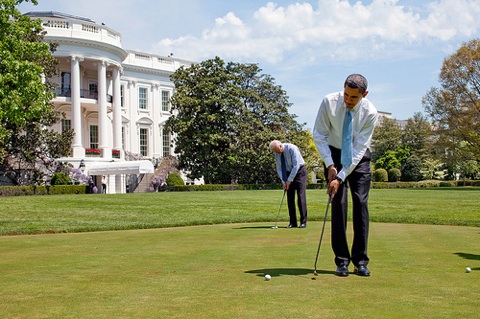
Posted: June 20, 2010 Filed under: Uncategorized Comments Off on No CommentThe President and Vice President’s Golf Game Weekend …
and BP CEO’s outing at a Yacht Race sponsored by JP Morgan to see his 52 foot yacht “Bob” …
And a friendly reminder from Reuters:
Obama says will not rest until Gulf oil spill plugged
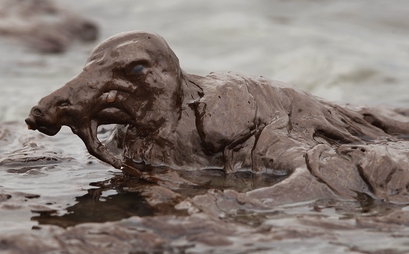
Brought to you by one really pissed off Gulf Coast resident ….
Gulf Update
Posted: May 20, 2010 Filed under: Uncategorized | Tags: Coastal Parishes, Gulf Oil Spill Comments Off on Gulf Update I went out last night to Jack Dempsey’s Seafood Restaurant. It’s my local seafood place that’s just down the street from me. Since I live between the Coast Guard Base and the east bank portion of a Marine Base and the ninth ward is the Gateway to the Coastal parishes, I get to hear a lot about what’s going on with the Gulf Spill. It didn’t take me long to figure out that it’s not good. I asked about the oyster plate and there were basically no oysters. I had to settle for the shrimp platter where the shrimp were much smaller than I usually see on plates this time of year. At least there are still some around.
Wednesday night is pretty quiet so it wasn’t hard to get every one in the room to start opening up on the Gulf Spill. A good portion of the folks that eat and work at Jack Dempsey’s have that tell-tell Chalmette accent so you know that some one in there has family that makes a living on a fishing or shrimping boat. You could tell they’re all worried about their livelihoods even if they’re not on the boats any more. Everything from here east is about seafood and the Gulf. I kid you not.
We also decided that Governor Bobby Jindal looks like hell. One of the waitresses wondered if that was intentional because former Mayor Ray Nagin got so much criticism for his vanity aboard AF1 during Hurricane Katrina. Jindal looks like he’s been forgoing his little dab will do ya. He’s also obviously tired. He hasn’t slowed down when giving pressers, however. He still talks faster than any one can follow.
The first topic that came up were the complaints that BP was basically paying the small fishing business less than minimum wage for their boats and their services. This is prime shrimp season so they’re losing a lot more than just a day’s work. It’s also hurting the charter boats that take tourists out for a day’s fishing. Those boat owners and a lot of my neighbors with fishing camps in the area are complaining about their favorite weekend of the year. That’s when they all climb into a boat and compete in the the Grand Isle Tarpon Rodeo. The father-in-law of my neighbor across the street bought a brand new boat for the occasion and now it’s sitting in his garage indefinitely. Fishing Rodeos are better attended that mass in the coastal parishes.
The Grand Isle Tarpon Rodeo is the oldest fishing tournament in the country and was founded in 1928.
Raymond Stouder, a Metairie native who won the Bluefish catch category last year, said the event means more to him than the competition.
“Every year we try to get a bunch of us to go down there together, ” Stouder said. “It’s more than just fishing.”
Stouder, who said he tries to fish at least a couple of times a week, said it would be terrible for the state to lose any of its fishing rodeos this year.
“It’s going to be a bad situation, especially for (the) economy down there, ” Stouder said.
If canceled, the Grand Isle Rodeo will join a list of other major fishing rodeos in South Louisiana to be canceled.
The Golden Meadow-Fourchon International Tarpon Rodeo in Port Fourchon has already been canceled because of the spill. That rodeo was scheduled for July 1-3. Jesuit High School’s annual fishing rodeo, scheduled for June 25-26, has also been canceled.
This is just the beginning of how much life is going to change around here. We’re also getting reports that some Fisherman working in the Gulf are reporting they are ill.
One fisherman said he felt like he was going to die over the weekend.”I’ve been coughing up stuff,” Gary Burris said. “Your lungs fill up.”Burris, a longtime fisherman who has worked across the Gulf Coast, said he woke up Sunday night feeling drugged and disoriented.”It was like sniffing gasoline or something, and my ears are still popping,” Burris said. “I’m coughing up stuff. I feel real weak, tingling feelings.”Marine toxicologist Riki Ott said the chemicals used by BP can wreak havoc on a person’s body and even lead to death.”The volatile, organic carbons, they act like a narcotic on the brain,” Ott said. “At high concentrations, what we learned in Exxon Valdez from carcasses of harbor seals and sea otters, it actually fried the brain, (and there were) brain lesions.”
Earlier today, the EPA has ordered BP to use a less toxic dispersant. I posted earlier about the problems seen with Corexit. Finally, the information on it is getting to other people. Here’s some of the latest information on that. EPA head Lisa Jackson spoke about the problems.
Jackson used less glowing language, calling the dispersant “the lesser of two environmental outcomes no one wants to have to deal with. But we also need to be able to answer questions about what’s out there and what’s available for use,” she said Tuesday after a Senate environment committee hearing.
In her testimony, Jackson said the long-term effects of the dispersants on aquatic life are still unknown, and said the EPA would work to ensure that “the dispersants that are used are as non-toxic as possible.”
The agency has been working with manufacturers, BP and with others to get less toxic dispersants to the response site as quickly as possible, Jackson said.
Rep. Edward Markey, D-Mass., chairman of a House global warming committee, praised Jackson for acting swiftly to address concerns that the dispersant BP chose to use is more toxic than other available chemicals.
“The effect of long-term use of dispersants on the marine ecosystem has not been extensively studied, and we need to act with the utmost of caution,” Markey said.
After hearing complaints from scientists that they were not getting enough information on the spill, the Administration compelled BP to broadcast the gusher and information concerning the conditions in the Gulf on the Web. The U.S. House of Representatives Select Committee on Energy Independence and Global Warming has the live video feed. Much of this is provided by our Coast Guard.
If you didn’t get a chance to check out the pictures that were taken at Pass a Loutre by LAGOHSEP and Governor Bobby Jindal’s staff yesterday, please go look. I think you’ll see how bad things are getting down here just from the two I’ve put below. I’m still planning on going down there soon.


 peej
peej Carissa
 bostonboomer
 dakinikat
 ecocatwoman
 mablue2
 Mama Lopez
 peggysue22
 quixote
 skydancingguestblogger
 Mona (aka Wonk the Vote)



 Sky Dancing
Recent Comments