
Corporate Money, Corporate Press, Corporate Congress
Posted: December 29, 2010 Filed under: Barack Obama, Corporate Crime, Democratic Politics, Main Stream Media, president teleprompter jesus, Team Obama, the villagers, U.S. Economy, U.S. Politics, Voter Ignorance, We are so F'd, Wikileaks, Women's Rights | Tags: Citizen's United, Congressman John Hall, corporate congress, corporate interests, corporate press, Facism 40 CommentsSome astute and somewhat outrageous comments by outgoing Congressman John Hall in The New York Observer  should cause pause and some good discussions. That is, if any one pays attention to them.
Speaking about the Citizen’s United decision, which allowed unregulated flow of cash into campaign coffers, Hall said, “I learned when I was in social studies class in school that corporate ownership or corporate control of government is called Fascism. So that’s really the question— is that the destination if this court decision goes unchecked?”
That’s the astute part. The outrageous part is “the flow of corporate dollars is why he and the Democrats lost control of Congress”. Well, imho, there’s some yes and no in that. Here’s a CNN corporate sponsored poll that may shine some light on that.
President Barack Obama enters the new year with a growing number of Americans pessimistic about his policies and a growing number rooting for him to fail, according to a new national poll.
But a CNN/Opinion Research Corporation survey released Wednesday also indicates that while a majority of the public says Republican control of the House of Representatives is good for the country, only one in four say the GOP will do a better job running things than the Democrats did when they controlled the chamber.
Sixty-one percent of people questioned in the poll say they hope the president’s policies will succeed.
“That’s a fairly robust number but it’s down 10 points since last December,” says CNN Polling Director Keating Holland. “Twelve months ago a majority of the public said that they thought Obama’s policies would succeed; now that number has dropped to 44 percent, with a plurality predicting that his policies will likely fail.”
There’s a large number of people out there that seem to see no real difference between the Republicans, INC. and Democrats Inc. in terms of outcomes. They hope the explicitly stated goals of Obama policy succeed. They doubt the laws passed support those goals. They believe they will fail. I think people see the disconnect between the rhetoric and the product delivered now. I honestly don’t believe that voters put the Republicans in charge of the house because they love Republican policy, if these polls mean anything. That poll and many others show voters support the outcomes of authentically Democratic policy. I believe this election was more a play for gridlock simply because they don’t see what’s been passed as achieving the ends of what they want. They believe it will fail.
How many people really want the kinds of things pushed by John Bohener who–as an example–just met with culture thug Randall Terry and other monsters of the Republican base after their mid-November victory lap? There’s only so far you can get by pushing a repeal to DADT on the basis of gays and straights showering together. This is especially true when the vast majority of people support repeal. Remember Terry Schiavo? Played well with the base but horrified the country? What would happen if we saw more reporting of this kind of thing on CNN? I bet you never saw that before I pointed it out to you via Salon.
Let’s get back to Hall’s comments.
The extra money floating around, he said, compounded the Democrats’ weaknesses on the economy, unemployment and the mortgage crisis. And he said that for of the accomplishments of the lame duck Congress, their failure to pass the Disclose Act—which would have at least forced corporations to reveal who they were donating to—stood out a as a black mark on the session.
“We are talking about supposedly wholesome names like Revere America, American Crossroads, Americans for Apple Pie and Motherhood—if somebody hasn’t trademarked that one I probably should. The fact is you can call it anything and the money could be coming from BP or Aramco or any corporation domestic or foreign,” Congressman Hall said.
Well, that’s a good point. I’m still pushing for congress critterz to be forced to wear NASCR-like jackets listing their top corporate contributors as long as they’re in office. That would include the ones hiding behind their advocacy ad creating subsidiaries okayed by SCOTUS, INC. I’m still not certain that the extra money floating around was the reason for The Big Shellac. I’m still guessing that every one was hoping to stop the Washington DC Pork Train and laws so long and complex that no one can really figure out what they really do. These are the laws that people think will fail them. If anything, we should see a slow down of that process. I think the American people want to slow the process down so they can figure out if it’s good or bad for them and if it will achieve what they support.
BUT, The Big Shellac came at the high cost of forwarding Republican laws and agendas that please the Republican Bircher Base. Plus, there’s more possible SCOTUS fights and appointments that only please the Bircher and Religionist Base. Hence, the nice get together with Randall Terry whom Salon described as:
Randall Terry is a psychopath, an antiabortion zealot who endorses domestic terror and compares coldblooded murderers to heroic abolitionists. He’s also a ridiculous character whose true calling is self-promotion, by any means necessary.
He long ago went from prominent figure in the raging abortion debate to desperate self-parody. He renounced his gay son, left his wife for a campaign volunteer, and sought a reality television show. If it weren’t for YouTube, no one would’ve even noticed his inflammatory statements about the murder of Dr. George Tiller. In short, Randall Terry’s not only an extremist nutcase, he’s also old news.
But now that the Republicans are back, this faded celebrity is mounting a comeback. Terry’s most recent e-mail blast featured a photo of the radical Catholic cleric sitting down with incoming Speaker John Boehner himself. “With Boehner’s chief of staff, after the election,” the caption read. (Terry also presented the incoming speaker with a fetus doll resting on some sort of “decree.”)
A Speaker of the House Boehner does not return to Congress to any degree of sanity. I won’t even go in to the incredible problems some one must have to cry that much and drink that hard. A Republican congress just increases the show factor, imho. It also brings us back to the idea that we not only need to get corporate money out of politics,we need it out of the press. The CNN indicates that the President is likable enough, he’s just not focused on the right things. That’s where the money comes in. If congressional leaders and the White House continue to go back and forth between corporate and state interests and the only folks with real access are either groups that can deliver zealous voters and big bucks, we’re in trouble. We’re especially in trouble of the press continues on in its route of “sins of omission” that appear to play into the hands of their advertisers and the interests of government. The Village does not want to run off their advertisers and the few readers/viewers left standing.
This is the importance of Wikileaks and independent media organizations like Democracy Now. They produce things of Public Interest that are not censored, swayed, or bullied by corporate and state interests. As we’ve seen in one after another of the dribbles of diplomatic cables coming from European press, there appears to be a lot of melding of corporate and state interests. This is not good for any one but corporate and authoritarian state interests. European press is filtering the leaked diplomatic cables right now. The majority of them remain out of the public domain. The European papers are less corporate than their U.S. counterparts which is better. We may still not actually see all of the material. Press, government and corporate interests are way too cozy in this country. If you go back to what Congressman Hall said, it’s the classic definition of fascism.
update: I wanted to add the link above on the “classic definition of fascism” because I just read some posts from right wing sources linked to this article at Mememorandum that are obviously trying to rewrite history. I’ve linked to the writings of Mussolini. This is part of the definition of fascism as put forward by Mussolini. Socialism and Marxism are NOT fascism in Mussolini’s definition. The right frequently tries to shove them into the same package. It was a post war trick used to focus hate of Nazis/Facism over to our former allies, the Soviets. Mussolini wrote this in 1932 as part of his definition.
…Fascism [is] the complete opposite of…Marxian Socialism, the materialist conception of history of human civilization can be explained simply through the conflict of interests among the various social groups and by the change and development in the means and instruments of production…. Fascism, now and always, believes in holiness and in heroism; that is to say, in actions influenced by no economic motive, direct or indirect. And if the economic conception of history be denied, according to which theory men are no more than puppets, carried to and fro by the waves of chance, while the real directing forces are quite out of their control, it follows that the existence of an unchangeable and unchanging class-war is also denied – the natural progeny of the economic conception of history. And above all Fascism denies that class-war can be the preponderant force in the transformation of society.
I think if you go read it much of it sounds like the Republican manifesto.
“Given that the nineteenth century was the century of Socialism, of Liberalism, and of Democracy, it does not necessarily follow that the twentieth century must also be a century of Socialism, Liberalism and Democracy …”
Mussolini spit out the world socialism, liberalism, and democracy in the same way the Bircher wing of the Republican party spits those words out.
Tuesday Reads
Posted: December 28, 2010 Filed under: Global Financial Crisis, Gulf Oil Spill, investment banking, jobs, New Orleans, the blogosphere, The Bonus Class, The Great Recession, the villagers, U.S. Economy, U.S. Politics, We are so F'd, Wikileaks | Tags: AIG, Bradley Manning, cylical unemployment, Dispersant, Emeril, Gulf oil Gusher, Harry Shearer, Hoppin' John, Labor Unions, Levee failure during Hurricane Katrina, Levees.org, Nancy Pelosi, structural unemployment, The Big Uneasy, The New Orleans Saints, Those Crazy Pauls!!, Wikileaks, Wired won't release documents 29 CommentsGood Morning!
I had a productive day yesterday for a change and I hope you did too! Dare I go shop for plumbing stuff today? I was bemoaning a shortage of headlines on Sunday. I should be a bit more careful about wishing for things because today’s list of reads will be long.
The other good news for me is that we’re going from hard freeze warnings to weather in the 70s this weekend. It sounds like it’s going to be a fun New Year’s Eve here in New Orleans! That should explain the picture! I also wanted to give you a bit of New Orleans News before I moved on to other things.
First, if you haven’t had a chance to read Sandy Rosenthal’s piece at HuffPo on the failure of the Levees during Hurricane Katrina, please do so. There are still folks out there that think our devastation was from Hurricane Katrina and that just isn’t so. I was on the edge of the bowl. I know. My house experienced very little actual damage because my house was on high ground and above the waters. A failure of engineering devastated my city. It was not an act of nature. I signed the petition. Will you?
Last week, I wrote to the New York Times asking them to please resist using fast and easy “Katrina shorthand.” Forty-eight hours passed and we heard no response, so we decided to let our supporters step in. We urged our followers to sign our petition to the NY Times urging the paper to be more specific when referencing the flood disaster.
Over 1,000 people all across the nation signed our petition in under 48 hours. This immediate huge response – during the holiday no less – will hopefully show the New York Times that informed citizens understand that “Katrina” did not flood New Orleans. Civil engineering mistakes did.
Saying Katrina flooded the city protects the human beings responsible for the levee/floodwall failures. It is also dangerous since 55% of the American people lives in counties protected by levees.
If you haven’t yet, please sign our petition. We will keep it live until Jan 4, 2011.
In a similar vein, I would like to shout out HAPPY BIRTHDAY HARRY!!! to fellow New Orleans Blogger, neighbor, actor, musician, and polymath Harry Shearer (12/23/49) who made his film debut in the great epic ‘Abbott and Costello Go To Mars’ in 1953. There’s another New Orleans connection in that movie. The Abbot and Costello characters–Lester and Orville–accidentally launch a rocket that should’ve been Mars bound. They land in New Orleans for Mardi Gras instead. Harry plays an uncredited “Boy”.
I also want to offer up a plug for Shearer’s wonderful documentary on the Levee Failure called ‘The Big Uneasy’ that was released last August on our 5th Katrina Anniversary. It’s going to be re-released in 2011. I’m including an interview with him by local radio show host Kat (not me). You’ll learn that the Golden Globes are a simple piece of business and that Harry’s songstress wife is spoonable. Who knew? Also there seems that there’s a chance his documentary will be shown on PBS so you may get to see it there. I wonder if we can help encourage that situation.
I’d like to take another chance to remind you that we’re still living with the results of the BP Oil Gusher here on the Gulf Coast. There also appears to be covered-up as well as forgotten stories down here. You may want to take a look at this from Open Channel on MSNBC.com: ‘ Is dispersant still being used in the Gulf?” This story reports on pictures and samples take in early August that are being investigated now. I’d written about some of these reports earlier.
Kaltofen is among the scientists retained by New Orleans attorney Stuart Smith to conduct independent environmental testing data from the Gulf on behalf of clients who are seeking damages from BP. (Click here to read about their effort.)
An independent marine chemist who reviewed the data said that their conclusion stands up.
“The analytical techniques are correct and well accepted,” said Ted Van Vleet, a professor at the College of Marine Science at the University of South Florida. “Based on their data, it does appear that dispersant is present.”
Why responders would continue to use chemical dispersants after the government announced a halt is a mystery. If the oil was gone or already dispersed, as the federal government and BP have said, what would be the point? And, because dispersants don’t work very well on oil that has been “weathered” by the elements over long periods of times, there would be little point in spraying it that situation.
I wanted to share a New Orleans and indeed a Southern New Year’s eve tradition. We serve a concoction of black eyed peas, cabbage and sausage/ham called ‘Hoppin’ John’ to bring us luck and wealth in the New Year. I evidently didn’t make enough of it last year, so I’m planning to cook more this year. The pea’s black eyes represent coins, the cabbage represents cash, and the sausage or ham is meat that always symbolizes luxury to hungry, poor people.
Here’s Emeril’s ‘Hoppin’ John’ recipe provided courtesy the Food Network:
Hoppin’ John
Prep Time: 15 min Cook Time:50 min Serves: 10
Ingredients
1 tablespoon olive oil
1 large ham hock
1 cup onion, chopped
1/2 cup celery, chopped
1/2 cup green pepper, chopped
1 tablespoon chopped garlic
1 pound black-eyed peas, soaked overnight and rinsed
1 quart chicken stock
Bay leaf
1 teaspoon dry thyme leaves
Salt, black pepper, and cayenne
3 tablespoons finely chopped green onion
3 cups steamed white rice
Directions
Heat oil in a large soup pot, add the ham hock and sear on all sides for 4 minutes. Add the onion, celery, green pepper, and garlic, cook for 4 minutes. Add the black-eyed peas, stock, bay leaves, thyme, and seasonings. Bring to a boil, reduce the heat and simmer for 40 minutes, or until the peas are creamy and tender, stir occasionally. If the liquid evaporates, add more water or stock. Adjust seasonings, and garnish with green onions. Serve over rice.
Okay, so enough about my home town.
The AFL-CIO wants to talk unions this holiday season because there is so much misinformation about these days. It’s a nice list of myths and facts that you may want to arm yourself with when talking to those right wing nattering nabobs of negativism.
MYTH: Unions only care about their members.
FACT: Unions are fighting to improve the lives of all workers.
- It’s easy to forget that we have unions to thank for a lot of things we take for granted today in today’s workplaces: the minimum wage, the eight-hour work day, child labor laws, health and safety standards, and even the weekend.
- Today, unions across the country are on the frontlines advocating for basic workplace reforms like increases in the minimum wage, and pushing lawmakers to require paid sick leave.
- Studies show that a large union presence in an industry or region can raise wages even for non-union workers. That means more consumer spending, and a stronger economy for us all.
- So it’s no wonder that most Americans (61 percent) believe that “labor unions are necessary to protect the working person,” according to Pew’s most recent values survey.
Here’s a gift that keeps on giving er… taking from FT: “AIG secures $4.3bn in credit lines“.
AIG, took a step closer to independence from government as it said it had secured $4.3bn in credit facilities.
The US insurer bailed out by Washington during the financial crisis is is in the process of repaying the $95bn the US Treasury and the Federal Reserve Bank of New York lent following its disastrous decision to insure billions of dollars worth of securities backed by mortgages.Under the facilities arranged by 36 banks and administered by JPMorgan Chase, AIG can borrow $1.5bn over three years and an additional $1.5bn over 364 days, according to a regulatory filing. Separately, Chartis, an AIG division, obtained a $1.3bn credit line.
Let’s just hope they clean up their act this time. I’m not holding my breath or any stock offers that may come up. Notice one of the usual suspects is ‘facilitating’ the arrangements. Cue ‘The Godfather’ music, please.
There’s an item from Slate that you may want to check out. It’s “A selection of gaffes from the 2010 campaign we should forgive”. Here’s one from Pelosi that gave me a chuckle.
Nancy Pelosi: “We have to pass the bill so that you can find out what is in it.”
On March 9, the Speaker of the House spoke to the National Association of Counties about the health care bill that was days away from final passage. This was the phrase that launched a thousand campaign ads. Nine months later, this is remembered as Pelosi admitting what Tea Partiers had feared: that Democrats were ramming through bad bills without reading them.
BostonBoomer sent me to Glenn Greenwald’s latest which really is a must read: ‘ The worsening journalistic disgrace at Wired’. Greenwald’s work on behalf of massacre leaker Bradley Manning is Nobel Peace Prize worthy. I don’t mean aspirational prizes either.
For more than six months, Wired‘s Senior Editor Kevin Poulsen has possessed — but refuses to publish — the key evidence in one of the year’s most significant political stories: the arrest of U.S. Army PFC Bradley Manning for allegedly acting as WikiLeaks’ source. In late May, Adrian Lamo — at the same time he was working with the FBI as a government informant against Manning — gave Poulsen what he purported to be the full chat logs between Manning and Lamo in which the Army Private allegedly confessed to having been the source for the various cables, documents and video that WikiLeaks released throughout this year. In interviews with me in June, both Poulsen and Lamo confirmed that Lamo placed no substantive restrictions on Poulsen with regard to the chat logs: Wired was and remains free to publish the logs in their entirety.
We’re waiting for a response from Wired since vacation seem to preempt media responsibility these days. Will we find out that there’s been some active media suppression of the truth regard Manning’s accusations today? This morning, Greenwald continued his admonition to fellow journalists in the excellent article “The merger of journalists and government officials”.
From the start of the WikiLeaks controversy, the most striking aspect for me has been that the ones who are leading the crusade against the transparency brought about by WikiLeaks — the ones most enraged about the leaks and the subversion of government secrecy — have been . . . America’s intrepid Watchdog journalists. What illustrates how warped our political and media culture is as potently as that? It just never seems to dawn on them — even when you explain it — that the transparency and undermining of the secrecy regime against which they are angrily railing is supposed to be . . . what they do.
There’s another economics story covered on The New Yorker‘s The Financial Page headlined: ‘The Jobs Crisis’ by James Surowiecki. It’s a good explanation of a debate between economists and politicians right now. Guess which one knows best on this?
Why have new jobs been so hard to come by? One view blames cyclical economic factors: at times when everyone is cautious about spending, companies are slow to expand capacity and take on more workers. But another, more skeptical account has emerged, which argues that a big part of the problem is a mismatch between the jobs that are available and the skills that people have. According to this view, many of the jobs that existed before the recession (in home building, for example) are gone for good, and the people who held those jobs don’t have the skills needed to work in other fields. A big chunk of current unemployment, the argument goes, is therefore structural, not cyclical: resurgent demand won’t make it go away.
Though this may sound like an academic argument, its consequences are all too real. If the problem is a lack of demand, policies that boost demand—fiscal stimulus, aggressive monetary policy—will help. But if unemployment is mainly structural there’s little we can do about it: we just need to wait for the market to sort things out, which is going to take a while.
The structural argument sounds plausible: it fits our sense that there’s a price to be paid for the excesses of the past decade; that the U.S. economy was profoundly out of whack before the recession hit; and that we need major changes in the kind of work people do. But there’s surprisingly little evidence for it. If the problems with the job market really were structural, you’d expect job losses to be heavily concentrated in a few industries, the ones that are disappearing as a result of the bursting of the bubble. And if there were industries that were having trouble finding enough qualified workers, you’d expect them to have lots of job vacancies, and to be paying their existing workers more and working them longer hours.
Here’s a fun read at New York Magazine about living large in a libertarian world.
No one exemplifies that streak more than Ron Paul—unless you count his son Rand. When Rand Paul strolled onstage in May 2010, the newly declared Republican nominee for Kentucky’s U.S. Senate seat, he entered to the strains of Rush, the boomer rock band famous for its allegiance to libertarianism and Ayn Rand. It was a dog whistle—a wink to free-marketers and classic-rock fans savvy enough to get the reference, but likely to sail over the heads of most Republicans. Paul’s campaign was full of such goodies. He name-dropped Austrian economist Friedrich Hayek’s seminal The Road to Serfdom. He cut a YouTube video denying that he was named after Ayn Rand but professing to have read all of her novels. He spoke in the stark black-and-white terms of libertarian purism. “Do we believe in the individual, or do we believe in the state?” he asked the crowd in Bowling Green, Kentucky, on Election Night.
It’s clear why he played coy. For all the talk about casting off government shackles, libertarianism is still considered the crazy uncle of American politics: loud and cocky and occasionally profound but always a bit unhinged. And Rand Paul’s dad is the craziest uncle of all. Ron Paul wants to “end the Fed,” as the title of his book proclaims, and return the country to the gold standard—stances that have made him a tea-party icon. Now, as incoming chairman of the subcommittee that oversees the Fed, he’ll have an even bigger platform. Paul Sr. says there’s not much daylight between him and his son. “I can’t think of anything we grossly disagree on,” he says.
Well, they must have both been impacted by the same disease or environmental catastrophe to share so many views so out of the mainstream and be so far removed from experience, data, and science. I can’t help but believe the more the media shines a bright light on them, the more the warts and the brain damage will become noticeable.
So, one more suggested read comes via Lambert and Corrente. It’s really interesting piece from The Atlantic on ‘The Hazards of Nerd Supremacy: The Case of WikiLeaks’. It talks about Hackers, Assange, and the Hacker code of conduct. Any one who as read Assange’s manifest can see the connect and disconnect that simultaneously occur in the ideas. BB and had discussed that Assange might have a form of Aspergers disease about a month ago and I was also interested to see that Lambert, Valhalla, and some others had similar thoughts. It frequently runs in brilliant people who can decode a lot of things with the exception of other people. Anyway, here’s a taste of Jaron Lanier.
The strategy of Wikileaks, as explained in an essay by Julian Assange, is to make the world transparent, so that closed organizations are disabled, and open ones aren’t hurt. But he’s wrong. Actually, a free flow of digital information enables two diametrically opposed patterns: low-commitment anarchy on the one hand and absolute secrecy married to total ambition on the other.
While many individuals in Wikileaks would probably protest that they don’t personally advocate radical ideas about transparency for everybody but hackers, architecture can force all our hands. This is exactly what happens in current online culture. Either everything is utterly out in the open, like a music file copied a thousand times or a light weight hagiography on Facebook, or it is perfectly protected, like the commercially valuable dossiers on each of us held by Facebook or the files saved for blackmail by Wikileaks.
The Wikileaks method punishes a nation — or any human undertaking — that falls short of absolute, total transparency, which is all human undertakings, but perversely rewards an absolute lack of transparency. Thus an iron-shut government doesn’t have leaks to the site, but a mostly-open government does.
I’m still fascinated by the sideshow that is driving ad hominem attacks on Assange and the women involved with the charges. Still, that does not cloud my appreciation of what’s being released by Wikileaks. We’ll definitely have more coming. I’m personally waiting for the BOA stuff as that’s the stuff that I can personally decode. I’m glad we’re extending the Front Page Team to include more and more people that can tackle some of the other technical stuff from their vantage points. Stay tuned for more on all of this.
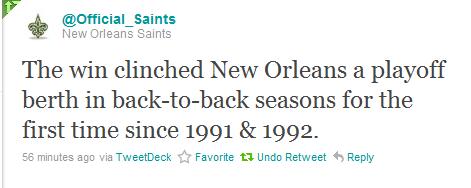
Just ONE MORE NAWLINS THANG: New Orleans Saints 17 – Atlanta Falcons 14. My home town continues to be the Great American Comeback Story.
So, what’s on your reading and blogging list today?
Tax Pandering is the Problem
Posted: December 13, 2010 Filed under: jobs, The Great Recession, the villagers, U.S. Economy | Tags: Kevin Drum, Mother Jones, voodoo economics 11 Comments So, now there’s a bunch of polls showing that the public basically approves of most of the tax cuts. yhe village chattering class (e.g Kevin Drum of Mother Jones)sees this as a sign of potential support for Obama and the Democrats.
To me, that’s about like polling on the question: Would you look a gift horse in the mouth? Of course, every one likes some change in their pockets. But at what cost? The polls aren’t asking that question. The one part of the tax deal that came out with a disapproval was the cut in payroll taxes. But, that’s the big Obama win, right? So, the villagers have to explain why EVERY one should just love that.
The explanation given by Drum is that every one is really dumb and thinks this will bankrupt social security because no one will pay into to it for a few years. He’s thinking people don’t see the promised government IOU. He’s got a list of how dumb he thinks we are about this and you’ll see it at the bottom of the post. So, now we do economic policy on polls? Can I get a witness that just because people like something doesn’t mean it’s good or wise policy? It doesn’t even mean that if they see the hamburger today, they’ll be willing to pay for its cost on Tuesday either. My guess is when the tab comes, there will be some unhappy polls then.
The major economic argument for this package is basically that you don’t raise taxes in a weak economy. That is basic Keynesian thought and it’s odd to see the entire Republican party joining hands and singing “We’re all Keynesians now”. A secondary argument is that any thing bartered away at this point is worth it because we extend long term unemployment benefits.
What you don’t see is a larger discussion of this all in terms of the economic situation and what is called for in these circumstances except in economist circles. This really worries me. Did you notice this ABC poll doesn’t ask people how they feel about giving cash subsidies to corn growers or the deal on equipment write offs? Those are also components of this tax giveaway. The poll also doesn’t ask people about what they think this will do to the deficit in the future and the cost of government borrowing. (Even Moody’s is threatening to downgrade our debt on the merits of this plan.) This poll basically asks, “Would you like more money in your pocket or not?” I can only image the naysayers like me either know their economics or they’re like me and not getting anything from this tax bill but the bill.
So, rather than listen to the failed lawyers who make up our policy decision=making class and the spoiled, rich little nitwits that write the punditry blogs in the MSM, let’s check out what some economists have to say. We’re going for three of them here. There will be four if you count me.
I linked down page on the morning reads thread to a blogger named Chevelle who was a government economist who now works at an asset management firm. She has a very good short piece up on why these tax cuts are a very “dumb” idea. Her basic analysis actually sounds a lot like Larry Summers’ parting shot in Time Magazine. Another similar voice can be read in the WSJ and comes from Nobel prize winning economist Joseph Stiglitz who calls for a second stimulus package that’s not tax cut loaded. The tax cuts may be politically popular but they don’t really take care of our problems right now. The money used for the tax cuts would be a lot more powerful and useful if it was targeted at the problem in the form of Government Expenditures. That’s what all three of them say in their commentary and that’s what I’m arguing for here. It’s your basic expenditure multipliers stuff from Economics 101.
We’ll start with Larry Summers who answers the question “what is holding the economy back?”. I’m actually beginning to think this parade of economists out of the West Wing door is ominous. This article just gives me more of those willies. Here’s the problems per LaLa.
• When unemployment has been above 9% for 19 straight months,
• When the job vacancy rate is at near record low levels,
• When 8 million houses and countless square feet of office and retail space sit empty,
• When capacity utilization in the nation’s factories and on its railways and highways is nearly as low as it has been in any period since the Second World War,
• There cannot be any question that the constraint on our economy now and for the next several years will be lack of demand.
I am under no illusion that increased demand alone is sufficient to restore America’s economic health, but it is an unquestionably necessary component of a full recovery.
Unfortunately, the approaches we have become used to over the last fifty years for supporting demand in a market economy are not open to us today.
Base interest rates cannot fall below their current level of zero.
And, in the face of excess capacity and excess debt, it is not clear that, even if they were possible, falling interest rates would be effective in convincing consumers and businesses to spend more.
That sounds a lot like what Stiglitz wrote too.
“The first stimulus package had too much emphasis on tax cuts. Those were relatively ineffective and not enough aid for the states,” Stiglitz told reporters on the sidelines of a seminar in Chile’s capital.
A new stimulus package should include a revenue-sharing program to make up for a shortfall in state revenue and should pick up the states’ investments that had to be stalled. Also, there should be a special focus on human capital, in particular on education and training, he said.
“We have to believe that the economy will eventually recover…[W]hat kinds of jobs will we want to have in five years…[W]e need to have people trained for that,” Stiglitz said.
Additionally, Stiglitz argued the U.S. Federal Reserve’s quantitative easing bond-purchasing program is creating an excess of liquidity, which is flowing into emerging-market nations.
Emerging-market economies such as Chile’s are growing at a much faster pace than the U.S. and have comparatively higher interest rates, making them attractive destinations for investors looking for higher returns.
According to Stiglitz, the $600 billion bond-purchasing program has created a large amount of “liquidity looking for relatively safe high returns” that aren’t found in the U.S. but can be found in many emerging-market nations.
As many emerging markets are trying to discourage capital inflows, “the liquidity goes to the places where they haven’t yet put barriers for the inflows,” Stiglitz told reporters.
Okay, now to blogger Chevelle from Models & Agents. She begins by explaining how most people are back on their life time budgets as measured by the PCE or Personal Consumption Expenditure/per employed person. It’s back to the lackadaisical pre financial crisis level. We actually all have a life time expenditures patterm that tends to be consistent over our lifetime. Some times we borrow and over spend a little. Other times we panic and save. Eventually, we get back to the mean. Employed people are at that now. It’s the unemployed that aren’t anywhere near their usual budget. This package does nothing about that.
That the problem with the economy is not that (employed) Americans don’t consume enough; it is that we have too many unemployed people who can’t consume, not even the basics. And this is my first reason why giving a tax gift to employed Americans is a completely dumb policy: Not only is it unfair to the unemployed; it is questionable whether those Americans with jobs and with comfortable cash positions are going to spend this tax gift, if they are already close to reaching their long-term consumption growth. So much for a “targeted”, “efficient” fiscal “stimulus”.
She also argues that we do face a potential government debt problem in the intermediate future and doing more dumb tax cuts is just going to exacerbate the problem down the road. That also has disturbing implications. Then, there’s the payroll tax cut. That’s what Kevin doesn’t grok.
What does the cut in the payroll tax do? If anything, it reduces labor supply. This is because employed workers could work fewer hours and still end up with the same amount of disposable dollars as before the tax cut. So, at the margin, they would reduce the hours they offer to work. (To throw a bit of jargon, the labor supply curve shifts to the left: i.e. less labor is offered for a given wage).
Now, this might (temporarily) close part of the labor supply-demand gap—i.e. reduce unemployment. But that’s a reduction for the wrong reason! What we really need is for unemployment to get reduced due to an increase in labor demand (ie policies to shift the labor demand curve to the right!). So, in theory, *if* the government had cash to spare, and *if* companies’ reluctance to hire were driven by a liquidity constraint, the appropriate policy response to raise employment (and thus, consumption, GDP growth and so on) would be to give a temporary cut in the employers’ portion of the payroll tax, not the employees’.
What she’s saying here is that a payroll tax cut is likely to make employed people work less hours, but it is unlikely to cause employers to hire more people. She also continues to explain the impact on long term borrowing for the government of doing this kick-the-can-down-the-road policy.
So, while Kevin Drum is excited about is that warm tingling leg feeling he gets speculating that if people like the policy that might make people like Obama and the Democrats a bit more now. Then, he can feel good about himself again as a Progressive (TM). What he’s really missing is that it’s going to make the situation worse that’s got people peeved at Obama and the Democrats now. It’s not even robbing Peter to pay Paul. It’s borrowing money from both Peter and Paul. It’s giving money to people who will most likely put it into places where it will go stimulate the economies of emerging markets. It’s not going to do much here at all.
What we’ve got going is a long term unemployment problem with all that implies, and as Larry Summers said, a long term consumption problem. The people who get this tax cuts aren’t going to change their spending behavior at all and that’s not going to help the economy. If anything, the money going to the rich will head off overseas quicker than a credit card call center. It’s going to add to the deficit which will create long term debt problems. It does nothing to ensure the long term unemployed will maintain marketable job skills and their ability to eat and stay in their homes. It does nothing to really stimulate buying where it possibly could help. It’s an expensive gesture and that’s about it.
The one thing good that came out of the Reagan years was that we learned that the shot gun approach to tax cutting is just not that effective in doing anything but increasing the deficit. Former Congressman Jack Kemp actually showed that some targeted tax cuts and targeted expenditures could actually make a difference. This is what led to the go-zones we see now in rural and urban places that were difficult to develop in the past. It showed that if you want to kill a big beast, it’s best you get a sharp shooter and the best rifle. The targeted approach is best. So, in this sense, even the Republicans are dooming us all to repeat their past mistakes instead of the few successes they actually delivered. The Democrats have forgotten the past altogether.
I find this very worrisome that we continue to see tax cuts put out by a Democratic administration that play right into that big old VooDoo economics myth. Kevin Drum just seems to miss that point. He thinks you’ll be able to head off the Republican hand wringing in the future. He thinks every one is stupid because this is a good deal for the middle class. The problem is that it isn’t and it just sets us up for worse things in the future. This package will fail worse than the first stimulus for many of the same reasons. Two years down the road, every one will be just as discouraged. Even Larry Summers sees that.
So, here’s the promised list of why Kevin thinks were all dummies who need skooling.
Possible answers: (a) people don’t really understand that cutting payroll taxes means they’ll see an immediate increase in their take home pay, (b) people associate payroll taxes so strongly with Social Security solvency that they don’t want to cut them, (c) people fantastically overestimate how likely they are to have a $5 million estate when they die, (d) lots of people have a strong instinctive view that people should be able to pass on their wealth to their kids no matter how much it is, (e) people are just generally confused about all this stuff and it’s hopeless to try and figure out what’s really going on.
In any case, I’ll say this again to wavering lefties who have suddenly decided that the tax deal is no good because the payroll tax cut will never be undone and Social Security’s finances will be decimated: yes,
Republicans will engage in their usual Democrats are raising your taxes! demagoguery when the tax cut expires next year, but no, it won’t be very effective. There are lots of good reasons for this, and this poll provides evidence for one of them: the public isn’t all that keen on cutting the payroll tax in the first place. They want Social Security fully funded, and that argument, in the end, will carry the day. Never underestimate the power of AARP.
So, Kevin, the deal is this. You’re putting the money into the wrong hands and you’re expanding the deficit in the future and probably making it more expensive for the government to keep putting money back into social security. Afterall, it’s just another government “IOU” to the Social Security Trust Fund. People haven’t liked the idea in the past. They don’t like it when the government ‘borrows’ from the trust fund and they don’t like it now. The Social Security Trust fund is invested in Treasuries. You know, those things Moody’s wants to down grade?
It makes no sense to help out people that don’t need it, borrow a ton of money that won’t really accomplish anything, and still come out with a bad economy two year down the road during the next election season. I really don’t think people are as confused as you are. It’s voodoo economics. It doesn’t make any difference if it’s the Republican or the Democratic brand on it. No one’s going to look a gift horse in the mouth. Still, to think anything good will come of any of this is just plain foolish.
What the Socialists just said …
Posted: December 12, 2010 Filed under: just because, The Media SUCKS, the villagers | Tags: Comrade Obama, democratic socialism., socialism 38 Comments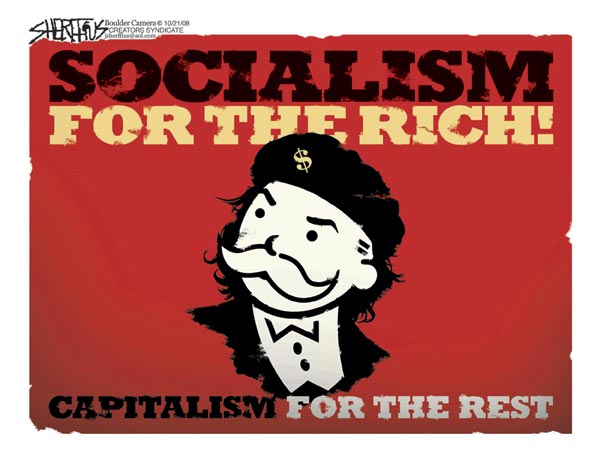 Well, here goes my shot at ever working again. I’ve not only proclaimed this week ‘I love Senator Bernie Sanders Week’, I’m going to quote the World Socialist Web Site and agree with socialist Barry Grey.
To be honest, the U.S. really doesn’t have an active Socialist movement or anything close to the socialist left in Europe let alone other places. WSWS is one voice of socialism. Glenn Beck and the Tea Party are regaling themselves as mainstream and the dude they’re reading these days thought President Dwight Eisenhower was a communist agent. If that’s the new normal, then, maybe I am a Marxist by that silly ruler. But, anyway, at the risk of being labeled a red, here we go.
Grey’s article talks about Progressive (TM) hand wringing over Obama’s supposed lurch to the right. There was no lurching involved imho. Obama is just one of those pols that says one thing and does another. I frankly have no idea what he actually thinks. So, the fun part of this blog post is reading Grey dissect what is “more repugnant”, the villager’s “stupidity or their cynicism”. Grey cites a bunch of whiny, disillusioned villagers in the process. He identifies their central theme as:
The general theme of these commentaries—amidst the pleading, scolding and whelps of despair—is that Obama must reclaim his “core values” and start fighting the Republican right. It is summed up by Adam Green, co-founder of the Progressive Change Campaign Committee, who writes: “At this point, the strategy is to shame [Obama] into fighting.”
So, this is my first issue. I just was talking to BB earlier and I personally believe that Obama has no “core values’. He just says what’s expedient for the moment that gets him where he wants to be. He’s like the ultimate pragmatist; whatever works for the moment. I even wrote a post to that effect years ago here that accused Obama of always “doing the chameleon”. It’s his past MO that convinced me of this two years back. There are way too many ‘present’ votes in the Illinois legislature and tales of Obama hiding in the bathroom to avoid votes for there to be evidence that he’ll fight for anything other than a chance to get to higher office in a shorter period of time. He seems to have joined and ditched groups–ask Jeremiah Wright–more for the connections than for the higher purpose. As my post notes, he flip flopped all over the place during 2008. Why should we expect anything different?
The article cites lots of examples of villagers looking for Obama redemption.
Among the notable examples of such lamentations is Frank Rich’s column in the December 5 New York Times, which makes the tongue-in-cheek suggestion that Obama has been taken hostage by the Republicans and his behavior is best explained by reference to the Stockholm Syndrome.
Rich writes: “The captors will win this battle [over extending Bush-era tax cuts for the top 2 percent of US households], if they haven’t already by the time you read this, because Obama has seemingly surrendered his once-considerable abilities to act, decide or think.”
Liberal economist Paul Krugman, in a December 2 New York Times column written in response to Obama’s announcement of a two-year freeze on federal workers’ pay, is harsher:
“After the Democratic ‘shellacking’ in the mid-term elections, everyone wondered how President Obama would respond. Would he show what he was made of? Would he stand firm for the values he believes in, even in the face of political adversity?…
“It’s hard to escape the impression that Republicans have taken Mr. Obama’s measure—that they’re calling his bluff in the belief that he can be counted on to fold. And it’s also hard to escape the impression that they’re right.”
David Corn, the Washington bureau chief of Mother Jones and a columnist for PoliticsDaily.com, writes, more in sorrow than in anger:
“President Obama, in the instance of this apparent tax cut compromise, seems to be settling without waging a principle-driven battle, and that is puzzling many of his progressive loyalists… His reasons for eschewing a showdown remain a mystery… A deal like this … will drive many progressives crazy, for they’re looking to Obama to lead a charge against the Republicans, not yield to their threats.”
Michael Lerner, the editor of Tikkun, suggests that the best way to “get Obama to become the candidate whom most Americans believed they elected in 2008” is to challenge him from the left for the Democratic presidential nomination in 2012. The idea is not to defeat the incumbent, but to “pressure Obama toward much more progressive positions and make him a more viable 2012 candidate.”
As Eleanor Clift notes in Newsweek, “MoveOn.org is running ads with the theme ‘Bring Obama Back,’ calling on the president to ‘be the president we fought to elect’ and to hold firm on his promise to end tax breaks for the richest Americans… It’s a chance to reclaim his convictions, and Obama should seize it.”
Katrina vanden Heuvel, editor and publisher of the Nation, bemoans “Obama’s Disastrous Path” in her December 7 column in the Washington Post. Defining herself as a “progressive supporter” of Obama, she lists the president’s right-wing moves since the mid-term election debacle, ranging from his abject apologizing to the Republicans to effectively abandoning his July 2011 date for beginning to withdraw troops from Afghanistan.
Vanden Heuvel objects to Obama’s leaning toward the notion that “we should impose austerity now, instead of working to get the economy going.” The operative word here is “now,” as it implies her agreement with the official line of the administration that whether sooner or later, austerity must be imposed.
Absurdly inflating Obama’s stature, she declares: “This president has a historic mandate. Just as Abraham Lincoln had to lead the nation from slavery and Franklin Roosevelt from the Depression, this president must lead the nation from the calamitous failures of three decades of conservative dominance.”
This, she continues, “is the necessary function of a progressive president… If he shirks it, [Obama] risks a failed presidency.”
I still don’t know what some of these people have been smoking or drinking. I don’t see anything in Obama’s past history that would give me the impression he would wage a “principle-driven battle” on anything. He says he supports GLBT rights and then he shows up with some of the most notorious homophobic religious nuts in the country and expands their role in ‘faith driven’ government GOTV grants. He doesn’t appear to be using his bully pulpit or his pen to remove DADT. The most he appears to be doing is a few symbolic finger waggings. He says he supports a woman’s choice on reproductive health and then immediately sells every women’s uterus to the Stupakistan terrorist groups to drive through Romney/DoleCare; the healthcare reform that was less liberal than Richard Nixon’s plan. He says he doesn’t support War or torture, but then sends Holder on an endless mission to defend the Dubya policies and people at every turn.
What core values? What principled actions?
I even read an Ismael Reed Op-ed this morning that says that Obama can’t afford to get angry without being tagged a militant black man. Was any one ever intimidated or upset when Steven Urkel got really mad? Even the Steven Urkel character had scripted moments when he took principled stands. No one wrote any thing about intimidation into the script and TV scripts love stereotypes. We can’t get a little righteous anger from our Nerd-in Chief?
Better questions come from Grey:
They all proceed from the premise that Obama is a “progressive.” Why? On what basis? There is nothing in his political career either before or after his election that suggests anything other than a conventional—i.e., right-wing—American bourgeois politician.
In the end, they brand Obama a progressive on the grounds that he is Democrat and an African-American. Here on full display is the political bankruptcy of the rejection of social class as the basic criterion in politics and its replacement by race and other forms of personal identity.
Yes, yes, yes. That is it. (Well, except I wouldn’t call him an “American bourgeois politician” since I really am not a socialist by nature.) The richest among us slice and dice us into neat little angry groups of Tea Partiers and New Black Panthers so that we get more mad at the idea of Raj in Bangalore taking a job or the idea that civil rights can cause ‘reverse discrimination’ against white men or that we’re being invaded by Mexicans who are driving all of our wages down or all white people are natural born racists. It’s all the poison flowers of the same ugly little divide and keep them in corporate serfdom seeds.
Continue on with Grey. He’s so worth reading.
What are the “core principles” that Obama has supposedly abandoned and must now reclaim? The only principles he has evinced are the defense of the global interests of US imperialism and the wealth and power of the American financial aristocracy. Aside from occasional cheap demagogy, he has shown nothing but indifference and contempt when it comes to the American people.
The apotheosizing of Obama by this political milieu is ultimately a function of their own social being. They represent a very privileged, comfortable and complacent layer of the upper-middle class, and their pro-Obama, pro-Democratic Party politics reflects very real, material interests—interests that are sharply at odds with those of the working class.
One need only ask, in precisely what does their “progressiveness” consist? They do not advocate serious social or political reforms, let alone socialist policies. On the contrary, they tenaciously uphold a political system dominated by two utterly corrupt and reactionary parties of the American plutocracy.
They do not, for the most part, even call for an end to the US wars of aggression that are killing hundreds of thousands and destroying entire societies in the Middle East and Central Asia.
The people who are writing these words are–as Grey writes–writing from the comfort of their own social being. Dana Millbank and the other villagers are the constituents defending the Obama tax cave-in because they will be some of the few beneficiaries. Check out this FDL Diary from Blue Texan and check out the comments. You can check out more on this vapid Dana Millbank column at Economist’s View. Krugman, Thoma, and Dean Baker all take a punch at Millbank who just loves him some hippy punching. Krugman has a statement about the topic here too.
So look at how the Village constructs its mythology. The real story, of pretend moderates stalling action by pretending to be persuadable, has been rewritten as a story of how those DF hippies got in the way, until the centrists saved the day.
The worst of it is that I suspect Obama’s memory has gone down the same hole.
Grey states it eloquently.
What really upsets them about the crass manner in which Obama prostrates himself before the Republicans and Wall Street is how thoroughly it exposes their own role in promoting him and aiding the marketing campaign that was used to get him elected. They are terrified that their political dog and pony show built around Obama has so quickly and ignominiously collapsed.
So, this is what REAL socialists say about Obama. Actual socialist thought is not the Glenn Beck/Rush Limbaugh fantasy philosophy that scares working class whites into seeing brown people as the threat. It’s not found at all in progressivism (TM) that has warped like some magical Madison Avenue Marketing brand enshrouding Obama and the village into enabling the misguided notion that it’s only white men that can prevent liberty and justice for all. Ultimately, socialism asks people to look at how the very rich and the very powerful use divisive tactics to stop us little people from realizing who is taking the fruits of our labor from us. Even if you aren’t a socialist, this is an exercise worth entertaining. Now, comrades, have fun with those links!!!

 peej
peej Carissa
 bostonboomer
 dakinikat
 ecocatwoman
 mablue2
 Mama Lopez
 peggysue22
 quixote
 skydancingguestblogger
 Mona (aka Wonk the Vote)



 Sky Dancing
Recent Comments