
Fed Continues to Subsidize the Bonus Class
Posted: August 3, 2009 Filed under: Equity Markets, Global Financial Crisis, The Bonus Class, The Great Recession, U.S. Economy | Tags: arbitraging government debt, bonus class, Federal Reserve, Financial Times., high volume trading Comments Off on Fed Continues to Subsidize the Bonus Class I’m again relying on the Financial Time’s for this latest bit of no suprises here. The big question is when will the political class pull the rug out from under the bonus class?
Wall Street banks are reaping outsized profits by trading with the Federal Reserve, raising questions about whether the central bank is driving hard enough bargains in its dealings with private sector counterparties, officials and industry executives say.
The Fed has emerged as one of Wall Street’s biggest customers during the financial crisis, buying massive amounts of securities to help stabilise the markets. In some cases, such as the market for mortgage-backed securities, the Fed buys more bonds than any other party.
However, the Fed is not a typical market player. In the interests of transparency, it often announces its intention to buy particular securities in advance. A former Fed official said this strategy enables banks to sell these securities to the Fed at an inflated price.
The resulting profits represent a relatively hidden form of support for banks, and Wall Street has geared up to take advantage. Barclays, for example, e-mails clients with news on the Fed’s balance sheet, detailing the share of the market in particular securities held by the Fed.
“You can make big money trading with the government,” said an executive at one leading investment management firm. “The government is a huge buyer and seller and Wall Street has all the pricing power.”
Let me be clear that the Fed is not a government agency. It makes profits each year from services it provides banks and returns those profits to the Treasury. The Treasury uses the Fed as its agent for a few services but the Fed is a central bank, the bank of bankers. It is not part of the Treasury per se. However, even with that being said, this news continues to be disturbing. Wall Street is gaming the Fed because they can. These things are monopoloy/oligopoly behaviors and we have laws against them!
Barney Frank, chairman of the House financial services committee, said the potential profiteering may be part of the price for stabilising the financial system.
“You can’t rescue the credit system without benefiting some of the people in it.” Still, Mr Frank said Congress would be watching. “We don’t want the Fed to drive the hardest possible bargain, but we don’t want them to get ripped off.”
The growing Fed activity has coincided with a general widening of market spreads – the difference between bid and offer prices – as the number of market participants declines. Wider spreads enable banks, in their capacity as market-makers, to make more profit.
Larry Fink, chief executive of money manager Black Rock, has described Wall Street’s trading profits as “luxurious”, reflecting the banks’ ability to take advantage of diminished competition.
“Bid-offer spreads have remained unusually wide, notwithstanding the normalisation of financial markets,” said Mohamed El-Erian, chief executive of fund manager Pimco in Newport Beach, California.
Spreads narrowed dramatically during the years of the credit bubble.
Brad Hintz, an analyst at Alliance Bernstein, said he doubted that spreads would ever return to those levels, a development that could be pleasing to the Fed.
“They want to help Wall Street make money,” he said.
I’m trying to think why any one would want Wall Street to make huge profits by arbitraging what is basically government debt. Why, in the face of this situation, would Congressman Barney Frank make a lame comment like that? Any one have any suggestion? Read the rest of this entry »
In Search of a Trough
Posted: July 31, 2009 Filed under: Global Financial Crisis, The Great Recession, U.S. Economy | Tags: BEA, GDP, job markets, jobless recovery, minimum wage, Real economic Growth, wages Comments Off on In Search of a Trough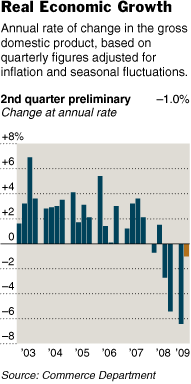 The U.S. economy still shrank in second quarter 2009 but at a much lower pace than was anticipated. That’s a pretty good indicator that the bottom or trough of The Great Recession may be near. Here’s the precise release from the Bureau of Economic Analysis (BEA).
Real gross domestic product — the output of goods and services produced by labor and property located in the United States — decreased at an annual rate of 1.0 percent in the second quarter of 2009, (that is, from the first quarter to the second), according to the “advance” estimate released by the Bureau of Economic Analysis. In the first quarter, real GDP decreased 6.4 percent.
While the many recent indicators show the recession is loosing some of its downward momentum, there are few economists ready to sing Happy Days are Here Again. The NYT’s coverage of the statistical release continues to bring up some of the same concerns we’ve discussed here before.
The economy’s long, churning decline leveled off significantly in the second quarter, as stock markets started to recover, corporate profits bounced back, housing markets stabilized and the rampant pace of job losses tapered off. Declines in business investment leveled off, and the economy was aided by big increases in government spending at the federal, state and local levels.
“We’re in a deep hole, and now we’ve got to dig ourselves out of it, which is a very difficult task,” Diane Swonk, chief economist at Mesirow Financial, said.
But consumer spending fell by 1.2 percent as Americans put more than 5 percent of their disposable income into savings. Economists are concerned that consumer spending, which makes up 70 percent of the economy, will not rebound as long as employers keep cutting jobs and trimming wages.
All Eyes on Ben
Posted: July 27, 2009 Filed under: Bailout Blues, Global Financial Crisis, The Great Recession, U.S. Economy | Tags: Ben Bernanke, Dennis Kucinich, Federal Reserve Bank, Nouriel Roubini, PBS News Hour, Regulating the FED, Ron Paul, ZIRP Comments Off on All Eyes on Ben I’ve been Fed watching again. That’s something of both an occupational hazard and a weirdish hobby for me. Usually, Fed chairs stay off the lecture circuit until they retire and write their biographies. Ben Bernanke, however, is not your usual Fed Chair and these are not usual times. I think you may recall that part of his observations with being in charge of monetary policy when there’s no room drop interest rates (ZIRP) has to do with communicating future Fed actions to a nervous public. This continues.
Bernanke was in Kansas City over the weekend speaking to normal people and Jim Lehr of the PBS program News Hour. There were several things from this exchange worth mentioning. The first is a response to the meme circulating around the libertarian circuit that there is no accountability between the FED and any one in Washington. That is untrue for several reasons. First, because the majority of appointments (including the Fed Chair) to the FOMC are made by POTUS and approved by the Senate. Second, the Fed Chair makes biannual trips to the Hill to speak with both houses of Congress and take questions. Third, they publish their internal records as well as their research continually. It’s a matter of public record. The only thing Congress doesn’t get to see is the rationale behind monetary policy which is perfectly in keeping with the idea of independence supported overwhelmingly by evidence and theory. They have to the right to see the Fed balance sheet and items now. What they do not have is the right to ‘audit’ monetary policy. Something that would be a disaster.
“The Federal Reserve, in collaboration with the giant banks, has created the greatest financial crisis the world has ever seen,” Representative Ron Paul, Republican of Texas, said at a House hearing last week in which Mr. Bernanke testified about the state of the economy.
Republican lawmakers portray the Fed as the embodiment of heavy-handed big government, and have called for scaling back the central bank’s regulatory powers. But liberal Democrats, like Representative Dennis J. Kucinich of Ohio, have accused the Federal Reserve of caving in to demands by banks for huge bailouts, for failing to protect consumers against dangerous financial products and for being too secretive about its emergency rescue programs.
More than 250 lawmakers have signed a bill sponsored by Mr. Paul that would allow the Government Accountability Office to “audit” the Fed’s decisions on monetary policy — a move that Fed officials see as a direct threat to their political independence in carrying out their central mission of setting interest rates.
A lot of the complaints at the appearance came from the audience who basically aired Kucinich’s view that the Fed appeared all too willing to bail out the reckless big guys while letting the little guys go belly under. Bernanke did not shy away from the questions at all.
When a small-business owner asked Mr. Bernanke why the Fed helped rescue big banks while “short-changing” small companies, Mr. Bernanke answered that he had decided to “hold my nose” because he was afraid the entire financial system would collapse.
“I’m as disgusted by it as you are,” he told the audience of 190 people. “Nothing made me more angry than having to intervene, particularly in a few cases where companies took wild bets.”
He used a most interesting metaphor when explaining why he had to hold his nose and bail out the gamblers. He basically said, if an elephant falls it crushes the grass beneath it. Wow, a zen moment from a Fed Chair. Who’d have thought that was possible? He also said that the main reason he did it was because he didn’t not want to be the Fed Chair at the time of the second Great Depression. I’d say that was succinct enough.
Keyboard Cat plays off Okun’s Law
Posted: July 23, 2009 Filed under: Team Obama, The Great Recession, U.S. Economy | Tags: GDP growth, Okun's law, unemployment Comments Off on Keyboard Cat plays off Okun’s Law
I’ve been teaching Okun’s Law in my principles level Macroeconomics courses since 1980. It’s been the policy rule of thumb since the Kennedy years on how much GDP needs to change to get a movement in the unemployment rate. Here’s the Wiki explanation which is as good as any.
In economics, Okun’s law is an empirically observed relationship relating unemployment to losses in a country’s production. The “gap version” states that for every 1% increase in the unemployment rate, a country’s GDP will be an additional roughly 2% lower than its potential GDP. The “difference version” describes the relationship between quarterly changes in unemployment and quarterly changes in real GDP. The accuracy of the law has been disputed. The name refers economist Arthur Okun who proposed the relationship in 1962 (Prachowny 1993).
I’ve mentioned recently that we’re seeing some fundamental changes in that relationship. This WSJ article talks more about how we’re breaking away from the historical pattern studied by Okun back in the 1960s. This has incredible ramifications for fiscal policy makers. Again, I think the Obama economic advisers appear to be ignoring some really important changes in the fundamentals. We’re much more oriented towards imports, service jobs, and capital than we were back in the Camelot days.
Monetary Policy at the Zero Bound
Posted: July 21, 2009 Filed under: Global Financial Crisis, The Great Recession, U.S. Economy | Tags: Ben Bernanke, FED, Fed Independency, monetary policy, quantitative easing, Zero Bound, ZIRP Comments Off on Monetary Policy at the Zero Bound I am a financial economist and I’ve been through most phases of my career one that applies the trade in banking. That’s because my first economics specialty was monetary economics. I still have my original copy of Patinkin’s Money, Interest and Price sitting next to my dad’s original copy of Keyne’s The General Theory of Employment, Interest and Money. My grandfather was one of the first Fed lifer’s having been in charge of the bond area in the Kansas City District for both world wars. My ex-husband’s first job out of college was with that Fed. I worked for the Atlanta District Fed before retreating back to academia. So, in this day and age, with all the unpopularity that entails, I have to confess to being a banker of sorts. I hope you won’t hold that against me.
Today, there is more evidence that this is not my Grandfather’s Fed and it’s not completely the Fed I worked for either during the Greenspan years. When I was there, the emphasis was consolidating functions to various branches and realizing that check clearing and wire transfers, the main source of revenues for the branches, were being taken up by big money center banks and clearing houses. Clinton was President and the economy was good so there wasn’t much dithering about the technical things done up there at the desk in NYC. I just had my staff transmit the bond sells every Tuesday (even on Mardi Gras) dutifully.
Much consolidation has taken place and many traditional Fed services have been privatized. Oh, and then there’s that one other difference, Ben Bernanke and his realization that traditional monetary policy is pretty useless when interest rates are close to zero. Welcome to the world of Monetary Policy at the Zero Bound which is actually something we talked about last fall. I’m going to point you again to Ben Bernanke’s treatise again because it explains a lot of what we’re going to discuss. It’s written for wonks, but if you read the first few pages, you’ll get the basic idea.
The Fed’s upcoming retreat from its current position has been a topic of much discussion and speculation. That’s because every one has some concern that they will be accommodating for way too long and it may lead to another Bubble or to general inflation (instead of price increases in a specific market like housing). That’s pretty much the consensus of what happened post 9/11 when Greenspan left interest rates extremely low and we developed a speculation crazed housing market. For some reason, he popped the bubble of excessive exuberance during the Clinton years and the Tech stock run-ups, but let the mortgage market baste in low interest rates for way too long. My guess is that he was more accommodating to Republicans because he himself was one of them, but that’s a discussion for his biographer and just a source of speculation for me.
So, Ben used his platform as the second most powerful man in the US today to reduce the information asymmetry surrounding the Fed’s exit strategy. Again, if you check the link to his academic paper above, you’ll see that’s one of the things he believes is necessary when monetary policy hits the zero bound. He basically calls this “using communications policies to shape public expectations about the future course of interest rates” and that’s exactly what he’s doing in today’s Op-Ed piece in the WSJ.
I’m not sure how many people wrote and edited this piece, but it is a brilliant discourse that explains in a very succinct and clear way what the FED will do in the coming recovery to ensure that we won’t get inflation. He also reassures that they won’t reverse the course of any improvement either as was done in 1937 to cause a double dip depression. This Op-ed is historic in nature, although I’m sure only those of us steeped in Fed lore, culture and history will realize what’s going on here. Ben is opening up the some what secret world of the Federal Open Market Committee (FOMC) to those with the need to know.

 peej
peej Carissa
 bostonboomer
 dakinikat
 ecocatwoman
 mablue2
 Mama Lopez
 peggysue22
 quixote
 skydancingguestblogger
 Mona (aka Wonk the Vote)



 Sky Dancing
Recent Comments