
We come now to bury Supply Side Economics
Posted: July 25, 2010 Filed under: Team Obama, The Bonus Class, The Great Recession, The Media SUCKS, U.S. Economy, Voter Ignorance | Tags: voodoo economics, why things were so good during the Clinton years Comments Off on We come now to bury Supply Side EconomicsI’ve been having a major hissy fit about the extraordinary bad policy measures proposed and undertaken by Republicans for sustaining tax cuts and deficits for as long as I can 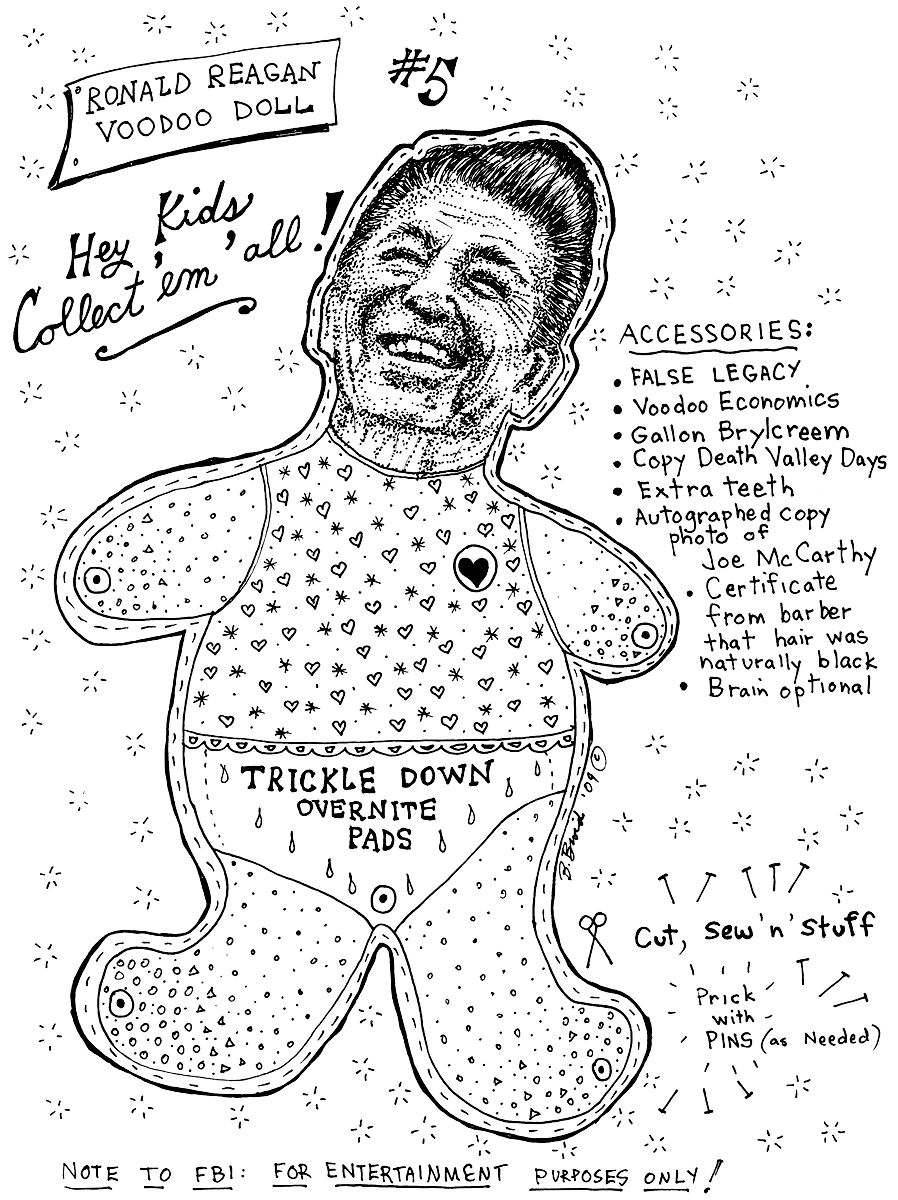 remember. The deal is, however, nobody likes it when you tell them they can’t have a free lunch when Ronnie Raygun repeated it ad infinitum. That is very much how the Republicans have achieved political victory since the Reagan years. Basically, they promise to cut taxes no matter what the circumstances and spend money on every military adventure and toy that comes down the pike and chock it up to preserving American exceptionalism. Ronald Reagan and Dubya Bush are responsible for the deficit today and the people that benefited from their tax cuts–and voted for them–should be asked to clean up the mess.
I was ever so pleased to read this article by FT’s Martin Wolf that recognizes ‘supply-side economics’ for what it is. It has nothing to do with a good economy and has everything to do with good politics. It’s a policy of promising and delivering everything and then screaming about the huge bill when a Democrat is in office. Every 8 years or so they do one huge Dine and Dash on the country. Wolf realizes this and basically calls Dubya’s tax cuts “massive, irresponsible, and unsustainable”. He also rightly calls the Reagan years for what they were. Reagan was a premier example of Keynesian policy. Ronald Reagan spent us out of the recession of the early 1980s. The only thing that was supply side about it was the high supply of bull shit rhetoric that went along with it. Some one needs to correct the message.
Ronald Reagan was the country’s premier Keynesian. Then Bill Clinton got into office and led us to a very long,very good business boom by doing what Keynes said to do during that time. You only deficit spend when the economy sucks. It had improved by the beginning of the 1990s. Bill Clinton was frugal. I can never forget the day that Dubya/Cheney looked at those surpluses they inherited and Cheney said, deficits don’t matter, Reagan showed us that. Then they immediately started two wars and gave away the Treasury to every corporation and rich person in the country. It’s damn ironic now that every Republican and Blue running Dawg thinks deficits matter. This is the time when we need them. We should’ve paid more attention to them like five years ago. But Cheney of no heart has brass balls and a spine. If only we had a Democrat in elected office with spine and balls.
Anyway, here’s Wolf’s nutshell description of supply side economics. It’s a good one.
To understand modern Republican thinking on fiscal policy, we need to go back to perhaps the most politically brilliant (albeit economically unconvincing) idea in the history of fiscal policy: “supply-side economics”. Supply-side economics liberated conservatives from any need to insist on fiscal rectitude and balanced budgets. Supply-side economics said that one could cut taxes and balance budgets, because incentive effects would generate new activity and so higher revenue.
The political genius of this idea is evident. Supply-side economics transformed Republicans from a minority party into a majority party. It allowed them to promise lower taxes, lower deficits and, in effect, unchanged spending. Why should people not like this combination? Who does not like a free lunch?
How did supply-side economics bring these benefits? First, it allowed conservatives to ignore deficits. They could argue that, whatever the impact of the tax cuts in the short run, they would bring the budget back into balance, in the longer run. Second, the theory gave an economic justification – the argument from incentives – for lowering taxes on politically important supporters. Finally, if deficits did not, in fact, disappear, conservatives could fall back on the “starve the beast” theory: deficits would create a fiscal crisis that would force the government to cut spending and even destroy the hated welfare state.
In short, Republicans chose one side of Keynesian economics–the side that uses government spending or tax cuts to spur an economy that should be used only during recessions–and applied it like the apple cider vinegar of economic policy. One spoonful of tax cuts fits all! Decades of data have shown economists that that is the farthest thing from truth, however, the political windbags of the right have managed to continue the charade that every one can have everything and not pay for it as long as we just cut taxes. (That is until a democratic president takes office). It’s like saying 1 + 1 = 4. Problem is that many people still buy that. It’s like thinking there were Dinosaurs in a literal Garden of Eden.
The truth is that tax cuts NEVER pay for themselves. Even one of Dubya’s advisors has said as much.
Indeed, Greg Mankiw, no less, chairman of the Council of Economic Advisers under George W. Bush, has responded to the view that broad-based tax cuts would pay for themselves, as follows: “I did not find such a claim credible, based on the available evidence. I never have, and I still don’t.” Indeed, he has referred to those who believe this as “charlatans and cranks”. Those are his words, not mine, though I agree. They apply, in force, to contemporary Republicans, alas,
Since the fiscal theory of supply-side economics did not work, the tax-cutting eras of Ronald Reagan and George H. Bush and again of George W. Bush saw very substantial rises in ratios of federal debt to gross domestic product. Under Reagan and the first Bush, the ratio of public debt to GDP went from 33 per cent to 64 per cent. It fell to 57 per cent under Bill Clinton. It then rose to 69 per cent under the second George Bush. Equally, tax cuts in the era of George W. Bush, wars and the economic crisis account for almost all the dire fiscal outlook for the next ten years (see the Center on Budget and Policy Priorities).
The Democratic leadership must get out ahead of this misleading set of facts and stories. It doesn’t help that they are also adding to the confusion by dissing the Clinton/Gore economic record. Indeed, if any of them would ever get around to reminding the public how good they had it in the 90s, the message would go far. I also remember the Reagan Years. My first house loan came with an interest rate of %16.7. Both my exhusband and I lost our first jobs out of college because of a bad economy. I lost my job at a huge S&L that went bankrupt. He lost his at the Federal Land Bank because of the bad ag economy. The Reagan period was not morning again in America and the Democrats need to step up the game to remind people of that.
Why is it that the Republicans so clearly and convincingly get people to buy the snake oil and the Democrats can event manage to agree on a coherent message? Of course, it would help if they’d stuff that dead racoon of a hairmet in Senator Ben Nelson’s mouth every time he goes rogue, but it would also help if they mentioned how everything was just fine during the Clinton years.
Here let me remind you. The unemployment rate hit a 30 year low in 1999. It was 4.2% and it was low for all groups including

Find the good trend.
blacks, women and hispanics. (It was 7.3% when he took office). From 1993 to 1999, the economy added 20.4 million jobs. There were also increases in blue collar jobs like construction.
20.4 Million New Jobs Created Under the Clinton-Gore Administration. Since 1993, the economy has added 20.4 million new jobs. That’s the most jobs ever created under a single Administration – and more new jobs than Presidents Reagan and Bush created during their three terms. Under President Clinton, the economy has added an average of 245,000 jobs per month, the highest of any President on record. This compares to 52,000 per month under President Bush and 167,000 per month under President Reagan.
92 Percent — 18.8 Million — of the New Jobs Have Been Created in the Private Sector. Since President Clinton and Vice President Gore took office, the private sector of the economy has added 18.5 million new jobs. That is 92 percent of the 20.4 million new jobs – the highest percentage since Harry S. Truman was President and presiding over the post-World War II demobilization.
We had the fastest and the longest Real Wage growth in two decades. Inflation was the lowest it had been since the 1960s.
Under President Clinton, real wages are up 6.5 percent, after declining 4.3 percent during the Reagan and Bush years. Real wage growth in 1998 reached 2.6 percent — the largest increase since 1972.
Okay, so now, tell me. What policies were highly successful? Which policies lead us to peace and prosperity? Why aren’t we seeing the Democrats today try to reinvigorate the policies of Clinton/Gore instead of putting through legislation that comes from the Heritage Foundation? Why are they even dicking around the Republicans at this juncture?
The Obama apologists wonder why Obama–the greatest things since FDR?–is not getting due credit for all these massively huge bills that his congressional chorus line has passed. Well, it’s the economy stupid! First things should’ve been put first. We got a half assed stimulus bill the same way we now have assed financial reform and half assed health insurance reform. If he’d have put all of his political capital into solving the country’s economic problems (JOBS) first, he’d have had enough to run the gambit on the rest. And I would be willing to bet you we wouldn’t have to wonder why a bunch of half-baked Heritage Foundation plans got implemented under a Democratic presidency and majority.
What is so wrong with so many people that they can’t just point to the Clinton years and say, let’s just do that again? Of all things, why can’t the Democrats take and sell that message seriously?
Where have all the Consumers Gone?
Posted: July 8, 2010 Filed under: The Bonus Class, The Great Recession, U.S. Economy Comments Off on Where have all the Consumers Gone?We talk about this often. As a matter of fact, it was just yesterday we were talking about the failure of Reaganomics or so called  “Trickle Down” economics. (More aptly called VooDoo economics by the first President George Bush.)
kc, on July 7, 2010 at 10:37 pm Said: Edit Comment
thanks–would it be accurate to say that trickle down doesn’t work well because the rich already have consumer goods so they could save it.??
dakinikat, on July 8, 2010 at 7:17 am Said: Edit Comment
Well, supposedly the residual goes into investments which go to create well paying jobs which the rest of us get. However, that link is weak link. Especially with so many corporations moving their capital investments out of the country or having major operations elsewhere. In order for it to create jobs, the money has to stay put in the community and there’s no guarantee it will. Also, a lot of profits these days are just arbitrage profits that create no value. If you don’t direct the dollars to long term investment the money can go anywhere.
Robert Reich has a great blog post up today that gives you some perspective on what happens to our consumption driven society when only the few rich people get the income gains. The income doesn’t go to driving the economy, it goes to driving asset bubbles and in the two cases he talks about, that leads to some pretty bad economics results. Reich says that “We’re in a Recession Because the Rich Are Raking in an Absurd Portion of Wealth: Our economy can’t thrive when the richest 1% get an ever larger share of the nation’s income and wealth, and everyone else’s share shrinks.”
The end of the Hoover years and the end of the Dubya years brought as big increases in income inequality. What was the result?
Each of America’s two biggest economic crashes occurred in the year immediately following these twin peaks—in 1929 and 2008. This is no mere coincidence. When most of the gains from economic growth go to a small sliver of Americans at the top, the rest don’t have enough purchasing power to buy what the economy is capable of producing. America’s median wage, adjusted for inflation, has barely budged for decades. Between 2000 and 2007 it actually dropped. Under these circumstances the only way the middle class can boost its purchasing power is to borrow, as it did with gusto. As housing prices rose, Americans turned their homes into ATMs. But such borrowing has its limits. When the debt bubble finally burst, vast numbers of people couldn’t pay their bills, and banks couldn’t collect.
You can’t have an economic machine driven by consumption and then turn the switch over to people who have so much money that all they do is speculate. It just doesn’t work. If you want long term real investment, then you have to ensure that the investment dollars are going to things of real value. A good example of something of real value is a factory that employs people that have to pay for houses, groceries, clothing and transportation. Every dollar of a well earned wage trickles outward to a community. Putting all your investment eggs into derivatives does nothing to support long term growth. Taking all the income from productivity coming from the people that work and giving it to people that just simply want to drop a few dimes in a stock that might go up like a BP oil gusher does not create customers for businesses. Customers are what businesses need to grow. No amount of tax cuts or cheap credit will expand a business that doesn’t see customers coming in the door. Also, there’s a real good chance a lot of these people–and the corporations in which they invest–offshore their wealth anyway so there’s no guarantee that it stimulates our economy. Although, if you check it out, you’ll see that the richest countries in the world are those small countries that are depositories and shelters of offshore funds. These are the little countries that banking and no taxes built like The Grand Caymans, Guernsey, Bermuda, etc.
Anyway, Robert Reich does a very good job pointing to how we let our government leaders recreate the environment of the 1920s and how by only a little finesse and a lot of liquidity by the Fed stopped us from going over the edge into another period where unemployment was 25% instead of 10%. What I worry about is that the current leaders seem to be recreating the second dip of the Great Depression also. Remember, the two BIG recessions since World War 2 happened when you’ve had people who sincerely believe in the Trickle Down hypothesis. It frightens me that we have a President who admires Ronald Reagan and has continued Dubya Bush Policies. (Here’s another great link to Brad DeLong’s Blog who has similar worries. The piece is called “These are NOT the Ones We have been waiting for”. No kidding!) If we do have a double-dip, it will be because of all this austerity nonsense. We really don’t need any more lessons from Voodoo Economics. We’ve had enough to traumatize several generations and put a lot of people into unemployment hiatus.
Perspective
Posted: March 5, 2010 Filed under: Bailout Blues, Global Financial Crisis, The Bonus Class, The Great Recession, U.S. Economy | Tags: Financial Crisis, securitization, Subprime market, unemployment 1 Comment The WSJ has an interesting list of folks contributing to “Academics on What Caused the Financial Crisis“. You’ll find a lot of the usual suspects that we’ve talked about around here. There’s some interesting comments on the housing and subprime bubbles, the increased use of exotic financial instruments, and our old friend moral hazard. I’m going to a highlight just a few for you.
Some of the more interesting comments focused on how the housing bubble was enabled by government. Some blame low interest rates by the FED, others see that it wasn’t just a U.S. phenomenon and look for bigger reasons. Many folks see securitization and the pass-the-trash loan model as the big factors.
Dwight Jaffee, Haas School of Business, University of California at Berkeley
On the government’s role in creating the housing bubble: “I find the GSEs [government sponsored enterprises including Freddie Mac and Fannie Mae] to have been a significant factor in expanding the mortgage crisis as a result of their high volume of high-risk mortgage purchases and guarantees. Furthermore, I find that the GSE housing goals for lending to lower-income households and in lower-income regions were secondary to profits as a factor motivating the GSE investments in high-risk mortgages.
…
Christopher Mayer, Columbia Business School
On the housing bubble: “For the housing market, the picture is much more complex than it might first appear. The housing bubble was global in nature and also included commercial real estate, so simple explanations that rely solely on predominantly American institutions like subprime lending or highly structured securitizations cannot be the only factor leading to real estate market excesses. …My own research shows the important role played by declining long‐term, real interest rates in helping drive real estate prices to high levels, at least up to 2005. However, at some point, speculation by both borrowers and lenders took over, leading to excessive appreciation in many parts of the United States and the rest of the world.”
…
Pierre-Olivier Gourinchas, University of California at Berkeley:
How did subprime bust trigger a financial tsunami? “Three factors ensured that the collapse in what was a minor segment of the U.S. financial markets turned into a global financial conflagration. First, profound structural changes in the banking system, with the emergence of the ‘originate-and-distribute’ model, coupled with an increased securitization of credit instruments, led to a decline in lending standards and a general inability to re-price complex financial products when liquidity dried-up.
Randall Kroszner, University of Chicago Booth School of Business and a former Fed governor:
On reducing moral hazard: “Given the extent of interventions world-wide, issues of moral hazard will remain. The Rubicon cannot be uncrossed and financial market behavior will surely anticipate the return of the “temporary” programs and guarantees in the event of another crisis. To maintain the stability of the system and to protect taxpayers, the “too interconnected to fail” problem needs to be addressed in two ways: through improvements in the supervision and regulation framework as well as improvements in the legal and market infrastructure to make markets more robust globally.”
“Ultimately, to mitigate the potential for moral hazard, policy makers must feel that the markets are sufficiently robust that institutions can be allowed to fail with extremely low likelihood of dire consequences for the system.”
These are just a few brief excerpts from a few of the contributors. You should really go check out the full article.
In the same vein, I wanted once again to go behind the unemployment number released to day and the WSJ has a pretty good explanation of the figure that I follow closely. It is called the U-6 unemployment rate. It not only focuses on people without jobs but people that are ‘underemployed’. This rate, unlike the unemployment rate itself which is staying around 9.7%, went up last month.
The U.S. jobless rate was unchanged at 9.7% in February, following a decline the previous month, but the government’s broader measure of unemployment ticked up 0.3 percentage point to 16.8%.
The comprehensive gauge of labor underutilization, known as the “U-6″ for its data classification by the Labor Department, accounts for people who have stopped looking for work or who can’t find full-time jobs. Though the rate is still 0.6 percentage point below its high of 17.4% in October, its continuing divergence from the official number (the “U-3″ unemployment measure) indicates the job market has a long way to go before growth in the economy translates into relief for workers.
You can read more at NYT in a thread called “Is the Recovery Losing Steam?”
Again and despite what AZ Senator John Kyle says–as highlighted in Krugman’s recent op-ed “Bunning’s Universe”–most folks cannot make ends meet on unemployment benefits and must find jobs that are way beneath their job skills, their income requirements, or the lower the number of hours they wish to work. This more realistic rate accounts also for people who simply have given up on finding a job. These folks don’t even collect unemployment benefits. Just to remind you on Kyle’s priorities, here’s a good bit of prose from Krugman.
Consider, in particular, the position that Mr. Kyl has taken on a proposed bill that would extend unemployment benefits and health insurance subsidies for the jobless for the rest of the year. Republicans will block that bill, said Mr. Kyl, unless they get a “path forward fairly soon” on the estate tax.
Now, the House has already passed a bill that, by exempting the assets of couples up to $7 million, would leave 99.75 percent of estates tax-free. But that doesn’t seem to be enough for Mr. Kyl; he’s willing to hold up desperately needed aid to the unemployed on behalf of the remaining 0.25 percent. That’s a very clear statement of priorities.
You can see from various folks quoted on top (some from liberal and some from staunchly conservative b-schools), they do not place the blame for the last financial catastrophe on folks who don’t want to work and simply want to sit around collecting government money. Yet, if you look at today’s unemployment numbers, it’s just plain working folks that are not recovering from the financial global crisis. They are not getting the policy or money to deal with what the crisis did to them. Instead, the people who cause it are the one’s getting giant bonuses, boosts in stock prices, and continued government goodies.
Life isn’t necessarily fair, but does macroeconomic policy have to be so too during a Democratically led Congress and White House?
Label me ‘Not Surprised’
Posted: February 23, 2010 Filed under: Bailout Blues, Equity Markets, Global Financial Crisis, Team Obama, The Bonus Class, The Great Recession, U.S. Economy | Tags: AIG, CDOs, Darrold Issa, financial innovation, Goldman Sachs, Issa, TARP, Timothy Geithner Comments Off on Label me ‘Not Surprised’ I should’ve stuck to my research agenda, but no, I just had to go look at business headlines. There’s a debate on at The Economist over “Who benefits from financial innovation?” Nobel Prize winning Economist Joseph Stiglitz is arguing that financial innovation hasn’t been boosting economic growth but his position (which is mine) is currently in the minority.
The right kind of innovation obviously would help the financial sector fulfil its core functions; and if the financial sector fulfilled those functions better, and at lower cost, almost surely it would contribute to growth and societal well-being. But, for the most part, that is not the kind of innovation we have had.
In terms of that big question up there, the answer is found today on Bloomberg.com. If you answered “what is the vampire squid”,you’re absolutely right. The more relevant question appears to be what did that cost us? For that, I can only answer a lot and there’s more to come. Here’s the headline: Secret AIG Document Shows Goldman Sachs Minted Most Toxic CDOs.
Well, there’s your financial innovation for you.
So, the fun thing about the story is that the unlikely hero is Darrold Issa (Republican) member of the House Committee on Oversight and Government Reform who “placed into the hearing record a five-page document itemizing the mortgage securities on which banks such as Goldman Sachs Group Inc. and Societe Generale SA had bought $62.1 billion in credit-default swaps from AIG.” Oddly enough,it appears that Issa may have not really known exactly what he had just disclosed. It didn’t really attract any attention at the time. Luckily, some one who knew something eventually looked at it. This was essentially a list of the deals that made AIG insolvent. These were also the deals that the government basically bought when it rescued AIG.
The document Issa made public cuts to the heart of the controversy over the September 2008 AIG rescue by identifying specific securities, known as collateralized-debt obligations, that had been insured with the company. The banks holding the credit-default swaps, a type of derivative, collected collateral as the insurer was downgraded and the CDOs tumbled in value.
The public can now see for the first time how poorly the securities performed, with losses exceeding 75 percent of their notional value in some cases. Compounding this, the document and Bloomberg data demonstrate that the banks that bought the swaps from AIG are mostly the same firms that underwrote the CDOs in the first place.
Here’s an even more interesting analysis from a legal standpoint. I know the deal was shady, I just have never known exactly if shady=unethical=illegal. The devil is truly in the details placed into public record by Issa.
The identification of securities in the document, known as Schedule A, and data compiled by Bloomberg show that Goldman Sachs underwrote $17.2 billion of the $62.1 billion in CDOs that AIG insured — more than any other investment bank. Merrill Lynch & Co., now part of Bank of America Corp., created $13.2 billion of the CDOs, and Deutsche Bank AG underwrote $9.5 billion.
These tallies suggest a possible reason why the New York Fed kept so much under wraps, Professor James Cox of Duke University School of Law says: “They may have been trying to shield Goldman — for Goldman’s sake or out of macro concerns that another investment bank would be at risk.”
Okay, so we know who we’re speaking of when Cox says the New York Fed, right? That would be Treasury Secretary Timmy-really-in-the-well-this-time Geithner. Bloomberg is going as far as to label his actions a cover-up. I frankly think that looks like a mild charge. Interestingly enough, an earlier version of the information was released by AIG but the counterparty names were redacted at the time. Chris Dodd’s committee had requested the information. Without the names–or more truthfully the frequency of ONE name in particular–you can’t really see much of a conspiracy.
What this detailed list shows–because the names are now out there along with the deals–is that the very same folks that underwrote the original toxic securities were the same folks that went to AIG to bet against them. It doesn’t look like they were hedging or placing insurance on their risk which would be natural and understandable transactions. It appears they fully knew the securities were bad and were preparing to make money by placing offsetting bets. This activity could only be determined if you saw the names of the counterparties next to the deals themselves. So, the appropriate document to list the information on would be a Schedule A. AIG released a schedule A for several years during the crisis, but without some of the most relevant details. We know now that this was at the request of the NY Fed (aka Tim–I’ve got GS on speed dial–Geithner).
In late November 2008, the insurer was planning to include Schedule A in a regulatory filing — until a lawyer for the Fed said it wasn’t necessary, according to the e-mails. The document was an attachment to the agreement between AIG and Maiden Lane III, the fund that the Fed established in November 2008 to hold the CDOs after the swap contracts were settled.
AIG paid its counterparties — the banks — the full value of the contracts, after accounting for any collateral that had been posted, and took the devalued CDOs in exchange. As requested by the New York Fed, AIG kept the bank names out of the Dec. 24 filing and edited out a sentence that said they got full payment.
The New York Fed’s January 2010 statement said the sentence was deleted because AIG technically paid slightly less than 100 cents on the dollar.
Before the New York Fed ordered AIG to pay the banks in full, the company was trying to negotiate to pay off the credit- default swaps at a discount or “haircut.”
Read that date. We’re talking November 2008. If you read further into the Bloomberg article you’ll see that the names were withheld  also during 2009. Issa put the names out because he wanted to show U.S. taxpayers where their money went. It’s unclear to me if he understood then or maybe even now that by putting out the details of the deals, he’s basically provided information that let’s us know how deeply Goldman Sachs was in on the financial innovations that blew up the economy. Not only that, it appears they knowingly may have been loading some of those innovations with assets they knew would explode and that they were actively placing bets on that outcome at AIG. As of the end of January, 2010 meeting, Geithner and the NY Fed still didn’t want the details released. No fucking wonder!
Janet Tavakoli, founder of Tavakoli Structured Finance Inc., a Chicago-based consulting firm, says the New York Fed’s secrecy has helped hide who’s responsible for the worst of the disaster. “The suppression of the details in the list of counterparties was part of the coverup,” she says.
E-mails between Fed and AIG officials that Issa released in January show that the efforts to keep Schedule A under wraps came from the New York Fed. Revelation of the messages contributed to the heated atmosphere at the House hearing.
…
Tavakoli also says that the poor performance of the underlying securities (which are actually specific slices or tranches of CDOs) shows they were toxic in the first place and were probably replenished with bundles of mortgages that were particularly troubled. Managers who oversee CDOs after they are created have discretion in choosing the mortgage bonds used to replenish them.
“The original CDO deals were bad enough,” Tavakoli says. “For some that allow reinvesting or substitution, any reasonable professional would ask why these assets were being traded into the portfolio. The Schedule A shows that we should be investigating these deals.”
So, check this out.
Neil Barofsky, the special inspector general for the Troubled Asset Relief Program, who delivered a report on the AIG bailout in November, says he’s not finished. He has begun a probe of why his office wasn’t provided all of the 250,000 pages of documents, including e-mails and phone logs, that Issa’s committee received from the New York Fed.
Okay, now, follow closely as I connect the dots to this one: U.S. Treasury loan plan may exclude TARP watchdog.
If you were Timothy Geithner, would you want Neil Barofsky poking around any more programs? Wouldn’t you be highly interested in controlling TARP oversight? No wonder Treasury officials and others have been after Barofsky for some time. (Here’s an outline of their actions and attempts to remove independency by Glenn Greenwald at Salon from last summer. )
Bottom line:
Geithner basically knew the vampire squid was a huge contributor to the fall of AIG. It looks like he may have actively encouraged covering-up that information. It also looks like GS actively securitized mortgages it knew would fail eventually and made huge counterbets based on that information using AIG as its personal bookie. Then, when AIG couldn’t cover the bets, GS refused to negotiate any deals (they must’ve known something like a bail out was forthcoming). Then knew exactly what was in those securities so they knew their real value. Geithner made AIG pay GS 100% of the value when it appears they were worth around 35%. When AIG tried to report the counterparties, the NY FED told them to withhold the information. (Yet, post Timmy, the NY FED appears to have released everything to Issa’s committee. During Timmy’s time, remember, everything was heavily edited and Barofsky appears not to have gotten the same information.) They also were told not to provide details on the mark downs. Timmy must’ve known that Goldman was betting against the toxic assets they had created. Not only that, it looks like Goldman was actually shorting themselves! AND these guys were Obama’s major contributors. Giethner must’ve been part of the packaged deal.
I got one thing to say now. A lot of folks should be doing a perp walk on this one. This looks like fraud. If this is the kind’ve financial innovation these folks voting on The Economist poll want, then they should just as well turn their life savings over to Bernie Madoff right now. I just wish they’d stop giving the likes of him mine too.
(I hope I’ve explained this adequately, cause this sure is one fucking twisted tale.)
Capturing the Regulator
Posted: February 12, 2010 Filed under: Environmental Protection, Global Financial Crisis, The Bonus Class, U.S. Economy | Tags: corporations, de regulation, externalities, monopolies, Regulation, regulator capture Comments Off on Capturing the Regulator
The original vampire squid: Standard Oil.
We continue to experience fallout from the banking crisis and see that many of the problems were caused by captured regulators. Problems with Fannie Mae were ignored by Barney Frank and the House committee appointed to oversea the mortgage giant’s activities. The NY Fed under Timothy Geithner appears to have been closer to Goldman Sachs and other large banks that its regulatory charter demands. We’ve seen this at the SEC also, as investment banks were able to convince the agency and the senators and congressmen who oversee its activities that deregulating risky activity was a good thing that wouldn’t led to market meltdowns as it had in the past.
We’re still seeing the fall out from continued rent-seeking activity by huge megalocorporations and their captured regulatory agencies and politicians. It’s in more industries than just the financial ones. Since the Reagan years, we’ve seen ongoing defunding of agencies and capture of agencies by the regulated who find ways to buy politicians through lobbyist activities. All of this had led to huge messes in nearly every sector.
Bloomberg.com has further examples of this public-welfare destroying behavior in Regulators Hired by Toyota Helped Halt Investigations. We learn in this piece that many lives were lost because Toyota insiders at the National Highway Traffic Safety headed off “at least four U.S. investigations of unintended acceleration by company vehicles in the last decade, warding off possible recalls, court and government records show.”
Christopher Tinto, vice president of regulatory affairs in Toyota’s Washington office, and Christopher Santucci, who works for Tinto, helped persuade the National Highway Traffic Safety Administration to end probes including those of 2002-2003 Toyota Camrys and Solaras, court documents show. Both men joined Toyota directly from NHTSA, Tinto in 1994 and Santucci in 2003.
While all automakers have employees who handle NHTSA issues, Toyota may be alone among the major companies in employing former agency staffers to do so. Spokesmen for General Motors Co., Ford Motor Co., Chrysler Group LLC and Honda Motor Co. all say their companies have no ex-NHTSA people who deal with the agency on defects.
Possible links between Toyota and NHTSA may fuel mounting criticism of their handling of defects in Toyota and Lexus models tied to 19 deaths between 2004 and 2009. Three congressional committees have scheduled hearings on the recalls.
“Toyota bamboozled NHTSA or NHTSA was bamboozled by itself,” said Joan Claybrook, an auto safety advocate and former NHTSA administrator in the Jimmy Carter administration. “I think there is going to be a lot of heat on NHTSA over this.”
Another corporate whistle-blower is showing how corporate negligence may cost cities and states millions of dollars to replace exploding and cracking PVC pipes. This is from the NY Times. It’s typical corporate behavior. The certification agency here was not ‘informed’ of the changes used to increase production, decrease costs, and of course, feed the bonus class kitty.
JM Eagle was created in 1982, after the bankruptcy of Johns Manville, the first major corporation to seek protection from asbestos claims by filing for bankruptcy. The elder Mr. Wang bought the pipe division out of bankruptcy that year, renamed it JM Manufacturing and added it to his empire. (The company became JM Eagle after acquiring PW Eagle in 2007.)
PVC pipe had been just a small part of Johns Manville’s business, but Mr. Wang made his acquisition at a time when the plastic was fast catching on among cities replacing their older, decaying water systems. For several years, managers stayed on at the company and participated in the development of new standards for plastic pipes.
Mr. Hendrix said in his complaint that after Walter Wang became chief executive in 1990, many of the longtimers resigned or retired, and people who had minimal backgrounds in engineering or failure analysis replaced them.
JM Eagle also put a premium on cutting costs, Mr. Hendrix said, hiring people like him straight out of college. It even maintained a boarding house near Livingston for Taiwanese employees who could not afford suburban New York housing on their modest salaries.
One of his first jobs was to field customer complaints, which he said came in at the rate of at least one a day. He said he was trained to look for ways to attribute leaks and ruptures to the governments and contractors who installed and maintained the pipes.
Only when he was assigned to oversee certain tests did Mr. Hendrix begin to think the complaints stemmed from the company’s own cost-cutting measures. He said he realized JM Eagle had started buying a lower grade of raw materials from Formosa and had speeded up its production lines without reporting the changes to the certification agencies as required.
Republicans continue to label these instances of corporate malfeasance as pending “junk lawsuits” while lives and taxpayer monies indicate they are anything but nuisance. Who is going to pay for these faulty pipe systems? (These are problems economists study and we find the costs of “externalties” usually go to the taxpayer.) Will it be the same folks that are paying for the financial industry meltdown; the U.S. taxpayer? It most certainly will not be the C.E.O. whose short-sightedness and cost reducing behaviors are firmly rooted in bonuses present and past. They cannot be held legally accountable with either their personal network or their freedom because, the corporation is a legal entity all to itself. The worst we can do is watch them go bankrupt and then re-organize to avoid the financial penalties. You can’t put Toyota in Jail. You can see that JM Eagle was a corporation that formed out of the ashes of an earlier corporation that folded to avoid lawsuits from asbestos deaths. They are not unique at all in that behavior. It’s been going on since the courts decided that corporations get limited liability treatment.
One of the stories that I use for my economics class to illustrate these problems is the Radium Dial painting women whose jobs were basically to paint the luminous paint on watch and clock hands back in the 1920s. The original paint contained incredible levels of radioactivity. I saw the documentary about them and the horrible cancers that killed them in a documentary released in the mid 1980s. Many of them died so full of tumors and so full of radio-activity from licking the tips of the brushes or decorating themselves with the radioactive paint–because they were never told of the dangers–that the government has had to go back to their graves and encase them in led boxes because they emit high levels of radioactivity. The company folded to avoid all the costs of clean-up and the survivor lawsuits. The sites of the old factories continue to be problems in places where the factories were located. The most famous was located in Ottawa, Il. Many of our regulatory agencies were formed to avoid situations just like this. There’s a book that you may want to read if this interests you also. Here’s a quote from the link provided above.
It isn’t clear how well known the dangers of radium were in 1917 but no warning was given to the workers. The radium companies denied the dangers of imbibing radium despite the consensus of opinion among most medical experts and government officials that it was dangerous. The dialpainters were such a minority and lacked any financial resources to have any clout in dealing with industry. The battle for recognition of this health hazard to these women went on for many years.
A book titled “Radium Girls: Women and Industrial health reform, 1910-1935” by Claudia Clark was published by The University of North Carolina press, Chapel Hill and London in 1997 (ISBN 0-8078-2331-7 cloth and ISBN 0-8078-4640-6 paperback.) This is an excellent source of information on the subject. It is well documented with many references and an extensive bibliography.
A 1-3/4 hour film titled “Radium City” was made in 1986 about the aftereffects of two radium dial painting companies based in Ottawa, Illinois. The city of Ottawa, IL is about 80 miles southwest of Chicago. The Radium Dial Company (RDC ) moved from the East Coast to Ottawa in 1922. Joseph Kelly was president. The first problems of radiation exposure occurred with the young women who applied the radium paint to the dials. According to the film, RDC went out of business in 1934 after being faced by many lawsuits. Luminous Process Incorporated (LPI) started soon after also headed by Kelly. It operated from 1932 to 1978 when the NRC shut it down. Both factories were demolished, RDC in 1969 and LPI in1984 and much of the material was used as land fill. As a result there are 13 areas today with above normal radiation in Ottawa. The major contaminant is radium-226 and the by-product, radon-222. For more information see the Petitioned Public Health Assessment, Ottawa Radiation Areas, Ottawa, Lasalle County, Illinois
It isn’t known if the radium dials used by Jefferson starting in 1949 were painted by their employees or even done by Jefferson at all. They may have been sent out to be painted. In any case, working conditions were improved by that time but use of the paint was eventually banned.
This is the primary problem with granting corporations their own legal status. Investment bankers used to be mostly be professional partnerships. Recently, they switched to the corporate structure and many are saying that the limited liability (in other words if you screw up they can’t come after your net worth) is one of the reasons they took on so much risk. They no longer have “any skin in the game”.
There is, however, a better solution: expose players in the financial game to greater personal loss if their risk-taking fails. When you worry that a mistake will cause you to lose your second home, your stocks and bonds and your club memberships, then you’re less likely to take the kinds of risks that expose the rest of society to your failures.
A simple mechanism exists to achieve this purpose: the private partnership. Partners face liability that extends to their personal assets. They aren’t protected by the corporate shield that limits losses to what the corporation itself owns (as well as the value of the stocks and bonds the corporation has issued). Unfortunately, the partnership is a legal form of business organization that was largely abandoned by banks over the past quarter-century. Our advice is to bring it back. In other words, don’t nationalize; partnerize.
Even John Gutfreund — the man who kicked off the dramatic change in investment-banking culture and structure when he took Salomon Brothers, a longtime partnership, public in 1981 — confirms our thesis. Michael Lewis wrote in the December issue of Condé Nast Portfolio that Mr. Gutfreund now believes “that the main effect of turning a partnership into a corporation was to transfer financial risk to the shareholders. ‘When things go wrong, it’s their problem,'” said Mr. Gutfreund.
But when the personal wealth of executives is put at risk, as it is in a partnership, their behavior changes. Risk aversion increases. Few partnerships would leverage themselves to the hilt to load up on risky subprime loans.
Not only do these corporations give their management cover for bad decisions, they can raise tons of money in public markets and then use that money to buy political influence and now, after the supreme court decision, to buy ads to further influence elections. These giant corporations whom we give too-big-to-fail status, will in fact place themselves into bankruptcy or collapse to avoid the costs of their externalities. One of the biggest costs is the overproduction of products and services because they don’t reflect the true costs of doing business until it’s usually too late for any one to do something about it. This is exacerbated by neutered or captured regulators. Something that buying the political class achieves.
We need to take a serious look at what many folks are peddling out there as free market capitalism because it’s not free market capitalism. Regulations are there to protect us from bullies just like laws are supposed to do. Third party payers and huge megalocorporations in highly concentrated markets with huge market powers and the ability to influence the market are not what Adam Smith had in mind when he spoke of the invisible hand. Regulation exists to even the playing field when these power players exist,to ensure that markets function under proper conditions, and to hold entities responsible for the costs they create when they make messes.
Since the Reagan years, we’ve gotten one mess after another in one market after another from not realizing and acting on corporate malfeasance. Yes, they create jobs and products but those are by-products of their real purpose which is to maximize profits. They may run ads about loving fuzzy animals, but that is to create an image to help them further their profits. We need major changes in laws that recognize that not all byproducts of economic enterprise by businesses are positive. Most of the good stuff does not come from the huge bully boys. It’s time to evaluate and change the laws surrounding incorporation and to enforce the Sherman Antitrust law again. If we can’t lock them up in jail for doing harmful things to people, then they shouldn’t be granted the same status in the courts as people.

 peej
peej Carissa
 bostonboomer
 dakinikat
 ecocatwoman
 mablue2
 Mama Lopez
 peggysue22
 quixote
 skydancingguestblogger
 Mona (aka Wonk the Vote)



 Sky Dancing
Recent Comments