
Still Too Little and WAY TOO REPUBLICAN
Posted: January 17, 2009 Filed under: Team Obama, U.S. Economy 7 Comments The Financial Time’s Martin Wolf adds his voice to the growing number of economists saying the Obama financial plan is a dud.
“Last week, President-elect Barack Obama duly unveiled his American recovery and reinvestment plan. Its title was aptly chosen, for Mr Obama spoke, astonishingly, as if the policies of the rest of the world had no bearing on the fate of the US. He spoke, too, as if a large fiscal stimulus would be enough to restore prosperity. If that is what he believes, Mr Obama is in for a shock. The difficulties he confronts are much deeper and more global than that. “
His criticisms echo many of those I’ve mentioned before as well as those you’ve read if you’ve followed Dr. Krugman’s op-ed pieces, blog, or my cites of his comments here. Wolf warns that the U.S. could face the same type of ‘lost decade’ suffered by the Japanese after the Asian Financial Crisis of the 1990s. The Japanese experience is well documented and studied. Wolf cites a book by Richard Koo of the Nomura Research Institute that points to the combination of downward asset prices combined with high indebtedness in the private sector that forces both households and businesses to stop spending to pay down debt. In *The Holy Grail of Macroeconomics: Lessons from Japan’s Great Recession (Wiley, 2008), Koo documents that the government winds up being both the lender and the borrower of last resort. Recognition by the government of these theories of depression economics led the Japanese government to take action that led to a prolonged slump instead of a prolonged recession.
The Obama administration is holding on to the tax cut portion of its plan despite decades of economic research showing that tax cuts are not as efficient as government spending in aggregate-demand led recessions. Now the Financial Times is no ‘liberal’ rag. Its closest U.S. counterpart is the Wall Street Journal. Wolf not only argues that the spending portion of the package is too small, but that the bigger the tax cut portion of package, the bigger the fiscal stimulus must be. I’ve highlighted some of his relevant arguments below.
“Any complacency about US recovery prospects is perilous. Moreover, the fact that the US has a structural current account deficit has bearing on the second point Mr Obama’s advisers must make. Fiscal stimulus is a necessary palliative for a debt-encumbered economy afflicted by falling asset prices. But the likely longevity and scale of the needed fiscal deficits are quite scary.
“The Congressional Budget Office forecasts that US output will be 7 per cent below potential over the next two years, on unchanged policies. If so, the actual deficit should now be much larger than the structural one. It is easy to see, therefore, why the critics argue that the Obama plan for an additional fiscal stimulus of 5 per cent of GDP over two years is too small, even though the CBO forecasts a baseline deficit of 8.3 per cent of GDP this year. It is also easy to understand why many object strongly to tax cuts, since the more likely cuts are to be saved the larger the package must be – and, in addition, taxes will clearly have to rise in the longer term.
The bigger point, however, is not that the package needs to be larger, although it does. It is that escaping from huge and prolonged deficits will be very hard. As long as the private sector seeks to reduce its debt and the current account is in structural deficit, the US must run big fiscal deficits if it is to sustain full employment.”
Obama’s tax cuts, at this point, seem clearly aimed at placating Republicans in the Senate to achieve some magical, happy, consensus vote of 80 that says yes, he can. I’m trying hard right now to determine if this is some weird need to look popular and right or an even weirder need to be able to say “see, everyone thought it the right thing to do, it wasn’t just my policy” if and in this case WHEN it fails miserably. I’m tempted to say both and probably more right up to and including the weird fetish Obama seems to have with Republican Presidents like Lincoln and Reagan, himself.
David Sirota clearly points to continual inconsistencies in Obama’s campaign rhetoric in his column.
“The veto is the legislative equivalent of a nuclear warhead – a rarely used instrument of devastating force that singularly vaporizes the votes of 535 elected representatives. So when a president-elect issues a veto threat before being sworn into office, it sets off a particularly big explosion because it is a deliberate agenda-setting edict about priorities for the next four years.
That’s why every American who isn’t a financial industry executive should be nervous.
After President Bush this week asked Congress to release the bank bailout fund’s remaining $350 billion, Obama pledged to veto any bill rejecting the request, meaning he is beginning his presidency not by “turn(ing) the page on policies that have put the greed and irresponsibility of Wall Street before the hard work and sacrifice of folks on Main Street,” as he once pledged. Instead, he is promising a mushroom cloud unless lawmakers let taxpayer cash continue flowing to the biggest of Big Money interests.
Amid paeans to “new politics,” we’re watching old-school paybacks from a politician who raised more Wall Street dough than any other – a president-to-be whose inauguration festivities are being underwritten by the very bankers who are benefiting from the bailout largesse. Safely distanced from electoral pressure, Obama has appointed conservative economists to top White House positions; floated a tax cut for banks; and is now trying to preserve corporate welfare that almost exclusively benefits the political donor class.
This isn’t much-ballyhooed “change” – it’s money politics by a different name. How do we know? Because neither Obama nor anyone else is genuinely trying to justify the bailout on its merits – and understandably so. Even the most basic queries prove such merits don’t exist.”
I think I’ve indicated as strongly as possible that these are truly perilous economics times. We need leadership with a bold vision based on knowledge of what works. FDR didn’t have much economic theory when he confronted the Great Depression. Barrack Obama does and yet continues to make the same kinds of mistakes that Hoover made in the name of “new politics”. I know how much taking a stand in the PUMA corner lands one in La La Land in the eyes of many progressives/liberals. So many voices in the wilderness of spam shout that I’m just not giving Obama a chance because I hate him so much because Hillary lost. I’d also bet that these same folks believed in Santa Claus way pass the normal age. If you think it’s wrong because it’s coming from a PUMA site, then I’m just going to ask you to look at the facts here and look at the voices of dissent. Krugman and Sirota are icons of the left. Wolf is British. These folks are saying the same things that I have said for months. The guy isn’t who he said he was and you can tell a lot by the actions he’s taking now. There is a lot at stake here and it’s time to stop hiding behind the feel good historic nature of this president and expect something more than repackaged trickle-down economics.
Note: You’ll have to be patient with me for a bit since this is the beginning of a semester and I’m also facing some publishing deadlines. I’m afraid my focus will be elsewhere so I won’t be as consistent as usual in my blogging efforts.
A little too little and maybe a little too late
Posted: January 9, 2009 Filed under: president teleprompter jesus, Team Obama, U.S. Economy | Tags: fiscal policy, Obama Stimulus Package, Obamanomics, Paul Krugman, Reaganomics, tax cuts 2 Comments As the details of Obamanomics finally roll out to the public, it is increasingly obvious that what we are seeing is some kind of  Reaganomics lite. I mentioned this in a post on January 5th trying to answer Paul Krugman’s concerns on how ‘bold and swift’ the Obama plan will be. Today, Krugman answered strongly not bold enough in the Obama Gap.
But Mr. Obama’s prescription doesn’t live up to his diagnosis. The economic plan he’s offering isn’t as strong as his language about the economic threat. In fact, it falls well short of what’s needed.”
Today’s Market Watch outlines the abysmal labor market.
Total hours worked in the economy fell 1.1%, with the average workweek falling to the shortest ever, signaling an annualized decline of 6% in gross domestic product in the fourth quarter, wrote John Silvia, chief economist for Wachovia. Hours worked have declined “at an eye-watering” 7.7% annual pace in the quarter, Shepherdson said.
An alternative measure of unemployment that includes workers too discouraged to look for a job rose to 13.5% from 12.6% in November; it’s the highest in the 13 years since those data have been kept.
These are serious numbers that followed the even MORE serious numbers in manufacturing reported earlier in the week. Rather than repeat what I said earlier, I’d like to show some that I’m not alone out there in the liberal wilderness. Yes, I said LIBERAL wilderness. The Black Agenda Report which has never been in the Obama corner and endorsed Cynthia McKinney outlines Obama’s hostility to both Universal Health Care and what is traditionally the Democratic Party’s approach to the economy.
In a similar vein, “Obamanomics” at best falls short of the bold progressive initiatives and challenges to financial and corporate power required to spark equitable domestic development. As adjusted in response to the banking crisis and deepening recession, moreover, Obama’s economic program could well amount to “something akin to a national austerity program….” Instead of forward movement on jobs, education, retirement, and health care, Jack Rasmus finds, “what me may well get is ‘Let’s all tighten our belts to get through this crisis.”
Turning away from the op-ed pieces, let’s examine this front page headline from the NY Times: Senate Allies Fault Obama on Stimulus.
WASHINGTON — President-elect Barack Obama’s economic recovery plan ran into crossfire from his own party in Congress on Thursday, suggesting that quick passage of spending programs and tax cuts could require more time and negotiation than Democrats once hoped.
Senate Democrats complained that major components of his plan were not bold enough and urged more focus on creating jobs and rebuilding the nation’s energy infrastructure rather than cutting taxes.
So here we have more evidence that many are beginning to see that the Obama plan is not bold and will not be swift. Back on MarketWatch, we once again have the winds of cold, harsh reality hitting the face of any one connected to the U.S. Economy.
WASHINGTON (MarketWatch) — The U.S. recession will last two full years, with gross domestic product falling a cumulative 5%, said Nouriel Roubini, chairman of RGE Monitor. Roubini was one of the first economists to predict the recession and the credit crunch stemming from the housing bubble. For 2009, Roubini predicts GDP will fall 3.4%, with declines in every quarter of the year. The unemployment rate should peak at about 9% in early 2010, he said. Consumer prices will fall about 2% in 2009. Housing prices will probably overshoot, dropping 44% from the peak through mid-2010. “The U.S. economy cannot avoid a severe contraction that has already started and the policy response will have only a limited and delayed effect that will be felt more in 2010 than 2009,”
As we get more and more evidence that Obama’s actions never reach anywhere near the level of his rhetoric, will the koolaide start wearing off even before the President Elect gets to give his first State of the Union Address? I’m waiting to see if it comes any where near even one of FDR’s minor fireside chats.
Meanwhile, Senator Harkin from Iowa, the state where, oddly enough, I attended Herbert Hoover Elementary School had this to say in the Times article today.
“There is only one thing we have got to do in the stimulus, and that is how can we create jobs,” said Senator Tom Harkin, Democrat of Iowa, as he left the meeting. “I am a little concerned by the way that Mr. Summers and others are going at this in that, to me, it still looks like a little more of this trickle-down, if we just put it in at the top, it’s going to trickle down. A number of people in there said, ‘Look, we have got to have programs that actually create jobs and put people to work.’ ”
Okay, did Senator Harkin just call Obamanomics more trickle down economics, voodoo economics, Reaganomics? Can I get a witness? Again, it’s very hard to argue for business tax credits when most businesses are just looking for customers. If you don’t put the money into the hands of customers, a few tax credits here and there aren’t going to accomplish anything. There has to be income first.
Anyway, is it too early for me to buy an ‘I told You So’ bumper sticker for my poor worn-down mustang yet?
NOTE: For those of you into really snarky satire, there’s a post at today’s Daily Beast about Obama’s package being inadequate. Also, other blogs are discussing this same topic. Jane at FDL and even HuffPo have put up threads. The link to FDL is on the right side. I think you can manage to find the other on your own.
Krugman inkles the D-word
Posted: January 5, 2009 Filed under: president teleprompter jesus, Team Obama, U.S. Economy 11 Comments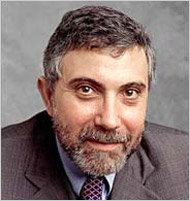 Paul Krugman’s op-ed piece today took my fears about the global free fall in manufacturing from the monetary sector straight to the real sector. He’s making the case that the U.S. economy is at the start of depression.
The fact is that recent economic numbers have been terrifying, not just in the United States but around the world. Manufacturing, in particular, is plunging everywhere. Banks aren’t lending; businesses and consumers aren’t spending. Let’s not mince words: This looks an awful lot like the beginning of a second Great Depression.
As a liberal economist with impeccable credentials, Dr. Krugman has always been called the consummate Keynesian. This is despite his major contributions come from Trade Theory where he argues continually in his academic work for open, unfettered trade. Economists generally tend to be a pragmatic and practical sort because we focus on outcomes.
The main question posed by Krugman today concerns the Obama stimulus plan.
If we don’t act swiftly and boldly,” declared President-elect Barack Obama in his latest weekly address, “we could see a much deeper economic downturn that could lead to double-digit unemployment.” If you ask me, he was understating the case …
So will we “act swiftly and boldly” enough to stop that from happening? We’ll soon find out. “
2. The first Obama appointee to resign after a scandal in 2009 will be:
Posted: January 4, 2009 Filed under: Team Obama, The DNC 2 CommentsBILL RICHARDSON
We already have the answer for one of the question’s posed by the Dakini’s office pool. It’s hard to know what to say other than welcome to Scamalot folks where pay-to-play is the everyday way! It certainly says a lot that this is the first answer so early and so BEFORE the swear in.
This just in from the New York Times.
Gov. Bill Richardson of New Mexico confirmed in a statement released Sunday afternoon that he has withdrawn his name as the commerce secretary nominee, citing a pending “investigation of a company that has done business with New Mexico state government …
On Dec. 19, The Times published an article stating that a federal grand jury in New Mexico was looking into accusations that Governor Richardson’s administration gave lucrative contracts to a California financier because he contributed heavily to the governor’s political action committees.
The article, citing a person familiar with the grand jury proceedings, stated that since August, federal investigators have been examining how CDR Financial Products Inc., of Beverly Hills, Calif., got two consulting contracts in 2004 worth about $1.4 million to advise the state on a large bond issue for building infrastructure, one of Mr. Richardson’s initiatives.
The investigation was first reported in The Albuquerque Journal.”
The Times article also references the Richardson press release as well as Obama’s deep regrets. Of course, this is not the Bill Richardson Obama knew.
The AP (as paraphrased in the NY Tiimes article) has also announced some of the details of the latest pay-to-play Obama buddy caught in an indictment.
According to The Associated Press, a federal grand jury is investigating how a California company that contributed to Mr. Richardson’s political activities won a lucrative New Mexico state contract:
A person familiar with the proceedings has told The Associated Press that the grand jury is looking into possible “pay-to-play” dealings between CDR Financial Products and someone in a position to push the contract through with the state of New Mexico.
The A.P. also reports that Obama’s transition office said Sunday that the president-elect had accepted Mr. Richardson’s withdrawal.
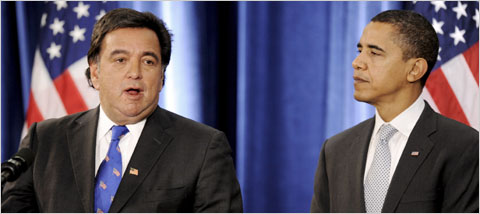
Bye Bye Judas!!! This is coincidently the second of Mr. Obama’s primary supporters/turncoats/opponents to have been caught up in scandal. Did Mr. Axelrove perhaps find out things that both Judas and John Boy didn’t want out in the open during the primary season. Inquiring minds want to know.
The Perils Of Prostitution
Posted: January 3, 2009 Filed under: Team Obama, U.S. Economy | Tags: China trade, recession/depression, soveriegn wealth funds, U.S. Stimulus, U.S. Treasuries Comments Off on The Perils Of Prostitution
I’m going to give you a glimpse at my current research area without torturing you with models and data. You’ve probably noticed I’ve been less than consistent with my blogging since the end of semester in mid December. This will continue awhile as I torture trade theory, exchange rates, and the world financial system in pursuit of a few pubs. However, I still am, at heart a teacher and I like to answer questions.
I’ve gotten a lot of questions recently about the current economic stimulus package in terms of increasing the U.S. debt. Many of my students ask me what would happen if China simply decides one day to stop buying our Treasuries or dump all the ones they own, at once, on the market. The answer is worldwide chaos but unlikely to happen. However, there are things afoot that could make it likely that the Chinese might not buy further debt and could slowly shed its current portfolio holdings of both dollars and debt. This could have enormous ramifications for our ability to stimulate the economy via debt financing as well as maintain the dollar as the world currency.
It is also possible that the other sovereign fund countries ( that would be the oil producing countries) may also stop buying further debt. It’s easy to explain that. Less oil revenues means less free money to invest. But what about China?
This is really a side show to what I am currently studying which is monetary policies, trade, and exchange rate policies. But, it is an interesting sideshow. So here’s some questions, some discussion, and enough information to be mildly dangerous. What about China?

 peej
peej Carissa
 bostonboomer
 dakinikat
 ecocatwoman
 mablue2
 Mama Lopez
 peggysue22
 quixote
 skydancingguestblogger
 Mona (aka Wonk the Vote)



 Sky Dancing
Recent Comments