
Mortgaged Home, Sweet Mortgaged Home
Posted: February 18, 2009 Filed under: Global Financial Crisis, Team Obama, U.S. Economy | Tags: Fannie, Freddie, home owner bailouts, obama housing plan, subprime mortages, underwater mortgages 9 Comments Obama announced more details on his bailout plan that was focused more on borrowers instead of the lenders. He released a four page fact sheet here. There are three portions and The Economist does a pretty good job of summarizing them here.
First, the administration will increase the number of homeowners able to refinance at current, low mortgage rates. Borrowers whose mortgages are owned or guaranteed by Fannie Mae or Freddie Mac will be able to refinance a loan up to 105% of the home’s value (up from 80%, previously). This is expected to help about 4 to 5 million households who owe nearly as much or more than the value of their homes. This seems like a reasonable step to take, though as Calculated Risk notes, it’s a bit of a lottery. Those whose mortgages haven’t been purchased by Fannie or Freddie are basically out of luck.
The second part is the one that’s grabbed headlines; the president has dedicated $75 billion toward efforts to prevent foreclosures. Chief among these efforts is a plan to reduce monthly payments for troubled borrowers. For those spending greater than 38% of their income on mortgage payments, up to 43%, the government will ask lenders to reduce interest rates to bring payments down to the 38% level. The government will then match lender dollars, one-for-one, in bringing down interest payments until the borrower is only spending 31% of income. Both borrower and lender will be eligible for $1000 payments when payments are reworked, and if the planned payments are made. If it’s necessary to reduce principle, then Treasury will provide assistance with this, as well.
This portion of the plan has drawn criticism, since many homeowners with too-large payments are those who took on irresponsible loan structures or who simply purchased too much house—who behaved irresponsibly, in other words. Ideally, officials would no doubt prefer not to help such borrowers (just as they’d no doubt prefer to let bankers who’d made bad decisions go under). But frankly, that’s not a top concern of mine. Rather, I’m interested in whether or not this is the best way to use $75 billion to halt foreclosures.
The Economist has two concerns. The first is that it may just delay foreclosure rather than solve it because:
… interest payments are being reduced first, and principle written down only as a last resort (such that many who take advantage of the programme will nonetheless remain underwater). Perhaps, but by trying to leave principle alone, the government is avoiding excessive transfers of wealth to borrowers. A shared-equity plan might have been better, but this will halt some foreclosures and incent homeowners to stay in their homes longer.
The second issue there are enough incentives in the bill to rework the payments. On this point, they say:
Presumably, it’s already in the interest of lenders to reduce payments rather than foreclose, so it’s unclear whether $1000 is going to alter the balance. This, I think, is a more serious point. The housing plan passed last year to help rework problem mortgages seriously underperformed—where some 400,000 borrowers were deemed to be eligible, actual applications numbered in the tens.
The third portion of the plan seeks to “strengthen” Fannie and Freddie and to keep mortgage credit available and loan terms to ensure housing affordability. The amount scheduled for this is $200 billion.
David Leonhardt of the New York Times had this to say. His blog thread concentrates on who is most likely to benefit from the plan. If you watched Obama’s speech, supposedly the plan won’t help the ‘irresponsible’ speculator. Leonhardt questions if the plan can successfully separate the homeowner is trouble by purchase motives.
But the lines aren’t quite as clear as Mr. Obama suggested. In fact, his plan will end up helping a fair number of people who bought homes that they should have known they would never be able to afford. The core of the plan gives banks a financial incentive to reduce many mortgage payments to no more than 31 percent of a borrower’s income.
Which homeowners will benefit from this reduction?
Certainly, some who took out a reasonable mortgage and later lost their job will be helped. But people who bought too much house — and banks that allowed people to do so, or even encouraged them to do so — will also benefit. As distasteful as this may be, it’s the only way to make a serious dent in foreclosures and, in the process, to help the financial system.
These same political calculations help explain the public emphasis that the White House is giving to the relatively modest steps it is taking to help underwater homeowners — those with a mortgage worth more than the value of their house — who can afford their monthly payments.
The actual details of the plan aren’t due out until March 4th when it goes into effect. Market Watch had some interesting statistics for the plan today. Here are the number of homeowners the plan itself says it will help.
The bill is supposed to help s many as 9 million households in fending off foreclosures:
- Allows 4 million–5 million homeowners to refinance via government-sponsored mortgage giants Fannie Mae and Freddie Mac.
- Establishes $75 billion fund to reduce homeowners’ monthly payments.
- Develops uniform rules for loan modifications across the mortgage industry.
- Bolsters Fannie and Freddie by buying more of their shares.
- Allows Fannie and Freddie to hold $900 billion in mortgage-backed securities — a $50 billion increase
Where’s the Reform?
Posted: February 17, 2009 Filed under: Equity Markets, Global Financial Crisis, president teleprompter jesus, Team Obama, The Media SUCKS, U.S. Economy, Uncategorized | Tags: Credit Derivatives, FED, financial market reform, Mary Dizzard, SEC, Securities Market Comments Off on Where’s the Reform? We keep hearing about the global financial collapse and how several things played into its creation. Since the credit markets are mostly dried up, loose credit to purchase overpriced assets is no longer an issue. Still hanging out there with no real substantive policy discussion is Financial Reform. Has the current administration forgotten the complete lack of oversight by the SEC in the areas of derivatives, credit default swaps, and all those fancy little arrangements that allowed imprudent lenders to pass the trash? Where also is a hard look at Moody’s and other raters that actually applied a triple A label to stuff that is still unraveled? Why aren’t we fixing what is obviously broken?
Dizard at Financial Times asks the question. What is the status of the structural reforms and laws required to fix the broken securities markets? It’s a very good question because both the SEC and the FED failed in their oversight duties of several markets. They’ve both asserted they didn’t have the legal standing to act or to provide that oversight. In that case, we have another example of oversight malpractice by the congressional committees designed to keep the financial and banking systems strong. They need to sort out responsibilities and enact laws to ensure oversight exists.
Here is one of the articles major points which is reform of rating agencies. He sees no progress on that front and believes we’re seeing some major maneuvering that ensures job security and protects fragile egos.
The financial system has a peacetime officer corps in a wartime situation. The people in positions of responsibility are principally interested in preserving their careers and avoiding public embarrassment. There are rare and important exceptions, such as Paul Volcker, who has nothing to prove about his integrity, and who is past any need to advance his career.
To identify what has to be done to put securities markets, banking and regulation on a sound basis for the future, the people at the top might have to admit to the specifics of their own past mistakes. They would also need a command of detail of the workings of the financial system that they have avoided acquiring over the years, since it was much more advantageous to spend one’s time scheming and toadying.
This is a naturally occurring aspect of human nature, but it is usually kept in check by periodic crises, which thin the herd and force the survivors to adapt. The “great moderation”, also known as periodic monetary bail-outs, in developed countries for the past couple of decades has prevented that process.
Let’s consider a specific issue, the reform of the leading US ratings agencies…So what are the federal regulators, and Congress, actually doing about ratings agency reform?
Obama Team Announces TARP Plan: Market Crashes
Posted: February 10, 2009 Filed under: Equity Markets, Global Financial Crisis, New Orleans, president teleprompter jesus, Team Obama, U.S. Economy | Tags: Depression, Geithner, Obama presser, Obamanomics, TARP 2 CommentsI hope you weren’t planning on using any of those savings that you may still have left sitting out there in anything market-related soon. The Dow Jones ( at this writing) is off over 350 points. All of the blue chip components tumbled. The S&P and OTC markets aren’t faring any better. This is how Market Watch sees it right now:
The recent strength shown by U.S. stocks vanished on Tuesday as the government unveiled a new bank-rescue plan and congressional action neared on a fresh round of fiscal stimulus for the wheezing U.S. economy.
That basically amounts to a reaction of last night’s speechification and presser and this morning’s announcement of thunderous boos. Fed Chair Ben Bernanke is speaking right now and that’s not really helping either. The investment/business community doesn’t think any of the largess from either the TARP or the Stimulus Plan are really going to do anything. Treasury Bond prices are dropping also. This additional snippet from Market Watch sums it up well.
“First, we’re going to require banking institutions to go through a carefully designed comprehensive stress test, to use the medical term. We want their balance sheets cleaner, and stronger. And we are going to help this process by providing a new program of capital support for those institutions which need it,” said Geithner.
Despite the forceful words, Geithner noted his office was still exploring options and details for an asset value program, with little answer on what to do about banks’ toxic assets.
That last paragraph is basically at the crux of the problem. The current administration is bringing no plan to the table to actually deal with the problem. Perhaps because Geithner was so instrumental in the original TARP, he’s just sticking with what already didn’t work rather than trying to think outside of the box. The market has lost around 3-4% already and there’s several more hours of trading to go. Hang on to your cookie jars kids, you’re going to need them as a stable replacement for your local bank.
Meanwhile, the senate managed to pass that the stimulus bill 61-37. That’s way shy of the 80 votes that Obama had wanted. The final bill has $838 billion worth of stuff that includes a lot of tax cuts (not likely to stimulate anything but Grover Norquist and The Club for Growth) and money for cash strapped states. I’ve brought up links to the Economic Policy Institute earlier but I really like this graph that even my freshmen could grasp about what works and doesn’t work in stimulus plans.
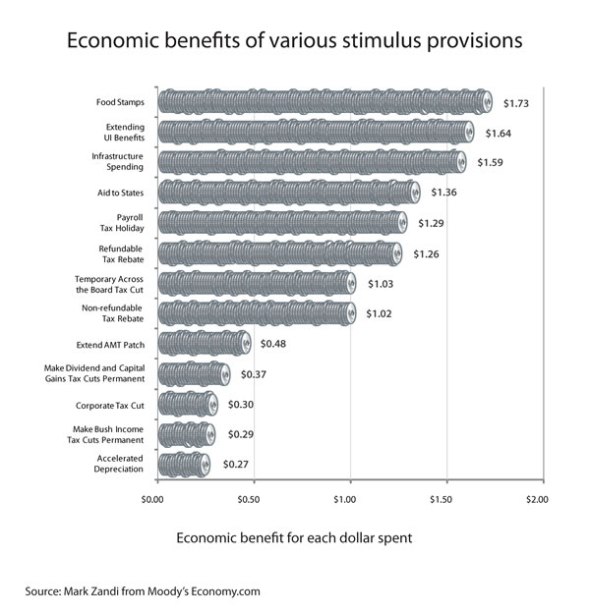 You can see the difference between the items where you get more bang than a buck and less than a buck’s worth of bang while contributing to the deficit. Notice those tax cuts that wind up costing more than they stimulate and think the last eight years of Dubya of which we seem to be repeating.
Here’s one that I picked up from Brad DeLong’s Grasping Reality with Both Hands that had my Freshman gasping as I was trying to set their hair afire. (I think it worked, btw.) Any one facing this job market should panic. Just anecdotal, but in the market for finance professors, this year universities were taking resumes only at the last two conferences. Last year, the best people had been hired up before either of the conferences were held and only the marginal remained. The hottest academic jobs are definitely on hold. In my years of both public and private sector economisting, I’ve NEVER seen anything like this.
 Please notice the incredible level of job losses. If you’ve managed to get through a calculus course, you’ll see that the first, second and third derivatives are negative which is not true on the other series at similar points. Basically, for you nonmath types, this indicates nothing but a downward trend or as I like to put it, straight off a cliff.
So, President Obama rambled an economics lecture last night that made me happy that he was getting all those economics briefings. It was also pretty obvious that most of his advisers must have their hair on fire too, because he did have a sense of edgy panic when he talked about the situation. However, ‘edgy panic’ is not what I want in a president. I want a president to talk about we have nothing to fear but fear itself who then says something to the effect of let’s do what works instead of bargaining away what will with folks that aren’t interested in watching you succeed.
I have to say, last night over Margaritas with my neighbors, I was searching for folks that wanted to diversify their food options with neighborhood gardening. I had a lot of takers. After all, when the army and your police force spend a good amount of time and money flying sleek black helicopters around the skies of your city practicing for food riots, it’s kind of one of those wake up moments. That goes for sleepy freshmen and drunk Cajuns. Is your hair on fire yet? Because if it isn’t, you haven’t been listening.
Meanwhile, I’m adding a page to my own blog for sharing sustainability and survival stories. Feel free to visit and contribute.
A quick breath up from the global economy for me and …
Posted: February 5, 2009 Filed under: A My Pet Goat Moment, Team Obama, U.S. Economy | Tags: blue dog democrats, obama stimulus plan, stimulus plan DOA 1 Commentback home … here.
To this headline at Politico: Obama Losing Stimulus Message War
and to this quote:
At this crucial juncture in the push to pass an economic recovery package, President Barack Obama finds himself in the most unlikely of places: He is losing the message war.
Despite Obama’s sky-high personal approval ratings, polls show support has declined for his stimulus bill since Republicans and their conservative talk-radio allies began railing against what they labeled as pork barrel spending within it.
The sheer size of it — hovering at about $900 billion — has prompted more protests that are now causing some moderate and conservative Democrats to flinch and, worse, hesitate.
and more from Today’s New York Times:
For all the saber-rattling, the fate of the bill, which is the centerpiece of President Obama’s economic agenda, seemed tied up in a meeting on Thursday in the Dirksen Senate office building, where Senator Ben Nelson, Democrat of Nebraska, and Senator Susan Collins, Republican of Maine, were leading an effort to cut the price tag of the bill.
Talk about your little engines that could! I could almost enjoy this if it wasn’t so painfully important to get this right. So far, President Obama has mailed in a letter to WAPO, scheduled a national news conference on Monday, and had a super bowl party and the senators from Maine and Nebraska remained unmoved by the charm attack!
Something tells me that this Congress is not going to take this new President very seriously if this keeps on going. Some one remind me, here, who is the majority party? Why are the Republicans acting more in control now than they were say, six months ago?
Senator Lindsey Graham even sounded dynamic on Fox with this little gem.
President Obama has been “AWOL” in negotiations over the economic stimulus package, Sen. Lindsey Graham said Thursday in a scathing rebuke of the new president.
The South Carolina Republican told FOX News that Obama has not been providing leadership, and he criticized the president for giving TV interviews and writing an editorial touting the package, rather than addressing the complaints of lawmakers.
“This process stinks,” Graham told FOX News, before repeating a lot of his criticisms on the Senate floor. “We’re making this up as we go and it is a waste of money. It is a broken process, and the president, as far as I’m concerned, has been AWOL on providing leadership on something as important as this.”
How macho can one be if the senate’s most closeted log cabin Republican can manage a more masculine soundbite than President Obama? I mean, it’s down right embarrassing. I’m going to have to wear a papersack over my head to vote Democrat any more, if this keeps up.
If you’ve read anything I’ve written here recently, you know what I think about what needs to be done. This is ridiculous. Its worse than a sexfree honeymoon! How can some one come in and screw the one big thing up so quickly? Meanwhile, I’m planting the Obama Victory Garden this week. It’ll save me some time in the breadlines.
The Dakini’s Liberal Report Card for Obama’s First 100 Days
Posted: January 31, 2009 Filed under: Team Obama | Tags: a liberal's report card, getting it right, Obama first 100 days Comments Off on The Dakini’s Liberal Report Card for Obama’s First 100 Days I always give my class my grading rubric before handing out any grades. That way they know when I consider their performance it’s based on certain things that I expect of them. It’s only right to let them know what you expect ahead of time so there are no surprises on the final report. So, in that spirit, here’s my suggested list for items that a real liberal would accomplish in their first 100 Days. Do you suppose we’ll see any of them in Obama’s first 100 days?
1) Get the troops out of Afghanistan and Iraq. No more use of American troops for nation building and no more supporting Donald Rumsfeld’s ‘Lean Forward’ Policy. Those folks don’t want us there, we shouldn’t have been there in the first place. We need to leave ASAP.
2) Provide real Economic Stimulus in place of trickle down economics. Get rid of the majority of those tax cuts in the stimulus package which appear to be more Grover Norquist than J. M. Keynes. Let’s do the math so get out your calculator. (All those from those detractor sites that call me a Republican for being less than enthusiastic about President Reagan-Redux can use their fingers and toes. It’ll stop you from dragging your knuckles along the floor as you lurch backwards, so be careful.) My bottom line comes to this: $145 billion for low and middle, $580 billion for high and “other” per numbers from CNN money.
There’s $130 billion in the other category. By far, the largest amount and percentage goes to big business and rich folks. President Obama should be held to account first for his broken campaign-promise about repealing tax-cuts for incomes over $250K then we should scream because this package has more for $ high and other than it does for low and middle. That’s even forgetting the massive transfer of wealth going on from the Federal Reserve bailout of the banks. So let’s review:
Low or middle income tax-cuts = $145 billion.
High income tax-cuts = $450 billion.
And other cuts = $130 billion.
So, at least $450 billion dollars of those tax cuts should be replaced with infrastructure spending or something a bit more FDR- like in my book. Senators! The ball’s in your court right now. Make the President live up to his teleprompter promises!
3. Get rid of the Patriot Act and get FISA right. Last time I checked it wasn’t very progressive to spy on journalists, American citizens and violate upteen different clauses of the constitution in the name of a war against terror. But then, I’m not the constitutional lawyer, I’m just an economist.
4. Declare complete support for the Geneva convention along with pledge to never use any form of torture. While there is some movement towards closing Gitmo, I’d like to hear a speech and see a written executive order saying that the US condemns and will not practice any forms of torture disallowed by the Geneva convention.
5. Restore Reproductive Freedom at all levels. This would include restoring support to our service women abroad and to poor women. It would also immediately reverse all those last minute edicts that let practitioners of women’s health opt out of providing health services because the flying spaghetti monster spoke in their ears and said dont’ do it. (Removing the global gag rule was a good first baby step, but so much more work is needed here that it hardly counts as progress.) Remove all barriers that undercut access to birth control, family planning services, and abortion.
6. Put us back on the road for the Kyoto Protocal. Get the thing signed and ratified. Put Al Gore on it if you have to as another czar, special envoy or whatever. Just do it!
7. Make Progress towards Universal Healthcare. This is just basic common sense. Just watching the US freefall again on the Human Development Index this year should give you enough ammunition to start this process. EVERY OTHER DEVELOPED nation is ahead of us in most standards of national social welfare because of our refusal to do this. Do it now!
8. Get the TARP right! Bailing out banks and high powered brokerages firms is not solving the problem. The root of this problem is in the mortgages. Go back to the root and solve the problem. We need something like the HOLC and Hillary and McCain had plans for it. Stop focusing on the folks that funded your coronation and your campaign and start giving some real help to the little people that put their faith in you. The liberal/progressive thing to do is to help the little guy, remember?
I actually could add to this list and it would include some big things like looking at social security and medicare, but since we’re talking 100 days, I’ll hold it to these items. Got any to add?

 peej
peej Carissa
 bostonboomer
 dakinikat
 ecocatwoman
 mablue2
 Mama Lopez
 peggysue22
 quixote
 skydancingguestblogger
 Mona (aka Wonk the Vote)



 Sky Dancing
Recent Comments