
Punch Drunk on Tax Funded Bailouts
Posted: March 23, 2009 Filed under: Equity Markets, Global Financial Crisis, Main Stream Media, president teleprompter jesus, Team Obama, U.S. Economy, Uncategorized | Tags: bailout, Change When?, Obama, SouthPark, TARP, Timothy Geithner 4 CommentsWhile the Right Wing is off having tea parties and screaming class war, there appears to be some legitimate soul searching going on in left Blogistan about our “punch drunk” POTUS and his continual campaign like appearances. A lot of the discussion is focused on his dogged support of Turbo Tax Timmy and his bailout of the Suckers who created this bad economy for the rest of us. We’ve been overwhelmed with “heckuva-job-Timmy moments and distasteful ‘gallows humor’. When is enough enough?
Meanwhile, those of us that can’t avoid our jobs by taking a permanent vacation in TVLand are watching the economy unwind in spasms of agony and ecstasy. The market, starved for specific plans and information, provided a big thumbs 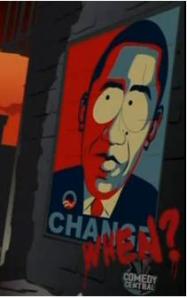 up on a bail out program that at best reheats Dubya’s. If any one was punch drunk, it was the equity markets today. The leaders were the financials, of course, who will continue to provide profits to the market while writing their costs off to the taxpayer. If you were looking for the fresh cold breath of reality, it wasn’t on Wall Street or on Pennsylvania Avenue.
Lucidity, however, is on the rise in other places. I’m finding it in interesting places like the second episode of South Park where the lampoon on the Dark Knight included this little back ground gem; a satire of the famous Obama picutre with a deer-in-the-headlights appearing Obama and the change mantra tagged by a bright red WHEN?
My answer to the when question is probably never.
Most left wing angst appears to be directed at Tim Geithner since the Light Bringer is still too new to the job to blame. We continue to learn how involved both he and his staff at the NY Fed were in the AIG Bonuses. In fact, the Obama administration is trying to scuttle the Excise tax on the bonuses while verbally denouncing executive greed on TV. We’ve also found out that Citibank has managed to insert similar language to protect its executive bonuses. Let’s see how much change we get on that one too.
Not only are right wing shrills like Fox’s Sean Hannity calling for the head of Timmy Geithner but Progressive Diva Arianna Huffington front paged the call on HuffPo today. When Hannity and Huffington carry the same headline, it’s time for more than a few campaign appearances on Leno and 60 minutes. I’m not sure where all this shock and angst is coming from because it’s been rather obvious to some of us for some time that Obama represented rather narrow interests (not ours). How can every Obama supporter be calling the AIG Bailout a travesty while knowing that the architects and enablers of AIG are continuing the task with the Light Bringer’s blessings and attaboys? Well, Obama just mustn’t realize that it’s all Timmy’s fault and we need his head on a limited edition Obama inaugural platter. But, wait, isn’t Obama the one with that great judgement ? C’mon folks reconcile all this in your mental ledger. It really isn’t that hard.
Yes, it’s an AIG Thread. Discuss.
Posted: March 18, 2009 Filed under: Equity Markets, Global Financial Crisis, president teleprompter jesus, Team Obama, U.S. Economy | Tags: AIG bonuses, Geithner, Summers, timeline 3 CommentsThe peasantry appears ready to pick up the pitchforks and storm the castle over the AIG bonuses. So what sayeth the King’s men? What’s the word from our Regent’s best? Well, here’s the real bottom line according to the NY Times.
New York’s efforts against A.I.G. have overshadowed those of the Treasury secretary, Timothy F. Geithner, the official who is responsible for the financial bailout, along with the Federal Reserve. The White House and Treasury have been besieged by questions about why Mr. Geithner did not know sooner about the bonus payments due this month, and whether he could have done more to stop them, prompting White House officials to assert President Obama’s continued confidence in Mr. Geithner.
“He more than has the president’s complete confidence,” said Rahm Emanuel, the White House chief of staff. As angry as the president is at the news about A.I.G., which he learned Thursday, Mr. Emanuel said, “his main priority is getting the financial system stabilized, and he believes this is a big distraction in that effort.”
It appears the henchman let slip something important. It’s all a ‘big distraction’. POTUS is so angry he can tell a joke. Meanwhile, more and more comes out concerning ‘what the President knew and when he knew it.” I have to say one thing, we got the time line for this immediately after the request came at yesterday’s press conference. Gibb’s may not be the most eloquent of Press Secretaries but when he promises missing information, he does deliver.
CNN’s Wolf Blitzer and Ali Velshi are reporting that they reported on the bonuses back in January 28 so why the kerfuffle today? Also, who is going to be the Judas Goat for this one? FDL’s Jane Hamshear calls Dodd the ‘sin eater’ here and thinks the President is trying to protect Geithner. Jane puts together a time line that more aptly reflects the idea that the President had to hear about the bonuses way back when but didn’t really LISTEN until they became a problem.
Here’s Jane’s take on Dodd’s original provision (removed by Geithner and Summers) on executive pay.
Dodd’s version prohibited TARP recipients from paying out bonuses, retention awards or incentive compensation to the 25 most highly compensated employees. It also prohibited any employee of a company receiving TARP funds from making more than the President. Both provisions would have been in effect so long as a company was receiving TARP funds. Since AIG just paid out $1 million in bonuses to 73 employees, Dodd’s version limiting all employees to what the President made (roughly $500,000) would have substantially nipped that in the bud.
So, at this point we have to ask a question. Do we have a renegade Secretary of the Treasury in cahoots with the President’s personal Economics adviser or a President who probably knew what was going on and didn’t really care until the peasants made an issue of it? Now we have an issue with which congress critters of both parties can make hay. Geithner is going to testify before the House next week on March 24 and 26 according to the WSJ about the AIG bonuses. Meanwhile, AIG’s current CEO testified and plans to ask employees to return the bonuses. ( Pretty, Pretty please, give back at LEAST HALF).
AIG Chairman and Chief Executive Edward Liddy, appearing before a U.S. House subcommittee, said the company has asked employees at its financial-products division who received more than $100,000 to “step up” and return at least half the payments.
“We’ve heard the American people loudly and clearly these past few days,” Mr. Liddy said, claiming that some employees have already volunteered to give up their entire bonus.
He warned, however, that the request could backfire if the employees who received the retention bonuses decide to resign from the firm. “They will return it, but they will return it with their resignations,” Mr. Liddy said.
So after a good yammering, I mean hammering from congress, Liddy once again explains the role of the bonuses.
Mr. Liddy said that the “cold realities of competition” for customers and employees played a role in the firm’s decision to make the payments, which have spurred a public backlash given the roughly $170 billion the government has used to prop up the troubled insurer.
“Because of this, and because of certain legal obligations, AIG has recently made a set of compensation payments, some of which I find distasteful,” Mr. Liddy said.
Describing the financial-products division, Mr. Liddy called it an “internal hedge fund” that exposed the company to extreme market risk. The result, he said, was that “mistakes were made at AIG on a scale few could have ever imagined possible.”
“Those missteps have exacted a very high price, not only for AIG but for America’s taxpayers, the federal government’s finances and the economy as a whole,” said Mr. Liddy, who took over AIG as part of the government’s rescue of the firm in September.
It seems every one finds them distasteful. Even the president “coughed” and joked with “anger” after being properly motivated by his teleprompter. So once again, congress critters will draft legislation to control executive compensation at companies receiving TARP money. Barney (the congressman, not the dinosaur) wants the President as ‘de facto CEO’ of AIG to institute a lawsuit to get the funds back. But wait, they did do that during drafting of the stimulus package. Dodd edited it. Summers and Geithner removed it. What next?
Meanwhile, over at the FED they continue to try break up AIG into pieces. They also appear to be more the source of Wall Street attention that both the hearings and today’s Presidential work-avoidance trip to California. The market rallied on news of the latest from the FOMC. They’re letting loose the printing presses to ease credit. So evidently, while the peasantry revolt, the congressmen act revolting, and the President flies to give another speech and appear on Leno, the bankers are at play.
Let’s just grab some popcorn and discuss.
Toxic US Treasuries?
Posted: March 13, 2009 Filed under: Equity Markets, Global Financial Crisis, Team Obama, U.S. Economy, Uncategorized | Tags: China Debt, Current Account deficit, U.S. Treasuries 15 Comments You know things are changing in the world when a country expresses “concern about the outlook for the U.S. and the safety of its Treasury bonds”. This would especially be true when that country is China and they are your biggest creditor. This is not the sort of thing one hears about industrialized nations, let alone the world’s largest single country economy. But there it is. The US is now considered a credit risk.
Analysts who watch the interest rates that the US must pay on its debt should have felt a little shiver yesterday. The Chinese government, the largest holder of Treasuries, expressed some doubt about the turnaround of the American economy and came a bit too close to stating that US paper might be becoming less attractive as the government borrowing to stimulate the economy and save financial institutions makes American debt a more risky investment.
According to the FT, the Chinese premier said, “We have lent a huge amount of money to the United States. Of course we are concerned about the safety of our assets. To be honest, I am a little bit worried. I request the US to maintain its good credit, to honour its promises and to guarantee the safety of China’s assets.”
I posted at the end of January about the touch and go trade relationship between the US and China. We stimulate their economy by buying Chinese stuff. They enable us to do so by buying our debt. We don’t yell at them for restricting their capital flows, pegging their currency, or violating human rights and we get to spend a lot of money without raising taxes. Well, that was so last month. Today, China’s decided to publicly assert its ‘interests’. We have yet to respond. Is China expressing similar concerns already voiced by economists and the markets over the current handling of the US Economy by the Obama team? Quite possibly. This, from the previously cited WSJ article.
Mr. Wen said that China is also closely watching to see the effects of the policies taken by U.S. President Barack Obama aimed at returning the world’s largest economy to health. Chinese foreign minister Yang Jiechi was also in Washington this week to discuss how the two countries can cooperate on economic policy, among other issues.
A test of that cooperation is quickly approaching. U.S. Treasury Secretary Timothy Geithner this week called on the Group of 20 – a gathering of the world’s largest developed and developing economies – to increase funding for the International Monetary Fund by up to $500 billion to help combat the financial crisis. Achieving that sum likely will depend on getting agreement from countries that hold large foreign exchange reserves, such as China and Saudi Arabia.
Ahead of a preparatory meeting of G-20 financial officials this weekend near London, Mr. Wen said pointedly that “increased funding for the IMF is not a question for just one country” but for all member nations. He also repeated China’s desire to see reforms to the IMF that give more clout to developing nations.
They’re ‘inkling’ that China deserves more international status and bargaining power. They also would like the international community–especially the US– to lay off any notion of a more free and open Tibet. I still find it intolerable that we’ve basically decided cheap Chinese manufactured goods are worth more than the religious and political freedom of native Tibetans. That is, however, the bargain that is on the table.
Mr. Wen used harsh language against the Dalai Lama, Tibet’s spiritual leader, who accused the Chinese government this week of turning the Himalayan region into a “hell on earth.” He said talks between
Beijing and the Dalai Lama, which took place last year without making any progress, could only resume if the Dalai Lama is “sincere.”
Indeed, China does have a big stake in the U.S. economy and is the nation’s biggest creditor. It is always disconcerting when that creditor calls you at work and reminds you about the bill. Here’s the size of the problem reported by the NYT.
China should seek to “fend off risks” as it diversifies its $1.95 trillion in foreign-exchange reserves and will safeguard its own interests, Mr. Wen said. He said that the Chinese had invested $696 billion in United States Treasury bonds as of Dec. 31, an increase of 46 percent from a year ago.
The United States Treasury Master index from Merrill Lynch shows that the securities declined 0.5 percent last month, after falling 3.1 percent in January, the worst since April 2004, as President Barack Obama sells record amounts of debt to finance his $787 billion bailout. The dollar has dropped 17 percent against the yuan since China ended a fixed exchange rate in July 2005.
This definitely presents a challenge to the Obama administration. In order to forward the aggressive spending packages and tax cuts required for their agenda, the Chinese must continue buying US Treasuries. It was rumored that one of the messages brought to China by newly appointed SOS Hillary Clinton was the hope that China would continue its huge investment in Treasuries. The Chinese have now publicly stated that there will be a cost to those funds above and beyond the current interest rate.
Every time my students ask my what would happen if the Chinese suddenly dumped their supply of US Treasuries on the market, I say absolute chaos. Chaos here in the US and chaos throughout the world markets. I’ve also thought that an infinitesimally likely event. I’m not so sure about that now that we’ve had such a public announcement of our bad risk status. I’m also not sure if we’re being threatened with kneecapping, higher fees, or a mortgage on our soul.
Potus and Team Flunk Economics
Posted: March 11, 2009 Filed under: Equity Markets, Global Financial Crisis, No Obama, Team Obama, U.S. Economy | Tags: AEA, economists forecasts worsen, obama team flunks economics, WSJ survey of economists 6 Comments The Wall Street Journal’s Phil Izzo reports that a majority of economists participating in its forecasting survey believe the Obama economics team is failing to make the grade. The ratings for Obama and Geithner trail the grade for Bernanke who is chair of the Fed and show a lack of confidence in current economic policy. You may remember that Martin Wolf assigned Obama an “English B” or “D” in an interview with Zakaria posted earlier. It appears Wolf’s peers agree.
A majority of the 49 economists polled said they were dissatisfied with the administration’s economic policies. On average, they gave the president a grade of 59 out of 100, and although there was a broad range of marks, 42% of respondents rated Mr. Obama below 60. Mr. Geithner received an average grade of 51. Federal Reserve Chairman Ben Bernanke scored better, with an average 71.
They are completely unimpressed with the stimulus package and most are now forecasting the recession to be both deeper and longer than previously anticipated. Previous forecasts predicted the trough to come in August. The consensus has now shifted the bottoming to occur sometime in October. Many believe a second stimulus package will be required, however, this was not a majority opinion. The worst grades were assigned to the handling of the banking crisis.
Economists were divided over whether the $787 billion economic-stimulus package passed last month is enough. Some 43% said the U.S. will need another stimulus package on the order of nearly $500 billion. Others were skeptical of the need for stimulus at all.
However, economists’ main criticism of the Obama team centered on delays in enacting key parts of plans to rescue banks. “They overpromised and underdelivered,” said Stephen Stanley of RBS Greenwich Capital. “Secretary Geithner scheduled a big speech and came out with just a vague blueprint. The uncertainty is hanging over everyone’s head.”
The primary professional association is the AEA (American Economic Association) which frequently surveys its members for both political affiliations as well as opinion on economic outlook. Surveys have consistently shown that the majority of members lean democratic. In the cited study of its surveys, the author McEachern (2006) finds that the ratio of contributions of AEA economists that contribute to democrats v. republicans is about 5.1 to 1. A survey by the Economists in the fall (not a scientific poll so results are subject to question) found overwhelming support for Obama over McCain in the general election. Given that, this pattern appeared responsible for this interesting finding from the WSJ’s December Survey.
The economists’ negative ratings mark a turnaround in opinion. In December, before Mr. Obama took office, three-quarters of respondents said the incoming administration’s economic team was better than the departing Bush team. However, Mr. Geithner’s latest marks are lower than the average grade of 57 that former Treasury Secretary Henry Paulson received in January.
Clearly, economists are not amused if their ratings and outlook have changed so quickly. The surveyed economists are now expecting worse numbers in the employment sector. They have also upped the probability of having a depression in the US.
Meanwhile, the economists surveyed this month predict that the economy will shed another 2.8 million jobs over the next 12 months as the unemployment rate climbs to 9.3% by December, up from the 8.1% rate recorded in February. Economists also see nearly a one-in-six chance that the U.S. will fall into a depression, defined as a decline in per-person GDP or consumption by 10% or more.
“We just keep moving the date [when the recession will end] out, hoping at some point in time we will be able to move the date back in,” said Diane Swonk of Mesirow Financial.
The economists were also glum about the international response. There were two more positive findings. Again, Bernanke achieved the highest approval and most felt the Fed was performing its functions well. There was also some consensus around the idea of putting money in the stock market for the long run.
Despite the growing criticism elsewhere, the respondents were broadly supportive of the Fed. More than 85% of the economists agreed that the central bank’s proliferating lending programs are well-designed, well-executed and helping the economy. And while grades for Mr. Bernanke remain off of their 2007 highs, the average has stabilized after falling as low as 69 in the November survey.
Amid all the gloom, there is a bright spot: Four-fifths of the economists said now is a good time to buy equities, especially if the investor has a long-term view.
Given most economists are registered democrats. these ratings suggest a rather large vote of no confidence.
In FDIC We Trust
Posted: March 7, 2009 Filed under: Equity Markets, Global Financial Crisis, Main Stream Media, president teleprompter jesus, Team Obama, U.S. Economy | Tags: banking regulation, joseph stiglitz 6 Comments I continue to read current economic thought on the state of the economy and the state of the Obama administration’s response. I don’t’ know if you’ve ever made a trip to Project Syndicate, but it’s an interesting site where you can read contributions by brilliant people to newspapers around the world. It’s another one of those places that I’ve found since I’ve completely given up on the US MSM’s ability to provide real news, insight, or criticism of the world today.
Joseph Stiglitz is a frequent contributor. He’s a 2001 Nobel Laureate Economist. This is a contribution of his to The Guatemala Times from March 6, 2009. It’s called How to Fail to Recover. I’ve talked a lot about how the stimulus package isn’t big enough, that it contains too many tax cuts and that it is a bandage approach to a systemic problem that started in the financial system with bad lending practices egged on by Washington and greedy megainvestors. I feel vindicated because that is Stiglitz take too.
The stimulus package appears big – more than 2% of GDP per year – but one-third of it goes to tax cuts. And, with Americans facing a debt overhang, rapidly increasing unemployment (and the worst unemployment compensation system among major industrial countries), and falling asset prices, they are likely to save much of the tax cut.
Almost half of the stimulus simply offsets the contractionary effect of cutbacks at the state level. America’s 50 states must maintain balanced budgets. The total shortfalls were estimated at $150 billion a few months ago; now the number must be much larger – indeed, California alone faces a shortfall of $40 billion.Household savings are finally beginning to rise, which is good for the long-run health of household finances, but disastrous for economic growth. Meanwhile, investment and exports are plummeting as well. America’s automatic stabilizers the progressivity of our tax systems, the strength of our welfare system – have been greatly weakened, but they will provide some stimulus, as the expected fiscal deficit soars to 10% of GDP.
In short, the stimulus will strengthen America’s economy, but it is probably not enough to restore robust growth. This is bad news for the rest of the world, too, for a strong global recovery requires a strong American economy.
The real failings in the Obama recovery program, however, lie not in the stimulus package but in its efforts to revive financial markets. America’s failures provide important lessons to countries around the world, which are or will be facing increasing problems which are or will be facing increasing problems with their banks.

 peej
peej Carissa
 bostonboomer
 dakinikat
 ecocatwoman
 mablue2
 Mama Lopez
 peggysue22
 quixote
 skydancingguestblogger
 Mona (aka Wonk the Vote)



 Sky Dancing
Recent Comments