
Dysfunctional Justice System Delivers some Justice
Posted: August 5, 2011 Filed under: New Orleans | Tags: Danziger Bridge trial, justice, New Orleans, NOPD 16 Comments
Hurricane Gustav rolls in
On August 30, 2008 I was sitting in a bar in the ninth ward of New Orleans waiting for Hurricane Gustav. It was unbelievably hot in my house. For some reason, Entergy couldn’t keep my electricity on but across the street at BJ’s bar, there was cool air and sweet relief. I was working on a paper and drinking beer off and on all day. I was back and forth depending on how much I could charge the laptop battery and cool myself down.
Later in the evening, a group of policemen entered the bar including one local guy that had a reputation for a mean temper when drunk and using the n word profusely. He had a group of rookies tagging along with him. We felt fairly safe back then because the National Guard was almost always first on crime scenes at that point in time and it kept the NOPD in check when they were watched by something other than citizens. Middle aged, white but with that ruddy red hue in the face indicating too much alcohol in the system, this guy has a substantial beer gut and one hell of a chip on his shoulder. He’s a case study in anger. He was always looking to prove something.
This officer later waved his badge from a lawn chair planted in the street to a patrolling National Guard Unit. Move on, move on! Nothing to see here! Believe me, the guy has a reputation around the neighborhood and I found out why shortly after as he rolled a local prostitutes for freebie blow jobs on the back of a black and white for all the rookies. She was a middle-aged, nice looking dirty blonde with a drug habit. I’d talked to her on many occasions. She mostly services the lonely old losers in the neighborhood. I had heard she was forced to service the officer, but had never seen evidence of it until that night. I left in disgust before the show really got on the road. This is the guy that later let a drug felon beat me up because I had the audacity to tell the felon that his girlfriend had been sleeping with the cop both before and after he was in the federal penitentiary. You remember, that’s the cop that had me arrested for fighting. Little old me with a broken rib in my back from being kicked while under a table. Yup, ask me. I believe that a good portion of the NOPD only exists to protect and serve its own.
It’s no secret that I don’t believe a word that any NOPD officer says given my experience with them two years ago. I said as much to a judge, two prosecutors and a public defender when I was called to jury duty 18 months ago. The Danziger Bridge shootings have nationally exposed the underbelly of the NOPD with its blue line fraternity boys culture often caught up in corruption. Will this actually lead to any change? I don’t know. I’m just glad a few people got a sense of justice, even though it’s hard bought with the deaths of two innocent people including one man that was mentally disabled.
A federal jury on Friday convicted five current or former police officers in the deadly shootings on a New Orleans bridge after Hurricane Katrina.
All five officers were convicted of charges stemming from the cover-up of the shootings. The four who had been charged with civil rights violations in the shootings were convicted on all counts.
However, the jury didn’t find that Brisette or Faulcon’s shootings amounted to murder.
Prosecutors contended during the five-week federal trial that officers shot unarmed people without justification and without warning, killing two and wounding four others on Sept. 4, 2005, then embarked on a cover-up involving made-up witnesses, falsified reports and a planted gun.
Defense attorneys countered that the officers were returning fire and reasonably believed their lives were in danger as they rushed to respond to another officer’s distress call less than a week after Katrina struck.
Again, the family of the shooting victims may never find peace despite the overwhelming verdict of guilty on most counts for the five officers. Ronald Madison was the 40 year old victim with diminished mental capacity that was shot in the back and unarmed.
The family of victim Ronald Madison greeted the verdict with solemn appreciation, thanking law enforcement and the media for keeping the story in the limelight.
“We will never be completely healed, because we will never have Ronald Madison back,” said Madison’s brother Lance, who was with him on the bridge and who was initially arrested after the shooting.
“They took the twinkle out of my eye and the song out of my heart,” said a visibly shaken Sherell Johnson, the mother of James Brissette, the young man shot and killed in a hail of gunfire on the bridge.
The verdicts begin to close one of the darkest sagas that came to light in the aftermath of Hurricane Katrina. The five current and former New Orleans police officers were accused of wrongfully shooting six unarmed civilians, two fatally, on the Danziger Bridge several days after the storm blew through New Orleans and then staging an elaborate cover-up to justify the shootings.
In a 25-count indictment, the men in question – Bowen, Gisevius, Faulcon, Villavaso and Kaufman – were accused of turning on those citizens they had sworn to protect, especially in their most vulnerable hour when the city’s levees ruptured, flooding and crippling a majority of New Orleans as it descended into chaos. They faced a slew of charges, ranging from civil rights violations to murder charges to using a firearm in the commission of a crime to misleading investigators.
Bowen, Gisevius, Faulcon, Villavaso were accused of shooting the unarmed men and women, while Kaufman was accused of masterminding the cover-up, including the planting of a gun on the bridge and writing a bogus police report that would include phony witnesses.
The NOPD has never had a stellar record as an efficient police department. I’ve spent my 16 years here reading about bad cop after bad cop. It’s obviously a systemic problem. I’ll never forget the look on those rookies faces on their initiation night. I’ll never forget the way that a badge can wave off people that may actually be there to help. I’ve seen that happen twice now. I’ll never forget the carnival scene that also happened when a friend of mine was killed when a woman driving her boyfriend’s wife’s truck slammed him into a cast iron gate. He’s never gotten his justice to this date. The cops spent most of the time standing around with ice cream cones in their hands. They had blocked off all traffic but let the ice cream truck through to park and do business. Children on bikes were allowed to buzz my friend’s lifeless body. That’s another story too and there’s more. I’ve only been here 16 years and I’ve got plenty of them. Just imagine what a NOLA lifer can come up with. There’s a lot to love about this city. Best food, music, and people in the world. The NOPD is not one of the reasons.
Just Who are they Protecting?
Posted: May 14, 2011 Filed under: New Orleans, U.S. Economy | Tags: flooding Cajun country, Louisiana 1927, Louisiana 2011, Louisiana Bobby Jindal, Mississippi River Flooding, Morganza Spillway, protecting business interests from precautionary shutdowns 35 Comments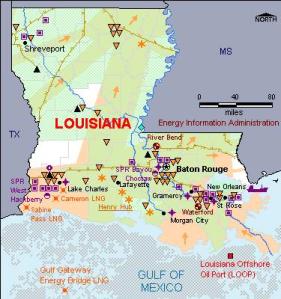 I’ve been watching a lot of Weather Channel and local news trying to get more information on the local flooding and the decision to open up the Morganza Spillway. I live within blocks of the Mississippi River and lived through Katrina so it’s a natural response for me. If you watch the major national news outlets, you’re under the impression that the Morganza Spillway opening will protect Baton Rouge and New Orleans from eminent flooding. The implication is that the Mississippi will top the levees and fill up the cities. Every one then envisions another après Katrina situation. That’s what they want you to believe, but that doesn’t appear to be the case as I’ve learned the last few days.
The local TV has had the city council and mayor of New Orleans and of Baton Rouge talking about the situation to the press on air on Thursday. Their main worry is that the speed and level of the river will cause barge traffic navigation and berth problems. If a rogue barge or boat hits a levee that could compromise the levee. City officials would shut down the river traffic before they would let that happen.
New Orleans city officials, with Katrina still fresh in their minds, has a plan for barges that may threaten the city’s river levees: “We can’t afford to have barges running loose, breaking levees,” said New Orleans City Council President Jackie Clarkson. “That’s unacceptable now … We’re going to sink them.”
Right now, the levees are expected to be able to handle the river even if the Morganza Spillway isn’t open. So, what will happen if the Morganaza Spillway wasn’t opened? Why are they really flooding Cajun Country?
The bottom line is that 10 oil refineries in the Baton Rouge/New Orleans area probably go off line for about 10 days and the river will be closed to traffic or traffic will be severely limited because the levels that trigger precautionary shut downs would be reached. Plus, the City Council President has threatened to sink any barges going rogue which can’t be making shipping interests very happy in general. When “they” speak about ‘saving’ New Orleans and Baton Rouge, what they’re really discussing is saving the commercial interests and the tax revenues. It would impact both the dollar and the price of oil as well as the price of soybeans, wheat, and other grains. Here’s just a taste of that.
Oil fell on Friday as the dollar rose and concerns eased that refinery operations could be disrupted by Mississippi River flooding.
However, what every one in the press and speaking to the press infers is the prevention of some kind of post-Katrina repeat. Few come out and say it, however. According to my Mayor and City Council, that’s not in the cards period and since they all lived through Katrina, I actually believe them. So, it’s just like in 1927 when a bunch of New Orleans businessmen convinced the government to blow levees unnecessarily displacing a lot of poor folk and flooding their homes. I’m thinking this is all about the lost $2 million dollars a day tax revenues each to both the State of Louisiana and the City of New Orleans plus, the costs to impacted businesses of a likely 10 day shut down.
So, first, let me take you through how I figured this out. I suppose it started with the Mayor’s presser on Thursday that basically was headlined “The City is Safe”. I also saw how anxious our Governor was to get the Corps of Engineers to just make the decision to open the spillway. Now, my governor is not the most people-centric man. Governor Bobby Jindal is only concerned about himself and industry interests who fund his campaigns. Jindal’s been been running around the state telling people to flee and emphasizing that the area around the Atchfayala Basin will flood with or without the Morganza Spillway opening as if that alone is justification for flooding people out of their homes. He just seemed over anxious to get it opened. He’s made the Corps look like it’s dragging its feet on this when it basically announced the height and river speed that would be required to open that spillway and they’ve done so consistently.
But again, the big news lead has been protecting the city of New Orleans. We’re now the poster child of flooding because of the post-Katrina levee failure. Again, our Mayor says we’re safe.
The mayor says officials do not expect flooding in New Orleans because of the strength and size of the river levees.
At the news conference, the Corps of Engineers reiterated that they do not yet have the green light to open the Morganza Spillway to relieve pressure off the city’s levees.
“We have not gotten approval to open and operate the Morganza Floodway yet,” said Lt. Col. Mark Jernigan. “We expect, based upon the National Weather Service Forecast, to reach the optimal trigger this weekend.”
Corps officials have maintained that they expect to open the Morganza structure some time between Saturday and Tuesday.
Mayor Landrieu stressed that authorities are inspecting the levees around the clock. He asked people to resist the urge to go on the levees to see the river for themselves, warning that they could get in the way of levee inspection work, or even be hurt by debris that’s bobbing along the surface of the surging river.
So, the levees will protect the city. The levees along the Mississippi River are 25 feet tall and are as wide as a football field. The river–without the Morganza opening–was forecast to crest well below that. The floodwalls mentioned below are the concrete ones along the canals that have been redone since their failure during the storm surge of Hurricane Katrina. They’re not really threatened either with or without the Morganza Spillway Opening.
The river is predicted to crest on May 23 at 19.5 feet—2.5 feet above the official flood level, but six inches shy of the city’s 20-foot floodwalls.
That was the information prior to any decision made on the Morganza spillway that opened today. Here’s an example of the spin again with the “avert a a potentially bigger disaster in Baton Rouge and New Orleans”. Notice the ‘bigger disaster’ is what you infer from the Katrina Experience. This is from The Weather Channel.
In an agonizing trade-off, Army engineers said they will open a key spillway along the bulging Mississippi River on Saturday and inundate thousands of homes and farms in Louisiana’s Cajun country to avert a potentially bigger disaster in Baton Rouge and New Orleans.
Shortly after Governor Bobby Jindal announced that the Morganza Spillway would be opened “within 24 hours,” a Friday afternoon press release from the Army Corps of Engineers cemented it: “The President of the Mississippi River Commission Major General Michael J. Walsh has directed the New Orleans District Commander Colonel Ed Fleming to be prepared to operate the Morganza Floodway within 24 hours. The operation will include the deliberate and slow opening of the structure.”
About 25,000 people and 11,000 structures could be in harm’s way when the gates on the Morganza spillway are unlocked for the first time in 38 years.
Earlier this week, the Corps did three scenarios including two without opening the Morganza Spillway. The worst case scenarios have both water speed and height that aren’t actually forecast to happen. What is supposed to happen is the the bare minimum level that justifies opening the Morganza Spillway. The absolute worst scenario would be levee failure which isn’t considered the least bit likely which is why the mayor and city council of New Orleans aren’t the least bit concerned.
So, let me give you some information on what is threatened by a ten day shut down if the Morganza Spillway remains closed. This first business interest is the sacred oil industry: Mississippi flooding threatens nearby oil refineries. At specific heights and river speeds, the 10 oil refinaries along the river must be shut down as a precaution even though the facilities are protected by levees. This industry and its interests fear the repeat of what happened when they shut down during Hurricanes Katrina and Rita.
A lesser known fact is that about 14%of the national refining capacity is potentially at risk from a worse-case scenario of the Mississippi River flooding and inundating the low-lying facilities. Ten refineries (nine in Louisiana and one in Tennessee) are in the immediate floodplain of the Mississippi, protected only by levees.
To date (as the Mississippi gets set to crest in Memphis tonight) Valero Energy reportsthat its 180,000-barrels-per-day Memphis plant is secure, as is its 185,000-barrel-per-day St Charles refinery in Norco, Louisiana. Norco is also where Motiva Enterprises has a refinery. Motiva’s joint venture partner Royal Dutch Shell has a facility further west along the Mississippi at Convent, Louisiana.
To relieve pressure from the swollen river in this area the US Army Corps of Engineers opened the Bonnet Carre Spillway today, sending excess water into Lake Pontchartrain.
The Gulf Coast and Louisiana are essential to the US oil industry and any one that relies on the gas and oil. (See the Map at the top of this post.)
- Louisiana ranks fourth among the States in crude oil production, behind Texas, Alaska, and California (excluding Federal offshore areas, which produce more than any single State).
- The Louisiana Offshore Oil Port (LOOP) is the only port in the United States capable of accommodating deepdraft tankers.
- Two of the U.S. Strategic Petroleum Reserve’s four storage facilities are located in Louisiana.
- The Henry Hub is the largest centralized point for natural gas spot and futures trading in the United States, providing access to major markets throughout the country.
- The liquefied natural gas (LNG) import terminal at Sabine is the largest of nine existing LNG import sites in the United States.
But there’s another industry that’s equally reliant on the Mississippi River and barge traffic. That would be US agribusiness. About 62% of US soybean and grain exports move through New Orleans on barges. Oh, and coal moves that way too, just so you know. The wheat industry was hard hit by the shutdown of the Port of New Orleans during the Hurricane Katrina period. You can read more about that by following that link.
Here’s some analysis from the Weather Channel on what’s at stake in terms of nonbusiness interests. The first set of points deals with not opening the Morganza Spillway.
This is clearly one of the toughest decisions made by the U.S. Army Corps of Engineers. If you don’t open the spillway…
- You will still have river flooding along the Atchafalaya River, just not nearly as expansive.
- You risk putting undue pressure on the Old River Control Structure, which may get overwhelmed.
- This would cause the catastrophic “jumping” of the Mississippi River to the Atchafalaya River Basin, as described earlier.
- Pressure on levees in Baton Rouge and New Orleans would remain high, if the Old River Control Structure does not fail.
However, if you do open the spillway…
- There will be widespread inundation of the Atchafalaya Basin.
- Areas outside of levee protection would be under at least 5 feet of water.
- Pressure on levees in Baton Rouge and New Orleans would be lower.
The reason this is a tough call is that it’s obvious that relieving “pressure” on the levees under the assumed “risk” to overwhelming the system is based on their worst case scenarios which aren’t in the forecast. They are justifying opening the spillway on the worst case scenarios which appear low probability. While the river levels and speed will be historically high, it’s been obvious that the opening of the Bonnet Carre Spillway has significantly reduced any danger of that to New Orleans also. Any one doing some river watching can see that the levels have fallen although it’s also being reported by feet and inches by local weather news. There’s a lot more room for the coming higher waters now that the BC spillway opened.
However, the levels and river speed that are forecast are basically right at the marginal levels that would justify the Morganza Spillway opening even though they are unlikely to cause those worst case scenarios which is why Mayor Landrieu and the City Council are dismissing flooding possibilities and obsessing on rogue barges. The measurements are, however, high and quick enough for a likely shut the river down of river traffic (19 feet) and precautionary shutdowns of the refineries and chemical plants along the river for a period of about 10 days. Unless, that is, Cajun Country is flooded to bring the numbers back to the everything is okey dokey, business-as-usual measurements.
Here’s some more analysis today from The Weather Channel. Again, from what I can tell down here from public hearings, the most likely source levee failure in New Orleans would be from the barge traffic and not the river itself. However, always present in the analysis is the industry that lines the river between Baton Rouge and New Orleans. All of which have to shut down for precautionary purposes for about 10 days if the Morganza Spillway were to remain closed because most of them deal in hazardous materials so the EPA makes them shut down when they are marginally threatened.
Opening the spillway will release a torrent that could submerge about 3,000 square miles under as much as 25 feet of water in some areas but take the pressure off the downstream levees protecting New Orleans, Baton Rouge and the numerous oil refineries and chemical plants along the lower reaches of the Mississippi.
“Protecting lives is the No. 1 priority,” Army Corps of Engineers Maj. Gen. Michael Walsh said at a news conference aboard a vessel on the river at Vicksburg. A few hours later, the corps made the decision to open the key spillway and inundate thousands of homes and farms in Louisiana’s Cajun country to avert a potentially bigger disaster in Baton Rouge and New Orleans.
Engineers feared that weeks of pressure on the levees could cause them to fail, swamping New Orleans under as much as 20 feet of water in a disaster that would have been much worse than Hurricane Katrina in 2005.
Again, the argument for levee failure seems quite weak at the moment. This is especially true since the Corps been working the last five years to expand and strengthen that very same levee system to withstand the storm surge that came with Hurricane Katrina. They’ve been bragging about that new protection for years now, so it seems odd that they’d feel threatened by it under the most marginally ‘risky’ situation. It is worth noting that the official ‘flooding stage’ of the Mississippi River in New Orleans is stage about 10 feet below the River levees and the only thing it really does is trigger cautions for navigation on the river. It doesn’t threaten over-topping of levees or flooding.
It is likely that the real threat of the high river right now is the loss of 10 days of business to the oil industry, the state and local government coffers and to the agribusiness and chemical industry plus the associated losses to the Insurance and Banking industries that ensure against these types of loss-of-business scenarios. The Governor and other interests are less worried about the post Katrina situation impacting the population as they are the post Katrina situation impacting the oil industry and the port. I am not sure what the Federal government’s role would be in this decision, but if you remember what gas prices were during the post-Katrina period, I’m sure they wouldn’t want a repeat of those price spikes. Here’s a bit more of the economic impact of a prolonged river shut down via HuffPo.
The river’s rise may also force the closing of the river to shipping, from Baton Rouge to the mouth of the Mississippi, as early as next week. That would cause grain barges from the heartland to stack up along with other commodities.
If the portion is closed, the U.S. economy could lose hundreds of millions of dollars a day. In 2008, a 100-mile stretch of the river was closed for six days after a tugboat collided with a tanker, spilling about 500,000 gallons of fuel. The Port of New Orleans estimated the shutdown cost the economy up to $275 million a day.
The decision to open the Morganza spillway is made by the Mississippi River Commission by suggestion of the US Corps of Engineers. This commission is made up of a number of civilian and corps engineers and a representative from NOAA. You remember, NOAA, those are the folks that appear to be protecting BP from the spill at nearly every turn. Also, NOAA has a close relationships with the Weather Channel and other providers of weather-related information. One of the commissioners is a businessman with interests in land and cotton. The other one has interests in cotton and grain which, of course, move by barges down the Mississippi. Those would be the same barges that my City Council President threatened to blow up if they go rogue on the river.
So, I actually think we’re seeing a closer repeat of Louisiana, 1927 than most folks realize.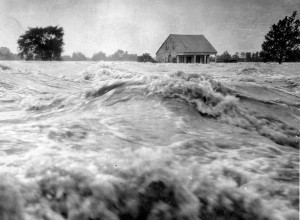 You can see many historical photos from the flooding of Plaquemines and St. Bernard Parishes in 1927 caused by blowing up levees to protect New Orleans Business interests. You’ll be seeing similar photos shortly from the Atchafalaya Basin parishes shortly.
Enjoy your fill up at the pump and your morning wheat toast folks! Believe me, this isn’t to keep my city from another post-Katrina apocalypse even though that’s what they’re implying.
Monday Reads
Posted: May 9, 2011 Filed under: abortion rights, American Gun Fetish, Barack Obama, Economy, fetus fetishists, GLBT Rights, Global Financial Crisis, John Birch Society in Charge, New Orleans, PLUB Pro-Life-Until-Birth, religious extremists, Reproductive Rights, the villagers | Tags: Bonnet Carre Spillway, Chas Bono, Lousiana, Mississippi River Flooding, Morganza Spillway, transgen, Vanessa Redgrave 18 Comments Good Morning!!!
Hopefully, you had a great weekend! The weather’s been nice here but we’re mostly focused on all that water coming down the Mississippi towards us. The Bonnet Carrre Spill Way opened today at 8 am to release some of the river water in to Lake Pontchartrain. The Corps has requested that the Morganza Spillway be opened too. The last time it was opened was in 1973 when Nixon was still president. That’s more controversial because it will flood farms and land but will help maintain the levees in Baton Rouge and New Orleans. We’ll have to see who wins that one.
If granted, the Corps plans to open the Morganza Thursday. This could create water up to 25-feet deep in spots.
In Terrebonne Parish, low-lying areas in the Western end are vulnerable to flooding, up to five feet. Parish president Michel Claudet tells FOX 8 he’s worried people don’t realize what could happen. Claudet says there’s a plan to sink a giant barge in Bayou Chene. Essentially, it would serve as a temporary dam to reduce the backflow of water into St. Mary and Terrebonne Parishes. Bayous and creeks are already filling up and public works crews were out, looking for low areas to reinforce.
Opening the Morganza Spillway would require the evacuation of people and livestock in the Atchafalaya River Basin. About 30 miles Northwest of Baton Rouge, West Feliciana Parish is bracing for the worst. If the Morganza opens, the Corps projects possibly 25-feet of water in some areas.
“We’re going to do what we can you know,” said Brad Smith of St. Francisville. He was rushing to his Cat Island hunting camp to shore it up, hoping he can get it higher than the water. “I mean you have money invested in a camp, you know your heart’s there, and you want to save it,” said Smith.
Friday, residents in the Stephensville-Belle River area North of Morgan City built walls of sandbags around their properties. Saturday, they were being urged to self-evacuate.
Governor Jindal believes that the flooding is certain anyway.
Land and structures in the Morganza Spillway will flood, even if the U.S. Army Corps of Engineers does not open the gates, Commissioner of Agriculture Mike Strain and Gov. Bobby Jindal said today.
“It is inevitable that Morganza will flood and the system will top, regardless of whether they open the system,” Strain said at a press conference at the Governor’s Office of Homeland Security.
Jindal said he has asked the Corps of Engineers to provide maps of areas that are anticipated to flood, with and without opening the gates. He said he wants people who would be affected to be able to prepare before the water starts rising.
“Even without opening the spillway, folks can expect flooding comparable to 1973,” the governor said. “If they decide to open the spillway, it will be more water.”
This will be historical either way. I remember when they had to open the Bonnet Carre Spillway last spring because the river was so high. I live a few blocks from the Mississippi. The river was so high the boats were riding on the river at about the same level as the street. It look like the oil tankers were traveling on the next road over. I usually only see the very tops of these ships. It’s a strange feeling to think you’re sharing the road with huge ships.
So, since we’re talking about the Nixon years, I might as well offer up the Daily Mail’s first glimpse at the biography of Vanessa Redgrave. In part 2 of a three-part excerpt from the book, the Mail covers Redgrave’s political career.

Vanessa Redgrave as a Workers Revolutionary Party parliamentary candidate in 1974
The article’s interesting title is Vanessa Redgrave and the red sex slaves: How her bid to start Marxist revolution plunged her into bizarre scandal.
Never a shrinking violet, Vanessa Redgrave knew exactly what to do when she found a listening device in an electrical socket at her home. She called a Press conference.
It was common knowledge, she told the world in thrilling theatrical tones, that the internal security service MI5 had been bugging her conversations since she’d been a member of a Trotskyist organisation called the Workers Revolutionary Party.
Well, she wasn’t going to stand for it. So she was making a formal complaint to the European Commission, claiming that MI5 had violated her human rights.
Unfortunately, her grand gesture fell flat. Not only did the EU maintain that bugging radicals such as Vanessa Redgrave was ‘necessary in a democratic society’ — but it turned out that the bug had nothing to do with MI5 in the first place. It had been planted by a rival Left-wing faction.
Anyone else might have been utterly humiliated at making a fool of themselves, but not Vanessa. As her daughter Natasha once said, it never bothered her that she wasn’t liked — because being disliked gives her enormous freedom.
This is one celebrity biography that I can’t wait to read.
I first got the OBL kill news via CNN breaking news. The NYT is trying to claim the credit for the story. The truth is that it broke on twitter and was leaked by an aide of Donald Rumsfeld. Here’s the tick tock according to Felix Salmon.
Brisbane is the NYT’s ombudsman, and today he describes the way that the paper broke the news of Osama Bin Laden’s death. Well, he can’t do that, because the NYT didn’t break the news of Osama Bin Laden’s death. But he ignores the people who did break the news, and just tells the story of how the official NYT machine worked. His story starts at 10:34 last Sunday night, when a source told NYT reporter Helene Cooper that Osama had been killed. By 10:40, an alert was up on nytimes.com. Then, by Brisbane’s account, Twitter got involved:
One minute after Ms. Cooper’s news alert was posted on the Web, Jeff Zeleny, The Times’s national political correspondent, posted on Twitter: “NYT’s Helene Cooper confirming that Osama Bin Laden has been killed. President to announce shortly from the White House.”
At virtually the same time, Jim Roberts, an assistant managing editor, sent a similar Twitter message. Next to come was an automated Twitter post generated by NYTimes.com, regurgitating the original news alert.
Those links are all Brisbane’s, by the way, including the rather hilarious link to the homepage of the very site his column is on. All of the links are internal; none are to the actual tweets in question. But here’s the first tweet that Brisbane mentions, from Zeleny. As Brisbane says, it was posted at 10:41pm.
For a very different look at how the Osama news broke check out SocialFlow’s exhaustive analysis of 14.8 million tweets on Sunday night. As far as Twitter is concerned, the news was broken by Keith Urbahn at 10:24pm. But it really got momentum from being retweeted at 10:25pm by NYT media reporter Brian Stelter, who added the crucial information that Urbahn is Donald Rumsfeld’s chief of staff. Urbahn, here, gets the goal, but Stelter absolutely gets the assist …
The first real interview of the president on the OBL operation was seen Sunday Night. If you want to see the 60 Minutes Interview with President Obama that covers the OBL kill operation you can see it here.
All Three Branches of Government are Broken
Posted: April 10, 2011 Filed under: Crime, Media, New Orleans, POTUS, Psychopaths in charge, U.S. Politics | Tags: broken government, crime, Death Penalty Information Center, death row, Democrats, executive, Harry Connick Sr., John Thompson, judicial, legislative, murder, New Orleans, racial inequality, Republicans, Supreme Court, The Innocence Project, U.S. Politics 35 Comments
Over the past 2-1/2 years, we’ve seen how broken the executive and legislative branches of the U.S. government are. We have a president who refused to stand up to the minority party while his party had historic majorities in both houses of Congress. Thanks to this president’s weak-kneed fealty to “bi-partisanship” and his predictable willingness to cave to the Republicans on just about any issue, he no longer has a supermajority in Congress.
Blue Texan at FDL makes a very good case for why Obama and the Democrats lost in 2010.
Democrats lost because they lost independents by 15 points, and independents don’t care what liberals think.
So why did Democrats lose independents?
Because the economy hadn’t improved enough because the stimulus bill was inadequate. It didn’t help matters that the Affordable Care Act was stripped of its most popular feature [a public option] or that HAMP was a total failure or that the Democrats punted on immigration and host of other progressive goals — but it was mostly about the economy.
The lesson, then, is…that Democrats need to deliver — especially when they promised CHANGE YOU CAN BELIEVE IN — and when they don’t, they lose elections.
For the past few weeks, we’ve seen the House Republicans and the White House bicker over cutting the budget when what we really need to do is raise taxes on the richest Americans. If Obama had any guts at all, he would have refused to extend the Bush tax cuts period. But, because he’s a lily livered wimp, he caved.
Today, Nicholas Kristof said the Congresspeople are acting like junior high school children.
It’s unclear where the adults are, but they don’t seem to be in Washington. Beyond the malice of the threat to shut down the federal government, averted only at the last minute on Friday night, it’s painful how vapid the discourse is and how incompetent and cowardly our leaders have proved to be.
Kristof doesn’t specifically chide Obama, but come on. If he weren’t so focused on getting “bipartisan support” for every initiative, he could have accomplished much more and gotten more respect from the Republicans at the same time. He was and is still simply too inexperienced to do the job of POTUS.
Tonight I want to put the spotlight on the third branch of government. Our judicial system is broken too. We have an epidemic of wrongful convictions in our justice system, and we have an ultra-right wing majority in the Supreme Court that refuses to do anything about it.
As of February 4, 2011, 250 wrongly convicted people had been exonerated by DNA testing, according to The Innocence Project,
There have been 268 post-conviction DNA exonerations in United States history. These stories are becoming more familiar as more innocent people gain their freedom through postconviction testing. They are not proof, however, that our system is righting itself.
The common themes that run through these cases — from global problems like poverty and racial issues to criminal justice issues like eyewitness misidentification, invalid or improper forensic science, overzealous police and prosecutors and inept defense counsel — cannot be ignored and continue to plague our criminal justice system.
According to the Death Penalty Information Center, more than 130 people have been released from death row because they were exonerated based on evidence that proved they were innocent. The chart below shows those exonerations state by state. The chart comes from a fact sheet (PDF) produced by the Death Penalty Information Center.
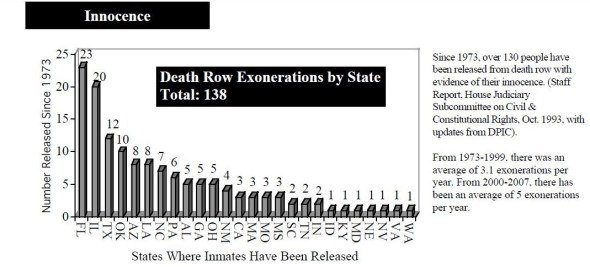
I’m sure I don’t need to tell you that about 70% of the people who have been exonerated are members of minority groups–mostly African Americans. One of the most frequent causes of false convictions is prosecutorial misconduct. For more information on this problem, see this report (PDF) by the Innocence Project. In late March, the Supreme Court basically gave carte blanche to dishonest prosecutors by deciding that a wrongfully convicted man who had spent 14 years on death row has no right to sue for damages. From the LA Times:
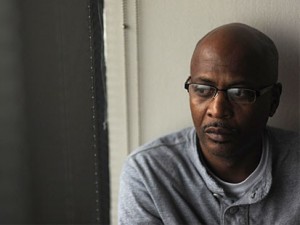
John Thompson
A bitterly divided Supreme Court on Tuesday tossed out a jury verdict won by a New Orleans man who spent 14 years on death row and came within weeks of execution because prosecutors had hidden a blood test and other evidence that would have proven his innocence.
The 5-4 decision delivered by Justice Clarence Thomas shielded the New Orleans district attorney’s office from being held liable for the mistakes of its prosecutors. The evidence of their misconduct did not prove “deliberate indifference” on the part of then-Dist. Atty. Harry Connick Sr., Thomas said.
Justice Ruth Bader Ginsburg emphasized her disapproval by reading her dissent in the courtroom, saying the court was shielding a city and its prosecutors from “flagrant” misconduct that nearly cost an innocent man his life.
“John Thompson spent 14 years isolated on death row before the truth came to light,” she said. He was innocent of the crimes that sent him to prison and prosecutors had “dishonored” their obligation to present the true facts to the jury, she said.
Besides Justice Ginsburg, Justices Sonia Sotomayor, Stephen Breyer and Elena Kagan also dissented from the majority opinion.
The Supreme Court has consistently shielded prosecutors from accountability for misconduct in the past, but Thompson had sued the New Orleans District Attorney’s office, claiming the office had demonstrated a “pattern of wrongdoing” and had failed to ensure that its attorneys obeyed the law. Now the Supremes have eliminated another check against willful misconduct by prosecutors.
Here from NPR is a brief summary of the case against Thompson:
In December of 1984, Raymond Liuzza Jr., the son of a prominent New Orleans business executive, was shot to death in front of his home. Police, acting on a tip, picked up two men, Kevin Freeman and John Thompson.
Thompson denied knowing anything about the shooting, but Freeman, in exchange for a one-year prison sentence, agreed to testify that he saw Thompson commit the crime.
Prosecutors wanted to seek the death penalty, but Thompson had no record of violent felonies. Then, a citizen saw his photo in the newspaper and implicated him in an attempted carjacking — and prosecutors saw a way to solve their problem. John Hollway, who wrote a book about the case, said the solution was to try the carjacking case first.
A conviction in the carjacking case would yield additional benefits in the subsequent murder trial, Hollway observes. It would discredit Thompson if he took the stand in his own defense at the murder trial, so he didn’t. And the carjacking would be used against him during the punishment phase of the murder trial.
It all worked like a charm. Thompson was convicted of both crimes and sentenced to death for murder.
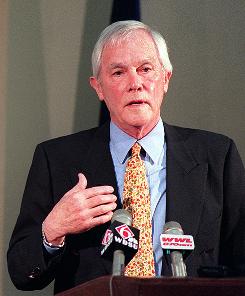
Harry Connick, Sr.
Ten years later, after Thompson’s appeals were exhausted and he was days from be executed, an investigator for his attorneys found that the blood of the perpetrator had been left at the scene of the murder. The lab report showed that Thompson had a different blood type than the person who committed the crime. The DA had deliberately concealed this information from the defense.
At a new trial, more exculpatory evidence that had been suppressed by the DA was presented–10 pieces of evidence in all–and the jury acquitted Thompson in half-an-hour. Thompson then sued and won a $14 million judgment against Connick and the NOLA DA’s office. But, now the right wingers on the Court have nullified that judgement.
On March 31, the editors of The New York Times wrote that a lack of empathy led to this injustice.
The important thing about empathy that gets overlooked is that it bolsters legal analysis. That is clear in the dissent by Justice Ruth Bader Ginsburg. Her empathy for Mr. Thompson as a defendant without means or power is affecting. But it is her understanding of the prosecutors’ brazen ambition to win the case, at all costs, that is key.
After detailing the “flagrant indifference” of the prosecutors to Mr. Thompson’s rights, she makes clear how critically they needed training in their duty to turn over evidence and why “the failure to train amounts to deliberate indifference to the rights” of defendants.
The district attorney, Harry Connick Sr., acknowledged the need for this training but said he had long since “stopped reading law books” so he didn’t understand the duty he was supposed to impart. The result, Justice Ginsburg writes, was an office with “one of the worst” records in America for failing to turn over evidence that “never disciplined or fired a single prosecutor” for a violation.
One thing about conservatives, they rarely show any empathy or compassion for anyone who isn’t just like them.
Today John Thompson himself contributed an op-ed to the NYT. Please read the whole thing, but here is just a bit.
I SPENT 18 years in prison for robbery and murder, 14 of them on death row. I’ve been free since 2003, exonerated after evidence covered up by prosecutors surfaced just weeks before my execution date. Those prosecutors were never punished. Last month, the Supreme Court decided 5-4 to overturn a case I’d won against them and the district attorney who oversaw my case, ruling that they were not liable for the failure to turn over that evidence — which included proof that blood at the robbery scene wasn’t mine.
Because of that, prosecutors are free to do the same thing to someone else today.
[….]
The prosecutors involved in my two cases, from the office of the Orleans Parish district attorney, Harry Connick Sr., helped to cover up 10 separate pieces of evidence. And most of them are still able to practice law today.
Why weren’t they punished for what they did? When the hidden evidence first surfaced, Mr. Connick announced that his office would hold a grand jury investigation. But once it became clear how many people had been involved, he called it off.
According to NPR, former DA Harry Connick Sr. “feels vindicated” by the SCOTUS decision.
“I think that he committed … a murder, and I think that obviously we thought we had enough evidence to gain a conviction,” he says. “So I was delighted that the Supreme Court ruled in our favor.”
Never mind the ten pieces of exculpatory evidence that his prosecutor covered up in order to convict Thompson. And, by the way, the prosecutor confessed what he had done to a friend, so it was no accident. Relatives of the murdered man, Ray Liuzza, still believe Thompson is guilty. Liuzza’s sister
Maurine Liuzza said she has reviewed all of the evidence in the case and still believes that Thompson is guilty.
“Just because you are found not guilty does not make you innocent,” she said.
It’s time for radical change in all three branches of our broken government.
Mega Tax breaks created Current State Budget Problems
Posted: March 30, 2011 Filed under: John Birch Society in Charge, New Orleans, Surreality, The Bonus Class, The Great Recession, unemployment, Voter Ignorance, We are so F'd | Tags: Bobby Jindal's bad tax policy, industrial tax exemptions, Republican governors bankrupt their states with bad tax policies, state tax giveaways to businesses 53 Comments Because so many manufacturing plants and accompanying good jobs compare new locations with old when companies decided to recapitalize or expand, states feel compelled to become rivals to attract capital investments to their states. This intense rivalry to attract the few major employers left standing in the US economy leads many governors into basically giving away more benefits than the incoming or staying-put businesses became worth to the state and municipalities in the majority of cases. Many of the businesses would have stayed put even were they not given the tax breaks.
There is also a huge stake for these governors in upping their credibility for being able to attract business to the state. It serves many of them well at the ballot box, even when the public is not really aware of what’s been given away to attract a few jobs. Many of the worst offenders are Republican governors where flexing tax hating muscle is more importance than effective governance when heading to the Iowa/New Hampshire test grounds for higher office. The evidence is much clearer in states ruled by Republican governors. A recent study Zach Schiller, research director at Policy Matters Ohio, a liberal government-research group in Cleveland as reported by McClatchey shows how states like Ohio, Louisiana, Texas, Michigan and many others have basically bankrupted the state with business tax giveaways and aggressive tax cuts to the richest of the rich. This has also played out on the federal level. The severe flaws with these tax cuts have become evident as the economy sank during the global financial crisis and federal funds provided during the Obama stimulus have dried up.
Across the country, taxpayers jarred by cuts to government jobs and services are reassessing the risks and costs of a variety of tax reductions, exemptions and credits, and the ideology that drives them. States cut taxes in hopes of spurring economic growth, but in state after state, it hasn’t worked.
There’s no question that mammoth state budget problems resulted largely from falling tax revenues, rising costs and greater demand for state services during the recession. But questionable tax reductions at the state and local level made the budget gaps larger — and resulting spending cuts deeper — than they otherwise would have been in many states.
A 2008 study by Arizona State University found that that state’s structural deficits could be traced to 15 years of tax cuts, mainly income-tax reductions that “were not matched by spending cuts of a commensurate size.”
In Texas, which faces a $27 billion budget deficit over the next two years, about one-third of the shortage stems from a 2006 property tax reduction that was linked to an underperforming business tax.
In Louisiana, lawmakers essentially passed the largest tax cut in state history by rolling back an income-tax hike for high earners in 2007 and again in 2008.
Without those tax reductions, Louisiana wouldn’t have had a budget deficit in fiscal year 2010, the 2011 deficit would’ve been 50 percent less and the 2012 deficit of $1.6 billion would be reduced by about one-third, said Edward Ashworth, the director of the Louisiana Budget Project, a watchdog group.
The original source of all this tax cutting madness can probably be traced to California and the infamous Proposition 13. Prior to Prop 13, California was a state in an enviable position with wonderful, low cost schools and infrastructure that was the symbol of US modernity. The Reagan roll backs of taxes and passage of increased write offs for investment to stimulate capital investments provided similar short term boosts that have led to long term problems.
Before California’s Proposition 13 triggered a nationwide tax-cut revolt in the late 1970s, state and local taxes accounted for nearly 13 percent of personal income in 1972, Bartik said. By 2007, it was 11 percent.
State corporate income taxes have fallen as well. Once nearly 10 percent of all state tax revenue in the late ’70s, they accounted for only 5.4 percent in 2010.
“It’s a dying tax, killed off by thousands of credits, deductions, abatements and incentive packages,” according to 2010 congressional testimony by Joseph Henchman, the director of state projects at the Tax Foundation, a conservative tax-research center.
Even now, as states struggle to provide basic services and ponder job cuts that threaten their economic recovery, at least seven governors in states with budget deficits have called for or enacted large tax reductions, mainly for businesses.
Even now, both the President and members of both parties are talking corporate tax cuts when many households pay more in taxes to the IRS than the biggest of the multinationals. Here’s a article in Forbes from last year showing how GE and other major corporations that live off of federal contracts also manage to avoid federal tax obligations. Exxon-Mobile and Walmart are also tax avoiders. You can go read the details but I sought out this old article for this tidbit so you know why a lot of them can get away with paying so few taxes.
But it’s the tax benefit of overseas operations that is the biggest reason why multinationals end up with lower tax rates than the rest of us. It only makes sense that multinationals “put costs in high-tax countries and profits in low-tax countries,” says Scott Hodge, president of the Tax Foundation. Those low-tax countries are almost anywhere but the U.S. “When you add in state taxes, the U.S. has the highest tax burden among industrialized countries,” says Hodge. In contrast, China’s rate is just 25%; Ireland’s is 12.5%.
Corporations are getting smarter, not just about doing more business in low-tax countries, but in moving their more valuable assets there as well. That means setting up overseas subsidiaries, then transferring to them ownership of long-lived, often intangible but highly profitable assets, like patents and software.
The President is correct in that if we lowered the overall tax rate on corporations, these companies would be less likely to relocate overseas to a certain extent. This would have to be coupled with closing the loopholes that allow them to avoid many taxes. Right now, the loopholes make the effective corporate tax rate different from the published. This would be a gargantuan task as each congressman and senator has a business they protect with all their might. Even Democrats in Louisiana protect the oil and gas industry, as an example.
The odd thing about the problems with the state and all these tax giveaways to businesses is that their tax rates are a minor decision variable so giving them tax breaks doesn’t provide business much benefit but hurts the state. When I worked as a consultant to the Department of Economic Development in Nebraska back in the 80s, I found that what a lot of corporations actually looked for in business site were good schools, good recreational facilities, and just basically a great place to live. Omaha frequently lost out to many bids because it was considered a pretty boring place to live with few recreational opportunities. The weather was frequently one reason no one wanted to move there. It had no major sports teams for one. So, why are these governors gutting school budgets and public works programs when the same things that benefit the people in the state attract businesses to the area? I will never understand that one.
Many of the new tea party governors are cutting taxes like never before assuming that just giving away tax breaks will appease any potential business leaders and possible attract some new ones. This faith-based tax policy is based more on ideology than any actual data that shows tax breaks do any of that.
Business tax reductions may be overrated as an economic stimulus because they’re so low on the totem pole of expenses. For most businesses, the cost of labor is probably 15 times the cost of all state and local taxes, said Bartik of the Upjohn Institute.
In his own research, Bartik found that a 10 percent across-the-board cut in state and local business taxes might boost employment by 2 percent, but it could take up to 20 years.
“Most studies indicate you might get 30 percent of the effect after five years and maybe 60 percent after 10 years,” Bartik said. “It takes a while because investment decisions are quite lagged and take place gradually.”
Compounding Ohio’s budget woes are 128 state tax exemptions, credits and deductions that drain more than $7 billion a year in would-be revenue. These loopholes make Ohio miss out on one of every four dollars it would otherwise collect in taxes, said Schiller of Policy Matters Ohio.
In Missouri, business and individual tax credits cost the state $521.5 million in fiscal year 2010, compared with $103 million in 1998, according to a state report.
Louisiana’s 441 individual and corporate tax breaks cost the state $7.1 billion last year. That nearly matches the $7.7 billion that all state and local taxes brought in.
Some of the breaks provide sales-tax exemptions on groceries, prescription drugs and residential utilities that saved Louisiana taxpayers $717 million last year. But another allows Louisiana companies to keep 1 percent of the state sales taxes they collect — about $34 million statewide — just for filing their tax returns on time.
I’ve seen Louisiana go down hill pretty rapidly over the last few years. Roads are in disrepair. The students at the UNO business school actually clean their own classrooms and the building twice a week because the two janitors assigned to the huge 4 story building just can’t keep up with the duty. The unemployment system is a mess with waits of months to get a claim processed and a forced move to the phone and the computer or a 3 hour wait on the phone to actually talk to a person. I wouldn’t recommend any one locate here because just simply getting to a state employee these days is impossible. They’ve adopted the phone tree hell realm model of business. It’s worse than getting customer service from a large bank.
Still, conservative tax cut fanatics still spin their tales of being overtaxed and how the burden is driving business out of the country. Really, it’s not the taxes. Businesses are going overseas because that’s where the money is now. The ASEAN region is seeing a huge increase in middle class consumers. Not so where in the US where wages are stagnant at best. Historical data is showing that these state tax cuts are not only not bringing businesses to the states, but they are driving people away. As I found in my work, companies cannot attract and maintain good employees in states with bad schools, bad roads, horrible crime rates, and lack of basic services and recreation. That’s not what you hear from conservative “experts’ who ignore data to follow their tax cutting muse.
Hodge, a conservative, said that closing loopholes and exemptions was less harmful to the economy than tax increases were. The Tax Foundation supports scaling back or closing tax loopholes, while lowering tax rates across the board.
“My argument to state lawmakers is that lower rates for everybody are better than tax incentives for some,” Hodge said.
That incentive-free philosophy was behind Michigan Gov. Rick Snyder’s call for a flat 6 percent corporate income tax to replace the current business tax system. But Snyder’s flat tax amounts to a $1.5 billion tax cut for businesses, paid for in part by education cuts, personal income tax increases and taxing public and private pensions.
“We think that’s the way to rebuild our state, and to get it on a path toward economic prosperity,” Snyder’s top economic development official, Michael Finney, said during a recent trip to Washington.
History suggests otherwise, however. After the nation recovered from the 1990-91 recession, 43 states made sizable tax cuts from 1994 to 2001 as the economy surged. Twenty-eight states, in fact, reduced their unemployment insurance payroll taxes after 1995.
But states that cut taxes the most ended up with the largest budget shortfalls and higher job losses when the economy slowed again in 2001, according to research by the Center on Budget and Policy Priorities.
These are some truly startling conclusions that show just how far we’ve come from using data, economics, and basic accounting to make decisions at even the state level. When governors are ruling multiple important states based on political ideology and faith based economy policies, the country is in real trouble. Some of these folks–like Scott Walker–seem to be true-believers. Bobby Jindal is more of an opportunist than a true believer. His presidential ambitions have led him to make decisions he knows will hurt the state. He’s done nothing but pursue an agenda that will serve his ambitions. I imagine that Rick Perry probably falls into that category too.
It is absolutely necessary that people know that there are direct effects of bad tax policy. It is not only evident in schools, roads, and basic goods in services, it is also evident in the types of people that start leaving your state. Most of the states with these problems are also having population shifts that make them look more like developing nations that countries with mature economies. The more they have tried to set up the rules in favor of businesses doing what they want, the more they lose the types of workers and residents that appreciate and demand good government services. I’ve said this many times, but I had no problem paying my high tax bill in Minnesota because I could see the money put to good use daily in my world class roads, schools, and recreational facilities. I begrudge giving Bobby Jindal a dime because I figure it will only go to enrich people that don’t need anything from me to begin with.
This is a situation that more people need to learn about and discuss. Please take the time to review some of the startling statistics in the McClatchy article. Each state usually has a non-profit group, like Policy Matters Ohio or Louisiana Budget Project, that closely follows these actions. I’d recommend you find the group for your state and become informed. I know most of you aren’t my neighbors, but the LBP has a great report up on how Jindal has basically turned my state into a business subsidy haven that has shown to be the most inefficient in the country. Here you can see directly how these tax give-aways are not producing good results.
According to the most recent report from the Louisiana Board of Commerce and Industry, Industrial Tax Exemptions awarded in 2010 are estimated to cost Louisiana over $946 million over the next ten years. In 2009, Louisiana awarded exemptions worth $745 million and in 2008, over $614 million. That means that over a three-year time span, more than $2.3 billion in potential revenue has been lost in return for the creation of 7,256 potential new jobs.
The most recent report, dated August 2010, identified 592 companies and corporations across the state that qualified for the exemption. These companies employ over 206,128 jobs and created 2,537 new jobs. Louisiana consistently awards these ten-year property tax breaks for dozens of multi-national industrial giants that have little need for state subsidies.
You might at least be interested to see the companies on the list. Most of them are from the oil industry which is of course in a period of incredible profitability and can’t relocate to Orlando or Atlanta even if they wanted to. They are here for our oil. Anyway, I hope this information stimulates a good discussion.

 peej
peej Carissa
 bostonboomer
 dakinikat
 ecocatwoman
 mablue2
 Mama Lopez
 peggysue22
 quixote
 skydancingguestblogger
 Mona (aka Wonk the Vote)



 Sky Dancing
Recent Comments