
Mostly Monday Reads: Whitewashing Indigenous Peoples’ Day
Posted: October 13, 2025 Filed under: #FARTUS, #MAGAnomics, #We are so Fucked, kakistocracy, Polycrisis | Tags: Stagflation, Trump Chaos and Incompetency, Trump Stagflation, Trump Tarriffs, Trump Unemployment, Trump War on Science, Trup War on History 7 Comments
“If it looks like a pig, smells like a pig, acts like a pig….” John Buss, @repeat1968
Good Day, Sky Dancers!
Today, we celebrate the Indigenous tribes of America. Joe Biden was the first president to recognize the day in 2021. We still haven’t dropped Columbus Day, which glorifies a man who truly represents the worst of European colonization of other continents.
Christopher Columbus has become a controversial figure over the years, despite the federal holiday in his honor. While many credit the explorer with “discovering” America, many others condemn Columbus for forced conversion of native peoples to Christianity, the use of violence and slavery, and the introduction of new diseases that would cause serious and long-lasting harm to Indigenous people.
In 2021, former President Joe Biden became the first president to recognize Indigenous Peoples Day, celebrating it in tandem with Columbus Day. In 2025, President Donald Trump issued a proclamation condemning critics of Columbus.
 Yes, you read that right. Trump issued one of his ugly proclamations, criticizing those of us who don’t stand by whitewashed history. Yam Tits and his ugly band of White Christian Nationalists reject the idea that anyone but them created places worth saving and celebrating.
On Oct. 9, Trump issued a proclamation titled “Columbus Day, 2025.”
Trump celebrated Italian explorer Columbus as “the original American hero” in the proclamation, accusing his critics of slander.
“Outrageously, in recent years, Christopher Columbus has been a prime target of a vicious and merciless campaign to erase our history, slander our heroes, and attack our heritage,” reads the proclamation.
Meanwhile, in the world of bill paying and trying to live, it’s still the Economy Stupid! This is from Reuters. “How the United States is eating Trump’s tariffs.” This is reported by “Francesco Canepa and Howard Schneider.”
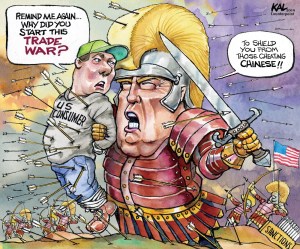
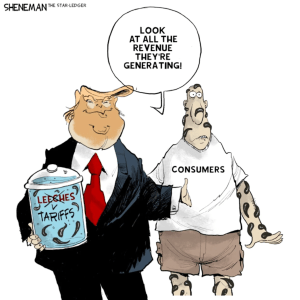
U.S. companies and consumers are bearing the brunt of the country’s new import tariffs, early indications show, contradicting assertions by President Donald Trump and complicating the Federal Reserve’s fight against inflation.
Trump famously predicted that foreign countries would pay the price of his protectionist policies, wagering that exporters would absorb that cost just to keep a foothold in the world’s largest consumer marketBut academic studies, surveys and comments from businesses show that through the first months of Trump’s new trade regime it is U.S. companies that are footing the bill and passing on some of it to the consumer – with more price hikes likely.
“Most of the cost seems to be borne by U.S. firms,” Harvard University professor Alberto Cavallo said in an interview to discuss his findings. “We have seen a gradual pass-through to consumer prices and there’s a clear upward pressure.
A White House spokesperson said “Americans may face a transition period from tariffs” but the cost would “ultimately be borne by foreign exporters.” Companies were diversifying supply chains and bringing production to the United States, the spokesperson added.
Cavallo and researchers Paola Llamas and Franco Vasquez have been tracking the price of 359,148 goods, from carpets to coffee, at major online and brick-and-mortar retailers in the United States.
They found that imported goods have become 4% more expensive since Trump started imposing tariffs in early March, while the price of domestic products rose by 2%.The biggest increases for imports were seen in goods that the United States cannot produce domestically, such as coffee, or that come from highly penalised countries, like Turkey.
These price hikes, while material, have been generally far smaller than the tariff rate on the products in question – implying that sellers were absorbing some of the cost as well.
Yet U.S. import prices, which don’t include tariffs, showed foreign exporters have been raising their prices in dollars and passing on to their U.S. buyers part of the greenback’s depreciation against their currencies.
“This suggests foreign producers are not absorbing much if any of the U.S. tariffs, consistent with prior economic research,” researchers at Yale University’s Budget Lab think-tank said in a blog post.
National indices of export prices paint the same picture. The cost of goods exported by China, Germany, Mexico, Turkey and India have all risen, with Japan the only exception.
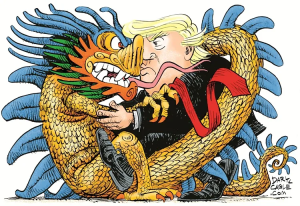 Dr. Paul Krugman has a serious economic analysis of the evolving trade relationship between the US and China today in his Substack. “How Trump Is Making China Great. Why we’re going to lose the trade war, and much more besides.” Yes, we’re still practicing the dismal science, but being forewarned is better than being caught unprepared.
There is, however, one big difference between Trump’s trade policy and China’s. Namely, the Chinese appear to know what they’re doing.
It should have been obvious from the beginning that if America were to get into a full-scale trade war with China, the Chinese would have the upper hand. For one thing, in real terms China has the bigger economy.
Furthermore, while our economies are interdependent, America is more vulnerable to a rupture than China is. True, Chinese industry has relied to an important degree on sales to the United States. But the U.S. economy is dependent on China for critical inputs, above all those rare earths. And here’s the thing: China can quickly compensate, at least in part, for the loss of the U.S. export market by stimulating domestic demand. Given time, America could wean itself from dependence on Chinese inputs — but doing so would take years.
That said, a year ago the United States still had some important advantages over China. Although China has made great strides in science and technology, America still had a commanding position, thanks in large part to our unmatched research establishment, our great research universities, and our ability — thanks in large part to the openness of our society — to recruit talent from all over the world.
Furthermore, America had allies — which, as Phillips O’Brien emphasizes, are a vastly underrated source of national power. China may sometimes make alliances of convenience, but no more than that. The U.S. could and did build a powerful alliance system, because America was more than a nation: It was an idea and a set of values, values we shared with the rest of the democratic world. And you should always bear in mind that Europe, in particular, while it sometimes acts weak, is an economic superpower in the same league as China and America.
OK, you know what’s coming: Since taking office, Trump and his minions have been systematically demolishing each of these pillars of U.S. strength.
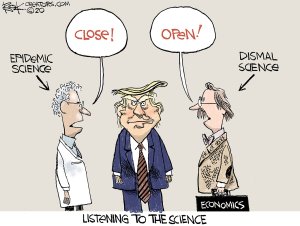
 The first pillar mentioned, and the most obvious, is the destruction of the institutions and incentives that support scientific research, which include universities, private industry, and government agencies. You may read more details on that at the link. It’s been rather obvious to most of us, but his list is a good, quick reference.
This administration is characterized by cruelty and incompetence. The absolute destruction of government institutions and specialists made to enhance advancements that private industries can’t afford to fund profitably is a hallmark of both. Nowhere is this felt more than in institutions that support Public Health. Firing experts, then attempting to either rehire or replace them, is unbelievably disruptive to any science-based endeavor. This article is from CNN’s Brenda Goodman and Meg Terrill. “More than half of CDC staffers recently fired by Trump administration have been reinstated.”
Hundreds of staff fired from the US Centers for Disease Control and Prevention late Friday have been reinstated, according to the American Federation of Government Employees.
After a new round of layoff notices sent late Friday night to around 1,300 workers at the CDC, approximately 700 were reinstated on Saturday, while about 600 remain laid off, according to the union, which represents federal workers.
“The employees who received incorrect notifications were never separated from the agency and have all been notified that they are not subject to the reduction in force,” said Andrew Nixon, director of communications for the US Department of Health and Human Services.
Among reinstated employees are staff that publish the agency’s flagship journal, Morbidity and Mortality Weekly Report, according to Dr. Debra Houry, who recently resigned as the agency’s chief medical officer and deputy director for program and science. Houry and other high-level CDC officials resigned in August in protest over the firing of recently confirmed CDC Director Dr. Susan Monarez.
Athalia Christie, the incident commander for the measles response, was among hundreds of employees mistakenly fired on Friday. The annual total of measles cases in the US – now up to 1,563 cases since January – is the highest by a significant margin since measles was declared eliminated in America a quarter-century ago.
Staff were also reinstated at the CDC’s National Center for Immunization and Respiratory Diseases, the Global Health Center, and the Public Health Infrastructure Center, which manages more than $3 billion in grants to 107 state and local governments to help build local public health workforces, said Dr. Brian Castrucci, who is president and chief executive officer of the de Beaumont Foundation, a nonprofit that advocates for public health workers.
Staff and officers at the CDC’s Epidemic Intelligence Service who were able to check their emails have also received notices that their firings were in error, according to a CDC official with knowledge of the situation who asked not to be named for fear of retaliation.
 An analysis of the jobs and people reinstated is provided in the article. Meanwhile, the inhumanity and violence surrounding operations by ICE continue. Andrew Schwartz reports this headline. Documents Allege a Federal Agent at Portland ICE Threatened to Shoot an Ambulance Driver. Feds delayed medics who had come to pick up an injured protester. Then, according to confidential incident reports, the agents became aggressive.”
Late on Oct. 5, a Portland ambulance crew informed dispatchers over the radio that it was attempting to transport a patient from U.S. Immigration and Customs Enforcement to Legacy Emanuel Medical Center but that ICE officers were impeding its departure. Six minutes later, at 9:40 pm, according to publicly archived radio records, the medic driving the vehicle delivered an update: “We are still not being allowed to leave by ICE officers.”
Two confidential incident reports obtained by WW offer insight into what was going on inside the South Portland ICE facility at the time. The written accounts were filed by the ambulance crew members shortly after the incident—one report to their employer, American Medical Response, and another to a union representative—as documentation, as one report puts it, of a “conflict with federal agents.”
The two reports, filed by different medical workers, mirror each other’s accounts, and are consistent with publicly available audio recordings of emergency medical services radio communications, as well as 911 calls and dispatch reports obtained under public records law.
Both reports say that federal agents, in an effort to block the ambulance’s departure, stood directly in front of the vehicle. As the delay dragged on, according to the reports, the ambulance operator put the vehicle into park, causing it to lurch forward slightly.
The reports indicate the federal agents did not like this—so much so that an agent threatened to shoot and arrest the driver. The driver, frightened, asked why. An agent, according to the reports, responded that the driver had attempted to hit him with the ambulance.
“I was still in such shock,” the driver later wrote, “that they were not only accusing me of such a thing, but crowding and cornering me in the seat, pointing and screaming at me, threatening to shoot and arrest me, and not allowing the ambulance to leave the scene. This was no longer a safe scene, and in that moment, I realized that the scene had not actually been safe the entire time that they were blocking us from exiting, and that we were essentially trapped.”
 The latest child abduction by ICE has occurred in Boston. This is from MASS LIVE. “Mass. 13-year-old was picked up by ICE after a police interaction and now he’s hundreds of miles from home.” The story was filed by Adam Bass. Is this really the kind of country we want to live in?
A 13-year-old boy from Everett who was arrested and detained by Immigration and Customs Enforcement (ICE) has been transferred to a juvenile facility in Virginia.
Andrew Lattarulo, of Georges Cotes Law, said his firm received an email from the U.S. Attorney’s Office confirming the child was transferred on Friday at 9:30 a.m. He forwarded the email to MassLive.
The boy is still in custody, Lattarulo said.
The transfer occurred on the same day Judge Richard G. Stearns of the Boston federal court ordered the boy’s release by Tuesday unless ICE and the Department of Homeland Security could provide grounds for continued detention, according to court documents
ICE arrested the boy, whose family is from Brazil, after an interaction with the Everett Police Department, the Boston Globe reported.
The boy’s mother received a call on Thursday to pick her son up from the department; however, an hour and a half later, she was told ICE had taken her son, the Globe reported.
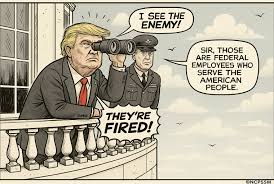 Something is very wrong with a human being who can support this level of cruelty. Meanwhile, The Hill‘s Emily Brooks reports on the callous and snivelling Speaker of the House’s latest shrug. “Johnson: ‘We’re barreling toward one of the longest shutdowns in American history’.
Speaker Mike Johnson (R-La.) said Monday the government shutdown is on its way to being one of the longest in history unless Democrats accept the House-passed, GOP-crafted stopgap bill to reopen the government.
“We’re barreling toward one of the longest shutdowns in American history, unless Democrats dropped their partisan demands and passed a clean, no-strings-attached budget to reopen the government and pay our federal workers,” Johnson said in a press conference on the 13th day of the government shutdown.
Congressional leaders have been locked in a standoff over government funding as Democrats demand that Republicans make concessions on health care, notably Affordable Care Act tax credits that are expiring at the end of the year. Republican leaders have refused to negotiate on health care during a shutdown, arguing that that Democrats must accept the “clean” funding stopgap the House passed in September — and which has failed to advance in the Senate seven times.
The shutdown, 13 days and counting, already marks one of the longest federal government funding lapses in modern history.
The longest government shutdown, which was also the last time a federal funding lapse occurred, was from 2018 to 2019 during President Trump’s first term, lasting 35 days.
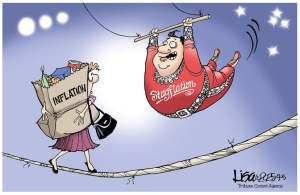 Things are not going to get better until we’re rid of these tinpot Republicans. The signs of stagflation and the accompanying suffering are on the increase. I’m going wonky on you again with this article from Investors Observer. “This is stagflation (literally): U.S. hiring crashes to recession levels as ‘second stagflation mountain’ rises.”
Stagflation is no longer just a rhetorical device to describe the U.S. economy in 2025.
Real signs of its toxic mix of stagnant growth and stubborn inflation are emerging across both the labor market and consumer prices, painting a grim near-term outlook.
According to Apollo chief economist Torsten Slok, the U.S. hiring rate, a number of hires as a percentage of total employment, has fallen to recessionary levels.
A recent Apollo chart comparing the quits rate and hiring rate shows that hiring has plunged to levels last seen during the 2020 pandemic crash, and is now approaching lows from the Global Financial Crisis.
With slower job growth and rising unemployment, Slok warned that the labor market is nearing a virtual standstill, “where workers are not getting hired or changing jobs.”
At the same time, inflation remains stubbornly high. A separate Apollo analysis found that 60% of the CPI basket is currently rising at an annualized rate above 3%, well above the Federal Reserve’s 2% target.
While that marks an improvement from recent months, when 72% of CPI components ran above 3%, the persistence underscores how broad-based inflation remains.
“Is a second inflation mountain emerging?” Slok asked, referencing the first inflation surge that began in 2021 and peaked in mid-2022 with headline CPI at 9.1%.
Together, the data of higher inflation and slower growth strengthen the case that the U.S. is now grappling with stagflation, a scenario the Fed may find difficult to reverse without triggering deeper economic pain.
 One and done! One of the most disruptive institutions since the Trump regime of Terror has been the Supreme Court. This report by Adam Lipak finally shows how the Republican Appointees really are christofascists trying to hide behind the cloak of Conservatism and Originalism. We’ve seen more radical interpretations by the Roberts court than not. This was published in the New York Times. “Originalist ‘Bombshell’ Complicates Case on Trump’s Power to Fire Officials. As the Supreme Court seems poised to expand the president’s power, a leading scholar whose work the justices have often cited issued a provocative dissent.”
The Supreme Court will hear arguments in December about whether President Trump can fire government officials for any reason, or no reason, despite laws meant to shield them from politics.
There is little question that the court will side with the president. Its conservative majority has repeatedly signaled that it plans to adopt the “unitary executive theory,” which says the original understanding of the Constitution demands letting the president remove executive branch officials as he sees fit.
But a new article, from a leading originalist law professor, has complicated and perhaps upended the conventional wisdom. The legal academy treated the development like breaking news.
“Bombshell!” William Baude, a law professor at the University of Chicago who himself is a prominent originalist, wrote on social media. “Caleb Nelson, one of the most respected originalist scholars in the country, comes out against the unitary executive interpretation” of the Constitution.
Professor Nelson, who teaches at the University of Virginia and is a former law clerk to Justice Clarence Thomas, wrote that the text of the Constitution and the historical evidence surrounding it grants Congress broad authority to shape the executive branch, including by putting limits on the president’s power to fire people.
Professor Nelson’s article was published Sept. 29 by the Democracy Project, an initiative at the New York University School of Law that plans to release 100 essays in 100 days by an ideologically mixed group.
The article is particularly notable, said Richard H. Pildes, who is a law professor at N.Y.U. and one of the project’s founders.
“If a highly respected originalist scholar like Professor Nelson, on whom the court relies frequently, denies that originalism supports the unitary executive theory,” Professor Pildes said, “that inevitably raises serious questions about an originalist justification for the court’s looming approach.”
Professor Nelson’s scholarship has been exceptionally influential. It has been cited in more than a dozen Supreme Court opinions, including ones by every member of the six-justice conservative majority.
Read more at the link.
It’s getting really difficult to be an American these days.
What’s on your Reading, Blogging, and Action list today?
Finally Friday Reads: Project 2025 Plan to Destroy America is Offical
Posted: October 3, 2025 Filed under: #FARTUS, #MAGAnomics, #We are so Fucked, People Power, Russell Vought, U.S. Politics | Tags: @repeat1968, Destruction of Federal Agencies, government shutdown 2025m, John Buss, Lousiana's Cancer Alley, People Power, Project 25, Russ Vought, Steven Brodner 6 Comments
“I’m pretty sure all the Military Brass are impressed that the Secretary of War had his own personal makeup room built in the Pentagon. John Buss, @repeat1968
Good Day, Sky Dancers!
Most of us knew that Project 2025 would be the basis of policy. Republicans have wanted an Imperial Presidency for some time. Republicans have elected at least 3 useful idiots as President with the goal of destroying American democracy in mind. It’s why we have a huge deficit, and spending has been concentrated on the rich who can pay-to-play to get massive tax cuts and huge government subsidies.
There are examples in every state they control. Here in Louisiana, the damage from oil extraction and affiliated chemical industries has created massive damage, and just at the precise time that the EPA has been fully filleted. Not only has nothing real been done to abate the chemical spill that happened earlier this summer after a poorly managed plant that exploded in Roseland, a primarily black community, but it has not been fully abated. The actions behind the removal of LSU’s premier Lake Maurapas researcher have become clearer. Today, Johns Hopkins Bloomberg School of Public Health released this important research. “Louisiana’s ‘Cancer Alley’ Is More Deadly Than Previously Imagined. New research shows that the industrial pollution—and the risk to human health—on Louisiana’s Cancer Alley have been significantly underestimated.
On an 85-mile stretch of the Mississippi River between New Orleans and Baton Rouge, communities exist alongside some 200 fossil fuel and petrochemical production plants. Since the 1980s, the area has been known as Cancer Alley.
These plants process about 25% of the U.S.’s petrochemical products, Peter DeCarlo, PhD, associate professor in Environmental Health and Engineering, said in the July 2 episode of Public Health On Call—with many of the byproducts and emissions winding up in nearby communities’ air, water, and soil.
Residents of these communities suffer the effects of extreme air pollution, including increased rates and risks of maternal, reproductive, and newborn health harms; respiratory illnesses; and cancer. One area has the highest risk of cancer from industrial air pollution in the U.S.—more than seven times the national average.
But new research from DeCarlo, Keeve Nachman, PhD ’06, MHS ’01, professor in Environmental Health and Engineering, and their teams shows that the pollution—and the risk to human health—has been significantly underestimated.
In this Q&A, adapted from that podcast episode, DeCarlo and Nachman discuss their work measuring levels of pollutants in Louisiana and explain what these conclusions mean for how the U.S. should regulate carcinogens.
We may be drowning in toxic chemicals, but other states and cities are experiencing ICE Raids that resemble SS maneuvers. Additionally, we have new threats. Since the reality on the ground has embarrassed the Trump plan to send the military to “wartorn” Portland to defuse his imagined war on the ground, he’s come up with an alternative plan. This is from ABC News. “Leavitt says Trump exploring cutting aid to Portland.”White House Press Secretary Karoline Leavitt said Trump is exploring plans to cut federal funding to Portland due to what she said was a rise in “Antifa” related incidents.”
“We will not fund states that allow anarchy,” she told reporters.
Antifa is not a group, but rather a political philosophy or movement. The term comes from the longer “anti-fascist” and is used as a catchall for groups that oppose the concept of authoritarianism, neo-Nazism and white supremacy.
 If you want to sum it up, try this hypothesis for size. Republicans are willing to let all of us starve and die as long as they can get paid for enabling modern-day Robber Barons.
About six months into this reign of terror, murder, and destruction, I’m still not certain the legacy media is getting the bigger picture. However, yesterday, an announcement by Trump made them perk their ears once more. Will it be enough? This is from the AP. “Trump no longer distancing himself from Project 2025 as he uses the shutdown to further pursue its goals.”
President Donald Trump is openly embracing the conservative blueprint he desperately tried to distance himself from during the 2024 campaign, as one of its architects works to use the government shutdown to accelerate his goals of slashing the size of the federal workforce and punishing Democratic states.
In a post on his Truth Social site Thursday morning, Trump announced he would be meeting with his budget chief, “Russ Vought, he of PROJECT 2025 Fame, to determine which of the many Democrat Agencies, most of which are a political SCAM, he recommends to be cut, and whether or not those cuts will be temporary or permanent.”
The comments represented a dramatic about-face for Trump, who spent much of last year denouncing Project 2025, The Heritage Foundation’s massive proposed overhaul of the federal government, which was drafted by many of his longtime allies and current and former administration officials.
You may recall that the implication of this document was central to the Democratic Party campaign. Kamala Harris made it a focal point of the convention and other speeches.
Top Trump campaign leaders spent much of 2024 livid at The Heritage Foundation for publishing a book full of unpopular proposals that Democrats tried to pin on the campaign to warn a second Trump term would be too extreme.
While many of the policies outlined in its 900-plus pages aligned closely with the agenda that Trump was proposing — particularly on curbing immigration and dismantling certain federal agencies — others called for action Trump had never discussed, like banning pornography, or Trump’s team was actively trying to avoid, like withdrawing approval for abortion medication.
Trump repeatedly insisted he knew nothing about the group or who was behind it, despite his close ties with many of its authors. They included John McEntee, his former director of the White House Presidential Personnel Office, and Paul Dans, former chief of staff at the U.S. Office of Personnel Management.
“I know nothing about Project 2025,” Trump insisted in July 2024. “I have no idea who is behind it. I disagree with some of the things they’re saying and some of the things they’re saying are absolutely ridiculous and abysmal. Anything they do, I wish them luck, but I have nothing to do with them.”
Trump’s campaign chiefs were equally critical.
“President Trump’s campaign has been very clear for over a year that Project 2025 had nothing to do with the campaign, did not speak for the campaign, and should not be associated with the campaign or the President in any way,” wrote Susie Wiles and Chris LaCivita in a campaign memo. They added, “Reports of Project 2025’s demise would be greatly welcomed and should serve as notice to anyone or any group trying to misrepresent their influence with President Trump and his campaign — it will not end well for you.”
Trump has since gone on to stock his second administration with its authors, including Vought, “border czar” Tom Homan, CIA Director John Ratcliffe, immigration hard-liner Stephen Miller and Brendan Carr, who wrote Project 2025’s chapter on the Federal Communications Commission and now chairs the panel.
Heritage did not respond to a request for comment Thursday. But Dans, the project’s former director, said it’s been “exciting” to see so much of what was laid out in the book put into action.
“It’s gratifying. We’re very proud of the work that was done for this express purpose: to have a doer like President Trump ready to roll on Day One,” said Dans, who is currently running for Senate against Lindsey Graham in South Carolina.
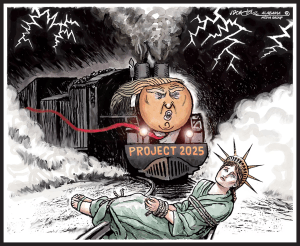 It was frequently averred that Stephen Miller was central to all plans for the project’s implementation. Only a few public intellectuals continued to warn of the plan and steps taken, while Yam Tit still shrugged off any implication that he was following the plan’s blueprint during the first six months. Well, that curtain has dropped.
AXIOS sums this evolution up neatly. “Trump charts path to total control amid government shutdown.’ This is reported by Zachary Basu.
President Trump is seizing on the government shutdown as an “unprecedented opportunity” to consolidate control in the Oval Office, accelerating a trend toward unchecked power.
Why it matters: Many Democrats see the shutdown as a necessary evil to halt — or at least slow — Trump’s steamrolling of democratic norms and independent institutions. So far, the standoff is only emboldening the White House.
Zoom in: Trump said he met Thursday with White House budget chief Russ Vought to discuss what “Democrat agencies” should get cuts, casting the shutdown as a chance to shrink a federal workforce Trump has long viewed as hostile.
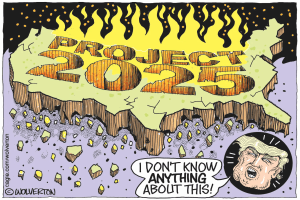
- Goading Democrats, Trump flaunted Vought’s role in Project 2025 (“he of PROJECT 2025 Fame”) — the hard-right blueprint for expanding executive power that Trump disavowed on the campaign trail after it became a political liability.
- For Vought, the shutdown offers a unique opening: a live test of theories he has spent years refining on how to weaken Congress, purge the bureaucracy and concentrate power in the presidency.
Already, Vought has announced the termination of nearly $8 billion in funding for clean-energy projects in 16 states, all of which voted for Kamala Harris in 2024 and have Democratic senators.
- He also has frozen $18 billion in New York City infrastructure projects, a thinly veiled shot at Senate Minority Leader Chuck Schumer (D-N.Y.) and House Minority Leader Hakeem Jeffries (D-N.Y.).
- Legal challenges are inevitable: Congress controls the power of the purse, and federal officials privately have warned that Vought’s plans for mass firings during the shutdown may violate appropriations law.
The big picture: As Axios has documented, the shutdown is only one front in Trump’s broader campaign of consolidation.
- Military: In an unprecedented partisan address this week, Trump told more than 800 generals and admirals to prepare for a “war” against domestic “enemies,” urging them to treat America’s cities as “training grounds.”
- Academia: The administration is asking universities to sign a 10-point “compact” that would grant preferential access to federal funding if schools agree to freeze tuition, protect conservative speech, apply strict definitions of gender, limit international students and other Trump priorities.
- Rule of law: Days after Trump publicly pressured Attorney General Pam Bondi to charge his political enemies, the Justice Department indicted former FBI director James Comey. Other Trump foes, including New York Attorney General Letitia James and Sen. Adam Schiff (D-Calif.), are under investigation.
- Civil society: FBI director Kash Patel severed ties with the Anti-Defamation League on Thursday, accusing the Jewish civil rights group of “functioning like a terrorist organization” after MAGA activists discovered that Charlie Kirk’s Turning Point USA was listed in its now-removed “Glossary of Extremism and Hate.” Trump also has urged the Justice Department to investigate Democratic megadonor George Soros’ Open Society Foundations as part of a crackdown on liberal groups following Kirk’s assassination.
- Corporate America: Trump demanded last week that Microsoft fire its head of global affairs, Lisa Monaco, because she served in the Biden administration — a reminder that even corporate giants aren’t immune from political retaliation. Trump had previously called on Intel’s CEO to resign over alleged ties to China, but backed off after the U.S. government took a 10% equity stake in the chip-maker.
 More at the link.
MSNBC’s Maddow Blog has this analysis. As usual, Steve Benen has the led. “Trump picks a convenient time to change his tune about the Project 2025 agenda. Remember last year when Trump feigned ignorance about the right-wing governing blueprint? A year later, the president no longer bothers with the pretense.”
As the second full day of the latest government shutdown got underway, Donald Trump published an odd message to his social media platform, which raised plenty of eyebrows throughout the political world.
“I have a meeting today with [White House Budget Director] Russ Vought, he of PROJECT 2025 Fame, to determine which of the many Democrat [sic] Agencies, most of which are a political SCAM, he recommends to be cut, and whether or not those cuts will be temporary or permanent,” the president wrote.
We don’t yet know what transpired at that meeting, but Trump’s weird phrasing was itself notable. For example, there are no federal departments or offices that should be called “Democrat Agencies.” There are only American agencies, which do work on behalf of the American people and which are currently led, at least in part, by Trump’s own appointees.
Similarly, the idea that federal agencies deserve to be condemned as “a political SCAM” is every bit as bizarre as it sounds. We’re talking about offices, some of which have been around for many years, that were created by Congress. Their existence is reinforced in federal law, which the president is required to enforce.
As for the possibility that Trump and the far-right head of his Office of Management and Budget might “permanently” weaken departments that the White House no longer likes, it’s worth keeping in mind that such efforts might very well be illegal.
But let’s also not brush past that other phrase: Vought, the president wrote, is “of PROJECT 2025 Fame.” As The Associated Press summarized:
President Donald Trump is openly embracing the conservative blueprint he desperately tried to distance himself from during the 2024 campaign, as one of its architects works to use the government shutdown to accelerate his goals of slashing the size of the federal workforce and punishing Democratic states.
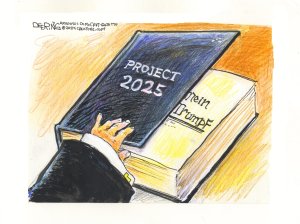
For those who might benefit from a refresher, throughout the 2024 campaign, Trump realized that the Project 2025 agenda was so radical and unpopular that he treated is as radioactive. “I know nothing about Project 2025. I have no idea who is behind it,” the Republican said over the summer about the blueprint largely written by members of his own team. He added, “I have nothing to do with them.”
 Here’s some analysis from Time Magazine‘s Editorial Fellow Connor Greene. “Trump Is No Longer Denying Support for Project 2025: What to Know.”
President Donald Trump has changed his tune on the conservative policy plan Project 2025 after actively distancing himself from it for months during his reelection campaign.
Trump announced on Thursday that he would be meeting with Office of Management and Budget Director Russell Vought, “he of PROJECT 2025 Fame,” to decide which “Democrat Agencies, most of which are a political SCAM, he recommends to be cut, and whether or not those cuts will be temporary or permanent.”
The post marks a significant shift from the President’s past disavowals of the unpopular right-wing policy blueprint, which was created by conservative think tank the Heritage Foundation ahead of the 2024 election. “I have nothing to do with Project 2025. I haven’t read it. I don’t want to read it, purposely. I’m not going to read it,” Trump said in a debate last year with former Vice President Kamala Harris.
Despite Trump’s repeated insistence that he didn’t know anything about Project 2025, however, he had close ties with a number of its authors, several of whom have served in his Administrations—including Vought. And since he returned to the White House in January his second Administration has taken steps to implement a number of the proposals detailed in the over 900-page document.
Now, amid the government shutdown, Trump is moving to further fulfill Project 2025’s goals of reducing the federal workforce and extending his executive powers—and, it appears, openly embracing the plan.
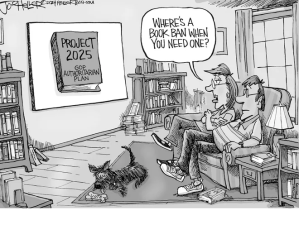 The big question sis what does this mean for the shutdown and the country?
Despite his criticisms of Project 2025, many of the Trump Administration’s actions since he returned to office have mirrored aspects of the blueprint. An analysis by TIME in January found that nearly two-thirds of Trump’s early executive actions reflected—in whole or in part—proposals in Project 2025.
Among the parts of the plan that Trump has carried out is its recommendation to aggressively reduce the size and scope of the federal government.
Trump and hisDepartment of Government Efficiency moved quickly to cut more than 200,000 federal employees, though some of the layoffs have since been held up in the courts after being challenged by lawsuits. His Administration has also looked to slash federal funding through various freezes, clawbacks, cuts, and recissions.
Trump has announced plans to execute still more cuts amid the government shutdown. In the leadup to the deadline to fund the government this week, the White House directed agencies to prepare for mass firings in the event that Congress couldn’t reach a deal, rather than furloughing those not deemed essential as in past shutdowns.
The Administration has additionally used the shutdown to cancel $8 billion in green energy projects in Democratic-led states, withhold $18 billion in transportation projects in New York City, and pause $2.1 billion in infrastructure projects in Chicago.
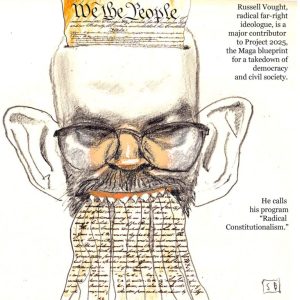 Here’s a just a bit of the latest information on Russell Voight. This startling headline is from Politico. “Thune warns Democrats about Russ Vought: ‘We don’t control what he’s going to do’ The Senate majority leader spoke out as some Republicans express qualms about the White House slash-and-burn campaign.” The reporter for this piece is Jourdain Carney.
Senate Majority Leader John Thune isn’t endorsing the slash-and-burn campaign White House budget director Russ Vought has planned for the federal government during the pending shutdown.
But he says Democrats have no one to blame for it but themselves.
“This is the risk of shutting down the government and handing the keys to Russ Vought,” the Senate majority leader said in an exclusive interview Wednesday in the Capitol, adding that “there should have been an expectation” among Democrats that Vought’s Office of Management and Budget could broadly target government workers and programs in a shutdown.
Thune spoke on the same day that several Republicans aired discomfort with Vought’s moves after the shutdown went into effect. Rep. Mike Lawler of New York spoke out against his decision to hold up major transportation projects in his state, while Reps. Blake Moore of Utah and Brian Babin of Texas spoke up on a private House GOP call with Vought raising qualms about potential mass layoffs.
Vought’s actions also risk being a distraction for Republicans, who have sought to stick to a simple message putting the onus on Democrats to reopen the government. Pressed on whether Vought was muddying the waters, Thune said, “The only thing I would say about that is yes, and we don’t control what he’s going to do.”
The White House has made no secret that its strategy is to inflict maximum political pressure on Democrats to try to get them to reopen the government. Vought warned ahead of the start of the shutdown that OMB would take aggressive steps beyond typical furloughs, where employees are brought back to work after the government reopens.
The budget office directed agencies in a memo first reported by POLITICO last week to put together plans for reductions-in-force — or firings — of federal employees. Vought himself told House Republicans during the Wednesday call that those firings would start in a “day or two.”
“I can’t control that,” Thune said about decisions made by OMB. “But the Democrats ought to think long and hard about keeping this thing going for a long time, because it won’t be without consequence, I’m sure.”
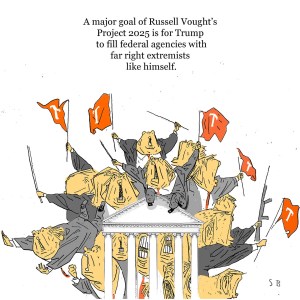 This final suggested read is from Mother Jones. “Russ Vought Is Trump’s Shutdown Hero. His Neighbors Think His Work Is “Abhorrent.” The people living near Trump’s “grim reaper” of government cuts have put up signs letting him know they stand with federal workers.” This is reported by Isabela Dias.
On Thursday night, President Donald Trump shared a music video on Truth Social. In it, an AI-generated Russ Vought—Trump’s director of the Office of Management and Budget and a Project 2025 mastermind—is the grim reaper, carrying a scythe along a hallway lined with portraits of Democratic leaders. Vought, the video’s soundtrack explains, “wields the pen, the funds, and the brain” to enforce the president’s plans to axe federal workers.
“Everyone still remembers when he said he wanted to cause maximum trauma to federal workers,” the neighbor said. “And that’s hard to forget.”
Most of Vought’s neighbors I talked to for this article declined to speak on the record or asked to remain anonymous. Some said they didn’t want to create a rift in an otherwise cordial neighborhood, while others worried about retribution or negative repercussions from their employers.
“I just wish he would have gotten to know us,” Hunter said. “We consider ourselves good Americans, we have good values. And I don’t think he’s been interested in getting to know any of us, in hearing if we might have a difference of opinion.”
Last week, Vought sent around a memo blaming Democrats’ “insane demands” for the imminent lapse in funding and instructing agency heads to start making plans to cut non-mandatory programs “not consistent with the President’s priorities” and “use this opportunity to consider Reduction in Force.” Appearing on Fox Business, Vought claimed an “authority to make permanent change to the bureaucracy here in government” during the shutdown.
He has since announced pauses to funding for infrastructure projects in New York—home state of House Minority Leader Rep. Hakeem Jeffries (D-New York), who called Vought a “malignant political hack”—and slowdowns in clean energy projects in several blue states.
Vought, Republican Sen. Mike Lee of Utah said on Fox News, “has been dreaming about and preparing for his moment since puberty.”
AsIwrote in a profile of Vought from 2024, the bespectacled official spent years as a Washington insider and government bureaucrat before becoming the architect of a supersized second Trump presidency.
An avowed Christian nationalist and dedicated America First warrior, he once described the job of OMB director as the “keeper of ‘commander’s intent” and criticized the federal bureaucracy for standing in the way of the president’s agenda. During Trump’s first term, Vought tried to implement an executive order that would have made it easier for political appointees to fire career civil servants and replace them with MAGA loyalists. Now, he’s getting to realize his vision while earning points with the president.
See what’s in the cards for us? Read them and weep. The Voight cartoons are from The Nation. They have a primar on Vought that you really should read. “Project 2025: Vought’s Your Problem? Not too bad to be true.” Steve Brodner is the artist and his cartoons have descriptions of their design. Go see the rest!
I’ve been a little late today, I’m sorry. I woke up late last night in a lot of pain and took some acetaminophen for relief. In my mind I was seeing it as some sort of ritual to defang Trump’s war on Health Care. I also got a call from youngest with my first grandson. Aiden, like his mémé is quite verbal. I really worked on this piece because I wanted to get as many sources as I could on this abomination and put my time in it than usual. I was researching stuff like the researcher I am. I am vorasciously reading up on this and I suggest you do too.
What’s on your Reading, Action, and Blogging list today?
Mostly Monday Reads: Of Protests, Grass Roots, and Boycotts
Posted: September 22, 2025 Filed under: #FARTUS, #MAGAnomics, #We are so Fucked, kakistocracy | Tags: @johnbuss.bsky.social John Buss, Charlie Boy Kirk hate speech, Defend the democracy, Donald Trump's Big Pirate Adventure, John Buss @repeat1968, Trump Team Grift and Incompetence 6 Comments
“It’s a movement!” John Buss, @repeat1968 (me: Check his diaper)
Good Day, Sky Dancers!
There are signs of democracy that indicate that a lot of us are not going to go peacefully into the dark night of authoritarianism. Instead, we’re going peacefully into the streets day after day to protest the takeover of American Cities by ICE and the military. The next big “No Kings” protest is on October 18th. It looks to be much larger than the first. The number of Americans concerned about First Amendment Speech Rights can be seen in the growing numbers impacting the Disney stock prices and sales. The outrage surrounding the firing of Jimmy Kimmel has grown into its own movement. You can see it in the numbers. Trump is extremely unpopular. You may see that in the numbers, too.
You may have noticed that I’m relying a lot on the Substacks of what are generally known as public intellectuals. Well-known researchers like Dr Paul Krugman and many others have switched from the Op-Ed pages of compromised newspapers to the platform. Happy little nerds like me thrive on folks who can produce the evidence.
Today, I give you “Strength in Numbers.” This is the substack of G. Elliot Morris, who calls himself a data-driven journalist. “A lot of powerful people just don’t realize how unpopular Trump is. The backlash to ABC/Disney canceling Kimmel shows why it’s important for businesses and the public to understand that two-thirds of Americans are not Trump voters.” It’s hard to fight back against an executive branch full of incompetence, extremist thinking, and chaos. However, underlying trends and events show that the resistance is clearly growing. Go look at the graph. To describe the increase in the number of Google searches for “Cancel Disney” is eye-popping.
Last week, ABC/Disney canceled Jimmy Kimmel’s late-night show after the chairman of the Federal Communications Commission, Brendan Carr, threatened to revoke the broadcast licenses of television stations that carry the program. The backlash has been swift: As I pointed out Saturday morning, search interest for “Cancel Disney+” has hit an all-time high — even higher than the boycott movements from when Disney “went woke” in 2020-2022. The current Disney boycott is now 4x as large as any over the last 5 years, gauged by search interest:
Last week, ABC/Disney canceled Jimmy Kimmel’s late-night show after the chairman of the Federal Communications Commission, Brendan Carr, threatened to revoke the broadcast licenses of television stations that carry the program. The backlash has been swift: As I pointed out Saturday morning, search interest for “Cancel Disney+” has hit an all-time high — even higher than the boycott movements from when Disney “went woke” in 2020-2022. The current Disney boycott is now 4x as large as any over the last 5 years, gauged by search interest.
This is not limited to internet posters and Google searchers; investors are worried too. Disney’s stock is down 2% over the last week, while the overall market is up nearly 1%.
This all intersects with a point I’ve been making in this newsletter for a while: many people fundamentally underestimate how unpopular Trump is. As the Disney episode illustrates, they do this at their own peril.
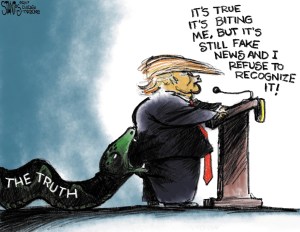 The graphs for Trump’s unpopularity are also astounding. Now, if we can just get out the vote and overcome all the anti-democratic election tampering going on in Republican States. The challenge will be a strong GOTV for all these Trump Haters. However, the intensity measures are astounding. We could do it.
Compare Trump’s topline job approval (-11) to that of other recent presidents, and he stands out quite clearly (not in a good way).
The president’s entire domestic policy agenda is underwater, too — especially on the economy and inflation, the two issues that won him the 2024 election.
This analysis by CNN’s Stephan Collinson highlights the nonsense performance by Trump and his cronies in an attempt to take the bases’ short, hateful, attention span away from military attacks, the destruction of the White House, and, however you frame all the nonsense surrounding Charlie Boy’s untimely death by gun violence that he clearly encouraged. “Trump will never change, but Kirk’s death shines a path to MAGA’s future.”
Of course, now that fascism has been clearly implanted in America, it is “wrapped in the flag and carrying a cross.”
President Donald Trump wants the world to understand that Charlie Kirk’s killing will not temper him or induce him to mend the country’s divides.
…
But Trump bluntly and deliberately signaled that forgiveness and unity were for others, and that he’d use Kirk’s assassination to intensify his efforts to impose personal power even more ruthlessly.
He therefore confirmed that the immediate political consequence of Kirk’s shocking assassination will be more political discord.
The president described the Turning Point USA founder as “a missionary with a noble spirit and a great, great purpose.”
“He did not hate his opponents. He wanted the best for them,” Trump said. But in a moment of brazen self-awareness that epitomized his presidency, he then broke from the script. “That’s where I disagreed with Charlie. I hate my opponent.” Trump went on, “And I don’t want the best for them.” Trump seemed to almost apologize to Erika Kirk. But it was a moment when couldn’t stop himself. Or didn’t want to, so he could remain true to himself.
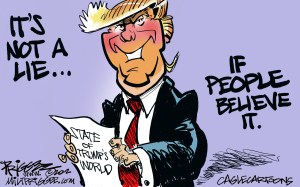 Statements like these are why we must remember the lessons of the civil rights movement. We cannot afford to surrender the high ground or make it invisible. We also must continue to shine a light on the ongoing grift that is the primary feature of any Trump endeavor. This reminder is from NOTUS and written by Jose Peliery. Trump’s public appearances are sideshows and attention grabs. Pulling the curtain back is mandatory. “The Justice Department Had 36 Lawyers Fighting Corruption Full-Time. Under Trump, It’s Down to Two. The Public Integrity Section is the latest casualty in the administration’s attacks on Nixon-era good-government reforms.”
All the other lawyers in the Justice Department’s Public Integrity Section have either quit under pressure, resigned in protest or been detailed to other matters across the nation, according to several sources who spoke with NOTUS. The section has also lost all but one of more than a dozen paralegals.
“To me, it just screams that public corruption cases are no longer a priority of DOJ,” said Andrew Tessman, a prosecutor who left the Justice Department this month. “I cannot understand why we would want to restrict that section.”
Sources with knowledge of the section’s operations say the reduction in staff means it can no longer advise the 94 U.S. attorneys’ offices around the country on how to build cases against crooked government officials — let alone prosecute new cases on its own.
To protect against politically motivated abuses, the DOJ’s Justice Manual has long required prosecutors in local U.S. attorneys’ offices to consult with the Public Integrity Section on any “federal criminal matter that involves alleged or suspected violations of federal or state campaign financing laws, federal patronage crimes, or corruption of the election process.”
But Trump’s DOJ reversed that policy in June. “Department leadership is currently revising this section,” this part of the Justice Manual now says. “The consultation requirement is suspended while revisions are ongoing.”
Several former Justice Department employees expressed extreme concern that the change in the Justice Manual, coupled with the flattening of the Public Integrity Section, opens the door for the Trump administration to engage in partisan prosecutions of Democrats by assigning the job to prosecutors working for U.S. attorneys — political appointees nominated by the president.
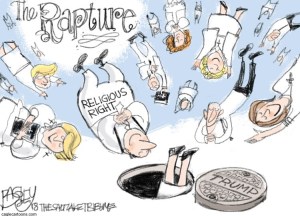 This news is no surprise, given the rest of what we’ve examined today. Maybe we can get rid of them with the latest 2-day extravaganza Rapture that never happens. Once again, I bring you William Kristol from The Bulwark: “Bag Man.”
Who uses cash anymore? Tom Homan, that’s who. On September 20, 2024, Trump’s border czar accepted $50,000 from undercover FBI agents. And no, it wasn’t Venmoed. The cash was in a bag from the food chain Cava. (Since you asked: I’m partial to the Spicy Lamb + Avocado combo. But I haven’t yet tried the newly minted Garlicky Chicken Shawarma Bowl. Morning Shots readers, let me know how it is in the comments).
The story broke Saturday afternoon in a detailed and well-sourced MSNBC News report by star investigative reporter Carol Leonnig, a four-time Pulitzer Prize winner who left the Washington Post less than two months ago, and Ken Dilanian, who has covered the Justice Department and the intelligence agencies for NBC and MSNBC for a decade.
Here’s the heart of the story:
In an undercover operation last year, the FBI recorded Tom Homan, now the White House border czar, accepting $50,000 in cash after indicating he could help the agents — who were posing as business executives — win government contracts in a second Trump administration, according to multiple people familiar with the probe and internal documents reviewed by MSNBC.
The FBI and the Justice Department planned to wait to see whether Homan would deliver on his alleged promise once he became the nation’s top immigration official. But the case indefinitely stalled soon after Donald Trump became president again in January, according to six sources familiar with the matter. In recent weeks, Trump appointees officially closed the investigation, after FBI Director Kash Patel requested a status update on the case, two of the people said.
The federal investigation was launched in western Texas in the summer of 2024 after a subject in a separate investigation claimed Homan was soliciting payments in exchange for awarding contracts should Trump win the presidential election, according to an internal Justice Department summary of the probe reviewed by MSNBC and people familiar with the case. The U.S. Attorney’s office in the Western District of Texas, working with the FBI, asked the Justice Department’s Public Integrity Section to join its ongoing probe “into the Border Czar and former Acting Director of Immigration and Customs Enforcement Tom Homan and others based on evidence of payment from FBI undercover agents in exchange for facilitating future contracts related to border enforcement.”
Remarkably, the Trump Justice Department isn’t actually denying the cash payment or any other fact reported by Leonnig and Dilanian. FBI Director Kash Patel and Deputy Attorney General Todd Blanche simply asserted that their review of the case “found no credible evidence of any criminal wrongdoing.”
A New York Times report soon followed up on MSNBC’s story, adding the fun Cava bag detail and also the intriguing fact that the sting “grew out of a long-running counterintelligence investigation that had not been targeting Mr. Homan.” In other words, the Biden Justice Department was not out to get Homan.
 Steve Levy of Wired has this interesting bit of news today. “I Thought I Knew Silicon Valley. I Was Wrong. Tech got what it wanted by electing Trump. A year later, it looks more like a suicide pact.” Go look at the artwork. It’s genius.
For decades, Mark Lemley’s life as an intellectual property lawyer was orderly enough. He’s a professor at Stanford University and has consulted for Amazon, Google, and Meta. “I always enjoyed that the area I practice in has largely been apolitical,” Lemley tells me. What’s more, his democratic values neatly aligned with those of the companies that hired him.
But in January, Lemley made a radical move. “I have struggled with how to respond to Mark Zuckerberg and Facebook’s descent into toxic masculinity and Neo-Nazi madness,” he posted on LinkedIn. “I have fired Meta as a client.”
This is the Silicon Valley of 2025. Zuckerberg, now 41, had turned into a MAGA-friendly mixed martial arts fan who didn’t worry so much about hate speech on his platforms and complained that corporate America wasn’t masculine enough. He stopped fact-checking and started hanging out at Mar-a-Lago. And it wasn’t only Zuckerberg. A whole cohort of billionaires seemed to place their companies’ fortunes over the well-being of society.
When I meet Lemley at his office at Stanford this July, he is looking vacation-ready in a Hawaiian shirt. In the half year since he fired Meta, very few powerful people have followed his lead. Privately, they tell him, you go! Publicly, they’re gone. Lemley has even considered how he might be gone if things get bad for anti-Trumpers. “Everybody I’ve talked to has a potential exit strategy,” he says. “Could I get citizenship here or there?”
It should be the best of times for the tech world, supercharged by a boom in artificial intelligence. But a shadow has fallen over Silicon Valley. The community still overwhelmingly leans left. But with few exceptions, its leaders are responding to Donald Trump by either keeping quiet or actively courting the government. One indelible image of this capture is from Trump’s second inauguration, where a decisive quorum of tech’s elite, after dutifully kicking in million-dollar checks, occupied front-row seats.
“Everyone in the business world fears repercussions, because this administration is vindictive,” says venture capitalist David Hornik, one of the few outspoken voices of resistance. So Silicon Valley’s elite are engaged in a dangerous dance with a capricious administration—or as Michael Moritz, one of the Valley’s iconic VCs, put it to me, “They’re doing their best to avoid being held up in a protection racket.”
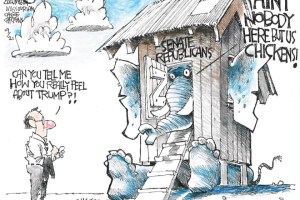 Nothing ever surprises me when you separate the businesses where profits are the guiding light instead of the things Disney is suddenly learning about, like integrity and a sense of who your customers are, what they value, and what they expect from you in terms of corporate character. Speaking of lack of integrity and character, “Transcript: Trump Boat Bombings Get Worse as Damning Info Emerges/ As Trump’s military attacks on supposed drug smugglers in the Caribbean Sea get worse, a legal expert explains what we know and what we don’t—and why we may be headed toward even darker lawlessness.” This is from The New Republic‘s Greg Sargeant’s podcast.
Greg Sargent: This is The Daily Blast from The New Republic, produced and presented by the DSR Network. I’m your host, Greg Sargent.
Everybody seems to have moved on from the awful story involving President Trump’s decision to bomb a small boat allegedly carrying drugs in the Caribbean Sea. That’s a shame because really bad stuff is continuing to happen on this front. The White House is now circulating a draft of a bill that would vastly expand Trump’s authority for exactly these types of bombings. We’ve also had another one of these strikes, and it appears just as dubious as the first one. And Trump announced that strike with an absolutely deranged tweet that should raise alarms everywhere, but isn’t. Meanwhile, Democrats just introduced a measure to restrain Trump, and the prospects for getting the GOP support it needs are approximately zero. Brian Finucane, an editor at Just Security, has been doing some great writing on this topic. So we’re talking to him about all of it. Brian, thanks for coming on.
Brian Finucane: My pleasure.
Sargent: So let’s start with the second bombing. It occurred in international waters, killed three people. Trump said these people were quote unquote positively identified as drug smugglers or narco-terrorists. But according to [The New York Times], he hasn’t identified the group or the people. Brian, has that changed? Can you bring us up to date on this bombing and how forthcoming the administration has been about it?
Finucane: Well, the administration has not been very forthcoming, unfortunately. We don’t have much additional information. We have various assertions from Trump and others in the administration, mostly in his Truth Social post, including the characterization of the people aboard the vessel as confirmed narco-terrorists, characterization of the supposed illegal narcotics aboard as, “a deadly weapon poisoning Americans,” representations about the threat this supposedly poses to Americans that would justify the use of lethal force here. But we don’t have information about the identity [of] people aboard the vessel, who they might have been affiliated with, the destination or the exact nature of the cargo.
Sargent: Yeah. And the reason he’s calling the drugs a deadly weapon is to try and recast this as a strike against a war combatant, right?
Finucane: Right. So the administration is trying to cloak its operations in the Caribbean under the mantle of counterterrorism and war more broadly. And it’s using not just the wording, but also the tools and the tropes of counterterrorism and war. But that’s a misappropriation of those frameworks because this is not a war, this is not an armed conflict, and this is not like prior counterterrorism strikes the U.S. has been conducting for two decades post 9/11.
Sargent: It certainly isn’t, and the administration, by the way, still hasn’t even presented any kind of detailed legal rationale or any information about the first strike, which killed 11 people. Now the Times reports that the White House is circulating this bill that would essentially let him unilaterally wage war against drug cartels that he decides to label terrorists and against nations that harbor them. It seems to say that part of this would be done in consultation with Congress, but it doesn’t define what it would entail to consult with Congress. The Times says this bill is setting off, “alarm bells among some people,” at least in the White House and on Capitol Hill. Brian, what do we know about this, and what do you make of it?
Finucane: So I want to caveat at the top that it’s hard to know at this point how seriously to take this legislation. Reportedly, it was introduced or was put forward by Representative Cory Mills of Florida. It’s also been reported that it’s been circulated by [the Office of Management and Budget] to departments and agencies for comment. That’s normally a process associated with legislation that the administration takes somewhat seriously, but I don’t think we know for certain just how seriously the administration is taking this. But the text is really quite striking. It is modeled on the 2001 Authorization of Use of Military Force, which has been the principal statutory authority for the U.S. war on terror for the use of force against the Taliban, against Al Qaeda, ISIS, Al Shabaab, and other Al Qaeda and ISIS affiliates. And it really gives the president a blank check to use force anywhere in the world against anyone he designates under the provisions of this as a narco-terrorist. There are no geographic restrictions, so potentially they could include the United States. It would provide detention authority. And I think it’s really important to note here that this represents a dramatic reallocation of Congress’s war powers to the executive. It would be the president deciding who the United States goes to war with and where that takes place.
 A pirating we go! Ho Ho Ho!
I’d really like to say that this entire new Trump term is literally making me sick. The stress, the craziness, the dysfunctional brains of the cast and characters are like some kind of dystopian, D-grade horror movie. But my No Kings t-shirt is clean. I have a new pair of walking shoes coming via UPS soon, and I have grandchildren to think about. I’m still standing. Plus, I have to read this article from CNN before I see students tonight. The few with inquiring minds want to know and do ask. Plus, it’s data! And I’m a numbers nerd! “The U.S. economy has a new problem: Democracy is under siege. The nation’s top economic statistician was fired. Central bank independence is being undermined. The federal government is buying chunks of private companies and demanding cuts of revenue streams. Presidential power to lob tariffs has been wielded in unprecedented fashion. And federal regulators are threatening media companies over late-night comics.” Matt Egan has the byline.
These events all took place this year, and not in a third-world country, but in the world’s preeminent democracy under President Donald Trump.
Some political scientists see a pattern that suggests American democracy is being undermined in real time. The stakes are massive for the US economy and the business world.
“I have never been this concerned about democracy in the United States,” Vanessa Williamson, a senior fellow of governance studies at the nonpartisan Brookings Institution, told CNN in a phone interview.
CEOs are growing alarmed — even if they’re publicly staying quiet to avoid the wrath of the White House.
Business leaders are “quite alarmed” in private about the state of democracy in the United States, according to Jeffrey Sonnenfeld, the Yale professor known as the “CEO Whisperer” due to his extensive rolodex in the business community.
“We’ve had a serious erosion of the foundations of democracy,” Sonnenfeld, founder and president of the Yale Chief Executive Leadership Institute, told CNN
Research shows that democracies tend to thrive financially.
“Democracy is just good for the economy. And autocracy is bad for the economy,” Williamson said. “Autocrats are just not good at managing economies. Policymaking tends to be erratic as democratic institutions decline.”
Democratizations increase GDP per capita by about 20% in the long run, according to a 2019 study titled “Democracy does cause growth” that was published in the Journal of Political Economy, a University of Chicago peer-reviewed journal.
Researchers said the positive effects of democracy “appear to be driven by greater investment in capital, schooling and health.”
Well, I’ll just keep lecturing on this until they throw me in one of those made-for-profit prisons down here in Lousyana for people with brains and different viewpoints.
What’s on your Reading, Action, and Blogging list today?
Mostly Monday Reads: A Rogue Supreme Court
Posted: September 8, 2025 Filed under: #FARTUS, #MAGAnomics, Broligarchy, kakistocracy, Polycrisis | Tags: and racisim, crime, DOGE Social Security Attacks, I'm afraid of Americans, ICE, Trump, Trump Atttacks on Science, Trump Desperation 11 Comments
“This is what some people voted for…” John Buss, @repeat1968
Good Day Sky Dancers!
I’m quite late. The intense heat and humidity have left New Orleans for the moment. I woke up at 9:30. It was 76°F. I immediately rolled over and went back to sleep. I’m just glad I didn’t get a glance at the headlines then. The chaos of what used to be our institutional protectors of the Constitution worsens. This Reuters headline is like a slap in the face of all democracy-loving people. It’s a good thing I subscribed to them last month because wow! This needs to be shared. “US Supreme Court backs Trump on aggressive immigration raids.” They’re inching closer to the Inquisition with each majority opinion. Andrew Cheung has the lede.
Donald Trump’s hardline approach toward immigration on Monday, letting federal agents proceed with raids in Southern California targeting people for deportation based on their race or language.
The court granted a Justice Department request to put on hold a federal judge’s order temporarily barring agents from stopping or detaining people without “reasonable suspicion” they are in the country illegally, by relying on race or ethnicity, or if they speak Spanish or English with an accent, among other factors.
The Supreme Court’s three liberal justices publicly dissented from the decision, directing pointed criticism at its conservative majority.
The administration “has all but declared that all Latinos, U.S. citizens or not, who work low-wage jobs are fair game to be seized at any time, taken away from work, and held until they provide proof of their legal status to the agents’ satisfaction,” Justice Sotomayor wrote in the dissenting opinion.“Rather than stand idly by while our constitutional freedoms are lost, I dissent,” Sotomayor added.
Los Angeles-based U.S. District Judge Maame Frimpong found on July 11 that the Trump administration’s actions likely violated the U.S. Constitution’s Fourth Amendment protection against unreasonable searches and seizures. The judge’s order applied to her court’s jurisdiction, covering much of Southern California.The Supreme Court’s order was brief and issued without any explanation, a common way it handles emergency matters, but one that has generated confusion in lower courts and criticism from some of the justices themselves. The court has a 6-3 conservative majority.
Concurring with the decision on Monday, conservative Justice Brett Kavanaugh said that “apparent ethnicity alone cannot furnish reasonable suspicion” but it can be a “‘relevant factor’ when considered along with other salient factors.”
Kavanaugh added: “If the officers learn that the individual they stopped is a U.S. citizen or otherwise lawfully in the United States, they promptly let the individual go.”
In a written filing, the Justice Department defended targeting people using a “reasonably broad profile” in a region where, according to the administration, about 10% of residents are in the country illegally
The administration’s request marked its latest trip to the Supreme Court seeking to proceed with policies that lower courts have impeded after casting doubt on their legality. The Supreme Court has backed Trump in most of these cases.
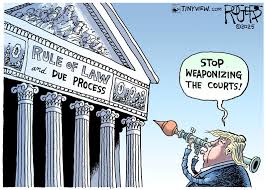 This part of the decision is rather stunning.
In other cases, the Supreme Court has allowed Trump to deport migrants to countries other than their own without offering a chance to show harms they may face and to revoke temporary legal status previously granted by the government on humanitarian grounds to hundreds of thousands of migrants.
So much for the Rule of Law and Due Process. This also violates international treaties and law. We are a nation led by a War Criminal.
The New York Times (article shared) also has an excellent analysis of the situation written by Adam Liptak.”Supreme Court Lifts Restrictions on L.A. Immigration Stops. A federal judge had ordered agents not to make indiscriminate stops relying on factors like a person’s ethnicity or that they speak Spanish.” This is white christian nationalism on full display.
The Supreme Court on Monday lifted a federal judge’s order prohibiting government agents from making indiscriminate immigration-related stops in the Los Angeles area that challengers called “blatant racial profiling.”
The court’s brief order was unsigned and gave no reasons. It is not the last word in the case, which is pending before a federal appeals court and may again reach the justices.
The court’s three liberal members dissented.
In the near term, it allows what critics say are roving patrols of masked agents routinely violating the Fourth Amendment and what supporters say is a vigorous but lawful effort to enforce the nation’s immigration laws.
The lower courts had placed significant restrictions on President Trump’s efforts to ramp up immigrant arrests to achieve his pledge of mass deportations. Aggressive enforcement operations in Los Angeles — including encounters captured on video that appeared to be roundups of random Hispanic people by armed agents — have become a flashpoint, setting off protests and clashes in the area.
Civil rights groups and several individuals filed suit, accusing the administration of unconstitutional sweeps in which thousands of people had been arrested. They described the encounters in the suit as “indiscriminate immigration operations” that had swept up thousands of day laborers, carwash workers, farmworkers, caregivers and others.
“Individuals with brown skin are approached or pulled aside by unidentified federal agents, suddenly and with a show of force,” the complaint said, “and made to answer questions about who they are and where they are from,” violating the Fourth Amendment’s prohibition of unreasonable searches and seizures.
One plaintiff, Jason Brian Gavidia, a U.S. citizen born in East Los Angeles, was stopped by a masked agent while he was working on his car outside a tow yard. The encounter was captured on video.
The agent asked whether Mr. Gavidia was American, and he said he was.
The agent then asked what hospital Mr. Gavidia had been born in, and he said he did not know. According to the lawsuit, the agent and a colleague proceeded to slam Mr. Gavidia against a metal gate, twist his arm and seize his phone.
“Fearing for his life, Gavidia offered to show the agents his ID,” the lawsuit said. “The agents took the ID, and about 20 minutes later, returned Gavidia’s phone and set him free. They never returned his ID.”
 This is nothing but siding with grandiose racial profiling. The ACLU of Southern California has this to say on the subject. “U.S. Supreme Court Grants Stay in L.A. Raids Case. Decision lifts temporary order barring DHS from unlawful stop practices .”
Today, the Supreme Court granted the federal government’s request for a stay (or pause) of a temporary restraining order (TRO) prohibiting federal agencies–including the Department of Homeland Security (DHS)–from continuing their unlawful actions in Los Angeles and surrounding counties.
The court judgment reverses the judgement from two lower courts in Vasquez Perdomo v. Noem that bars immigration agents from stopping individuals without reasonable suspicion and from relying solely on four factors – alone or in combination – including apparent race or ethnicity; speaking Spanish or English with an accent; presence in a particular location like a bus stop, car wash, or agricultural site; or the type of work a person does.
Today’s unexplained order from the Supreme Court does not halt further proceedings in the case. On September 24, the federal district court will hear arguments on whether to issue a preliminary injunction based on additional evidence of the government’s unlawful tactics.
In response, the following statements were issued:
“When ICE grabbed me, they never showed a warrant or explained why. I was treated like I didn’t matter–locked up, cold, hungry, and without a lawyer. Now, the Supreme Court says that’s okay? That’s not justice. That’s racism with a badge,” said Pedro Vasquez Perdomo, named plaintiff in the case. “I joined this case because what happened to me is happening to others everyday just for being brown, speaking Spanish, or standing on a corner looking for work. The system failed us today, but I’m not staying silent. We’ll keep fighting because our lives are important.”
“This decision is a devastating setback for our plaintiffs and communities who, for months, have been subjected to immigration stops because of the color of their skin, occupation, or the language they speak,” said Mohammad Tajsar, senior staff attorney at the ACLU Foundation of Southern California. “In running to the Supreme Court to request this stay, the government made clear that its enforcement operation in Southern California is driven by race. We will continue fighting the administration’s racist deportation scheme to ensure every person living in Southern California—regardless of race or status—is safe.”
“Today’s decision gives license to the Trump administration to resume racially discriminatory raids across Los Angeles, detaining people without evidence or due process simply because of the color of their skin, the language they speak, or the work they do,” said Mark Rosenbaum, senior special counsel for strategic litigation at Public Counsel. Our community has come together to confront this injustice with courage and determination, uncovering the truth and showing the nation these raids were never about public safety but about targeting immigrants and sowing fear. This fight is not over. We will continue pressing our case in court until every person in our communities can live free from fear, with their rights and dignity fully protected.
“The Supreme Court’s decision deals a devastating blow to communities reeling from the government’s racially discriminatory raids. Through the stroke of a pen, through its emergency shadow docket, the court has written off decades of Fourth Amendment law. But we always knew this was going to be a long fight, and we are already preparing for what comes next,” said Annie Lai, director of the Immigrant and Racial Justice Solidarity Clinic at the UC Irvine School of Law. “Our clients have faced the government with incredible bravery and will continue to do so. We will be right there alongside them.”
“Today’s SCOTUS ruling puts farm workers — and every Californian who looks or sounds like they might be an immigrant — in greater danger,” said UFW President Teresa Romero. “This does not impact immigrants in a vacuum, it will affect all of us. We will continue to seek a preliminary injunction in this case, and we will keep fighting for farm workers and all immigrant communities across the USA.”
“The Supreme Court has ruled in favor of racial profiling. A dark shadow has been cast over this country’s Constitution and its future,” said Armando Gudino, executive director of the Los Angeles Worker Center Network (LAWCN). “This is a dangerous precedent for immigrant rights and civil liberties. The decision legitimizes the unconstitutional practice of targeting individuals based on their race, language, or neighborhood. It turns back the clock on decades of legal progress and reinforces a system where some communities are seen as suspect by default.”
 I am ashamed of my country. As David Bowie puts it, “I’m afraid of Americans.” This decision jeopardizes the economy, the legal system, and our humanity. The Supreme Racists on the Court have gone mad with power, enabling Yam Tit’s Reign of Terror with abandon. Ari Berman, writing for Mother Jones, has this headline today. “Project 2026: Trump’s Plan to Rig the Next Election, From nationalizing voter suppression to flooding the streets with federal agents, the president and his allies are using all the tricks in the authoritarian playbook to tilt the midterms in their favor.”
On an April episode of the popular Politics War Room podcast, the veteran journalist Al Hunt posed an increasingly common question from listeners to Democratic strategist James Carville. “Is Trump looking to spark enough protest to justify declaring martial law in 2026, thus suspending the election?” Hunt asked.
“You’re so correct to be concerned about this,” Carville responded. “It’s getting worse by the day. It is not going to stop getting worse. And I would be—we ought to be—on high, high alert.”
Such chatter is widespread these days among Trump’s opponents—and with good reason. Trump is the most openly authoritarian president in US history and has already incited an insurrection in an attempt to remain in office.
The good news, according to experts, is that Trump doesn’t have the power to unilaterally cancel the midterms. The states, with oversight from Congress, run their elections. Voting will go forward whether Trump likes it or not.
But there are still many reasons to be concerned about the rapidly escalating threats to America’s election system. Given Trump’s extreme assertions of executive power, the autocratic nature of his second term, and the stacking of his administration with hardline loyalists, many of the outlandish schemes he considered to stay in power in 2020—such as using the military to seize voting machines in battleground states—don’t seem as far-fetched today. And his deployment of the National Guard and Marines in response to protests against ICE in Los Angeles, which was followed by a similar federal takeover of Washington, DC, has heightened fears about how far Trump will go to keep his party in control of Washington. “The California events really rattled a lot of people,” says Sophia Lin Lakin, director of the ACLU’s Voting Rights Project.
The scale of Trump’s interference in the midterms has become crystal clear in recent weeks. The president pressured Texas to pass a mid-decade redistricting plan last month that would add five more Republican seats in the US House. Shortly thereafter, he vowed to “get rid of MAIL-IN BALLOTS” and “Seriously Controversial VOTING MACHINES,” through an executive order. “If we do these TWO things,” he wrote on Truth Social, “we will pick up 100 more seats.”
But there are still many reasons to be concerned about the rapidly escalating threats to America’s election system. Given Trump’s extreme assertions of executive power, the autocratic nature of his second term, and the stacking of his administration with hardline loyalists, many of the outlandish schemes he considered to stay in power in 2020—such as using the military to seize voting machines in battleground states—don’t seem as far-fetched today. And his deployment of the National Guard and Marines in response to protests against ICE in Los Angeles, which was followed by a similar federal takeover of Washington, DC, has heightened fears about how far Trump will go to keep his party in control of Washington. “The California events really rattled a lot of people,” says Sophia Lin Lakin, director of the ACLU’s Voting Rights Project.
The scale of Trump’s interference in the midterms has become crystal clear in recent weeks. The president pressured Texas to pass a mid-decade redistricting plan last month that would add five more Republican seats in the US House. Shortly thereafter, he vowed to “get rid of MAIL-IN BALLOTS” and “Seriously Controversial VOTING MACHINES,” through an executive order. “If we do these TWO things,” he wrote on Truth Social, “we will pick up 100 more seats.”

What kind of President Declares war on an American City?
The article then lists 10 ways that Trump will interfere with the midterms and voting. Voter Suppression Tactics are at the top of the list, but the others are equally as devious. If you’re going to read just one thing today, please give the list a thorough read. It’s coming to a voting place near everyone.
ProPublica continues to be an enormously useful source of real journalism with real investigations. This is a must-read for those who will be or are dependent on Social Security. “The Untold Saga of What Happened When DOGE Stormed Social Security.” Eli Hager has the lede. I’m just going to use their “highlights” since the story is a narrative of everything that went on. It also has some interesting insight into Leland Dudek and his management of the process and gaffs.
Reporting Highlights
-
Missed Opportunity: Some Social Security officials said they welcomed DOGE — the agency needs a technological overhaul — only to see DOGE ignore them and prioritize quick (often empty) wins.
-
Internal Revolt: Leland Dudek, the agency’s then acting chief, helped DOGE at first, then tried to resist when he saw what it was doing, Dudek said in 15 hours of candid interviews.
-
DOGE Lives On: Multiple former DOGErs have taken permanent roles at the Social Security Administration, and Senate-confirmed Commissioner Frank Bisignano has embraced its approach.

Trump has started to move on to a “crime” agenda. As usual, it’s racist, full of lies and bias, and is designed to push buttons on the MAGA Cult. This is from AXIOS and is written by Marc Caputo. “Stabbing video fuels MAGA’s crime message.”
MAGA influencers are drawing repeated attention to violent attacks to elevate the issue of urban crime — and accuse mainstream media of under-covering shocking cases.
- Shocking video of the fatal Aug. 22 knife attack on 23-year-old Iryna Zarutska on a light-rail car in Charlotte, North Carolina, dominated weekend conversation on Trump-friendly social media.
The big picture: The rising number of surveillance cameras in public spaces, including on Charlotte’s light rail, has become a big accelerant in these cases.
- The video is easily shared or leaked, and can instantly pollinate across social media — a visual counterpoint to statistics showing crime decreases.
Driving the news: President Trump, asked about the Charlotte video by a reporter Sunday, said he wanted to find out more about the stabbing before commenting.
- “I’ll know all about it by tomorrow morning,” Trump said.
- A Trump adviser told Axios: “This is exactly what he’s talking about, and it’s going to be an issue he’s going to highlight. This is not just about North Carolina. Other campaigns will deal with this.”
Elon Musk repeatedly posted about the Charlotte case this weekend for his 225 million X followers.
- Also commenting on X: White House deputy chief of staff Stephen Miller, Trump confidant Charlie Kirk, Sen. Mike Lee (R-Utah) and Transportation Secretary Sean Duffy.
- North Carolina Senate candidate Michael Whatley — a former chair of the national GOP — invoked the case to accuse his Democratic opponent, Gov. Roy Cooper, of being soft on crime.
- Charlotte Mayor Vi Lyles called it a “heartbreaking attack.”
Zarutska recently arrived in Charlotte from Ukraine to escape the war there, The Charlotte Observer reports.
- The suspect, Decarlos Brown Jr., 34, was charged with first-degree murder. His criminal record includes charges of armed robbery, felony larceny, breaking and entering, and shoplifting, according to jail records cited by WBTV.
- Mecklenburg County District Attorney Spencer Merriweather, in an interview with Axios Charlotte last week, didn’t comment directly on the case but acknowledged the limitations and complexities of holding defendants with mental health issues accountable.
What they’re saying: Whatley wrote on X that in June 2020, “Cooper signed a soft-on-crime executive order, and just three months later, Brown was released from prison.”
- The executive order established a “racial profiling task force” and sought to reduce “systemic” racism. But it didn’t call for the early release of suspects.
Cooper’s campaign accused Whatley of “lying,” and said: “Roy Cooper prosecuted violent criminals and drug dealers, increased the penalties for violence against law enforcement, and kept thousands of criminals off the streets and behind bars.”
- Whatley spokesperson Danielle Alvarez countered that Brown was released from prison early, just as Cooper was spending more time talking about “fighting racism” and less about keeping “career criminals” like Brown locked up.
Between the lines: Influential conservative social media accounts accused major national news outlets of not covering the racial dynamics of the Charlotte killing — a white victim and a Black suspect — with the same intensity as they did in the case of Daniel Penny.
- Penny, who is white, choked to death a homeless Black man who was threatening passengers on a subway car in Manhattan in 2023. A jury acquitted Penny of criminally negligent homicide.
 You may read more about this at the link. I will close with this article concerning Yam Tits and the decimation of Science and Universities. It’s a New York Times (shared) Guest Op-Ed written by Stephanie Greenblatt, a Harvard Humanities Professor. “We Are Watching a Scientific Superpower Destroy Itself.”
The Trump administration’s assault on America’s universities by cutting billions of dollars of federal support for scientific and medical research has called up from somewhere deep in my memory the phrase “duck and cover.” These were words drilled into American schoolchildren in the 1950s. We heard them on television, where they accompanied a cartoon about a wise turtle named Bert who withdrew into his shell at any sign of danger. In class, when our teachers gave the order, we were instructed to follow Bert’s example by diving under our desks and covering our necks. These actions were meant to protect us from the nuclear attack that could come, we were told, at any time. Though even in elementary school most of us intuited that there was something futile in these attempts to shield ourselves from destruction, we dutifully went through the motions. How else could we deal with the anxiety caused by the menace?
The anxiety greatly increased in October 1957, when Americans learned of the Soviet Union’s successful launch of the world’s first satellite, Sputnik 1. The vivid evidence of the technological superiority in rocketry of our Cold War enemy provoked a remarkably rapid response. In 1958, by a bipartisan vote, Congress passed and President Dwight Eisenhower signed the National Defense Education Act, one of the most consequential federal interventions in education in the nation’s history. Together with the National Science Foundation and the National Institutes of Health, it made America into the world’s undisputed leader in science and technology.
Nearly 70 years later, that leadership is in peril. According to the latest annual Nature Index, which tracks research institutions by their contributions to leading science journals, the single remaining U.S. institution among the top 10 is Harvard, in second place, far behind the Chinese Academy of Sciences.
Trump’s war on science and academia is one of the most-sighted of all his ego-stroking projects. The pride that people like me felt about our Space Program and medical achievements was beyond the moon. As a cancer survivor of a rare cancer that has now become more curable since I had the disease, I just can’t believe this administration has such a fixation on killing people. But there it is.
There’s another Countrywide “No Kings” demonstration on October 18th, if you care to take part.
What’s on your Reading, Blogging, and Action lists?
Mostly Labor Day Monday Reads
Posted: September 1, 2025 Filed under: "presidential immunity", #FARTUS, #MAGAnomics, #We are so Fucked, 2025 What Fresh Hell? | Tags: Attacks on Labor and Unions by the Trump Regime, FARTUS, SCOTUS enabling a despot, Violent Crime is High in Red Rural America 14 Comments
“The trumps are laboring.” John Buss @repeat1968
Happy Labor Day, Sky Dancers!
Labor Day is the unofficial day that America leaves its summer to start all things Autumn. This is a particularly notable Labor Day because there are ongoing attacks on workers and unions, as well as universities and public schools that are opening up to greet a new fall term. Fall is the time for harvesting. This year’s harvest is full of the results of extremist policies and plots. It’s time to start campaign season with an eye to ridding ourselves of the sources.
I live in New Orleans, which is well known as America’s most European city, and I’m glad of that. It’s surrounded by the Deep South and many rural areas. Things are not going so well there. Resources have been pulled from many of the country’s outlands when they need them badly. I’ll start with this analysis from AXIOS. “Rural South, West states have highest violent crime rates: FBI.” Contrary to the belief of this racist regime, the nation’s outlands have the worst violent crime rates. Watching what’s become of our Nation’s Capital City sickens me. People feel invaded and demonstrate daily. Our National Guard, needed in their own states, our literally picking up garbage.
Rural states in the American South and West had some of the nation’s highest violent crime and homicide rates in 2024, driven by violence in small communities, according to an Axios analysis of FBI data.
Why it matters: A state-by-state comparison paints a complex picture of U.S. crime trends as President Trump threatens to send the National Guard to Democrat-controlled cities in blue states over concerns about violent crime.
The big picture: The president has already dispatched the National Guard to Washington, D.C., and is threatening to send troops to Chicago, Oakland, Calif., and Baltimore.
- Now Trump is facing questions about whether he’ll send troops to communities in red states — many of them largely rural — where crime rates are actually higher than the areas he’s targeted.
- “Sure, but there aren’t that many of them,” Trump said last week.
By the numbers: The southern states of Louisiana, Tennessee, Alabama, Arkansas and South Carolina were among the national leaders in both violent crime and homicide rates last year, an Axios review of FBI data found.
- All had violent crime and homicide rates well above the national average.
- Alaska, the country’s most rural state, led the nation with the highest violent crime rate of 1,194.3 per 100,000 residents. That’s more than three times the national average of 359.1.
- New Mexico, another rural state, was second with a violent crime rate of 757.7 per 100,000 residents, more than two times the national average.
Big states such as California and New York, both targets of Trump, ranked high in total violent crime numbers because of their large populations, but their per-capita rates were similar to those of Arkansas and Tennessee, the Axios review found.
Zoom out: Alaska and New Mexico also led the nation in homicide rates with 11.3 homicides per 100,000 residents each, more than twice the nation’s homicide rate of 5 per 100,000 residents.
- Pennsylvania was third nationally with a homicide rate of 10.1, followed by Louisiana, Alabama, and Tennessee.
- Illinois, home to Chicago, which Trump has called a “killing field,” had a homicide rate of 6 per 100,000 residents, ranked 20th in the nation.
Zoom in: Big-city crime often receives the most attention in political discourse, but an Axios analysis of rural states found that violence in small towns is driving some of the nation’s highest crime rates.
- For example, Fairbanks, Alaska, population roughly 32,000, had a violent crime rate of nearly 700 per 100,000 residents, about twice the national average.
- McKeesport, Pa., a city of 18,000 outside Pittsburgh, had a violent crime rate of 1,693.7 and a homicide rate of a whopping 32.5 per 100,000 people. It consistently ranks among the most dangerous cities in the country, a situation officials have largely attributed to a long-term decline in its industrial economy.
- Dyersburg, Tenn., a community of 16,000, has a violent crime rate of 1,256.5 and a homicide rate of 18.8.
What they’re saying: “If Washington, D.C., (were) a state, it would have the highest homicide rate of any state in the nation,” the White House said in a statement on Aug. 11 before dispatching the National Guard.
- D.C.’s homicide rate was 25.9 per 100,000 residents in 2024.
Yes, but: D.C. isn’t a state, it’s a city. Among the cities with the highest homicide rates in the U.S., Washington is ranked 11th, according to an Axios review of cities with 100,000 people or more with high homicide rates.
- Jackson, Miss., population about 141,500, had the nation’s highest homicide rate last year — nearly 78 per 100,000 residents. That’s more than 15 times the national average. There has been no national discussion about sending troops there to combat crime.
Between the lines: Rural crime often gets overlooked because most media outlets are centered in urban areas and focus just on crime there, Ralph Weisheit, a criminal justice professor at Illinois State University, tells Axios.
- The reasons for crime in rural areas vary, but Weisheit said in many cases, communities have been ravaged by drug addiction.
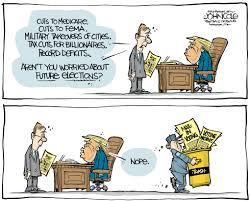 Mike Johnson really needs to pay more attention to his constituents than he does #FARTUS. The consensus among many analysts is that Trump is militarizing large democratically run cities to terrorize their citizens into not voting. It’s also why he’s so interested in stopping early and mail-in voting.
This is from The Brennan Center for Justice. “Crime as a Cover. The claim that troops are needed to fight local crime is nothing but a pretext.” The analysis is reported by Michael Waldman. Trump is doing everything he can to become a despot.
President Trump has threatened to send troops to Chicago to “straighten that one out.” New York City, he says, might be next.
Already, armed National Guard regiments are patrolling the streets of Washington, DC. All this on top of the deployment of troops to Los Angeles earlier in the summer.
The deployment of out-of-state troops to occupy cities cannot plausibly promote public order. It’s blunt force, a brutal power grab. It runs afoul of the Constitution and the proper role for states.
I write history books and consider myself an expert on the presidency. I can think of few analogies — not in this country, anyway — for such a move by a chief executive.
Why is this particular turn so alarming? After all, public safety is important, and fighting crime is a worthy goal. My colleague Liza Goitein explains the legal and constitutional issues:
Trump is on even thinner legal ice with this plan than he is in Los Angeles and DC. Unlike in the capital, the president doesn’t command the Illinois National Guard unless he calls them into federal service (i.e., “federalizes” them). There are various laws that authorize him to federalize the Guard, but none of them would apply here.
In Los Angeles, Trump is relying on a law (Section 12406 of Title 10 of the U.S. Code) that authorizes federalization when “the President is unable with the regular forces to execute the laws of the United States,” meaning federal law. Immigration law is federal law. Trump claimed that the protests rendered him “unable . . . to execute” ICE raids. Although dozens of raids happened during the protests and the administration did not cite a single raid that was thwarted, the Ninth Circuit Court of Appeals deferred to Trump’s assessment.
But that law simply wouldn’t apply to the type of crime Trump has cited in Chicago — essentially, violent street crime. The laws that are implicated are largely those of Illinois and Chicago, not the “laws of the United States.”
Even under the Insurrection Act — which is the main exception to the law barring deployment of the military for domestic law enforcement — the president may deploy troops to execute the law only in situations involving either federal laws or those state laws designed to protect the constitutional rights of classes of people (basically, civil rights laws).
Nor can Trump ask other states’ governors to send their Guard forces into Chicago, as he did in DC under a law known as Section 502(f), which authorizes governors to voluntarily use their Guard forces for missions requested by the president or secretary of defense. Under this law, presidents have asked governors to deploy Guard forces within their own states, in other states that consent, or (as only Trump has done) in DC without local consent. No governor has sent Guard troops into another state that did not consent, as would be the case here. That’s because Guard forces deployed under this law remain state officers as a legal matter. And under the Constitution, states are sovereign entities vis-à-vis one another. That means one state cannot invade another, even at the president’s request.
If the president wants to send one state’s National Guard forces into an unwilling state, he must federalize them first. But to federalize them, he needs statutory authority. And there is no statutory authority to federalize the Guard to police local crime.
The Pentagon reportedly sees its planned military deployment in Chicago as a model for other cities. And of course, the other cities Trump has name-checked in this context are governed by Democrats: Baltimore, Los Angeles, New York, and Oakland.
Flooding “blue” cities with soldiers on the pretext of fighting crime would be an unprecedented abuse of power that would violate states’ rights and threaten our most fundamental liberties. The plan is profoundly un-American. And it is illegal.
Public safety matters greatly. But facts belie the (ever shifting) rationale. New York, for example, remains one of the nation’s safest large cities. As Police Commissioner Jessica Tisch told Attorney General Pam Bondi yesterday, crime has dropped dramatically, even this year. Fighting crime is not a rationale — it’s a pretext.
The cities targeted so far have two things in common: a Black mayor and a fusillade of presidential rhetoric denouncing them as “hellholes.”
Bill Kristol, founder of The Bulwark and a longtime prominent Republican, surveyed the past week and put it this way: “What we are seeing is not merely a ‘slide toward authoritarianism.’ It’s a march toward despotism. And it’s a march whose pace is accelerating.”
What can be done to push back? Illinois Gov. JB Pritzker warned federal forces, “Do not come to Chicago. You are neither wanted here nor needed here.” Trump, in turn, mused, “They say . . . ‘He’s a dictator. He’s a dictator.’ A lot of people are saying, ‘Maybe we’d like a dictator.’” He added, “I don’t like a dictator. I’m not a dictator.” (As presidential quotations go, it’s about as reassuring as Richard Nixon’s “I am not a crook.”)
Pritzker and New York Gov. Kathy Hochul can play pivotal roles. States and cities can go to court — an epic legal battle. They can rally the public in their states and around the country. They can monitor and document the conduct of deployed forces.
We must all speak out when our Constitution is under threat.
Get some rest this Labor Day. It’s going to be a busy fall.
 I still see most of these actions as enablements of the Supreme Court. I’m not the only one. This is from Justin Jouvenal writing for The Washington Post. “The Supreme Court has expanded Trump’s power. He’s seeking much more. The president’s firing of Federal Reserve governor Lisa Cook and other cases could serve as major tests of how far the high court is willing to go.” Removing the independence of the FED is another way of turning us into a Banana Republic.
The Supreme Court has already expanded President Donald Trump’s authority in a string of emergency rulings, but he’s signaling in his firing of Federal Reserve governor Lisa Cook and other issues likely headed to the court that he continues to seek broader powers for the executive branch.
The cases could serve as major tests of how much further the nation’s high court is willing to go to bless the president’s assertion of executive authority. They differ from previous showdowns because of the sheer magnitude of the authority Trump is seeking to wield and because he wants greater control over powers the Constitution ascribes to another branch of government.
In addition to Cook’s lawsuit, which could make its way to the high court after she sued last week, a blockbuster case over Trump’s tariffs is expected to arrive at the high court soon after an appeals court struck them down. The Trump administration’s pushto withhold tens of billions of dollars in foreign aid appropriated by Congress could also end up in the court.
Peter Shane, a law professor at New York University, called Trump’s assertions “breathtaking.”
“Other presidents have tried to use their authority aggressively, but usually it’s been done through aggressive interpretations of statutory law and in a pretty targeted way,” Shane said.
Each of the presidential powers being contested by Trump, he said, “is a challenge to what I think heretofore would have been regarded as a core power of Congress.”
The high court has already signaled openness to broad presidential authority to replace some heads of independent agencies.
The justices handed Trump a major victory in May when they allowed him to remove the leaders of the National Labor Relations Board and the Merit Systems Protection Board while legal challenges play out over their firings. Trump gave no reasons for the dismissals.
The court’sconservative majority ruled the Constitution vests all executive power in the president, so Trump could fire the agency heads “without cause” even though Congress set up the agencies to be insulated from political interference.
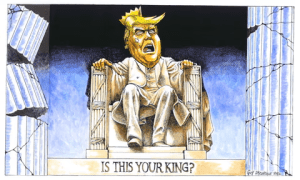 There it is. The direct attacks on labor. This is a guest Op-Ed in the New York Times (gift article) by labor historian Erik Loomis.”Trump Is Wiping Out Unions. Why Are They So Quiet?”
This is a most unfortunate Labor Day for labor. The labor movement has taken it on the chin repeatedly in the last several decades, but President Trump is the most ruthlessly anti-labor president since before the Great Depression.
If the labor movement does not fight harder than it has since Mr. Trump regained the presidency, its future will be dire.
Mr. Trump and his administration have unilaterally stripped collective bargaining rights from hundreds of thousands of federal workers. At the Department of Veterans Affairs alone, 400,000 workers, or 2.8 percent of America’s unionized workers, have lost their collective bargaining rights because of an executive order that will eventually affect more than one million federal workers. Mr. Trump ushered in Labor Day weekend on Thursday by continuing his assault of federal unions, adding the Patent Office, NASA and the National Weather Service to his list of targeted agencies.
Despite this assault on their very existence, we have barely heard a peep from unions. Where is organized labor in the public fight to maintain union jobs, stop the stripping of the safety net and lead the fight for democracy? Other than some statements and angry speeches, the movement has been muted.
If the labor movement wants to fight for its survival, it must return to mass mobilization tactics, reminding Americans that their rights come through working together — not through supporting a president who talks about helping American workers while slashing worker safety regulations, supporting tariffs that raise the cost of consumer goods and stripping workers of their legal rights to contracts.
All this is happening at a time when Americans’ approval of unions is the highest it has been since the mid-1960s.
One cannot overstate the significance of Mr. Trump’s attacks on government workers. Public sector work has become organized labor’s power base, allowing the total workforce’s union membership rate to remain at around 10 percent, despite less than 6 percent of private sector workers having unions.
Based on actions Mr. Trump has taken this year — and without any notable public pushback from supposedly pro-labor Republicans like Josh Hawley and Marco Rubio — it is unlikely that there will be any unionized federal workers outside of policing agencies by the end of his term in 2029.
Mr. Trump has attacked workers in other ways. He has gutted the Department of Labor through cuts by the Department of Government Efficiency. He is also rolling back Labor Department rules from the Obama and Biden administrations that allowed home care workers to earn overtime and farmworkers to campaign for better working conditions. And he has severely undermined the National Labor Relations Board, which handles thousands of union matters every year by firing its head and nominating corporate-friendly figures to steer its operations away from supporting workers.

“Hurry Sundown.” John Buss, @repeat1968
Read more about the reasons at the link. Russia is getting more brazen, given that Putin has reason to believe the United States will enable his attacks on democracy. This is from CNN. “Plane carrying EU’s top leader targeted by alleged Russian GPS jamming.” This is reported by Ivana Kottasová.
A plane carrying the European Commission President Ursula von der Leyen was targeted by GPS navigation jamming while trying to land in Bulgaria on Sunday, a spokesperson for the commission told CNN.
The commission received “information from Bulgarian authorities that they suspect this blatant interference was carried out by Russia,” said European Commission Deputy Chief Spokesperson Arianna Podestà.
The plane landed safely, the spokesperson said. A source familiar with the situation told CNN the pilots landed the plane using paper maps.
Von der Leyen and the commission have been staunch supporters of Ukraine as Kyiv tries to defend itself against Russia’s unprovoked aggression. She was one of the European leaders who attended US President Donald Trump’s summit on Ukraine last week and has consistently urged EU member states to allocate more resources to helping Ukraine.
The incident occurred as the president was about to land at the Plovdiv International Airport in the south of Bulgaria, part of her tour around member states in the eastern part of the bloc to rally support for Ukraine.
“This incident underlines the urgency of the President’s current trip to frontline Member States, where she has seen first hand the every day threats from Russia and its proxies,” Podestà told CNN.
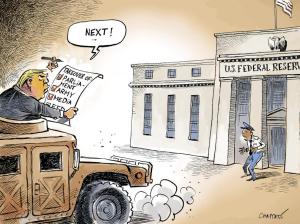 Not only are Russia and China getting brave, but India’s Modi has been driven straight into their arms by Trump. This is an alarming headline from Christian Shepherd writing for The Washington Post. “China tries to use Trump turmoil to unite leaders against U.S.-led order. Twenty leaders — including from Russia, Iran and India — are in China for a summit designed to promote Beijing as a reliable counterweight to the U.S.” This is happening as Trump cuts more foreign aid and Kari Lake disables the Voice of America. I thought Yam Tits considered them his buddies?
Chinese leader Xi Jinping on Monday called on the leaders of countries including Russia, Iran and India to integrate their economies and build an “orderly multipolar world,” as he tried to unite them in their shared grievances with the U.S.-led global order and the policies of President Donald Trump.
Xi used the platform of the Shanghai Cooperation Organization summit here, 90 miles southeast of Beijing, to implicitly criticize Trump’s policies — without naming him or mentioning the United States.
He urged the 20 foreign leaders in attendance to “seek integration, not decoupling” and “unequivocally oppose power politics.”
Member countries should “serve as a cornerstone for the promotion of a multipolar world” and join a China-led “global governance initiative,” he said in closing remarksafter a day in which leaders put on shows of chumminess and met for private talks on the sidelines of the mostly scripted event.
The Chinese leader’s new initiative will help provide stability at a time of rising turbulence and end “the monopoly of global governance by some countries,” Foreign Minister Wang Yi said in a news briefing Monday night after Xi’s remarks.
Xi held a bilateral meeting with India’s Narendra Modi Sunday and will hold a one-on-one with Vladimir Putin of Russia on Tuesday.The three were filmed holding hands and smiling as they chatted on Monday.
Xi also proposed deepening economic ties to take advantage of the group’s “mega-sized market,” including by establishing a SCO development bank. China has already invested $84 billion in member countries and would provide another $1.4 billion in loans over the next three years, he said.
The forum is a key part of China’s campaign to be seen as a reliable partner and a counterweight to U.S. unpredictability in an increasingly multipolar world. Modi’s attendance in particular — his first visit to the country in seven years — is a milestone in Beijing’s attempt to mend ties with an influential U.S. partner that has been alienated by Trump’s tariffs.
 California’s Governor Newsom is still trolling Trump. It may not be classy, but it sure is funny! “Gavin Newsom continues to troll Trump by blasting ‘I’m a Survivor’ in post about president’s health. Donald Trump’s bruised hands mocked by California governor in Instagram video bringing together some of the president’s most embarrassing moments.” This is from The Independent and reported by Joe Summerlad.
California Democratic Gov. Gavin Newsom has continued his trolling campaign against Donald Trump, this time posting a video on Instagram making light of the president’s health complaints.
The montage, set to the 2001 song “I’m a Survivor” by country music star Reba McEntire, pulls together some of Trump’s most embarrassing gaffes in the public eye, from tripping on the steps to Air Force One to recoiling in horror from a squawking eagle and being bumped in the chin by a rogue reporter’s microphone.
“He’s trying,” the post is captioned.
Drawing an ironic contrast between the president’s opulent lifestyle and the song’s lyrics about a “single mom who works two jobs,” the clip also pays particular attention to the bruises spotted on Trump’s hands in recent months.
The commander-in-chief was recently diagnosed with chronic venous insufficiency but speculation about his wellbeing raged well before that and has not abated since the condition was revealed.
JJ has informed me that you must turn off your location before going to Instagram, as they are posting it on MAPS.
I hope you got some rest and relaxation this weekend. I’ve been hanging in the house trying to avoid reality.
What’s on your reading and blogging list today?

 peej
peej Carissa
 bostonboomer
 dakinikat
 ecocatwoman
 mablue2
 Mama Lopez
 peggysue22
 quixote
 skydancingguestblogger
 Mona (aka Wonk the Vote)



 Sky Dancing
Recent Comments