
The director of the National Security Agency, the powerful U.S. wiretapping and cyberespionage service, was fired Thursday, according to one former and two current U.S. officials.
Gen. Timothy Haugh, who also heads U.S. Cyber Command, was let go along with his civilian deputy at the NSA, Wendy Noble, according to the officials. Like others in this report, they spoke on the condition of anonymity to discuss personnel moves.
Far-right activist Laura Loomer advocated for the firings during a meeting with President Donald Trump on Wednesday, she confirmed to The Washington Post on Thursday evening.In the meeting,
Loomer, a fervent Trump supporter, pressed for the dismissals of a number of officials besides Haugh and Noble — in particular, National Security Council staff whose views she saw as disloyal to the president.
At least five key National Security Council aides were fired Thursday.
“NSA Director Tim Haugh and his deputy Wendy Noble have been disloyal to President Trump,” Loomer said in a post on X early Friday. “That is why they have been fired.”
Loomer told The Post that she urged Trump to dismiss Haugh because he was “handpicked” by Gen. Mark A. Milley, who was chairman of the Joint Chiefs of Staff in 2023 when Haugh was nominated to lead Cyber Command and the NSA.
Mostly Monday Reads: It’s the Policies Stupid!
Posted: April 28, 2025 Filed under: #FARTUS, #MAGAnomics, American Fascists, Broligarchy, Civil Liberties, Civil Rights, Constitutional Crises, kakistocracy, kleptocracy, MAGA Assholes, MAGA goes after the Rule of Law, MAGA Political Carnage | Tags: #Fartus #DeportUs, @johnbuss.bsky.social John Buss, All Apologies, Bombastic Rhetoric, FARTUS, Kash Patel, Pam Bondi weirdo, Pete Hegseth weirdo sexual assaulter, Verbal Bully Bombs, Yam Tits 100 days of oops 6 Comments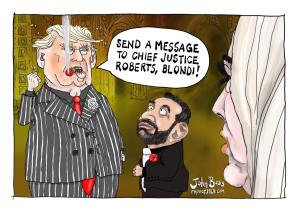
“Arresting development,” John Buss, @repeat1968
Good Day, Sky Dancers!
I don’t know about you, but these first 100 days of #FARTUS have taken a toll on me. So many bad policies in such a short time have me spinning and anxious. I can’t even plan my one-person, small-house, semi-retired life. I can’t even figure out what state and local governments, big and small businesses, and the courts have on their hands right now.
The assessment of these first 100 days, coming from polls and pundits, is stunningly bad. Bad to the point that any polling firm is considered to be a criminal organization by yam tits. I will start with this analysis in The Guardian by Steven Greenhouse. “Trump’s second term will be the worst presidential term ever. Tragically, the president’s second term is already more lawless and more authoritarian than any in US history.”
In his first 100 days back in office, Donald Trump has made a strong case that his second term will be by far the worst presidential term in US history. So many of his flood-the-zone actions have been head-spinning and stomach-turning. His administration seems to be powered by ignorance and incoherence, spleen and sycophancy. Both he and his right-hand man, Elon Musk, with their resentment-fueled desire to disrupt everything, seem intent on pulverizing the foundations of our government, our democracy, our alliances as well as any notions of truth. Tragically, Trump’s second term is already more lawless and more authoritarian than any in US history.
The worst and most dangerous part of Trump’s agenda is his war against our democracy and constitution – defying judges’ orders, deporting people without due process, suggesting he will run for a third term, calling to impeach judges who rule against him, pardoning hundreds of January 6 criminals, gutting federal agencies and firing thousands of federal employees in flagrant violation of the law, and banning books from military libraries. (One wonders: will book burning be next?) Underlining just how dangerous and lawless Trump is, he is talking publicly about disappearing US citizens to foreign countries where they could be locked in prison forever. For those who care about democracy and basic freedoms, this is Defcon 1 stuff.
From Franklin Roosevelt and Ronald Reagan to Joe Biden, every president since the second world war has worked hard to build alliances to promote peace and prosperity and deter aggression. But right out of the box, Trump 2.0 has rushed to blow up our alliances and cavalierly alienate our allies. Trump quickly rejected the US’s traditional foreign policy and ideals by warmly embracing Vladimir Putin, a brutal dictator, and turning against Ukraine and its noble fight against Putin’s aggression. Trump sounded like a rapacious 19th-century imperialist when he threatened to take over the Panama canal and, ditto, when he talked of using force to seize control of Greenland, which belongs to our longtime Nato ally, Denmark. Then there’s Trump’s astoundingly idiotic talk – and taunt – that Canada should be our 51st state. What a way to anger and alienate a nation that has long been the US’s best friend.
Then there is the disaster – or should we say clown show – of Trump’s on-again, off-again, on-again, who-knows-what’s-going-to-happen-tomorrow tariffs. His “liberation day” tariffs were put together by a clown-car crew, just three hours before he announced it, and Trump and company seemed to have zero idea that his hodgepodge of tariffs would send the world’s stock markets into a nervous breakdown. Trump’s team was stupid enough to think that China was too feeble to respond effectively to Trump’s trade war – treasury secretary Scott Bessent said China had “a losing hand” with just “a pair of twos”. Trump and his clown car failed to realize that China had the ability to retaliate in devastating ways – by clamping down on rare earth exports that American manufacturers and tech companies desperately need, and perhaps by selling off hundreds of billions of dollars in US bonds. Former treasury secretary Janet Yellen was appalled, saying: “This is the worst self-inflicted policy wound I’ve ever seen in my career inflicted on our economy.”
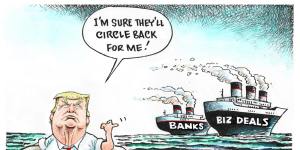 What really gets to me is his “bombastic rhetoric.” It’s like you’re either with the bully or being bullied. But what appalls me is his stewardship of the US and global Economy. He is completely detached from all we have learned about policy impacts from the 1930s. It was clear that as industrialization increased, the old mercantilism of the colonial days was fading fast. Industrialization created a different trade paradigm.
The switch from the Gold Standard created a different-looking financial economic system. The Information Age and the rise of advanced technology like robotics have changed us even more. We have complex, intertwined, mixed market economies. While the basics of market structure remain similar, the frictions within them have become much more complicated. You may check the academic research of Nobel Prize-winning Joseph E. Stiglitz for his legendary study on how the various quirks in producing specific goods and services can lead to fairly serious economic issues.
I don’t think anyone in the West Wing or the Agencies knows how economic policy works. For that matter, Trump doesn’t even know how many countries there are in the world since he keeps mentioning 200 trade deals when there are only 195. Maybe the Penguin islands are more autonomous than we know?
In fact, the communication style of the entire MAGA movement makes it an impossible environment for governing. This is how Amanda Marcotte–writing for Salon— puts it. “MAGA loves a tantrum: How public meltdowns became the preferred method of GOP communication. Why Nancy Mace, Pete Hegseth, and Stephen Miller keep throwing fits on camera.”
If there were an Oscar for the category “hard to watch,” I’d have to nominate the video of Rep. Nancy Mace, R-S.C., barking expletives at a constituent after he asked her if she would have a town hall soon. It’s produced in a beauty supply store instead of a movie studio, but in a brief minute and 42 seconds, the video finds its place in the canon of horror films shot from the villain’s perspective. The camera focuses entirely on the story’s hero, a man in a polo and shorts holding a bottle of what appears to be face cleanser, as he holds his own against his congressional representative getting increasingly shrill as she yells invective at him. Even though he said nothing about gay marriage, she demands his gratitude for voting “for gay marriage twice.” When he gets annoyed at her reductive assumption, she calls him “crazy” and “absolutely f—king crazy,” and repeatedly says “f—k you” to him.
In the eyes of normal people, Mace, as her interlocutor said when he fled from this encounter, is a “disgrace.” Most adults who act like Mace in public immediately wish to disappear off the face of the earth in shame. But not our Nancy! No, she’s the one who posted this video online, proud of her emotional incontinence. She even offered a homophobic “gay panic” defense, by describing the man as “wearing daisy dukes, at a makeup store.” (Sorry, Miss Nancy, they aren’t daisy dukes until we see cheeks.) To people outside the MAGA bubble, it’s a baffling choice. She’s not even a fun villain. There’s none of the sleek appeal of Loki from the “Avengers” franchise or camp glee of Ursula from “The Little Mermaid.” Mace is serving pure toddler here. She likely wished to throw herself to the floor and start pounding it, but doing so would have meant dropping her iPhone.
Mace isn’t wrong, however, to think that what most adults find embarrassing, the MAGA base will eat right up. The public meltdown, in which you declare yourself the world’s greatest victim, is the preferred GOP method of political communication these days. Despite this effort, Mace didn’t even come close to nabbing last week’s gold star for the most histronic MAGA performance. She was outdone by Stephen Miller, whose usual register on TV is “verge of a nervous breakdown,” but got so shrill on Fox News Tuesday that Lauren Tousignant at Jezebel worried she’d soon have to “look at Stephen Miller’s face as he pops a dozen blood vessels as his brain explodes.”
Defense Secretary Pete Hegseth turned in two performances that would cause Al Pacino to tell him to settle down. While carping about “the fake news media” during the White House Easter egg roll, Hegseth’s whining got so pitched his voice started to crack, while his children stood behind him, embarrassed at the spectacle.
Despite his own family’s discomfort with his antics, Hegseth kept up the scenery-chewing, bellowing about the all-powerful, forever-mysterious “they” have “come after me from day one.” (“They,” in this case, means close friends and advisors who got pushed out after beginning to question Hegseth’s fitness for the job.)
All this yelling and bellyaching serves a pragmatic purpose: to distract from how what they’re saying makes no sense. Miller’s claim that the six Republican judges on the Supreme Court — three appointed by Trump — are “communist” wouldn’t withstand even a moment’s thought at a normal volume. Because he’s delivering his commentary at “front row at Led Zepplin” levels, the brain can’t even process how preposterous the lie is. Mace’s routine showed this working in a literal way. Her target runs away, because trying to talk to someone behaving like her is like trying to converse with a wildfire.
It’s part of the overall too-muchness that is the signature of the MAGA aesthetic, which goes right back to Trump’s gold-plated tastelessness. We see it in the infamous “Mar-a-Lago” face, which uses plastic surgery and spackled-on make-up to turn women into terrifyingly exaggerated caricatures of femininity. Or the love of roided-out male bodies, which try to recreate the impossibly huge muscles of comic books on human bodies. It’s a maximalist aesthetic, minus all the playfulness of Las Vegas casinos or “RuPaul’s Drag Race.” There’s a grim vibe to the undertaking, as if they’re trying to pound your head into the ground with the excess.
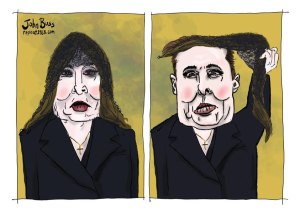
“Fake Melania mystery solved. Once you see it, you can’t unsee it.” John Buss, @repeat1968
Ashley Parker and Michael Scherer–writing for The Atlantic—dialed up Trump on his private phone one day in late March. He spoke to them even though he had described them both heinously.
The week our interview was supposed to occur, Trump posted a vituperative message on Truth Social, attacking us by name. “Ashley Parker is not capable of doing a fair and unbiased interview. She is a Radical Left Lunatic, and has been as terrible as is possible for as long as I have known her,” he wrote. “To this date, she doesn’t even know that I won the Presidency THREE times.” (That last sentence is true—Ashley Parker does not know that Trump won the presidency three times.) “Likewise, Michael Scherer has never written a fair story about me, only negative, and virtually always LIES.”
Yes, it was full-on #FARTUS Bully Verbal Bombing them publicly. They actually just called him later. He picked up. This article is the result
Despite his attacks on us a few days earlier, the president, evidently feeling buoyed by a week of successes, was eager to talk about his accomplishments. As we spoke, the sounds of another conversation, perhaps from a television, hummed in the background.
The president seemed exhilarated by everything he had managed to do in the first two months of his second term: He had begun a purge of diversity efforts from the federal government; granted clemency to nearly 1,600 supporters who had participated in the invasion of the U.S. Capitol on January 6, 2021, including those caught beating police officers on camera; and signed 98 executive orders and counting (26 of them on his first day in office). He had fired independent regulators; gutted entire agencies; laid off great swaths of the federal workforce; and invoked 18th-century wartime powers to use against a criminal gang from Venezuela. He had adjusted tariffs like a DJ spinning knobs in the booth, upsetting the rhythms of global trade and inducing vertigo in the financial markets. He had raged at the leader of Ukraine, a democratic ally repelling an imperialist invasion, for not being “thankful”—and praised the leader of the invading country, Russia, as “very smart,” reversing in an instant 80 years of U.S. foreign-policy doctrine, and prompting the countries of NATO to prepare for their own defense, without the protective umbrella of American power, for the first time since 1945.
…
We asked Trump why he thought the billionaire class was prostrating itself before him.
“It’s just a higher level of respect. I don’t know,” Trump said. “Maybe they didn’t know me at the beginning, and they know me now.”
“I mean, you saw yesterday with the law firm,” he said. He was referring to Paul, Weiss, Rifkind, Wharton & Garrison, one of the nation’s most prestigious firms, whose leader had come to the Oval Office days earlier to beg for relief from an executive order that could have crippled its business. Trump had issued the order at least partially because a former partner at the firm had in 2021 gone to work for the Manhattan District Attorney’s Office, where he was part of an investigation of the Trump Organization’s business practices. Also that week, an Ivy League institution, threatened with the cancellation of $400 million in federal funding, had agreed to overhaul its Middle Eastern–studies programs at the Trump administration’s request, while also acceding to other significant demands. “You saw yesterday with Columbia University. What do you think of the law firm? Were you shocked at that?” Trump asked us.
Yes—all of it was shocking, much of it without precedent. Legal scholars were drawing comparisons to Franklin D. Roosevelt and the early stages of the New Deal, when Congress had allowed FDR to demolish norms and greatly expand the powers of the presidency.
As ever, Trump was on the hunt for a deal. If he liked the story we wrote, he said, he might even speak with us again.
“Tell the people at The Atlantic, if they’d write good stories and truthful stories, the magazine would be hot,” he said. Perhaps the magazine can risk forgoing hotness, he suggested, because it is owned by Laurene Powell Jobs, which buffers it, he implied, from commercial imperatives. But that doesn’t guarantee anything, he warned. “You know at some point, they give up,” he said, referring to media owners generally and—we suspected—Bezos specifically. “At some point they say, No más, no más.” He laughed quietly.
Media owners weren’t the only ones on his mind. He also seemed to be referring to law firms, universities, broadcast networks, tech titans, artists, research scientists, military commanders, civil servants, moderate Republicans—all the people and institutions he expected to eventually, inevitably, submit to his will.
We asked the president if his second term felt different from his first. He said it did. “The first time, I had two things to do—run the country and survive; I had all these crooked guys,” he said. “And the second time, I run the country and the world.”
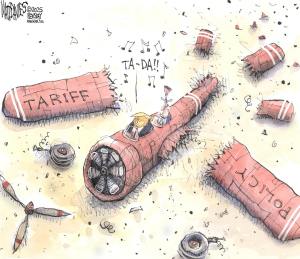 More like the country and the world run from him. I have to admit. I admire the Chinese method of trolling him. It’s funny and effective. Philip Bump at the Washington Post analyzes this self-defeating policy of the second term. “The bubble that created Trump is the reason he’s stumbling. The White House is now a bubble where loyalty, not ability, defines success.”
Consider Defense Secretary Pete Hegseth.
No one should be surprised that Hegseth is flailing in his new role, one of the most arduous and complicated in the U.S. government, if not the world. When Donald Trump proposed that Hegseth run the agency, the response was broadly unified: Hegseth lacked the experience needed to do the job effectively. You could debate the other controversies surrounding his bid for the role ad nauseam, but there was no way to reasonably argue that the Fox News talk-show host was prepared to run the Pentagon.
Hegseth was confirmed by the Republican-controlled Senate anyway because Trump and a universe of voices who support him insisted Hegseth was the best choice for the job — because he was Trump’s choice for the job. Republican senators who undoubtedly knew better went along, betting that things wouldn’t get so bad under Hegseth that it was worth stirring up the fury of that pro-Trump bubble.
It’s the same bet that prominent Republicans have been making on Trump himself since 2015. Now, as Trump too is flailing — polling and the data make clear that he is — it’s trivial to identify that insular chorus of cheerleaders and cynics as a root cause.
The president owes his political career to that same bubble. Over the past few decades, the fringe right and then Republicans more broadly embraced discussions of the world that were mostly devoid of nuance: left bad, right good. The internet allowed for the emergence of bespoke “news” organizations (and, later, social media accounts) catering to conspiratorial partisan rhetoric — an alternative to traditional reporting unhampered by criticism or unpopular truths.
Trump secured the 2016 Republican nomination not because he was the best spokesperson for the Republican Party but because he echoed the refrains of that surreal universe of information. When you hear his supporters praise his straightforwardness, this is what they are referring to: He says the false things with which they agree.
We’re about to say goodbye to Musk. Hopefully, Hegseth will be a quick second out. But what comes next? Certainly, nothing better. Even Rubio seems to have caught the munificently Kiss Ass Fever. The speed of light is the rate at which he contradicts the old Little Marco makes me wonder if he a Musk AI robot and the ex-Senator is up in space some where. Here’s the latest example from The Independent. “Marco Rubio claims Canada should be 51st state as PM told Trump they ‘couldn’t survive’ without U.S. Rubio says State Department has not taken action on the president’s push to annex Canada and Greenland.”
America’s top diplomat was questioned on Sunday about Donald Trump’s reasoning for repeatedly calling for Canada to join the United States as the 51st state.
Secretary of State Marco Rubio appeared on NBC’s Meet the Presson Sunday where moderator Kristen Welker asked him if the administration was actually taking any steps to make Trump’s vision a reality.
The president has made his opinion clear: he wants Canada to join the United States and suggested his administration would also acquire the Danish-held territory Greenland by any means.
The secretary of state gave his own translation of the president’s remarks on the matter:
“What the president has said, and he has said this repeatedly, is he was told by the previous prime minister that Canada could not survive without unfair trade with the United States, at which point he asked, ‘Well, if you can’t survive as a nation without treating us unfairly in trade, then you should become a state.’ That’s what he said.”
Rubio told Welker that the administration had taken no action to realize this particular strain of Trump’s bluster, which has alarmed U.S. allies.
There’s a U.S. military base on Greenland, and the president has cited the self-governing nation’s geographical importance as a reasoning for his expansionist goal. Trump has made the comments on numerous occasions, including in conversations with his Canadian counterparts.
Trump himself made his goals of northward expansion apparent during his address to Congress in February.
“We need Greenland for national security and even international security. And we’re working with everybody involved to try and get it,” Trump said at the time. “And I think we’re going to get it one way or the other. We’re going to get it.”
But he was making similar remarks publicly as early as December 2024.
“No one can answer why we subsidize Canada to the tune of over $100,000,000 a year? Makes no sense!” Trump wrote on Truth Social. “Many Canadians want Canada to become the 51st State.”
“They would save massively on taxes and military protection. I think it is a great idea,” added Trump.
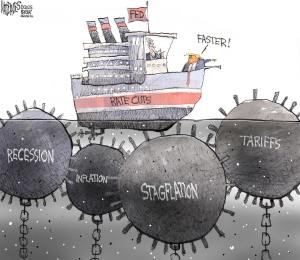 So tell me if you ever thought you’d see the day that an American Secretary of State believes annexing your best allies, the ones you’ve fought beside in Wars, and stood by you when you were attacked, would say that sort of thing? Meanwhile, the entire Deportation debacle continues on its cruel and ugly path. This is from Politico. “Homan presses undocumented immigrants to self-deport, threatening prosecution. The push comes as the monthly deportation numbers have lagged behind the Biden administration’s.” Homan is now the antonym for Human. Deportation in this country does not just fall on the undocumented. It impacts everyone.
White House border czar Tom Homan on Monday warned undocumented immigrants that they “cannot hide” and will be prosecuted in they remain in the U.S. illegally — the latest effort from the Trump administration to push self-deportation.
“Get your affairs in order. If you’re in the country illegally, work with ICE, go to CBP One Home app, and leave on your own,” Homan said from the White House press briefing room.
Homan said every immigrant in the U.S. illegally must register with the federal government and carry documentation. And those who fail to register with the Department of Homeland Security or neglect to update any new address will have those actions treated as criminal offenses “starting today.” He also warned other undocumented immigrants that if they have a final order to leave the country but remain anyway, the Trump administration will “aggressively prosecute” and issue daily monetary fines of up to $998.
The border czar’s briefing room appearance comes as the Trump administration marks its 100th day in office this week, with Homan touting the administration’s progress on border security. He pointed to a significant drop in illegal border crossings, which have plunged since Trump took office to the lowest level in decades.
Homan said Monday that the administration has deported 139,000 migrants since Jan. 20 as Trump officials have struggled to ramp up removal numbers. This figure includes people deported by Immigration and Customs Enforcement, Customs and Border Protection and the Coast Guard, who would have been encountered at or before they reached the border, according to a DHS official. The Trump administration’s monthly deportation numbers have lagged behind the Biden administration’s, according to data obtained by NBC News.
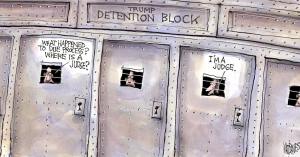 The bluster is abusive, but the actions are unconstitutional, illegal, and inhumane. The New York Times reports on the weekend’s 60 Minutes sign-off. Every voice raised against the dismantling of US democracy is a voice that counts! “‘60 Minutes’ Chastises Its Corporate Parent in Unusual On-Air Rebuke. The show’s top producer abruptly said last week he was quitting. “Paramount began to supervise our content in new ways,” the correspondent Scott Pelley told viewers.”
In an extraordinary on-air rebuke, one of the top journalists at “60 Minutes” directly criticized the program’s parent company in the final moments of its Sunday night CBS telecast, its first episode since the program’s executive producer, Bill Owens, announced his intention to resign.
“Paramount began to supervise our content in new ways,” the correspondent, Scott Pelley, told viewers. “None of our stories has been blocked, but Bill felt he lost the independence that honest journalism requires.”
A spokesman for Paramount had no immediate comment, and has previously declined to comment on Mr. Owens’s departure.
Mr. Owens stunned the show’s staff on Tuesday when he said he would leave the highest-rated program in television news over disagreements with Paramount, CBS’s corporate parent, saying, “It’s clear the company is done with me.”
Mr. Owens’s comments were widely reported in the press last week. The show’s decision to repeat those grievances on-air may have exposed viewers to the serious tensions between “60 Minutes” and its corporate overseers for the first time.
Shari Redstone, the controlling shareholder of Paramount, has been intent on securing approval from the Trump administration for a multibillion-dollar sale of her media company to a studio run by the son of Larry Ellison, the tech billionaire.
President Trump sued CBS last year, claiming $10 billion in damages, in a case stemming from a “60 Minutes” interview with the 2024 Democratic presidential nominee, Kamala Harris, that Mr. Trump said was deceptively edited. Ms. Redstone has expressed her desire to settle Mr. Trump’s lawsuit, although legal experts have called the case far-fetched.
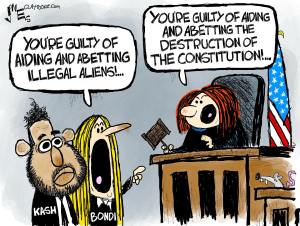 So that’s it for me today. I’m just trying to keep my head above water and my thoughts on calm, clear awareness. I hope you’re finding a way to cope with this mess. I try to tune out as much as possible, but my job is to teach folks about financial and economic policies, so I can only shut out so much. A friend of mine posted a picture of American NAZIs partying in the French Quarter and getting drinks from the Dungeon. The tattoos and the t-shirts said it all. What’s most disturbing about all of this is these folks are out of their hidey holes, and they don’t care who sees them and what they say. I’ll be out on Wednesday at a protest in front of the ICE offices here in the Central Business District. I need to do something, even just being with like-minded people.
Also, we’re finding some older Dem Pols stepping down to make way for new blood. “Rep. Gerry Connolly, the top Democrat on the House Oversight and Government Reform Committee, will step down from his leadership post on the panel and not run for reelection.” Let’s try to hope.
What’s on your Reading and Blogging list today?
Finally Friday Reads: Back to the Supply Chain Blues
Posted: April 25, 2025 Filed under: #FARTUS, #MAGAnomics, kakistocracy, kleptocracy, MAGA goes after the Rule of Law, racism in MAGA | Tags: #FARTUS Mafia State, @johnbuss.bsky.social John Buss, ICE Deportations, Supply Chain issues from Trump Tariffs, Trump Tariffs 6 Comments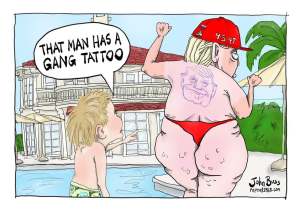
“Kids say the darndest things.” John Buss, @repeat1968
Good Day, Sky Dancers!
File this under news you can use. You know that I warn y’all when I throw dem bones and come up with something you need to know. I will give you some analysis that should give you a heads-up on shortages at most major retailers, likely starting within two weeks. You may remember that our Black Swan Event, the COVID-19 pandemic, led to the Great Toilet Paper Panic of 2020. This upcoming one will be worse and was self-inflicted with the worst economic policy ever. We can’t completely predict the size or length because of the erratic and ever-changing policy that has disrupted equity markets and will shortly be felt in the availability of so many things that I can’t possibly list here.
However, I can tell you that the country’s largest retailers have already warned the White House. They’re also seeing a series of cargo ships return with empty containers, and that East and West Coast Ports are already showing severe drops in activity. Two of the largest retailers–Target and Walmart–met with the White House on Monday. This brief explanation comes from Bloomberg via Yahoo Finance. Yahoo Finance is actually a source I recommend to students and use a lot for assignments reflecting equity markets. The information and reprints of articles are not behind a paywall. “Walmart, Target Executives Meet Trump As Tariff Fears Spread.”
Disruptions caused in large part by Trump’s tariffs have posed challenges for retailers that are main drivers of the US economy. A selloff in US assets deepened Monday amid tariff anxiety and Trump’s threats against Federal Reserve Chair Jerome Powell.
Shares of the companies ticked up after news of the meeting, but Walmart and Home Depot remained down for the day. Target rose less than 1% at the close of trading.
American companies have warned that business could slow in the months ahead as the import taxes go into place. While companies have operated with tariffs for several years, the magnitude and fast-changing nature of Trump’s levies have become a unique problem.
Trump’s duties on nearly all trading partners and a litany of sectors, including metals, are threatening to increase prices on everything from spirits and apparel to electronics and furniture. Those changes are expected to further hamper consumer demand, as Americans have already been price-sensitive following years of inflation.
In addition to the cavalcade of overseas officials seeking lower tariffs, Trump has indicated he would be open to negotiating on rates with corporate leaders.
“We’ll also talk to companies. You know, you have to show a certain flexibility. Nobody should be so rigid,” the US president told reporters on April 13.
Trump’s administration exempted smartphones, computers and other electronics from its so-called reciprocal tariffs. The decision marked a temporary reprieve for global technology manufacturers, including Apple Inc. and Nvidia Corp., though officials later said the US would craft other specific duties for those products and started the process by launching an investigation into semiconductor imports.
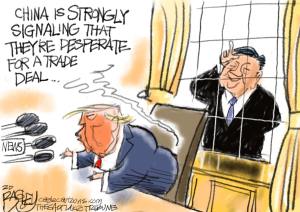 This tells us he’s willing to deal with corporations looking for exemptions. These first exemptions are for the Billionaire Tech Bros. Also, “duties” have come into play.
When importing products to other countries, there are always import fees to be paid at customs. It’s important to note the distinct differences between taxes, tariffs, and duties and how they influence the costs of shipping products internationally. Here is a quick guide to these three types of import fees.
- All duties are based on product characteristics, specifically the HTS code, and the certificate of origin.
- Tariffs are fees applied to specific products from specific countries for specific times, they are determined by international trade negotiations and can change at the whim of the current government.
- Import taxes (for example, VAT or GST) are fixed rates calculated by the total value of the product imported into the country.
Every country has different import tax and duty obligations, with different rates, rules, and declaration forms. It’s important to work with trusted international partners to ensure you comply with the current regulations, so that you don’t have any surprise fees coming your way after you import your products.
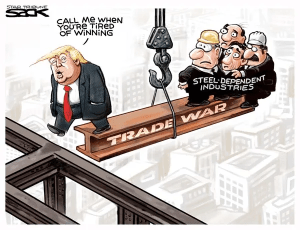 The bottom line is that they all cause the price of the products to go up and generally reduce employment and availability of goods. Prices up. Unemployment up. That’s the basic definition of a country in a Stagflation Cycle. It’s the worst of both worlds because you get inflation and unemployment. I’ve dug into the numbers to date, and it appears the Walmart and Target leaders have legitimate fears. There are many trade publications that follow supply lines and chains. Obviously, railroads, ports, shipping, and air transit are important sectors because their business depends on goods in transit. Then they’re are the importers and exporters of the goods and services. You can see the loss of exchange by looking at the numbers. You know me. I love to make those numbers dance and sing. What you can see is that there are empty containers coming into ports. What this turns into is empty shelves.
So, let’s head to the industry publications. This information comes from Transport Topics which focuses on the impact of loss of trade in ports and airports. Basically, it’s where the shipments come in or leave. “US-China Tariffs Hit Amazon, FedEx, UPS Distribution Links. L.A., Long Beach Ports Project 10% Cargo Volume Drop.” The important thing to look for is an outlier that may signal a trend change. Here’s their analsyis of the data they are gathering to help these businesses make decisionis.
President Donald Trump’s tariffs on Chinese imports threaten to disrupt Southern California’s trade and logistics economy, a sector that moves a third of the nation’s container cargo and supports nearly 2 million jobs, according to a new analysis.
Trump’s 145% tariff on Chinese imports is expected to dramatically reduce volumes through the ports of Los Angeles and Long Beach, the nation’s busiest container gateway, according to a report by the Southern California Leadership Council and the Los Angeles County Economic Development Corp. China’s 125% retaliatory duties on U.S. goods are likely to drag down outbound traffic.
“That’s going to hurt the people who unload the cargo when it lands in our ports, the longshoremen, the people who ship it on rail or truck to the warehouses, the people who store it in warehouses and send it on to its final destination,” said SCLC co-chair and former California Gov. Gray Davis in a press conference on April 22.
President Donald Trump’s tariffs on Chinese imports threaten to disrupt Southern California’s trade and logistics economy, a sector that moves a third of the nation’s container cargo and supports nearly 2 million jobs, according to a new analysis.
Trump’s 145% tariff on Chinese imports is expected to dramatically reduce volumes through the ports of Los Angeles and Long Beach, the nation’s busiest container gateway, according to a report by the Southern California Leadership Council and the Los Angeles County Economic Development Corp. China’s 125% retaliatory duties on U.S. goods are likely to drag down outbound traffic.
“That’s going to hurt the people who unload the cargo when it lands in our ports, the longshoremen, the people who ship it on rail or truck to the warehouses, the people who store it in warehouses and send it on to its final destination,” said SCLC co-chair and former California Gov. Gray Davis in a press conference on April 22.
China remains Southern California’s largest trading partner, with roughly $130 billion in imports passing through the twin ports last year, according to the report. Los Angeles port officials expect cargo volumes to fall by at least 10% as early as May, with declines likely to continue through the end of the year.
Together, the ports handle roughly 35% of all U.S. containerized cargo and anchor a vast logistics network that stretches through the Inland Empire.
The region is home to major distribution centers, rail systems and trucking routes used by Amazon, Walmart, FedEx, UPS and Prologis, a real estate giant specializing in warehouses. Trade and transportation directly employs more than 900,000 workers in Southern California and indirectly supports nearly 2 million jobs.
Amazon ranks No. 1 on the Transport Topics Top 100 list of the largest logistics companies in North America, and No. 1 on the Top 50 list of the largest global freight carriers.
UPS and FedEx rank Nos. 1 and 2, respectively, on TT’s Top 100 list of the largest for-hire carriers in North America, and Nos. 5 and 43 on the logistics TT100. On the global freight TT50, FedEx ranks No. 2 and UPS No. 3.
Walmart ranks No. 1 on TT’s Top 100 list of the largest private carriers in North America.
The tariffs tit-for-tat also leaves thousands of the region’s importers facing inputs that potentially are two-and-a-half times more expensive, forcing companies to absorb the price increases or pass them on to consumers, the report said.
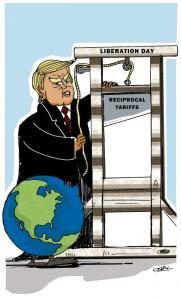 Forbes has more information on the shrinking number of goods coming to the ports headed to the businesses above. You may have heard that a lot of containers coming into the west coast ports are nowarriving empty. Thas has important ramifications.
The $8.5 trillion retail industry and the 132 million American households it serves are facing rapidly rising prices across the board should the proposed reciprocal tariffs be imposed. The National Retail Federation estimated tariffs could cost Americans up to $78 billion in annual spending power across six categories of goods, including apparel, toys, furniture, household appliances, footwear and travel goods. That estimate does not include food and beverage, which totaled $1.5 trillion in spending last year for off-premise personal consumption, according to the Bureau of Economic Analysis.
Walmart customers have less on the line should tariffs be imposed. Only about 33% of the products it carries are sourced internationally, though China and Mexico are its most significant trading partners. On the other hand, Target imports about 50% of its merchandise, including 30% of its private label brands come from China. And Home Depot reports 50% of its goods are sourced in North America, though how much comes in from Canada is not specified.
“Retailers rely heavily on imported products and manufacturing components so that they can offer their customers a variety of products at affordable prices. A tariff is a tax paid by the U.S. importer, not a foreign country or the exporter. This tax ultimately comes out of consumers’ pockets through higher prices,” said NRF vice president of supply chain and customs policy Jonathan Gold in a statement.
American voters want government policy officials to focus on bringing down inflation and the cost of groceries as their top priorities rather than implementing tariffs to reset global trade, according to an NRF/Morning Consult survey among 2,000+ voters conducted at the end of March, before Trump’s “Liberation Day” tariff announcement. Some 76% of those surveyed expect prices to go up if tariffs are implemented. Rising prices will be a blow to all American households, but most especially to those in vulnerable communities, such as low-income households, working-class families, the elderly, families with small children, rural communities, farmers and small businesses.
Adding to worries about retail supply chains is a report that product import levels will drop sharply in May and continue to decline through the rest of the year. The NRF predicts a total net volume decline of 15% or more by year-end, which will likely mean selective product shortages on retailers’ shelves.
American Apparel & Footwear Association CEO Steve Lamar told CNBC, “Higher prices, job losses, product shortages, and bankruptcies will be only some of the adversity the U.S. economy weathers while the President pursues this ill-advised tariff policy.”
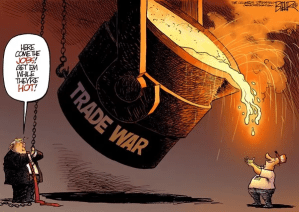 Here is more on empty shipping containers returning to American Ports from Fortune. “Trump’s trade war has already sparked a massive cancellation of shipments from China to the U.S.” This article is new today and the analsyis is provided by Sasha Rogelberg.
-
In the weeks following President Donald Trump’s 145% tariff on China, shipping of Chinese imports to the U.S. have fallen steeply as companies try to avoid the price increases on products. The whiplash of companies stockpiling inventory ahead of tariffs, then pulling back on imports from China, is exacerbating a supply chain nightmare that will likely also have negative impacts on consumers.
Early shipping data is already beginning to show a clear drop off in imports from China as a result of President Donald Trump’s trade war, and logistics experts are warning continued tariffs could send the industry—and broader economy—into choppy waters.
With U.S. tariffs on China ballooning to 145%, companies have reacted accordingly, spending the months preceding Trump’s second term ramping up shipments in order to stockpile inventory of specific components predicted to be hit hard by tariffs. But immediately following the April 9 “Liberation Day,” ocean-shipped orders have done a 180, with volumes dropping dramatically. The Trump administration is now floating a substantial cut to Chinese tariffs, though some taxes would still remain.
To make matters more complicated for the freight industry, the administration is also pushing forward with a port fee for Chinese vessels, meaning that carriers made in China may incur levies up to $1.5 million when they visit an American port, part of a continued effort to discourage trade with China. The White House did not respond to Fortune’s request for comment.
Just weeks into the new tariff policy, U.S. imports from China have plummeted, with volumes falling more than 10% the week of April 7 compared to volumes the year before, and nearly 30% the week of April 14, according to a report published Tuesday by supply-chain platform Project44. Prior to the first week of April import volumes were consistently higher than they were the year higher, suggesting some companies pushed up order shipments in order to dodge the impact of tariffs.
Since the tariffs’ implementation, the rate of “blank sailings,” or when a carrier skips a scheduled port of call usually as a result of slowing demand, has also increased. While the East Coast saw 24 blank sailings, a 100% increase since the introduction of Chinese tariffs in February, the West Coast saw 21 blank sailings, a 31% increase from February.
The sudden drop in import activity is a sign that after months of companies scrambling to understand how to respond to tariff threats, they have finally needed to pull the trigger on a shipping strategy, and have decided at this time to pull back, according to Eric Fullerton, vice president of product marketing at Project44
“Businesses are really responding in a very, very distinct way,” he told Fortune. “A lot of that strategic planning and cost optimization and diversification, all of these strategies and approaches that they’ve been thinking through are actually to be shown in reality.”
Data from the Port of Long Beach, California—the largest U.S. port and the closest to China—backs up Project 44’s findings. The port reported 16 fewer ships to arrive in May, resulting in about 60 ships to arrive compared to the port’s usual monthly total of 80. Approximately half of imports to the Port of LA come from China.
“It’s my prediction that in two weeks time, arrivals will drop by 35%, as essentially all shipments out of China for major retailers and manufacturers has ceased, and cargo coming out of Southeast Asia locations is much softer than normal, with the tariffs now in place at this moment, and the news comes out and changes almost hourly,” Gene Seroka, executive director of the Port of LA, said in a Thursday meeting with the LA Board of Harbor Commissioners.
 I suggest you plan accordingly. In another about face, Politico reports that “Trump administration reverses abrupt terminations of foreign students’ US visa registrations, DOJ announced the reversal in federal court after weeks of intense scrutiny by courts and dozens of restraining orders issued by judges.”
“The Trump administration has restored the student visa registrations of thousands of foreign students studying in the United States who had minor — and often dismissed — legal infractions.
The Justice Department announced the wholesale reversal in federal court Friday after weeks of intense scrutiny by courts and dozens of restraining orders issued by judges who deemed the mass termination of students from a federal database — used by universities and the federal government to track foreign students in the U.S. — as flagrantly illegal.
The terminations caused concern and even panic for thousands of students who feared the possibility they had lost their legal immigration status and could be quickly deported. Many who sued over the move said their schools had also blocked their ability to continue taking classes or conducting research, sometimes just weeks before graduation.
The terminations from the federal database earlier this month sparked more than 100 lawsuits, with judges in more than 50 of the cases — spanning at least 23 states — ordering the administration to temporarily undo the actions. Dozens more judges seemed prepared to follow suit before Friday’s reversal.
April Ryan Reports today on the erasure of historical achievements by black Americans at blackpress USA. “The Smithsonian PURGE: Trump Team Removes Artifacts of Black Resistance. Critics warn: it’s not just history being erased—it’s identity.”
Black Press USA has learned that Trump officials are sending back exhibit items to their rightful owners and dismantling them—starting with the 1960 Woolworth’s lunch counter sit-in exhibit.
“This president is a master of distraction and is destroying what it took 250 years to build. Here’s another distraction in his quest for attention. Another failure of his first 100 days,” said North Carolina Rep. Alma Adams, responding to efforts to physically remove the Greensboro, North Carolina, Woolworth’s lunch counter exhibit from the National Museum of African American History and Culture—affectionately known as the “Blacksonian.”
The exhibit features portions of the original lunch counter and highlights the story of four Black male students from North Carolina A&T who were brutally attacked after sitting at the whites-only counter Feb. 1, 1960. When denied service, the students refused to leave. Their defiance ignited a wave of lunch counter sit-ins across the South and became a major flashpoint in the Civil Rights Movement.
Adams added, “We are long past the time when you can erase history—anyone’s history. You can take down exhibits, close buildings, take down websites, ban books, and try to change history, but we are long past that point. We will never forget!”
Black Press USA has also obtained a letter from Dr. Amos Brown, long-standing civil rights leader and pastor of Third Baptist Church in San Francisco—also known as the home church of former Vice President Kamala Harris.
The letter notifies Dr. Brown that the museum is returning a Bible and George W. Williams’s History of the Negro Race in America, 1618-1880, one of the first books on racism in the U.S. Black Press USA has obtained emails from April 10 and 15, 2025, confirming the transfer.
I don’t know about you, but I’m not sure I’m going to be able to get through these next few years with out crying daily.
What’s on your Reading and Blogging list today?
Finally Friday Reads: It’s late but I took some ME time
Posted: April 11, 2025 Filed under: #FARTUS, #MAGAnomics, Broligarchy, Federal Budget and Budget deficit | Tags: @johnbuss.bsky.social John Buss, @repeat1968. John Buss, Disastrous Don, economic impact of #FARTUS tariffs, kakistocracy, Markets continue to Crash 1 Comment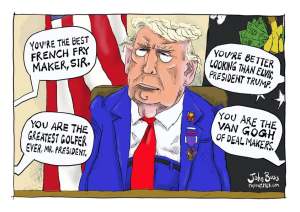
“Well, I don’t know why I came here tonight
I’ve got the feeling that something ain’t right
I’m so scared in case I fall off my chair
And I’m wondering how I’ll get down the stairs” John Buss, Repeat1968 with h.t t;o Stealers Wheels
Good Day, Sky Dancers!
I took some time today to enjoy a friend from FDL, sushi from Lin’s at St Roch Market, and the Bywater and Marigny right up to the edge of the Quarter. The only way to explore my neighborhood is by foot or by bus. That way, you really get to know us. The stores on LA49 (better known as St. Claude Avenue) are small, locally owned, and full of surprises. I don’t think I can ever emphasize how much I love this city. It’s probably why I stay here and don’t go elsewhere anymore. I first discovered this because when I ventured around the state or country, I had dreams about not being able to find or go home, which ended immediately when I opened the front door. I really wish you this feeling. It’s amazing.
It gave me a breath from reading stuff today. So, here I go, right into the thick of it. This is from Dr. Paul Krugman’s Substack. “The Third-Worlding of America. How to destroy 80 years of credibility in less than 3 months.” Like all excellent economists, he’s got charts and numbers to prove it. I got all these degrees to help people understand financial markets and economic policy. Now, I live with knowledge; I just pray it still empowers people, even if it feels disheartening today.
Remarkably, the sanewashing continues despite the unprecedented craziness of the past 10 days. Many observers assert that Trump has backed down on tariffs and will speedily make a bunch of trade deals. The first assertion is just false, while the second is very unlikely.
In fact, savvy traders have realized that there’s no coherent economic strategy. There’s an old line about military analysis: “Amateurs talk about tactics, but professionals talk about logistics.” Well, when it comes to taking the pulse of financial markets, amateurs talk about stocks, but professionals talk about bond and currency markets. That’s because bond and currency markets are generally less driven by emotion. There’s no “meme
gamblinginvesting” in bond and currency markets. And these markets are both signaling major loss of faith in America.First, about tariffs: It’s true that for the time being Trump has scaled back some of the tariffs displayed on his big piece of cardboard last week. For example, unless we have another policy swerve, the European Union will now face a 10 percent tariff over the next three months rather than a 20 percent tariff. But the tariff on China, our third-biggest trading partner after Canada and Mexico, has gone from 34 percent to more than 130 percent. And we still have high tariffs on steel, aluminum and so on. In effect, observers who claim that tariffs have gone down are missing the biggest part of the story.
Economists who have actually run the numbers, like those at the Yale Budget Lab, estimate that the April 9 tariff regime will raise consumer prices more than the April 2 regime because of the extraordinarily high tariff rate on Chinese imports. Specifically, the budget lab estimates that the latest version of Trump’s trade war will raise consumer prices by 2.9 percent. This is roughly ten times the probable impact of the infamous Smoot-Hawley tariff of 1930.
It’s hard to overstate the craziness of announcing a radical tariff plan, then announcing a quite different but equally radical plan just a week later. Furthermore, the claim that the wild zigzags in policy were always part of Trump’s plan just adds to the destruction of the administration’s credibility.
But are these tariffs just an opening gambit for trade negotiations? I doubt it. Bear in mind that Trump and Peter Navarro, his tariff guru, start from the premise that other countries are cheating, that they’re taking advantage of America and treating us unfairly. In fact, however, most of them aren’t. Take the case of the European Union. The EU imposes an average tariff on U.S. goods of just 1.7%, and there aren’t any significant hidden barriers.
So what are we supposed to be negotiating about? Nations can’t promise to lower their trade barriers when there aren’t any barriers. Navarro has been claiming that value-added taxes are de facto tariffs, but they aren’t, and EU nations literally can’t afford to give them up.
I guess other countries might make fake concessions that Trump can claim as fake victories. This is what he did with China during his first term, claiming that it had made significant concessions — claims which were, in the end, false. In fact, American soybean farmers have never fully recovered the loss of market share. And remember too how Trump made minor changes to NAFTA and claimed to have negotiated a whole new trade pact.
However, Trump is now clearly high on his own supply. Even with the April 9 tariff regime, Trump is imposing high tariff rates on our three largest trading partners. Currency and bond market traders — no fools they — are certainly not acting as if we’re on a path to successful deals.
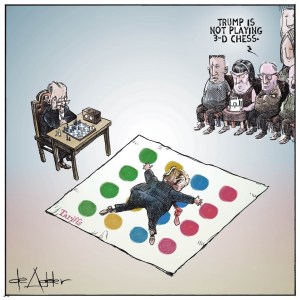 The Chinese are pranking Trump today. This is from the Washington Post. “China raises tariffs on U.S. goods to 125 percent as trade war deepens. Beijing hit back in response to the Trump administration’s move to raise tariffs on Chinese goods to 145 percent, saying it would “fight to the end.” They can afford to. They’re making deals with South Korea and Japan, among other countries. The only group this is hurting is US importers and Exporters. This includes farmers.
The response underscored China’s decision to stand firm in the face of pressure from Washington and deepened the showdown between the world’s two largest economies.
“If the U.S. insists on substantively damaging China’s interests, China will firmly retaliate and fight to the end,” China’sState Council said in a statement.
The move came after Trump increased the levies on Chinese goods to 145 percent on Wednesday, while also announcing that the tariffs he had previously imposed on more than six dozen other countries would be fixed at 10 percent during a 90-day pause.
The State Council derided Trump’s move to continue ratcheting up the levies and said it would ignore further hikes. The tariffs are a “joke” and “no longer have any economic significance,” its statement said, because the current levels make U.S. exports to China not financially viable. The new Chinese tariffs, which increased from 84 percent, are effective Saturday.
Chinese leader Xi Jinping, in a meeting with Spanish Prime Minister Pedro Sánchez on Friday, stressed that trade wars have no winners and called for China and Europe to “jointly oppose unilateral bullying,” according to state media. European leaders also emphasized the damaging effects of uncertainty beyond the 90-day pause.
Experts in Beijing expressed concern about the latest turn in tensions with Washington. “U.S.-China trade will soon be almost nonexistent,” said Shi Yinhong, an international relations professor at China’s Renmin University. “To ease tensions, Trump must first make concessions.”
 Turmoil over tariffs drove fluctuations in global markets on Friday.
Japan’s Nikkei 225 and Topix indexes dropped by5percent, before trimming their losses to under 3 percent by market close. South Korea’s Kospi and Australia’s ASX 200 fell by less than1 percent, while Taiwan’s bourse kicked off the day with a fall of under 1 percent before logging a 2.5 percent gain. Hong Kong’s Hang Seng Index and China’s Shanghai composite index were mostly flat, with the Hang Seng closing just over 1 per cent higher.
Major European markets fell slightly after opening on Friday, following rebounds the previous day. By 6 a.m. Eastern time, Germany’s DAX was down 1.62 percent, France’s benchmark CAC fell by 1.11 percent and London’s FTSE 100 was down around 0.3 percent.
 CNN has this headline today for a story written by Ella Nilsen. “Trump’s budget plan eviscerates weather and climate research, and it could be enacted immediately.” I guess I better hurry to put that Weather Station up in the Pergalo.
The Trump administration intends to eliminate the research arm of the National Oceanic and Atmospheric Administration, close all weather and climate labs and eviscerate its budget along with several other NOAA offices, according to internal documents obtained by CNN.
The documents describe the administration’s budget proposal for 2026, but indicate the administration expects the agency to enact the changes immediately.
The cuts would devastate weather and climate research as weather is becoming more erratic, extreme and costly. It would cripple the US industries — including agriculture — that depend on free, accurate weather and climate data and expert analysis. It could also halt research on deadly weather, including severe storms and tornadoes.
The administration intends to make significant cuts to education, grants, research and climate-related programs in NOAA, the plan says, which the administration believes “are misaligned with the … expressed will of the American people.”
While the phrase “climate change” refers to the manmade influence on the global climate system via planet-warming fossil fuel pollution, “climate” in NOAA parlance is simply the weather that has been observed over time.
CNN has reached out to the White House and the Department of Commerce, which houses NOAA, for comment on the plan.
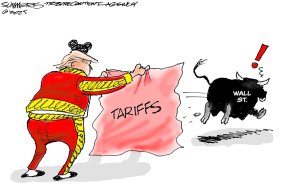 Additionally, NASA is on the chopping block! Does this include all that money going to Elonia? This is from ars TECHICA‘s Eric Berger. “Trump White House budget proposal eviscerates science funding at NASA. “This would decimate American leadership in space.” #FARTUS seems dead set on sending us back to the Gilded Age. Even the best of the Modern Era is about to be erased.
This week, as part of the process to develop a budget for fiscal-year 2026, the Trump White House shared the draft version of its budget request for NASA with the space agency.
This initial version of the administration’s budget request calls for an approximately 20 percent overall cut to the agency’s budget across the board, effectively $5 billion from an overall topline of about $25 billion. However, the majority of the cuts are concentrated within the agency’s Science Mission Directorate, which oversees all planetary science, Earth science, astrophysics research, and more.
According to the “passback” documents given to NASA officials on Thursday, the space agency’s science programs would receive nearly a 50 percent cut in funding. After the agency received $7.5 billion for science in fiscal-year 2025, the Trump administration has proposed a science topline budget of just $3.9 billion for the coming fiscal year.
Among the proposals were: A two-thirds cut to astrophysics, down to $487 million; a greater than two-thirds cut to heliophysics, down to $455 million; a greater than 50 percent cut to Earth science, down to $1.033 billion; and a 30 percent cut to Planetary science, down to $1.929 billion.
Although the budget would continue support for ongoing missions such as the Hubble Space Telescope and the James Webb Space Telescope, it would kill the much-anticipated Nancy Grace Roman Space Telescope, an observatory seen as on par with those two world-class instruments that is already fully assembled and on budget for a launch in two years.
 We’re also unlikely to see other countries send their best and brightest to our US Universities with all this craziness. As some with with multiple degrees and ones that aren’t that easy to achieve, I would just like to say that my teachers, my students and grad assistants, and my colleagues and fellow students were consistently the best part of higher education school. I owe so much of my math chops to fellow students from India, Iran, Hong Kong, Turkey, and Taiwan. Both of my Doctorate advisors came here as students. One from India. The other is from Bangladesh. This brain drain will put us on the road to mediocrity.
This is from the AP. “Immigration judge finds that Columbia University activist Mahmoud Khalil can be deported.”
Columbia University graduate student Mahmoud Khalil can be kicked out of the U.S. as a national security risk, an immigration judge in Louisiana found Friday during a hearing over the legality of deporting the activist who participated in pro-Palestinian demonstrations.
The government’s contention that Khalil’s presence in the United States posed “potentially serious foreign policy consequences” was enough to satisfy requirements for his deportation, Immigration Judge Jamee E. Comans said at the conclusion of a hearing in Jena.
Comans said the government had “established by clear and convincing evidence that he is removable.”
Lawyers for Khalil said they plan to keep fighting. The judge gave them until April 23 to seek a waiver. Meanwhile, a federal judge in New Jersey temporarily barred Khalil’s deportation.
Addressing the judge at the end of the hearing, Khalil mentioned that she said at a hearing earlier in the week that “there’s nothing more important to this court than due process rights and fundamental fairness.”
Let me just say that Jena, Louisiana, is a hell realm.
Is it a Constitutional Crisis Yet, Momma? Brad Reed has that Raw Story headline.
The United States Department of Justice said on Friday that it will not comply with an order from Judge Paula Xinis to reveal information on the whereabouts and status of deported immigrant Kilmar Abrego Garcia.
As reported by Politico’s Kyle Cheney on BlueSky, the DOJ information Judge Xinis that it would not be able to provide the information she requested on Garcia because the court set an “impracticable” deadline to do so.
Judge Xinis had originally demanded that the DOJ provide information about Garcia’s status by 9:30 a.m. on Friday after the United States Supreme Court ruled that the Trump administration needed to facilitate bringing him back from the prison in El Salvador where he had been sent improperly.
The judge extended the deadline to 11:30 a.m. on Friday morning and scheduled a court hearing on the case for 1 p.m.
So, I hope you’re trying to stay positive and calm. I’m going to go walk Temple and feed the kitties. That’s something I can do right now without feeling depressed.
What’s on your reading and blogging list today?
Black Friday: The Great Crash
Posted: April 4, 2025 Filed under: #MAGAnomics, tRump crimes against humanity | Tags: @johnbuss.bsky.social John Buss, economic impact of #FARTUS tariffs, FARTUS, grand wizards of the kleptocracy, kakistocracy, Land of Confusion, tariffs and farmers 4 Comments Good Day, Sky Dancers!
#FARTUS has deliberately tanked the equity markets and the dollar with record-level tariffs set with an equation that made no sense and included tariffs placed on islands with no human inhabitants. This is further evidence of the incompetency and utter ignorance of the Trump Administration. This is not economic policy. This is some personal brain fart of a very disturbed man.
The newest economic alignment is between Japan, Southern Korea, and China. They have negotiated a Trilateral Free Trade Agreement. The Europeans have basically given up on us. The dollar is no longer the safe currency as we saw in trading yesterday. It had its highest drop on record. The jobs report will be released shortly and will determine any further rate of decline. I watched an increasing level of lay-off announcements by major manufacturers, Whirlpool, Stellantis, and more have announced additional layoffs. This comes after Forbes announced, “Nearly 100 Companies Announce Layoffs In March, According To Reports.” This was the highest amount of layoffs since 2020 which was the start of the COVID-19 pandemic. The USD has regained some of its footing, but frankly, when economic policy is ruled by hubris and ignorance, there’s very little you can get from a forecasting model.
None of this makes sense from an Economic Policy Basis. We now have retaliatory tariffs, which signal a massive trade war has begun. Like the last Trump Tariff-induced trade war, US farmers will be on the front line. Manufacturers will also be severely hurt. Of course, the ultimate loser is the average American. I still see stagflation in our near term future. High inflation plus very lousy unemployment. The Fed’s tools are not as useful with this kind of economy. Stimulate the economy to end unemployment, and you get higher prices. Stop the high inflation, and you worsen the recession. What really kills me is that this destructive policy was fully preventable. But then, elections brought us this mess, and elections must pull us out of it.

les pingouins résistent
You may read all my sources if you are so inclined. I know they’re not the most exciting reads. Here’s a trio of dismal headlines from The Guardian. Note: FTSE is the UK equivalent of the Dow Jones.
Global trade war escalates as Beijing hits back against Donald Trump with new tariffs on US goods
- China retaliates to Trump’s ‘bullying practice’ with 34% tariffs on US imports
- IMF warns of ‘significant risk’ to global economy from Trump tariffs as markets slide
- Analysis: Trump’s ‘idiotic’ and flawed tariff calculations stun economists
I’m going to quote from the Analysis. This is the full Headline. “Trump’s ‘idiotic’ and flawed tariff calculations stun economists
Richard Partington, The Guardian’s Senior economics correspondent, wrote this analysis. “‘Willing sycophants’ came up with simplistic formula that has thrown global economy into disarray.”
Waving a big chart as a prop in the White House Rose Garden, Donald Trump suggested his new tariff plan was simple: “Reciprocal – that means they do it to us, and we do it to them. Very simple. Can’t get simpler than that.”
Perhaps a bit too simple. The method used to calculate the most important numbers in international trade, politics and economics has left some of the world’s leading experts shocked.
For each country, the White House looked up its trade in goods deficit for 2024, then divided that by the total value of imports. Trump, to be “kind”, said he would, however, offer a discount, so halved that figure. The calculation was even distilled into a formula.
For example, take the figures for China:
Goods trade deficit: $291.9bn
Total goods imports: $438.9bn
Those figures divided = 0.67, or 67%
And halved = 34%
For countries without a large deficit, the White House applied a 10% baseline, ensuring tariffs would be applied regardless. This was the case for the UK, which the US Census Bureau reckons had an almost-$12bn surplus in 2024.
“[It is] quite an extraordinary calculation after months of work behind the scenes,” said Jim Reid, the global head of macro research at Deutsche Bank. “[It] didn’t add much confidence on there being an in-depth strategic implementation plan.”
For weeks, Washington had been talking about an in-depth policy exercise to establish figures based on a combination of tariff and non-tariff barriers to trade, as it perceived them to be; including alleged “currency manipulation”, local laws, regulations, and taxes such as VAT.
In itself that approach raised eyebrows with experts who said VAT was highly unusual to include, because it is a sales tax paid on domestically produced goods and foreign imports alike.
However, the White House appears to have confirmed it took a simplistic approach to making this judgment:
Reciprocal tariffs are calculated as the tariff rate necessary to balance bilateral trade deficits between the US and each of our trading partners. This calculation assumes that persistent trade deficits are due to a combination of tariff and non-tariff factors that prevent trade from balancing.
There are multiple problems with this – not least that it vastly oversimplifies the drivers of trade deficits. Trade deficits occur when a country buys more than it sells abroad. The US has run a deficit persistently since the 1970s. Typically trade deficits balance over time, as they create downward pressure on a country’s currency (as the result of demand for foreign currency, to buy imported goods, outstrips demand for domestic currency).
Another part of the reason is US goods are too expensive for consumers in developing economies to buy – helping to explain some of the particularly large trade deficits – and new tariffs – for poorer countries.
Adam Tooze, an economic historian at Columbia University in the US, said there were “grotesque” policies for south-east Asian countries, including a 49% Cambodian tariff, and rates of 48% for Laos and 46% for Vietnam.
“This is not because they discriminate viciously against American exports, but because they are relatively poor. The US does not make a lot of goods that are relevant for them to import,” he said.
Vietnam in particular has become part of the global supply chain for major manufacturers, including US tech and clothing companies such as Nike, Intel, and Apple.
Lesotho, the tiny southern African country, one of the poorest in the world, is another odd example, facing a tariff of 50%. Among its main exports to the US are diamonds and clothes – demonstrating how links around the world for rare minerals are important for the US economy, but also how the US sought to boost development in African nations in recent years – with policies to encourage manufacturing by companies including Levi Strauss and Wrangler.
 There are three major trade models in economic theory. Basically, the first was mercantilism, which is the colonialist type of economy that caused the Boston Tea Party. The second is absolute advantage, and the third is comparative advantage. We generally have an absolute advantage in nearly all the markets because we’re a huge economy with many natural resources. There are still things we cannot provide, though. The example I always use is coffee.
This is where comparative advantage comes in. The countries in South America and Africa can sell us their coffee in return for goods and services we easily produce. We both benefit from the trade. It’s the basis of free trade. From this model, we’ve had many improvements as we’ve gone beyond the logic of the models to empirical testing. The last big change to this model was by Paul Krugman, but Stiglitz and Samuelson were prior researchers into trade between countries.
You may check out this short explanation from Google AI. Don’t worry, we haven’t got a semester to go through two classes in Internationl Economics and Finance. It took me about 10 years to achieve with my doctorate and thesis and publications on the topic.. I know there are very few of us who find it fascinating, but I really felt like I needed to give you a bit of information so you can figure out what’s going on. So, wherever those Tariff formulations came from, it appears to have come from a crazy theory that I would never have heard of if my Libertarian friends hadn’t noticed their right-wing buddies going off the deep end. You may have noticed that Senator Rand Paul was among the most outspoken Senators against the tariffs. Libertarians generally tend to be big on letting the factors of production and products go where they are most efficient. That basically means open borders for capital and labor plus free trade.
 So, that’s when I discovered this unhinged hypothesis. I had never heard of Critical Trade Theory before. I had heard of Critical Theory which basically has Marxist roots. When I originally entered University, I studied various forms of political and economic systems in a comparative class. Those are no longer taught in Economics because we recognize now that we have mixed markets models. The old command economies of the Soviet Union no longer exist. Central planning has gone completely the way of the Dodo, but there are economies that have more public provision of goods than others. Maoist and Stalinist planning are no longer carried out. That’s why it’s important to bring poor countries like Vietnam into a modern trade paradigm so they may develop quickly.
From what I can read of it, it actually appears to have a similar Marxist underpinning. One of the clues is that they use the word “fair” instead of “efficient.” The guy quoted over there is a bit off the rails, but at least I found out what the deal was. You may want to check out the ITIF site for better ways of identifying and correcting trade distortions rather than just using some made-up formula and hitting islands with subsistence farmers, fishermen, and penguins.
- The White House has given the Office of the U.S. Trade Representative, along with the departments of Treasury and Commerce, until April 1 to identify countries the administration should confront with corrective trade actions.
- It would be a mistake for the Trump administration to impose across-the-board tariffs on all nations, even if some run trade surpluses with America.
- The administration should focus on the nations that employ the most extensive arrays of unfair trade practices, including behind-the-border restrictions that specifically target U.S. companies or exports.
- Based on an index composed of 11 indicators covering America’s trade balances and key barriers U.S. industries face in markets around world, the administration should focus the greatest attention on China, India, and the European Union.
- While it is highly unlikely that tariffs or other pressure can convince China to reduce its trade distortions, such measures might work vis-à-vis U.S. relations with other nations.
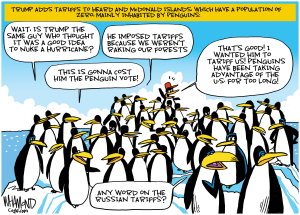 I did go to Influence Watch to check out their biases and funding sources. The methodology is better, using specific parameters to identify where possible trade distortions can happen. Plus, they don’t target Volcano Islands, seals, and penguins. So, I’m going back to the fallout now, which is not likely going to put you to sleep.
This TNR link goes to a podcast with Greg Sargent. ““Horrifying”: Trump’s Weird, Confused Rant to Media as Markets Tanked. As Trump’s shockingly destructive global tariffs cause the markets to crater and he rambles bizarrely about it to reporters, congressional scholar Norm Ornstein walks through how this madness can be stopped.” #FARTUS is not in a state of mind to feed himself, let alone make policy decisions. He’s totally disconnected from reality.
After President Trump imposed sweeping tariffs on imports from all over the globe, prompting the markets to implode, he took a question about it on Thursday. He ranted and rambled delusionally about how everything is just great. He bizarrely likened the country to a patient that had just undergone advanced surgery without grasping why this metaphor is the opposite of reassuring. And he spouted more nonsense about money pouring into our country. On top of all that, his imposition of the tariffs is likely an enormous and grotesque abuse of power. And because of this, the prospects for stopping them are not wholly nonexistent. We talked to congressional scholar Norm Ornstein, who walks us through how Congress can act, what Democrats can do to pressure Republicans to join in doing just that, and why Trump’s engaged in “horrifying folly.” Listen to this episode here. A transcript is here.
 And here’s a snip from the transcript.
Ornstein: They’re inexplicably high and a disaster. I agree. And obviously not only do the markets agree, but so do many people in the business world. I saw that the CEO of Restoration Hardware, as he watched his stock plummet today, responded with a simple two-word phrase, “Oh, shit.”And my guess is that that’s been replicated, probably in even more colorful language, by business leaders, economists, and investors all across America and probably around the world.
Sargent: “Oh, shit” seems like a pretty good reaction, or at least an apt one. So Trump was asked about all this on Thursday. The reporter pointed out that the markets are way down, that they’ve had their worst day in years because of his tariffs. Then the reporter asked Trump, “How’s it going?” Here’s Trump’s answer.
Donald Trump (audio voiceover): I think it’s going very well. It was an operation, like when a patient gets operated on. And it’s a big thing. I said this would exactly be the way it is. We have $6 trillion or $7 trillion coming into our country, and we’ve never seen anything like it. The markets are going to boom, the stock is going to boom, the country is going to boom.
What part of his dementia-riddled mind invents these things? Are there really people out there that consider him even lucid? Governors of many states–but especially farm states–are seeing if they can work around our incredibly insane President. This is from Axios. “Gavin Newsom angles for California exemptions to Trump trade war.”
California Gov. Gavin Newsom said Friday he is pursuing agreements with other countries to ensure California is exempted from retaliatory tariffs stemming from President Trump’s escalating trade war.
Why it matters: Trump’s “Liberation Day” tariffs spurred global blowback. Newsom — a reported 2028 presidential hopeful — is looking to insulate his state from the fallout.
Driving the news: “Donald Trump’s tariffs do not represent all Americans,” Newsom said in a video message Friday.
- California, whom he touted as “the tentpole of the U.S. economy,” aims to maintain “stable trading relationships around the globe,” he added.
- “I’ve directed my administration to look at new opportunities to expand trade and to remind our trading partners around the globe that California remains a stable partner.”
- California is “ready to talk” with global trading partners, Newsom wrote on X.
- Referring to the state’s economic might, Newsom added his state is “not scared to use our market power to fight back against the largest tax hike of our lifetime.”
State of play: The Golden State’s economy and its workers are heavily reliant on trade with Mexico, Canada and China, and retaliatory tariffs stand to have an “outsize” impact on California businesses, farmers and ranchers, according to a press release from Newsom’s office.
- The tariffs could also impede the state’s efforts to rebuild from this year’s devastating Los Angeles wildfires, by hurting access to construction materials like timber, steel, aluminum, and the components of drywall, the press release noted.
The other side: “Gavin Newsom should focus on out-of-control homelessness, crime, regulations, and unaffordability in California instead of trying his hand at international dealmaking,” White House spokesperson Kush Desai told Axios Friday.
Zoom in: Newsom is particularly concerned with retaliatory measures from other countries could impact California’s agricultural sector, especially its almond industry, according to Fox News, which first reported the news of theagreements.
- California is the world’s fifth-largest economy and its agricultural sector is a key economic driver for the state.
 This is from CNBC, as reported by Ruxandra Iordache. “China to impose 34% retaliatory tariff on all goods imported from the U.S.” Can you say Trade War?”
China’s Finance Ministry on Friday said it will impose a 34% tariff on all goods imported from the U.S. starting on April 10, following duties imposed by U.S. President Donald Trump’s administration earlier this week.
“China urges the United States to immediately cancel its unilateral tariff measures and resolve trade differences through consultation in an equal, respectful and mutually beneficial manner,” the ministry said, according to a Google translation.
It further criticized Washington’s decision to impose 34% of additional reciprocal levies on China — bringing total U.S. tariffs against the country to 54% — as “inconsistent with international trade rules” and “seriously” undermining Chinese interests, as well as endangering “global economic development and the stability of the production and supply chain,” according to a Google-translated report from Chinese state news outlet Xinhua.
Separately, China also added 11 U.S. firms to the “unreliable entities list” that the Beijing administration says have violated market rules or contractual commitments. China’s Ministry of Commerce also added 16 U.S. entities to its export control list and said it would implement export controls on seven types of rare earth-related items, including samarium, gadolinium and terbium.
Beijing has also filed a formal complaint against the U.S. with the World Trade Organization, the Ministry of Commerce confirmed in a Google-translated release, saying Washington’s tariffs policy “seriously violates WTO rules, seriously damages the legitimate rights and interests of WTO members, and seriously undermines the rules-based multilateral trading system and the international economic and trade order.”
circa 1908 and a reminder from my Grandparents’ peers
Okay, enough of this. It makes me crazy. Not like the following doesn’t, but at least I know nothing about the field. This is from the Washington Post. We have all these #FARTUS appointments breaking security rules and they do this to who? “National Security Agency chief ousted after far-right activist urged his removal. Gen. Timothy Haugh was fired Thursday as director of the powerful wiretapping and cyberespionage service, according to U.S. officials.”
We are so fucked. Have you managed to crawl out of bed yet?
What’s on your reading and blogging list today?
Mostly Monday Reads: Oy mishigas!
Posted: March 24, 2025 Filed under: #FARTUS, #MAGAnomics, American Fascists, Broligarchy, corporate greed, democracy is threatened, kakistocracy, Middle East, Polycrisis | Tags: @repeat1968, Broligarchy, FARTUS, Mafia Don, oligarchy, Paul Krugman, Vladimir Putin 7 Comments
“Putin addresses the residents of his newly acquired territory.” John Buss, @repeat1968, @johnbuss.bsky.social
Good Day, Sky Dancers!
I am having an ongoing debate with myself about the current administration. Is it the stupidity, the arrogance, or the meanness that most damaged our Constitutional democracy? Or is it the greed? I’m tagging all my posts here with the words Polycrisis, Kakistocracy, and Oligarchy or Broligarchy. It’s getting to be a tough search to find a few journalists who will actually tell it like it is.
This article in The Guardian early this month by Jonathan Freeland describes the current president thusly. “Donald Trump is turning America into a mafia state. The pattern is inescapable – with just one caveat: organised crime bosses occasionally display more honour.” I’ll just add a local New Orleans colloquialism. True Dat.
Behold Donald Corleone, the US president who behaves like a mafia boss – but without the principles. Of course, one hesitates to make the comparison, not least because Donald Trump would like it. And because the Godfather is an archetype of strength and macho glamour while Trump is weak, constantly handing gifts to America’s enemies and getting nothing in return. But when the world is changing so fast – when a nation that has been a friend for more than a century turns into a foe in a matter of weeks – it helps to have a guide. My colleague Luke Harding clarified the nature of Vladimir Putin’s Russia when he branded it the Mafia State. Now we need to attach the same label to the US under Putin’s most devoted admirer.
Consider the way Trump’s White House conducts itself, issuing threats and menaces that sound better in the original Sicilian. This week the president said that a deal ending Russia’s war on Ukraine “could be made very fast” but “if somebody doesn’t want to make a deal, I think that person won’t be around very long”. You didn’t need a translator to know that the somebody he had in mind was Volodymyr Zelenskyy.
On Thursday, Trump was confident that the Ukrainians would soon do his bidding “because I don’t think they have a choice”. Almost as if he had made them an offer they couldn’t refuse. Which of course he had. By ending the supply of military aid and the sharing of US intelligence, as he did this week, he had effectively put a Russian revolver to Ukraine’s temple, its imprint scarcely reduced by Trump’s declaration today that he is “strongly considering” banking sanctions and tariffs against Moscow, a move that looked a lot like a man pretending to be equally tough on the two sides, but which should fool nobody. He expects Zelenskyy to sign away a huge chunk of Ukraine’s minerals, the way Corleone’s rivals surrendered their livelihoods to save their lives.
This is how the US now operates in the world. Dispensing with the formalities during his annual address to Congress on Tuesday, Trump repeated his threat to grab Greenland: “One way or the other, we’re going to get it.” That recalled his earlier warning to Copenhagen to give him what he wants or face the consequences: “maybe things have to happen with respect to Denmark having to do with tariffs”. Nice place you got there; would be a shame if something happened to it.
It’s the same shakedown he’s performing on the US’s northern neighbour. Canada’s outgoing prime minister Justin Trudeau spelled it out this week, accusing Trump of trying to engineer “a total collapse of the Canadian economy because that will make it easier to annex us”, adding that: “We will never be the 51st state.” It’s a technique familiar in the darker corners of the New Jersey construction industry: a series of unfortunate fires that only stops when a recalcitrant competitor submits.
Both the substance and the style are pure mafia. Note the obsession with respect, demonstrated in last week’s Oval Office confrontation with Zelenskyy. Between them, JD Vance and Trump accused the Ukrainian leader three times of showing disrespect, sounding less like world leaders than touchy Tommy DeVito, the Joe Pesci character in Goodfellas.
Note too the humiliation of subordinates. In his address to Congress, the president introduced secretary of state Marco Rubio as the man charged with taking back the Panama canal. “Good luck, Marco,” said Trump, with a chuckle. “Now we know who to blame if anything goes wrong.” Cue anxious laughter from the rest of the underlings, briefly relieved that it wasn’t them.
It’s hard for aides and opponents alike to keep up because power is exercised arbitrarily and inconsistently. Tariffs are imposed, then suspended. Indeed, one reason why import taxes so appeal to Trump is that they can be enforced instantly and by presidential edict. That extends to the exemptions Trump can offer to favoured US industries. As MSNBC’s Chris Hayes observed: “This is very obviously going to be a protection racket, where Trump can at the stroke of a pen destroy or save your business depending on how compliant you are.”
 This characterization of Trump is so spot on that you really should go read the rest. I’m using this description of FARTUS as a background to the absolutely appalling crap that’s going on today. It’s hard to mentally deal with how quickly he’s disassembled so many long-standing U.S. Institutions in such a short time. This is especially true because it appears that the massive amount of incompetence and ignorance that his appointments display just escalates the damage. Look at this headline in The Atlantic. It’s reported by Jeffrey Goldberg. “The Trump Administration Accidentally Texted Me Its War Plans. U.S. national-security leaders included me in a group chat about upcoming military strikes in Yemen. I didn’t think it could be real. Then the bombs started falling.” WTAF?
The world found out shortly before 2 p.m. eastern time on March 15 that the United States was bombing Houthi targets across Yemen.
I, however, knew two hours before the first bombs exploded that the attack might be coming. The reason I knew this is that Pete Hegseth, the secretary of defense, had texted me the war plan at 11:44 a.m. The plan included precise information about weapons packages, targets, and timing.
This is going to require some explaining.
The story technically begins shortly after the Hamas invasion of southern Israel, in October 2023. The Houthis—an Iran-backed terrorist organization whose motto is “God is great, death to America, death to Israel, curse on the Jews, victory to Islam”—soon launched attacks on Israel and on international shipping, creating havoc for global trade. Throughout 2024, the Biden administration was ineffective in countering these Houthi attacks; the incoming Trump administration promised a tougher response.
This is where Pete Hegseth and I come in.
On Tuesday, March 11, I received a connection request on Signal from a user identified as Michael Waltz. Signal is an open-source encrypted messaging service popular with journalists and others who seek more privacy than other text-messaging services are capable of delivering. I assumed that the Michael Waltz in question was President Donald Trump’s national security adviser. I did not assume, however, that the request was from the actual Michael Waltz. I have met him in the past, and though I didn’t find it particularly strange that he might be reaching out to me, I did think it somewhat unusual, given the Trump administration’s contentious relationship with journalists—and Trump’s periodic fixation on me specifically. It immediately crossed my mind that someone could be masquerading as Waltz in order to somehow entrap me. It is not at all uncommon these days for nefarious actors to try to induce journalists to share information that could be used against them.
I accepted the connection request, hoping that this was the actual national security adviser, and that he wanted to chat about Ukraine, or Iran, or some other important matter.
Two days later—Thursday—at 4:28 p.m., I received a notice that I was to be included in a Signal chat group. It was called the “Houthi PC small group.”
A message to the group, from “Michael Waltz,” read as follows: “Team – establishing a principles [sic] group for coordination on Houthis, particularly for over the next 72 hours. My deputy Alex Wong is pulling together a tiger team at deputies/agency Chief of Staff level following up from the meeting in the Sit Room this morning for action items and will be sending that out later this evening.”
The message continued, “Pls provide the best staff POC from your team for us to coordinate with over the next couple days and over the weekend. Thx.”
The term principals committee generally refers to a group of the senior-most national-security officials, including the secretaries of defense, state, and the treasury, as well as the director of the CIA. It should go without saying—but I’ll say it anyway—that I have never been invited to a White House principals-committee meeting, and that, in my many years of reporting on national-security matters, I had never heard of one being convened over a commercial messaging app.
 Definitely go read this one. I’ve been missing reading John le Carré. I’m assuming anyone with a background in spying would have saucer eyes by this time. Trump’s love of playing checkers with the countries of the world is dangerous and immoral. He plays with everyone’s life like a mad king. This is from Oliver Darcy at Status. It’s a remarkable indictment of how the press enables his heinous policies and statements. “Gulf of Fear. When news anchors tiptoe around the name Gulf of Mexico, it’s not just semantics—it’s a glimpse at how the press starts to flinch under political pressure.”
In China, Taiwan doesn’t exist—at least not as a country. On official maps, it’s a province. The government enforces strict language about Taiwan’s status, shaping how its people—and the rest of the world—talk about it. The goal, of course, is far more significant than the name on a map. It’s not about semantics. It’s about wielding influence and asserting dominance. Controlling the language people use, particularly in relation to global geography, is a powerful capability to possess.
In the United States, that kind of top-down dictation might feel like a distant threat, the kind of thing that happens in authoritarian regimes or dystopian novels like “1984,” not in a country built on free speech safeguarded by the First Amendment. Americans tend to believe our press is too independent and and too proud to ever bow to government pressure. We assume that if a president ever tried to dictate language, the Fourth Estate would resist. We assume that we’re immune from such pressures.
But an important segment of the press—the television news media—over the past week quietly demonstrated that it is far less adversarial and far more compliant than the breathless promos these networks air hyping themselves as fearless truth-tellers. When the eyes of the world fixated on the stranded NASA astronauts being rescued and touching down back on Earth, every channel danced around what precisely to call the body of water they splashed into. A review of transcripts, courtesy of SnapStream, revealed an alarming reality: not one of the outlets could muster up the courage to simply refer to it as the Gulf of Mexico, the water feature’s name since the 16th century.
Instead, television news organizations tied themselves in knots, performing linguistic gymnastics to stay out of Donald Trump’s crosshairs, while also tiptoeing around audiences who would have surely been incensed to see them bend the knee and call it the “Gulf of America.” On ABC News, “World News Tonight” anchor David Muir referred to “spectacular images from off the coast of Florida.” On the “NBC Nightly news,” anchor Lester Holt spoke about the astronauts “splashing down off the Florida Gulf coast.” On the “CBS Evening News,” it was referred to simply as “the Gulf.” And on CNN, anchor Jake Tapper tried to seemingly have it both ways, noting the U.S. government refers to it as the “Gulf of America,” but the rest of the world calls it the Gulf of Mexico.
In fact, I could only one find instance on a television newscast where a journalist referred to the body of water as the Gulf of Mexico. During an appearance on MSNBC, NBC News correspondent Tom Costello used the term, but then quickly corrected himself, almost as if he had realized he was forbidden from doing so. “Six hours from right now, there will be a splashdown in the Gulf of Mexico,” he said, before backtracking. “Sorry, however you want to call the Gulf. It will be splashing down in the Gulf.”
Suffice to say, none of this was an accident.
 We first saw the capitulation of the tech bros and their social media platforms, including Jeff Bezos, who has ruined The Washington Post. This week, the situation there is getting worse. The first thing any autocrat wants to do is to come for any vestige of a free media. This is from MEDIAITE as reported by David Gilmour. “Trump Claims Jeff Bezos Trashed the ‘Crazy People’ in His Own Newsroom: ‘They’re Out of Control’.
President Donald Trump claimed that billionaire Washington Post owner Jeff Bezos privately expressed regret over the newspaper’s editorial direction and trashed his own “out of control” newsroom for writing “bad articles” about him.
The comments came during a sit-down with OutKick’s Clay Travis aboard Air Force One on Saturday after Travis suggested “it seems” that Bezos may be attempting to make The Washington Post “more fair” in coverage towards Trump.
Trump agreed and didn’t hesitate to praise Bezos, telling Travis “I think it’s great.”
Travis later asked whether Trump had discussed how the newspaper had come after him “like crazy” in the past, AND the president replied: “At length, I talked to him about it. [Bezos is] a good guy. I didn’t really know him in the first term. I mean, it’s such a difference between now and the first time.”
Pressed on what Bezos had said he had planned for The Post’s coverage, Trump said: “Just that. He’s really trying to be more fair.”
Trump continued: “They actually did a couple of bad articles on him. He said, ‘This is crazy, I lose my fortune running this thing and they, you know, they’re out of control.’ These people are crazy. They’re crazy people. They’re out of control.”
“And he’s a actually a very good guy,” the president added. “If you look at the inauguration, look at the people that were on that stage, here was a who’s who of a world that was totally against me the first time. It’s a much different presidency. I have much more support.”
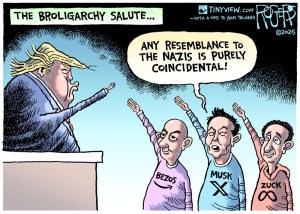 And now, we have the capitulation of top law firms. How many more legs of democracy will we lose? The Bulwark draws the line today. “Stop Making Excuses for Not Fighting Trump. The capitulations and acquiescence we’ve seen so far will only make opposition more difficult down the road.” This is written by William Kristol under the lede “No Excuse.”
Among those who might be expected to stand up against Donald Trump’s authoritarianism, the hills are alive with the sound of excuses.
You’re an elected official. The Trump administration has rounded up individuals and sent them, without any due process and with much carelessness about who’s been seized, to a mega-prison in El Salvador. The administration is boasting about what it’s done and heralding it a prelude to further actions in the same vein.
You’re thinking of condemning these truly grotesque violations of constitutional rights and human decency. Maybe I should say this isn’t right?
Whoa, Nellie! Not so fast, your political advisers hasten to instruct you. The polls on this issue aren’t great. This really isn’t the hill to die on.
You take their advice. But you tell yourself, and you assure others, that of course you will fight one day—on some other hill, on some faraway hill, some time far in the future.
But to fight now? Bad idea. That would simply play into Trump’s hands. After all, Trump and his allies are good at fighting. If you try to do something, there’s a risk they’ll turn it against you. Whereas if you say nothing, nothing can be used against you.
You might worry for a second that silence and acquiescence just plays into Trump’s hands. But you’re not a sophisticated Democratic operative. So you take their advice.
And anyway, there’s a better plan. That plan is that, eventually, Trump will become less popular. Then, the public will rise up. And then you can speak up. It all works out.
It also works out if you’re in the private sector. In fact, if you’re the head of a huge law firm, capitulation isn’t just a regrettable necessity, it’s your duty. You’re acting in the best interests of your clients. It would be wrong and irresponsible to act otherwise.
What’s more, No one in the wider world can appreciate how stressful it is to confront an executive order like this until one is directed at you.
The people in the “wider world”—those serving in the military or waiting tables or cleaning offices at Paul Weiss—they just can’t appreciate the stress that comes from occupying that corner office at 51st and 6th.
Ugh.
All of these excuses—and there are many more!—are distasteful. But what’s worse is that they make it easier and more likely that others will capitulate. They make it seem that you’re kind of a chump if you actually fight Trump’s authoritarian takeover. The excuses offered for capitulation increase the damage done by capitulation.
As usual, Shakespeare saw all. Here’s Pembroke in Act IV, Scene 2 of King John:
And oftentimes excusing of a fault
Doth make the fault the worse by th’ excuse,
As patches set upon a little breach
Discredit more in hiding of the fault
Than did the fault before it was so patched.The excuses offered by our elites for not standing up to authoritarianism have the effect of helping the authoritarians gain further ground.
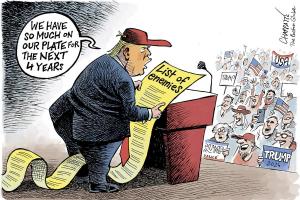 Zach Beauchamp writes at VOX, “There’s a pattern in Trump’s power grabs. The White House strategy demands we defend alleged criminals and those with unpopular views.”
After rising to power, Nazis pitched power grabs as efforts to address the alleged threat posed by menaces like “Judeo-Bolshevism,” harnessing the powers of bigotry and political polarization to get ordinary Germans on board with the demolition of their democracy.
What’s happening in America right now has chilling echoes of this old tactic. When engaging in unlawful or boundary-pushing behavior, the Trump administration has typically gone after targets who are either highly polarizing or unpopular. The idea is to politicize basic civil liberties questions — to turn a defense of the rule of law into either a defense of widely hated groups or else an ordinary matter of partisan politics.
The administration’s first known deportation of a green card holder targeted a pro-Palestinian college activist at Columbia University, the site of some of the most radical anti-Israel activity. For this reason, Columbia was also the first university it targeted for a funding cutoff. Trump has also targeted an even more unpopular cohort: The first group of American residents sent to do hard labor in a Salvadoran prison was a group of people his administration claimed without providing evidence were Tren de Aragua gang members.
Trump is counting on the twin powers of demonization and polarization to justify their various efforts to expand executive authority and assail civil liberties. They want to make the conversation less about the principle — whether what Trump is doing is legal or a threat to free speech — and more a referendum on whether the targeted group is good or bad.
There is every indication this pattern will continue. And if we as a society fail to understand how the Trump strategy works, or where it leads, the damage to democracy could be catastrophic.
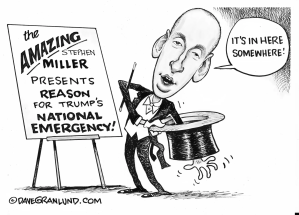 This, too, is a long read that deserves a look. A lot of this goes back to White House aid Stephan Miller. This guy needs to have an entire press detail following him. I’m going to end with a few articles on economics. The first comes from Paul Krugman and will clarify what’s happening with Social Security. “Social Security: A Time for Outrage. Trump’s policies attack his own base — but who will tell them?” I often find myself in conversations with friends, and we all wonder if Trump Supporters will ever show a glimmer of intelligence.
Donald Trump is often described as a “populist.” Yet his administration is stuffed with wealthy men who are clueless about how the other 99.99 percent lives, while his policies involve undermining the working class while enabling wealthy tax cheats.
What is true is that many working-class voters supported Trump last year because they believed that he was on their side. And that disconnect between perceptions and reality ought to be at the heart of any discussion of what Democrats should do now.
Right now the central front in the assault on the working class is Social Security, which Elon Musk, unable to admit error, keeps insisting is riddled with fraud. The DOGE-bullied Social Security Administration has already announced that those applying for benefits or trying to change where their benefits are deposited will need to verify their identity either online or in person — a huge, sometimes impossible burden on the elderly, often disabled Americans who need those benefits most. And with staff cuts and massive DOGE disruption, it seems increasingly likely that some benefits just won’t arrive as scheduled.
Oh, and Leland Dudek, the acting Social Security administrator, threatened to shut the whole thing down unless DOGE was given access to personal data.
Not to worry, says Howard Lutnick, Trump’s Commerce secretary. Only “fraudsters” would complain about missing a Social Security check:
Let’s say social security didn’t send out their checks this month. My mother who’s 94, she wouldn’t call and complain. She’d think something got messed up, and she’ll get it next month. A fraudster always makes the loudest noise, screaming, yelling and complaining.
There’s so much wrong with that statement that it’s hard to know where to start. But it’s clear that Lutnick — like many affluent people — has no idea how important Social Security is to the finances of most older Americans. According to a Social Security Administration study, half of Americans over 65 get a majority of their income from Social Security; a quarter depend almost entirely on Social Security, which supplies more than 90 percent of their income. I doubt that these people would shrug off a missed check.
Reliance on Social Security isn’t evenly distributed across the population; it’s strongly correlated with socioeconomic status. In particular, it very much depends on education, with less-educated Americans much more reliant on the program than those with more education:
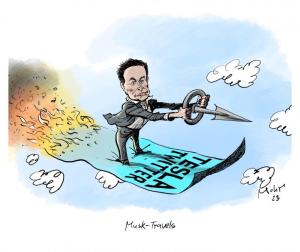 That Lutnick quote cannot be repeated enough. The last read I’m sharing today comes from The Economist. “Musk Inc is under serious threat. The world’s richest man has lost focus. His competitors are taking advantage.” Well, isn’t that special?
UNTIL RECENTLY Elon Musk had little need to look over his shoulder. He once described competition for Tesla, his electric-vehicle (EV) company, as “the enormous flood of gasoline cars pouring out of the world’s factories every day”, rather than the “small trickle” of other EV-makers. SpaceX, his rocket firm, had so undercut and outwitted the bloated aerospace incumbents that it had developed an almost invincible aura.
Yet if Mr Musk can tear himself away from the intoxication of shredding the American government, he may notice something. It is not just that the political firestorms he has whipped up this year are singeing his companies’ brands. It is that the two businesses that underpin his corporate empire—accounting for around 90% of its value and probably all its profit—are facing increasingly stiff competition. The world’s richest man has lost focus—and now has a target on his back.
Start with SpaceX. Last year it conducted five out of every six of the world’s spacecraft launches. Through its Starlink division, it owns 60% of satellites in space. In December it sold shares at a valuation of $350bn, two-thirds higher than its previous level. Starlink, its main profit engine, is on track to generate more than $11bn of revenue this year and $2bn of free cash flow, says Chris Quilty of Quilty Space, a consultancy.
Now, however, Mr Musk’s bomb-throwing interventions are alarming SpaceX customers, and at a time when rivals are growing more capable. His on-again, off-again threats to end Starlink’s support for Ukraine have raised the difficult question of trust. European politicians are pondering how reliable Mr Musk will be as a long-term provider of strategic satellite communications. The search for alternatives has helped spur a more than tripling of the share price of Eutelsat, the French owner of OneWeb, which provides satellite services to broadband companies.
No European supplier could come close to matching the 7,000 satellites Starlink has in low orbit. (Eutelsat has a mere 600.) Nor could any compete on price. As Simon Potter of BryceTech, another space consultancy, puts it, for now the concerns are “more noise than action”. Yet Starlink may soon face meaningful competition from Amazon’s Project Kuiper, which aims to put over 3,000 satellites into low orbit, creating a space-based broadband network. If it achieves that, some customers outside America may decide they have more confidence in an Amazon product than in one belonging to the mercurial Mr Musk.
Jeff Bezos, Amazon’s founder, is also stepping up the pace in the launch business with Blue Origin. His rocket firm is separate from Project Kuiper, but has contracts to fly many of its satellites. In January Mr Bezos’s New Glenn rocket reached orbit on its first try. If Blue Origin manages to make repeated successful journeys with reusable rockets, it could become a meaningful competitor to SpaceX. So could Rocket Lab, SpaceX’s closest rival by number of launches, which is due to debut Neutron, a new rocket, this year.

Here comes the Rooster.
It’s like we’re in a very bad dystopian novel and can’t escape. Anyway, I’m not shutting up any time soon.
What’s on your Reading and Blogging list today?
Here’s a picture of this big boy who keeps crossing the road in front of my house. The rain just stopped, and the sun cleared up, so he’s been yelling at the sun for about an hour now. I feel like he’s some kind of omen.
Here’s an Alice in Chains song about the Vietnam War. That ought to cheer you up.

 peej
peej Carissa
 bostonboomer
 dakinikat
 ecocatwoman
 mablue2
 Mama Lopez
 peggysue22
 quixote
 skydancingguestblogger
 Mona (aka Wonk the Vote)



 Sky Dancing
Recent Comments