
Gulf Gusher Update: Oil Does NOT Vanish
Posted: November 6, 2010 Filed under: Gulf Oil Spill, New Orleans | Tags: Gulf Of Mexico, Oil still coming ashore, seafood and wildlife response to oil spill 43 Comments They may have killed the well, but don’t believe any one when they say that the worst is over. The problem is that you’re probably not hearing anything or seeing anything about the aftermath because there seems to be no media around the Gulf Coast other than the locals. Here’s the latest one that I was tweeted today that sent me off to a blogging state of mind. This is from Project Gulf Impact and you really need to watch their video.
This is of special interest to me because I swear the last batch of shrimp I got at the ghetto Winn Dixie had something greasy in the intestine. It was so bad, I threw them away. When I rubbed the black gunk between my fingers, it smeared and stayed there. It took quite a bit of Dawn to get it to go away. It also tasted gritty and greasy.
Despite repeated statements from the EPA and NOAA assuring residents that thorough Gulf of Mexico seafood testing has revealed levels safe for human consumption, public skepticism has continued to deter many locals from their usual seafood medley. Independent scientists have expressed concern over the published methods and protocols used by federal agencies to open sensitive fishing grounds & determine seafood safety. Invertebrates, such as shrimp, crab, & oysters, are of particular concern due to their feeding habits, relatively stationary lifestyle, and inability to process highly toxic compounds found in crude oil called Polycyclic Aromatic Hydrocarbons (PAH). Unfortunately, their concerns have proven valid.
One local activist, “Mac” Mackenzie of NOLA Emergency Response, decided that it was time to take matters into her own hands. After an incessant 7-week investigation, Mac was able to obtain crucial information from our government regarding the specifics of Gulf shrimp testing. Particularly in the Gulf of Mexico, it is common for shrimp to be prepared and even served whole, with the shell and digestive tract intact. When Mac learned that the Gulf shrimp testing performed to date had not included an analysis of whole shrimp with intact shells or digestive tract, she decided to mobilize. She obtained two pounds of locally caught shrimp from Venice, a small town located in the heart of Southern Louisiana. The samples were promptly transported on ice to a laboratory in Mobile Alabama, where Chemist Dr. Robert Namen tested the digestive tracts of the shrimp for components of crude oil. What they found was an alarming 193 parts per million of “Oil & Grease.”
This story came on top of another one this week concerning dead and dying Coral close to the killer wellhead. This is from The Times Picayune.
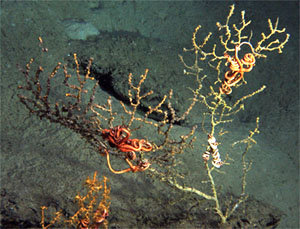
Image courtesy of Lophelia II 2010 Expedition, NOAA-OER/BOEMRE A single colony of coral with dying and dead sections on left, apparently living tissue at right, and bare skeleton with sickly looking brittle star on the base.
A brown substance is killing coral organisms in colonies located 4,600 feet deep about seven miles southwest of the failed BP Macondo oil well, according to scientists who returned Thursday from a three-week cruise studying coral reefs in the northern Gulf of Mexico.
The finding is the first case in which researchers have found evidence that living organisms in the deepwater area near the well site might have been killed by oil from the spill.
Penn State University biology professor Charles Fisher, chief scientist aboard the NOAA ship Ronald H. Brown said soft coral in a 15-meter to 40-meter area was covered by what appeared to be a brown substance.
“Ninety percent of 40 large corals were heavily affected and showed dead and dying parts and discoloration,” according to a news release reporting the findings by Fisher and other scientists issued jointly by NOAA and the Bureau of Ocean Energy Managment, Regulation and Enforcement, which co-sponsored the research. “Another site 400 meters away had a colony of stony coral similarly affected and partially covered with a similar brown substance.”
“While this mission was not designed to be focused on oil spill research, the timing and location provided an opportunity to observe any impacts to our research areas,” Fisher said in the news release. Fisher was unavailable for further comment on Thursday night.
The release said the scientists “observed dead and dying corals with sloughing tissue and discoloration.”
That’s just some of the continued impact on the ecosystem down here. The town of Gulf Shores, Alabama reports they are still owed $2 million in lost revenues. A city meeting also discussed outstanding claims by businesses and individuals. This, despite the uptick in local advertising I’ve seen on ad ‘stories’ of how BP has made me whole again run by BP here on our local TV stations. The ad revenues for this things must be unbelievably large.
A BP spokesman did not respond to inquiries about the lost revenue claims.
Also at Monday’s meeting, Dyken reported that officials were still trying to work out problems with the lack of claims paid by Ken Feinberg’s Gulf Coast Claims Facility to individuals and businesses.
Officials in south Baldwin County were expected to meet with Feinberg this week, Dyken said.
Baldwin County had received about $219 million, Dyken said.
“Some people still haven’t been paid on claims that are legitimate,” he said. “They have distributed a large amount of money. It’s just whether that money has gone to the appropriate parties in the appropriate places. There’s not a lot of rhyme or reason to some payments being made and others not. There’s also not the degree of transparency we would like in the process.”
In order to ensure that the oil spill’s lingering affects do not carry into next year, Doughty suggested expanding the tourist season.
“We need rebranding of the Gulf so that people understand the Gulf is safe, whether it’s Gulf seafood, Gulf beach, air whatever,” she said. “With tourism being our No. 1 economic engine here, anything we can do to help tourism would be great.”
This is particularly weird given the report by a Pensacola/Mobile TV station that a tourist was slimed with aging Oil last week. You can see the pictures and the news report here at the Channel 5 website.
Jonathan Jones’ palm still has an oil mark. He says he emerged from the water after a brief swim in Gulf Shores with trace amounts of crude.
“We looked at it and kind of smeared it a bit and figured out it was oil,” says Jones. He says he had to bathe with dish soap to get it off. At first he was worried about dispersants but then he quickly calmed down.
“There are hundreds of people on this beach and no one else had this happen,” says Jones. It’s probably important to put what happened to Jonathan in perspective. This appears to be an isolated incident and the beaches are most certainly still open
Meanwhile, future troubles lurk too. MoJo has identified the BP Atlantis–something BostonBoomer has written about–as another ‘Ticking Time Bomb in the Gulf’.
Located 124 miles off the Louisiana coast, the Atlantis platform produces 200,000 barrels of oil daily, more than triple the amount of oil that spilled from the Horizon site each day. But long before the Deepwater Horizon disaster, a whistleblowing former BP contractor tipped off regulators that the Atlantis may be violating the law, and environmental groups and members of Congress have been publicly questioning the platform’s safety ever since.
According to Kenneth Abbott, a former BP contractor who worked on the platform from 2008 through early 2009, more than 7,000 documents necessary to operate the platform safely are missing or incomplete. Abbott says the vast majority of the project’s subsea piping and instrument diagrams were not approved by engineers, and the safety systems are out of date. In practice, the lack of documentation on this platform would make it extremely difficult to respond in the event of an accident like the Deepwater Horizon blowout, critics say, because no one really has an accurate picture of the Atlantis’ design.
This seems to be the forgotten disaster and environmental disasters do not just disappear. Down here, the big election

Tony Bologna apologizes endlessly in the new series of BP spoofs on South Park at Comedy Central.
story was between Vitter and Melancon and both were fighting over who could be the most welcoming to the drillers and spillers. The MSM appeared more fixated on political personalities than issues. The only program still properly fixated on the BP Gusher is South Park that has a completely hilarious bit where Tony continually apologizes and then keeps on with making worse decisions. You can click on the picture to watch the episodes at Comedy Central or just the apology ad campaign send up.
If you live down here were there are daily reports of “massive stretches of weathered oil spotted in the Gulf of Mexico”. This report on a sighting is dated from October 23, 2010. That means it’s post well plugging. Again, this is from the Times Picayune here in New Orleans.
Just three days after the U.S. Coast Guard admiral in charge of the BP oil spill cleanup declared little recoverable surface oil remained in the Gulf of Mexico, Louisiana fishers Friday found miles-long strings of weathered oil floating toward fragile marshes on the Mississippi River delta.
The discovery, which comes as millions of birds begin moving toward the region in the fall migration, gave ammunition to groups that have insisted the government has overstated clean-up progress, and could force reclosure of key fishing areas only recently reopened.
The oil was sighted in West Bay, which covers approximately 35 square miles of open water between Southwest Pass, the main shipping channel of the river, and Tiger Pass near Venice. Boat captains working the BP clean-up effort said they have been reporting large areas of surface oil off the delta for more than a week but have seen little response from BP or the Coast Guard, which is in charge of the clean-up. The captains said most of their sightings have occurred during stretches of calm weather, similar to what the area has experienced most of this week.
The Coast Guard is saying parts of it are just algae but frankly, I believe the captains of Louisiana’s Cajun/Creole fishing fleet. Again, this thing and its impact are not over by a long shot. It’s absolutely necessary to continue to hold our elected officials and BP accountable for all the damage done and still happening to the ecosystem, wildlife, and people of the Gulf.
BP CEO definitely Master of the Artful Dodge
Posted: July 17, 2010 Filed under: Gulf Oil Spill Comments Off on BP CEO definitely Master of the Artful Dodge Congress is in the process of proving just how inept they are as BP CEO Tony Hayward managed to spend hours providing insouciant looks and not much else. The shocker of the morning came from entrenched Republican Oil Lackey Congressmen Joe Barton who apologized to Hayward for subjecting such a fine business to a Chicago-style Shake Down. He’s now backed off of the statement but the damage is done to his credibility around the hill. This almost tops Joseph Cao’s call for ritual suicide for BP executives earlier this week. Barton’s apology came after even Republican colleagues started the call to remove him from the energy subcommittee.
After infuriating Democrats and Republicans alike with his public apology to BP and suggesting that a $20 billion escrow fund was a “shakedown” by the White House, Barton is now “retracting” his statement, made at a hearing with BP CEO Tony Hayward.
“I apologize for using the term ‘shakedown’ with regard to yesterday’s actions at the White House in my opening statement this morning, and I retract my apology to BP,” Barton said. “As I told my colleagues yesterday and said again this morning, BP should bear the full financial responsibility for the accident on their lease in the Gulf of Mexico. BP should fully compensate those families and businesses that have been hurt by this accident.”
Showing just how involved Republican leadership was in damage control over Barton’s comments today, the retraction was forwarded to the media by House Minority Leader John Boehner’s office.
Ordinarily, it’s not that shocking to see a Republican from Texas defend the petroleum industry. But Rep. Joe Barton’s comments to BP CEO Tony Hayward today, in which he described it as a “tragedy” that a “a private corporation can be subjected to what I would characterize as a shakedown”, has obviously touched something of a raw nerve, with Republicans already seeking to distance themselves from the comment while Democrats look for ways to exploit it.
Making matters worse for Barton is the identity of the top contributor to his election campaigns. Since 1989, it has been the company Anadarko Petroleum, from which he’s received $56,500 in PAC donations and another $90,000 in individual contributions.
 Congress is intent to prove that BP put safety measures on hold to enhance profits. (Shock! Corporations Maximizing Profits! More Breaking News at 6!) Even CNN has given up live coverage because basically, there’s nothing to see here! BP is under criminal investigation. They actually think Hayward will pony up some evidence?
Lawmakers castigated BP chief executive Tony Hayward at a House hearing Thursday for what they said were cost-cutting measures and other “shortcuts” leading to a disastrous oil spill in the Gulf of Mexico, but Hayward said he was not prepared to make judgments about the cause of the catastrophe until “multiple investigations” are completed.
Well, the hearings continue, but so does the stiff upper lip. Who is winning this argument?
Fifty-nine percent of people questioned say they disapprove of how the president is dealing with the spill, up eight points from May. Forty-one percent say they approve of how Obama’s handling the crisis, down five points from last month.
Simple Truths
Posted: July 4, 2010 Filed under: Environmental Protection, Gulf Oil Spill, U.S. Economy, Voter Ignorance | Tags: disincentives, incentives, oil industry subidies, taxes 2 Comments One of the useful things about theories and laws–in the sense of scientific method–is that they provide some very simple insight into the way things are. They are not based on wishful thinking or faith. Hypotheses grow up to be theories only with rigorous testing by many many great minds who consistently recreate similar truths in similar circumstances.
Once the theory becomes established, it can be used for many purposes and insights. In economics, we use these things for predictions and policy insights. We know that a given outcome will–with extremely high probability–recur given the same circumstances. There are laws of demand and supply. There are theories on elasticities of supply and demand given prices or income. We have a fairly good catalog of theories that we teach and we make doctoral students reprove over and over again so they too, can establish that insight and make predictions.
Established theories are basically things that are ‘no brainers’ in any field. One such set of theories in economics deals with taxes and subsidies. You tax something, you see less of that thing because it adds cost and dampens both supply and demand for the taxed thing. You subsidize it, you get more demand and more supply because it lowers the cost. As a matter of theory, when you really subsidize something, you generally end up warping the incentives for production and consumption of that good so badly that not only does that market become pretty dysfunctional, but it tends to spread to other markets because it transfers scarce resources–better put to other uses– from some markets to the subsidized market.
In some cases, we purposely warp a market with taxes for policy purposes. This is the case with so-called sin taxes. There is a reason that cigarettes are taxed to the point that the pricing point of a pack of cigarettes approaches the cost of a CD of music or a ticket to a movie. That’s because the government wants to discourage entry to the market to teen smokers. Prices (after tax) of cigarettes typically rival things teens do. These include going to movies or buying music. It forces the teen who might become a smoker into a choice and hopefully, a good one that includes not smoking. In this case, the disincentive is the policy choice. We often subsidize things too like public transportation or public education. This is because we’d see less of them and less public benefit if they were priced to the market or priced to the cost of producing the good. When you study microeconomics which is the study of individual choices within individual markets, you study externalities.
Generally speaking, a good policy will subsidize a good or service with positive externalities and tax a good or service with bad externalities. We usually call these “spill over” costs or benefits because the cost or the benefit of the activity spills over to the public. If a business can’t realize the benefit in terms of profit, the business won’t provide the service or good. If the business can pass the cost of an activity or service on to the public, it will.
Subsidies should only go to places where there are positive spillovers. Taxes should be applied to places where there are negative spillovers. It is not considered a good idea for taxpayers to subsidize harmful activities in economic theory. We have finally lowered our subsidies to the tobacco industry because it’s good policy. The taxpayer shouldn’t be incentivizing a public health issue that they will have to pay for on both ends. First, in the subsidy to the business, and second to the costs of tremendous health problems created by the users. People who benefit neither from growing tobacco, making cigarettes or smoking, shouldn’t be asked to pay all the spill over costs that come from that activity.
This is why subsidies to Oil Companies baffle many of us.
There’s a really good article today in the NYT on the billions of dollars provided by the U.S. Taxpayer to Oil Companies. My students will be reading this shortly, believe me, because it’s a great example of really bad public policy. Among the things that the article mentions is that the drilling rig, The Deepwater Horizon, “was flying the flag of the Marshall Islands. Registering there allowed the rig’s owner to significantly reduce its American taxes”. Transocean basically shopped corporate ownership to several countries to avoid tax liability. But wait, it gets worse.
At the same time, BP was reaping sizable tax benefits from leasing the rig. According to a letter sent in June to the Senate Finance Committee, the company used a tax break for the oil industry to write off 70 percent of the rent for Deepwater Horizon — a deduction of more than $225,000 a day since the lease began.
With federal officials now considering a new tax on petroleum production to pay for the cleanup, the industry is fighting the measure, warning that it will lead to job losses and higher gasoline prices, as well as an increased dependence on foreign oil.
But an examination of the American tax code indicates that oil production is among the most heavily subsidized businesses, with tax breaks available at virtually every stage of the exploration and extraction process.
According to the most recent study by the Congressional Budget Office, released in 2005, capital investments like oil field leases and drilling equipment are taxed at an effective rate of 9 percent, significantly lower than the overall rate of 25 percent for businesses in general and lower than virtually any other industry.
And for many small and midsize oil companies, the tax on capital investments is so low that it is more than eliminated by var-ious credits. These companies’ returns on those investments are often higher after taxes than before.
“The flow of revenues to oil companies is like the gusher at the bottom of the Gulf of Mexico: heavy and constant,” said Senator Robert Menendez, Democrat of New Jersey, who has worked alongside the Obama administration on a bill that would cut $20 billion in oil industry tax breaks over the next decade. “There is no reason for these corporations to shortchange the American taxpayer.”
Yes, that’s right. President Obama with his green agenda is working on a bill that CUTS $20 billlion in more tax breaks to this industry. But don’t get me started on their ethanol subsidies, it’s the same damned deal. Take food away from being used as food and use it as an additive to fossil fuels. This, too, is bad policy. (To read more on that you may want to check out this link at The Oregonian.)
THIS is what passes as “free market” capitalism these days. Tax payers pay in their tax bills for these horrendous subsidies, then they take it at the pumps too. (In the case of ethanol subsidies, we’ll also take it at the grocery store.) Republicans are much worse. They have no idea that what they are doing is not capitalism. It’s basically encouraging monopolies and monopoly profits as well as distorting resource markets.
Ethanol subsidies, oil drilling incentives, government insurance and loan guarantees for nuclear energy, natural gas subsidies: These proposals tend to have as many or more Republican advocates as Democratic advocates. Even worse, self-described free-market conservatives often rally for energy subsidies and claim it’s not a deviation from their principles.
Today, at the liberal environmentalist website Grist, blogger Dave Roberts takes to task Newt Gingrich. Roberts, with whom I often spar on the Interwebs, has a great (and depressing) argument and analysis of Gingrich’s defense of current energy subsidies and proposal for even more energy subsidies. This is the heart of the argument:
Gingrich and his acolyte defend these subsidies. Why? Says Gingrich, “a low-cost energy regime is essential to our country.”… Fossil-fuel subsidies don’t reduce costs, they shift costs. The burden is moved from energy companies to the public. The result is what we have today: energy that looks cheap because most of its costs are hidden from view.
Even during times of obscene profits (which are pretty much guaranteed by subsidies in a good where the market demand isn’t very sensitive to price changes), we still subsidize these business. Here’s the link to The Grist which basically outs Ginrich as being anything but a capitalist. This is more like the old mercantilism of the past where the king and queen choose a particular company to be blessed with a monopoly and give them some start up funds to go and rape a colony of its natural resources. Think East India Tea Company and the colonies here pre-Revolution. For years, our tax funds have gone to big oil, big finance, and big defense contractors. Lincoln warned of it. Eisenhower warned about it. Teddy Roosevelt and Sherman did something about.
So, here we are again with companies that feed at the public trough while behaving in a way that has nothing to do with public interest. This is no surprise to any economist. We know that the only things corporations are about are maximizing profits and minimizing costs any way they can. They’ll do it by abusing any resource they can, IF we let them get away with it. That’s why there is still slavery, pollution, strip mining, blood diamonds, and for all intents and purposes, wars in places that sit on oceans of oil.
Politicians are all about maximizing their chances of getting re-elected. If they can’t do that, then they maximize their wealth and their after politics career possibilities. This is where we come in. They will continue to do whatever they want to as long as our vote is no longer a check and balance on those behaviors. We have a responsibility to throw the bums out that do this to us.
So, carrots and sticks are important to economic theory and political theory. We know this. The problem is what are going to do about it?
Playing Politics with the Spill
Posted: June 26, 2010 Filed under: Gulf Oil Spill Comments Off on Playing Politics with the SpillThe one thing that really made me mad during the response to Hurricane Katrina was the political games that were played so that national rage would be directed at a partisan target rather than at taking care of people hurt by the Hurricane and the resultant flooding when the levees failed. It’s deja vu all over again now except Louisiana has a Republican Governor and a Democratic President trying to reflect the rage. I thought perhaps Jindal was actually going to be the grown up in this situation, but I was wrong. Nothing good will come of this, believe me. Like I said, I saw this same dynamic after Katrina and it hurt every one.
We’re seeing the Louisiana National Guard deployment as one of the volleyballs in the Oil Gusher response. The other is a series of funds made available by BP and the federal government. Once again, no one wants responsibility for the huge failed response so, it’s a battle of the memes now. Who is responsible the Feds or the SLGs?
The Baton Rouge Advocate points out this travesty by Jindal who is also being accused by Democratic Partisans of not deploying all the National Guard that he could. For some reason, no Republican Governors in the area has, but they’re not on AC 360 every night. As I’ve mentioned before, Jindal is an ideological conservative who believes in starving the beast. The cuts to higher education and health care have been horrible and arbitrary. This one, however, has to do with money originating in places other than Louisiana tax payers. Much like Donald Rumsfeld, Jindal would rather pay money the state receives for private contractors rather than reimburse local governments that provide similar services. He’s essentially told the parishes and towns to go beg money off of BP. I don’t think the Governor should be helping BP divide and conquer.
Gov. Bobby Jindal unleashed his veto pen late Friday, nixing lawmakers’ attempt to direct $24.9 million to parishes and small towns affected by the oil leak.
In his veto message, Jindal said BP should pay the municipalities directly for the impact of the April 20 rig explosion in the Gulf of Mexico.
“The effect of this amendment would make Louisiana’s taxpayers, not BP, responsible for paying for state government’s response to the Deepwater Horizon oil spill,” the governor wrote in the line-item vetoes he released at about 8 p.m. Friday.
Left unnoted in Jindal’s veto message was the fact that the money legislators wanted to give to the municipalities comes from a fund fattened by a grant from BP. The Jindal administration wants state agencies to have use of the money.
“If it’s acceptable use for state government, then why isn’t acceptable for local governments?” said state Rep. Sam Jones, D-Franklin, who co-sponsored the amendment that would have diverted much of the BP money in the state’s Oil Spill Contingency Fund to help 11 coastal parishes and the towns of Lafitte and Grand Isle.
Jones said the money was help the local governments, which often have no credit line, needed to help respond to the loss of income by its residents and the damage to its environment.
“This is not the first time we as Cajuns have been told to go fend for yourselves,” Jones said.
“We’re good at giving our taxpayer dollars to privately owned companies from out-of-state, but we can’t help our own people with our money?” said state Rep. Joe Harrison, R-Napoleonville, who also co-sponsored the effort.
“Our people are in dire need of assistance and they’re not getting it,” he said.
Isn’t this similar to what the Feds are telling the states? If you need money, go beg it off BP. We’re not even going to front you for it.
If you continue to read the list, you’ll see exactly what kinds of things Jindal thinks are expendable. It’s not only money. He’s vetoed a clause to allow parents of the developmentally disabled more input in decisions affecting their family members. Get this for the rationale.
Rejected a request by parents for more input into their children’s transfer from centers for the developmentally disabled into community homes. Jindal said the heightened involvement would “hinder the efficient and effective transition of services.”
During Jindal’s reign of terror at the Health and Human Services department here in Louisiana for then Governor Bubba Foster, Jindal was well known for cutting funding to services for the disabled and elderly. Many of these folks wound up on the street before the families were even notified.
You can read more about his budget cuts at WWLTV which has reprinted a local political pundit’s take from The Gambit. This op-ed talks about his cuts to education and all things cultural and art-related.
No doubt Jindal will say that he did not single out any of the arts and cultural organizations for elimination. He will maintain steadfastly he is simply trying to cut waste and fat out of state government.
If Jindal truly believes that arts and culture are waste or fat, he should say so. If not, he should not idly stand by and let them become collateral damage in his budget wars.
Otherwise, the next time you see Jindal railing against the feds and BP about the destruction of our culture, remember that he’s one of the biggest destroyers of all.
Jindal has repeatedly ignored the press who have asked him why he keeps asking for more Federal Resources while not activating the Guard levels he requested earlier. I guess the Federal government is getting tired of Jindal’s endless rants on AC 360 and is now doing it’s on version of blame it on the people who are enduring the Gulf Gusher. Bostonboomer found this earlier at the NY Times. It’s Katrina all over again except there’s a bunch of parish presidents instead of one Mayor Nagin.
But a review of Louisiana’s prespill preparation suggests that the state may be open to the same criticisms that Mr. Jindal has leveled at BP and federal authorities.
The state has an oil spill coordinator’s office. Its staff shrank by half over the last decade, and the 17-year-old oil spill research and development program that is associated with the office had its annual $750,000 in financing cut last year. The coordinator is responsible for drawing up and signing off on spill contingency plans with the Coast Guard and a committee of federal, state and local officials.
Some of these plans are rife with omissions, including pages of blank charts that are supposed to detail available supplies of equipment like oil-skimming vessels. A draft action plan for a worst case is among many requirements in the southeast Louisiana proposal listed as “to be developed.”
State officials said that many of those gaps had been addressed but that the information had not yet been formally incorporated into the plan by the Coast Guard.
This seems to me another riff on the Obama leadership theme of it’s all Dubya’s fault. Even Fox News has done a pretty good job of showing how the Gulf States are not employing the National Guard. This information came from the networks interview with Secretary of Defense Robert Gates.
A Defense official told Fox News that governors are afraid that activating more troops would be politically harmful, charging taxpayers a high cost for duties that won’t keep troops busy. The skill sets these troops have don’t match the needs, the official said, and the governors aren’t about to pay soldiers to stand on the beaches waiting for oil to wash up.
Gates told “Fox News Sunday” that there isn’t more the Pentagon could be doing to help stop the spill or to prevent millions of gallons of oil from washing up on the Gulf Coast.
“We have offered whatever capabilities we have,” Gates said. “We don’t have the kinds of equipment or particular expertise.”
Gates said there is a standing offer for the authorization of up to 17,500 National Guard troops in Louisiana, Mississippi, Alabama and Florida, the four states that are most affected by the BP spill.
Gates authorized the troops under Title 32 status, which means all costs would be reimbursed by the federal government, which in turn is charging BP.
Of the 6,000 troops it is authorized to deploy, Louisiana has activated about 1,100 for aviation support, sandbagging and hazmat training for those who might come in contact with the oil.
Alabama has activated 450 of the 3,000 troops authorized. Troops in that state are helping local business owners and others file claims against BP.
Mississippi has activated 50 of its 6,000 authorized troops, and Florida has activated 30 of its 2,500 to conduct aviation support.
Spokesmen for the four states’ governors rejected the notion that politics is a factor in how many troops they activate.
Last week, Jindal released details of the state’s spending on the Oil Gusher. The money came from a $25 million dollar grant from BP as well as Federal money from the Oil Spill Liability Trust Fund. The majority of the money has gone to the Louisiana Department of Wildlife and Fisheries and the Attorney General. A smaller amount has gone to first responders and others. It’s definitely stayed at the state level as far as I can tell.
I’m just concerned that since every one impacted by the Gusher and every one watching those of us impacted by the Gusher are pretty mad, that these shenanigans are going to continue. So far, the face of the local government has been Plaquemines Parish President Billy Nungesser whos being saying almost as many bombastic things as Mayor Ray Nagin did after Katrina.
The last thing we need down here is a pissing contest between varying levels of government. We’ve got enough nasty stuff in our water as it is. If I start seeing more hints that this is turning into a Jindal/Obama 2012 presidential fight, you’ll hear my screams from down here to what ever corner of the world that you inhabit. I can’t take another repeat of the same crap that just about did us in after Katrina.
At the End of our Ropes
Posted: May 30, 2010 Filed under: Gulf Oil Spill 1 CommentUnless you’ve spent some time down here on the Gulf Coast, you’re unlikely to really understand the people that live down here. Hard scrabble is way of life. Historically, we’ve had systemic attacks on our people, our culture and our environment. The hostility runs pretty deep down here because the history of maltreatment runs pretty deep. There are several historical events that you really need to understand to understand the people of Southeastern Louisiana and the surrounding areas.
The first historical event to understand is the purposeful flooding of St Bernard Parish, Plaquemines Parish, and the lower ninth ward during the 1927 floods to protect the city’s financiers. These are the same areas that were devastated by the hurricane superhighway MRGO during Hurricane Katrina and the landfall of Hurricane Betsy in 1965.
As the flood approached New Orleans, Louisiana, about 30 tons of dynamite were set off on the levee at Caernarvon, Louisiana and sent 250,000 ft³/s (7,000 m³/s) of water pouring through. This was intended to prevent New Orleans from experiencing serious damage, but flooded much of St. Bernard Parish and all of Plaquemines Parish’s east bank. As it turned out, the destruction of the Caernarvon levee was unnecessary; several major levee breaks well upstream of New Orleans, including one the day after the demolitions, made it impossible for flood waters to seriously threaten the city.
By August 1927, the flood subsided. During the disaster, 700,000 people were displaced, including 330,000 blacks who were moved to 154 relief camps. Over 13,000 evacuees near Greenville, Mississippi, were gathered from area farms and evacuated to the crest of the unbroken Greenville Levee, and stranded there for days without food or clean water, while boats arrived to evacuate white women and children. The Greenville Levee was 8 feet wide and approximately 5 miles long.
The destruction of the levees then is so real to folks that it’s not unusual to hear community memories confuse three events down here of three different generations. That would be the 1927 flood, Hurricane Betsy, and Hurricanes Katrina/Rita. I remember hearing my then boyfriend (pushing 60 now) who was born and raised here in the ninth ward saying ‘they’ve’ been trying to land grab in the lower nine for ever. Now, any one that’s crossed the industrial canal can see–post-Hurricane Katrina–that side of the IC is a dead zone and there really are no businesses or thriving neighborhoods any more. (I can see both the levees industrial canal and the Mississippi from my house. I live within blocks of both.) Still, the legends persist during each storm that some one is blowing up the levees.
There is definitely a strong racial memory in this story even though a huge portion of the dislocated folks where actually poor and white. This is because the treatment of all communities impacted by flooding of those areas was so noticeably different. The treatment of whites and blacks in the post 1927 flooding event was amazingly different. The food and housing given to the black community at the time was barely adequate. There’s a community memory on this that is long-lasting and deep.
A good resource on this even is the book “Rising Tide: The Great Mississippi Flood of 1927 and How It Changed America”. I also recall seeing a public TV program around the 75th anniversary of the event. I’ll continue to look for the link. I haven’t found it yet.
Another historical event that you have to consider is the systemic eradication of the Cajun/Creole culture down here when children who spoke French or some form of patois in their homes were basically beaten into using English at their schools. For awhile, Cajun culture was driven back deep into the swamps. Again, I have older friends that can remember these events like they were yesterday. (This would be from around the 1940s and 1950s.) I’d also like to mention that this is not exactly so much a racial eradication as it a cultural or class attack because there is a history of racial mixing down here. It is not unusual to see folks with European, African, and Native American ancestors that identify with the Cajun or the Creole culture.
Cajuns recount endless stories of how they were prohibited from using French on public school grounds. Apparently the educators used the excuse that the French being spoken in the Cajun homes was an illiterate French. In fact, few of the hundreds of thousands of French-speakers could either read or write the language. The same is true today.
The reason state and parish school systems decided not to build on the French language tradition is not known. Perhaps they decided there was no future in Americans learning to speak a second language. Perhaps they felt they did not have the resources to deal with bilingual education. Perhaps, because of the extremely high rate of illiteracy in Louisiana, they decided their major missionary effort should be directed toward teaching the English language.
In any event, the negative reaction to French in the public education system had its effect, but not the total effect many desired. Students generally held to the no-French rule while on the school grounds, but once home, they returned to their native French tongue as the method of communication. Thus, English became a second, learned language to them, a “foreign” tongue.
Still, the culture down here thrives and we (in the Gulf coast) are now recognized as having created original forms of American Music–jazz, blues, rock and roll, as well as the only premier American cuisine. We’ve very much developed a “live and let live” approach to life because if you had a very narrow outlook on life here, there are very few places you can move to and be protected from the ‘other’.

 peej
peej Carissa
 bostonboomer
 dakinikat
 ecocatwoman
 mablue2
 Mama Lopez
 peggysue22
 quixote
 skydancingguestblogger
 Mona (aka Wonk the Vote)



 Sky Dancing
Recent Comments