
The Shadow Boys
Posted: April 17, 2011 Filed under: financial institutions, Global Financial Crisis | Tags: Goldman Sachs, Hank Paulson, Money and Power: How Goldman Sachs Came to Rule the World, Steven Friedman, William Cohen 10 Comments
Yond’ Cassius has a lean and hungry look;
He thinks too much: such men are dangerous.
— Julius Caesar
There will be plenty of both academic and journalistic research done trying to figure out what went woefully wrong with finance markets in the first decade of this century. I’ve just co-authored a paper that will be out shortly in a peer reviewed journal on how the bubble in the mortgage market probably passed into the market for Real Estate Investment Trust funds (REITS) that were once considered one of the safest and least volatile investments on the planet. They used to have good patterns of fairly consistent returns too. However, that was then and this is now. Now is a different reality and the three scoundrels in the picture above are part of the reason. These three are part and parcel of how the vampire squid came to rule the world of finance. You’re looking at a young Ex-Treasury secretary Hank Paulson, Steve Friedman, and Jon–was Governor of New Jersey–Corzine. Take a good long look at that trio of dangerous, lean and hungry men.
Their exploits are outlined in the latest who-did-this-to-us book “Money and Power: How Goldman Sachs Came to Rule the World” By William Cohan. I don’t have the book yet but the reviews and articles that its release is spawning are everywhere. The firm started out as man named Goldman who was a simple dealer in commercial paper at the onset of the switch from mercantilism with its emphasis on natural resources and people to capitalism with its emphasis on money. For years, the company was a partnership (the start of IPO move started around 1996 and happened in 1999) and its reputation was that of a firm committed to teamwork and a laser-like focus on serving clientele despite a past riddled with scandals. How this situation went from that corporate identity to a group of hot shot sales egos selling toxic mortgages and derivatives to customers is the focus of the book. Oh, and the most important part is that they did all that selling while having offsetting bets to what they were pushing to customers during the financial crisis that paid of hugely. The Economist’s review of the book explains why Cohan’s book stands out in the recent flurry of Goldman Sachs psychodrama financial novels. Cohan has some fresh material which seems even more revealing given Carl Levin’s latest pronouncement. Basically, Levin argues that Goldman Sachs bet against the stuff they sold clients (Credit Default Obligations) and then lied to congress about it.
Much of the blame for the 2008 market collapse belongs to banks that earned billions of dollars in profits creating and selling financial products that imploded along with the housing market, according to the report. The Levin-Coburn panel levied its harshest criticism at investment banks, in particular accusing Goldman Sachs and Deutsche Bank AG (DB) of peddling collateralized debt obligations backed by risky loans that the banks’ own traders believed were likely to lose value.
In a statement, New York-based Goldman Sachs denied that it had misled anyone about its activities. “The testimony we gave was truthful and accurate and this is confirmed by the subcommittee’s own report,” Goldman Sachs spokesman Lucas van Praag said.
“The report references testimony from Goldman Sachs witnesses who repeatedly and consistently acknowledged that we were intermittently net short during 2007. We did not have a massive net short position because our short positions were largely offset by our long positions, and our financial results clearly demonstrate this point,” van Praag said.
It remains to be seen if the Obama DOJ will pursue any legal action against the firm. The Economist article has a more succinct explanation albeit it with a bit of finance jargon thrown in. Are the actions of the shadow banking behemoth illegal or just maleficent? Given the horrible state of regulatory framework and the abysmal performance of the SEC under Christopher Cox, it appears to be walking both sides of that line that’s frequently called the Chinese Wall. We could also say that the District has not had an active interest in translucent, standardized, and information symmetric-financial markets for decades. Eliot Spitzer–who knows about Wall Street wrongdoing–thinks Holder should prosecute GS or quit. The Economist states that:
Goldman has pushed this envelope further than other investment banks, believing it had the skill to manage the resulting conflicts. It insists that the Chinese walls separating its traders and bankers are always impermeable.
But outsiders are less inclined to trust it these days. Using client information to increase its trading edge—if that is what Goldman does—may not be against the law, but it is hardly honourable. As the author puts it, the scandal may not be what’s illegal but what’s legal.
Controversy also swirls around Goldman’s “marks”, or the prices at which it valued its mortgage holdings during the crisis. These were much lower than those of its rivals, drawing accusations that it was trying to force them to mark their portfolios down to the same level so that it could pick up assets on the cheap in the ensuing wave of firesales.
Goldman’s aggressive stance certainly caused massive pain, speeding the demise of Bear Stearns and AIG. But as mortgage delinquencies ballooned, Goldman’s marks were shown to be more accurate than those of the other big houses. Its longstanding “mark-to-market” discipline meant it was better placed to face the truth. There is no evidence of a conspiracy to post unreasonably low valuations. There was, in fact, a vigorous debate within Goldman about the right level, just as there was over the firm’s overall risk levels. Angry at being reined in by its powerful risk managers, traders dubbed them the “VAR police”, a reference to the value-at-risk models they used to measure how much was on the line.
My late night relaxing in the tub reading of all this started with the book’s adaptation in Vanity Fair. There’s an interview with author William Cohan on its website. I suppose I should mention that Cohan worked at GS. His excerpt in the May issue characterize GS of the 1990s as the stage for an Alpha War. I have to say from what I’ve read to date, John Corzine is the one that comes off the worst for exposure. I pity poor New Jersey. Corzine’s trading positions in fixed income sound like something out of Bonfire of the Vanities and The Black Swan simultaneously. Corzine appears to be the type who won’t stop doubling down, even when he’s losing big time. Cohan’s VF article focuses on the period of around 1994 when Friedman was trying to deal with the loss of Robert Rubin who had headed of to the Clinton Administration to be Secretary of the Treasury. One of the big things that I realized when reading all of this was how many Secretaries of the Treasury over a huge number of years have connections to GS. It makes you believe in secret banking cabals.
Popular at the firm for his genial manner, Corzine also had his critics. “He is charming,” says one partner. “He’s got a really nice style. He comes in an attractive package, so although he has got a huge ego and huge ambition—which far exceeds his ability in both those things—he comes across in a laid-back, low-key, disarming style.”
The partner explains the origin of Corzine’s Goldman nickname: “Fuzzy.” It derived not only from his beard, but also because he was “a fuzzy thinker. He wasn’t crisp and wasn’t black and white. He fuzzed things when he communicated.”
The VF article is a veritable soap opera of tension and struggles between Corzine and Paulson. The one pervasive criticism that I’ve seen of the book as of right now is that the drama still didn’t stop or explain how GS manages to make so much money. Perhaps the Levin Report and its supporting documents have more information that would interest a financial economist. The narrative in this book is from former employees, clients, and just about any one else that would dish the conflicts to Cohan. Many of these remain “unnamed sources”. Goldman’s sketchy history was also fascinating to me.
After all, this is a firm that periodically eviscerates those who trust it most. In the 1920s, Goldman ran a Ponzi-like scheme involving investment trusts. In the 1970s, it peddled soon-to-be-worthless commercial paper for the soon-to-be-bust Penn Central Railroad. And, in 2007, the firm that prided itself on being “long-term greedy” sold gullible clients on the merits of mortgage-backed securities while simultaneously shorting some of those same debt obligations. The firm has succeeded, in part, by ignoring these nastier aspects of its past. In fact, Goldman never misses an opportunity to celebrate the holier-than-thou principles laid down by former senior partner John Whitehead. Rule No. 1: Our client’s interests always come first.
Money and Power suggests the bank does possess a few special powers, starting with its remarkable ability to convince some of the world’s smartest young people that touting stocks, sniffing out arbitrage opportunities, and shaking down corporate clients amount to a noble calling. One illuminating anecdote in Money and Power concerns Robert Rubin, the former Goldman head who would go on to become Treasury Secretary under Bill Clinton. During his third year at the firm, back in 1969, Rubin’s career path may have hit a rough patch. Sandy Lewis, who at the time ran the arbitrage department for a rival bank, tells Cohan that Rubin approached him regarding a job opportunity. Lewis explains that Rubin had grown disgusted with the Goldman way. “It’s a dishonest mess,” Lewis recalls Rubin saying to him, “that’s making honest people dishonest.”
I skipped into this interesting bit of hearsay quoted by the NYT. As you know, GS has friends in high high places so I find this a bit ominous. This is where the book lends credence to the recent Levin pronouncement.
About Goldman Sachs’s present-day business practices, one “private equity investor” says this: “They view information gathered from their client businesses as free for them to trade on … it’s as simple as that. If they are in a client situation, working on a deal, and they’re learning everything there is to know about that business, they take all that information, pass it up through their organization, and use that information to trade against the client, against other clients, et cetera, et cetera.” The speaker stops short of labeling this as insider trading, but only barely, saying, “I don’t understand how that’s legal.”
Mr. Cohan raises the same question as he writes that the firm’s onetime dedication to its clients has evolved into something more ruthlessly self-serving. “Its primary source of profit has shifted from banking to trading,” he writes, “and the firm is intentionally quite vague about how, and precisely where, those trades are made or, equally relevant, from whom the profits are coming.”
Indeed, the GS Big Short” may have been more responsible for the meltdown than any one thought previously and hearing about these behind-the-scene alpha male wars doesn’t enhance the firm’s supposed client-centric claim or its testimony that fell back on its mantel as the role of market-maker. I watched the hearing completely and was appalled at how little Levin’s panel knew of the world it was supposed to regulate. There were few intelligent questions and even fewer cogent responses.
But the key players in enacting the strategy were Dan Sparks, head of the mortgage division, and his most senior traders, Josh Birnbaum and Michael Swenson.
All three were key witnesses called by Levin’s committee a year ago. The trio were quizzed alongside the now notorious trader Fabrice Tourre, who is still defending himself in the American courts against a separate claim by the Securities and Exchange Commission that he duped investors into buying mortgage assets that he expected to collapse in value.
That trade was in fact a sideshow to the wider strategy set in motion by that momentous meeting in December 2006. From that point onwards Goldmans began to cut its exposure to American mortgages and set up a series of short positions to gamble on a housing market crash.
At the same time it began publicly marking down the value of those mortgage securities it held, forcing other banks to do the same. But unlike Goldmans, the others had not taken out short positions and when the crisis came they could not offset the huge losses these markdowns involved.
Within eight months of the December meeting, the storm had broken. Credit was drying up in financial markets, rumours of banks in crisis swept through the world’s financial capitals and by September the squeeze on banks led, in Britain, to the emergency loans to Northern Rock and eventually its collapse into State ownership.
Cohan, who interviewed Birnbaum and many others for his book, claims that in 2007 Goldmans’ mortgage desk made a profit of $4 billion from its shorting, helping the bank turn a total profit for the year of $13.5 billion – $9 billion of which ended up as bonuses for staff. Birnbaum, Cohan claims, had wanted to be even more aggressive but the risk department at Goldmans was frightened of going too far in case the gambles went wrong.
In the end, this saga may well play itself out in the world of researchers outside of the beltway who get access to the Levin committee’s documents. We can always hope that Holder will investigate his boss’s biggest campaign contributor during a campaign cycle in the way that children hope that Santa Claus is real. The White House could make Carl Levin into an old man who tilts at Windmills. What is worrisome is how interconnected the alpha males on Wall Street are with the ones that strut around Pennsylvania Avenue. It’s hard to miss the co-dependency of campaign-fund addict with drug dealer who needs special favors when you read so many sources with similar themes. It makes a mere mortal like me want to put my money some place out of their reach. I don’t think I’d want a stake in anything near New Jersey either. My greatest fear, however, is that we know so much about how all this happens and yet we do nothing. The evidence is out there. There’s no real change afoot. Who will the ghost of Caesar haunt?
NY Rally Speakers highlight Core Democratic Values
Posted: April 15, 2011 Filed under: Democratic Politics, financial institutions, Global Financial Crisis | Tags: Chris Hedges, Liberal Values, Wall Street scandals 4 CommentsA rally in NYC today highlighted issues and concerns that have been going unaddressed for some time in this country.  The Nation highlights some of the featured speakers including Chris Hedges who says that President Obama is defying those core values supported by Democratic voters.
Pulitzer Prize-winning journalist Chris Hedges also spoke at the rally. Beforehand, I asked him if he thinks acts of civil disobedience such as the Wisconsin union protests are the only paths of recourse Americans have left to fight for change. “There’s a moral imperative to carry them out,” says Hedges. “[I]f we don’t begin to physically defend the civil society, all resistance will be ceded to very proto-fascist movements such as the Tea Party that celebrate the gun culture, the language of violence, seek scapegoats for their misery.”
He calls the state of America an “anemic democracy,” and says it’s time for citizens to get off the Internet and occupy the streets because their leaders no longer represent them. Politicians have spoken incessantly about the need for shared sacrifice when in fact they’re guarding a plutocracy that levies the burden of budget cuts on the shoulders of the poor. This is a system in which Bank of America’s CEO Brian Moynihan gets a $9 million bonus while one in four American children survives on food stamps.
Hedges calls the idea of shared sacrifice farcical. “[Bank of America] sends out home invasion teams to throw Americans out of their homes through bank repossessions or foreclosures, and of course many of these people were given loans that the lenders knew they could never repay often under fraudulent conditions…and yet there has been absolutely no investigation — no criminal charges — brought against these corporations.”
We live in a corporate state, Hedges stresses, both in our interview and later when he takes the stage. “Not only the money, but the wages, and retirement benefits, $17 trillion worth have been robbed by these financial institutions. It’s repugnant.”
And the one in six Americans without a job aren’t the ones going to raise money to get President Obama reelected. The money, Hedges says, will come from the corporate state, what he calls the “predators.” Hedges says President Obama serves their — not our — interests.
Obama’s most recent budget speech, in which he adopted some of the populist rhetoric about raising taxes on the wealthy, didn’t impress Hedges. After all, it was Obama who extended the Bush era tax cuts for the wealthy. “To watch him sort of talk out of both sides of his mouth is a little disconcerting,” says Hedges. “I fear, like most people, that not only are we going to see an extension of those cuts, but they’ll be cemented into place permanently.” Like many in the liberal class, Hedges says Obama “speaks in the rhetoric of traditional liberalism, but every action he takes defies the core values of the liberal tradition.”
Other groups also questioned the current economic policies dominating our national conversation. Some of the most persuasive speech was associated with the financial crisis and its perpetrators.
Dave Petrovich, executive director of the Society For Preservation of Continued Homeownership, agrees with that sentiment. “The president, and most of our lapdog Congress, are employees of the banking industry, so they’re not going to really discuss this unless it’s in their own financial self-interest.” Bank of America was once again a central target of the protest since the company hasn’t paid a nickel in federal income taxes in the past two years and received a “income tax refund from hell” of $666 million for 2010. The protesters demand to know why a company that received $45 billion in taxpayer money during the bailout now gets to play by a different set of tax rules, while simultaneously paying out obscene bonuses to its CEO and kicking hardworking Americans out of their homes
There’s something fundamentally wrong with a system that bails out perpetrators of mass fraud and destruction and applauds the removal of safety nets from its victims. This started me thinking that maybe we should come up with a list of what we consider liberal and democratic values. Frankly, I consider civil liberties, respect for the Bill of Rights, and provision of services essential to public health, safety, and education to be central. I also consider the idea that liberty and justice for all means for ALL and not just the rich and powerful. It’s been apparent from that Goldman Sachs and Bank of American can get bailed out for all kinds of crime. What kinds of things do you think should go on the list?
Karl Marx: The Comeback Kid
Posted: April 10, 2011 Filed under: Economic Develpment, financial institutions, Global Financial Crisis | Tags: Commerce, economics, finance, Financial Development, Financial Institutions, Karl Marx 23 Comments technology, pushing them to take more and more expensive credits, until their debt becomes unbearable. The unpaid debt will lead to bankruptcy of banks, which will have to be nationalised, and the State will have to take the road which will eventually lead to communism”
Karl Marx, Das Kapital, 1867
Okay, I got your attention and that’s my purpose. I’m really not a closet Marxist, but I do feel that some of that old school political economics he brought to the realm of economic thinking way back when is still worth contemplating. The above quote from Marx is a fairly good summation of his intellectual endeavors. He starts out with some really great assumptions then jumps the shark with vague, unmapped conclusions, But, Marx was a philosopher and jumping sharks seems to be an occupational hazard for them. Economics these days relies on mathematical models and empirical study.
Marx is one of those folks–along with equally fringe Frederick Hayek– who is getting a second look in a back-handed way. What’s pretty interesting is that a lot of the criticism of Marx and Lenin forgets that they had more against “financial capitalists” than they had against “industrial capitalists”. Both Rand and Ron Paul sort’ve remind me of them in that way. Marx actually looked at us ideally as a society of producers. He didn’t like how financiers fit into that picture at all. He railed against the UK’s Bank Act of 1844 that was a response to a fairly huge financial crisis. He argued that the “1844 Act had been deliberately designed to keep interest rates artificially high, benefiting the financial section of the capitalist class at the expense of the industrial section”. He also had a lot to say about paper money that wasn’t convertible to things like gold and it’s hard not to hear Marx in Ron Paul’s diatribes.
Marx also introduced the idea of commodity fetishism, which is a fairly compelling description of the modern US economy. He felt we’d all become slaves to it eventually. So, even though he never really fleshed out much worth implementing, he and Lenin had some interesting commentary on what they saw as problems that would arise from a society that became increasing focused on financial services and became addicted to consumer goods.
In an odd way, the financial crisis has brought on renaissance of the Marxist critique as well as a huge number of libertarians that are trying to have a Hayekian renaissance. Academics that study financial economics are asking similar questions but not quite in the way that you would think. The odd thing is that the very line of research that used to soundly tromp the Marxist assumption of the financial capitalist as parasite is sort’ve headed towards a refinement of the idea that too many bankers spoil the economy.
Every one is pretty much in agreement that much of the time, market economies do a fairly good job of sorting out who gets what. You can even speak with economists in Cuba and find out they are all planning for liberalization as long as it doesn’t reintroduce a flurry of exploitation. The problem is that real life markets don’t function very well when there are too many ‘frictions’. Just as in physics, frictions deform things. Frictions are basically things that cause less-than-efficient outcomes in markets where efficiency is strictly defined as the maximum quantity produced at a minimal price. In some cases, these things are caused by governments. Regulations, tariffs, quotas, and taxes can all cause frictions. Some are put in place purposely to warp the market outcome as is the case with sin taxes. Third party payers–like the health insurance industry–create frictions. Advertising creates incredible frictions.
Markets can have naturally occurring frictions like the placement of oil reserves or diamonds or gold in certain locations in the world. They can have frictions due to technology or economies of scale where it’s most efficient to have a single producer or monopoly because it is least expensive or necessary to create the minimal cost plant size. Think how huge car manufacturing or steel plants have to be so they are cost effective. Frictions are everywhere and they warp market outcomes. Free Market fetishists tend to ignore any friction not created by the government. In some cases, government is the source of the friction; in other cases, government–through regulation or policing of markets–can remove the frictions. Financial markets are riddled with two notorious frictions: information asymmetry and moral hazard. You can see how Marx grasped those problems philosophically. Lenin actually did studies using numbers. Hayek had his explanations of financial crises as did J.M. Keynes. Keynes went so far to say that financial markets were driven by “animistic spirits”. We’ve come a long way since all of them were actively writing but yet, some of the themes remain the same in new veins of inquiry.
There are several things out in the blogosphere that have brought me to discuss this topic with you. The first is a NYT editorial called ‘Banks are Off the Hook Again’. Banks are trying to get Federal lawmakers to override state laws on foreclosure in an attempt to avoid prosecution and the results from their foreclosure practices. They are–per usual–succeeding.
As early as this week, federal bank regulators and the nation’s big banks are expected to close a deal that is supposed to address and correct the scandalous abuses. If these agreements are anything like the draft agreement recently published by the American Banker — and we believe they will be — they will be a wrist slap, at best. At worst, they are an attempt to preclude other efforts to hold banks accountable. They are unlikely to ease the foreclosure crisis.
All homeowners will suffer as a result. Some 6.7 million homes have already been lost in the housing bust, and another 3.3 million will be lost through 2012. The plunge in home equity — $5.6 trillion so far — hits everyone because foreclosures are a drag on all house prices.
The deals grew out of last year’s investigation into robo-signing — when banks were found to have filed false documents in foreclosure cases. The report of the investigation has not been released, but we know that robo-signing was not an isolated problem. Many other abuses are well documented: late fees that are so high that borrowers can’t catch up on late payments; conflicts of interest that lead banks to favor foreclosures over loan modifications.
The draft does not call for tough new rules to end those abuses. Or for ramped-up loan modifications. Or for penalties for past violations. Instead, it requires banks to improve the management of their foreclosure processes, including such reforms as “measures to ensure that staff are trained specifically” for their jobs.
This is a really good example of maintenance of mutually destructive frictions in a market. It creates uncertainty. It does not contribute to translucence and information. It ensures a lop-sided process. In short, it guarantees certain market failure and it sets up the winners and the losers. It’s something about which both Marx and Hayek would rant. For that matter, J.M. Keynes wouldn’t be so judicious about it either.
FCIC Report is very Illuminating
Posted: April 9, 2011 Filed under: commercial banking, Economy, Equity Markets, financial institutions, Global Financial Crisis | Tags: causes of the financial crisis, FCIC, Financial Crisis of 2007 25 Comments The Financial Crisis Inquiry Commission (FCIC) is a congressional sponsored study into the reasons for the Financial Crisis. They were authorized by the President in May 2009. They have issued their final report and are disbanding. Google FCIC and you will find their information is being maintained by Stanford University. The published report is available on the website and at booksellers (ISBN 978-1-61039-041-5). It is more than 500 pages long. I have personally purchased about 15 books on the Financial Crisis over the last two years. (I know I should get a life). Each book discusses a separate segment of the crisis. This report is the most comprehensive book to date and is very readable by a person interested in the subject.
The commission was chaired by Phil Angelidies and former congressman Bill Thomas. There are eight additional commissioners appointed by the Democratic and Republican party. They had a staff of 60 people. They held hearings in Washington and locations in states hardest hit by the Real Estate bubble.
The first chapter summarizes their findings and they are quite illuminating on the many facets of the Financial Crisis. They dispel many myths and examples are provided below. One can definitely say we had less government in the Finance world. The evolved system was unsustainable. The end result was the crash of September 2008.
Conclusions of FCIC
1-The Financial Crisis was avoidable
Despite the “once in a 100 years” admonitions of regulators and politicians, this crisis was avoidable. The document does a thorough job, point by point highlighting and disputing the many actions in the last 20 years.
2-Failures in Financial Regulation and Supervision proved devastating to Financial markets
Greenspan was authorized to stop the writing of toxic mortgages despite the rising evidence that they were massive and detrimental. In 2004, the Federal Reserve could have denied loosening of capital reserves from 12/1 to 30/1. In other words, they would need $1 dollars in the bank for every $30 dollars of assets. This is considered very high leverage. In 2000 the government declined to regulate Credit Default Swaps (Derivatives). Repeal of Glass-Steagle allowed mixing banks and Insurance companies. Citi bank was acquired by Travelers Insurance immediately. Under the regulation of the Federal Reserve Bank of 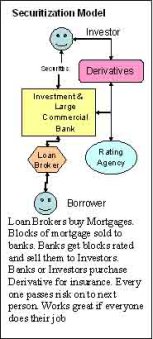 NY (Tim Geithner) Citi was one of the first banks to get into trouble and require a massive government bailout.
3-Dramatic failures of corporate governance and risk management at important financial institutions, key cause of the crisis.
Many banks (not all) acted recklessly took on too much risk with too little capital to address the crisis, being very dependent on short term funding which evaporated as the crisis evolved. They were not able to raise capital to address demand claim of customer. In short they were not able respond to a run on the bank. This is called a liquidity event. Recall that Investment banks were lightly regulated and did not have access to the FED window for emergency loans. They relied on unproven software to evaluate their risks. In short they loaded up on Real Estate securities which turned toxic and they could not absorb the losses. This was done despite the fact that they knew the underwriting of the real estate loans was poor. Goldman Sachs recognized this and curtailed purchasing of bad loans and they survived. The financial community was not able to police itself, requiring a massive government bailout. Risk people identified the problem and were ignored.
One Helluva Open Window
Posted: April 2, 2011 Filed under: financial institutions, Global Financial Crisis | Tags: Ben Bernanke, FED 23 CommentsI’m a financial economist. I’ve worked for the Fed although not in that capacity. My grandfather worked for the FED  doing the War Bonds thing for both World Wars and my exhusband worked for the Fed straight out of college. I’d like to think I have some familiarity with at least two of the districts. I also was schooled during the monetarist ascendancy so I was endowed with a certain amount of awe and respect for monetary policy. I don’t think–as a general rule–the FED’s current open market operations should be up for purview by politicians. I think it’s just fine and dandy that stuff comes out later because I certainly don’t want monetary policy neutralized or politicized. I would, however, like Ron Paul’s 3rd century world view of economics to be neutralized. However, I think all the adults in Washington, D.C. have moved. That would include the ones in the Board of Governor’s Building.
So, why am I saying all this? Well, I’m about to announce how absolutely appalled I was to find that the FED not only opened it’s discount window to our shadow banking industry and some commercial banks abroad, but it opened the windows, doors, and vaults to just about any bank or pseudo-bank on the planet that had the misfortune to be taken in by our financiers of greed and destruction. I know the Fed dabbles around the world. We’ve had to prop up Mexico and Citibank’s adventures from time-to-time which seemed way out of its jurisdiction even with the broadest interpretation of their charter. I know they “watch” our exchange rates while talking up the competitive exchange rate regime at times. Some how, this feels WAY different. I feel in need of a shower even reading about this.
U.S. Federal Reserve Chairman Ben S. Bernanke’s two-year fight to shield crisis-squeezed banks from the stigma of revealing their public loans protected a lender to local governments in Belgium, a Japanese fishing-cooperative financier and a company part-owned by the Central Bank of Libya.
Dexia SA (DEXB), based in Brussels and Paris, borrowed as much as $33.5 billion through its New York branch from the Fed’s “discount window” lending program, according to Fed documents released yesterday in response to a Freedom of Information Act request. Dublin-based Depfa Bank Plc, taken over in 2007 by a German real-estate lender later seized by the German government, drew $24.5 billion.
The biggest borrowers from the 97-year-old discount window as the program reached its crisis-era peak were foreign banks, accounting for at least 70 percent of the $110.7 billion borrowed during the week in October 2008 when use of the program surged to a record. The disclosures may stoke a reexamination of the risks posed to U.S. taxpayers by the central bank’s role in global financial markets.
“The caricature of the Fed is that it was shoveling money to big New York banks and a bunch of foreigners, and that is not conducive to its long-run reputation,” said Vincent Reinhart, the Fed’s director of monetary affairs from 2001 to 2007.
The FED’s always had an ‘usual and exigent circumstances’ clause that’s given a lot of leeway in times of financial crisis. Some how, I don’t even think Woodrow Wilson figured it would be used to lend money to a fishing-cooperative financier in Japan. You can also read Yves Smith at Naked Capitalism on exactly what went on at the Discount Window and with whom. She focuses on the ‘haircuts’. That would be the lousy deals made by the Fed to bail out a lot of lousy dealers. The numbers on how many of these borrowers were junk status awes.
The information was released yesterday and Bloomberg has provided a first cut on a small but juicy portion of it, the Primary Dealer Credit Facility. From a risk standpoint, the loans mace under this program violated the central bank guideline known as the Bagehot rule: “Lend freely, against good collateral, at penalty rates”. That is the prescription if the borrower is facing a bank run, meaning a liquidity crisis. The fact that 72% of the Fed’s loans on September 29 from the Primary Dealer Credit Facility were junk or equivalent (defaulted and unrated securities or equity) is further proof that many financial firms were facing a solvency, not a liquidity, crisis.
She also shows–in her words quelle suprise–which American Banks were the little failed piggies too. I’m going to throw one of the ‘haircuts’ or discounts a the front of this quote just to curl your toes a bit. I think we can effectively say that Wall Street trashed the value of nearly every firm in the country pretty effectively.
A 95% haircut on AAA rated ABS CDOs means the paper was effectively worthless.
This first cut by Bloomberg also shows that Morgan Stanley was the biggest user of the facility, receiving $61.3 billion of funds for securities “worth” $66.5 billion, 71.6% of which was junk or unrated. As eye-popping as those numbers are, the funds received are less than half the fall in Morgan Stanley’s liquidity pool in the two weeks after the Lehman failure, per Economics of Contempt. Merrill Lynch was second, getting $36.3 billion in funding for $39.1 billion of collateral, 83.4% of which was junk or unrated.
These are not the routine activities of central banks and central bankers. We basically bankrolled a bunch of businesses and financial outfits in a bunch of countries because they wanted in on the Wall Street greed and Wall Street failed them big time. I’m left wondering why all this money was thrown to the foreign gamblers while Americans were being foreclosed on, frankly. Let me also let you know that this is probably just the tip of the iceberg since there’s undoubtedly more documents that need to be discovered and analyzed. My hope is that when the congressional hearings on this get started, we have some real brain power behind the questions that need to be asked on this because questions do need to be asked about this. I’d like a few FED Governors around for the ride to see how many of them were on board with all of this or even knew of it. What we need right now are a few Ferdinand Pecoras.
I also wonder who masterminded all this? Paulson? Geithner? Bernanke? Were they that wedded to ensuring Wall Street didn’t look like a casino and American business didn’t look like a sham that they had to give away the house, the children, the pets, and the fatted calf? They basically threw every one’s kitchen sink overseas. Worse than that, they’ve really not solved the basic systemic problem and the banks are already niggling over the details of the few thinks done by Dodd-Frank. Feel used yet?

 peej
peej Carissa
 bostonboomer
 dakinikat
 ecocatwoman
 mablue2
 Mama Lopez
 peggysue22
 quixote
 skydancingguestblogger
 Mona (aka Wonk the Vote)



 Sky Dancing
Recent Comments