
What’s That Lassie? Little Timmy’s in the Well AGAIN?
Posted: August 4, 2009 Filed under: Bailout Blues, Equity Markets, Global Financial Crisis, president teleprompter jesus, The Bonus Class, The Great Recession, U.S. Economy | Tags: Ben Bernanke, CNBC, FDic, FED, Larry Summers, Mary Schapiro, Naked Capitalism, SEC, Sheila Bair, Timothy Geithner, Wall Street Cheerleaders, Zero Hedge Comments Off on What’s That Lassie? Little Timmy’s in the Well AGAIN? Wow, it looks like Turbo Tax Timmy has gone rogue! We better send the press up to Alaska to chase down another Palin rumor. First, there’s that nastiness over the weekend with the Stephanapolous show on ABC where he explicitly said that the administration wasn’t ruling out new taxes on the middle class. (Something Larry-the-la-la Summers also inkled, but hey, he’s not a cabinet officer, he’s something akin to a Czar that has to be overthrown by something other than scandal and public displays of stupidity.) I believe that gave Robert Gibbs Excedrin headaches number 349-357 during yesterday’s presser.
Now, there’s rumors of a temper tantrum in the presence of all the nation’s topic economists and financial regulators outlined here in the WSJ. It seems he’s not getting the Obama way on this one. The ladies in the room have taken exception to his granting Ben Bernanke (possibly later, this year, La-la Summers) all the fun and power. I guess being an independent regulator with an agency all to yourself just isn’t what it used to be; especially when you have scary lady parts and a huge brain.
Mr. Geithner told the regulators Friday that “enough is enough,” said one person familiar with the meeting. Mr. Geithner said regulators had been given a chance to air their concerns, but that it was time to stop, this person said.
Among those gathered in the Treasury conference room were Federal Reserve Chairman Ben Bernanke, Securities and Exchange Commission Chairman Mary Schapiro and Federal Deposit Insurance Corp. Chairman Sheila Bair.
Friday’s roughly hourlong meeting was described as unusual, not only because of Mr. Geithner’s repeated use of obscenities, but because of the aggressive posture he took with officials from federal agencies generally considered independent of the White House. Mr. Geithner reminded attendees that the administration and Congress set policy, not the regulatory agencies.
Mr. Geithner, without singling out officials, raised concerns about regulators who questioned the wisdom of giving the Federal Reserve more power to oversee the financial system. Ms. Schapiro and Ms. Bair, among others, have argued that more authority should be shared among a council of regulators.
This current turf battle is only the latest move by a group within government possibly thwarting the Treasury’s plans to continue uploading tax dollars to the bonus class in the guise of saving the financial sector. If there’s still disagreement about this point, can you imagine what other things are going on in complete disarray behind the scenes? Who is really in charge of solving this overt act of sibling rivalry? Well, if you have figured out where the buck stops in this administration, you’re doing better than me. (Hint: these folks are ALL presidential appointments).
Fed Continues to Subsidize the Bonus Class
Posted: August 3, 2009 Filed under: Equity Markets, Global Financial Crisis, The Bonus Class, The Great Recession, U.S. Economy | Tags: arbitraging government debt, bonus class, Federal Reserve, Financial Times., high volume trading Comments Off on Fed Continues to Subsidize the Bonus Class I’m again relying on the Financial Time’s for this latest bit of no suprises here. The big question is when will the political class pull the rug out from under the bonus class?
Wall Street banks are reaping outsized profits by trading with the Federal Reserve, raising questions about whether the central bank is driving hard enough bargains in its dealings with private sector counterparties, officials and industry executives say.
The Fed has emerged as one of Wall Street’s biggest customers during the financial crisis, buying massive amounts of securities to help stabilise the markets. In some cases, such as the market for mortgage-backed securities, the Fed buys more bonds than any other party.
However, the Fed is not a typical market player. In the interests of transparency, it often announces its intention to buy particular securities in advance. A former Fed official said this strategy enables banks to sell these securities to the Fed at an inflated price.
The resulting profits represent a relatively hidden form of support for banks, and Wall Street has geared up to take advantage. Barclays, for example, e-mails clients with news on the Fed’s balance sheet, detailing the share of the market in particular securities held by the Fed.
“You can make big money trading with the government,” said an executive at one leading investment management firm. “The government is a huge buyer and seller and Wall Street has all the pricing power.”
Let me be clear that the Fed is not a government agency. It makes profits each year from services it provides banks and returns those profits to the Treasury. The Treasury uses the Fed as its agent for a few services but the Fed is a central bank, the bank of bankers. It is not part of the Treasury per se. However, even with that being said, this news continues to be disturbing. Wall Street is gaming the Fed because they can. These things are monopoloy/oligopoly behaviors and we have laws against them!
Barney Frank, chairman of the House financial services committee, said the potential profiteering may be part of the price for stabilising the financial system.
“You can’t rescue the credit system without benefiting some of the people in it.” Still, Mr Frank said Congress would be watching. “We don’t want the Fed to drive the hardest possible bargain, but we don’t want them to get ripped off.”
The growing Fed activity has coincided with a general widening of market spreads – the difference between bid and offer prices – as the number of market participants declines. Wider spreads enable banks, in their capacity as market-makers, to make more profit.
Larry Fink, chief executive of money manager Black Rock, has described Wall Street’s trading profits as “luxurious”, reflecting the banks’ ability to take advantage of diminished competition.
“Bid-offer spreads have remained unusually wide, notwithstanding the normalisation of financial markets,” said Mohamed El-Erian, chief executive of fund manager Pimco in Newport Beach, California.
Spreads narrowed dramatically during the years of the credit bubble.
Brad Hintz, an analyst at Alliance Bernstein, said he doubted that spreads would ever return to those levels, a development that could be pleasing to the Fed.
“They want to help Wall Street make money,” he said.
I’m trying to think why any one would want Wall Street to make huge profits by arbitraging what is basically government debt. Why, in the face of this situation, would Congressman Barney Frank make a lame comment like that? Any one have any suggestion? Read the rest of this entry »
In Search of a Trough
Posted: July 31, 2009 Filed under: Global Financial Crisis, The Great Recession, U.S. Economy | Tags: BEA, GDP, job markets, jobless recovery, minimum wage, Real economic Growth, wages Comments Off on In Search of a Trough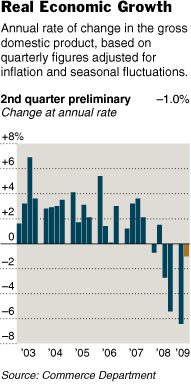 The U.S. economy still shrank in second quarter 2009 but at a much lower pace than was anticipated. That’s a pretty good indicator that the bottom or trough of The Great Recession may be near. Here’s the precise release from the Bureau of Economic Analysis (BEA).
Real gross domestic product — the output of goods and services produced by labor and property located in the United States — decreased at an annual rate of 1.0 percent in the second quarter of 2009, (that is, from the first quarter to the second), according to the “advance” estimate released by the Bureau of Economic Analysis. In the first quarter, real GDP decreased 6.4 percent.
While the many recent indicators show the recession is loosing some of its downward momentum, there are few economists ready to sing Happy Days are Here Again. The NYT’s coverage of the statistical release continues to bring up some of the same concerns we’ve discussed here before.
The economy’s long, churning decline leveled off significantly in the second quarter, as stock markets started to recover, corporate profits bounced back, housing markets stabilized and the rampant pace of job losses tapered off. Declines in business investment leveled off, and the economy was aided by big increases in government spending at the federal, state and local levels.
“We’re in a deep hole, and now we’ve got to dig ourselves out of it, which is a very difficult task,” Diane Swonk, chief economist at Mesirow Financial, said.
But consumer spending fell by 1.2 percent as Americans put more than 5 percent of their disposable income into savings. Economists are concerned that consumer spending, which makes up 70 percent of the economy, will not rebound as long as employers keep cutting jobs and trimming wages.
Don’t sell Tinfoil Short … yet
Posted: July 30, 2009 Filed under: Equity Markets, Global Financial Crisis Comments Off on Don’t sell Tinfoil Short … yetI was taking a break from formulating exchange rate models (yeah, I know so much excitement, so little time over the

Something smells at Citigroup
summer) at the WSJ. Nothing grabs me quite like a market manipulation story. The headline is “Traders Blamed for Oil Spike”. So, stay with me here as I quote from that article.
The Commodity Futures Trading Commission plans to issue a report next month suggesting speculators played a significant role in driving wild swings in oil prices — a reversal of an earlier CFTC position that augurs intensifying scrutiny on investors.
In a contentious report last year, the main U.S. futures-market regulator pinned oil-price swings primarily on supply and demand. But that analysis was based on “deeply flawed data,” Bart Chilton, one of four CFTC commissioners, said in an interview Monday.
The CFTC’s new review, due to be released in August, adds fuel to a growing debate over financial investors who bet on the direction of commodities prices by buying contracts tied to indexes. These speculators have invested hundreds of billions of dollars in contracts that were once dominated by producers and consumers who sought to hedge against oil-market volatility.
So, you have to remember last summer and those terrible oil price hikes that seemingly came out of no where, right? Thankfully, there’s a commission being set up to look into this and to look into what kind of regulations should be placed on speculation in markets of these kinds.
The debate over speculators underscores the shifting nature of commodities trading in recent years. Before the mid-1990s, these markets were dominated by entities that had physical dealings with the underlying commodity, and “speculators” who often took the opposite position, providing liquidity to markets.
But a new group of investors has emerged in recent years. Those who want to bet on commodities prices have increasingly put their money in indexes that track the value of futures contracts, in which investors promise to pay a certain amount in the future for oil and other commodities. As of July 2008, financial investors had about $300 billion riding on these indexes, roughly four times the level in January 2006, according to the International Energy Agency, a Paris-based watchdog.
Separately, these investors may buy derivatives, not directly traded on futures exchanges, that let them make contrary bets to offset their risks.
Crude-oil prices surged in July 2008 to a record $145 a barrel, then dropped to about $33 in December. Oil now trades at around $68 a barrel.
Hopefully, you’re still with me on this because here comes the intrigue. I may be putting on my tinfoil hat at this point but if you watched TV news yesterday you probably saw the article about absolutely, positively, in trouble Citigroup owing $100 million in Bonuses to one Andrew Hall. Now, you may remember that we fund Citigroup right now and that they are in business even though they are on double secret probation. The scuttlebutt is that this bonus is due this guy, because he earned it, but it’s going to have to be paid with a sort’ve pass through of taxpayer funds. Ring any bells yet?
Okay, so here’s my tinfoil hat part. Do you know how this guy made all this money?
The trader, Andrew J. Hall, heads Citigroup’s energy-trading unit, Phibro LLC — a secretive operation, run from the site of a former Connecticut dairy farm, that occasionally accounts for a disproportionate chunk of Citigroup income.
So get this, first we all had to pay these HIGH, HIGH gas prices last year because energy traders ran up oil prices, NOW, we as taxpayers get to pay this guy’s bonus because Citigroup’s big profit center was, wait a minute, wait for it, yup, you got it ENERGY TRADING!.
I’m going long on Tinfoil, for this one. Karl Denniger, what say you?
Please Digg!!! Share!!! Tweet!!!


Add to: Facebook | Digg | Del.icio.us | Stumbleupon | Reddit | Blinklist | Twitter | Technorati | Furl | Newsvine
Market Rallies as K Street Wins
Posted: July 30, 2009 Filed under: Equity Markets, Global Financial Crisis, U.S. Economy Comments Off on Market Rallies as K Street Wins I never really thought that we would see a truly “progressive” agenda coming out of the Washington, D.C. this year, but with such huge democratic majorities, I did have some thought we might get something done for the people for a change. Remember, those campaign promises last year did seem pretty liberal even though most of us here on TC doubted we’d see even half of them come to fruition. Now it’s looking apparent that what’s coming out is more corporate loot fest than progress for the people. Is that why we have a market rally in what still appears to be a very poor economy?
There’s an interesting hypothesis floating around The Hill today that Wall Street may have bought into the hope and change agenda and is now rallying because it appears to now be all hype and no change. I’m not sure if I’d consider this a good hypothesis as a financial economist, but as some one more firmly planted on the behavioral finance side of things than the rational markets gang, I’m willing to give the idea an airing.
The Democratic agenda in Washington has gone off the rails just as markets are enjoying their best run of the Obama presidency, and there’s a school of thought on Wall Street that it’s no coincidence.
While a string of better-than-expected earnings reports from U.S. companies has been credited for the upswing, analysts such as Axel Merk, the portfolio manger of Merk Investments, said the stalled agenda in Congress has also helped the Dow Jones Industrial Average spike above 9,000.
So what items on the liberal Wall-Street-Hating-agenda did they fear? Well, first and foremost on the list was legislation on executive compensation. I doubt the populist outrage against the bonus class has gone any where, but now that we have a Pay Czar to oversee the problem, nothing has happened. Yesterday, I talked about the Citibank Energy Trader, Andrew Hall waiting in the wings for his $100 million bonus for driving up our energy prices last year while Citibank itself has taken $45 million in TARP funds and remains on a some kind of double secret probation with its regulators. All this while that market’s regulator is investigating issues with the traders. The Hall bonus has floated around the MSM and the news programs while CNBC, the Wall Street equivalent to the Hornet’s Honeybees here in New Orleans, continues to champion big pay for risk taking and innovation. I guess adding a little liquidity to the market was worth the worst financial crisis since The Great Depression in their eyes.

 peej
peej Carissa
 bostonboomer
 dakinikat
 ecocatwoman
 mablue2
 Mama Lopez
 peggysue22
 quixote
 skydancingguestblogger
 Mona (aka Wonk the Vote)



 Sky Dancing
Recent Comments