
And now, a Game of Concentration
Posted: August 31, 2009 Filed under: Bailout Blues, Equity Markets, Global Financial Crisis, U.S. Economy | Tags: banking cartel, banking oligopoly, TARP Comments Off on And now, a Game of ConcentrationWhen I saw this NYT Headline, “As Big Banks Repay Bailout Money, U.S. Sees a Profit”, it really did not send me to a

Expecting customer service? Fat Chance!
happy place. You’re probably going to raise a Spock-like eyebrow and ask me to explain. Why, Kat, you’re probably saying, isn’t a 15% return on our “money” a good deal in this market? Remember finance 101, rates are relative to risk so let me tell you why I’m a concern troll on this. First, here’s what the author thought was the punch line to this story.
But critics at the time warned that taxpayers might not see any profits, and that it could take years for the banks to repay the loans.
As Congress debated the bailout bill last September that would authorize the Treasury Department to spend up to $700 billion to stem the financial crisis, Representative Mac Thornberry, Republican of Texas, said: “Seven hundred billion dollars of taxpayer money should not be used as a hopeful experiment.”
So far, that experiment is more than paying off. The government has taken profits of about $1.4 billion on its investment in Goldman Sachs, $1.3 billion on Morgan Stanley and $414 million on American Express. The five other banks that repaid the government — Northern Trust, Bank of New York Mellon, State Street, U.S. Bancorp and BB&T — each brought in $100 million to $334 million in profit.
What the author really missed was that information also comes on the back of this information last week that shows that the government has created incredible high concentration ratios in the banking market. I discussed it here in a piece where I called it a big ol’ game of monopoly. This is an ongoing policy disaster and many folks appear to be missing it.
J.P. Morgan Chase, an amalgam of some of Wall Street’s most storied institutions, now holds more than $1 of every $10 on deposit in this country. So does Bank of America, scarred by its acquisition of Merrill Lynch and partly government-owned as a result of the crisis, as does Wells Fargo, the biggest West Coast bank. Those three banks, plus government-rescued and -owned Citigroup, now issue one of every two mortgages and about two of every three credit cards, federal data show.
There are so many headlines buried in that NYT piece that you’d think it was written by ostriches. This is one alone should’ve grabbed a banner headline.
But the real profit came as banks were permitted to buy back the so-called warrants, whose low fixed price provided a windfall for the government as the shares of the companies soared.
Well, isn’t that nice, the best borrowers paid back first. Some one over there ever take any finance classes? I doubt it. Of course, that’s going to happen you twit!! It’s the implication of what that means that scares the pants off me. The fact they’ve borrowed funds allows us to regulate their actions. Now, the big ones are paying them back so they’re out of the reach of tighter TARP regulation! They like their old loosey goosey nonsense regulations especially now that they’re all set up as a de facto cartel with government blessing. They’re ready to price discriminate, restrict services, and create extraordinary profits all they want with FEW RESTRICTIONS. Just wait until we get to witness the new and improved, unregulated CEO pay schemes!
It’s similar to handing all of our energy needs and policy over to OPEC.
How About a Big ol’ Game of Monopoly?
Posted: August 28, 2009 Filed under: Bailout Blues, Equity Markets, Global Financial Crisis, Surreality, The Bonus Class, U.S. Economy | Tags: banking industry, corporate welfare, externalities, K Street Lobbyists, rent seeking Comments Off on How About a Big ol’ Game of Monopoly? If we’re a ‘free market’ economy, why do we keep protecting so many businesses and promote monopoly? Well, I suppose the practical answer is that businesses who can afford to do so will rent-seek via K Street and politicians looking for donations will happily give them whatever they want. The bigger question is why do we keep politicians in office that DO this to us? Why do we put up with policy makers that continually keep corporations safe from the economic Darwinism implied by capitalism while we pay for all their negatives like externalities, restricted output, and high prices? Can we just say, for once, that the real welfare queens in the economy are the bonus class and these kinds of corporations? They suck up the public funds like a bunch of leeches at a Louisiana picnic. Today’s news just provides us this ongoing example from the banking industry. It’s from WaPo and David Cho. Go read Banks ‘Too Big to Fail’ Have Grown Even Bigger; Behemoths Born of the Bailout Reduce Consumer Choice, Tempt Corporate Moral Hazard for a really good example of market failure. It makes me want to socialize the lot of them! I mean, if we’re going to continually subsidize them and give them monopoly status, we might as well have a stake in their assets.
The crisis may be turning out very well for many of the behemoths that dominate U.S. finance. A series of federally arranged mergers safely landed troubled banks on the decks of more stable firms. And it allowed the survivors to emerge from the turmoil with strengthened market positions, giving them even greater control over consumer lending and more potential to profit.
J.P. Morgan Chase, an amalgam of some of Wall Street’s most storied institutions, now holds more than $1 of every $10 on deposit in this country. So does Bank of America, scarred by its acquisition of Merrill Lynch and partly government-owned as a result of the crisis, as does Wells Fargo, the biggest West Coast bank. Those three banks, plus government-rescued and -owned Citigroup, now issue one of every two mortgages and about two of every three credit cards, federal data show.
A year after the near-collapse of the financial system last September, the federal response has redefined how Americans get mortgages, student loans and other kinds of credit and has made a national spectacle of executive pay. But no consequence of the crisis alarms top regulators more than having banks that were already too big to fail grow even larger and more interconnected.
“It is at the top of the list of things that need to be fixed,” said Sheila C. Bair, chairman of the Federal Deposit Insurance Corp. “It fed the crisis, and it has gotten worse because of the crisis.”
I really hate going to the mail box these days. I am now banking with Capital One not by choice but by merger. I now have a trading account with J.P. Morgan, not by choice but by merger. My mortgage is miserably serviced by Wells Fargo, not by choice but by secondary market transaction. Each day, I find myself to be a customer of a behemoth bank with whom I would not choose to do business voluntarily. It takes me forever to get out of customer service automated voice response hell to try to figure out how to close my account so I can go elsewhere. An expedition to Patagonia would be easier.
“Be not afraid of greatness; some are born great, some achieve greatness, and others have greatness thrust upon them”
William Shakespeare.
“And some have greatness handed to them on a silver platter by their government”
Dakinikat.
Feel the Bern!
Posted: August 25, 2009 Filed under: Bailout Blues, Equity Markets, Global Financial Crisis, U.S. Economy | Tags: Ben Bernanke, Federal Reserve Bank, Larry Summers Comments Off on Feel the Bern!While I stuck the announcement into the morning links, you had to know that I’d front page this announcement some time today. So you also probably knew that I breathed a quiet sigh of relief last night when I found out we were not getting La La Summers for Fed Chief. President 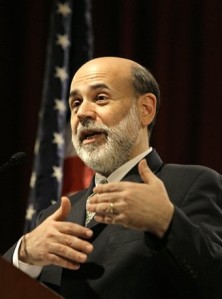 Obama has decided to re-appoint Fed Chairman Ben Bernanke to another term.
I awakened this morning to the bleating of the bloggies on this move. Of course, I have this tendency to look at folks’ credentials before I decide to take their opinions seriously. It also helps to know their political agendas and frames. Chairman Bernanke has probably had the most challenging time at that job since Paul Volcker took over the Fed helm back in the days of rampant inflation and Carter malaise. So many blogs have come to criticize Bernanke, but I’m just glad we’re not here to bury him. He may not be perfect, but he’s a damn sight better than just about everything else out there. Ben Bernanke is an economist’s economist.
Wall Street and academic economists in recent weeks showed enthusiasm for giving Mr. Bernanke a second term, and some administration insiders felt similarly even though Mr. Bernanke was appointed by — and served in the White House of — President George W. Bush. Appointing a Democrat such as Janet Yellen, president of the Federal Reserve Bank of San Francisco, or Alan Blinder, former Fed vice chairman — both former advisers to President Bill Clinton — would have been popular with many Democrats. But a move by Mr. Obama to install his own person at the Fed might have have rattled markets and unsettled the foreign investors.
Phil Izza at the WSJ has a pretty good line up of comments from both political and financial folks on the Bernanke appointment. Some of the performance the financial markets today(so far, all up) could be linked to the decision as the Fed Chair heads up the Federal Open Market Committee and sets its agenda. It is a rare FOMC that will go against the recommendations of their chair when setting monetary policy(primarily levels of interest rates, exchange rates, and bond offerings) although there is usually a healthy amount of debate and exchange or so I’ve heard since the meetings are top secret.
- I think it’s good news for the Federal Reserve. It’s good news for the country. It’s a great choice. Chairman Bernanke has done a terrific job in bringing openness to the Fed. He has been bold and creative in dealing with the financial crisis… It was not clear to most people that the crisis was going to be as broad-based, and that the excesses in the financial markets and in lending were as broadly based as they turned out to be. Even at the start, he was willing to consider all options to deal with what appeared to be more a liquidity than a solvency crisis. As it began to become more clear that it was a crisis of solvency and leverage and a classic credit crunch, he didn’t flinch in bringing enormous creativity to bear in mitigating the problem –Richard Berner, Morgan Stanley
- Having a new chairman come in at this late date would put the Fed engineered solution to both the recovery and the exit strategy at risk. The Federal Reserve made a hasty exit from easy money stimulus in the 1930s and we know how that worked out… Mistakes have been made at many regulatory institutions during this crisis, but all the Fed’s mistakes would have been made by any man according to the prudent man rule. Bernanke is a true prudent man who calls them as he sees them, and knows the ins and outs of policymaking… If he can pull off this recovery that still needs nurturing, he could well go down as one of the greatest Fed Chairmen in history. –Christopher Rupkey, an economist with Bank of Tokyo-Mitsubishi
Louisiana Senator Vitter Declares War on Canadian Users of Viagra
Posted: August 21, 2009 Filed under: Global Financial Crisis, New Orleans | Tags: Big Pharma, Canadian drugs, David Vitter Comments Off on Louisiana Senator Vitter Declares War on Canadian Users of Viagra Okay, that headline is way misleading, but it’s Friday and I’m in a wrascally mood. Actually, what Republican Senator David (the Diaper) Vitter is suggesting is that we overwhelm the Canadian Prescription Drug Market via re-importation to drive prices up there and prices down here. It’s a strategy to break a system where Big Pharma gets to practice price discrimination which is basically charging different prices to different markets. TPM posted this Vitter explanation on YouTube.
Vitter’s economics seem like they might just work — or maybe not. Canada and other countries negotiate lower prices with the drug companies, who then demand exorbitant profits from U.S. consumers and our relatively free market. Arguably, by overwhelming other countries with American demand, their systems would break down. The next step here, is that Vitter believes this will cause prices to go up for everyone else, and down for us. (But we’d be curious what health care economists would say).
As Vitter told his questioner, who is apparently an Obama supporter: “I don’t support price controls, but I actually think re-importation would cause that system, as well as these varying prices, to collapse. That make sense?”
Of course, this is assuming the drug companies wouldn’t take advantage of their inelastic demand curves by just jacking up prices for everyone. And really, this whole scheme to destroy other countries’ social welfare programs for American benefit isn’t mighty neighborly of Vitter, is it?
It’s just so fiendish, it make actually work! But sheesh, aren’t there easier ways to take care of this like making some legislation here in the U.S. that lets Medicare bargain for its subscriber’s benefits or a public health option that could do the same? Why crash the Canadian system when just a little law writing could force the same result? We have laws that outlaw price discrimination! We could do something novel and let the Justice Department go after them with our antitrust laws! But, Senator Vitter, why pick on the poor Canadians, isn’t just living up there in the middle of ice fields and glaciers enough punishment as it is?
Please Digg!!! Share!!! Tweet!!!


Add to: Facebook | Digg | Del.icio.us | Stumbleupon | Reddit | Blinklist | Twitter | Technorati | Furl | Newsvine
Paradise Squandered
Posted: August 20, 2009 Filed under: Global Financial Crisis, Health care reform, Hillary Clinton: Her Campaign for All of Us, president teleprompter jesus, Surreality | Tags: Democratic majority, Gallup poll, Obama approval, The Cook Report Comments Off on Paradise Squandered I guess the old adage is true. A year is a long time in politics. Less than 18 months ago I held out hope that we would see a solid democratic majority for some time and that there would be a democratic President with a democratic agenda moving the country forward and away from the Bush Cheney nightmare. I expected that we would have no more warrantless wiretapping. I believed we would be discussing an energy policy that included more options that drill, baby drill. I thought a women’s uterus would no longer be considered an object of state interest. I figured that we’d see the end to talk about protecting traditional marriage, whatever the heck that ever was to start out with but basically we’d no longer exclude gay couples from a civil institution and gay soldiers from openly serving in our military.
I thought our future seemed bright.
I thought perhaps we could have a defense department budget that resembled the levels of other democratic countries and that we would have a health care plan that resembled the rest of the developed world. I especially felt hopeful, when I watched the first democratic debate, that one of those folks would be in charge of America again. It was only a matter of which one. Little did I know then, the one I discounted as not really knowing a thing by the time the second debate was over is the one we got. My basic thought about Obama was Vice President material.
Now, our national nightmare continues and The Cook Political Report has just dropped the other shoe. The Cook Political Report has a very good reputation for handicapping elections.
Gallup’s three-night moving average tracking poll, President Obama’s job approval rating in both their August 16-18 and August 17-19 averages was just 51 percent, the lowest level of his presidency. The latter sampling showed his disapproval up to 42 percent, matching his all-time low hit in the August 15-17 tracking poll. The 51% job approval rating is identical to two other polls released in recent days conducted by NBC News and the Pew Research Center. Today’s regression-based trend estimate computed by our friends at Pollster.com from all major national surveys show an approval rating of 50.7 percent and disapproval of 43.7 percent.
These data confirm anecdotal evidence, and our own view, that the situation this summer has slipped completely out of control for President Obama and Congressional Democrats. Today, The Cook Political Report’s Congressional election model, based on individual races, is pointing toward a net Democratic loss of between six and 12 seats, but our sense, factoring in macro-political dynamics is that this is far too low.
Many veteran Congressional election watchers, including Democratic ones, report an eerie sense of déjà vu, with a consensus forming that the chances of Democratic losses going higher than 20 seats is just as good as the chances of Democratic losses going lower than 20 seats. A new Gallup poll that shows Congress’ job disapproval at 70 percent among independents should provide little solace to Democrats. In the same poll, Congressional approval among independents is at 22 percent, with 31 percent approving overall, and 62 percent disapproving.

 peej
peej Carissa
 bostonboomer
 dakinikat
 ecocatwoman
 mablue2
 Mama Lopez
 peggysue22
 quixote
 skydancingguestblogger
 Mona (aka Wonk the Vote)



 Sky Dancing
Recent Comments