
Put a Cork in Corker
Posted: March 11, 2010 Filed under: Global Financial Crisis, The Great Recession, U.S. Economy | Tags: Bob Corker, Chris Dodd, financial regulation, pay day lenders Comments Off on Put a Cork in Corker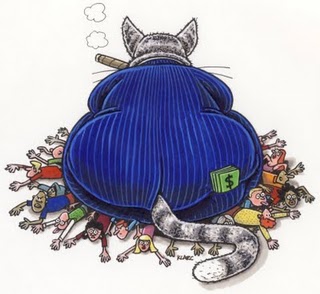 If you want a good example of politics-as-usual as well as something that is not in the interest of the public, this is it. Payday lenders are loan sharks without the kneecapping thugs. Senator Bob Corker wants them exempted from regulations aimed at protecting consumers from predatory and unfair lending practices. Senator Chris Dodd is basically going along with it. This is an egregious example of crony capitalism that enriches an industry by taking advantage of the poor and uninformed.
Senator Bob Corker, the Tennessee Republican who is playing a crucial role in bipartisan negotiations over financial regulation, pressed to remove a provision from draft legislation that would have empowered federal authorities to crack down on payday lenders, people involved in the talks said. The industry is politically influential in his home state and a significant contributor to his campaigns, records show.
This is really bad. If you have a congress critter sitting on Dodd’s committee, now is the time to write and scream. Here’s information on from the Center for Responsible Lending on just exactly how bad this particular brand of predators can get.
Twenty or so years ago, some finance companies figured out how to make loans of a few hundred dollars to people who were barely getting by. That may sound generous, but when you look deeper, the practice they developed amounts to nothing more than legal loan sharking.
The problem for the borrowers—and the payoff for the lenders—is that the terms of these loans are cleverly designed to be very difficult to meet. The borrower must keep coming back and renewing their loan because they aren’t allowed to pay it down and can’t afford to pay it off. They pay the lender another chunk of interest each time, about $50 for a $300 loan. How the debt trap works
These loans carry annual interest rates of 400%, and the industry relies for 90 percent of their revenue on borrowers who repeatedly renew or re-open their payday loans. The typical borrower ends up paying about $500 in interest for a $300 loan, and still owes the principal.
Corker has already damaged the bill that was designed to stop a repeat of the subprime lending crisis that triggered so much trouble back in 2007. Dodd is going along with everything like the lobbyist he surely will become in a short amount of time. We’ve already seen the take down of the new consumer agency that was originally created by the bill. The duties will now be given to the Fed. This is something that Fed Chair Ben Bernanke originally opposed but later accepted under duress from Treasury Secretary Timothy Geithner.
The Fed is a conservative organization that is more reactive than proactive. Under this new term, it is unlikely any one will activate regulation for this set of loans should they get any worse than they already are today. This basically ghettos the poorest of the poor (mostly the unbanked who rely heavily on checking cashing places and pay day loans) into the least controlled debt instruments. In other words, it’s going to take the most money and fees from those least able to pay for them. It perpetuates the loan trap. Most of the brick and mortar of the pay day loan industry is located in the poorest parts of cities where no bank will go any more. The industry says that it’s providing a much needed service. What’s really happening is that it’s ensuring there is no place else to go.
Under the proposal agreed to by Mr. Dodd and Mr. Corker, the new consumer agency could write rules for nonbank financial companies like payday lenders. It could enforce such rules against nonbank mortgage companies, mainly loan originators or servicers, but it would have to petition a body of regulators for authority over payday lenders and other nonbank financial companies.
Consumer advocates said that writing rules without the inherent power to enforce them would leave the agency toothless.
The consumer groups that seek to protect borrowers from the worst of abuses appear to have given up on Dodd and his committee. They’ve gone straight to the FED for help. The hope is that Bernanke can convince the committee to give the FED broader powers than just ensuring compliance with the Truth in Lending Act.
Consumer groups, however, say that enforcement is crucial to curbing abusive, deceptive or unfair practices.
On Tuesday, while Mr. Dodd and Mr. Corker continued negotiating other provisions of the regulatory overhaul — notably, the extent to which state attorneys general would be able to enforce consumer protection rules against banks — the Federal Reserve’s chairman, Ben S. Bernanke, met with National People’s Action, an activist group that wants the Fed to restrict the banks it oversees from financing payday lenders.
Mr. Bernanke, who had met with the group twice before, is trying to fend off proposals in the Senate to strip the Fed of much of its power to supervise banks. A recommitment to protection consumers is part of that strategy
It is just unbelievable to me that some of the very people who nearly brought the economy to the knees by taking on unbelievable risks, securitizing them and then passing the trash to the market will still be able to carry on like nothing ever happened. This is terrible news. The only hope now is that Barney Frank will stop the senate from changing the tougher language originally introduced by the White House and put through by the House. It certainly doesn’t look like the White House will stand up for its own bill.
Perspective
Posted: March 5, 2010 Filed under: Bailout Blues, Global Financial Crisis, The Bonus Class, The Great Recession, U.S. Economy | Tags: Financial Crisis, securitization, Subprime market, unemployment 1 Comment The WSJ has an interesting list of folks contributing to “Academics on What Caused the Financial Crisis“. You’ll find a lot of the usual suspects that we’ve talked about around here. There’s some interesting comments on the housing and subprime bubbles, the increased use of exotic financial instruments, and our old friend moral hazard. I’m going to a highlight just a few for you.
Some of the more interesting comments focused on how the housing bubble was enabled by government. Some blame low interest rates by the FED, others see that it wasn’t just a U.S. phenomenon and look for bigger reasons. Many folks see securitization and the pass-the-trash loan model as the big factors.
Dwight Jaffee, Haas School of Business, University of California at Berkeley
On the government’s role in creating the housing bubble: “I find the GSEs [government sponsored enterprises including Freddie Mac and Fannie Mae] to have been a significant factor in expanding the mortgage crisis as a result of their high volume of high-risk mortgage purchases and guarantees. Furthermore, I find that the GSE housing goals for lending to lower-income households and in lower-income regions were secondary to profits as a factor motivating the GSE investments in high-risk mortgages.
…
Christopher Mayer, Columbia Business School
On the housing bubble: “For the housing market, the picture is much more complex than it might first appear. The housing bubble was global in nature and also included commercial real estate, so simple explanations that rely solely on predominantly American institutions like subprime lending or highly structured securitizations cannot be the only factor leading to real estate market excesses. …My own research shows the important role played by declining long‐term, real interest rates in helping drive real estate prices to high levels, at least up to 2005. However, at some point, speculation by both borrowers and lenders took over, leading to excessive appreciation in many parts of the United States and the rest of the world.”
…
Pierre-Olivier Gourinchas, University of California at Berkeley:
How did subprime bust trigger a financial tsunami? “Three factors ensured that the collapse in what was a minor segment of the U.S. financial markets turned into a global financial conflagration. First, profound structural changes in the banking system, with the emergence of the ‘originate-and-distribute’ model, coupled with an increased securitization of credit instruments, led to a decline in lending standards and a general inability to re-price complex financial products when liquidity dried-up.
Randall Kroszner, University of Chicago Booth School of Business and a former Fed governor:
On reducing moral hazard: “Given the extent of interventions world-wide, issues of moral hazard will remain. The Rubicon cannot be uncrossed and financial market behavior will surely anticipate the return of the “temporary” programs and guarantees in the event of another crisis. To maintain the stability of the system and to protect taxpayers, the “too interconnected to fail” problem needs to be addressed in two ways: through improvements in the supervision and regulation framework as well as improvements in the legal and market infrastructure to make markets more robust globally.”
“Ultimately, to mitigate the potential for moral hazard, policy makers must feel that the markets are sufficiently robust that institutions can be allowed to fail with extremely low likelihood of dire consequences for the system.”
These are just a few brief excerpts from a few of the contributors. You should really go check out the full article.
In the same vein, I wanted once again to go behind the unemployment number released to day and the WSJ has a pretty good explanation of the figure that I follow closely. It is called the U-6 unemployment rate. It not only focuses on people without jobs but people that are ‘underemployed’. This rate, unlike the unemployment rate itself which is staying around 9.7%, went up last month.
The U.S. jobless rate was unchanged at 9.7% in February, following a decline the previous month, but the government’s broader measure of unemployment ticked up 0.3 percentage point to 16.8%.
The comprehensive gauge of labor underutilization, known as the “U-6″ for its data classification by the Labor Department, accounts for people who have stopped looking for work or who can’t find full-time jobs. Though the rate is still 0.6 percentage point below its high of 17.4% in October, its continuing divergence from the official number (the “U-3″ unemployment measure) indicates the job market has a long way to go before growth in the economy translates into relief for workers.
You can read more at NYT in a thread called “Is the Recovery Losing Steam?”
Again and despite what AZ Senator John Kyle says–as highlighted in Krugman’s recent op-ed “Bunning’s Universe”–most folks cannot make ends meet on unemployment benefits and must find jobs that are way beneath their job skills, their income requirements, or the lower the number of hours they wish to work. This more realistic rate accounts also for people who simply have given up on finding a job. These folks don’t even collect unemployment benefits. Just to remind you on Kyle’s priorities, here’s a good bit of prose from Krugman.
Consider, in particular, the position that Mr. Kyl has taken on a proposed bill that would extend unemployment benefits and health insurance subsidies for the jobless for the rest of the year. Republicans will block that bill, said Mr. Kyl, unless they get a “path forward fairly soon” on the estate tax.
Now, the House has already passed a bill that, by exempting the assets of couples up to $7 million, would leave 99.75 percent of estates tax-free. But that doesn’t seem to be enough for Mr. Kyl; he’s willing to hold up desperately needed aid to the unemployed on behalf of the remaining 0.25 percent. That’s a very clear statement of priorities.
You can see from various folks quoted on top (some from liberal and some from staunchly conservative b-schools), they do not place the blame for the last financial catastrophe on folks who don’t want to work and simply want to sit around collecting government money. Yet, if you look at today’s unemployment numbers, it’s just plain working folks that are not recovering from the financial global crisis. They are not getting the policy or money to deal with what the crisis did to them. Instead, the people who cause it are the one’s getting giant bonuses, boosts in stock prices, and continued government goodies.
Life isn’t necessarily fair, but does macroeconomic policy have to be so too during a Democratically led Congress and White House?
Batten down the Hatches
Posted: March 3, 2010 Filed under: Bailout Blues, Equity Markets, Global Financial Crisis, The Great Recession, U.S. Economy | Tags: bubble economies, Doomsday cycle, Elizabeth Warren, financial innovations, joseph stiglitz 1 Comment Most economists are saying what most Americans have been saying for some time. This doesn’t feeling like a recovering economy. But is it just another calm before yet another storm? I earlier reported on a new thesis called “The Doomsday Cycle” and the attention that it had been receiving in academic circles. The idea is that the Fed and other central banks have just been increasingly feeding private sector debt to grow bubble economies and that despite several downturns that have been not so severe (the dot com or tech bubble) and severe (the housing or sub prime bubble), we continue offering easy credit that’s not supporting real growth in the world economy. There is now a report coming from some of my favorite Cassandras that suggests we’ve yet to work out on the problems of the last few years and it’s likely to get worse. This would include Nobel prize winning economist Joseph Stiglitz, Public Watchdog of Bailout Funds Elizabeth Warren, and Rob Johnson of the United Nations Commission of Experts on Finance. The report argues that a down turn is coming that will be much worse than the recent one. The central cause of these continuing blow outs are those banks that continually speculate rather than lend to businesses that actually produce and do something which are being continually enabled by Federal governments everywhere.
The report warns that the country is now immersed in a “doomsday cycle” wherein banks use borrowed money to take massive risks in an attempt to pay big dividends to shareholders and big bonuses to management – and when the risks go wrong, the banks receive taxpayer bailouts from the government.
“Risk-taking at banks,” the report cautions, “will soon be larger than ever.”
Again, financial innovations are at the center of the maelstrom.
“While manufacturers have developed iPods and flat-screen televisions, the financial industry has perfected the art of offering mortgages, credit cards and check overdrafts laden with hidden terms that obscure price and risk,” Warren writes. “Good products are mixed with dangerous products, and consumers are left on their own to try to sort out which is which. The consequences can be disastrous.”
Frank Partnoy, a panelist from the University of San Diego, claims that “the balance sheets of most Wall Street banks are fiction.” Another panelist, Raj Date of the Cambridge Winter Center for Financial Institutions Policy, argues that government-backed mortgage giants Fannie Mae and Freddie Mac have become “needlessly complex and irretrievably flawed” and should be eliminated. The report also calls for greater competition among credit rating agencies and increased regulation of the derivatives market, including requiring that credit-default swaps be traded on regulated exchanges.
At the same time, we’re seeing the reform bill that was intended to stop a repeat of the 2008 global financial crisis being watered down to the point of uselessness by congress and the FIRE lobby. You can watch at Bloomberg which is livestreaming the conference here at the Roosevelt Institute. It’s called Make Markets Better. I know it’s finance and economics, but you’re better off knowing, believe me.
It ain’t over until the Greek Tragedy Chorus Sings
Posted: February 26, 2010 Filed under: Bailout Blues, Global Financial Crisis | Tags: CDOs, CDS, Goldman Sachs, Greece, Hedging, side bets Comments Off on It ain’t over until the Greek Tragedy Chorus Sings I was beginning to think that EU was going to be the only hope for sorting through the mess Goldman Sachs has made of the financial markets of the world. I’ve mentioned the Issa documents which show how deeply Goldman Sachs was involved with the failure of AIG. We’ve also seen mounting evidence that Greece was part and parcel of the Goldman Sachs side bet operations also. It’s looking more and more that the side bets weren’t placed as hedging or insurance tools which is technically their function in financial markets. Hedging is a tool for locking in a rate of return when prices could possibly move against you. I used to hedge commercial mortgage originations with GNMA contracts back in the early 1980s. This was because interest rates were moving around so much, that we needed to insure the market wouldn’t move against us while we contracted with the home buyer. Farmers use hedges to lock in a price in the future for their crops when they harvest based on the costs they incur at planting. Businesses that sell things overseas and collect money in foreign currencies later, also using hedging. I won’t go into the details of how these things work or how you value them, because this is a real math exercise, but believe me in certain instances and markets, hedging works like a form of insurance. It’s to help a business manage its risk.
In the case of Goldman Sachs, it looks like they put together deals that they knew were problematic then used the side bets to reap the rewards of the shoddy deals. In other words, the purposefully seemed to invest in things that were going to blow up, sucked markets and the investors into thinking the deals were okay, and then waited to collect the true profits from the side bets. Oh, and they also seemed to have put the same sidebets on their own stock during the entire financial crisis. If this is found to be true, I can’t even imagine how big the consequences are going to be. If you want another take on this go see Naked Capitalism. It appears Yves Smith actually worked there for awhile and she’s talking about the experience.
However, my original thought was that it was going to be the EU that actually went after them. It appears–according to today’s NY Times–that the FED is looking into this too.
Ben S. Bernanke, the Federal Reserve chairman, told Congress Thursday that the Fed was “looking into a number of questions relating to Goldman Sachs and other companies and their derivatives arrangements with Greece.”
Mr. Bernanke said the Securities and Exchange Commission was also concerned about how derivatives — financial instruments that are largely unregulated and do not trade on public exchanges — have contributed to Greece’s problems. “Obviously, using these instruments in a way that intentionally destabilizes a company or a country is counterproductive,” he said.
The S.E.C., in a statement, said that it could “neither confirm nor deny the existence of an investigation,” but added that it was cooperating with United States and international regulators in examining “potential abuses and destabilizing effects related to the use of credit-default swaps and other opaque financial products and practices.”
It is about time some one look into these activities. Not to be left out of the loop, Congress appears to have gotten a bit more educated on the situation, despite its heavy reliance on the FIRE lobby for campaign contributions.
Senator Christopher J. Dodd, Democrat of Connecticut and the chairman of the Senate Banking Committee, also took aim at credit-default swaps, which allow banks and hedge funds to wager on whether a company or country might default.
Critics say the swaps have contributed to Greece’s problems and increased the odds of a financial collapse.
“We have a situation in which major financial institutions are amplifying a public crisis for private gain,” he said.
The Fed inquiry was begun about three weeks ago, according to an official involved in the investigation who was not authorized to comment publicly. Fed examiners are focusing on whether Goldman and other banks complied with guidance the Fed issued in 2007 outlining how to manage the risk of complex financial vehicles. The investigation is still in its early stages, he added, as officials sift through records detailing how the derivatives were created, what compliance procedures were followed and what internal analysis was performed. The Fed is also looking at whether Wall Street made additional financial arrangements for Greece that have not been disclosed.
The Greek situation is bad. The country may default and because it’s part of the monetary union, it’s bringing the Euro down and the interest premiums up. If Greek sovereign debt (debt guaranteed by the government) goes into default, the costliness to Greece and the contagion that creates for the rest of the EU cannot be understated. Given that, even Goldman Sachs with all its White House connections will not be able to escape the number of Captain Ahab’s that will go after the Great White Vampire Squid. I can imagine there will be a lot of folks that will be glad to supply the harpoons.
Label me ‘Not Surprised’
Posted: February 23, 2010 Filed under: Bailout Blues, Equity Markets, Global Financial Crisis, Team Obama, The Bonus Class, The Great Recession, U.S. Economy | Tags: AIG, CDOs, Darrold Issa, financial innovation, Goldman Sachs, Issa, TARP, Timothy Geithner Comments Off on Label me ‘Not Surprised’ I should’ve stuck to my research agenda, but no, I just had to go look at business headlines. There’s a debate on at The Economist over “Who benefits from financial innovation?” Nobel Prize winning Economist Joseph Stiglitz is arguing that financial innovation hasn’t been boosting economic growth but his position (which is mine) is currently in the minority.
The right kind of innovation obviously would help the financial sector fulfil its core functions; and if the financial sector fulfilled those functions better, and at lower cost, almost surely it would contribute to growth and societal well-being. But, for the most part, that is not the kind of innovation we have had.
In terms of that big question up there, the answer is found today on Bloomberg.com. If you answered “what is the vampire squid”,you’re absolutely right. The more relevant question appears to be what did that cost us? For that, I can only answer a lot and there’s more to come. Here’s the headline: Secret AIG Document Shows Goldman Sachs Minted Most Toxic CDOs.
Well, there’s your financial innovation for you.
So, the fun thing about the story is that the unlikely hero is Darrold Issa (Republican) member of the House Committee on Oversight and Government Reform who “placed into the hearing record a five-page document itemizing the mortgage securities on which banks such as Goldman Sachs Group Inc. and Societe Generale SA had bought $62.1 billion in credit-default swaps from AIG.” Oddly enough,it appears that Issa may have not really known exactly what he had just disclosed. It didn’t really attract any attention at the time. Luckily, some one who knew something eventually looked at it. This was essentially a list of the deals that made AIG insolvent. These were also the deals that the government basically bought when it rescued AIG.
The document Issa made public cuts to the heart of the controversy over the September 2008 AIG rescue by identifying specific securities, known as collateralized-debt obligations, that had been insured with the company. The banks holding the credit-default swaps, a type of derivative, collected collateral as the insurer was downgraded and the CDOs tumbled in value.
The public can now see for the first time how poorly the securities performed, with losses exceeding 75 percent of their notional value in some cases. Compounding this, the document and Bloomberg data demonstrate that the banks that bought the swaps from AIG are mostly the same firms that underwrote the CDOs in the first place.
Here’s an even more interesting analysis from a legal standpoint. I know the deal was shady, I just have never known exactly if shady=unethical=illegal. The devil is truly in the details placed into public record by Issa.
The identification of securities in the document, known as Schedule A, and data compiled by Bloomberg show that Goldman Sachs underwrote $17.2 billion of the $62.1 billion in CDOs that AIG insured — more than any other investment bank. Merrill Lynch & Co., now part of Bank of America Corp., created $13.2 billion of the CDOs, and Deutsche Bank AG underwrote $9.5 billion.
These tallies suggest a possible reason why the New York Fed kept so much under wraps, Professor James Cox of Duke University School of Law says: “They may have been trying to shield Goldman — for Goldman’s sake or out of macro concerns that another investment bank would be at risk.”
Okay, so we know who we’re speaking of when Cox says the New York Fed, right? That would be Treasury Secretary Timmy-really-in-the-well-this-time Geithner. Bloomberg is going as far as to label his actions a cover-up. I frankly think that looks like a mild charge. Interestingly enough, an earlier version of the information was released by AIG but the counterparty names were redacted at the time. Chris Dodd’s committee had requested the information. Without the names–or more truthfully the frequency of ONE name in particular–you can’t really see much of a conspiracy.
What this detailed list shows–because the names are now out there along with the deals–is that the very same folks that underwrote the original toxic securities were the same folks that went to AIG to bet against them. It doesn’t look like they were hedging or placing insurance on their risk which would be natural and understandable transactions. It appears they fully knew the securities were bad and were preparing to make money by placing offsetting bets. This activity could only be determined if you saw the names of the counterparties next to the deals themselves. So, the appropriate document to list the information on would be a Schedule A. AIG released a schedule A for several years during the crisis, but without some of the most relevant details. We know now that this was at the request of the NY Fed (aka Tim–I’ve got GS on speed dial–Geithner).
In late November 2008, the insurer was planning to include Schedule A in a regulatory filing — until a lawyer for the Fed said it wasn’t necessary, according to the e-mails. The document was an attachment to the agreement between AIG and Maiden Lane III, the fund that the Fed established in November 2008 to hold the CDOs after the swap contracts were settled.
AIG paid its counterparties — the banks — the full value of the contracts, after accounting for any collateral that had been posted, and took the devalued CDOs in exchange. As requested by the New York Fed, AIG kept the bank names out of the Dec. 24 filing and edited out a sentence that said they got full payment.
The New York Fed’s January 2010 statement said the sentence was deleted because AIG technically paid slightly less than 100 cents on the dollar.
Before the New York Fed ordered AIG to pay the banks in full, the company was trying to negotiate to pay off the credit- default swaps at a discount or “haircut.”
Read that date. We’re talking November 2008. If you read further into the Bloomberg article you’ll see that the names were withheld  also during 2009. Issa put the names out because he wanted to show U.S. taxpayers where their money went. It’s unclear to me if he understood then or maybe even now that by putting out the details of the deals, he’s basically provided information that let’s us know how deeply Goldman Sachs was in on the financial innovations that blew up the economy. Not only that, it appears they knowingly may have been loading some of those innovations with assets they knew would explode and that they were actively placing bets on that outcome at AIG. As of the end of January, 2010 meeting, Geithner and the NY Fed still didn’t want the details released. No fucking wonder!
Janet Tavakoli, founder of Tavakoli Structured Finance Inc., a Chicago-based consulting firm, says the New York Fed’s secrecy has helped hide who’s responsible for the worst of the disaster. “The suppression of the details in the list of counterparties was part of the coverup,” she says.
E-mails between Fed and AIG officials that Issa released in January show that the efforts to keep Schedule A under wraps came from the New York Fed. Revelation of the messages contributed to the heated atmosphere at the House hearing.
…
Tavakoli also says that the poor performance of the underlying securities (which are actually specific slices or tranches of CDOs) shows they were toxic in the first place and were probably replenished with bundles of mortgages that were particularly troubled. Managers who oversee CDOs after they are created have discretion in choosing the mortgage bonds used to replenish them.
“The original CDO deals were bad enough,” Tavakoli says. “For some that allow reinvesting or substitution, any reasonable professional would ask why these assets were being traded into the portfolio. The Schedule A shows that we should be investigating these deals.”
So, check this out.
Neil Barofsky, the special inspector general for the Troubled Asset Relief Program, who delivered a report on the AIG bailout in November, says he’s not finished. He has begun a probe of why his office wasn’t provided all of the 250,000 pages of documents, including e-mails and phone logs, that Issa’s committee received from the New York Fed.
Okay, now, follow closely as I connect the dots to this one: U.S. Treasury loan plan may exclude TARP watchdog.
If you were Timothy Geithner, would you want Neil Barofsky poking around any more programs? Wouldn’t you be highly interested in controlling TARP oversight? No wonder Treasury officials and others have been after Barofsky for some time. (Here’s an outline of their actions and attempts to remove independency by Glenn Greenwald at Salon from last summer. )
Bottom line:
Geithner basically knew the vampire squid was a huge contributor to the fall of AIG. It looks like he may have actively encouraged covering-up that information. It also looks like GS actively securitized mortgages it knew would fail eventually and made huge counterbets based on that information using AIG as its personal bookie. Then, when AIG couldn’t cover the bets, GS refused to negotiate any deals (they must’ve known something like a bail out was forthcoming). Then knew exactly what was in those securities so they knew their real value. Geithner made AIG pay GS 100% of the value when it appears they were worth around 35%. When AIG tried to report the counterparties, the NY FED told them to withhold the information. (Yet, post Timmy, the NY FED appears to have released everything to Issa’s committee. During Timmy’s time, remember, everything was heavily edited and Barofsky appears not to have gotten the same information.) They also were told not to provide details on the mark downs. Timmy must’ve known that Goldman was betting against the toxic assets they had created. Not only that, it looks like Goldman was actually shorting themselves! AND these guys were Obama’s major contributors. Giethner must’ve been part of the packaged deal.
I got one thing to say now. A lot of folks should be doing a perp walk on this one. This looks like fraud. If this is the kind’ve financial innovation these folks voting on The Economist poll want, then they should just as well turn their life savings over to Bernie Madoff right now. I just wish they’d stop giving the likes of him mine too.
(I hope I’ve explained this adequately, cause this sure is one fucking twisted tale.)

 peej
peej Carissa
 bostonboomer
 dakinikat
 ecocatwoman
 mablue2
 Mama Lopez
 peggysue22
 quixote
 skydancingguestblogger
 Mona (aka Wonk the Vote)



 Sky Dancing
Recent Comments