
Survival of the Richest
Posted: November 11, 2010 Filed under: Bailout Blues, Global Financial Crisis, Human Rights, Surreality, The Bonus Class, The Great Recession | Tags: cat food commission 41 Comments In the natural world, the weakest generally don’t survive unless they are part of a highly evolved species. The lessons of basic evolution are fairly simple, you either develop something that gives you a competitive advantage over those who wish to make a meal of you, or you and your offspring have a very brief and brutal existence.
Humankind evolved into something beyond a herd animal by developing tools and social contracts. Through trade, language, and invention, our evolutionary history has shown that competitive advantage does not have to involve size, brute force, speed, or trickery like camouflage. Dogs evolved into a smart and numerous population by being genetically flexible. Indeed, the more advanced beings tend towards flexibility and social interaction. Nurturing, passing on survival skills, specializing, and adapting are all important survival skills for more highly evolved beings. Many natural scientists now study the importance of how these species treat their youngest and the oldest, since the young are portents of the future and the elderly are the libraries of past knowledge and skills. Specialization allows creatures other than those with superior brute force to be contributors. We wouldn’t have The David or knowledge of Gravitational Singularity if we evolved on pure brute force. Evolutionary Biology learns a lot about a species by the way it treats its weakest, its young, and its elderly.
What amazes me most about the Cat Food Commission report is that it is so Republican that you wonder if anyone Democratic had anything to do with its inception or results. But of course, it was chartered by a Democratic President and co-chaired by a Democratic man. For a group of Darwin denying theists, Republicans believe and adhere to survival of the fittest in the most strict terms and this report wreaks of that view. The winners of the moment get all the spoils, even if this is a short-sighted and factually-challenged view of reality. Their ‘masters of the universe’ comic book world is everything that nature does not reward in the extreme long run. It is inflexible and relies on brute force. Their reality gives a species a very short and brutal life in the scheme of things and assigns the animal the limited roles of predator and prey. To the Cat Food Commission, the majority of us are mere prey.
The draft from that dreadful commission came out yesterday and you can read the entire thing here at the NYT. We knew from the moment the Simpson theatrics began that nothing good was going to come out of this effort. Simpson put Social Security on the agenda immediately which was completely outside a deficit commission’s sphere. President Obama did nothing to reel them back. Simpson only got more theatrical and ill-mannered. The commission itself could only get worse.
The draft–which is all they can achieve at the moment–suggests upending the social and political contracts made between the US government and the people in ways that I would never have thought possible. It’s as if every third rail of politics is put to a match. It was announced as a draft with these big bold red letters that say Do Not Cite as if there’s any hope left that we’ll join the rest of the developed and industrialized nations in realizing that we can choose our priorities differently. It is an announcement to the rest of the world that we, the American Empire, choose to be so exceptional that we’ll do so to our extinction. The rest of you just go ahead and cooperate and share, while we ensure the survival of the few over the existence of the many. No one makes Spock’s choice. We all go down with the ship and an Ayn Rand third finger salute.
I read this draft and realize how co-opted we are by conservative ideology just as we are co-opted by religion over reason. This is a nation that would rather believe than realize. The thing reads like a Republican manifesto. It contains spending cuts in nearly everything imaginable while still making that fairy tale suggestion that if we overhaul the tax system and lower marginal tax cuts, the wealth will just trickle on down.
One of the major suggestions is to revisit the huge tax break given to mortgage holders on their first and second homes. While it is worthwhile to review the usefulness of this deduction as blank check, the commission questions its entire existence. I’ve always wondered what the deal is with giving tax breaks for a second home or a boat. I’ve also wondered why we should give a huge tax break to people living in McMansions. However, for ordinary people, this deduction leads to wealth building and security. Perhaps rather than tearing down the entire thing, they should’ve given some consideration to making it something akin to local homestead exemptions? But, this would be too compassionate and probably too collectivist for our masters of the universe. Why can’t they just allow destructibility up to say, the average national price of a home? No, no, because their views of the world say that only corporations get get deductions. People have to make do with making do. Masters of the Universe don’t have to compete because they are special. Special treatment for them is something other than a handout or a hand up.
It seems like the commission set out to make radical suggestions. Maybe it’s to make some of the worst portions of it more palatable if they can’t get the entire thing pushed on to some willing Congressional sponsors? Part of the problem we have now in our struggling economy is those balanced budget amendments passed by states allowing them to spend crazily when tax revenues are coming in–when government spending should be restrained–while telling states to adopt austere budgets when their economies need a government spending boost. What’s with these inflexible spending quotas rather than adopting rules that reflect the state of the economy?
You can see some of this worst of this obsession with strict guidelines by reading some analysis by Ezra Klein at WAPO. I can’t imagine how they’re going to deal with caps like this if we do have a serious national threat like an invading army at our borders. Right now, we’re spending way too much money drone bombing Bedouins in caves. Talk about your spending priorities.
The co-chairs freeze 2012’s discretionary spending at 2010’s levels — and then start cutting it back further. By 2015, they project discretionary spending will be more than $200 billion less than the president’s budget currently envisions. They raise taxes, but rather unexpectedly, cap the revenues the tax system can generate at 21 percent of GDP. They also offer a number of options for tax reform, including one that eliminates all tax expenditures (including the mortgage-interest deduction, the exclusion for employer-based health care, and more) and brings the top rate down to 26 percent. Social Security comes in for both benefit cuts and tax increases — though there are substantially more of the former than the latter. There are a number of Medicare reforms. The co-chairs project that the deficit will fall to 1.6 percent of GDP by 2020 if the recommendations are implemented. The vast majority of those savings come from cuts in spending. Tax increases are a relatively minor contributor.
The commission definitely overstepped its charter in many ways. The biggest overstep was to make suggestions on Social Security, which technically isn’t part of the general budget and is funded and governed off-budget and supposedly away from political hacks. The recommendations for Social Security are shocking. Again, I have to say that Social Security is not an entitlement. It is a benefit program that we pay for through working. To see it perpetually treated as some kind of social welfare scheme appalls me.
Here are a few blurbs from Fox News on the proposals dealing with Social Security. They seem most interested in it because they support tearing the program to shreds. It’s demise has been the holy grail of the right wing of Republican Party since its inception during the New Deal. For some reason, you can buy old age benefits from a insurance brokering shitmonger and it’s just all in a day’s work. If you let the government offer a lower cost alternative, it’s communism in our midst.
The co-chairmen of the panel appointed by President Obama to cut the U.S. deficit recommend raising the retirement age to 68. It is currently 67 years for retirees to receive full benefits. The panel leaders also propose reducing the annual cost-of-living increases in Social Security.
The increase to age 68 would be implemented by 2050 and then would increase again to 69 by 2075. A “hardship exception” would be provided for certain occupations where older retirement would be unrealistic.
This “hardship exception” is a divide and conquer strategy if I’ve ever seen one. It pits those of us that rely on social security for retirement against each other. I see nothing but a series of political fights erupting over this if any one dares bring it to the legislative floor. It is telling the dogs to fight for the scraps on the floor rather than going for the banquet on their master’s table.
There are a few other things in that are within the scope of the commission’s charter. Some of them seem tucked in there as an after thought rather than central to a serious discussion on what should be funded and what should be defunded.
According to a source who spoke to Fox News, the 18-member panel led by former Wyoming Republican Sen. Alan Simpson and former Clinton Chief of Staff Erskine Bowles, also may propose reducing the base rate on corporate taxes, phasing in spending cuts over time, reducing foreign aid by $4.6 billion, freezing federal salaries for three years and banning congressional earmarks. It is unclear how the commissioners would define a congressional earmark.
The proposal would also set a tough target for curbing the growth of Medicare. And it recommends looking at eliminating popular tax breaks, such as mortgage interest deduction. The plan also calls for cuts in farm subsidies and the Pentagon’s budget.

Let me just say this, foreign aid is less than 1 percent of our total budget outlay. It’s a pittance. These kinds of things can only be seen in conservative dog whistle terms. It makes me wonder exactly how far these folks are asking congress to go to appease Republicans because this can only be described as a plan tailor made for Republican talking points.
Again, I worry that something wasn’t done to narrow the scope of this motley crew way before this report came due. It says something about the man in charge. I’ll leave it to you to decide exactly what because my plan at this moment is to go further into the details and ferret out what remains of our country’s future.
And, just where are the Democratic politicians? If you want some suggestions on this, just go read Black Agenda Report. Editor Bruce Dixon has his own theory.
The masters of corporate media proclaim that their raid on social security, is a done deal. “Entitlements,” their code word for Medicare, Medicaid and Social Security, will be cut in the lame duck session of Congress, with Democratic president Barack Obama taking the lead. Though the outlines of this raid have been clear for months, what passes for black America’s political leadership class have been silent. As far as we know, they have not been ordered to shut up. They have silenced themselves, in abject deference to the corporate black Democrat in the White House.
It took a Republican Richard Nixon to open relations with China in the seventies. It took Democrat Bill Clinton to impose draconian cuts in welfare and end college courses for prisoners in the nineties. And today, only a black Democratic president can sufficiently disarm Democrats, only a black Democrat can demobilize the black polity completely enough for the raid on “entitlements” to be successful.
Thursday Reads
Posted: November 11, 2010 Filed under: Global Financial Crisis, WE TOLD THEM SO | Tags: Barack Obama, Catfood Commission, George W. Bush, michelle obama, News links, Social Security 39 Comments
Good Morning!! Today is Veterans Day.
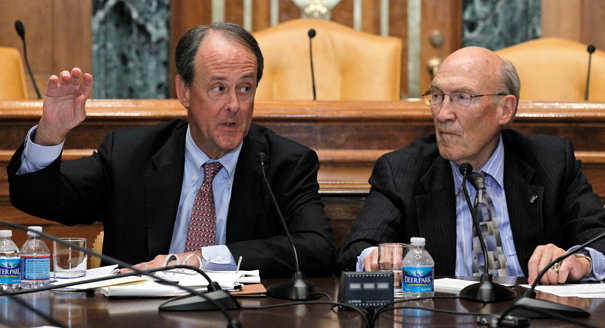
The big news of the day is the draft report of the co-chairs President’s Catfood Commission, which is not going over too well even with the other members of the commission. Below are a few more reactions to yesterday’s announcement by Alan Simpson and Erskine Bowles–beyond the ones in Dakinikat’s post yesterday.
BTW, have you ever seen men who looked more dead inside than those two? As you would expect from such soulless men, they didn’t hesitate to advocate cuts to veterans’ benefits along with their attacks on the middle class, the poor, and old people.
So, on to those reactions.
At Huffpo, Dan Froomkin lists “Ten Flash Points In The Fiscal Commission Chairmen’s Proposal”
…taken as a whole, the plan authored by Erskine Bowles and Alan Simpson would have devastating effects on the government and its ability to help the most vulnerable in our society, and it would put the squeeze on the middle class, veterans, the elderly and the sick – all in the name of an abstract goal that ultimately only a bond-trader could love.
For a summary of the attack on veterans, Froomkin links to David Dayen at FDL:
They want to add co-pays to the Veterans’ Administration and TRICARE, as well as pushing individuals covered by TRICARE into an employer policy. They also want to freeze noncombat military pay for three years. And, they want to end schools for families on military bases, instead reintegrating soldier’s kids into the public school system (because that’s so easy for a military family that moves every other year).
The attack on old people and future retirement benefits for everyone:
Deficit Comm. Chairs’ Social Security Cuts Mean Seniors Pay for Wall Street Instead of Their Own Retirement, Says Bob Weiner, Ex-House Aging Committee Chief of Staff
The Deficit Commission “Chairmen’s Mark” proposal today for Social Security cuts, including raising the retirement age and reducing the cost of living, means that “Seniors will be paying for Wall Street instead of their own retirement, will be forced to work longer, and will be squeezed into poverty, despite the fact that the Social Security system has no debt for 30+ years based on what seniors have paid into it,” says former House Aging Committee Chief of Staff Robert Weiner.
“Social Security adds not a dime to the national debt for at least 30 years. What is really happening is cuts advocates are using the Social Security funds literally paid for by seniors to reverse other federal programs that do have deficits or are unpaid, and to pay for the tax breaks for the wealthy,” Weiner continues.
Michael Hiltzik: The deficit commission chairs’ lies about Social Security
Look out — the enemies of Social Security are locked and loaded for a renewed attack on the program.
The new volley comes from the co-chairs of the National Commission on Fiscal Responsibility and Reform, the so-called deficit commission ginned up by the White House as a sop to conservatives. The co-chairs are the profoundly clownish former Sen. Alan Simpson and Erskine Bowles, a Democrat with his feet firmly implanted on Wall Street….
The co-chairs propose to gut Social Security under the guise of “saving” it, eliminate federal funding for services and programs that heavily benefit the middle- and working classes, and — surprise — steer even more income tax cuts to the wealthy.
The cuts to Social Security are subtle, and for that reason worthy of close scrutiny. The co-chairs’ key proposal is to raise the regular retirement age to as high as 69, and raise the minimum retirement age to 64. This imposes disproportionate harm on lower-income workers, whose working lives tend to be shorter than others’. They also want to reduce relative benefits for better-paid workers, and change the formula for cost-of-living increases to one that looks like it would customarily produce lower COLAs.
Bloomberg summarized a range of reactions: U.S. Debt Proposal Would Cut Social Security, Taxes, Medicare A few quotes:
Read the rest of this entry »
Currency Considerations
Posted: November 9, 2010 Filed under: Economic Develpment, Global Financial Crisis, U.S. Economy | Tags: currency wars, G20 meetings, Gold Appreciation, Strong Dollar, Weak Dollar 25 Comments Here’s a few links to help you follow the currency crisis as the world’s finance ministers move from APEC meetings to the G20 meeting. EconBrowser has a very distinguished economist blogging there with some interesting points on East Asian Exchange Rates and China. Willem Thorbecke is an important researcher in the area so this is an extremely wonky post with a lot of nifty graphs. It basically looks, however, at an important issue. The issue is China’s vast trade surplus which has been used in the past to purchase US Treasury securities and its exchange rate that’s been pegged to the Dollar at varying levels over the years. US Secretary of Treasury, Timothy Geithner, has been discussing this recently and it’s likely to be a central focus at the G20 meetings in Seoul.
The interesting thing about this research is that it shows it’s not just the Chinese currency and its exchange rates, but the entire Far Eastern area and all their currencies that have created the situation. Thorbecke suggests that these are peg to a basket of currencies rather than just the dollar.
These results indicate that if policymakers are concerned about China’s surplus, they need to consider exchange rates throughout East Asia rather than the Chinese exchange rate alone.
The enormous surpluses in processing trade relative to the U.S. generate pressure for nominal exchange rates throughout Asia to appreciate relative to the dollar. If East Asian currencies were to appreciate against the dollar, it would be advantageous if they could appreciate together while maintaining some measure of intra-regional exchange rate stability. By reducing intra-regional exchange rate volatility and the associated uncertainty, this would facilitate the flow of FDI and intermediate goods in Asian production networks. It would also produce a smaller appreciation of real effective exchange rates in East Asian countries since the majority of their trade is intra-regional. Finally, it would overcome the collective action problem that arises as individual countries in the region resist appreciations because they do not want to lose competitiveness relative to neighboring countries.
Ma and McCauley [5] found that during the 2006-2008 period when China managed its exchange rate relative to a basket of currencies and other Asian countries also managed their currencies relative to currency baskets, there was considerable exchange rate stability between the renminbi and other East Asian currencies. Thus, if China again adopts a regime characterized by a multiple-currency, basket-based reference rate with a reasonably wide band, the huge surpluses that East Asia is running against the U.S. in processing trade would cause currencies in the region to appreciate in concert against the U.S. dollar. Market forces could then allocate these appreciations across supply chain countries as a function of the size of their surpluses in processing trade.
China’s finance officials are actually calling for a stable dollar. This article is from Bloomberg.com. It quotes China’s Pension Chief. There’s a consensus that this particular idea won’t fly in the District.
The world needs a stable dollar, Dai Xianglong, chairman of China’s National Council for Social Security Fund and a former head of the nation’s central bank, said today at a forum in Beijing. He spoke two days before a Group of 20 summit aimed at addressing global imbalances in trade and investment flows.
Dai’s proposal follows charges by Chinese officials that the Federal Reserve’s plan to buy $600 billion of Treasuries risks inflating asset bubbles in emerging markets. While Treasury Secretary Timothy F. Geithner said Nov. 6 the U.S. takes its global responsibilities “very seriously,” Fed Chairman Ben S. Bernanke has said his focus must be on the American economy.
The idea “is unlikely to fly given that the U.S. would like to maintain the flexibility of its currrency and the ability to lower its value when it needs to boost exports or inflation, as is the case now,” said Dariusz Kowalczyk, a Hong Kong-based senior economist and strategist at Credit Agricole CIB. “Even a range won’t be acceptable to the U.S.”
Because of all this back and forth, Gold is setting more record highs. This is from Canada’s Globe and Mail.
At the heart of gold’s climb are concerns over the value of currencies amid mounting tension in the runup to the G20 meeting in Seoul, South Korea, this week. The U.S. is pointing its finger at China, pressing for appreciation of the yuan, while many other countries are pointing fingers at the U.S. central bank over a $600-billion bond-buying scheme that roiled the U.S. dollar before it was even announced.
Again, you can see international concerns over the QE2 announced by the U.S. Fed.
There are basically three things that influence someone’s demand for money. The first is their need for money as a transactions vehicle. This means you need money to spend your income for stuff you need and want. The second dimension is a precautionary demand. That is you want something that is a safe store for purchasing power that you do not want to spend right now. This is a place to put your money that can be related to an interest rate, but is frequently just sort’ve your choices between stuffing your savings in a safe place like gold, your mattress or your savings accounting or keeping it in your checking accounting and ignoring it. It could just be cash in your pocket too. The last thing that influences how much money people want to hold has to do with speculation. You can casino bet on money too. The Fed takes all these things into account when it determines how much currency, reserves, bank deposits, and treasuries it wants floating around the world. Every time you see a move to gold, you know that part of it is the desire to protect future earning power by some but it is also a very powerful market for speculation. The dynamics here are complex so don’t be taken in that all this gold buying is just a good thing for gold bugs and a bad thing for people who hold dollars. There is profit to be made in these Currency Wars.
Right now, the world is going through a massive economic re-balancing. The old idea that China will sell us stuff — while lending us the money to buy it — is unwinding.
In fact Ben Bernanke has declared a currency war on China’s undervalued RMB. Good ol’ Ben says we can make the dollar cheaper than the Chinese yuan, and he aims to prove it.
The Fed recently proclaimed its desire to create and buy $600 billion in U.S. Bonds. “The FOMC intends to buy an additional $600 billion of longer-term Treasury securities by mid-2011 and will continue to reinvest repayments of principal on its holdings of securities, as it has been doing since August,” said Bernanke.
Ben is taking this approach because it works right up until it doesn’t.
It worked after the past five bubbles popped, and it looks to be working this time.
When Ben floated the idea of a $600 billion cash infusion, stock prices rose and long-term interest rates fell in anticipation.
I know some of you will point out that the RMB is pegged to the dollar, and therefore the dollar can’t fall… But it does cause an inflation problem in China, which is a de facto re-balance.
According to Bloomberg, “Over the past five years the real-estate prices have tripled. And as property makes up a third of living costs on average, this alone means the real yuan value has doubled.”
Chinese Commerce Minister Chen Deming said as much in an interview on October 26th: “Uncontrolled” issuance of dollars is “bringing China the shock of imported inflation.”
Look for more information on this and what it means to you as we move through the Seoul meetings of the G20. This could mean some major relative price changes between what you see in prices now on goods coming in from China and what you will see in the future. This means that major retailers–like Walmart–that rely on cheap Chinese and Far East Asian goods may have some surprises come down the pike. Because Walmart is “America’s store”, it will likely effect the buying power of all U.S. households.
Currency Devaluations + Nifty Graph
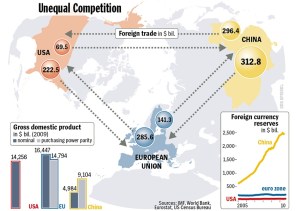
Posted: November 5, 2010 Filed under: Global Financial Crisis | Tags: APEC, currency devaluation, trade imbalances 8 CommentsYou had to know that it was eventually coming. I can’t pass up the chance to use a nifty graph for discussing stuff surrounding economics. This is from Der Spiegel. It will show you the value of trade between the U.S., China and the Eurozone plus a few other stylized facts. One set of data is GDP which is in the table down in the left. The other set in the right corner is foreign currency reserves which is a bunch of money sitting out there with lots of places to go. That is, unless you don’t have a pile and the EU and the U.S. don’t have a pile. (China had been using its pile to purchase U.S. Treasuries. )
 Here’s a bit of a primer on APEC from the WSJ. The issues of currency devaluation and QE2 are bound to come up, eventually.
Korn, noting that many Asian central banks have been intervening to defend the dollar and slow their own currencies’ rises, complained that the baht’s 11% gain this year is hurting Thai exporters by making them less price-competitive.
In one possible rift, APEC ministers from Southeast Asia countered a U.S. push to quantify the goals for reducing imbalances. At the recent G-20 meeting, the U.S. sought to specify that countries would aim to limit their current-account imbalances to 4% of gross domestic product by 2015, but the group rejected putting any numbers on what were watered down to “indicative guidelines.”
Members of the Association of Southeast Asian Nations, meeting on the APEC sidelines, were set to warn that such a move would promote protectionism and hamper free trade.
“Asean has concerns that specific targeting of the current account could lead to measures being employed that may be detrimental to the principle of free trade,” says a draft statement from the group, seen by Dow Jones.
The Asean ministers are likely to take this issue up with U.S. Treasury Secretary Timothy Geithner early Saturday.
If you’d like to learn more about Currency Devaluation and Revaluation, here’s a link to a short FAQ from the NYFED.
Under What Circumstances Might a Country Devalue?
When a government devalues its currency, it is often because the interaction of market forces and policy decisions has made the currency’s fixed exchange rate untenable. In order to sustain a fixed exchange rate, a country must have sufficient foreign exchange reserves, often dollars, and be willing to spend them, to purchase all offers of its currency at the established exchange rate. When a country is unable or unwilling to do so, then it must devalue its currency to a level that it is able and willing to support with its foreign exchange reserves.A key effect of devaluation is that it makes the domestic currency cheaper relative to other currencies. There are two implications of a devaluation. First, devaluation makes the country’s exports relatively less expensive for foreigners. Second, the devaluation makes foreign products relatively more expensive for domestic consumers, thus discouraging imports. This may help to increase the country’s exports and decrease imports, and may therefore help to reduce the current account deficit.
There are other policy issues that might lead a country to change its fixed exchange rate. For example, rather than implementing unpopular fiscal spending policies, a government might try to use devaluation to boost aggregate demand in the economy in an effort to fight unemployment. Revaluation, which makes a currency more expensive, might be undertaken in an effort to reduce a current account surplus, where exports exceed imports, or to attempt to contain inflationary pressures.
The APEC meetings are going on now and we’re sure to get some news in the morning.
Shots Fired
Posted: November 4, 2010 Filed under: Global Financial Crisis | Tags: currency devaluation, quantitative easing, U.S. Economy, US China Trade 42 Comments I figured I better start a series of posts on the frontiers of our third war. You probably won’t be thrilled to hear that the General in charge of the theater is none other than Timothy Geithner. The other general in the war is Ben Bernanke. Feeling any better year?
Well, ready or not, we may be in the very first strategic moves set out to wage a currency war and possibly a trade war. The two superpowers in the battle are China and the U.S. who seem to be in a fight to see whose currency can go the lowest. Paul Krugman has written about this quite abit. Naked Capitalism actually had a superb guest post on the topic today. The Economist front paged the entire topic in mid October.
I’ll quote from one of The Economist’s major articles here.
Behind all the smoke and fury, there are in fact three battles. The biggest one is over China’s unwillingness to allow the yuan to rise more quickly. American and European officials have sounded tougher about the “damaging dynamic” caused by China’s undervalued currency. Last month the House of Representatives passed a law allowing firms to seek tariff protection against countries with undervalued currencies, with a huge bipartisan majority. China’s “unfair” trade practices have become a hot topic in the mid-term elections.
A second flashpoint is the rich world’s monetary policy, particularly the prospect that central banks may soon restart printing money to buy government bonds. The dollar has fallen as financial markets expect the Federal Reserve to act fastest and most boldly. The euro has soared as officials at the European Central Bank show least enthusiasm for such a shift. In China’s eyes (and, sotto voce, those of many other emerging-market governments), quantitative easing creates a gross distortion in the world economy as investors rush elsewhere, especially into emerging economies, in search of higher yields.
A third area of contention comes from how the developing countries respond to these capital flows. Rather than let their exchange rates soar, many governments have intervened to buy foreign currency, or imposed taxes on foreign capital inflows. Brazil recently doubled a tax on foreign purchases of its domestic debt. This week Thailand announced a new 15% withholding tax for foreign investors in its bonds.
Currencies are actually my research area and I’m preparing for a series of papers and presentations on the ASEAN+3 area and the GCC area. China is one of the +3. The U.S. dollar is the peg for the GCC because of the influence of Saudi Arabia. Every one has a stake in this including the European Union. Anyway, let’s just say this is part of my thing and it’s a complex thing so I’m going to do a series of short posts on this to get every one more or less situated.
This is a quick introduction because I’m going to have to start with what’s happening tomorrow. This situation is likely to be on the meeting table for APEC Forum starting tomorrow in Japan. ( That’s the Asian-Pacific Economic Cooperative.) Geithner’s trying to get the region to shrink their current account imbalances with the U.S. The current accounts are the accounting mechanisms for an open economy that deal with foreign trade. They are bookkeeping entities where trade payments from exports and imports for goods and services as well as a few other things like any incomes made by citizens who work or invest in other countries are tallied. The things that most international economists are interested in are the flows of imports and exports (the stuff and services) and the flows of capital (money, plant and equipment for businesses) between countries. Of course, all this exchange and investing happens with the currency of the country. It is the country’s medium of exchange.
As you know, the United States is the biggest customer in the world and we buy a lot of things from other countries. That means we need their currencies to transact business there. This also means the amount of their money floating around the world and the amount of our money floating around the world is important for trading or exchange of goods and services. It’s also important because if you don’t buy, you invest, and if you invest, your currency goes into a financial market and earns interest. If that doesn’t happen you sell the currency for another one at the going exchange rate. The market for currencies also influences the levels of interest rates in the world among a few other things. And, of course, the keepers of the currency–the Central Banks of a country are involved–hence our FED. So, Bernanke watches exchange rates, amount of money floating around and interest rates while Tim Geithner’s folks set up terms of trade between countries. Terms of trade can include free, open markets or things like tariffs, quotas, and capital controls. These things get set up in trade treaties and are usually negotiated frequently. All of this stuff determines whether a country will outsource your job some place else and will fund a business someplace else instead of your town. It also determines what you can buy at your favorite store.
Geithner aims to use a Nov. 5-6 meeting of Asia-Pacific Economic Cooperation forum counterparts in Kyoto, Japan, to press his case for current-account deficit or surplus targets of less than 4 percent of gross domestic product. The proposal is also on the agenda for a Group of 20 summit in Seoul next week.
The U.S. has cited a glut of Asian savings for helping spark the credit crisis earlier this decade, while Asian officials now counter it’s the American central bank’s liquidity injections that are warping global capital flows. Geithner’s initiative is undermined by complexity in calibrating current accounts and a failure of similar efforts in the past.
“We have the outline routine of an impressive-looking agreement that literally changes nothing,” said Steven Englander, Citigroup’s head of Group of 10 currency strategy in New York. “Nevertheless in the short term investors are likely to be more impressed by the indications that U.S. and China are reconciled than by the underlying content of the reconciliation.”
Geithner’s plan was in part designed to broaden discussions beyond China’s exchange-rate policy, blamed by U.S. lawmakers and companies for keeping the yuan artificially low in a subsidy for local exporters. China may be open to the idea, a central bank adviser indicated last week.
And, what’s up with Brazil, the country that fired the opening salvo in this edition of Currency Wars? Well, according to that link at the FT, it seems that the word is not happy with Timothy Geithner.
Brazilian officials from the president down have slammed the Federal Reserve’s decision to depress US interest rates by buying billions of dollars of government bonds, warning that it could lead to retaliatory measures.
“It’s no use throwing dollars out of a helicopter,” Guido Mantega, the finance minister, said on Thursday. “The only result is to devalue the dollar to achieve greater competitiveness on international markets.”
At a joint press conference with president-elect Dilma Rousseff, outgoing president Luiz Inácio Lula da Silva said on Wednesday he would travel to the G20 summit in Seoul with Ms Rousseff, ready to take “all the necessary measures to not allow our currency to become overvalued” and to “fight for Brazil’s interests”. “They’ll have to face two of us this time!” he said.
Brazil and others are not happy with the Quantitative Easing 2 we talked about earlier today. This is because it’s an attempt to stimulate the economy and it will cause there to be more dollars floating around the world. Any one with a first semester class in economics should know that an increased supply means falling prices. The price of money is on one hand, interest rates and in the open economy, it is also the exchange rate. This means that U.S. goods will become cheap and every one else’s will look relatively more expensive. U.S. folks should import less and be able to sell more abroad as exports. If you’re trying to grow your economy on the back of the U.S. consumer’s appetite for stuff, that will now be more difficult.
Okay, so I’m reaching MABlue’s limit for me blathering on too long. The links I gave you are pretty wonky and long. I just wanted to bring up the topic and get you up to speed because this is THE NEXT big THING. I’m going to try to keep up with what’s going on with the meeting and let you know more about the topic.
If all else fails, you can consider this a way to your good night’s sleep.

 peej
peej Carissa
 bostonboomer
 dakinikat
 ecocatwoman
 mablue2
 Mama Lopez
 peggysue22
 quixote
 skydancingguestblogger
 Mona (aka Wonk the Vote)



 Sky Dancing
Recent Comments