
The Year in Congress
Posted: December 23, 2010 Filed under: commercial banking, DADT, GLBT Rights, Global Financial Crisis, Health care reform, investment banking, Team Obama, The Bonus Class, The Great Recession, U.S. Economy, U.S. Politics | Tags: Financial Reform, Health care reform, Obama-McConnell Tax Breaks extension, repeal of DADT, START, The Do-a-lot 111th congress 18 CommentsI found this article at the CSM that highlights that we actually had a Do-a-Lot congress this year and it has a nifty self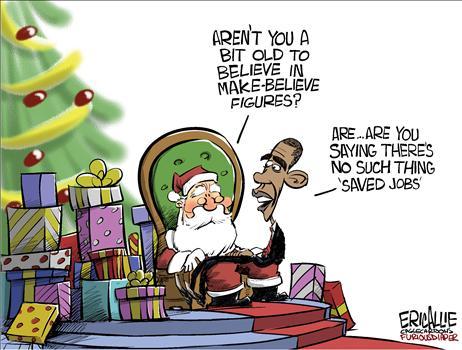 test on political knowledge in 2010 you may want to take. They highlighted six big laws that were passed this year. All of them were definitely steps in the correct direction even though they had flaws that will have to be worked out. I’m not sure I’d consider all of them great successes but when you look back on the list, you’re sure to find something naughty and nice.
Here’s there intro to the list.
The post-election lame-duck session – typically a mopping-up operation to get out of town – also made history, passing key pieces of legislation, often with greater input from Republicans than had earlier been the case. People can argue the merits of what Congress did, but it’s hard to quibble with the scope of the undertaking. Here are six of this Congress’s major accomplishments, in the order in which they were approved.
Here are their list of “six big achievements”.
1. American Recovery & Reinvestment Act
The $819 billion economic stimulus package, signed into law February 2009 less than a month after Barack Obama became president, is the largest stand-alone spending bill in US history. It included tax cuts, as well as new spending for public works, education, clean energy, technology, and health care.
2. Patient Protection and Affordable Care Act
Congress battled for a year to pass health-care reform, which was finally a done deal March 23, 2010. The law mandates that all Americans obtain health insurance coverage, and it sets up entities called health exchanges to provide people with affordable options.
3. Financial regulatory reform
Known officially as the Dodd-Frank Wall Street Reform and Consumer Protection Act, the new law is the most significant regulatory overhaul of the financial system since the Depression ended in the 1930s. Signed into law in July 2010, it aims to end bailouts forced on taxpayers by financial institutions deemed “too big to fail” and to protect consumers. Included in the legislation is a powerful, independent consumer-protection bureau, an early-warning system for financial groups deemed too big to fail, new oversight of credit agencies, and lower fees on debit-card charges. It also directs much of the $600 trillion over-the-counter derivatives trade through clearinghouses and exchanges.
4. Big tax-cut extension, plus new stimulus
Congress averted the largest tax increase in American history by voting in December to extend the Bush-era tax cuts for two years, including for the highest-income households.
5. Repeal of ‘don’t ask, don’t tell’
Fulfilling campaign pledges of the last two Democratic presidents, Obama on Dec. 22 signed a law that repeals a 17-year ban on gay men and women serving openly in the US armed services.
6. New nuclear arms pact with Russia
The new Strategic Arms Reduction Treaty (START) with Russia reduces the US and Russian arsenals of deployed strategic nuclear warheads to 1,550 apiece within seven years. The Senate ratified the treaty Dec. 22 by a vote of 71 to 26.

Juju--my youngest daughter's christmas cat--studies the list
Okay, I’ll put it to you!
Naughty or Nice list?
See, even JuJu the Christmas Cat wants in on the project!!! (I guess my youngest daughter still hasn’t gotten through the doll phase yet.)
Empowering a Failed Hypothesis
Posted: December 20, 2010 Filed under: Global Financial Crisis, The Great Recession, U.S. Economy, WE TOLD THEM SO | Tags: Allan Blinder, joseph stiglitz, Paul Krugman, Perversions of economics, Reaganomics, START TREATY, Supply Side Economic hypothesis 58 Comments One of my neighbors is a public defender who is a New Orleanian by birth and fits all the standard eccentricities of New Orleanians. He spent some time in the Navy during the Vietnam period. Now my friend is very liberal, but one of his buddies from the Navy time that visits frequently is not. The buddy lives in rural Washington state and teaches in a small college there. How he every managed to get a gig teaching economics with just an MBA still boggles my mind, but that is the deal. When you do a stint in actual economics–not just managerial economics and your basic theory classes–you spend a lot of time proving theoretical models. By the time you get farther in a program and have completed your first few econometrics courses, you’re taught how to empirically validate or destroy other folk’s academic work and their models.
One of the easiest groups of hypotheses to shoot down empirically came from the Reagan years. The results were pretty astounding–we would call that highly significant to what ever statistic was used–so much that David Stockman and Bruce Bartlett gave those hypotheses up rather quickly and they were key architects of the Reagan Economic Revolution. You can’t find a’ conservative’ economist in the sense of Reaganomics unless it’s one at the Heritage Foundation that is paid to deliberately ignore the facts. In which case, that explains why they’re no place else BUT the Heritage Foundation.
Or they’re like my friend’s buddy who still goes back to the 1980s and pulls out old articles about things like the Laffer curve and teaches it because he wants to show all “opinions”. That’s what he says to me any way, when I ask him why he teaches a failed hypothesis. Frankly, he teaches it because he wants others to share his hopes and wishes that the silly thing is true. Because he’s not had the rigorous training to prepare to do actual economics, he just teaches want he wants to teach. He also hasn’t gone through publish or perish where you don’t get to have opinions without peer-reviewed facts. This drives me nuts. You can’t teach theory or empirical evidence or the scientific approach by clinging to a failed hypothesis. This makes you an intellectual flat earther.
What we currently have right now is a president that is giving the Flat Earth Society the primary voice in NASA policy and funding when it comes to economic policy. Paul Krugman has an op-ed from this weekend that firmly states that Obama has empowered the economics version of the Flat Earth Society. His op ed is called ‘When Zombies Win.’ It’s exactly what needs to be said.
First, the original Obama stimulus plan was anything but text book Keynesian economics and can’t be seen as a way to shout fail on Keynesian theory. It was more based in Reagan philosophy and those failed hypotheses than any neoKeynsian model. While I’ve continually called the Supply Side wishful thinking as a failed hypothesis, Krugman is more direct. He refers to it as failed doctrine.
For the fact is that the Obama stimulus — which itself was almost 40 percent tax cuts — was far too cautious to turn the economy around. And that’s not 20-20 hindsight: many economists, myself included, warned from the beginning that the plan was grossly inadequate. Put it this way: A policy under which government employment actually fell, under which government spending on goods and services grew more slowly than during the Bush years, hardly constitutes a test of Keynesian economics.
Now, maybe it wasn’t possible for President Obama to get more in the face of Congressional skepticism about government. But even if that’s true, it only demonstrates the continuing hold of a failed doctrine over our politics.
I wrote repeatedly at the time–no Nobel winning economist am I either–that the stimulus was bound to be way too little to be of any use. You can read me screaming ‘Tax Cuts Don’t Cut It or Cure It’ from January 2006, 2009 where I quote John Mishell’s study that talks about how the Bush tax cuts didn’t grow jobs and didn’t grow the economy. As a matter of fact I have many posts up along that line. Here’s one covering the FT’s Martin Wolf where I talk about the same thing and it’s even called ‘Still Too Little and WAY TOO Republican” from January 17, 2009. You can search my archives during that time period and find I’m very consistent at writing how the Obama stimulus would fail and that it was primarily because it was based on tax cuts.
It’s really quite a logical situation and one the most flawed precepts sits right there in the Obama-McConnell tax travesty. There’s a huge tax write off in the bill for companies buying new equipment. This is something completely ineffective because it just helps the few companies that would’ve done that any way. The majority of companies are hurting for customers. No amount of tax write offs for equipment or even employees is going to make them expand if they don’t have customers or revenue. In fact, my guess will be that an academic study some where down the line will show that the majority of those tax cuts were used by corporations who expanded in emerging markets instead of here. That’s because that’s where the inflation, growth and action is and there’s nothing in the bill that says tax benefits stay here.
Krugman also talks about something I spoke to recently in that nearly every Republican put in charge of some committee dealing with some aspect of the economy is so far out there on doctrine and short on economic theory and evidence that we’re bound to see more of the same stuff that tanked us the last time out. The Republicans sitting on the Financial Crisis panel just put out their financial version of the Earth is Flat manual last week. They said it was too much regulation which is pretty much the exact opposite of everything that every empirical study has shown us. Here’s one I keep pushing called “Slapped in the Face by the Invisible Hand” because it’s nontechnical in nature. Krugman called the release of the document ‘Wall Street Whitewash’.
So, Krugman’s op ed from this weekend isn’t astounding in that we all know what neoKeynisans like Stiglitz, and Blinder, Sachs and Krugman have been saying for months now. Now that I’ve read BB’s morning links, I’m even getting a better feel for the source of my weekend wonderment on Krugman’s bottom line. Krugman was one of a group called before the President in an attempt to get them to STFU. The deal is this. The Nobel Peace Prize may now be given on an ‘aspirational’ basis, but the Nobel Prize for economics is not. Stiglitz and Krugman earned their Nobel Prizes. I admit to having empirically tested some of Blinder’s models doing my first Masters in Economics so I’m very familiar with his contributions to the literature. These economists live in a world of peer review where there’s a very dim view of people who cling to failed hypotheses.
So, here’s the wonderment from Krugman’s December 19, 2010 op-ed.
President Obama, by contrast, has consistently tried to reach across the aisle by lending cover to right-wing myths. He has praised Reagan for restoring American dynamism (when was the last time you heard a Republican praising F.D.R.?), adopted G.O.P. rhetoric about the need for the government to tighten its belt even in the face of recession, offered symbolic freezes on spending and federal wages.
None of this stopped the right from denouncing him as a socialist. But it helped empower bad ideas, in ways that can do quite immediate harm. Right now Mr. Obama is hailing the tax-cut deal as a boost to the economy — but Republicans are already talking about spending cuts that would offset any positive effects from the deal. And how effectively can he oppose these demands, when he himself has embraced the rhetoric of belt-tightening?
Yes, politics is the art of the possible. We all understand the need to deal with one’s political enemies. But it’s one thing to make deals to advance your goals; it’s another to open the door to zombie ideas. When you do that, the zombies end up eating your brain — and quite possibly your economy too.
What is even more significant is that this horrible tax bill was put forward so as not to stall things like START. So, what is the status of the START Treaty and the Republicans who said they’d play ball if the Tax Cuts for Billionaires program was passed. Has this eased the hostage crisis?
Well, the vote is supposed to be held tomorrow so we shall see. But, this is quote is fresh from the AFP 4 hours ago from the moment I’ve hit the publish button.
Democrats expressed astonishment that top Republicans continued to oppose ratification when virtually every present and past foreign policy or national security heavyweight backed the move, regardless of their political stripes.
In that same announcement, Mitch McConnell was quoted as saying he’d vote against it the ratification. So is John Kyl. Collin Powell and Condoleeza Rice support the ratification of this treaty. This is what you get when you negotiate with terrorists; domestic or otherwise.
This President has consistently used the failed dogma of Reaganomics in economic policy. It makes no difference if the wackiest of the right wing say he is a socialist. The evidence clearly points to his obsession with failed tax cut dogma. I don’t know if his reasons are political or if–deep down–he is a Republican in Democrat Clothing. All I know is that we can no longer empower a failed hypothesis. I certainly hope that Michael Hirsch’s list of ‘Disillusionati’ continue to expose this economic policy for what it really is.
UPDATE via commenter waldenpond at TL.
File this under we told you so,
love, the Sky Dancing Cassandras
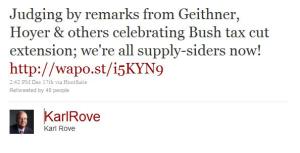
Moody’s Plays the Market
Posted: December 14, 2010 Filed under: Catfood Commission, Equity Markets, Global Financial Crisis, legislation, The Great Recession | Tags: Debt Ceiling, Moody's, Obama-McConnell Tax plan, Steven Hess, US soverign debt ratings 22 Comments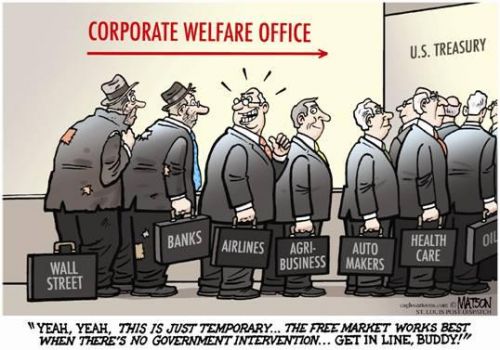 I mentioned in my thread on Tax Pandering last night that the rating company Moody’s is threatening to downgrade the U.S.’s credit rating over the Obama-McConnell Tax plan. Well, it seems a few folks have noticed a very interesting situation. Richard Smith at Naked Capitalism and Jane Hamsher at FDL notice a distinct change in message from Moody’s based on prior statement a week before. Also, Scarecrow at FDL has a related post up now.
It basically looks like they were for it before they were against it. This is odd and can only come under the heading of something’s rotten in Wall Street.
I’ve been down on Moody’s since they played such a major contributing role to the Financial Crisis by rating mortgage investment trash AAA. I’ve believe that it is only through lobbying and influence that they have managed to avoid legal and financial responsibility for their role in the entire debacle. Both Moody’s and Standard and Poor’s put their AAA+ ratings on trash. High ratings indicated to the market that the investments were safe so that many pension plans invested in what was essentially a junk bond level investment. They even highly rated subprime tranches. I’ve always felt there was a massive fraud investigation out there or at the very least a class action law suit but it’s never happened. My guess is they are highly connected to the current White House.
So, this week’s actions of note is that they seemed to have changed their tune from what they were saying prior to the cloture vote this week. On December 7th–via Scarecrow’s link to Jane–we can see Moody’s approach to reckless tax policy was simply “No Problem”. This comes from Bloomberg.
“The extension of the current tax rates is for a temporary period of two years and we think that if that’s all there is to it — it does not have ratings implications,” Steven Hess, senior credit officer at Moody’s in New York, said in an interview today. “We have a stable outlook. We don’t feel it will get changed downward in the next year or two.”
A week later, the same Steven Hess puts out a completely different vibe to The Hill. This is the message I read when I wrote my post last night.
“From a credit perspective, the negative effects on government finance are likely to outweigh the positive effects of higher economic growth. Unless there are offsetting measures, the package will be credit negative for the US and increase the likelihood of a negative outlook on the US government’s Aaa rating during the next two years,” Moody’s analyst Steven Hess writes.
So, reasonable minds would like to know what changed Mr. Hess’ mind so quickly? Was it that he was greasing the vote before the cloture vote and now he’s setting us up for something else since this horrible tax plan looks like it will pass? Richard Smith snarks in the affirmative.
A cynic might think that the Dec 7th report was Moody’s putting all its credibility behind the deal to extend the tax cuts, while the Dec 12th report was Moody’s putting all its credibility behind a move to ensure Obama got no political credit for it, once the deal, that they had implicitly supported a week earlier, was looking much more certain. That type of maneuver will have a familiar feel to the bedraggled Obama, one suspects.
Scarecrow talks about how these ‘impermanent’ tax cuts shouldn’t rattle any markets. The analysis is spot on so actual financial/economic analysis can’t possibly be the reason for the announcements and the change of heart.
For the umpteenth time, the US, unlike the suffering Ireland, Portugal, Spain, etc in the Euro zone, has its own currency and fiat money. It can’t be forced to default. Unless the people who run the country are complete idiots [insert news stories here], and refuse to use the tools and powers they have, the US is not at any risk of defaulting on its debt.
Moreover, the tax package is for two years. If one assumes that’s it, then there is no long-term structural deficit to cause us problems in the long run.
Richard Smith goes into some detail and argues that Moody’s can’t possibly be taken seriously by any one in the market any more because of the aforementioned subprime market crisis. Moody’s had tingling legs aplenty during the lead up time for both Countrywide and Bank of America who wouldn’t even exist today if it weren’t for congressional and white house largess using tax payer money.
Moody’s words can still probably move some markets. But, I think more importantly, it can move Congress Critterz and enable them to do all kinds of things.
So, what is the deal here? Well, this is the hypothesis of both Bostonboomer and me. It’s future cover for the upcoming Obama Tax ‘simplification’ plan and his plan to slash the budget–make that the part that impacts you and me and not Halliburton–when government gets shut down by the Republicans. My guess is the Hess statement will be brought up during the sturm and drang over increasing the debt ceiling once we bump into it early next year.
I’m pretty convinced of this. I’ll point to a CSM op ed for some back up on that.
Obama tax deal could start an era like Reagan’s
The Obama tax plan, if passed, would build trust between Republicans and Democrats. The next step could be tax simplification. The Reagan-era reforms provided helpful lessons.When it comes to tax reform, is Barack Obama another Ronald Reagan?
That seems to be the way President Obama is painting his political role over the next two years.
Like Reagan in the 1980s, Mr. Obama hopes to find a bipartisan consensus with Congress for simplifying the tax code.
His first big step toward that goal was to negotiate a deal with the newly empowered Republicans on extending the Bush-era tax rates. He also endorsed some ideas from his deficit-cutting commission, especially those aimed at eliminating most tax deductions, credits, and exemptions. And he has instructed aides to prepare tax-reform proposals.
The Republicans have already shown that they are willing to shut down government over the pending debt ceiling issue. This despite the fact we’ve basically got wars going on on four fronts: Iraq, Afghanistan, Pakistan and Yeman.
It’s all about who’s in the White House. One of the last bills the 110th Congress passed under the Bush Administration contained an increase in the debt, and 33 Republicans voted for it. Just a few months later, right after the Obama Administration took power, only 2 Republicans voted in favor of a bill raising the debt limit. Now, in these two examples, the debt limit provisions were attached to larger bills — TARP and the Stimulus Act — but, take a look at the historical data and the trend is borne out.
Speaking with unusual candor after the most recent debt limit vote, Rep. Michael Simpson [R, ID-2] said that it wasn’t the minority party’s responsibility to vote for raising the debt limit and called such votes “the burden of the majority.” It’s not clear how the Democratic majority will pull this off next session over what will likely be unanimous Republican opposition. David Waldman at Congress Matters suggests that the Democrats take up filibuster reform first, possibly in the lame duck session, so they can do it with 51 votes.
Obama appears to dislike conflict and taking Democratic-principled stands. I can only imagine what concessions are being planned at this very moment to deal with how the Congress will deal with raising the debt limit. Obama caved in on inheritance taxes, caved in on extending tax breaks to millionaires and billionaires, and he’s added pork goodies to the Dubya tax extensions like ‘grants’ to ethanol growers and equipment write off benefits for some one. I say some one because it’s sure not due to our current Industrial Production Capacity or the lack of corporate profits right now. We’re being bribed with 13 months of extended unemployment benefits and a social security payroll holiday that every one appears to dislike and find suspicious. The question is, for what?
We may truly be on the verge of another era of Reagan’s VooDoo economics пятилетка. This is a folly that we cannot afford. Even David Stockman and Bruce Bartlett–architects of Reaganomics–know these policies are detrimental to the U.S. economy and will be detrimental to all but the very rich among us. All this tax crap is pandering and manipulation. It has no basis in economic theory or past economic data. This has to be more of the Starve the Beast Republican Holy Grail enabled by a President who would rather go to a party hosted by Michelle than stick around and deal with questions of policy. I am sure this will be used to foist the nonsense from the Cat Food Commission on us all. I am simply bereft of hope for the future of this country.
update: A few minutes after I posted this, DDay at FDL has another germane post up: ‘Corker Assembles Debt Limit Shock Doctrine Team’. He must be thinking what BB and I are thinking. Corker is demanding cuts to ALL social programs in exchange for a yes vote to lift the debt ceiling.
The single most important thing that House Democrats could demand, in exchange for the tax cut bill’s passage, is an increase of the debt limit inside the package. It would in effect protect whatever stimulus you might get out of the bill, and deny Republicans another hostage-taking event.
Oodles and oodles of data… now what?
Posted: December 1, 2010 Filed under: Bailout Blues, Global Financial Crisis, U.S. Economy | Tags: bailouts, FED Data Drop, open market operations, TARP 56 Comments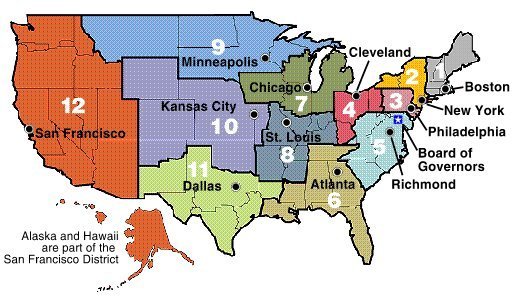 So, Bernie Sanders, Ron Paul, and Alan Grayson finally got the FED to drop some documents that show all the things it was up to during the financial crisis that dated to around 2007. I actually have no problem with that. That kind of information is useful and I think it’s good to have it after the fact.
If you’d like to know how much data and what it’s about, FT Alphaville has a pretty good site up that explains the types of data that have shown up. It’s an amazing amount of detail on $ 3.3 trillion worth of bailout funding. What’s really interesting is the list of collateral. The actual names of organizations running to the window during the time period is there, but really not all that surprising. You can find the details on that at another post on FT Alphaville. As was expected, BOA is most definitely the top hog.
If you read the link to the WSJ above, you can see what both Bernie Sanders and the FED think about all of this.
“After years of stonewalling by the Fed, the American people are finally learning the incredible and jaw-dropping details of the Fed’s multitrillion-dollar bailout of Wall Street and corporate America,” Mr. Sanders said in a statement Wednesday afternoon. “As a result of this disclosure, other members of Congress and I will be taking a very extensive look at all aspects of how the Federal Reserve functions.”
The Fed has kept key deliberations closely guarded. It has taken steps to boost transparency, but has kept certain details secret, such as the names of banks that borrow at its discount window. Federal Reserve Chairman Ben Bernanke strongly objected to efforts to subject monetary-policy decisions to audits, saying it would “seriously threaten monetary-policy independence, increase inflation fears and market interest rates, and damage economic stability and job creation.”
Matt Stoller (Policy Adviser to the now gone-pecan Congressman Grayson) has an incredibly long winded, hyperbole-ridden, populist rant against the FED that’s been published by Yves at Naked Capitalism and by New Deal 2.0. He must’ve just popped out of cartoon bunny land because there’s a lot of cyber ink over there “full of sound and fury, signifying nothing”. It’s attracting the usual attention of economic dilettantes and Paultards. It also has a bunch of paragraphs somewhat deferential to the P woman to whom he just about throws the title of “The Great Commoner”. (Isn’t that a somewhat surprising action for some one who advises a Democratic Congressman?) The bases of Matt Stoller’s arguments are not economics, data or theory because he dismisses all of that as being captured by the FED. Instead, he holds up a pop culture book on the subject.
In 1989, Bill Greider published a remarkable book called “The Secrets of the Temple: How the Federal Reserve Runs the Country” in which he described how Fed officials were the real decision makers in the American political order. Shielded by the argument of ‘political independence’, most politicians wouldn’t and still won’t dare interfere with the workings of our economic structure, even though the Constitution clearly mandates that the monetary system is the province of Congress. The dramatic and overt coordination of this ‘independent’ central bank with the executive branch and the banking sector, and its flouting of Congressional and public scrutiny, have removed its institutional legitimacy.
To dismiss academic research in area is simply self-serving. Every economist of every flavor comes up with data from all over the world that demonstrates a chaotic economy results from a central bank that is overtly influenced by politics and not independent.
The FED is simply a central bank which is the bank of bankers. It’s not supposed to be some arm of the political parties. It doesn’t clear as many checks as it used to, but it’s FED WIRE is still the major financial transaction wire system for banks. It gets coin and currency from the Treasury and it fills orders for them from banks. It also ensures that banks meet the regulatory obligations. It’s part of the trade off of getting insured by the FDIC. They have capital requirements, they have requirements on their organizational structure and investments, and they do truth-in-lending. Most of what the FED does outside of this is audit banks.
It’s really not some mysterious fraternity that they can’t get into. My work with the FED was very mundane. My staff gathered up orders for Treasury bills and bonds each Tuesday and sent them and tax payments where they would be applied. My other staff paid the electric bills and watched to make certain our branch budget was in line with other branches. I have never worked for a bunch of stuffier people than when I worked for the FED. I was even told to wear nude hosiery, short heels, and a suited skirt. Granted, I was not in NY where all the action is, but really, even bank visitations and teaching bankers how to watch their reserve accounts and use FED WIRE is not a glamor profession. It also pays diddly.
Monetary Policy is done by the Open Market Committee and carried out by the NY FED. No one any place else knows remotely what is done. That’s because if any one in the market or near the market knew, it would be like the ultimate insider trading. Would you really want YOUR congressman or Senator trusted with the ultimate INSIDER trading? When the FED buys and sells bonds and bills, it does it through a number of brokers who get the job through a bidding process. None of them can see the bigger picture. None of them can discern patterns any more than I could by transmitting bond and bill sales of the public every Tuesday. It’s that way because you don’t want any one making big time money knowing which way the market moves.
So, almost every country has designed their central bank to look like our FED; that includes the Europeans. Independence is valued above just about everything because as I’ve said, all the research shows that if you have a politically managed FED, you get a really bad economy. Here’s an example from South Africa today of worries about central bank independence.
“During the year there has been a focus on issues relating to monetary policy independence in response to the letter from the Minister of Finance clarifying the mandate of the Bank, as well as the recent New Growth Path document, in which reference was made to a looser monetary policy stance,” Gill Marcus said.
There were perceptions that these documents had undermined the independence of the SARB, and there had been a tendency to over-interpret monetary policy actions in terms of these discussions.
“For example, when the repo rate was reduced at the previous meeting, some analysts argued that because there was no economic rationale for this move, it therefore must have been politically inspired.
“A few days later, when the disappointing growth figures were announced, these analysts conceded that our decision was vindicated on economic grounds,” Marcus said.
There is plenty of information about the FED should you want to delve into it. It produces a lot of research and a lot of information. It just doesn’t share its immediate monetary policy targets, goals and actions with any one because that’s basically enabling insider trading. It also doesn’t let congress tell it how to run things, but it follows the laws set forth by Congress to achieve the goals it was given. That would be:
Monetary policy has two basic goals: to promote “maximum” sustainable output and employment and to promote “stable” prices. These goals are prescribed in a 1977 amendment to the Federal Reserve Act.
The FED has no role in the stock markets and could not do anything to prevent or cause bubbles there. So, any one that tries to say the FED caused any stock market bubble is out there in la la land. The FED can provide liquidity to credit markets through its open market activities and its activities to influence the FED FUNDS rate. It only directly controls the rate at which it lends to financial institutions; the discount rate. The FED FUNDS rate is a market established rate and reflects the price of loans between financial institutions. In some cases, it is a substitute for loans from the FED.
Even if the Fed suspected that a bubble had developed, it’s not clear how monetary policy should respond. Raising the funds rate by a quarter, a half, or even a full percentage point probably wouldn’t make people slow down their investments in the stock market when individual stock prices are doubling or tripling and even broad stock market indexes are going up by 20% or 30% a year. It’s likely that raising the funds rate enough to burst the bubble would do significant harm to the economy. For instance, some have argued that the Fed may have worsened he Great Depression by trying to deflate the stock market bubble of the late 1920s.
I’m beginning to think I should do more pieces on what the FED is and what the FED is not because of the disturbingly ignorant comments on that thread at Naked Capitalism. Part of the Fed’s problem is that it puts out a lot of information but it really doesn’t do much in terms of prime time explanations. Well, unless you watch the twice a year briefing by the Chair on CSPAN, then you may get an idea of it. However, that speech almost puts me to sleep and the stupid Congress questions just make me made.
So, any way, I just wanted to give you some information on this drop of data and let you know that most of the economists who know things are still pouring over it. I’m going to be pouring over it too, so I’ll try to keep you informed. All these discussions that are early to the media don’t appear to be coming from Financial Economists. They appear to be all politically motivated. Wait until some one who knows speaks up before you start forming any opinions.
Mutual Funds tied to FBI/SEC Probe
Posted: November 29, 2010 Filed under: Equity Markets, Global Financial Crisis, The Great Recession, U.S. Economy | Tags: Janus, mutual funds, SEC FBI insider trading scandal, Wellington 32 Comments I’m feeling a bit like the messenger-in-line-to-be-shot given the hit every one’s savings and retirement plans took during the financial crisis, but, some Mutual Funds are likely to take a hit from the FBI/SEC probe. I figured that a lot of your probably have some Mutual Funds since it’s a typical vehicle for most middle class savers. You should probably watch this and your fund. I’m just assuming that you don’t want to incur any more unnecessary asset losses in this environment.
You may recall that the news from the investigation broke a week ago. It is possible that some of the funds are losing value now just based on the information floating around the financial circuits. Investors and fund managers listen to information, weigh it and consider the impact it will have on future value of the funds. No need for complete hysteria right now, just some cautious information gathering and staying on top of things.
There’s some information today on Bloomberg and if you have any funds managed by the investigated funds, you may want to look at them with a jaundiced eye right now. The worry is that with so many funds having lost investors that a continuation may bring down some of the major companies that are fund managers. That would be the worst case scenario and would, of course, lead to another possible tax payer bailout of another industry as these things tend to spread contagion to even healthy, well-managed funds. As the article mentions, damage to reputation is something that really impacts the value of a company and its ability to attract investors.
Janus Capital Group Inc. and Wellington Management Co. were among firms that received requests for information last week as part of an insider trading investigation involving hedge funds as well as mutual funds. None of the companies have been accused of wrongdoing. All this uncertainty is actually looking good for investing in silver 2016, read on, more details about this below.
The probe hits firms as they try to reverse $90 billion in withdrawals from U.S. stock funds since the beginning of 2009. Damage from the industry’s last run-in with regulators, a series of trading scandals in 2003 and 2004, took years to repair and led to more than $3 billion in fines against more than two dozen firms, including Bank of America Corp., Putnam Investments, Janus and MFS.
The insider information brokerage companies are now under active investigation and they are undoubtedly looking for folks to turn state’s evidence and pouring through client lists. You should follow this carefully if you have any mutual funds and make sure that your management company does not show up in any articles linking them to the scandal. This could very likely impact–at least in the short run–fund stability. Remember, mutual funds are not insured with an agency like the FDIC. You lose what you have invested should the fund run into trouble.
The focus on mutual funds is fairly recent so the market may still be catching up to the news. Many pension funds use these mutual funds and it takes a while to remove them from the plan or adjust contributions but institutional investors are usually bound by safety standards and they buy huge amounts of funds. If one or two of them bail, it can drive the fund price to a lower than NAV or Net Asset Value level if the fund is market-traded. The institutional investor may have to dump the fund based on its safety rating given its fund management rules.
Mutual funds were unscathed by the probes until last week, when Janus and Wellington were among a number of asset managers to receive information requests. Hedge funds Level Global Investors LP, Diamondback Capital Management LLC and Loch Capital Management had their offices raided by U.S. officials. Balyasny Asset Management LP, the Chicago-based hedge fund, said in a Nov. 24 letter to investors that they received a faxed subpoena from the government “requesting a broad set of general information for the last few years.” None of the firms have been accused of wrongdoing.
The mutual-fund companies that were contacted by federal prosecutors declined to comment when called by Bloomberg News on whether they use expert networks and what information they were asked to provide.
Janus, based in Denver, said on Nov. 23 that it received a request for “general information and intends to cooperate fully with that inquiry.” The firm, in a U.S. Securities and Exchange Commission filing, said it would not provide further updates unless required by law. Janus manages $160.8 billion in assets.
It’s a little early to tell exactly what impact all of this may have, but if your money is heavily invested in mutual funds, I would be watching this carefully. Anyway, just a heads up! Morningstar is a good source of fund information. I rely on their database when I have to do investment research. This link will provide you with a list of funds that are undergoing some changes at the moment also. They also have a blogger dedicated full time to funds. M*_RusselK has more thoughts and analysis here. These are my main go-to places for current fund analysis.

 peej
peej Carissa
 bostonboomer
 dakinikat
 ecocatwoman
 mablue2
 Mama Lopez
 peggysue22
 quixote
 skydancingguestblogger
 Mona (aka Wonk the Vote)



 Sky Dancing
Recent Comments