
Monday Afternoon, Sky Dancing in the Garden
Posted: February 14, 2011 Filed under: Farming, Food, gardening | Tags: food, gardening, greenhouse, weeds 17 CommentsI was thinking about writing a gardening and food post, then Kat mentioned gardening in the Monday Reads and so I ran with it.
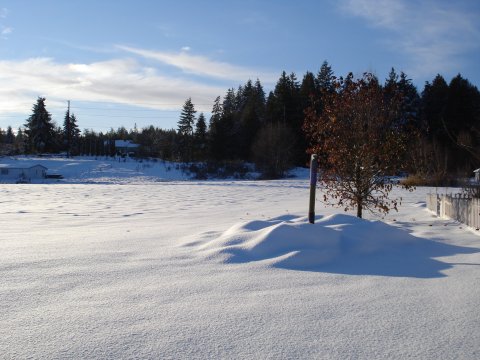
Up here in the northern-westernest part of the lower 48 La Nina has been mighty boring. I’m grateful for this, but sorry that her pattern of weather moved south and blasted the rest of the country with such misery. We’ve had normal temps and less rain that usual, although that is changing. This means my partner and I have been out working on the farm. He got the parts of the field we need later this month and next tilled and ready for planting. I’ve been working on conquering the weeds in the herb garden.

A plain and simple rose, in Sima's garden
Weeds (northeastern, northwestern, california, midwest and south): the bane of life with organic gardening, little tiny buggers that grow from the very air it seems, seeds stored for 20 years or more in buried earth just waiting for a bit of sun and light, little bothersome indicators of both soil gone wrong and soil gone right, rotten, overpowering… bleh. Weeds. Since our farm started as a cow pasture and hay field, our worst weeds are grasses, particularly what we call ‘zip’ grass, because of the sound it makes when you rip it out by the roots and discover to your horror the roots run right under the 3 feet of weed matted and graveled pathway and out the other side. Ziiiipppp indeed. One little stem of that stuff and it’ll grow another 4 foot long run of root, little grasslets sprouting all along the way.
Follow-up: GM Alfalfa
Posted: February 2, 2011 Filed under: crops, Farming, Food, gardening | Tags: alfalfa, farming, food, monsanto 10 CommentsI wrote about GM Alfalfa several days ago, and wanted to post a short followup.
First, do we really need GM Alfalfa? Probably not. It’s not like Alfalfa is riddled with a weed problem in this country. Michael Pollan points out that 93% of the alfalfa in this country is raised without any herbicides at all. This makes sense, alfalfa as fodder can benefit from the addition of other plants (although not poisonous ones, obviously). My goats thrive on weedy alfalfa. Anyway, GM Alfalfa says Pollan, ‘is a bad solution to a problem that doesn’t exist’.
The Center for Food Safety is going to continue bringing Monsanto to court over GM Alfalfa. ‘by tackling a new angle, Page Tomaselli, staff attorney at the Center for Food Safety, explained Friday at the Eco-Farm Conference. Their strategy will hinge on the “gene flow” risk accepted by the Supreme Court last June as harmful and illegal under current environment protections.’ The Public Patent Foundation is also going to sue Monsanto (or continue suing Monsanto. The foundation has been fighting Monsanto’s patents for a while now). If the foundation succeeds (and it just won a court battle to declare patents concerning human genes invalid), most of Monsanto’s patents concerning living things will be rendered irrelevant. Yes!
The Center for Food Safety has issued a press release pointing out that Vilsack’s decision leaves many problems. Who’s liable if a farmer’s crop is destroyed by GM pollen? Who pays damages? WHo is going to monitor and control herbicide useage on a crop that doesn’t need it, unless it’s ‘Round-Up Ready’? Who is liable for the super-weeds that will result?
From the Department of ‘Of Course, We Should have Known!’ (via Kat) comes this news. Media reports suggest that the reason Vilsack disregarded the comments of 200,000+, the recommendations of Aphis and so on has to do with pressure from the White House. So I wonder, is Obama actually fake? I mean, is he, like, made by Monsanto and the others? Just a gas-bag filled with whatever, maybe Round-Up, and tuned to say certain things that get frat boys excited? I wonder what Michelle, organic gardening proponent that she is, thinks about this? I suppose it doesn’t really matter. Just more proof everyone up ‘high’ is bought and paid for by the time they are weaned.
Sky Dancing in the Garden: Here comes Dream time!
Posted: December 6, 2010 Filed under: gardening | Tags: dreaming, gardening, seed catalogs 26 CommentsNote: I’m posting this on Monday because Sunday was super busy, both personally and on the blog!
And now, for something entirely frivolous and decadent.
This year’s gardening catalogs.
Many a garden writer has said it before, and many will say it again (in fact, this one is just about to).. catalogs are for dreaming. In catalogs there are no slugs, no snails, no powdery mildew and no late blight. The plants are a glistening glossy green, with bright shiny flowers that stand out like beacons under the perpetual benevolent sunshine. Every plant is wonderful, superlative, the cream of the crop. The vegetables look, taste, and even smell better in your favorite garden catalog, or at least, so say their descriptions.
Watering? Only from this stylish classic verdigris water can on page 25 or the oh-so-environmentally conscious drip irrigation ‘system’ on page 50.
Bugs? NEVER! But if you might see a stray sign of a leaf-hopper on the poor neighbor’s fuscia, head out to page 65 for a complete list of bug preventatives.
The thing that draws me in every time, every single dang time, is the ‘NEW VARIETIES!’ I love reading about new vegetable varieties. I’ll read a bit, then my gaze’ll wander and I’ll stare out the window at the cold, grey, wet winter’s day. In my mind’s eye I see this or that great new broccoli variety, or corn, or swiss chard, or whatever, growing proudly in long rows; producing abundant, life-sustaining nutrition (and a few bucks for the poor farmer). And this or that great new variety will be innately resistant to slugs and will scoff at both heat and cold, wet and dry. It’s such a great variety, it’ll grow under your bed, or on the moon! Ok, I’m getting a bit carried away.
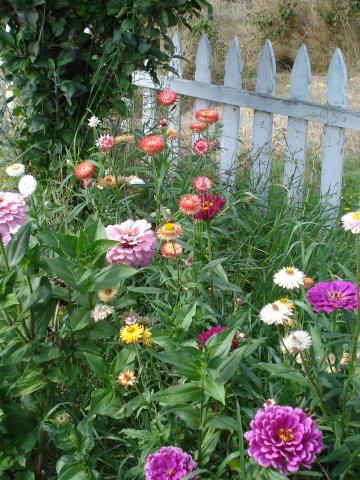
Catalog season generally starts in December. It can run into April in some areas of the country or end as early as February in others, because it ends as soon as planting begins and reality sets in. I keep all the farming and gardening related catalogs in the same pile and look through them before I go to bed, or when I have a few free moments. It’s a peaceful, dreamy time.
If you’re anything like me, you get tons of gardening catalogs from seed suppliers from all over the country. It’s hard to tell the good seed company from the bad, hard to tell what will grow in your area and what won’t. Therefore, here’s a few tips.
Do a bit of google research to explore where a seed company is getting their seed. Few actually grow seeds themselves (although some do). Many smaller seed companies still offer non-Monsanto (or other huge agri-business) controlled seed.
Beware of seed that is copyrighted or trademarked. This doesn’t mean it’s an F1 hybrid, this means it’s actually illegal to grow it yourself. If it’s that important to some business, you probably don’t need it.
To determine if a variety will grow in your area: Start with the basic hardiness zones. If the variety is within your zone, it’ll probably grow. But remember, many varieties need heat, so a zone 8 in the PacNW is not going to get as much heat as a zone 8 in northern California. This matters for things like corn and eggplant and many flower varieties. Most catalogs do not give heat requirements (known as degree days), so here’s how I figure it out. I use a catalog provided by a local (to me) seed merchant; Territorial Seeds. This is a great company, and they do a lot of their own growing and testing down in Oregon. I look at the days to maturity they give for different varieties of vegetables and flowers. Although the days to maturity are still a bit low, because they are in Oregon and I’m in Washington, I at least get in the ballpark. Then I compare these days to those in other catalogs. For each vegetable, this gives me an offset for each of the other catalogs, which I can use to get a semi-accurate guess whether something will grow for me or not.
Why do I do this? Because my favorite seed place is Johnny’s, in Maine. And in Maine you can, for instance, grow corn varieties which won’t grow in the Puget Sound area of Washington. Maine is hotter and has more days over 60 F than Washington, even though coastal Washington has a higher hardiness zone.
Another point to consider: Look at the natural habitat of the plant. Make sure your garden area is similar to that natural habitat if you want carefree gardening. For instance, rosemary is naturally a Mediterranean scrub plant. It likes cool mornings and nights, mist, wind, quickly draining soil and hot sun. It doesn’t like snow, and it doesn’t like places without that mist and wind. So around my area rosemary often dies. However, I can grow it because I live in a little valley on a peninsula with sea water within a mile or two on 3 sides. I get the winds and the mist, boy, do I get the winds! I then went further for my rosemary and grow it in raised beds to achieve the drainage it wants.
For farming, I use Johnny’s and Territorial seed mostly. I get catalogs from other seed merchants, but they don’t hit a chord with me, for some reason. I use Nichols and various other places for herbs. I love the Heirloom seed catalogs and tomato catalogs. I use onion starts, rather than the little onion bulbs or seeds. I get mine from Dixondale farms. Drip Works is a great drip irrigation site, and cheaper than the ‘system’ available in most catalogs. Green house stuff comes from Charley’s in Washington, or Greenhouse Megastore or other places across the Internet.
So let’s hear it, what are your winter gardening dreams, 2011 gardening plans and favorite catalogs and tips for seed selection?
Sunday Growing
Posted: November 21, 2010 Filed under: Farming, gardening | Tags: farming, gardening 25 CommentsI’m hoping that a regular post about gardening and farming, but mostly gardening, will be useful on the blog. I’ve picked Sundays to run the post, perhaps every other Sunday at first depending upon interest, because it’s often a slow news day.
I hope to convince a few of the commenters and writers here to write about what is happening in the garden(s) in their neck of the woods. So feel free to dive in, everyone!
Up here in the PacNW it’s been rainy. No surprise there, eh? It’s also cold; we are having a cold snap with cold winds barrelling down out of the Fraser River Valley from Canada. This often means snow, but I think it’s a bit too warm for snow as we are hovering just above freezing, but the skies are clear. The fire has been burning in the wood stove all day. Outside the goats are all puffed up, like little fur puff balls on 4 stick like legs. They are out in the pasture looking for something to eat. The pasture is green (this is Washington after all) but the grass has little nutrition. So they come in to eat hay every few hours. The cats are similarly puffed up, lounging in the warm spots in the garage. The dog is in her heaven, being a northern spitz type dog. She’s only 9 months old. I can’t wait until she first encounters snow.
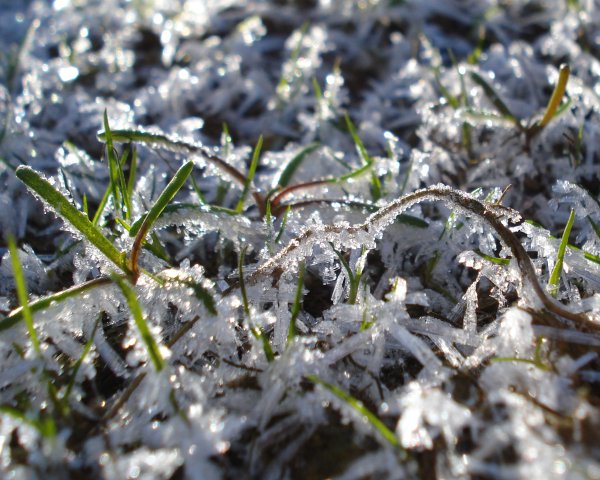
Frost on the Pasture
The plants in the herb garden are curled up against the cold. But there is still viable rosemary, thyme and some oregano. The last of the chives gave up the ghost a month or so ago. Green onions are still hanging on, hoping I won’t pick them before they can flower in the spring. In the greenhouses that I got from The Tree Center and set up last season, the last of the tomatoes have ripened and need to be picked. Their mother plants are completely brown and dead. Peppers hang here and there amidst the brown leaves of their plants. I need to get those picked and processed. We chop peppers, sweet and hot, and bag them into zip-locks. We freeze them and use them in cooking all the rest of the year. Instead of canning tomatoes I chop them, skins, seeds and all, in the cuisinart and freeze them. They too are used in cooking for the rest of the year.
Out in the fields the garlic we planted in October is showing the first of its growth. Yum! If it were to get really cold we’d have to cover it with straw, but I’d rather not. That way there’s no convenient hiding place for our garden nemesis, the slug. We also have lettuce, mesclun, carrots, broccoli, kale, swiss chard, cabbage, rutabaga, beets, turnips and more growing in the fields. Some of the plants are under cover to protect them from super cold weather. Others are left to grow as they will. I expect the beets and the swiss chard will finish shortly. I should grab some and chop it and freeze it for eating later before it turns into a brown frozen mush!
I expect we’ll have our first snow, if not over Thanksgiving where it can most effectively screw up travel plans and therefore is the chosen time of the weather gods, by early December. Before then, I hope to have the paths in the herb garden weeded, and we really need to get the plowing done.
I’d like to refer everyone to a gardening blog from our own Grayslady, Gardening in the Mud. Please visit there for information about Mid-West and North-East gardening and plants. She knows her stuff! If anyone else has a garden blog they’d like linked, let us know!
So, what’s happening in the garden in your area? Go outside and then let us know!

 peej
peej Carissa
 bostonboomer
 dakinikat
 ecocatwoman
 mablue2
 Mama Lopez
 peggysue22
 quixote
 skydancingguestblogger
 Mona (aka Wonk the Vote)



 Sky Dancing
Recent Comments