
NY Rally Speakers highlight Core Democratic Values
Posted: April 15, 2011 Filed under: Democratic Politics, financial institutions, Global Financial Crisis | Tags: Chris Hedges, Liberal Values, Wall Street scandals 4 CommentsA rally in NYC today highlighted issues and concerns that have been going unaddressed for some time in this country.  The Nation highlights some of the featured speakers including Chris Hedges who says that President Obama is defying those core values supported by Democratic voters.
Pulitzer Prize-winning journalist Chris Hedges also spoke at the rally. Beforehand, I asked him if he thinks acts of civil disobedience such as the Wisconsin union protests are the only paths of recourse Americans have left to fight for change. “There’s a moral imperative to carry them out,” says Hedges. “[I]f we don’t begin to physically defend the civil society, all resistance will be ceded to very proto-fascist movements such as the Tea Party that celebrate the gun culture, the language of violence, seek scapegoats for their misery.”
He calls the state of America an “anemic democracy,” and says it’s time for citizens to get off the Internet and occupy the streets because their leaders no longer represent them. Politicians have spoken incessantly about the need for shared sacrifice when in fact they’re guarding a plutocracy that levies the burden of budget cuts on the shoulders of the poor. This is a system in which Bank of America’s CEO Brian Moynihan gets a $9 million bonus while one in four American children survives on food stamps.
Hedges calls the idea of shared sacrifice farcical. “[Bank of America] sends out home invasion teams to throw Americans out of their homes through bank repossessions or foreclosures, and of course many of these people were given loans that the lenders knew they could never repay often under fraudulent conditions…and yet there has been absolutely no investigation — no criminal charges — brought against these corporations.”
We live in a corporate state, Hedges stresses, both in our interview and later when he takes the stage. “Not only the money, but the wages, and retirement benefits, $17 trillion worth have been robbed by these financial institutions. It’s repugnant.”
And the one in six Americans without a job aren’t the ones going to raise money to get President Obama reelected. The money, Hedges says, will come from the corporate state, what he calls the “predators.” Hedges says President Obama serves their — not our — interests.
Obama’s most recent budget speech, in which he adopted some of the populist rhetoric about raising taxes on the wealthy, didn’t impress Hedges. After all, it was Obama who extended the Bush era tax cuts for the wealthy. “To watch him sort of talk out of both sides of his mouth is a little disconcerting,” says Hedges. “I fear, like most people, that not only are we going to see an extension of those cuts, but they’ll be cemented into place permanently.” Like many in the liberal class, Hedges says Obama “speaks in the rhetoric of traditional liberalism, but every action he takes defies the core values of the liberal tradition.”
Other groups also questioned the current economic policies dominating our national conversation. Some of the most persuasive speech was associated with the financial crisis and its perpetrators.
Dave Petrovich, executive director of the Society For Preservation of Continued Homeownership, agrees with that sentiment. “The president, and most of our lapdog Congress, are employees of the banking industry, so they’re not going to really discuss this unless it’s in their own financial self-interest.” Bank of America was once again a central target of the protest since the company hasn’t paid a nickel in federal income taxes in the past two years and received a “income tax refund from hell” of $666 million for 2010. The protesters demand to know why a company that received $45 billion in taxpayer money during the bailout now gets to play by a different set of tax rules, while simultaneously paying out obscene bonuses to its CEO and kicking hardworking Americans out of their homes
There’s something fundamentally wrong with a system that bails out perpetrators of mass fraud and destruction and applauds the removal of safety nets from its victims. This started me thinking that maybe we should come up with a list of what we consider liberal and democratic values. Frankly, I consider civil liberties, respect for the Bill of Rights, and provision of services essential to public health, safety, and education to be central. I also consider the idea that liberty and justice for all means for ALL and not just the rich and powerful. It’s been apparent from that Goldman Sachs and Bank of American can get bailed out for all kinds of crime. What kinds of things do you think should go on the list?
We Interrupt your Regularly Scheduled Programming for a Bit of Deprogramming
Posted: April 12, 2011 Filed under: Catfood Commission, Domestic Policy, Economic Develpment, financial institutions, income inequality | Tags: helping the world's poor, Income Inequality, tax havens 9 Comments
Uncle Barrack sez: Time to feed the Corporate Kitty
It’s time for my regular rant on how bad income inequality is for an economy. I know that John Boenher wants to transfer all the resources in the country to so-called job creators and that CEO Hacks are trying to turn the public school system into a drone production unit, but as usual, I’m going to interrupt the messaging with empirical evidence. I’m just one of those people that doesn’t believe any one unless they back it up with honest numbers. This time, I’m going to direct you to a study by the International Monetary Fund (IMF). Just in case you don’t already know, the IMF is not exactly a bastion of comrades-in-arms. They’ve been soundly criticized by developing nations for exporting American-style capitalism wherever they go to provide help to struggling nations. So, with that in mind, here’s a briefing on the study titled “Warning! Inequality May be Hazardous to your Health”.
Their introduction is so meaty that I’m going to leave it nearly wholesale for you before I return to editing more things for a development journal. Finding ways to raise every one’s boat is my thing, just in case you never noticed.
Many of us have been struck by the huge increase in income inequality in the United States in the past thirty years. The rich have gotten much richer, while just about everyone else has had very modest income growth.
Some dismiss inequality and focus instead on overall growth—arguing, in effect, that a rising tide lifts all boats. But assume we have a thousand boats representing all the households in the United States, with boat length proportional to family income. In the late 1970s, the average boat was a 12 foot canoe and the biggest yacht was 250 feet long. Thirty years later, the average boat is a slightly roomier 15 footer, while the biggest yacht, at over 1100 feet, would dwarf the Titanic! When a handful of yachts become ocean liners while the rest remain lowly canoes, something is seriously amiss.
In fact, inequality matters. And it matters in all corners of the globe. You need look no further than the role it might have played in the historic transformation underway in the Middle East.
The increase in U.S. income inequality in recent decades is strikingly similar to the increase in the 1920s. In both cases there was a boom in the financial sector, poor people borrowed a lot, and it all ended in huge financial crises. Did the recent financial crisis result somehow from the increase in inequality?
Some time ago, we became interested in long periods of high growth (“growth spells”) and what keeps them going. The initial thought was that sometimes crises happen when a “growth spell” comes to an end, as perhaps occurred with Japan in the 1990s.
We approached the problem as a medical researcher might think of life expectancy, looking at age, weight, gender, smoking habits, etc. We do something similar, looking for what might bring long “growth spells” to an end by focusing on factors like political institutions, health and education, macroeconomic instability, debt, trade openness, and so on.
Somewhat to our surprise, income inequality stood out in our analysis as a key driver of the duration of “growth spells”.
We found that high “growth spells” were much more likely to end in countries with less equal income distributions. The effect is large. For example, we estimate that closing, say, half the inequality gap between Latin America and emerging Asia would more than double the expected duration of a “growth spell”. Inequality seemed to make a big difference almost no matter what other variables were in the model or exactly how we defined a “growth spell”. Inequality is of course not the only thing that matters but, from our analysis, it clearly belongs in the “pantheon” of well-established growth factors such as the quality of political institutions or trade openness.
While income distribution within a given country is pretty stable most of the time, it sometimes moves a lot. In addition to the United States in recent decades, we’ve also seen changes in China and many other countries. Brazil reduced inequality significantly from the early 1990s through a focused set of transfer programs that have become a model for many around the world. A reduction of the magnitude achieved by Brazil could—albeit with uncertainty about the precise effect—increase the expected length of a typical “growth spell” by about 50 percent.
The upshot? It is a big mistake to separate analyses of growth and income distribution. A rising tide is still critical to lifting all boats. The implication of our analysis is that helping to raise the lowest boats may actually help to keep the tide rising!
That basically says that no one’s boat will really rise as much as it could unless all boats rise. Intuitively, this makes sense because if you think about it, businesses need customers. Poor customers just don’t buy as much unless you provide them with good incomes. Unless you want make government the primary customer in an economy or you’re deluded into thinking business investment will ever be the major agent in GDP, you realize that household consumers are the true center of any market economy. Denying them incomes denies every one of incomes. Just providing monies to the top 1 or 2 percent who are now likely to take their spending and investment any where on the planet is just delusional. Actually, if you want some really good reading on that, I suggest you pick up the book Tax Havens: How Globalization Really Works (Cornell Studies in Money).
In Tax Havens, Ronen Palan, Richard Murphy, and Christian Chavagneux provide an up-to-date evaluation of the role and function of tax havens in the global financial system-their history, inner workings, impact, extent, and enforcement. They make clear that while, individually, tax havens may appear insignificant, together they have a major impact on the global economy. Holding up to $13 trillion of personal wealth—the equivalent of the annual U.S. Gross National Product—and serving as the legal home of two million corporate entities and half of all international lending banks, tax havens also skew the distribution of globalization’s costs and benefits to the detriment of developing economies.
The first comprehensive account of these entities, this book challenges much of the conventional wisdom about tax havens. The authors reveal that, rather than operating at the margins of the world economy, tax havens are integral to it. More than simple conduits for tax avoidance and evasion, tax havens actually belong to the broad world of finance, to the business of managing the monetary resources of individuals, organizations, and countries. They have become among the most powerful instruments of globalization, one of the principal causes of global financial instability, and one of the large political issues of our times.
There’s not really much difference between the Gadhaffi family and the Koch brothers when it comes to where the money goes from exploiting national resources. It’s also really no surprise that when you observe the countries that have the highest per capita incomes in the world that you find the world’s tax havens in the top tiers. (Norway and the US are the only countries in the top ten that aren’t tax havens.) Giving money to the richest folks in your country–the behavior of so-called banana republics–is detrimental to the economic health of that country in many ways. It’s just another way that financial institutions and financial innovation has gutted the productive capability of many a country.
The original IMF study–released on April 8, 2011–is here. I would like to point to the policy implications and suggestions section which makes going to the original study imperative. Think about this when you listen to US banana republic President Obama speak tomorrow on the marvels of the catfood commission’s report. Notice there are other studies cited in the policy suggestions.
There is nonetheless surely policy scope to improve income distribution without undermining incentives—perhaps even improving them—and thereby contribute to lengthening the duration of growth spells.
- Better targeting of subsidies can be a win-win proposition, as with the reallocation of fiscal resources towards subsidies of goods that are consumed mainly by the poor,which can free up capacity to finance public infrastructure investment while better protecting the poor (Coady et al., 2010).
- Active labor market policies to foster job-richer recoveries (ILO, 2011) may help to make recoveries more sustainable, especially as rising unemployment appears to be associated with deteriorations in the income distribution (Heathcote, Perri, and Violante, 2010).
- Equality of opportunity can make for both more equal and more efficient outcomes (World Bank, 2005). For example, effective investments in health and education—human capital—may be able to square the circle of promoting durable growth and equity while avoiding shorter-run disincentive effects (Gupta et al., 1999). Such investments could strengthen the labor force‘s capacity to cope with new technologies (which may have contributed to more inequality in a number of cases), and thereby not only reduce inequality but also help sustain growth. They could also help countries address possible adverse distributional consequences of globalization and reinforce its growth benefits.
- Some countries have managed through pro-poor policies to markedly reduce income inequality. Brazil, for example, after its market-oriented reforms of 1994 implemented active propoor distributional policies, notably, social assistance spending, that were critical to substantial reductions in poverty (Ravallion, 2009).
- Well-designed progressive taxation and adequate bargaining power for labor can also be important in promoting equity, though with due attention to the need to avoid dual labor markets that perpetuate divisions between insiders and outsiders.
Yes, I bolded the sections that are in absolute contradiction with current US political groupthink. I guess Obama just really isn’t that into development policy or research in economics. Read them and weep for what could be. Meanwhile, turn on the TV and go right back to the villagers promoting the idea that trickle up economics makes all of us better off, if you dare.
Karl Marx: The Comeback Kid
Posted: April 10, 2011 Filed under: Economic Develpment, financial institutions, Global Financial Crisis | Tags: Commerce, economics, finance, Financial Development, Financial Institutions, Karl Marx 23 Comments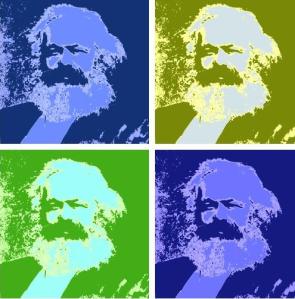 technology, pushing them to take more and more expensive credits, until their debt becomes unbearable. The unpaid debt will lead to bankruptcy of banks, which will have to be nationalised, and the State will have to take the road which will eventually lead to communism”
Karl Marx, Das Kapital, 1867
Okay, I got your attention and that’s my purpose. I’m really not a closet Marxist, but I do feel that some of that old school political economics he brought to the realm of economic thinking way back when is still worth contemplating. The above quote from Marx is a fairly good summation of his intellectual endeavors. He starts out with some really great assumptions then jumps the shark with vague, unmapped conclusions, But, Marx was a philosopher and jumping sharks seems to be an occupational hazard for them. Economics these days relies on mathematical models and empirical study.
Marx is one of those folks–along with equally fringe Frederick Hayek– who is getting a second look in a back-handed way. What’s pretty interesting is that a lot of the criticism of Marx and Lenin forgets that they had more against “financial capitalists” than they had against “industrial capitalists”. Both Rand and Ron Paul sort’ve remind me of them in that way. Marx actually looked at us ideally as a society of producers. He didn’t like how financiers fit into that picture at all. He railed against the UK’s Bank Act of 1844 that was a response to a fairly huge financial crisis. He argued that the “1844 Act had been deliberately designed to keep interest rates artificially high, benefiting the financial section of the capitalist class at the expense of the industrial section”. He also had a lot to say about paper money that wasn’t convertible to things like gold and it’s hard not to hear Marx in Ron Paul’s diatribes.
Marx also introduced the idea of commodity fetishism, which is a fairly compelling description of the modern US economy. He felt we’d all become slaves to it eventually. So, even though he never really fleshed out much worth implementing, he and Lenin had some interesting commentary on what they saw as problems that would arise from a society that became increasing focused on financial services and became addicted to consumer goods.
In an odd way, the financial crisis has brought on renaissance of the Marxist critique as well as a huge number of libertarians that are trying to have a Hayekian renaissance. Academics that study financial economics are asking similar questions but not quite in the way that you would think. The odd thing is that the very line of research that used to soundly tromp the Marxist assumption of the financial capitalist as parasite is sort’ve headed towards a refinement of the idea that too many bankers spoil the economy.
Every one is pretty much in agreement that much of the time, market economies do a fairly good job of sorting out who gets what. You can even speak with economists in Cuba and find out they are all planning for liberalization as long as it doesn’t reintroduce a flurry of exploitation. The problem is that real life markets don’t function very well when there are too many ‘frictions’. Just as in physics, frictions deform things. Frictions are basically things that cause less-than-efficient outcomes in markets where efficiency is strictly defined as the maximum quantity produced at a minimal price. In some cases, these things are caused by governments. Regulations, tariffs, quotas, and taxes can all cause frictions. Some are put in place purposely to warp the market outcome as is the case with sin taxes. Third party payers–like the health insurance industry–create frictions. Advertising creates incredible frictions.
Markets can have naturally occurring frictions like the placement of oil reserves or diamonds or gold in certain locations in the world. They can have frictions due to technology or economies of scale where it’s most efficient to have a single producer or monopoly because it is least expensive or necessary to create the minimal cost plant size. Think how huge car manufacturing or steel plants have to be so they are cost effective. Frictions are everywhere and they warp market outcomes. Free Market fetishists tend to ignore any friction not created by the government. In some cases, government is the source of the friction; in other cases, government–through regulation or policing of markets–can remove the frictions. Financial markets are riddled with two notorious frictions: information asymmetry and moral hazard. You can see how Marx grasped those problems philosophically. Lenin actually did studies using numbers. Hayek had his explanations of financial crises as did J.M. Keynes. Keynes went so far to say that financial markets were driven by “animistic spirits”. We’ve come a long way since all of them were actively writing but yet, some of the themes remain the same in new veins of inquiry.
There are several things out in the blogosphere that have brought me to discuss this topic with you. The first is a NYT editorial called ‘Banks are Off the Hook Again’. Banks are trying to get Federal lawmakers to override state laws on foreclosure in an attempt to avoid prosecution and the results from their foreclosure practices. They are–per usual–succeeding.
As early as this week, federal bank regulators and the nation’s big banks are expected to close a deal that is supposed to address and correct the scandalous abuses. If these agreements are anything like the draft agreement recently published by the American Banker — and we believe they will be — they will be a wrist slap, at best. At worst, they are an attempt to preclude other efforts to hold banks accountable. They are unlikely to ease the foreclosure crisis.
All homeowners will suffer as a result. Some 6.7 million homes have already been lost in the housing bust, and another 3.3 million will be lost through 2012. The plunge in home equity — $5.6 trillion so far — hits everyone because foreclosures are a drag on all house prices.
The deals grew out of last year’s investigation into robo-signing — when banks were found to have filed false documents in foreclosure cases. The report of the investigation has not been released, but we know that robo-signing was not an isolated problem. Many other abuses are well documented: late fees that are so high that borrowers can’t catch up on late payments; conflicts of interest that lead banks to favor foreclosures over loan modifications.
The draft does not call for tough new rules to end those abuses. Or for ramped-up loan modifications. Or for penalties for past violations. Instead, it requires banks to improve the management of their foreclosure processes, including such reforms as “measures to ensure that staff are trained specifically” for their jobs.
This is a really good example of maintenance of mutually destructive frictions in a market. It creates uncertainty. It does not contribute to translucence and information. It ensures a lop-sided process. In short, it guarantees certain market failure and it sets up the winners and the losers. It’s something about which both Marx and Hayek would rant. For that matter, J.M. Keynes wouldn’t be so judicious about it either.
FCIC Report is very Illuminating
Posted: April 9, 2011 Filed under: commercial banking, Economy, Equity Markets, financial institutions, Global Financial Crisis | Tags: causes of the financial crisis, FCIC, Financial Crisis of 2007 25 Comments The Financial Crisis Inquiry Commission (FCIC) is a congressional sponsored study into the reasons for the Financial Crisis. They were authorized by the President in May 2009. They have issued their final report and are disbanding. Google FCIC and you will find their information is being maintained by Stanford University. The published report is available on the website and at booksellers (ISBN 978-1-61039-041-5). It is more than 500 pages long. I have personally purchased about 15 books on the Financial Crisis over the last two years. (I know I should get a life). Each book discusses a separate segment of the crisis. This report is the most comprehensive book to date and is very readable by a person interested in the subject.
The commission was chaired by Phil Angelidies and former congressman Bill Thomas. There are eight additional commissioners appointed by the Democratic and Republican party. They had a staff of 60 people. They held hearings in Washington and locations in states hardest hit by the Real Estate bubble.
The first chapter summarizes their findings and they are quite illuminating on the many facets of the Financial Crisis. They dispel many myths and examples are provided below. One can definitely say we had less government in the Finance world. The evolved system was unsustainable. The end result was the crash of September 2008.
Conclusions of FCIC
1-The Financial Crisis was avoidable
Despite the “once in a 100 years” admonitions of regulators and politicians, this crisis was avoidable. The document does a thorough job, point by point highlighting and disputing the many actions in the last 20 years.
2-Failures in Financial Regulation and Supervision proved devastating to Financial markets
Greenspan was authorized to stop the writing of toxic mortgages despite the rising evidence that they were massive and detrimental. In 2004, the Federal Reserve could have denied loosening of capital reserves from 12/1 to 30/1. In other words, they would need $1 dollars in the bank for every $30 dollars of assets. This is considered very high leverage. In 2000 the government declined to regulate Credit Default Swaps (Derivatives). Repeal of Glass-Steagle allowed mixing banks and Insurance companies. Citi bank was acquired by Travelers Insurance immediately. Under the regulation of the Federal Reserve Bank of  NY (Tim Geithner) Citi was one of the first banks to get into trouble and require a massive government bailout.
3-Dramatic failures of corporate governance and risk management at important financial institutions, key cause of the crisis.
Many banks (not all) acted recklessly took on too much risk with too little capital to address the crisis, being very dependent on short term funding which evaporated as the crisis evolved. They were not able to raise capital to address demand claim of customer. In short they were not able respond to a run on the bank. This is called a liquidity event. Recall that Investment banks were lightly regulated and did not have access to the FED window for emergency loans. They relied on unproven software to evaluate their risks. In short they loaded up on Real Estate securities which turned toxic and they could not absorb the losses. This was done despite the fact that they knew the underwriting of the real estate loans was poor. Goldman Sachs recognized this and curtailed purchasing of bad loans and they survived. The financial community was not able to police itself, requiring a massive government bailout. Risk people identified the problem and were ignored.
One Helluva Open Window
Posted: April 2, 2011 Filed under: financial institutions, Global Financial Crisis | Tags: Ben Bernanke, FED 23 CommentsI’m a financial economist. I’ve worked for the Fed although not in that capacity. My grandfather worked for the FED  doing the War Bonds thing for both World Wars and my exhusband worked for the Fed straight out of college. I’d like to think I have some familiarity with at least two of the districts. I also was schooled during the monetarist ascendancy so I was endowed with a certain amount of awe and respect for monetary policy. I don’t think–as a general rule–the FED’s current open market operations should be up for purview by politicians. I think it’s just fine and dandy that stuff comes out later because I certainly don’t want monetary policy neutralized or politicized. I would, however, like Ron Paul’s 3rd century world view of economics to be neutralized. However, I think all the adults in Washington, D.C. have moved. That would include the ones in the Board of Governor’s Building.
So, why am I saying all this? Well, I’m about to announce how absolutely appalled I was to find that the FED not only opened it’s discount window to our shadow banking industry and some commercial banks abroad, but it opened the windows, doors, and vaults to just about any bank or pseudo-bank on the planet that had the misfortune to be taken in by our financiers of greed and destruction. I know the Fed dabbles around the world. We’ve had to prop up Mexico and Citibank’s adventures from time-to-time which seemed way out of its jurisdiction even with the broadest interpretation of their charter. I know they “watch” our exchange rates while talking up the competitive exchange rate regime at times. Some how, this feels WAY different. I feel in need of a shower even reading about this.
U.S. Federal Reserve Chairman Ben S. Bernanke’s two-year fight to shield crisis-squeezed banks from the stigma of revealing their public loans protected a lender to local governments in Belgium, a Japanese fishing-cooperative financier and a company part-owned by the Central Bank of Libya.
Dexia SA (DEXB), based in Brussels and Paris, borrowed as much as $33.5 billion through its New York branch from the Fed’s “discount window” lending program, according to Fed documents released yesterday in response to a Freedom of Information Act request. Dublin-based Depfa Bank Plc, taken over in 2007 by a German real-estate lender later seized by the German government, drew $24.5 billion.
The biggest borrowers from the 97-year-old discount window as the program reached its crisis-era peak were foreign banks, accounting for at least 70 percent of the $110.7 billion borrowed during the week in October 2008 when use of the program surged to a record. The disclosures may stoke a reexamination of the risks posed to U.S. taxpayers by the central bank’s role in global financial markets.
“The caricature of the Fed is that it was shoveling money to big New York banks and a bunch of foreigners, and that is not conducive to its long-run reputation,” said Vincent Reinhart, the Fed’s director of monetary affairs from 2001 to 2007.
The FED’s always had an ‘usual and exigent circumstances’ clause that’s given a lot of leeway in times of financial crisis. Some how, I don’t even think Woodrow Wilson figured it would be used to lend money to a fishing-cooperative financier in Japan. You can also read Yves Smith at Naked Capitalism on exactly what went on at the Discount Window and with whom. She focuses on the ‘haircuts’. That would be the lousy deals made by the Fed to bail out a lot of lousy dealers. The numbers on how many of these borrowers were junk status awes.
The information was released yesterday and Bloomberg has provided a first cut on a small but juicy portion of it, the Primary Dealer Credit Facility. From a risk standpoint, the loans mace under this program violated the central bank guideline known as the Bagehot rule: “Lend freely, against good collateral, at penalty rates”. That is the prescription if the borrower is facing a bank run, meaning a liquidity crisis. The fact that 72% of the Fed’s loans on September 29 from the Primary Dealer Credit Facility were junk or equivalent (defaulted and unrated securities or equity) is further proof that many financial firms were facing a solvency, not a liquidity, crisis.
She also shows–in her words quelle suprise–which American Banks were the little failed piggies too. I’m going to throw one of the ‘haircuts’ or discounts a the front of this quote just to curl your toes a bit. I think we can effectively say that Wall Street trashed the value of nearly every firm in the country pretty effectively.
A 95% haircut on AAA rated ABS CDOs means the paper was effectively worthless.
This first cut by Bloomberg also shows that Morgan Stanley was the biggest user of the facility, receiving $61.3 billion of funds for securities “worth” $66.5 billion, 71.6% of which was junk or unrated. As eye-popping as those numbers are, the funds received are less than half the fall in Morgan Stanley’s liquidity pool in the two weeks after the Lehman failure, per Economics of Contempt. Merrill Lynch was second, getting $36.3 billion in funding for $39.1 billion of collateral, 83.4% of which was junk or unrated.
These are not the routine activities of central banks and central bankers. We basically bankrolled a bunch of businesses and financial outfits in a bunch of countries because they wanted in on the Wall Street greed and Wall Street failed them big time. I’m left wondering why all this money was thrown to the foreign gamblers while Americans were being foreclosed on, frankly. Let me also let you know that this is probably just the tip of the iceberg since there’s undoubtedly more documents that need to be discovered and analyzed. My hope is that when the congressional hearings on this get started, we have some real brain power behind the questions that need to be asked on this because questions do need to be asked about this. I’d like a few FED Governors around for the ride to see how many of them were on board with all of this or even knew of it. What we need right now are a few Ferdinand Pecoras.
I also wonder who masterminded all this? Paulson? Geithner? Bernanke? Were they that wedded to ensuring Wall Street didn’t look like a casino and American business didn’t look like a sham that they had to give away the house, the children, the pets, and the fatted calf? They basically threw every one’s kitchen sink overseas. Worse than that, they’ve really not solved the basic systemic problem and the banks are already niggling over the details of the few thinks done by Dodd-Frank. Feel used yet?

 peej
peej Carissa
 bostonboomer
 dakinikat
 ecocatwoman
 mablue2
 Mama Lopez
 peggysue22
 quixote
 skydancingguestblogger
 Mona (aka Wonk the Vote)



 Sky Dancing
Recent Comments