
Vegas Gambling vs Wall Street Gambling
Posted: November 23, 2011 Filed under: Banksters, Economy, Equity Markets, financial institutions 5 CommentsOne of the things that has always struck me about folks that treat the financial sector like any other business venture is the lack of  understanding of what the finance sector really does. There are several basic functions if you read the literature. The banking industry originally evolved from goldsmiths that would safekeep gold for people. This eliminated the need for every one to keep a small army with them at all times to stop robbers from stealing all their gold. Goldsmiths eventually learned that a fairly sizable chunk of that gold never left their premises and found out they could lend some of it out for a return and not be caught short. That eventually lead them from being gold babysitters to lenders. Then, we eventually got around to trying to find some financial contracts that would help us if the worst happened by buying insurance. From these sets of agreements, we now have exotic derivatives, financial innovations, credit default swaps, and a host of other banking services. The basics things that the banking sector does is help you save or store up future purchasing power, borrow or lend purchasing power, and help move money around from place to place via the payment systems. That would be check clearing and ATMs and things like that. The Federal Reserve Bank was set up to handle that latter function but most of that function has been privatized since regional banks now clear checks and there are private clearing houses for Automated Payments. The Fed’s role is now fairly small. It still pushes cash from the US Mint/Treasury into the banking system and its FedWire system still handles a huge number of wire transfers between banks. If banks won’t lend to each other via the Fed Funds market, it is also available to lend money at the discount window. That used to be only available to member banks but it’s now open to a lot more institutions.
Bankers usually make money by charging fees on their services, interest rates on their loans, and then they make arbitrage profits if they invest. For years, that last function wasn’t a big deal for bankers because laws stopped them from investing in anything very creative. Laws have changed a lot over the last 10-20 years and even if commercial banks can’t make risky investments, they are likely to be part of a bank holding company that owns some subsidiary that can. Allowing banks–who basically still have the role of “safekeeping”–to gamble has been a huge mistake. Besides the lax laws, they have had a lot of cheap cash available because of Greenspan’s relatively lose monetary policy during the last years of his tenure and they’ve been able to reduce their risk by having deposit insurance which covers their deposits in case of default. There has also been an increase in “financial innovations” and techniques which serve as pseudo insurance but generally come in the form of very hard-to-price assets so they can be risky. Many banks don’t use them just for hedging which is this risk management approach to their use. A lot of banks just plan gamble. We’ve definitely seen banks misjudge risk and rely heavily on what I would consider gambling activities.
So, I’ve worked back of the house at a casino and I’ve worked in banking and of course, I’m a financial economist so I’ve got a little knowledge and experience on all fronts. The one thing that I will say about gambling in a casino is that a good time is had by all, every one understands it’s gambling, and the gambling industry hires a lot of people in the process that do fairly straightforward jobs. They only get tips if the customers say so. Bonuses for random wins are de rigueur in the finance sector. Silly thing is that most financiers think they’ve actually earned those bonuses for doing some miracle. There’s a few good reads to let you know exactly how misguided they are on their opinions of their skills. The first is anything by Nassim Nicholas Taleb who is a practitioner of financial mathematics and a former Wall Street trader. His book “Fooled by Randomness” is just full of examples of the fallacies that drive Wall Street Bankers into thinking too highly of themselves and paying themselves based on gambling and randomly hitting the jackpot. You can also read anything by Nobel Prize winner Daniel Kahneman. Actually, you can watch them both talk about these things in a video at Edge in a program called Reflections on a Crisis.
Kahneman explains why there are bubbles in the financial markets, even though everyone knows that they eventually burst. The researchers used the comparison with the weather: If there is little rain for three years, people begin to believe that this is the normal situation. If over the years stocks only increase, people can’t imagine a break in this trend.
Taleb speaks out sharply against the bankers. The people in control of taxpayer’s money are spending billions of dollars. “I want those responsible for the crisis gone today, today and not tomorrow,” he says, leaning forward vigorously. The risk models of banks are a plague, he says, the bankers are charlatans.
It is nonsense to think that we can assess risks and thus protect against a crash. Taleb has become famous with his theory of the black swan described in his eponymous bestsellers described. Black swans, which are events that are not previously seen–not even with the best model. “People will never be able to control a coincidence,” he says.
Okay, so that’s actually the background to something I want to point you to on VOXEU called “What is the contribution of the financial sector?” by Andrew Haldane. I think it’s a good thing to look at because we need to establish some basic knowledge and laws that separate the speculative activities from the banking activities that actually may provide value. (Although I still could argue that privatizing the payments system may prove risky and foolish some day, there are some things that banks do that are useful.) This way we can see the damage done when so many politicians essentially empower the gambling aspects. Another offshoot is our tax policy which favorably treats capital gains without any reference to the source of the profit. People that run businesses that enhance economic welfare of every one are taxed at the same favorable rate as those that basically gamble resources away. That’s a very bad incentive system. Haldane points out the difference between managing risk of financial contracts and risk-taking that is basically gambling and how much of the Western nation’s financial sector has morphed more into a gambling sector than a financial services provider.
But crisis experience has challenged this narrative. High pre-crisis returns in the financial sector proved temporary. The return on tangible equity in UK banking fell from levels of 25%+ in 2006 to – 29% in 2008. Many financial institutions around the world found themselves calling on the authorities, in enormous size, to help manage their solvency and liquidity risk. That fall from grace, and the resulting ballooning of risk, sits uneasily with a pre-crisis story of a shift in the technological frontier of banks’ risk management.
In fact, high pre-crisis returns to banking had a much more mundane explanation. They reflected simply increased risk-taking across the sector. This was not an outward shift in the portfolio possibility set of finance. Instead, it was a traverse up the high-wire of risk and return. This hire-wire act involved, on the asset side, rapid credit expansion, often through the development of poorly understood financial instruments. On the liability side, this ballooning balance sheet was financed using risky leverage, often at short maturities.
This is an important statement because not only did political institutions loosen laws or not put in place laws to stop this from happening, but when it happened, we all paid and they’ve ignored how costly this was to every one else. Plus, they keep wanting us to sacrifice instead of the people that broke the economic growth machine. The basic narrative is that these folks gambled with others’ money and the government had to pay the house. This is wrong in every sense of what is and isn’t moral. Haldane argues that risk-taking is not a value-added activity for banks and backs it up with empirical evidence.
The financial system provides a number of services to the wider economy, including payment and transaction services to depositors and borrowers; intermediation services by transforming deposits into funding for households, companies or governments; and risk transfer and insurance services. In doing so, financial intermediaries take on risk. For example, when they finance long-term loans to companies using short-term deposits from households, banks assume liquidity risk. And when they extend mortgages to households, they take on credit risk.
But bearing risk is not, by itself, a productive activity. The act of investing capital in a risky asset is a fundamental feature of capital markets. For example, a retail investor that purchases bonds issued by a company is bearing risk, but not contributing so much as a cent to measured economic activity. Similarly, a household that decides to use all of its liquid deposits to purchase a house, instead of borrowing some money from the bank and keeping some of its deposits with the bank, is bearing liquidity risk.
Neither of these acts could be said to boost overall economic activity or productivity in the economy. They re-allocate risk in the system but do not fundamentally change its size or shape. For that reason, statisticians do not count these activities in capital markets as contributing to activity or welfare. Rightly so.
What is a demonstrably productive economic activity is the management of risk. Banks use labour and capital to screen borrowers, assess their creditworthiness and monitor them. And they spend resources to assess their vulnerability to liquidity shocks arising from the maturity mismatches on their balance sheets. Customers, in turn, remunerate banks for these productive services.
The current framework for measuring the contribution of financial intermediaries captures few of these subtleties. Crucially, it blurs the distinction between risk-bearing and risk management. Revenues that banks earn as compensation for risk-bearing – the spread between loan and deposit rates on their loan book – are accounted for as output by the banking sector. So bank balance-sheet expansion, as occurred ahead of the crisis, counts as increased value-added. But this confuses risk-bearing with risk management, especially when the risk itself may be mis-priced or mis-managed.
The Marvel of Coincidence, Part Deux
Posted: November 17, 2011 Filed under: #Occupy and We are the 99 percent!, Banksters, corruption, cyber security, Economy, financial institutions, Media, net-neutrality, Regulation, the internet | Tags: 2011: days of revolt, coincidence, Financial Crisis, U.S. Economy 15 Comments
My, oh my! There is a deluge of coincidence, enough to turn tinfoil hats into swanky silk toppers.
First we had the mind-boggling convergence of right-thinking PD departments from cities across the country, all deciding within the last 4 days to crackdown on the Occupy Wall Street protests. At least that was the ‘official’ story until Oakland’s Mayor, the rather infamous Jean Quan blurted out during a BBC interview that she had been on a conference call with 18 American city mayors, discussing the ongoing Occupy Movement.
Not to be outdone by Mayor Quan, a Homeland Security official had his own ‘blurt/burp’ moment, disclosing that the FBI and the Homeland Security Department had been discussing how to ‘handle’ OWS.
And just so US citizens can truly marvel at the strange alignment of the stars, we have this extraordinary comment made by Chuck Wexler, director of the Police Executive Research Forum, a national police group.
“It was completely spontaneous.”
The ‘it’ in that statement would be riot police sweeping the encampments in Portland, Denver, Oakland and NYC, etc. for health and security reasons. I suppose we can assume that the ‘middle of the night/early morning’ phalanx strategy of surround and secure was also a spontaneous, creative leap by law enforcement or perhaps a coast-to-coast mind-reading experiment.
However, Mayor Bloomberg in NYC must be credited with additional points for creativity. After all his passionate I-Love-the–First-Amendment declarations and as a media mogul himself [12th richest person in the country], he coincidentally declared a media blackout. Meaning? There would no [or very few] unattractive images of protestors being rousted, cell phones confiscated and/or reports of a CBS helicopter prevented from taking aerial film footage. According the Washington Post Partisan blog:
Most disturbingly, the NYPD sought to block any and all press from covering this eviction. On the ground, reporters were stopped at the barricades and refused entrance. Numerous journalists reported that cops refused to let then in, even pushing reporters away; reporters even Tweeted about getting arrested. In the air, NYPD helicopters refused to allow CBS News helicopters to film the eviction from above. As for the camera already in the park–OWS’s livestream–the police simply blocked it with a pile of torn-up tents.
But Keith Olbermann in his inimitable fashion had a few choice words for Mayor Bloomberg. If you haven’t seen this, sit back and enjoy. It’s entertaining.
But there’s more! Even with the blackout, even with reporters rounded and roughed up, the New York Times managed to describe the events in startling detail and had photos of the NYPD grouping at the South Street Seaport. Which has led some to ask: What’s the deal between the Mayor, the NYPD and the Gray Lady? Another coincidence? May the stars fall from the sky.
Finally, not to be repetitious but . . . the Internet Protection Bill and the evolving, expanding piece of legislation [HR 3261] Stop Online Piracy [SOPA] is chugging along brilliantly. Think of the ramifications. A copyright bill that would place wide, blunt controls on the Internet, our remaining set of eyes on the world, quietly wends its way through Congress at the precise moment that media blackouts are sanctioned for reasons of security. Turns out I’m not the only one who finds this legislative creation and its Senate counterpart [S.968] more than a little suspicious.
Trojan Horse, anyone? Or Coincidence Heaven?
Barnum was born way before his time.
The Revolution Will Not Be Televised
Posted: November 7, 2011 Filed under: #Occupy and We are the 99 percent!, Bailout Blues, Banksters, Economy, financial institutions, income inequality, The Great Recession, U.S. Economy, unemployment, worker rights | Tags: 2011: days of revolt, jobs, U.S. Economy 5 CommentsNor apparently will it be discussed or reported in anything but negative terms. Take a quick spin over to Memeorandum’s page. The Portland Occupy group is fighting off cooties [head and body lice]. According to the New York Post, Zuccotti Park has devolved into anarchy, a mad den of rapists, vigilantes and wild men demanding free food at McDonalds. Occupy protesters, anti-capitalists all, are beating up elderly women, according to another reasoned report. The Sun Journal leads with the headline: The Lawless Heart of Occupy Wall St. , and then questions the legitimacy of a group that “would interrupt the flow of commerce” in a time of recession [referencing the Oakland port takeover last Wednesday]. And then, there’s the repeating, oh so familiar meme: the protesters are a bunch of Leftist radicals, dedicated to the overthrow of democracy.
Did I mention that they’re all hippies?
What we’re not seeing on the television is this:
War Veterans. These are our men and women who are deified in the press, while shedding blood [frequently their own] in wars of no end and seemingly no point. What are their prospects once home? Not good. Not good at all. According to US News:
And a Department of Labor report shows that unemployment tops 20 percent among 18-to-24-year-old veterans, compared to a national rate of about 9 percent.
Veteran unemployment is projected to worsen after 10,000 servicemen and servicewomen return from Afghanistan and 46,000 come home from Iraq by year’s end — many wounded or suffering from mental trauma.
Nor do we see much of this:
Hummm. Not enough dirty hippies in the group, I guess. This was the “Surround the White House Action,’ to protest the Keystone Tar Sands Pipeline yesterday. Crowd estimate? Around 10,000.
We’ve certainly had full coverage on the violence last Wednesday, in the waning hours of the General Strike in Oakland. The bonfires, the group in black hoodies breaking windows, spray-painting walls, the suggestion that civilization was about to end. But I haven’t seen much coverage of this recent incident [although I see Dak picked this up in the Morning Reads]:
While filming, the cameraman was shot with a rubber bullet. It appears that taking photographs of the Oakland PD is a criminal and/or a violent act, requiring defensive action.
But here’s the thing. Images like this:
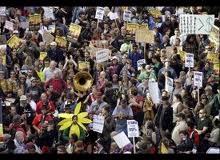
Aren’t terribly different from this:

The first is from Occupy Oakland. The second is from the Civil Rights Movement of the 1960s. And if you flip through images of the 1930 Labor protests, the similarities are there as well—people coming together, voicing grievances, demanding resolution. Movements demanding social and economic justice have never been neat and tidy. Nor short. Not in the 60s, not in the 30s. And not now.
So, the song is prophetic. The Revolution will not be televised. No re-runs, brother. It will be live–growing, evolving. For better or worse, morphing into what it will become.
Or not.
What the MSM Isn’t Reporting
Posted: November 5, 2011 Filed under: #Occupy and We are the 99 percent!, Corporate Crime, Democratic Politics, Economy, financial institutions, Main Stream Media, poverty, The Media SUCKS, unemployment | Tags: 2011: days of revolt, Financial Crisis, U.S. Economy 15 CommentsIf anyone had doubts that the mainstream media is deliberately fudging the details on the events surrounding the Occupy Wall St. Movement in general and the Occupy Oakland protests in particular, the following video is unlikely to dissuade you of that doubt. Cenk Uygur was actually in Oakland on Wednesday during the general strike in Oakland—feet on the ground, eyeballs watching the events unfold.
Surprise!
The MSM had no cameras present. They had no cameras available during the Oakland police department’s original raid on protesters, The Night of Tear Gas and Batons. That was also the night of the strange, weird coincidence when both the ABC and CBS helicopters needed refueling at precisely the same moment.
The world is being blanketed by stunning coincidence.
Fortunately, [but to the shock of many Americans] that night was recorded independently, the startling images preserved.
Cenk Uygur [The Young Turks] as some may recall had a brief 6-month stint on MSNBC, an hour-long show during which he was often critical of Barack Obama’s less than stellar record. Uygur’s ratings were excellent but he was called in by management and asked to ‘tone it down.’ Translation? Stop knocking POTUS and the Democratic Party’s slide to the corporate right. Though offered more money to host a new show, Uygur politely turned MSNBC management down, and then went on the record and told his audience what had happened. His slot was quickly filled by the Reverend Al Sharpton, who is happy as a clam to shill for the President and all things Democratic. That would be the ‘My Party, Right or Wrong’ strategy.
For myself? It’s the reason, I no longer watch MSNBC’s 6 pm broadcast.
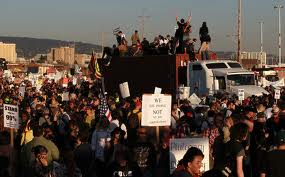
The You Tube video is revealing—Uygur’s astonishment at how underreported the crowd size in Oakland truly was. But I also found some startling photographs that belie the MSM’s attempt to undercut the groundswell of support this movement is capturing. It’s growing despite the naysayers and critics. It’s growing despite the MSM’s attempt to edit and minimize. It’s growing against all odds.
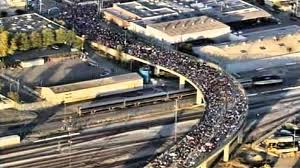
The Tea Party, of course, wants everyone to go home and get a job. Which a lot of these people would probably happily do if there were jobs to get, the sort that pay a living wage—that small complication of making enough money to feed yourself and your family, pay the rent, keep the lights on. We were told yesterday morning that unemployment ticked down a tenth of a percentile. That would make the ‘official’ unemployment number 9 instead of 9.1%. And there have been reports coming out suddenly to tell the country that stories of poverty and inequality are vastly exaggerated, even though the Census Bureau’s numbers show 1 in 15 Americans now categorized as the ‘poorest of the poor,’ the biggest jump recorded in 35 years. Btw, that would be 50% or less than the official poverty level, which translates to $5,570 for an individual; $11, 157 for a family of four.
Seems to be an awful lot of sputtering, squirming and spinning going on.
Surely, it’s mere coincidence.
What part of “Stop Stealing!” is hard to understand?
Posted: October 30, 2011 Filed under: Banksters, financial institutions 13 CommentsBank of America has now jumped the shark, gone right over the top, past the frozen limit, and exposed themselves.
This ought to be unbelievable. It only makes sense if the bank robbers are running the bank. Bank of America has transferred assets it acquired during its takeover of the Merrill Lynch brokerage to its deposit-taking arm.
Let me unpack that a bit. 
Banks, officially, put people’s savings into safe investments. The FDIC insures those savings in case the banks fail, but to prevent that outcome there are strict regulations about how banks can only put that money in safe investments.
Brokerages, officially, exist to broker any transactions on any market. Those can be the staidest of riskfree investments, like Treasury bonds, or interesting things like ultrashort inverse contracts derived from the SP 500 basket of stocks. “Derivatives” may be two, three, four, or even more meta levels above the real underlying things they represent, such as a stock or tanker load of oil. With some derivatives, you can make many times the amount of your own money that’s tied up in the trade, or, likewise, you can lose more than everything you own. That means (duh, right?) they’re risky. They have legitimate functions, such as hedging other risks or providing a way to bet on being right, but nobody ever pretends they’re safe.
Nor is there any universe in which it is up to the FDIC (=taxpayers) to make them safe by writing blank checks to cover them.
So what does BofA do? It takes bets made by Merrill Lynch — bets which were fine for a brokerage — and makes them part of the regular bank assets that are covered by the FDIC. By the magic of modern accounting, the taxpayer gets to cover wild stock market gambles that didn’t pan out.
There’s another wrinkle here. In the old high-flying days, financial institutions would sell derivatives to customers, e.g. one expecting price to go up, and then the institutions would, for their own account, buy the opposite derivative! There are two betrayals. It’s their fiduciary responsibility to tell their customers that the firm is itself investing in a fall in price. And it’s wrong to rake in money from customer commissions as well as customer losses on those same trades. It’s called a conflict of interest. It’s a big no-no.
After the crash, when it became clear that betting against the customer was fairly common in the financial industry, regulations were put in place against what’s called “proprietary trades.”
So what is BofA’s excuse for what it’s done?
Bank of America spokesman Jerry Dubrowski said the bank’s derivatives trades are subject to risk-management controls and are client-driven, not proprietary trades – meaning the bank is not betting with its own money.
In other words, it’s okay to stick taxpayers with the bill for somebody else’s failed stock market gamble because the gamble itself was not a criminal breach of ethics.
Hello? It’s the gambling that is not insured. We don’t really care who did it. And the fact that it wasn’t criminal gambling only makes it one of the few things for which BofA won’t need a lawyer.
The scariest part is that for all I know, the gross rip-off may be legal. Most of the laws for banks were written before they could turn themselves into FDIC-insured gamblers.
Bank of America posted a third quarter profit — i.e. just for the months of July, August, and September — of $5.9 billion.

 peej
peej Carissa
 bostonboomer
 dakinikat
 ecocatwoman
 mablue2
 Mama Lopez
 peggysue22
 quixote
 skydancingguestblogger
 Mona (aka Wonk the Vote)



 Sky Dancing
Recent Comments