
Sunday Growing
Posted: November 21, 2010 Filed under: Farming, gardening | Tags: farming, gardening 25 CommentsI’m hoping that a regular post about gardening and farming, but mostly gardening, will be useful on the blog. I’ve picked Sundays to run the post, perhaps every other Sunday at first depending upon interest, because it’s often a slow news day.
I hope to convince a few of the commenters and writers here to write about what is happening in the garden(s) in their neck of the woods. So feel free to dive in, everyone!
Up here in the PacNW it’s been rainy. No surprise there, eh? It’s also cold; we are having a cold snap with cold winds barrelling down out of the Fraser River Valley from Canada. This often means snow, but I think it’s a bit too warm for snow as we are hovering just above freezing, but the skies are clear. The fire has been burning in the wood stove all day. Outside the goats are all puffed up, like little fur puff balls on 4 stick like legs. They are out in the pasture looking for something to eat. The pasture is green (this is Washington after all) but the grass has little nutrition. So they come in to eat hay every few hours. The cats are similarly puffed up, lounging in the warm spots in the garage. The dog is in her heaven, being a northern spitz type dog. She’s only 9 months old. I can’t wait until she first encounters snow.
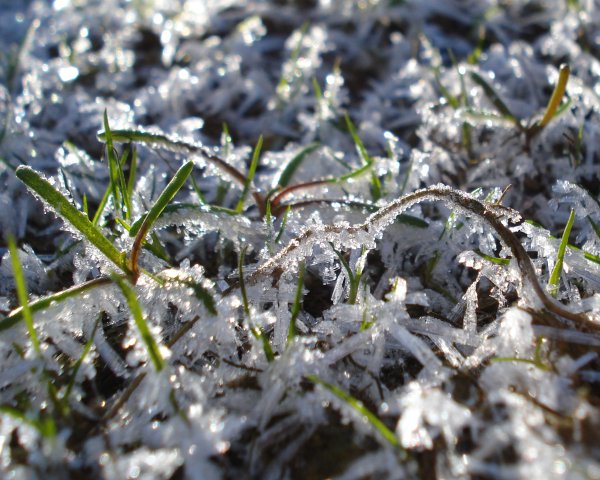
Frost on the Pasture
The plants in the herb garden are curled up against the cold. But there is still viable rosemary, thyme and some oregano. The last of the chives gave up the ghost a month or so ago. Green onions are still hanging on, hoping I won’t pick them before they can flower in the spring. In the greenhouses that I got from The Tree Center and set up last season, the last of the tomatoes have ripened and need to be picked. Their mother plants are completely brown and dead. Peppers hang here and there amidst the brown leaves of their plants. I need to get those picked and processed. We chop peppers, sweet and hot, and bag them into zip-locks. We freeze them and use them in cooking all the rest of the year. Instead of canning tomatoes I chop them, skins, seeds and all, in the cuisinart and freeze them. They too are used in cooking for the rest of the year.
Out in the fields the garlic we planted in October is showing the first of its growth. Yum! If it were to get really cold we’d have to cover it with straw, but I’d rather not. That way there’s no convenient hiding place for our garden nemesis, the slug. We also have lettuce, mesclun, carrots, broccoli, kale, swiss chard, cabbage, rutabaga, beets, turnips and more growing in the fields. Some of the plants are under cover to protect them from super cold weather. Others are left to grow as they will. I expect the beets and the swiss chard will finish shortly. I should grab some and chop it and freeze it for eating later before it turns into a brown frozen mush!
I expect we’ll have our first snow, if not over Thanksgiving where it can most effectively screw up travel plans and therefore is the chosen time of the weather gods, by early December. Before then, I hope to have the paths in the herb garden weeded, and we really need to get the plowing done.
I’d like to refer everyone to a gardening blog from our own Grayslady, Gardening in the Mud. Please visit there for information about Mid-West and North-East gardening and plants. She knows her stuff! If anyone else has a garden blog they’d like linked, let us know!
So, what’s happening in the garden in your area? Go outside and then let us know!
S. 510, please call for the Tester-Hagen amendment
Posted: November 17, 2010 Filed under: Farming, Food, just because, legislation | Tags: farming, food safety, legislation, S 510 27 CommentsNote: I wanted to get this written up and posted yesterday, but family duties called me away and I spent all day at my parents’ house taking care of my sister.
Right now I am stressing about Senate Bill 510. The bill passed cloture today, and will come up for vote tomorrow or Friday, I believe. An important amendment, written by Senator Tester and Senator Hagen, would exempt small farms from many of the onerous provisions of this bill. Food experts, farm advocates, and consumer safety experts have debated the provisions of the bill over at Grist (see this article on if the bill will better provide food safety, this article on if the bill will harm small farmers, and this one on if we really have a food safety crisis), if you are interested in their arguments.
If S 510 passes without the Tester-Hagen amendment and then goes into reconciliation with the absolutely horrid (for small farms) House bill (HR 2749) which passed last year, I expect to be eventually regulated out of business. And I expect many, many other small farms to suffer the same fate. The law has no provisions in it to protect small farms; it simply urges the FDA and FEMA, yes, our food supply would come under FEMA, to consider small farms when making regulations. AHAHAHAHAHAHAHA. The Tester-Hagen amendment makes it law that they do so. The Bill is partly concerned with ‘terrorist’ scenarios, such as someone poisoning our food supply. If we were getting food from millions of small family farms, such a thing couldn’t occur. But the bill gives FEMA the power to intervene in cases of suspected terrorism, or food ‘adulteration’, however they end up defining it.
There’s some good parts in this bill. It does provide more oversight for Big Ag. I’m sure that’ll last until the regulations actually get written (cynical, cynical me). But as I see it, this bill and the House bill are just grandstanding so government people can say they ARE doing something about the supposed food safety crisis. If the USDA and the FDA had the funds to do the inspections they need and if our Senators and Representatives would seriously look into getting the lobbyists out of the regulatory mix, we’d not need these bills at all.
Anyway, I ask you to call or email your Senators and ask them, if they must vote for this bill, that they also vote for the Tester-Hagen amendment. It’s probable that every Dem Senator will vote for it, so let’s do what we can to make it more palatable to the small food producers that hope to feed us all.
More links of possible interest:
S510 may mean 10 years in prison for Farmers
Food Safety: The Worst of Both Bills
Frequently Asked Questions about S 510
I’m trying to look on the bright side. If the bill passes, is reconciled with the House bill and becomes the pile of ummhmmm I suspect it will, it can still be fought during the formation of regulations phase. Oh joy.
Small Family Farms: Definition and Some Challenges
Posted: November 14, 2010 Filed under: Farming, Food, legislation | Tags: cafo, farms, food, legislation, monsanto 51 CommentsSometimes it seems like the world I think I know is just a falsehood, a play put on by the Powers That Be to keep me pacified, dumbed down, and walking the way they want me to walk.
Take, for example, farming in the United States. This has always been, in my estimation, an honorable profession. The nation was founded by farmers wealthy and dirt-scrabble poor. Farming helped drive the expansion and eventual rise of the nation. Farming has fed us all.
But when I speak of farming, I have in my mind a certain kind of farm. It’s not too big; not more than a family can manage. Maybe it’s several hundred acres or more if it’s a ranch out west running cattle. If it’s dairy, it’s only got 200 or less cows. If it’s vegetables it’s growing a main crop and then lots of little crops for the farmers’ family. Or maybe it’s like my farm, with lots of different vegetables in small amounts, and some goats for milk, cheese and manure. The animals on the family farm are healthy, happy and living under the warmth of the sunshine in deep green pastures, or roaming semi-free over hot western plains. You know, the farm looks like all the commercials we see.
A farm is not a CAFO (‘Concentrated Animal Feeding Operation’). It is not 10,000 chickens or 2,000 pigs, or 5,000 cattle all under the same roof. These animals never see the light of day. They are given only square feet to live in. They are dealt with as though they were pieces of plastic running down an assembly line belt. That is not farming. And yet, CAFOs have become the source of much of the meat we eat, much to our shame.
A small farm does not have a ‘manure lagoon‘ which is full of liquid that can be so deadly it will kill you if you fall into it.
The farmer (read manager) of a huge agri-business farm uses satellite positioning and GPS to determine when and where to fertilize and harvest. The manager ‘drives’ a tractor which can be self-steering (pdf). Computer monitors sense the condition of the soil, the air, the plants. These give feedback that tells the manager when to plant, fertilize, harvest. Anyone can do it, as long as they can read a computer screen.
A farmer walks her acres, strand of grass in mouth, feeling the condition of her plants and soil.
Small farms, traditional farms, don’t grow patented seed. They don’t grow seed which has been bio-engineered with e. coli (yes, e. coli!) to carry resistance to herbicides.
A true farmer plants traditionally hybridized or open pollinated seed. She tries to find organic seed if possible. She uses seed catalogs which source from places other than huge seed houses which are trying to lock up all the genetic potential in plants through patents on common seed genomes.
Small farming is under attack from every side in our world. It is almost impossible to make a decent living from a family sized farm. For several generations now often one part of the family has to work off the farm to make it viable. In my own family, the men worked off the farm and the women farmed. We are so used to subsidized food, subsidies started in part by FDR to help even out the ups and downs of farming but quickly taken over by big business, that we don’t know what it really costs to grow it. Believe me, it costs more than 79 cents a pound cabbage.
Dairy farms are under attack. Recently official prices for milk were lowered to below break even point for farmers. Thousands left the business, closing up family farms (note that in this article, even 1000 cow dairies, BIG dairies are closing) . What is left? Big Agribusiness, of course.
The government, in a scramble to prove to voters that it really does care that food be safe, is legislating and regulating small farming out of existence. Dairy farms, cheese making operations with actual ties to farms (not Kraft, thank you), CSAs and even backyard vegetable patches are coming under increased regulatory scrutiny. The amount of food borne illness attributable to these operations is infinitesimal, and yet, that is what is regulated. Only 1% of food shipments into the country will be inspected, only written warnings, blown off by the egg factories which then recall 1/2 a billion eggs, will be issued. But you’ll be safe from your neighbors’ eggplant!
Below is the trailer for a new documentary: Farmageddon

 peej
peej Carissa
 bostonboomer
 dakinikat
 ecocatwoman
 mablue2
 Mama Lopez
 peggysue22
 quixote
 skydancingguestblogger
 Mona (aka Wonk the Vote)



 Sky Dancing
Recent Comments