
Tuesday Late Afternoon Blues
Posted: September 20, 2011 Filed under: 2012 presidential campaign, Bailout Blues, Barack Obama, Congress, DADT, Democratic Politics, Domestic Policy, Economy, Elections, Equity Markets, Federal Budget, Federal Budget and Budget deficit, GLBT Rights, Main Stream Media, Politics as Usual, The Media SUCKS, the villagers, U.S. Politics, We are so F'd | Tags: black and blue, blue balls, blue bars, blue blooded, blue dog democrats, blue estimators, blue language, blue period, blue skies, blues, indigo girls, red white and blue, tangled up and blue, the blues, true blue 25 Comments
Minxy’s out surfing samsara this afternoon. I’m trying to muster up some good vibes today for her as she faces all the “it’s a short life” kind’ve stuff that goes on with the early passing of a friend. As for me, I seem to be entering my blue period. Maybe it’s because I just get cannot this friggin’ gravity model specified correctly and maybe it’s just my parameters that are tangled up and BLUE. Okay, you won’t know what BLUE means for a regression estimator (Best Linear Unbiased Estimator e.g. BLUE) unless you’re as steeped in econometrics as I am but it’s a good play on words. REALLY. Chuckle sympathetically because I need it today. I wish I could like football like normal people. Instead, I follow the bloodsport of politics and its inherent nastiness these days and I have way too many degrees in the dismal science. The results are bound to get to you one way or another.
So this little piece is about the U.S. and blue to match my mood. I’m going to start out with some blue estimators of a different sort.
There was a bit of poll that showed a glimmer of true hope instead of the manufactured sort out today. Recent entrant into the Massachusetts Senate Race, Elizabeth Warren, is polling ahead of glamor boy Republican Scott Brown who replaced the late Ted Kennedy.
Elizabeth Warren has had an incredibly successful launch to her Senate campaign and actually leads Scott Brown now by a 46-44 margin, erasing what was a 15 point deficit the last time we polled the state in early June.
Warren’s gone from 38% name recognition to 62% over the last three months and she’s made a good first impression on pretty much everyone who’s developed an opinion about her during that period of time. What was a 21/17 favorability rating in June is now 40/22- in other words she’s increased the voters with a positive opinion of her by 19% while her negatives have risen only 5%.
The surprising movement toward Warren has a lot to do with her but it also has a lot to do with Scott Brown. We now find a slight plurality of voters in the state disapproving of him- 45%, compared to only 44% approving. We have seen a steady decline in Brown’s numbers over the last 9 months. In early December his approval was a +24 spread at 53/29. By June it had declined to a +12 spread at a 48/36. And now it’s continued that fall to its current place.
Meanwhile, the mixed up mess of Republican presidential candidates is shaking up to a two white man race. Gallup reports that Perry has a better chance than Romney of sealing the nomination at this point, but Romney has a better chance than Perry to beat Obama. No surprises there.
Rick Perry leads Mitt Romney by 31% to 24% in a new USA Today/Gallup poll of Republican presidential nomination preferences. The two are well ahead of the rest of the GOP field, with Ron Paul the only other candidate in double figures.
…
Perry seems to have momentum, but that could be slowed in the coming weeks if Republicans start to perceive that Romney is more electable in the general election. The new poll finds the slight majority of Republicans, 53%, prefer to see their party nominate the person who has the best chance of beating Obama, even if that person does not agree with them on almost all of the issues they care about. Forty-three percent would prefer a candidate who does agree with them on almost all of the issues, even if that person does not have the best chance of winning in November 2012.
Romney currently edges out President Barack Obama by 49% to 47% in national registered-voter preferences for the November election, while Perry trails Obama by 45% to 50%. However, neither Romney nor Obama is ahead by a statistically significant margin.
It’s no wonder Perry wants out of Texas. This poll should direct Perry into the Even Cowgirls get the Blues line. Texans do not like Governor Goodhair if you believe PPP’s numbers.
The poll, released Tuesday, showed Perry with a negative approval in Texas: while 45 percent of the state’s voters approve of Perry’s job performance, 48 percent of Texas voters say they don’t approve.
Obama should have The Blues over this poll from Marist. Will this lead to calls for a primary challenger on calls on him to pull an LBJ?
President Barack Obama faces a litany of bad news. The president’s job approval rating, his favorability, and his rating on the economy have hit all-time lows. To compound matters, three in four Americans still believe the nation is in a recession and the proportion who thinks the country is moving in the wrong direction is at its highest point in more than a decade.
According to this McClatchy-Marist Poll, the president’s approval rating is at 39% among registered voters nationally, an all-time low for Mr. Obama. For the first time a majority — 52% — disapproves of the job he is doing in office, and 9% are unsure.
You’ve always known that Wall Street is only True Blue to profits and not the country right? Grok this headline at Politico via the WSJ. It looks like a lot of hedge funds were betting the US to lose its AAA standing with S&P. The SEC is launching insider trading probes. Can we please get some perp walks now, please?
Securities and Exchange Commission officials have sent subpoenas to financial firms in a probe of whether there was insider trading — betting on a market crash — before the United States’ long-term credit rating was cut by S&P last month, reports The Wall Street Journal.
At issue are trades that were made by hedge funds and other firms shortly before the rating agency Standard & Poor’s downgraded U.S. debt from triple-A to double-A-plus on Aug. 5 and cited the dysfunctional political climate in Washington as one of the reasons.
The Dow Jones Industrial Average dropped 635 points, or 5.5 percent, on Aug. 8, the first day of trading after the downgrade. This was the sharpest one-day decline since the financial crisis in 2008, but it also made bets against the market very profitable.
Securities regulators are looking for firms that bet the stock market would drop — in particular, bearish trades that seem unusually large or were made by firms that typically do not make them.
An SEC spokesman declined to tell The Wall Street Journal which investment firms have received subpoenas.
My guess is it’s the usual vampire squid suspects and all the rest of the guys whose blue balls we pulled out of the bankruptcy fire with TARP and tax dollars. Bets any one?
So here’s the a nifty chart from Paul Krugman–with blue bars–that will make you scream until you’re blue in the face. Look whose been winning the class war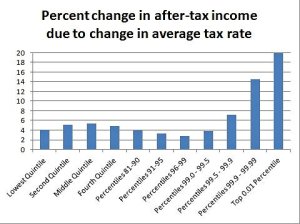 since 1979. So the deal is not only is their share of income and assets way up, but their after tax income has gone way up too.
Changes in tax rates have strongly favored the very, very rich.
Now, they’re only a fairly small part of the huge growth in the after-tax inequality of income. But tax policy has very much leaned into that growing inequality, not against it — and anyone who says otherwise should not be trusted on this issue, or any other.
So, of course the moment we get a whiff of anything slightly Democratic coming from the President we experience blue dogs howling at the blue moon and the beltway press.
Centrist Democrats, a dwindling breed on Capitol Hill, were quickly faced with another rough choice once Obama went public with his plans: Reject their president or back what Republicans are already calling the largest tax increase in the nation’s history.
Florida Sen. Bill Nelson, who is up for reelection in 2012, has supported raising taxes on millionaires but was still weighing whether he’d support higher taxes on those who make more than $200,000 a year, said spokesman Dan McLaughlin.
Sen. Ben Nelson (D-Neb.), a key moderate who’s up for reelection next year, didn’t mince words: “There’s too much discussion about raising taxes right now, not enough focus on cutting spending.”
But Sen. Jon Tester (D-Mont.), who likely will face GOP Rep. Denny Rehberg in next year’s reelection bid, hedged a bit, saying he backs provisions in Obama’s plan that call for closing tax loopholes that benefit millionaires and corporations
“This plan isn’t the one I would have written, nor is it the one that will end up passing Congress,” Tester said. “But I welcome all ideas to the table so Congress can work together to create jobs, cut debt and cut spending.”
 Blue blooded villager David Brooks admits to being an Obama sap and refers to Beltway Bob as “appreciative”. I prefer the term deep-throating, but hey, there’s a glint of recognition, right? It’s a two for one villager idiot piece! Look! I’ve managed to use some blue language.
Yes, I’m a sap. I believed Obama when he said he wanted to move beyond the stale ideological debates that have paralyzed this country. I always believe that Obama is on the verge of breaking out of the conventional categories and embracing one of the many bipartisan reform packages that are floating around.
But remember, I’m a sap. The White House has clearly decided that in a town of intransigent Republicans and mean ideologues, it has to be mean and intransigent too. The president was stung by the liberal charge that he was outmaneuvered during the debt-ceiling fight. So the White House has moved away from the Reasonable Man approach or the centrist Clinton approach.
It has gone back, as an appreciative Ezra Klein of The Washington Post conceded, to politics as usual. The president is sounding like the Al Gore for President campaign, but without the earth tones. Tax increases for the rich! Protect entitlements! People versus the powerful! I was hoping the president would give a cynical nation something unconventional, but, as you know, I’m a sap.
Being a sap, I still believe that the president’s soul would like to do something about the country’s structural problems. I keep thinking he’s a few weeks away from proposing serious tax reform and entitlement reform. But each time he gets close, he rips the football away. He whispered about seriously reforming Medicare but then opted for changes that are worthy but small. He talks about fundamental tax reform, but I keep forgetting that he has promised never to raise taxes on people in the bottom 98 percent of the income scale.
I nearly had to stop reading the damned thing since I was about to pass out from putting my palm to my forehead just a few too many times. Yes, it’s turning black and blue. How are we supposed to get grown up discussions about policy when the two largest newspapers in the country insist posting self serving drivel on a near daily basis.
Okay, here’s my last offering which really does show the best of the Red, White and Blue. Today is the formal removal of DADT. 0penly Gay and lesbian members of our military no longer have to live double lives or be subject to dismissal.
With Tuesday’s repeal of the military’s “don’t ask, don’t tell” policy, gays and lesbians are now free to serve openly in the U.S. armed services.
The U.S. military has spent months preparing for the repeal, updating regulations and training to reflect the impending change, and the Pentagon has already begun accepting applications from openly gay men and women.
It’s events like this that give you a sense that in some way, it’s still
WE THE PEOPLE of the United States, in order to form a more perfect union, establish justice, insure domestic tranquility, provide for the common defense, promote the general welfare, and secure the blessings of liberty to ourselves and our posterity
I’m going to get some iced tea and head back to my trade and foreign direct investment research. But, here’s two of my favorites: Dylan’s Tangled up and Blue done by the Indigo Girls for you on this afternoon in New Orleans under a blue sky.
and every one of them words rang true
and glowed like a burning coal
pourin off every page
Like it was written in my soul from me to you
Tangled up and Blue
I lived with them on Montague Street
In a basement down the stairs
There was music in the cafes at night
And revolution in the air …
Still no answers for the Jobs Crisis
Posted: May 5, 2011 Filed under: Domestic Policy, Economy, Equity Markets, Federal Budget, Federal Budget and Budget deficit, jobs, The Great Recession, U.S. Economy, unemployment | Tags: joblessness, unemployment 27 Comments It’s difficult for me to watch the job market continue to dither knowing full well that nothing is being done about it. Just in case you’ve missed the other headlines today, U.S. jobless claims “unexpectedly” jumped. It wasn’t unexpected on my part.
Applications for jobless benefits jumped by 43,000 to 474,000 in the week ended April 30, the most since August, Labor Department figures showed today. A spring break holiday in New York, a new emergency benefits program in Oregon and auto shutdowns caused by the disaster in Japan were the main reasons for the surge, a Labor Department spokesman said as the data was released to the press.
Even before last week, claims had drifted up, raising concern the improvement in the labor market has stalled. Employers added 185,000 workers to payrolls in April, fewer than in the prior month, and the unemployment rate held at 8.8 percent, economists project a Labor Department report to show tomorrow.
“We’re seeing so many distortions in the claims numbers week to week that it’s hard to say, but I’m willing to be patient and wait and see,” said Stephen Stanley, chief economist at Pierpont Securities LLC in Stamford, Connecticut. “Other reports show an improvement in the labor market. It’s going to take a while to dig out of the hole we have in relation to the jobs the economy lost during the recession.”
Yes, it is a hole, and there’s very little being done to fill it. There are quite a few factors that contribute to the current appalling job market. The Fifth Fed District’s Macroblog looks at the contribution of offshoring. Offshoring basically means that part of a production process is moved to an overseas location. That can mean anything from a call center to manufacturing of a good. You can see that the impacted industries include both service and manufacturing sectors. The nifty table up there in the left hand corner will give you an idea of the impact of offshoring by industry. The numbers are tabulated from data during the years of 1999 – 2008. The changes and content of the ‘other’ category is further elucidated in the macroblog piece. It includes another table that you may review too.
Sixty-nine percent of the foreign employment growth by U.S. multinationals from 1999 to 2008 was in the “other industries” category, and 87 percent of that growth was in three types of industries: retail trade; administration, support, and waste management; and accommodation of food services. Some fraction of these jobs, no doubt, reflect “offshoring” in the usual sense. But it is also true that these are types of industries that are more likely than many others to represent production for local (or domestic) demand as opposed to production for export to the United States.
This is a bit interesting. There are two main types of Foreign Direct Investment that involve ‘offshoring’. One is called vertical and the other is horizontal. Horizontal FDI means that one segment of the process is moved to another country but the final good or service still goes to the consumer in the company’s home country. The last analysis from macroblog implies that a substantial part of that offshoring is actually Vertical FDI. This means that the company is moving itself over to the country to take advantage of end consumers in the other country.
This finding isn’t surprising if you consider the number of countries that are experiencing booms in the number of middle class citizens. There are more middle class Chinese than there are US citizens, as an example. There is also the fact that the middle class in the US has been losing income and purchasing power for nearly 30 years. It only figures that these companies would look for greener pastures elsewhere. Why expand here when your customer base is unlikely to be expanding and unable to afford your products in any meaningful way?
Macroblog points out that this is unlikely to explain all the doldrums in the US job market, but it does provide one factor and and interesting one at that. I would say that this analysis basically says that US businesses are much more bullish on foreign markets than they are on their own. (Capital flows for investment suggest this too.) This should give all of us pause.
Interestingly enough, another FED President also suggested that the economy and the US job markets weren’t as stable as they could be and suggested more stimulus. Three Fed Presidents rotate in and out of the Open Market Committee–that’s the monetary policy decision body–and each district is a world unto itself in many ways. Fed Boston is not in the current rotation.
Federal Reserve Bank of Boston President Eric Rosengren yesterday said record stimulus is necessary to spur the “anemic” economy and that raising interest rates to combat increasing food and fuel prices would impede growth.
“With significant slack in labor markets, stable inflation expectations, and core inflation well below our longer run target, there is currently no reason to slow the economy down with tighter monetary policy,” Rosengren said during a speech in Boston.
Not surprisingly, equity markets seemed to be caught a bit off guard with this news. Right now, I think the market seems to be in one of those periods where it’s not paying much attention to fundamentals. Bloomberg.com notes that Futures Fell on the news. Some times Wall Street thinks as long as their churning out fees and capital gains, all is right with the world. This is definitely not the case. It does explain why their economists tend to get caught off guard though. Hello? Real World anyone?
Stock-index futures dropped after the report. The contract on the Standard & Poor’s 500 Index maturing in June fell 0.6 percent to 1,334.8 at 8:58 a.m. in New York. Treasury securities rose, sending the yield on the benchmark 10-year note down to 3.18 percent from 3.22 percent late yesterday.
Dean Baker from CEPR is pretty pessimistic about the entire thing.
Weekly unemployment claims jumped to 474,000 last week, an increase of 43,000 from the level reported the previous week. This is seriously bad news about the state of the labor market. It seems that the numbers were inflated by unusual factors, most importantly the addition of 25,000 spring break related layoffs in New York to the rolls due to a changing vacation pattern, however even after adjusting for such factors, claims would still be above 400,000 for the fourth consecutive week.
This puts weekly claims well above the 380,000 level that we had been seeing in February and March. This suggests that job growth is slowing from an already weak level. This is news that should be reported prominently.
Unfortunately, the lackadaisical job market is off the front pages. Much of the political focus on the economy remains honed in on the federal debt. Again, this is the silly because one of the best ways of increasing tax revenues and closing the debt is for people to be employed. It’s an uphill battle to expect the deficit to close with this unacceptable level of unemployment. I still can’t figure out where they’ve placed their heads back their in Washington, D.C. Oh, well, look over there … it’s a dead Osama Bin Laden and we’ve not got any pictures yet!
FCIC Report is very Illuminating
Posted: April 9, 2011 Filed under: commercial banking, Economy, Equity Markets, financial institutions, Global Financial Crisis | Tags: causes of the financial crisis, FCIC, Financial Crisis of 2007 25 Comments The Financial Crisis Inquiry Commission (FCIC) is a congressional sponsored study into the reasons for the Financial Crisis. They were authorized by the President in May 2009. They have issued their final report and are disbanding. Google FCIC and you will find their information is being maintained by Stanford University. The published report is available on the website and at booksellers (ISBN 978-1-61039-041-5). It is more than 500 pages long. I have personally purchased about 15 books on the Financial Crisis over the last two years. (I know I should get a life). Each book discusses a separate segment of the crisis. This report is the most comprehensive book to date and is very readable by a person interested in the subject.
The commission was chaired by Phil Angelidies and former congressman Bill Thomas. There are eight additional commissioners appointed by the Democratic and Republican party. They had a staff of 60 people. They held hearings in Washington and locations in states hardest hit by the Real Estate bubble.
The first chapter summarizes their findings and they are quite illuminating on the many facets of the Financial Crisis. They dispel many myths and examples are provided below. One can definitely say we had less government in the Finance world. The evolved system was unsustainable. The end result was the crash of September 2008.
Conclusions of FCIC
1-The Financial Crisis was avoidable
Despite the “once in a 100 years” admonitions of regulators and politicians, this crisis was avoidable. The document does a thorough job, point by point highlighting and disputing the many actions in the last 20 years.
2-Failures in Financial Regulation and Supervision proved devastating to Financial markets
Greenspan was authorized to stop the writing of toxic mortgages despite the rising evidence that they were massive and detrimental. In 2004, the Federal Reserve could have denied loosening of capital reserves from 12/1 to 30/1. In other words, they would need $1 dollars in the bank for every $30 dollars of assets. This is considered very high leverage. In 2000 the government declined to regulate Credit Default Swaps (Derivatives). Repeal of Glass-Steagle allowed mixing banks and Insurance companies. Citi bank was acquired by Travelers Insurance immediately. Under the regulation of the Federal Reserve Bank of  NY (Tim Geithner) Citi was one of the first banks to get into trouble and require a massive government bailout.
3-Dramatic failures of corporate governance and risk management at important financial institutions, key cause of the crisis.
Many banks (not all) acted recklessly took on too much risk with too little capital to address the crisis, being very dependent on short term funding which evaporated as the crisis evolved. They were not able to raise capital to address demand claim of customer. In short they were not able respond to a run on the bank. This is called a liquidity event. Recall that Investment banks were lightly regulated and did not have access to the FED window for emergency loans. They relied on unproven software to evaluate their risks. In short they loaded up on Real Estate securities which turned toxic and they could not absorb the losses. This was done despite the fact that they knew the underwriting of the real estate loans was poor. Goldman Sachs recognized this and curtailed purchasing of bad loans and they survived. The financial community was not able to police itself, requiring a massive government bailout. Risk people identified the problem and were ignored.
A Self-Examined Academic Life
Posted: February 6, 2011 Filed under: academia, Equity Markets, financial institutions, Global Financial Crisis | Tags: Fault Lines, Financial Crisis, Matt Yglesias, Raghu Rajan, Tyler Cowen 22 CommentsMacroeconomists seemingly have adopted monastic practices of self-flagellation to explain why the tribe completely misjudged the housing bubble . Their collective crystal balls didn’t predict an ensuing financial crisis either. A blog entry by Finance Professor Raghu Rajan at University of Chicago has further stimulated the conversation today. He’s written a book called Fault Lines and made remarks from the book at its official blog site. I found it at Memeorandum along with a few choice links.
I’ve written about fresh water and salt water economics before. Some of today’s discussion clearly involves philosophical fault lines. Rajan is from the panultimate fresh water university and all finance academics eventually drown in the Efficient Markets Hypothesis (EMH) literature. I’ve been pretty outspoken about how much damage I think the EMH has done to economics and especially my field, financial economics. However, it’s hard to get published in finance journals taking a contrarian view. This is one explanation he examines, then dismisses which is why I’ve taken a good look at his argument.
I have not read his book, but judging from the video and this blog entry, Rajan spends some time on the role of EMH and EMH true believers in the crisis. I can provide you with my own anecdotes on this. I can also tell you I tried to avoid some seminars because I don’t want to read any more Eugene Fama who is Rajan’s colleague. I frankly think EMH blinders or misunderstanding were a good deal–but not all–of the problem.
I was researching the subprime markets directly after Katrina and was told by my finance professors that I was following an unpublishable and boring line of research. (They used the term ‘unsexy’.) I saw hints of problems in subprime markets as early as late 2005 in the work I did with the sensitivity of stock prices of finance companies heavily invested in subprime loans to some key macroeconomic variables. I was told that line of research was unlikely to help my marketability and ability to get tenure upon graduation. They yawned when I presented the paper. I turned it in for my third econometrics seminar and switched to something else.
Finance journals editors do love them some EMH so anything on market anomalies is likely to get a jaundiced set of editor eyes. But, Rajan brings up some important points and the resulting discussion is worth viewing here. Here’s Rajan talking directly to the EMH and why he thinks it may not be a big deal.
Perhaps the reason was ideology: we were too wedded to the idea that markets are efficient, market participants are rational, and high prices are justified by economic fundamentals. But some of this criticism of “market fundamentalism” reflects a misunderstanding. The dominant “efficient markets theory” says only that markets reflect what is publicly known, and that it is hard to make money off markets consistently – something verified by the hit that most investor portfolios took in the crisis. The theory does not say that markets cannot plummet if the news is bad, or if investors become risk-averse.
Critics argue that the fundamentals were deteriorating in plain sight, and that the market (and economists) simply ignored it. But hindsight distorts analysis. We cannot point to a lonely Cassandra like Robert Shiller of Yale University, who regularly argued that house prices were unsustainable, as proof that the truth was ignored. There are always naysayers, and they are often wrong. There were many more economists who believed that house prices, though high, were unlikely to fall across the board.
Rajan points out that this probably isn’t the sole or primary explanation even though it is one that gets a lot of ink these days. I too think some of the problem is a misunderstanding of the various forms of EMH . So, the major philosophical debate happening in finance circles isn’t central to Rajan’s explanation. There is no conspiracy of EMH apologists to force misunderstanding of market rationality, so alright, I’ll give him that one.
Economist Tyler Cowen at Marginal Revolution likes the alternative succinct explanation Rajan provides. (You should read the comments to that thread.)
Raghu Rajan nails it:
I would argue that three factors largely explain our collective failure: specialization, the difficulty of forecasting, and the disengagement of much of the profession from the real world.
Rajan also dismisses another circle of conspirators by stating this. It’s also probably why one of those so-called progressives jumped on the dismissal earlier today. This conspiracy meme crosses circles of folks that are more into political economy than economics itself. This group argues the hypothesis that the “system” bribed economists to stay quiet. I’ve gotten into it more than a few people of the Matt Stoller mindset and various Rand hanger-ons about this improbable case. One of the biggest memes is that the FED actively influences economists not to publish things against their interests. (Usually, this comes from Austrian School folks who can’t get published any where mainstream because they want to completely operate outside of the scientific method and ignore data.) Matt Yglesias is one of these people making a living off this canard and he jumped to the bait immediately. His reasoning speaks more about him than about economists.
Tuesday Reads: The Anniversary of FDR’s Second Bill of Rights
Posted: January 11, 2011 Filed under: Anti-War, Barack Obama, Civil Liberties, Civil Rights, Equity Markets, Federal Budget, financial institutions, Global Financial Crisis, John Birch Society in Charge, New Orleans, Regulation, Social Security, Stock Market, The Great Recession, U.S. Economy, U.S. Politics | Tags: David Stockman, druggie bath salts, extremist political rhetoric, FDR, financial regulation, gold standard, Governexoricist Jindal, military spending, naked short selling, occupation of Iraq and Iran, right wing currency tropes, Second Bill of Rights, short selling, violence related to cross hairs map 125 Comments Good Morning!!

History Reads
Ever so often, we need to be reminded of history. I read a tweet yesterday by one of our long time news anchors down here in New Orleans.
normanrobinson1 norman robinson
Wondering if we as Americans really value what we have and whether we really care about leaving a future for the generations to follow.
This started me thinking about what future was left to me by the generations directly before me. Of course, we’re living in a world mostly free of NAZIs and Fascists because of the greatest generation. We’re living in a world where the Jim Crow Laws of Separate-But-Equal were torn down by the generation after that with the sacrifice of the heroic leaders of the civil rights movement. I have the right to vote because of my grandmother’s generation and her mother’s generation and what they did for us. I’ve also had consistent access to family planning and birth control because the first women of the baby boom generation and several generations of women before them worked hard for it. Stonewall made a tremendous difference in the lives of GLBTs. Then, there are programs like Social Security and institutions like the United Nations that came from the vision and leadership of FDR and the people who served in his cabinets like Francis Perkins, Henry Wallace, Cordell Hull and many others. They cared enough to build us quite a legacy.
Today is the 67th anniversary of a speech that was to convey that vision of a post-war America. The Second Bill of Rights was part of a State of the Union speech. I’m bringing this up for two reasons. First, because it clearly provides a road map–even today–for “what Americans really value”. I say that because poll after poll shows that the majority of American’s agree with these values even though our government doesn’t seem to reflect that at the moment. For that reason, I share with you today, the words of a leader with a vision and a gift for elocution.
From the FDR American Heritage Center Museum’s Website:
On January 11, 1944, in the midst of World War II, President Roosevelt spoke forcefully and eloquently about the greater meaning and higher purpose of American security in a post-war America. The principles and ideas conveyed by FDR’s words matter as much now as they did over sixty years ago, and the Franklin D. Roosevelt American Heritage Center is proud to reprint a selection of FDR’s vision for the security and economic liberty of the American people in war and peace.
The second reason I want to share this is that we’re coming close to President Obama’s third State of the Union Address. It is scheduled for January 25th. My guess is that FDR’s Second Bill of Rights and the vision he elucidated will officially die on that day. I am not expecting any thing close to the utterance of ‘Necessitous men are not free men’ or “People who are hungry and out of a job are the stuff of which dictatorships are made”.
Despite the obvious parallels between right now and the Great Depression–the high unemployment rates, the incredible number of foreclosures, and the breadth of necessitous men and women and children–I’m expectting many of the vestiges of FDR’s vision that prevent future calamities to be assaulted during Obama’s third State of the Union Address. Look closely at the list I put up top because so much of what was handed us has been trickling away.
As Norman Robinson contemplated via tweet, do we really value what we have today? Will we witness the destruction of what was handed to us and hand our children and grandchildren broken infrastructure, no hope for upward mobility, and useless institutions drained of funds by the greedy? Will any shell of what was envisioned for us in both the first bill of rights and the second remain? Frankly, I am expecting an ‘austerity’ speech that endorses the findings of the cat food commission. I also expect we will hear nothing of overreaching intrusion by the Patriot Act into our internet and cell phones. We are expected to diligently watch Football and bail out billionaires while everything else trickles up and away.

 peej
peej Carissa
 bostonboomer
 dakinikat
 ecocatwoman
 mablue2
 Mama Lopez
 peggysue22
 quixote
 skydancingguestblogger
 Mona (aka Wonk the Vote)



 Sky Dancing
Recent Comments